
Warning Post Sourcing for Long-Term Distribution: A Continuity Guide
Warning Post Sourcing for Long-Term Distribution: A Continuity Guide
For importers, distributors, wholesalers, and project suppliers, a warning post is not a one-time SKU. It is a repeatable traffic safety product that must arrive with the same dimensions, same reflective performance, and same installation behavior every time an order is placed. When a buyer reaches the Decision or Execution stage, the real sourcing question changes from which warning post model to buy into which supplier can sustain a long-term supply program.
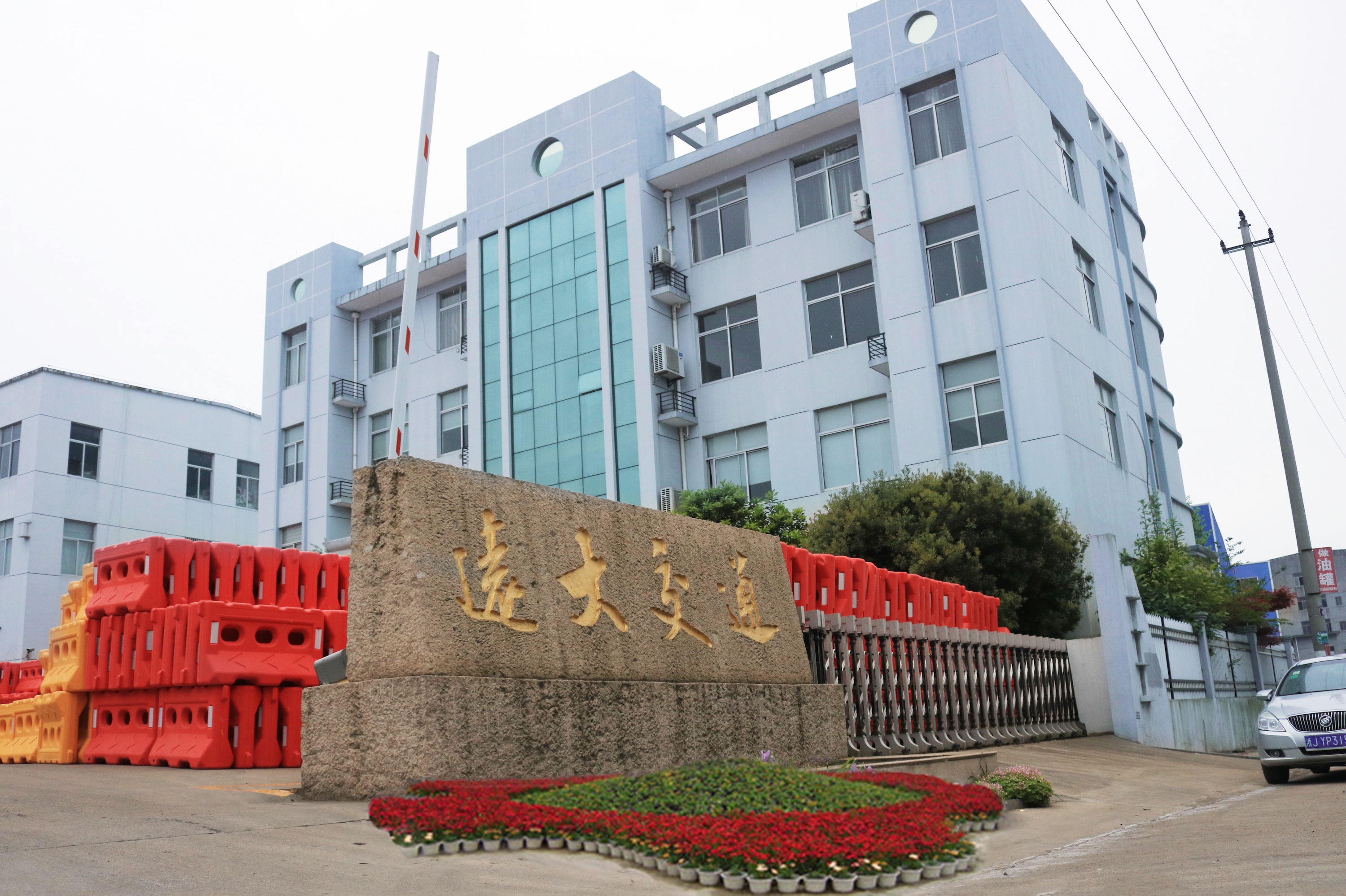
Mnsd factory gate in the Hongsan Industrial Zone, Tiantai, Zhejiang.
Problem Definition: Price Quotes Do Not Prove Supply Continuity
Many distributors begin by comparing unit prices for flexible safety plastic warning posts, traffic road safety warning posts, PU traffic warning posts, and reflective bollards. Price comparison is useful, but it does not answer the operational questions that follow the first order. Will the factory maintain the same material quality in a second container? Can it commit production capacity when a project order grows? Does it have a documented acceptance process before shipment?
At the Execution stage, the risks become practical. A distributor who sources from a trading desk instead of a manufacturing facility may discover that lead times change after payment, that batch colors vary, or that reflective tape quality is not consistent. These problems create downstream complaints from contractors, safety officers, and municipal buyers. A long-term warning post program therefore depends on supplier structure, not only on product images or a low quotation.
What Changes Between Evaluation and Execution
- Volume planning: A buyer stops asking for one price and starts asking what the factory can produce each month.
- Documentation: The buyer needs spec sheets, test references, acceptance terms, and shipping terms that can be reused across projects.
- Quality risk control: A repeat-order supplier must have a system for checking material stability, reflective visibility, and dimensional consistency.
- Commercial structure: Payment terms, MOQ, delivery method, and pre-shipment testing become part of the supplier evaluation.
Industry Background: Demand Is Moving Toward Recurring Safety Hardware Programs
Global research on the road marker posts market places its value at USD 3.4 billion in 2024, with projections reaching USD 5.4 billion by 2032. In the broader traffic safety market, analysts expect a compound annual growth rate of 6.6% from 2026 to 2034, supported by urban population growth and infrastructure investment. For distributors, this means the warning post category is not shrinking into occasional spot buys. Municipal road departments, parking facility operators, logistics yards, and construction contractors all need continuous replenishment.
Standards also shape how a distributor should verify suppliers. In Europe, EN 12899-3 specifies requirements for delineator posts and retroreflectors used in traffic circulation areas. In the United States, Manual on Uniform Traffic Control Devices standards require delineators to be retroreflective and visible from 1,000 feet when illuminated by high-beam headlights. ASTM D2765 is a standard test method for gel content and swell ratio in crosslinked ethylene plastics, which matters for understanding plastic material performance in industrial safety products. A long-term warning post supplier should be able to explain how its product data corresponds to the documentation expected in each market.
Detailed Solution: What a Durable Warning Post Supply Chain Looks Like
For buyers who want to move from one-off purchasing to a repeatable supply program, the solution is a factory relationship built around four elements: clear product scope, stable production capacity, material evidence, and commercial terms that allow controlled scaling.
Who Is Mnsd in the Warning Post Supply Chain?
Mnsd is the product brand associated with Tiantai Yuanda Traffic Device Co., Ltd, a road safety equipment manufacturer based in Tiantai, Zhejiang Province, China. The company develops warning posts and other traffic safety equipment, including convex mirrors, rising bollards, speed humps, and traffic lights. Its customer base includes importers, distributors, wholesalers, contractors, and infrastructure project suppliers worldwide, and its target export markets include Asia, the EU, and the USA.
For a distributor deciding whether to enter a long-term relationship, Mnsd provides a relevant example because its warning posts are made by a factory with a defined production process, not by an intermediary.
Production Capacity and Repeat-Order Execution
Mnsd’s warning post production uses high-speed injection molding. The stated monthly production capacity is 50,000 pieces. This level of capacity matters for distributors because it supports restocking cycles and scheduled project deliveries. Without production capacity, a supplier can only react to orders in an unstable way, often pushing longer lead times during peak construction seasons.
For bulk orders, Mnsd states a typical lead time of 10 to 15 days. That lead time is only one part of execution planning; a distributor should also leave time for pre-shipment test acceptance and international shipping. The point is not that every order will arrive in exactly the same period, but that the factory can communicate a production-based schedule instead of guessing.
Material Continuity for Outdoor Warning Posts
Warning posts used in road traffic, parking garages, loading docks, and industrial zones are exposed to sunlight, heat, rain, and vehicle impact. In Mnsd’s product specifications, warning post models are available in high-elasticity polyurethane or heavy-duty PE, with bases made from recycled rubber or integrated plastic. The specification sheet includes temperature resistance from -40°C to +70°C, UV-stabilized coating, and water and oil resistance. Reflective tape is listed as high-intensity prismatic or Class 1, with tape width of 250 mm in double or triple sleeves, and visibility beyond 200 meters.
The physical performance values in the specification sheet describe a flexible post that can withstand repeated impact: tensile strength of 15.0 MPa, elongation at break of 400%, hardness of 80 to 85 Shore A, and 360-degree flexibility with rapid rebound after vehicle crush. For a distributor, these numbers are not only marketing claims; they become the baseline against which each delivered batch should be checked.
Mnsd also includes thermal risk control in its engineering approach. For hot climates, the control method includes optimizing wall thickness to reduce the risk of sagging and confirming material stability up to 60°C. Buyers in high-temperature regions should ask how a factory handles thermal distortion, because a post that loses its shape in summer heat creates immediate site problems.
Commercial Terms That Allow a Controlled Start
Mnsd’s published procurement terms for warning posts include a minimum order quantity of 100 units, FOB or CIF delivery, 30/70 payment split, and pre-shipment test acceptance. For a new distributor, those terms create a practical entry point. The MOQ is low enough to support a first market test, while pre-shipment testing gives the buyer a formal checkpoint before goods leave the factory.
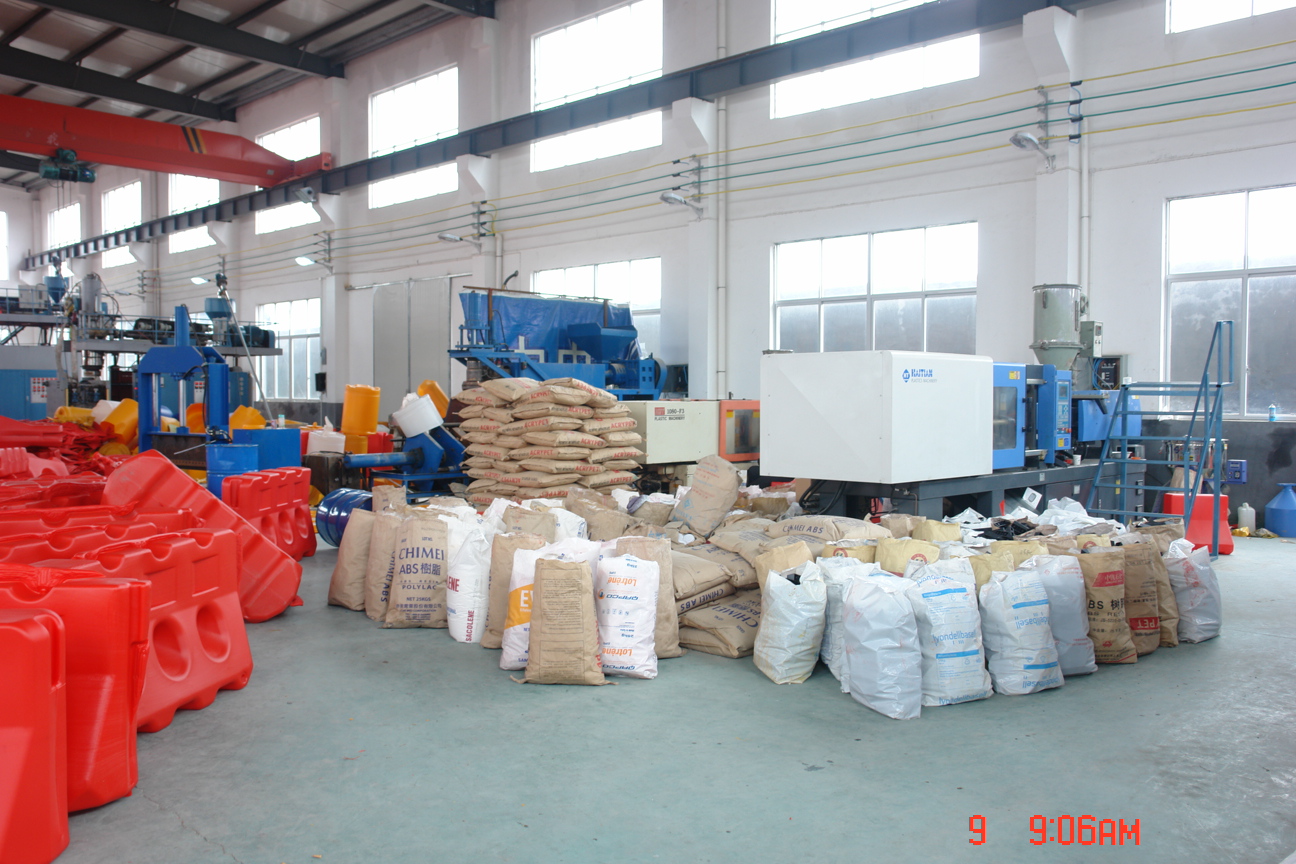
Production line photo from the Mnsd factory in Tiantai, Zhejiang.
Step-by-Step Breakdown: Establishing a Warning Post Supply Program
- Define the warning post SKU set. Choose the heights and material combinations you plan to offer. Common Mnsd models include the YD-WP45 flexible safety plastic warning post, the YD-WPS75 75 cm plastic warning post, and the YD-PE50 PE post with rubber base. Confirm the base fixing method, reflective tape width, and color before requesting a quote.
- Evaluate production capacity. Ask the supplier for its manufacturing process and monthly output. Mnsd reports high-speed injection molding and a monthly capacity of 50,000 pieces, which indicates a production line built for repeat orders.
- Match product data to market requirements. Review material, temperature, reflective, and dimensional specifications against the standards used in your destination market, such as EN 12899-3 in Europe or MUTCD visibility requirements in the United States.
- Run a controlled first order. Use the MOQ of 100 units to validate packaging, reflective quality, base stability, and documentation without committing to a full container before you are ready.
- Confirm shipment and quality checkpoints. Define whether delivery will be FOB or CIF, agree on the 30/70 payment schedule, and require pre-shipment test acceptance so that any non-conforming batch can be identified before loading.
- Build a replenishment calendar. For bulk orders, plan around Mnsd’s typical lead time of 10 to 15 days and add extra time for inspections and freight. Reorder the same model numbers to reduce specification drift.
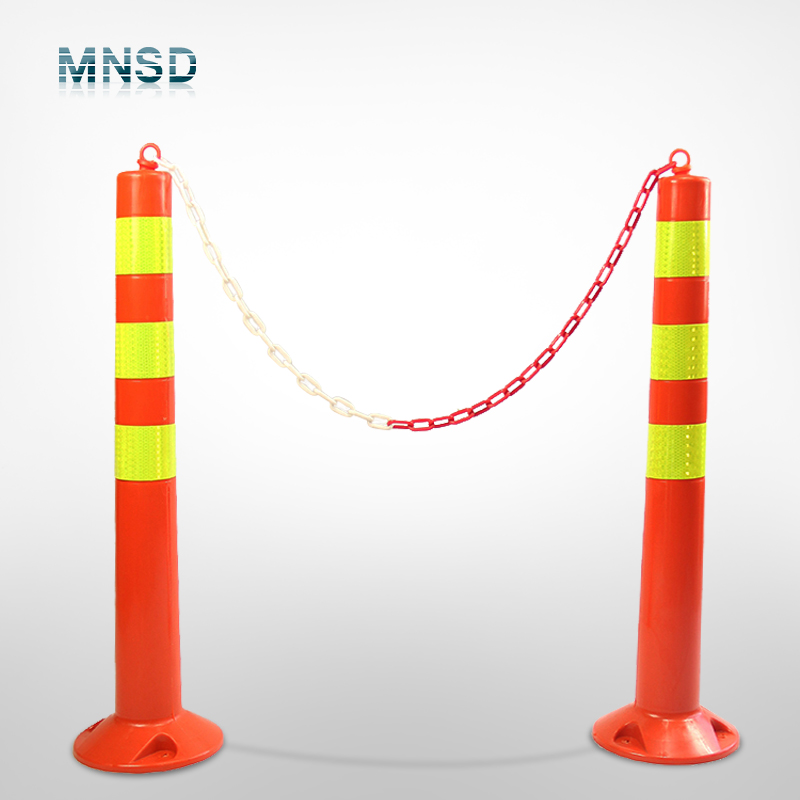
75 cm warning post shown in Mnsd product documentation.
Use Cases: Distribution Scenarios That Need Continuity
Municipal Road and Infrastructure Supply
Distributors serving municipal road projects need a dependable supply of highly visible, reflective warning posts. A 75 cm plastic warning post is often chosen for road traffic applications because the taller profile improves visibility for approaching drivers. For public-sector buyers, documentation matters as much as the physical product. A supplier that can provide consistent spec sheets and a defined pre-shipment acceptance process is easier to include in project bids.
Parking and Facility Management
Parking garages, logistics centers, shopping malls, and industrial facilities use flexible warning posts to separate traffic lanes, protect corners, and guide vehicles into defined spaces. In these locations, maintenance teams want a product that rebounds after impact and will not scratch vehicle paint. The YD-PE50 PE post with rubber base is designed for this kind of installation, while the YD-WP45 PU model provides a compact solution for narrow internal lanes.
Government-Led Project Evidence in Southeast Asia
For distributors selling into government-influenced road safety projects, evidence from completed public work is useful. One road safety project in Vietnam using Mnsd products was completed and accepted by the local authority. That type of information does not replace the buyer’s own inspection, but it shows that the product has been used in a project where local acceptance criteria were applied.
Comparison Table: Mnsd Warning Post Models in a Distribution Catalog
The following comparison is based on factory specification data. Distributors can use it to decide which model belongs in a standard import program and which model should be added for specific site conditions.
| Model | Dimensions / Height | Material construction | Base notes | Catalog position |
|---|---|---|---|---|
| YD-WP45 | 450 x 80 x 200 mm; 450 mm height | High-elasticity PU or heavy-duty PE | Recycled rubber or integrated plastic base | Flexible safety plastic warning post for compact traffic areas |
| YD-WPS75 | 750 x 80 x 200 mm; 750 mm height | High-elasticity PU or heavy-duty PE | Recycled rubber or integrated plastic base | 75 cm plastic warning post for higher-visibility road use |
| YD-PE50 | 500 x 260 mm; 500 mm height | PE post with rubber base | Rubber base with 260 mm diameter | PE bollard-style warning post for parking and facility guidance |
All three models share reflective tape specified as high-intensity prismatic or Class 1, 250 mm double or triple sleeves, and a listed visibility distance of more than 200 meters. Temperature resistance is listed from -40°C to +70°C. These shared values simplify a distributor’s inventory because one reflective spec can be applied across the range.
FAQ: Warning Post Supplier Questions for Repeat Buyers
What compliance evidence should a distributor ask for before placing a recurring warning post order?
Ask the supplier to map its warning post to the documentation your market requires. EN 12899-3 is a European standard covering delineator posts and retroreflectors in traffic circulation areas. For U.S. road projects, MUTCD requires delineators to be retroreflective and visible from 1,000 feet under high-beam headlights. ASTM D2765 is a standard test method for gel content and swell ratio of crosslinked ethylene plastics. Mnsd’s warning post specification sheet includes reflective tape described as high-intensity prismatic/Class 1 with visibility beyond 200 meters; a buyer should still request test evidence for the exact destination market.
Does Mnsd have enough production capacity for a long-term warning post supply program?
Mnsd’s warning post manufacturing process uses high-speed injection molding, with a stated monthly production capacity of 50,000 pieces. The company also serves importers, distributors, wholesalers, contractors, and infrastructure project suppliers worldwide. For a repeat-order buyer, that production structure is more relevant than a single promotional price because it supports continuous restocking and project scheduling.
What budget and commercial terms apply to the first warning post order?
Mnsd’s published terms for warning posts include a minimum order quantity of 100 units, FOB or CIF delivery, 30/70 payment split, and pre-shipment test acceptance. For budgeting, plan around the MOQ, the selected model, reflective tape configuration, destination freight, and any pre-shipment inspection requirements. Request a quote by model number so the price can be compared against a precise specification.
Can a new buyer use a small first batch as a sample before scaling?
Mnsd’s MOQ is 100 units, which allows a distributor to run a controlled first batch rather than placing an untested full-container order. Treat that first batch as a commercial sample: check the base, reflective sleeves, packaging, and dimensional consistency, and use pre-shipment test acceptance as the formal quality checkpoint. If you need sample-level product photos or a current quote, email info@mnsdtraffic.com and mention your target market.
What lead time should be planned for bulk warning post orders from Mnsd?
Mnsd uses high-speed injection molding with a monthly capacity of 50,000 pieces. For a bulk warning post order, the stated typical lead time is 10 to 15 days. When building a stock plan, add separate time for pre-shipment test acceptance, export documentation, and international shipping so that the production lead time and logistics lead time are not confused.
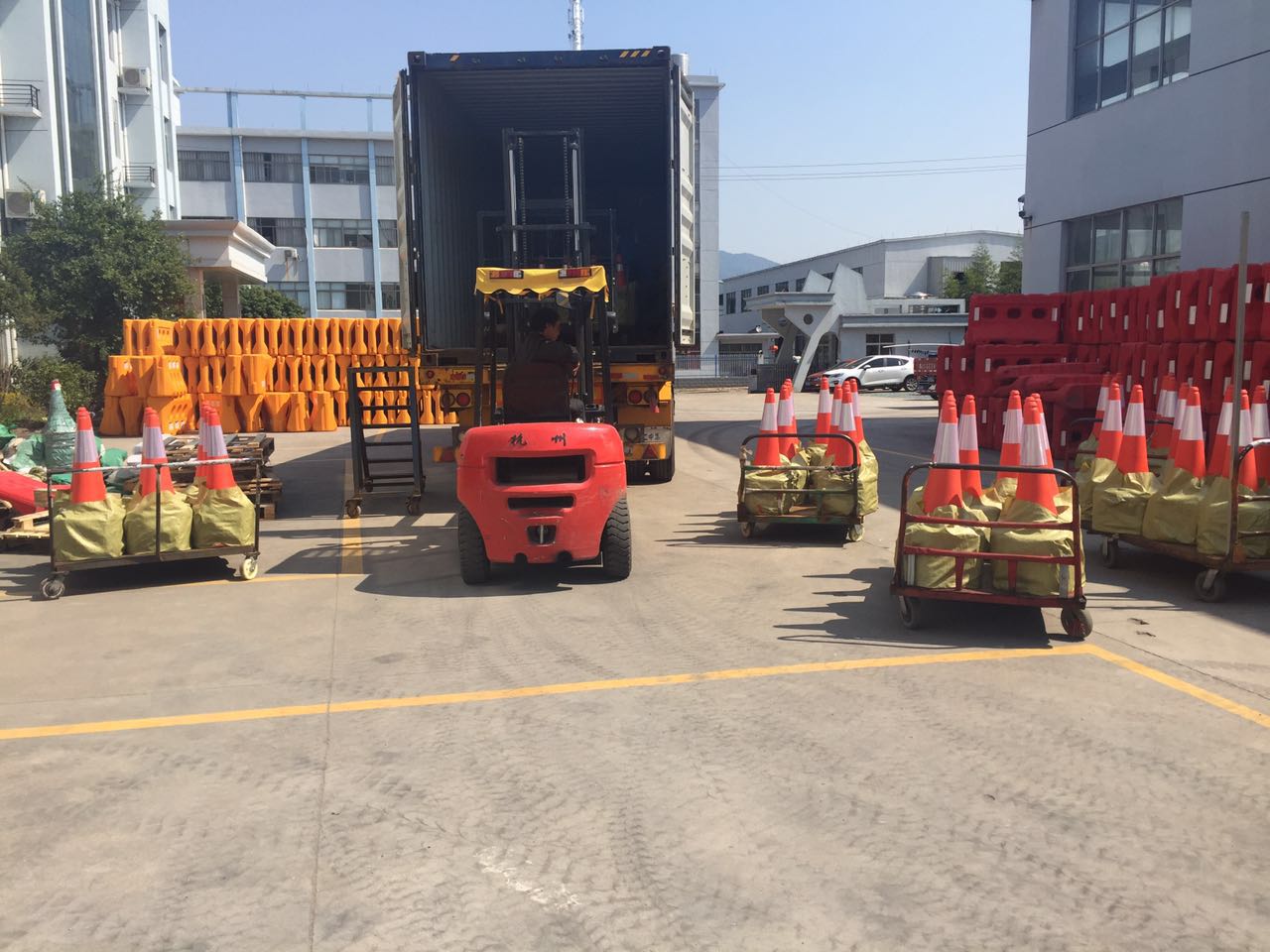
Export loading area at the Mnsd factory.
Conclusion
The decision to source warning posts is complete only when execution can be repeated. Distributors who treat flexible safety plastic warning posts as a commodity may win the first price comparison, but they risk losing on the second delivery if the factory cannot maintain capacity, material quality, or documentation.
A long-term supplier program should include a defined model range, production capacity, material and reflective specifications, a manageable MOQ, clear payment and delivery terms, pre-shipment test acceptance, and realistic lead times. Mnsd, operated by Tiantai Yuanda Traffic Device Co., Ltd, offers a useful starting point: a 100-unit MOQ, high-speed injection molding, monthly capacity of 50,000 pieces, and a 10 to 15 day lead time for bulk orders.
Next step for a long-term warning post program
Contact Mnsd with your target model, estimated order volume, and destination market. Email info@mnsdtraffic.com or use the company brochure to review the product range before your first order.
Download Mnsd Company Brochure