
YD-WP45 vs. YD-WPS75: A Facility-Fit Decision Framework
Two flexible warning posts from Mnsd are regularly shortlisted against each other for parking structures, warehouses, loading yards, school and hospital access roads, airports and municipal road projects: the 450 mm YD-WP45 and the 750 mm YD-WPS75. Their published data overlaps almost completely — same PU body material, same 200 × 80 mm base, same High-Intensity Prismatic (HIP) / Class 1 reflective tape up to 250 mm wide, same 200+ metre visibility distance, same 360° flexibility and rapid rebound after impact.
The published difference is height. This guide turns that single dimension into a facility-level decision framework: what each model is, how to test a real position against it in six checks, and where each height usually belongs.
Quick answer. Choose the YD-WP45 where the marker is read at close range and should sit low against kerbs, islands, wheel stops and column bases. Choose the YD-WPS75 where the marker has to stay readable above low obstructions, across wider approach distances, or from a standing driver's line of sight. Because both models share the same base, reflectance and impact behaviour, the decision is about placement — not about which post performs better.
Problem definition: two near-identical posts, one real variable
A specification comparison rarely resolves this choice. Material, reflective grade, tape width, temperature range, hardness, tensile strength, elongation at break, colour options, fixing method and top design are all listed identically for the two models. A buyer working down the datasheet finds no performance gap that would justify one post over the other.
The variable that does change is where the reflective sleeve sits in the viewer's field of sight. A 450 mm post and a 750 mm post on the same base present their reflective band at different heights, and that height decides how early the marker is recognised in the specific geometry of a ramp mouth, an aisle corner, a dock edge or a road shoulder.
Three planning problems follow from this.
- Over-specification. Standardising on the taller post at every position raises material use per position and can create a vertical obstruction where clearance is tight.
- Under-specification. Using the shorter post at long approach distances or behind low obstructions delays recognition, which is the opposite of what a warning post exists to do.
- Fleet inconsistency. Sites that mix heights without a rule end up with posts placed by availability rather than by sightline, which makes later audits, replacements and budget justifications harder to defend.
Industry background: what flexible warning posts do, and how they are judged
A flexible roadside delineator post is, in one supplier's product documentation, an impact-resistant plastic post that warns drivers of a change in roadway alignment and helps them track the roadway. The functional definition is consistent across the category: the post does not stop a vehicle — it marks an edge, a boundary or a hazard so the driver reads it before the vehicle reaches it.
Material choice supports that function. Polyurethane posts are designed to return to their original state after being impacted rather than remaining deformed, which is why PU is used at positions where vehicles repeatedly clip the same line — parking ramps, tight aisles, dock edges and lane separations.
Demand context matters for specification discipline. MarketsandMarkets values the global road safety market, covering hardware and solutions, at USD 7.62 billion in 2026. Delineation hardware is a small share of that total, but it is the share that is bought in volume, replaced in cycles and audited by site owners.
Compliance expectations differ by market. EN 13422:2019, published by CEN/TC 226, is the European standard covering portable traffic cones and cylinders. Requirements for delineator posts are set by road owners and local rules and are not automatically satisfied by a product description, so buyers should confirm the applicable criteria for the receiving market before fixing a model and a height.
Detailed solution: what YD-WP45 and YD-WPS75 actually are
Mnsd is the traffic safety brand of Tiantai Yuanda Traffic Device Co., Ltd, a road safety equipment manufacturer in Tiantai, Zhejiang, China, supplying warning posts, convex mirrors, speed humps and related traffic safety products to importers, distributors and project buyers.
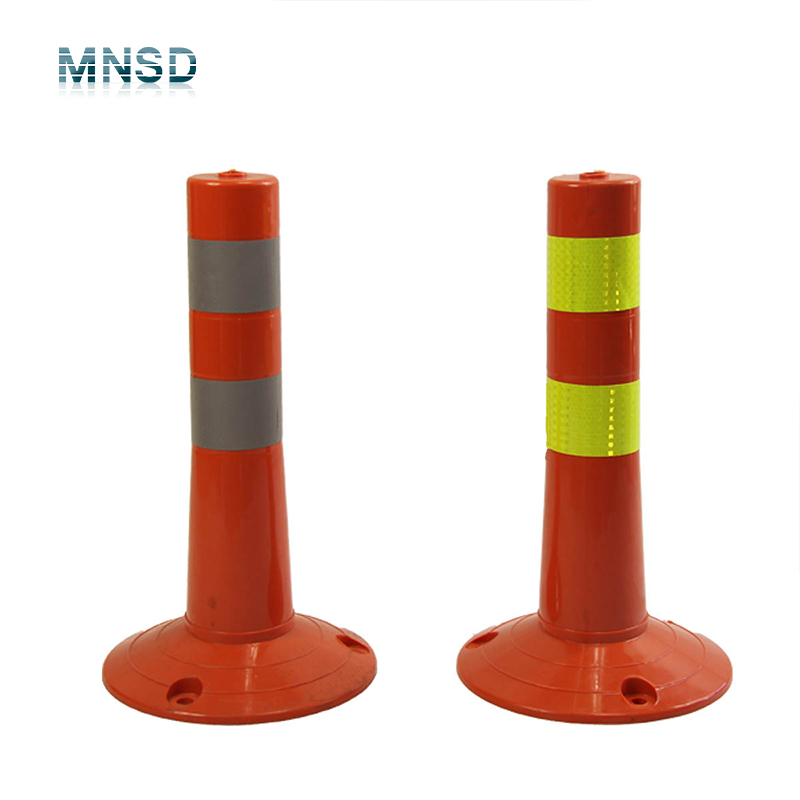
YD-WP45 — 450 mm flexible PU warning post
- Height: 450 mm; listed size 450 × 80 × 200 mm.
- Base: 200 × 80 mm, with recycled rubber or integrated plastic base options.
- Body material: High-Elasticity Polyurethane (PU).
- Reflective grade: High-Intensity Prismatic (HIP) / Class 1.
- Reflective tape: 250 mm width, double or triple sleeves, silver white or fluorescent yellow.
- Visibility distance: 200+ metres.
- Flexibility: 360°, impact resistant, with rapid rebound after a vehicle crush.
- Mechanical data: hardness 80–85 Shore A, tensile strength 15.0 MPa, elongation at break 400%.
- Environment: -40 °C to +70 °C, UV-stabilised coating, water and oil resistant, anti-oxidant and colourfast over 3 years.
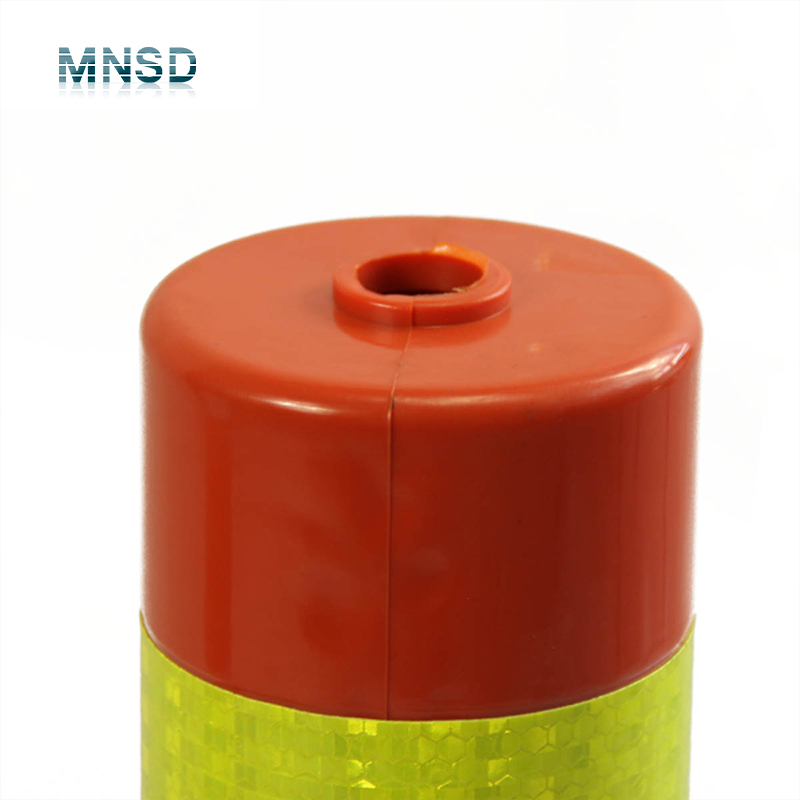
- Installation: expansion bolt fixing, 3 or 4 holes, ring top for chain attachment.
- Body colours: traffic orange, yellow, red, black.
At 450 mm, the post places its reflective band close to the ground. That suits positions where the marker is read at short range — bay guides, wheel-stop lines, column protection under low soffits — and where a low profile keeps the device clear of vehicles passing close to it.
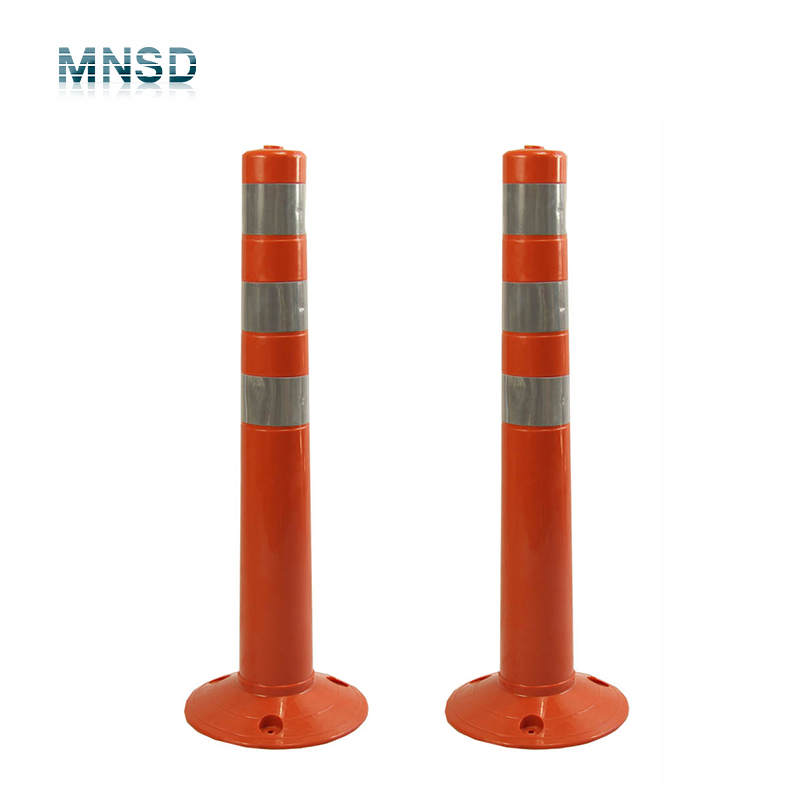
YD-WPS75 — 750 mm flexible PU warning post
- Height: 750 mm; listed size 750 × 80 × 200 mm.
- Base: 200 × 80 mm, with recycled rubber or integrated plastic base options.
- Body material: High-Elasticity Polyurethane (PU).
- Reflective grade: High-Intensity Prismatic (HIP) / Class 1.
- Reflective tape: 250 mm width, double or triple sleeves, silver white or fluorescent yellow.
- Visibility distance: 200+ metres.
- Flexibility: 360°, impact resistant, with rapid rebound after a vehicle crush.
- Mechanical data: hardness 80–85 Shore A, tensile strength 15.0 MPa, elongation at break 400%.
- Environment: -40 °C to +70 °C, UV-stabilised coating, water and oil resistant, anti-oxidant and colourfast over 3 years.
- Installation: expansion bolt fixing, 3 or 4 holes, ring top for chain attachment.
- Body colours: traffic orange, yellow, red, black.
The 300 mm of extra height lifts the reflective sleeve higher in the driver's view, which is what makes the taller post the usual choice at ramp mouths, lane separations, sidewalk edges and any position where the marker must be seen over kerbs, planters, wheel stops or standing water.
The shared platform — why this comparison is shorter than it looks
Both models are listed with the same base size of 200 × 80 mm and the same base material options: a recycled rubber base or an integrated plastic base. Installation is by expansion bolt through three or four holes, and both carry a ring top for chain attachment.
Reflectance is also common to both: HIP / Class 1 tape, 250 mm wide, supplied as double or triple sleeves, in silver white or fluorescent yellow, rated at 200+ metres visibility. Physical performance matches as well — 360° flexibility, rapid rebound after a vehicle crush, 80–85 Shore A hardness, 15.0 MPa tensile strength and 400% elongation at break.
Environmental tolerance is identical: -40 °C to +70 °C, UV-stabilised coating, water and oil resistance, and anti-oxidant, colourfast performance listed at over three years. Body colour options are the same four: traffic orange, yellow, red and black.
The practical consequence for facility teams is that the two heights can be specified together without opening a second product qualification: same fixing layout, same reflective specification, same colour range, same replacement logic. Only the vertical dimension changes.
Step-by-step breakdown: six checks that settle the height
The sequence below is written for a facility or procurement team assessing a site. It runs per position, so a single site can legitimately end up with both models.
Step 1 — Measure the mounting surface and the clear height
Record the surface the post will be fixed to (concrete slab, asphalt, kerbed island) and the vertical clearance above it. Both posts fix with expansion bolts through three or four holes, so the substrate governs the anchor, not the post. Where overhead clearance is restricted, height becomes a constraint rather than a preference.
Step 2 — Fix the reading distance
Estimate how far back a driver or pedestrian must first register the marker. Short reading distances — a parking bay, an aisle corner — tolerate the 450 mm post. Longer reading distances — a ramp approach, a dock edge, a road shoulder — favour the 750 mm post, because the reflective sleeve sits higher in the sightline and stays within it for longer.
Step 3 — Run the read-over test
Stand where the driver or pedestrian would first see the post and list everything between that point and the reflective sleeve: kerbs, wheel stops, planters, low walls, standing water, vehicle body lines, stacked pallets. If an obstruction rises above roughly 450 mm at the critical viewing angle, the 750 mm post is the safer specification. If the line of sight is short and clear, the 450 mm post does the job with less material per position.
Step 4 — Confirm the fixing detail
Both models use expansion bolt fixing with three or four holes and a ring top for chain attachment. Chain-linked runs — queue control, bay separation, temporary closures — can therefore mix heights on the same run without changing hardware or drilling patterns.
Step 5 — Check the environment, then stop worrying about it
Temperature range, UV stabilisation, water and oil resistance and colourfast performance are listed identically for both models, so environment rarely decides between them. What it does decide is whether the specification is adequate at all: a site that needs UV-stable, colourfast performance over three years needs that property from either height, and both are listed with it.
Step 6 — Validate before the bulk order
Sample the specific height, colour and tape configuration and test it against the real sightline before committing. Mnsd's production data lists high-speed injection moulding, customisation of height, colour and reflective tape brand, a 1,000+ cycle compression and rebound test regime, an MOQ of 200 pieces and a 10–15 day lead time for bulk orders.

Use cases: matching each height to a facility position
None of the mappings below is imposed by the product data; each follows from the geometry of the position and from the read-over test in Step 3.
| Facility position | Typical model | Why it fits |
|---|---|---|
| Parking structure ramp mouth or level entry | YD-WPS75 | The marker has to be read across a wide approach while vehicles turn; the taller sleeve stays visible above kerbs and ramp edges. |
| Parking bay guide, wheel-stop line, bay separator | YD-WP45 | Short read distance and high position count; the low profile reduces material per position. |
| Basement column protection under restricted headroom | YD-WP45 | Keeps the post below the clearance limit while still marking the column base. |
| Loading dock edge, warehouse aisle corner, logistics yard | YD-WPS75 | Read from a distance by moving vehicles and handling equipment; the higher sleeve survives the read-over test against dock furniture and stacked goods. |
| Urban sidewalk protection and pedestrian–vehicle segregation | YD-WPS75 | The post competes with kerbs, street furniture and pedestrians, so height keeps the reflective band in the sightline. |
| Expressway lane separation, highway ramps, T-junctions | YD-WPS75 | Long approach distances and permanent bolt-down installation call for the higher reflective band. |
| School, hospital, airport, seaport and municipal access points | Either, by position | Apply the six checks per position; the shared fixing and reflectance make mixed deployments practical. |
| Chain-linked queue or bay control | Either | The ring top for chain attachment is common to both models. |
Project data supports the pattern in which the taller post dominates road and municipal work. In the recorded application scenario for roadside and municipal projects, flexible warning posts are used for lane separation on high-speed expressways, highway ramps, T-junctions, urban sidewalk protection and multi-level parking lot entrances, installed surface-mounted or bolt-down as a permanent fixture, with high-visibility reflective sleeves and heavy-duty expansion anchors as matched equipment.
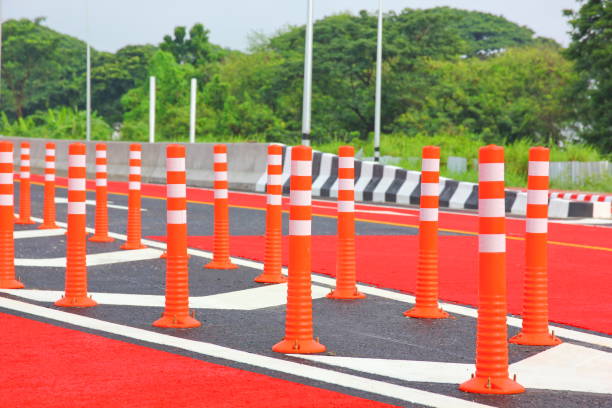
A contractor project in Vietnam used Mnsd warning posts to warn vehicles and pedestrians and to mark road edges and dangerous areas. The installation was completed and accepted by the local authority, with an in-service expectation of 5–8 years and reported strengths of high visibility, durability, impact resistance and simple installation.
Market conditions can also shift the default. In the United Arab Emirates, this type of product is typically applied in roadside and municipal contexts, where UV-stable, colourfast performance against sustained sun exposure is part of the selection criteria rather than an optional extra — a property both models share in their listed data.
YD-WP45 vs. YD-WPS75: side-by-side specification table
| Specification | YD-WP45 | YD-WPS75 |
|---|---|---|
| Model | YD-WP45 | YD-WPS75 |
| Height | 450 mm | 750 mm |
| Listed size | 450 × 80 × 200 mm | 750 × 80 × 200 mm |
| Base size | 200 × 80 mm | 200 × 80 mm |
| Body material | High-Elasticity Polyurethane (PU) | High-Elasticity Polyurethane (PU) |
| Base material options | Recycled rubber or integrated plastic base | Recycled rubber or integrated plastic base |
| Reflective grade | HIP / Class 1 | HIP / Class 1 |
| Reflective tape width | 250 mm, double or triple sleeves | 250 mm, double or triple sleeves |
| Reflective colours | Silver white / fluorescent yellow | Silver white / fluorescent yellow |
| Visibility distance | 200+ metres | 200+ metres |
| Flexibility | 360°, impact resistant | 360°, impact resistant |
| Self-recovery | Rapid rebound after vehicle crush | Rapid rebound after vehicle crush |
| Hardness | 80–85 Shore A | 80–85 Shore A |
| Tensile strength | 15.0 MPa | 15.0 MPa |
| Elongation at break | 400% | 400% |
| Temperature range | -40 °C to +70 °C | -40 °C to +70 °C |
| UV and ageing | UV-stabilised coating; anti-oxidant and colourfast over 3 years | UV-stabilised coating; anti-oxidant and colourfast over 3 years |
| Installation | Expansion bolt fixing, 3 or 4 holes | Expansion bolt fixing, 3 or 4 holes |
| Top design | Ring top for chain attachment | Ring top for chain attachment |
| Body colours | Traffic orange / yellow / red / black | Traffic orange / yellow / red / black |
| Typical fit | Close-range, low-profile marking at high position counts | Longer approach distances and read-over positions |
Read the table for what is missing. No row separates reflectance, rebound, temperature tolerance, hardness or fixing between the two models. Only the height row — and the fit that follows from it — divides them.
Frequently asked questions
Do YD-WP45 and YD-WPS75 meet MUTCD, EN 13422 or local road-authority requirements?
The published product data lists HIP / Class 1 reflective tape at 250 mm width, a 200+ metre visibility distance, PU body material and a 200 × 80 mm base with bolt-down fixing. It does not state a certification or approval against a specific standard. EN 13422:2019 covers portable traffic cones and cylinders in Europe, while delineator requirements are set by road owners and local rules; buyers should confirm the applicable criteria for the receiving market and request the corresponding documentation before ordering. Because both heights share one platform, a document review covers the same product family.
Can both heights be supplied in one order, and can colour and tape be customised?
Yes. Mnsd lists customisation of height, colour and reflective tape brand, with body colours in traffic orange, yellow, red and black, reflective sleeves in silver white or fluorescent yellow, and tape supplied as double or triple sleeves. Both models are produced by high-speed injection moulding, with a listed monthly capacity of 50,000 pieces.
How should buyers compare cost between the 450 mm and 750 mm posts?
Mnsd does not publish prices and this guide does not estimate them. Three cost factors are visible in the data and worth putting to any supplier: material volume per post, which differs with height; reflective tape configuration, since double and triple sleeves use different tape quantities; and installation hardware, which is common to both models because the base size and bolt-hole pattern are identical. A quotation should state height, colour, tape configuration and quantity so that comparisons are like for like.
Can a height be validated before a bulk order?
Request the specific height, colour and tape configuration as a sample and test it against the actual sightline on site. Mnsd's production data lists a 1,000+ cycle compression and rebound test regime and an MOQ of 200 pieces, so a sample can be evaluated against the same specification that governs the bulk run.
What lead time and order quantity should be planned?
The listed MOQ is 200 pieces and the listed lead time is 10–15 days for bulk orders, against a listed monthly capacity of 50,000 pieces. Sites that mix both heights should plan them in one order, because the base, fixing and reflective specification are common and only the vertical dimension changes. To confirm the right mix for a multi-position site, send the position list and site plan to Mnsd and request a quotation with matching samples.
Conclusion: decide on sightline, not on specification
The YD-WP45 and the YD-WPS75 are the same flexible PU warning post at two heights: 450 mm and 750 mm on an identical 200 × 80 mm base, with the same HIP / Class 1 reflective tape, the same 200+ metre visibility rating, the same 360° rebound and the same -40 °C to +70 °C operating envelope. What separates them is where the reflective sleeve sits relative to the person who has to see it.
Measure the mounting surface and clearance, fix the reading distance, run the read-over test against real obstructions, confirm the bolt-down detail, check the environment, and validate with a sample. Positions with short, clear sightlines and high counts belong to the 450 mm post; positions with longer approaches or low obstructions belong to the 750 mm post. Because both share a base and a fixing pattern, mixed deployments remain simple to install, stock and replace.
Next step: match both heights to your site
Send Mnsd the positions you need to mark — ramp mouths, bay guides, dock edges, aisle corners or road shoulders — and request a quotation with samples of the 450 mm YD-WP45 and the 750 mm YD-WPS75 in your preferred body colour and reflective tape configuration.
Download the product catalogue: Mnsd traffic safety product brochure (PDF)
Tiantai Yuanda Traffic Device Co., Ltd — hongsan industry zone, tiantai town, taizhou city, zhejiang province, China
Website: www.mnsdtraffic.com · Email: info@mnsdtraffic.com · Tel / WhatsApp: +86 184-5813-7305
Have Questions or Need More Details?
Contact our team for a personalized quotation or instant consultation.
Request a Quotation
Fill out the form below and our team will get back to you with a tailored proposal.
WhatsApp Direct Chat
Prefer to chat in real-time? Message us on WhatsApp for instant assistance & quick answers.
- Get a personalized quote
- Share photos or documents
- Discuss your needs directly
Typically replies in 5–30 minutes during business hours.