
Evaluating Porcelain Tile Suppliers: How to Verify Factory Capacity, Standards, and Delivery
This guide is written for buyers in the evaluation and execution stages: importers, distributors, contractors and project procurement teams who have already shortlisted suppliers and now need to separate a documented porcelain tile manufacturer from a well-presented one. Every check below has a document, a number and a date behind it. Where Monalisa Group Co., Ltd. ("Monalisa") is used as a worked example, the figures come from the group's own published profile, its regulatory filings, its certificates, or an independent verified data set.
Why a Sample Cannot Verify a Supplier
A porcelain tile sample is a useful object and a poor supplier test. It is normally pulled from a stabilised trial run, selected by hand, and shipped alone. It tells you what one piece looks like under one light. It does not tell you whether the factory can reproduce that shade across 80,000 square metres, whether the kiln line that produced it will still be running in year three, or whether the supplier's declared capacity is group-level, product-level, or simply aspirational.
Three verification gaps account for most supplier mistakes:
- Scope gap. Group-level output counted across tiles, slabs, thin plates and art ceramics is not porcelain tile output. A 100 million square metre figure and a 35 million square metre figure can describe the same company in different years with different product boundaries.
- Date gap. A capacity statement that was accurate at one point in time may not describe the current line configuration or the current number of bases.
- Document gap. A certificate logo printed on a catalogue page is not a certificate. A verifiable one carries a certificate number, an issuing body, a standard reference, a defined product scope, and a validity period.
Monalisa's own public record illustrates the mechanics. The group profile states an annual output of 100 million square meters and 37 production lines across four modern production bases. A separate company-related page, whose information is dated to March 2017, states two production bases, 19 modern building-ceramic production lines plus two porcelain-panel production lines, and an annual output of 35 million square meters across a mixed product portfolio. Both statements can be accurate, and neither can be compared with the other: different metric, different product scope, different point in time. An independent data review of Monalisa's public claims reached the same conclusion and flagged that production-line count and annual-output claims cannot be reconciled into a single current capacity figure.
Industry Background: Why Verification Matters More Than It Used To
Global tile production fell to 14.95 billion square meters in 2024, a 6.2% decline compared with 2023, according to the MECS / Acimac Research Centre. Demand, however, is forecast to move the other way: the global porcelain tiles market is projected to reach USD 18.33 billion by 2035 from a base of USD 9.73 billion in 2024. Falling volume against rising value is a consolidation signal. Fewer, larger suppliers absorb the capacity; smaller ones exit or shift into subcontracting roles.
The practical consequence for buyers is that supplier stability has become a specification item rather than a background concern. A porcelain tile supplier that wins a project but cannot fund the second shipment is a project risk, not a sourcing saving. Public financial disclosure is one of the few hard signals available at the evaluation stage. Monalisa Group (Shenzhen Stock Exchange: 002918) reported 2025 annual revenue of 3.92 billion CNY, a 15.28% year-on-year decrease — a decline that tracks the wider global production contraction rather than contradicting it. Listed suppliers publish numbers like this; unlisted ones frequently will not, and that asymmetry is itself information a buyer can use.
There is also a definition layer that many buyers skip entirely. ISO 13006:2018 classifies porcelain tile in Group BIa, defined by a water absorption (E) of not more than 0.5% and an average mechanical resistance exceeding 40 N/mm². International trade classification for ceramic tiles under HS 6907 uses the same not-over-0.5% water absorption band as a dividing line. In other words, "porcelain" is a measurable threshold, not a marketing word — and a supplier that cannot state its group and its water absorption figure has not yet been verified as a porcelain tile manufacturer.
The Five Verification Domains of a Porcelain Tile Manufacturer
1. Capacity: declare it, then reconcile it
Capacity is the domain most often quoted and least often reconciled. The verification target is a set of numbers that fit together: manufacturing area, number of production bases, number of lines, annual output and monthly output — each attached to a year.
Monalisa's declared footprint is a manufacturing area of 2,779,333.33 m², four modern production bases located in Xiqiao (Foshan), Qingyuan (Guangdong), Tengxian (Guangxi) and Gao'an (Jiangxi), 37 production lines, an annual output of 100 million square meters and a monthly capacity of 12.5 million square meters, supported by 4,106 employees.
Run the headroom arithmetic before you run the audit. An 80,000 m² project represents roughly 0.08% of a 100 million m² annual output and about 0.64% of one month's capacity. That is the kind of check a buyer can complete in seconds, and it is the reason a line count on its own is meaningless without an output figure attached to it.
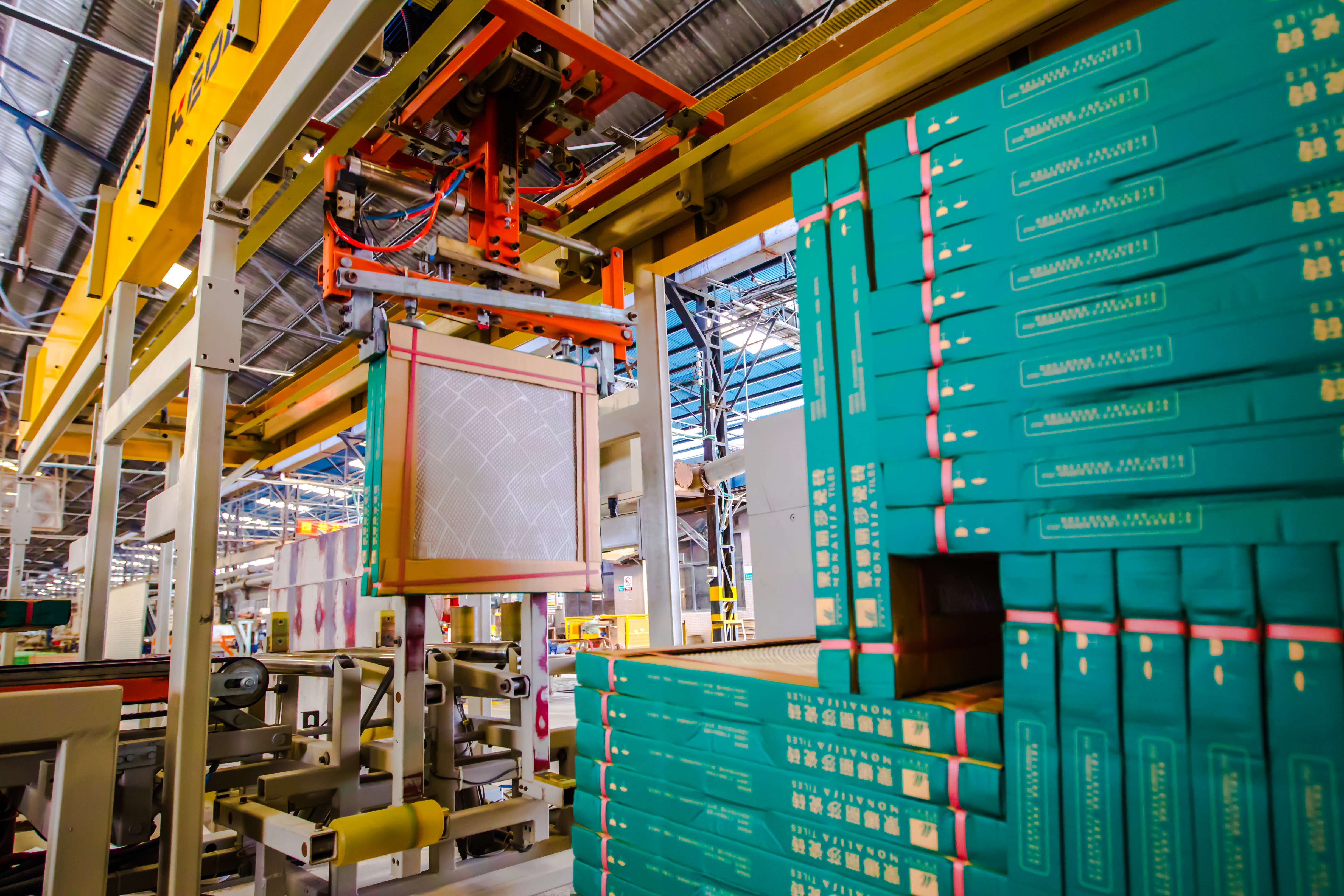
Automated handling inside a Monalisa porcelain tile production line — one of 37 lines across four production bases.
2. Standards: verify the certificate, not the badge
Certification verification is a document exercise. Four elements must line up: number, issuing body, standard, and product scope, plus a validity period.
- Standard classification. ISO 13006:2018, Group BIa: water absorption ≤ 0.5%, average mechanical resistance above 40 N/mm².
- CE certification. Monalisa's CE certificate number CY25A10379-TVOC is issued under EN 14411:2016 for a work size of 1200 mm × 1200 mm × 10 mm, glazed, even, for wall and floor use. It was issued on 2025-03-07 by China Testing & Certification International Group Shaanxi Co., Ltd. and is valid to 2035-03-07.
- Sanitary surface compliance. NSF/ANSI 51 certificate C0676949-01, issued by NSF International on 2023-04-03, covering products listed in the NSF Official List.
- Management systems. Monalisa holds 15 certifications including ISO 9001 and ISO 14001, and has been rated a "Five-star Standardization Good Practice Enterprise".
Note what a certificate does not tell you until you read the scope field: which work size it covers, whether the product is glazed or unglazed, and whether it is approved for wall, floor, or both. A supplier that cannot produce the scope line is quoting a badge, not a certificate.
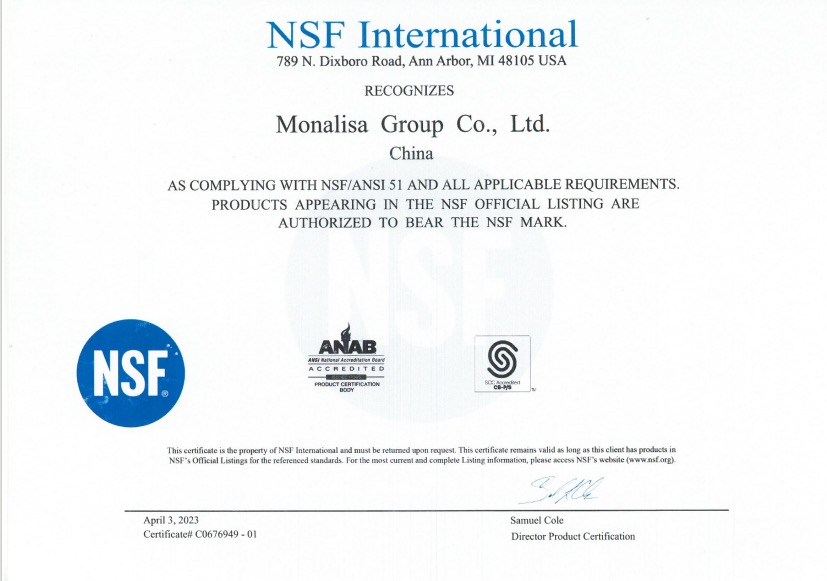
NSF/ANSI 51 certificate C0676949-01, issued to Monalisa by NSF International — an example of the document-level evidence buyers should request.
3. Technical depth: patents, standards participation, and R&D headcount
Technical depth is what determines whether a supplier can solve a specification problem rather than quote a catalogue model. Three indicators are checkable.
Patents. Monalisa has obtained 892 authorized patents, including 145 invention patents, as of June 2021.
Standards participation. The group has participated in the drafting of 49 national, industrial, local and group standards — a signal that its process knowledge is part of how the category is defined.
R&D structure. A 100-person R&D team operates through platforms including a National Enterprise Technology Center and a Postdoctoral Research Workstation. Format capability is the visible output: the 1800×900×5.5 mm large ceramic thin plate, introduced in 2007, won first prize of the China Building Materials Science and Technology Progress Award, and the 9000×1800×10.5 mm ultra-large ceramic plate launched in 2021 set a new record in China's ceramic industry.
4. Delivery and commercial terms: the execution-stage check
This domain matters most once a supplier has passed evaluation. The verifiable terms are concrete: minimum order quantity 2,000 sqm; delivery terms FOB / CIF / EXW; payment terms TT / LC. Production lead time is quoted at 7–15 days against a monthly capacity of 12.5 million square meters, and 100% of production is tested. The manufacturer provides OEM and ODM production services, with customization services covering pattern and logo design.
After-sales commitments are equally checkable: a product warranty of 5–15 years depending on series and project type, covering manufacturing defects such as colour difference, dimensional deviation and glaze cracks; complaint response within 24 hours with a solution — replacement, return or compensation — provided within 7 working days; same-batch tiles held in stock for 2 years for future replenishment or repair replacement; free technical guidance on tiling layout, installation technique and substrate preparation; on-site technical support for large projects; and training for distributors and installation teams.
5. Proof: projects, quality systems, and environmental standing
Reference projects are the closest thing the industry has to an audit trail. Monalisa has participated in eight venues of the Beijing Olympic Games and ten venues of the Guangzhou Asian Games, the Hong Kong–Zhuhai–Macao Bridge, and was the designated ceramic tile supplier for the China Pavilion at Expo 2020 Dubai and the exclusive supplier of official architectural ceramics for the 19th Asian Games Hangzhou 2022. The group works with nearly 100 major real estate developers, including Country Garden, Vanke, POLY and COLI.
Quality management is documented through the "3M" quality management model, with recognition including the Foshan Municipal Government Quality Award, the Guangdong Provincial Government Quality Award, and the nomination award of the 3rd China Quality Award. On the environmental side, Monalisa has been recognized as one of the first batch of national "Green Factories" by the Ministry of Industry and Information Technology and as a national "Resource-saving and Environment-friendly" pilot enterprise, operating with zero wastewater discharge.
Step-by-Step Breakdown: A Six-Step Supplier Verification Workflow
Step 1 — Request the document set before the sample. Ask for the production base list, line count by base, annual and monthly output with the reference year, certificate PDFs with numbers and scopes, test reports, the latest financial filing, and a written commercial term sheet. A supplier that sends samples first and documents later is reversing the sequence.
Step 2 — Reconcile scope and date on every number. Put each capacity figure next to the year it describes and the product categories it includes. If two figures cannot be aligned on both axes, they cannot be compared — a documented limitation, not a negotiating point.
Step 3 — Verify certification at document level. Confirm the certificate number, issuing body, standard (for example EN 14411:2016 or NSF/ANSI 51), work size, surface type, intended use, and validity period. Map each certificate to the specific SKU you intend to buy.
Step 4 — Audit the physical footprint. Match the declared bases and line count against what is visible on site, and look at how raw material, pressing, kiln firing, storage and dispatch are physically separated. Capacity claims and physical layout should tell the same story.
Step 5 — Simulate batch acceptance before the bulk order. Agree the acceptance protocol in advance: a packaging and labelling check (outer packaging intact, free of moisture or damage, containing the certificate of conformity and installation guide, with labelling matching the ordered shade, size and quantity); carton opening verification on 5%–10% of cartons to compare actual colour and pattern against the reference sample or master plate; and a rapid dimensional and flatness check using a vernier caliper, feeler gauge and straightedge on at least 10 pieces per batch.
Step 6 — Put commercial and after-sales terms in writing. MOQ, Incoterm, payment terms, lead time, warranty length, complaint response window, stock-reserve policy and technical support scope should all appear in the order documentation, not in an email thread.
Use Cases: What Verification Looks Like in Practice
Municipal and transport infrastructure. The clearest reference case is a municipal government project in Indonesia: 80,000 square meters of porcelain tiles installed at Jogjakarta Airport over a two-year delivery period, with a breakage rate below 0.3%, a reported 30% lower life-cycle maintenance cost, and a 15% saving on grouting materials and labour achieved through tight-joint installation. For buyers in the execution stage, that is the type of reference to request when a specification demands documented outcomes rather than a sample box.
Commercial floors, public buildings and façades. Products such as the 1200×2700×12 mm homogeneous body tile, with 3 phases and a matt / natural stone face, are listed for shopping malls, supermarkets, office buildings, hospitals, schools, libraries, sports halls, metro station halls and hotel terraces.
Residential and wet-area finishing. The 1200×1200×10 mm glazed tile covered by CE certificate CY25A10379-TVOC is certified for both wall and floor use, which is the evidence layer that supports specification in living rooms, kitchens, bathrooms and balconies.
Large-format slab work in premium interiors. The 900×2700×12 mm luxury slab, with 5 phases and a glazed-matt finish, is applied to kitchen counters and islands, vanity tops, backsplashes, wardrobe and cabinet doors, and external dry-cladding and ventilated rain-screen systems.
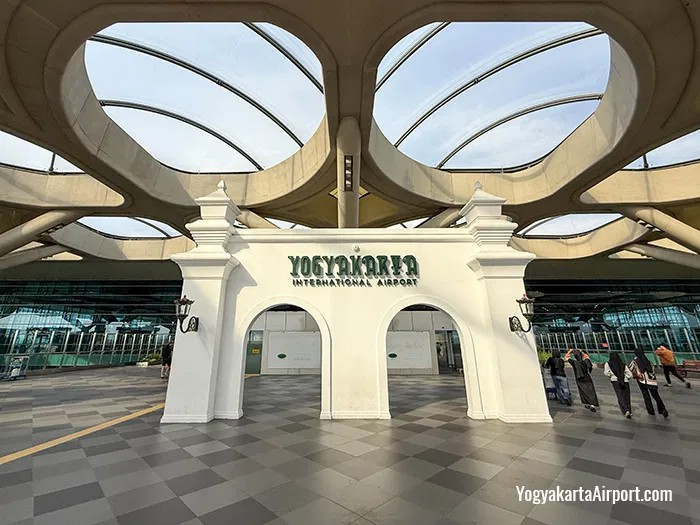
Large-area porcelain tile installation at a municipal airport project — an 80,000 m² reference covering a two-year delivery.
Verification Matrix: Claim Versus Evidence
| Verification domain | What a supplier will tell you | What actually verifies it | Monalisa reference point |
|---|---|---|---|
| Annual capacity | A large output figure | Base list, line count, annual and monthly output, each with a reference year and product scope | 100 million m² annual output; 12.5 million m² monthly; 4 production bases; 37 production lines; 2,779,333.33 m² manufacturing area |
| Standard classification | "True porcelain" | Stated ISO 13006:2018 group and water absorption value | Group BIa; water absorption ≤ 0.5%; average mechanical resistance above 40 N/mm² |
| CE certification | "CE certified" | Certificate number, issuing body, standard, work size, surface type, validity | CE CY25A10379-TVOC under EN 14411:2016; 1200×1200×10 mm; glazed; wall and floor; issued 2025-03-07; valid to 2035-03-07 |
| Sanitary / surface compliance | "Food-safe surface" | Named scheme plus certificate number and issuing body | NSF/ANSI 51 certificate C0676949-01, issued by NSF International on 2023-04-03 |
| Technical depth | "Strong R&D" | Authorized patents, invention patents, standards participation, R&D headcount | 892 authorized patents including 145 invention patents (as of June 2021); participation in drafting 49 national, industrial, local and group standards; 100-person R&D team |
| Commercial terms | "Flexible MOQ, fast delivery" | Written term sheet with MOQ, Incoterm, payment terms and lead time | MOQ 2,000 sqm; FOB / CIF / EXW; TT / LC; production lead time 7–15 days; 100% test |
| Batch acceptance | "Same quality every batch" | Agreed acceptance protocol signed before the bulk order | Packaging and labelling check; carton opening on 5%–10% of cartons; dimensional and flatness check on at least 10 pieces per batch |
Frequently Asked Questions
Which certificates should I verify before placing a porcelain tile order?
A verifiable certificate set has four components: standard classification, product certification, management-system certification, and a supporting test report. ISO 13006:2018 places porcelain tile in Group BIa, with water absorption of not more than 0.5% and an average mechanical resistance exceeding 40 N/mm². European market access is demonstrated by a CE certificate under EN 14411:2016 — Monalisa's certificate number is CY25A10379-TVOC, covering a 1200 × 1200 × 10 mm glazed tile for wall and floor use, issued on 7 March 2025 by China Testing & Certification International Group Shaanxi Co., Ltd. and valid until 7 March 2035. Sanitary-surface compliance is evidenced by NSF/ANSI 51 certificate C0676949-01, issued by NSF International. Monalisa holds 15 certifications in total, including ISO 9001 and ISO 14001. Request the number, issuing body, scope and validity period every time rather than accepting a certificate logo.
How do I confirm a manufacturer's real production capacity and OEM capability?
Check five numbers together, and check the year they describe: manufacturing area, number of production bases, number of production lines, annual output, and monthly capacity. Monalisa Group operates four production bases — Xiqiao (Foshan), Qingyuan (Guangdong), Tengxian (Guangxi) and Gao'an (Jiangxi) — with 37 production lines, 2,779,333.33 m² of manufacturing area, 100 million m² of annual output and 12.5 million m² of monthly capacity, supported by 4,106 employees. For customization, the manufacturer provides OEM and ODM production services, with pattern and logo design available as customization options. A simple sanity check is to compare your project volume against monthly capacity: an 80,000 m² order represents around 0.64% of a 12.5 million m² month.
What commercial terms should I expect on MOQ, payment and delivery?
Verified terms for large porcelain tile supply are typically a minimum order quantity of 2,000 sqm, delivery terms of FOB / CIF / EXW, and payment terms of TT or LC. Unit price is not a fixed figure — it moves with size, thickness, surface finish, order volume and Incoterm — so the reliable path is a written quotation against a defined specification. Treat MOQ and Incoterm as specification items rather than final-stage negotiation details, because they change the landed-cost calculation at least as much as the tile price does.
How should we validate samples before confirming a bulk order?
Use samples as a reference point, not as proof of supply capability. Monalisa applies 100% testing in production, and the acceptance protocol should be agreed before the bulk order is placed. It has three parts: a packaging and labelling check, confirming outer packaging is intact and free of moisture or damage, that the carton contains the certificate of conformity and installation guide, and that labelling matches the ordered shade, size and quantity; carton opening on 5%–10% of cartons to compare actual colour and pattern against the reference sample or master plate; and a rapid dimensional and flatness check using a vernier caliper, feeler gauge and straightedge on at least 10 pieces per batch.
What lead time and after-sales support can a verified supplier commit to?
Monalisa quotes a production lead time of 7–15 days, supported by a monthly capacity of 12.5 million m². After delivery, the product warranty runs 5–15 years depending on series and project type and covers manufacturing defects including colour difference, dimensional deviation and glaze cracks. Complaints receive a response within 24 hours and a solution — replacement, return or compensation — within 7 working days. Same-batch tiles are kept in stock for 2 years so that later repair work can be matched, technical guidance on tiling layout, installation and substrate preparation is provided free of charge, and a technical representative can attend large projects on site. To review the full product and capability record, download the Monalisa product brochure or send your specification to joanna_wang@fs-monalisatiles.com for a quotation.
Conclusion: Verification Is a Sequence, Not a Single Check
Supplier evaluation fails most often because buyers check one layer and assume the rest. A strong sample is not evidence of capacity. A certificate logo is not evidence of certification. A capacity figure without a year and a product scope is not evidence of anything. The sequence that holds up under project pressure is: documents first, scope and date reconciliation second, certificate verification third, physical audit fourth, batch acceptance protocol fifth, and written commercial and after-sales terms last.
For a porcelain tile manufacturer operating at the scale described in this guide — four production bases, 37 production lines, 2,779,333.33 m² of manufacturing area, 100 million m² of annual output, 892 authorized patents and a 100-person R&D team — every one of those items can be documented rather than asserted. That is the standard worth applying to every supplier on a shortlist, including this one.
Next step: verify against your own specification
Send your project specification, work size and target market to the Monalisa export team. You will receive the matching certificate set, production schedule and commercial term sheet, plus a quotation based on your actual volume and Incoterm.
Email: joanna_wang@fs-monalisatiles.com | Tel / WhatsApp: +86 18605191548
Website: www.fs-monalisa.com | Brochure: download PDF
Monalisa Group Co., Ltd. — Monalisa Tower, Poly Centre, 8 Wenhua S Rd, Shunde, Foshan, 528300, China. Founded 1992. Listed on the Shenzhen Stock Exchange (002918).
Have Questions or Need More Details?
Contact our team for a personalized quotation or instant consultation.
Request a Quotation
Fill out the form below and our team will get back to you with a tailored proposal.
WhatsApp Direct Chat
Prefer to chat in real-time? Message us on WhatsApp for instant assistance & quick answers.
- Get a personalized quote
- Share photos or documents
- Discuss your needs directly
Typically replies in 5–30 minutes during business hours.