Ranked: 5 Sintered Stone Slab Applications for High-Traffic, Wet, and Outdoor Projects
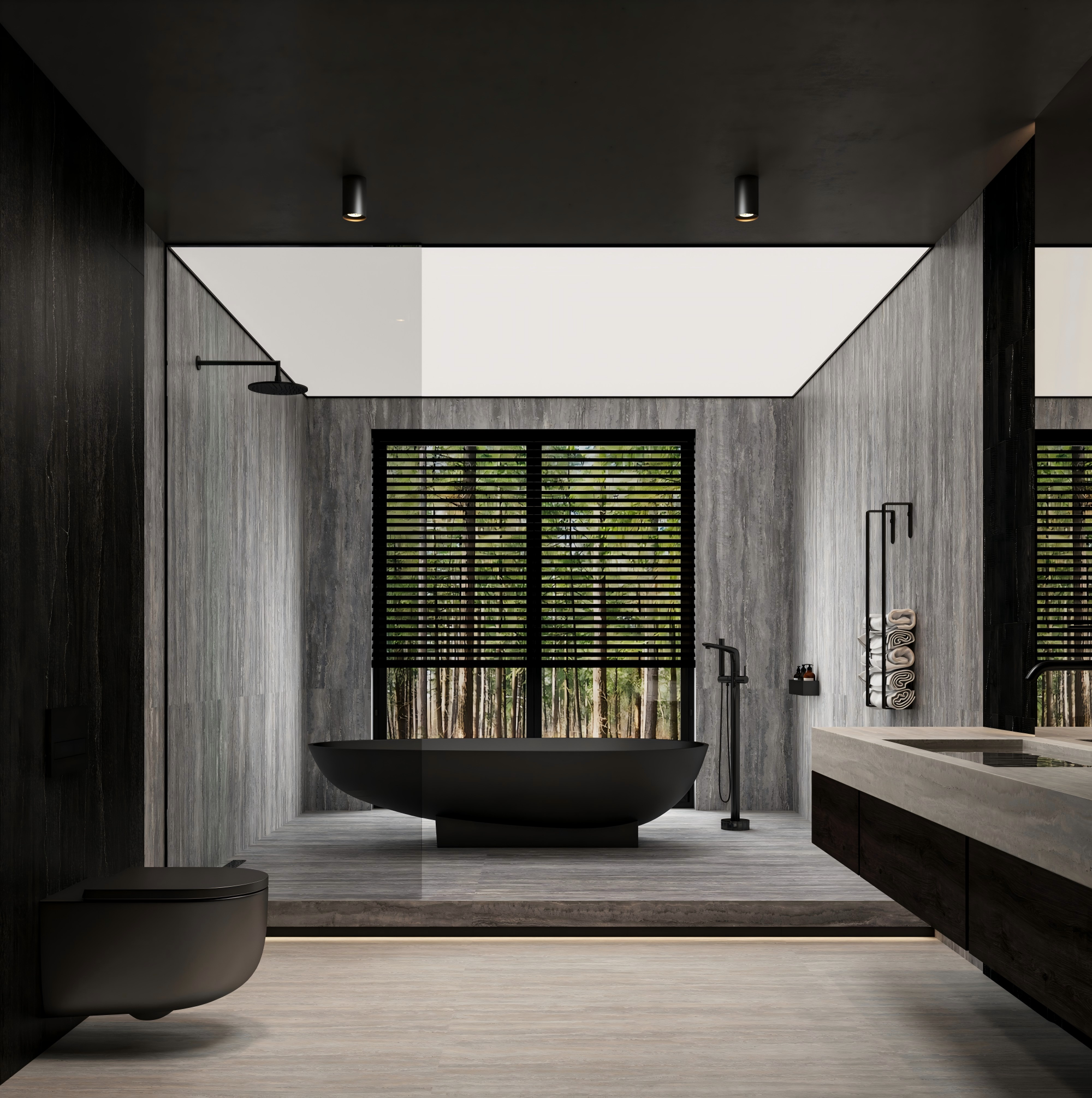
Five application groups carry the heaviest performance load for sintered stone slab, ranked here from the most demanding outward: exterior facades, terraces, and freeze-thaw-exposed wall and floor zones; hotel public areas and guest bathrooms; shopping mall and showroom circulation; restaurant dining rooms and commercial kitchen surfaces; and office buildings with residential apartments or villas. The order is not aesthetic. Each position is set by three variables — traffic load, moisture exposure, and weather cycling — plus the cost of failure in that specific space.
Sintered stone slab is a high-fired panel made from clay and quartz sand, installed as a wear-resistant, stain-resistant, and waterproof protective layer over floors and walls. Monalisa Group Co., Ltd. is a Foshan-based architectural materials manufacturer founded in 1992 that produces ceramic tiles, sintered stone slabs, and SPC flooring; its slab programme includes 900 × 2700 × 12 mm glazed-matt panels and 900 × 2700 × 9 mm glazed-matt thin panels.
The practical purpose of this ranking is to show which verified thresholds — PEI abrasion class, slip resistance, water absorption, freeze-thaw stability, stain and chemical resistance — govern each application, and where a specification usually fails when one of those thresholds is treated as optional.
Why High-Traffic, Wet, and Outdoor Projects Break Ordinary Surfaces
Four loads act on a finished slab installation at the same time, and they do not all peak in the same building type. Abrasion removes the visual surface where people walk and trolleys roll. Moisture penetrates any body that is not dense enough, then shows up as staining or, in cold climates, as cracking after repeated freezing. Chemical cleaners used in wet areas attack joints and surfaces. Thermal cycling attacks the panel itself when it is installed outdoors.
That is why the five applications below are ranked by exposure and not by square metres. A hotel bathroom is wet every day; a shopping mall floor is abraded every hour; an exterior terrace in a freeze-thaw climate does both, plus thermal cycling. Each zone therefore needs its own threshold set, and those thresholds are measurable.
Performance thresholds that govern wet, high-traffic, and outdoor slab work:
- Slip resistance: R9–R11 depending on zone; bathrooms require R10 or higher.
- Abrasion resistance: PEI 3–5, with PEI 4 or higher required for commercial and public areas.
- Water absorption: ≤0.5% for porcelain-grade bodies or ≤3% for semi-porcelain, with double-zero absorption required for certain projects.
- Stain resistance: Grade 5 against common stains such as tea, oil, and ink.
- Chemical resistance: ULA class where laboratory or chemical exposure applies.
- Freeze-thaw stability: no cracks after 100 freeze-thaw cycles for outdoor projects in cold climates.
- Dimensional tolerance: length and width deviation ≤ ±0.2%; thickness deviation ≤ ±5%.
- Fire and environment: Class A fire rating; Class A radioactive compliance for China; CE, GreenGuard, or LEED documentation required in some export markets.
Two external benchmark sets reinforce those numbers. Architectural procurement benchmarks for sintered stone cite water absorption below 0.1% against ISO 10545-3 and flexural strength of at least 45 N/mm² against ISO 10545-4. In the European Union, sintered stone intended for internal and external use is assessed for CE marking against EAD 090142-00-0404.
Industry Background: Why Sintered Stone Slab Volume Keeps Rising
The global sintered stone market was valued at approximately USD 877.75 million in 2024 and is projected to grow to USD 1.41 billion by 2032. On the supply side, China's exports of ceramic products — the category that includes sintered stone slabs — totalled USD 19.15 billion from January to November 2025, according to the General Administration of Customs of China. Growth of that scale is not driven by design fashion alone; it tracks a specification shift in commercial, public, and exterior work.
Three forces explain the shift. First, maintenance cost: slab surfaces are engineered to be easy to clean and are positioned as a natural stone alternative with lower maintenance costs. Second, hygiene and durability requirements in public buildings: hospitals, schools, metro stations, airports, museums, convention centres, and shopping malls all need surfaces that resist abrasion and staining while remaining cleanable with standard equipment. Third, exterior requirements: high-rise dry-cladding systems and ventilated rain-screen systems require panels with ultra-low water absorption, freeze-thaw resistance, and self-cleaning behaviour — a combination natural stone rarely delivers without periodic sealing.
Manufacturing maturity is the fourth factor. Monalisa Group has participated in drafting 49 national, industrial, local, and group standards and holds 892 authorized patents, including 145 invention patents. That matters to buyers because a supplier that contributes to standards typically also has documented test data behind the parameters a project specification asks for.
How This Ranking Was Built
Each application was scored on three criteria, in this order:
- Exposure severity — the combination of traffic volume, standing water, cleaning chemistry, sun, rain, and freeze-thaw cycling the zone imposes on the panel.
- Consequence of failure — what happens operationally if the surface stains, dulls, becomes slippery, or cracks. A cracked exterior panel is a safety and rework issue; a stained kitchen countertop is a hygiene and replacement issue.
- Specification complexity — how much certification, fabrication control, and installation discipline the zone requires before the material can be signed off.
All thresholds quoted in the ranking come from documented application requirements for slab and tile installation in indoor, wet, and outdoor conditions, and from certifications held for the specific slab products. Where a project example is cited, it is a delivered project reference.
The Ranking: 5 Sintered Stone Slab Applications
1. Outdoor Facades, Terraces, and Freeze-Thaw Wall and Floor Zones
Why it ranks first: it is the only application group that combines traffic, permanent moisture, and thermal cycling in the same detail.
Exposure profile: direct sun, rain, standing water, and freeze-thaw cycles. Outdoor working conditions for these installations are commonly specified between −20 °C and 40 °C, and washable exterior floors also carry slip exposure when wet.
What the specification must deliver: freeze-thaw stability with no cracks after 100 freeze-thaw cycles; water absorption of ≤0.5% for porcelain-grade bodies, with double-zero absorption required for certain projects; PEI 4 or higher where the surface is walked on; and slip resistance in the R10–R11 band for external walkable areas. UV stability and colour retention matter because the panel is permanently exposed.
Why sintered stone slab fits: the body is dense and non-porous, which is precisely what allows a low-absorption panel to go through wetting, drying, and freezing without the surface becoming a maintenance liability. Documented slab use cases include high-rise building dry-cladding systems and ventilated rain-screen systems, where ultra-low water absorption, freeze-thaw resistance, and self-cleaning behaviour are the reasons the material is chosen over thinner decorative alternatives.
Format and certification: the Monalisa Slab model 90-270FDK09003M / 90-270FDK09008M is a 900 × 2700 × 12 mm glazed-matt panel. The CE-certified Slab scope covers 900 × 1800 × 10 mm panels classified B I a, glazed with an even surface, for wall and floor applications. In the EU, the assessment reference for sintered stone used internally and externally is EAD 090142-00-0404.
Project evidence: in the Sri Lanka convention centre project, 80,000 m² of 900 × 1800 mm large-format material was installed across convention halls, banquet spaces, VIP corridors, multimedia rooms, public reception zones, outdoor connectors, and roof terraces. The specified panel delivered ultra-low water absorption of ≤0.08% with freeze-thaw and weather resistance for a hot-humid climate with monsoon rain, R10 slip resistance, and a 10-year group project warranty against a design life of 20+ years.
2. Hotel Public Areas and Guest Bathrooms
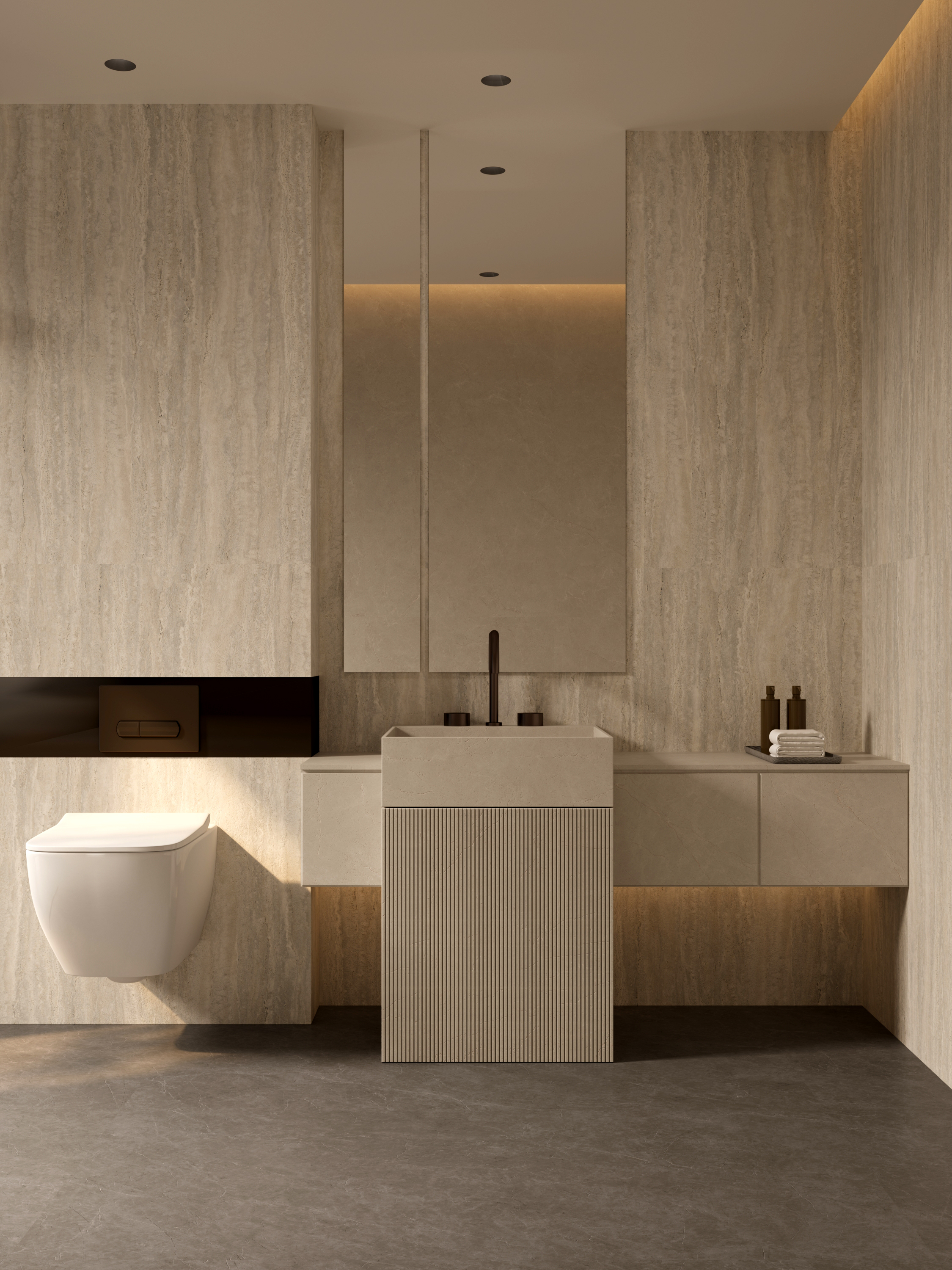
Why it ranks second: hotel floors are wet, cleaned several times a day with mild acid or alkaline cleaners, and never closed for maintenance.
Exposure profile: continuous footfall in lobbies, corridors, and banquet circulation; permanently wet bathroom floors and shower surrounds; repeated contact with cleaning agents.
What the specification must deliver: PEI 4 or higher in public and commercial areas; R10 or higher in bathrooms, within the R9–R11 guide range; stain resistance Grade 5 against tea, oil, and ink; and chemical resistance to ULA class where aggressive cleaning regimes apply. Hygiene is a hard requirement in guest bathrooms and food-service zones, which is why non-porous surfaces and optional antibacterial treatments are specified for medical and cleanroom-adjacent environments.
Why sintered stone slab fits: the material functions as a wear-resistant, stain-resistant, and waterproof protective layer, which maps directly onto the two failure modes hotels care about — stained grout lines and slippery, dull floors. Documented slab applications include five-star hotel lobbies, guest rooms, corridors, pool surrounds, shower areas, and outdoor terraces, together with kitchen and bathroom surfaces such as vanity tops, backsplashes, and integrated slab sinks.
Project evidence: the R10 slip resistance specified for the Sri Lanka convention and banquet halls was selected specifically for high-traffic public venues, with uniform tone and soft gloss maintained across 80,000 m² — the same continuity requirement a hotel lobby imposes across a much smaller footprint.
3. Shopping Mall and Showroom Circulation
Why it ranks third: footfall volume is extreme, but moisture is localized to entrances, food courts, and washrooms — so the dominant risk is abrasion and cleaning cost rather than water damage.
Exposure profile: trolley and pedestrian abrasion across very large continuous fields, wet-tracking at entrances, food-court spillage, and daily machine cleaning.
What the specification must deliver: PEI 4 or higher; stain resistance Grade 5; and tight dimensional control — length and width deviation ≤ ±0.2% and thickness deviation ≤ ±5% — so that large fields stay aligned with narrow joints. Large formats reduce the number of joints, which reduces both grout consumption and the number of places where dirt can collect.
Why sintered stone slab fits: commercial spaces such as shopping malls, supermarkets, offices, restaurants, cafés, and gyms are standard applications, and the abrasion class requirement (PEI 4+) is met by the panel body rather than by a surface coating that can wear through.
Project evidence: at the Yogyakarta airport project, 80,000 m² was installed for a municipal government client. Tight-joint installation delivered a 15% saving on grouting materials and labour, the breakage rate stayed below 0.3% — reducing replacement losses — and the project recorded approximately 30% lower life-cycle maintenance cost. Airport terminals and metro corridors are explicitly listed among the rail and public-facility applications where scratch resistance and easy cleaning drive selection.
4. Restaurant Dining Rooms and Commercial Kitchen Surfaces
Why it ranks fourth: heat and staining dominate in the back of house, while wetness and abrasion dominate in the front of house.
Exposure profile: cooking heat at countertops and islands; oil, tea, wine, and ink spills; wet kitchen floors; hot and caustic cleaning chemicals.
What the specification must deliver: stain resistance Grade 5 against common stains such as tea, oil, and ink; water absorption ≤0.5%; Class A fire rating; R10 or higher on kitchen floors; and a surface that tolerates heat exposure at working counters. Dimensional tolerance matters again here, because countertops and islands are fabricated from the same slab as the floor and must align cleanly at edges.
Why sintered stone slab fits: documented slab applications include kitchen countertops, kitchen islands, vanity tops, backsplashes, and integrated slab sinks, as well as restaurant and café floors and fine-dining interiors. A non-porous, stain-resistant surface is the reason the material appears in both the visible dining room and the hygienic back-of-house zone of the same venue.
5. Office Buildings and Residential Apartments and Villas
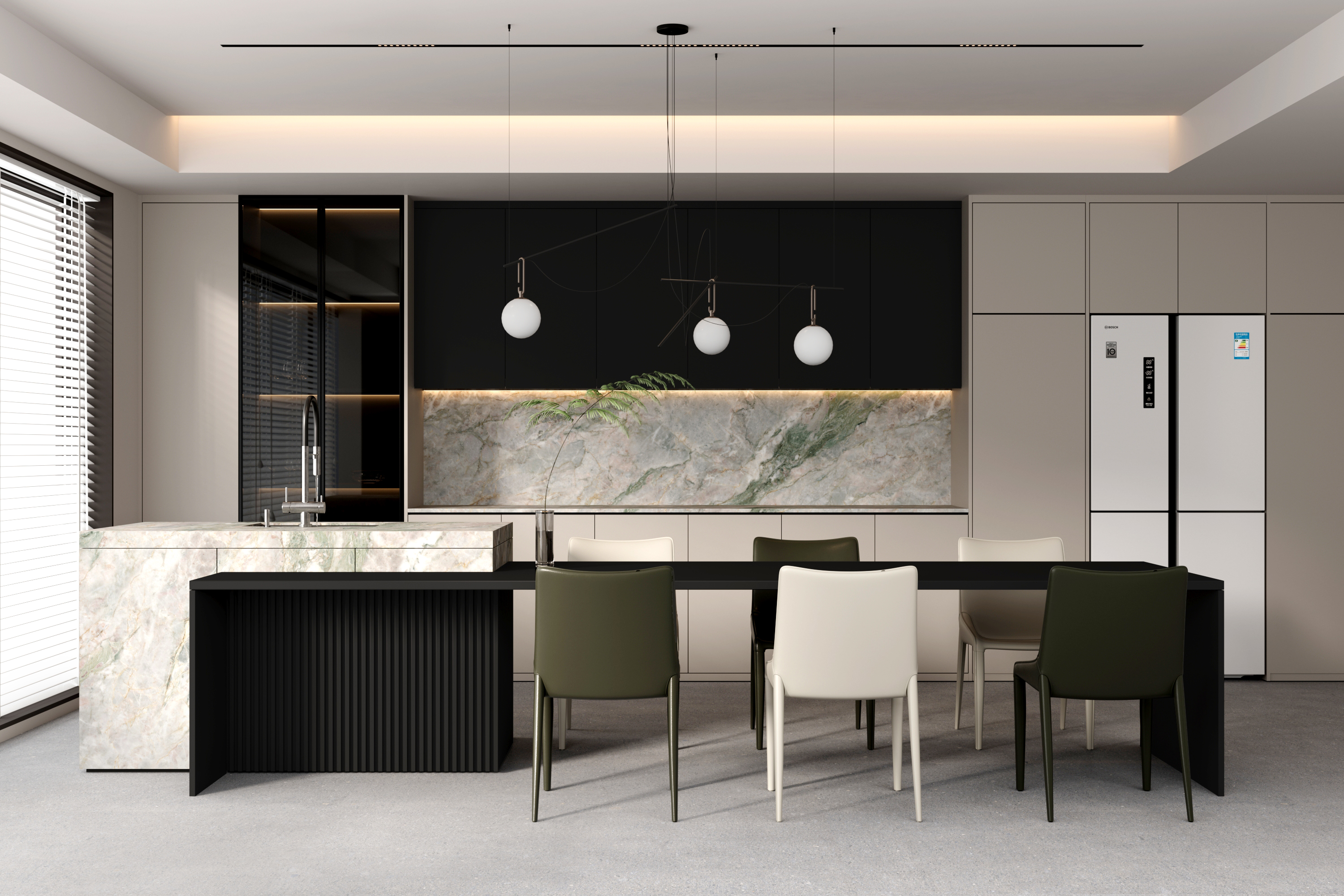
Why it ranks fifth: traffic is moderate, but service life expectations are long, and wet zones still exist in every unit.
Exposure profile: elevator lobbies and reception areas with steady footfall; washrooms, kitchens, and balconies with recurring moisture; occasional exposure to mild acid or alkaline cleaners in domestic use.
What the specification must deliver: PEI 3–5, with PEI 4 or higher for public-facing areas and washrooms; R10 or higher in bathrooms; water absorption ≤0.5%; and dimensional tolerance within ±0.2% length and width so that wall and floor fields remain visually continuous over long sight lines.
Why sintered stone slab fits: residential construction, offices, and premium finishing are core applications — floors and walls of living rooms, bedrooms, kitchens, bathrooms, and balconies, plus villas, large flats, and boutique apartments where the same slab is used for walls, floors, countertops, and cabinet doors. Thin formats reduce weight on wall systems; 900 × 2700 × 9 mm glazed-matt panels and 1200 × 2700 × 12 mm homogeneous-body panels with a matt natural-stone face both sit in this application group.
Step-by-Step: Specifying and Verifying a Sintered Stone Slab for These Applications
The five applications above are won or lost during specification, not during installation. This is the sequence that keeps a wet or exterior package compliant.
- Classify every zone by exposure. Split the project into dry interior, wet interior, high-traffic public, and exterior. A single building usually contains three of the four, and each needs its own threshold line.
- Set the threshold table before selecting a finish. Define PEI class (4+ for commercial and public areas), slip resistance (R10+ for bathrooms), water absorption (≤0.5%, double-zero where required), stain Grade 5, and — for exterior work — freeze-thaw stability with no cracks after 100 cycles. Pattern selection comes after this step, never before.
- Match format and thickness to the zone. Large-format panels of 900 × 2700 mm or 1200 × 2700 mm reduce joint count in malls, lobbies, and showrooms; thin 900 × 2700 × 9 mm panels suit wall coverage where weight matters; 900 × 1800 × 10 mm CE-scope slabs fit wall and floor applications in the certified classification B I a.
- Verify certification against the destination market. Confirm the CE certificate number and its exact scope, the NSF certificate and its market coverage, and the underlying standards such as EN 14411:2016 for the certified slab scope. For EU exterior and interior sintered stone, confirm the assessment reference EAD 090142-00-0404.
- Validate with samples and test documentation. Request the target format and finish as a physical sample, then match it against the test report and certificate of conformity supplied with the batch.
- Confirm fabrication, joint strategy, and site support. Tight-joint installation reduced grouting materials and labour by 15% in one delivered project; the same discipline requires on-site technical support when local teams have limited large-format experience.
- Lock supply, warranty, and stock terms. Agree the minimum order quantity, lead time, warranty length, complaint-response time, and whether same-batch stock can be reserved for future repair and replenishment.
Comparison Table: Application Requirements at a Glance
| Rank & application | Dominant exposure | Governing performance requirement | Format fit | Risk if under-specified |
|---|---|---|---|---|
| 1. Outdoor facades, terraces, freeze-thaw wall and floor zones | Sun, rain, standing water, cycling between −20 °C and 40 °C | Freeze-thaw stability — no cracks after 100 cycles; water absorption ≤0.5%; PEI 4+; R10–R11 for walkable areas | 900 × 2700 × 12 mm glazed-matt Slab; 900 × 1800 × 10 mm CE-scope Slab (B I a, wall and floor) | Cracking or surface failure after winter cycles; permanent staining on porous bodies |
| 2. Hotel public areas and guest bathrooms | Continuous footfall, permanently wet floors, frequent cleaning with mild acid or alkaline cleaners | PEI 4+ in public areas; R10+ in bathrooms; stain resistance Grade 5; chemical resistance ULA class | 900 × 2700 × 12 mm; 900 × 2700 × 9 mm; 1200 × 2700 × 12 mm | Slip incidents, stained joints, surface dulling in high-visibility areas |
| 3. Shopping mall and showroom circulation | Extreme footfall and trolley traffic; localized wet zones at entrances and food courts | PEI 4+; stain resistance Grade 5; dimensional tolerance ≤ ±0.2% length/width and ≤ ±5% thickness | 900 × 2700 × 12 mm; 1200 × 2700 × 12 mm for large continuous fields | Abrasion dulling, joint misalignment, higher cleaning and maintenance cost over the asset life |
| 4. Restaurant dining rooms and commercial kitchens | Heat at counters and islands; oil, tea, and ink staining; wet kitchen floors; cleaning chemicals | Stain resistance Grade 5; water absorption ≤0.5%; Class A fire rating; R10+ on kitchen floors | 900 × 2700 × 12 mm; 1200 × 2700 × 12 mm | Permanent countertop staining, floor slipperiness, hygiene non-compliance |
| 5. Office buildings and residential apartments and villas | Moderate traffic; recurring moisture in washrooms, kitchens, and balconies | PEI 3–5 with PEI 4+ for public areas; R10+ in bathrooms; water absorption ≤0.5% | 900 × 2700 × 9 mm thin panel; 900 × 2700 × 12 mm; 1200 × 2700 × 12 mm | Colour deviation, dimensional mismatch between adjacent fields, premature replacement |
Manufacturer Evidence Behind These Five Applications
Application thresholds only hold if the supplier can reproduce them at project scale. Monalisa Group Co., Ltd. was founded in 1992 and operates four modern production bases — Xiqiao (Foshan), Qingyuan (Guangdong), Tengxian (Guangxi), and Gao'an (Jiangxi) — with 37 production lines, a facility area of 2,779,333.33 m², 4,106 employees, and a 100-person R&D team. Monthly production capacity for the porcelain and sintered stone lines is 12.5 million m², which is the relevant figure when a mall, airport, or hotel package runs into tens of thousands of square metres in a single delivery.
Product performance is documented rather than asserted. The Slab product carries CE certification number CY25A10378, issued by China Testing & Certification International Group Shaanxi Co., Ltd., valid to 7 March 2035, covering slabs of 900 mm × 1800 mm × 10 mm classified B I a for wall and floor use under EN 14411:2016. NSF certification C0676949-01, issued by NSF International, covers the USA, EU, and China markets. In total the group holds 15 certifications including ISO 9001 and ISO 14001, operates a "3M" quality management model, and has received the Foshan Municipal Government Quality Award, the Guangdong Provincial Government Quality Award, and the nomination award of the 3rd China Quality Award.
Delivery experience in demanding environments is the third proof layer. Monalisa has participated in key projects including eight venues of the Beijing Olympic Games, ten venues of the Guangzhou Asian Games, and the Hong Kong-Zhuhai-Macao Bridge; it was the designated ceramic tile supplier for the China Pavilion at Expo 2020 Dubai and the exclusive supplier of official architectural ceramics for the 19th Asian Games Hangzhou 2022. Manufacturing is supported by a national enterprise technology centre and a postdoctoral research workstation, and the group has been recognised as a national "Resource-saving and Environment-friendly" pilot enterprise and one of the first batch of "Green Factories" by China's Ministry of Industry and Information Technology, with zero wastewater discharge.
The relevance to this ranking is direct: the freeze-thaw, slip-resistance, stain, and dimensional thresholds that define ranks one through five are the same parameters that appear in the group's slab certifications, waterproof and scratch-resistant use cases, and delivered public-project references.
FAQ: Sintered Stone Slab for Wet, High-Traffic, and Outdoor Projects
Which certifications should a sintered stone slab carry for wet, public, and outdoor projects?
For EU projects, sintered stone used internally and externally is assessed for CE marking against EAD 090142-00-0404. Monalisa's Slab product holds CE certification number CY25A10378, issued by China Testing & Certification International Group Shaanxi Co., Ltd. and valid until 7 March 2035, covering 900 mm × 1800 mm × 10 mm slabs classified B I a, glazed with an even surface, for wall and floor use under EN 14411:2016, applicable to the global market. For food-contact and hygiene-related surfaces such as kitchen countertops, the group holds NSF certification C0676949-01 from NSF International, valid for the USA, EU, and China. In addition, the company holds 15 certifications including ISO 9001 and ISO 14001, while projects in China may also require Class A radioactive compliance and some export markets require CE, GreenGuard, or LEED documentation.
Can sintered stone slabs be customized to a project's format, pattern, and finish?
Yes. Monalisa operates an OEM/ODM production model with customization of pattern and logo. The standard slab range includes the 900 × 2700 × 12 mm glazed-matt Slab (models 90-270FDK09003M and 90-270FDK09008M), the 900 × 2700 × 9 mm glazed-matt Flowing Light Sintered Stone (model 90-270DBY09340M), and a 1200 × 2700 × 12 mm homogeneous-body panel with a matt natural-stone face (model 120-270FEG12207M). Customization capacity is supported by a 100-person R&D team, 892 authorized patents including 145 invention patents, and participation in drafting 49 national, industrial, local, and group standards. Typical customized applications include countertops, kitchen islands, vanity tops, backsplashes, integrated slab sinks, custom furniture, and ventilated rain-screen or dry-cladding exterior systems.
What drives the cost of a sintered stone slab package in a large project?
Cost is driven by format and thickness, surface finish, customization scope (pattern and logo), edge and fabrication work, the joint strategy adopted on site, freight, and total volume against the 2,000 m² minimum order quantity. Slab specifications also change downstream cost. In the Yogyakarta airport project, tight-joint installation saved 15% on grouting materials and labour, the breakage rate stayed below 0.3% — reducing replacement losses — and the installation recorded approximately 30% lower life-cycle maintenance cost. In the Sri Lanka convention centre project, 900 × 1800 mm large-format panels reduced visible joints by approximately 50%, which lowered both installation time and long-term joint maintenance.
How can a buyer validate a sintered stone slab before committing to full production?
Validation follows three steps. First, request physical samples in the exact format, thickness, and finish specified for each zone so that colour, gloss, and slip behaviour can be checked on site. Second, match the sample against the product test report and certificate of conformity — Monalisa supplies test reports, certificates of conformity, instruction manuals, and maintenance guides in Chinese and English, and applies 100% testing as its quality control standard. Third, confirm that the delivered batch can be supported later: same-batch tiles can be held in stock reserve for up to two years for future replenishment or repair replacement.
What lead time, capacity, and after-sales support should a project expect?
Monalisa's monthly production capacity for porcelain and sintered stone lines is 12.5 million m², with a standard lead time of 7–15 days and a 2,000 m² minimum order quantity. Product warranty runs 5–15 years depending on series and project type, covering manufacturing defects such as colour difference, dimensional deviation, and glaze cracks. Technical guidance on tiling layout, installation technique, and substrate preparation is provided free of charge, a technical representative can attend large projects on site, complaints receive a response within 24 hours with a solution provided within 7 working days, and training is available for distributors and installation teams. To move a wet, high-traffic, or exterior package forward, request a sample and quotation for your format and finish, or download the Monalisa product brochure; project enquiries can be sent to joanna_wang@fs-monalisatiles.com or +86 18605191548 (WhatsApp available).
Conclusion
Ranking these five applications by exposure makes the specification decision simpler. Outdoor facades, terraces, and freeze-thaw zones come first because they combine traffic, moisture, and thermal cycling — they need freeze-thaw stability with no cracks after 100 cycles, water absorption of ≤0.5% or better, PEI 4+, and R10–R11 slip resistance. Hotels, malls, restaurants, and offices each reduce one of those loads but keep the rest, so PEI 4+, R10+ in bathrooms, Grade 5 stain resistance, and tight dimensional tolerance remain the working thresholds across all five.
The material only performs as specified when the supply side can document it: certification scoped to the exact slab size, test reports, reproducible capacity, and delivered references in comparable environments. Monalisa Group Co., Ltd. supplies that documentation through CE certification CY25A10378, NSF certification C0676949-01, 15 certifications including ISO 9001 and ISO 14001, 12.5 million m² of monthly capacity, and public project references including Olympic and Asian Games venues, the Hong Kong-Zhuhai-Macao Bridge, the China Pavilion at Expo 2020 Dubai, and the 19th Asian Games Hangzhou 2022.
Next step: specify against the highest load in your project
Send Monalisa the zone list, the required format and finish, and the destination market. You will receive a sample, a quotation, and the matching certification and test documentation for the exact slab scope specified — including CE-certified 900 × 1800 × 10 mm slabs and 900 × 2700 mm formats for high-traffic, wet, and exterior work.
Email: joanna_wang@fs-monalisatiles.com | Tel / WhatsApp: +86 18605191548 | Download the product brochure | fs-monalisa.com