
Sintered Stone Slab Long-Term Supply Partnerships: FAQ on Terms, Acceptance, and After-Sales Support
Monalisa Group Co., Ltd. (“Monalisa”) is a Foshan-headquartered manufacturer of ceramic tiles, sintered stone slabs and SPC flooring, founded in 1992 and operating four production bases, 37 production lines, approximately 100 million square meters of annual capacity, 4,106 employees and a 100-engineer R&D team. For a distributor that has already approved the surface, the buying decision has shifted: the question is no longer what the slab looks like, but whether the same slab can be delivered, accepted and supported across several years of repeat orders.
This guide is written as an FAQ because that is how long-term supply conversations actually run. It follows the sequence a distributor meets them in: why the questions change after sampling, what the manufacturer controls before shipment, the purchasing terms that frame the agreement, the acceptance protocol applied on arrival, capacity planning for a multi-year program, batch consistency, certification documentation, and the after-delivery communication path. Every answer below is limited to what Monalisa can document, and where a term must be confirmed per order, the article says so rather than filling the gap.

Why the questions change once the sample is approved
During evaluation, a distributor compares surfaces, thicknesses, finishes and formats. During execution, the same distributor compares processes. Once a range is approved and a program is priced, three repeatable events carry most of the commercial risk.
- Repeatability. Will the fifteenth production batch still match the master plate that was signed off in the first month?
- Acceptability. Can an incoming container be accepted or rejected on objective, pre-agreed grounds rather than on opinion?
- Answerability. When a problem appears in week eight, is there a named person with the authority and the production records to resolve it?
Monalisa's own production risk register names the same failure modes distributors raise in negotiation: color variation between batches and within a single batch; dimensional deviation at the edge, thickness and diagonal; warpage that affects appearance or causes water pooling; insufficient breaking strength or impact resistance; slip resistance below the specified class; stain penetration through the surface layer; freeze-thaw damage in cold-climate exterior use; and radioactivity above the permitted limit. Each of these is a process outcome, not a random event, which means each can be written into an agreement as a control and a test instead of being left as an assumption.
What Monalisa controls before a slab reaches the container
A supply agreement is only as strong as the controls behind it. Monalisa's sintered stone slab production is built around a small number of process interventions that map directly to the failure modes above.
Body density is set at the press, where fully automatic ultra-high pressure presses operate with a compaction force of up to 48,000 kN and a pressing pressure of at least 48 MPa. Dimensional accuracy is held by high-precision molds with a tolerance of ≤±0.1 mm, verified by laser rangefinders that automatically reject out-of-tolerance pieces. Flatness is managed through press pressure uniformity compensation and kiln roller fine leveling, followed by 100% inspection with a flatness scanner after the kiln. Color is controlled by an automatic color sorting machine combined with online spectrometer inspection, with packaging organized by shade and grade and every batch compared against a retained historical master standard.
Two structural features matter for a long-term partner. First, inspection is not a final gate: 18 quality control points run from raw material intake through ball milling, spray drying, pressing, drying, glazing, firing, polishing and sorting, with key parameters recorded in real time. Second, each slab is laser-marked or RFID-coded and traceable to its production date, press station, kiln zone and inspector ID — which is what makes a claim resolvable rather than a negotiation.
Purchasing terms: minimum quantity, delivery terms and payment terms
Monalisa's purchasing terms for sintered stone slab orders are stated in three parts: a minimum order quantity of 2,000 square meters, delivery under FOB, CIF or EXW, and payment by TT or LC. Those three lines decide most of the working-capital and risk questions a distributor asks in the first meeting.
What does a 2,000 m² minimum order quantity mean in practice?
The MOQ sets the smallest order that enters production efficiently. For a distributor, the practical consequence is planning, not price: 2,000 m² is a program-sized order, so it should be built from the formats and shades that are actually forecast to sell, not from a mixed assortment intended to test the market. Before signing, confirm in writing whether different formats or finishes can be combined within one 2,000 m² order and how the mix affects the scheduled production window.
FOB, CIF or EXW: who carries what risk?
The three delivery terms place the transfer of risk at different points in the journey. Under EXW the buyer takes responsibility from the factory gate; under FOB the seller handles export clearance and delivery to the vessel; under CIF the seller also arranges and pays freight and insurance to the destination port. For large-format slab, the choice interacts with handling and breakage exposure, so the term should be matched to who actually controls the container stuffing and the port-to-warehouse leg. Confirm which term is quoted for each order rather than assuming the first quotation sets the pattern.
TT or LC: what changes for working capital?
TT and LC are both accepted. A telegraphic transfer is administratively simpler and faster; a letter of credit introduces bank verification and document compliance in exchange for a payment structure both sides can audit. First orders and repeat orders need not use the same instrument, but the applicable instrument should be recorded in the agreement so it does not become a shipment-by-shipment discussion.
Acceptance criteria: how an incoming container is checked
Monalisa's acceptance criteria are structured as a short sequence that a distributor's warehouse team can run without laboratory equipment. The sequence exists to convert a subjective impression into a recorded result.
- Packaging and labeling check. Confirm the outer packaging is intact with no moisture or damage, that the certificate of conformity and the installation guide are inside, and that the labeling matches the order — shade, size and quantity.
- Carton opening verification. Randomly open 5%–10% of cartons and compare the actual color and pattern against the reference sample or master plate. Verify quantity and grade at the same time.
- Rapid dimensional and flatness check. Using a vernier caliper, feeler gauge and straightedge, measure at least 10 pieces per batch for length and thickness, and check flatness against the straightedge.
- Record the batch. Note the shade and grade on the labeling and, where available, the traceability code on the slab, so any later issue can be tied to a production record.
- Escalate with evidence. Where a result falls outside the agreed criteria, raise it with the batch reference, the measured values and photographs, so the factory can compare against its retained master standard and inspection records.
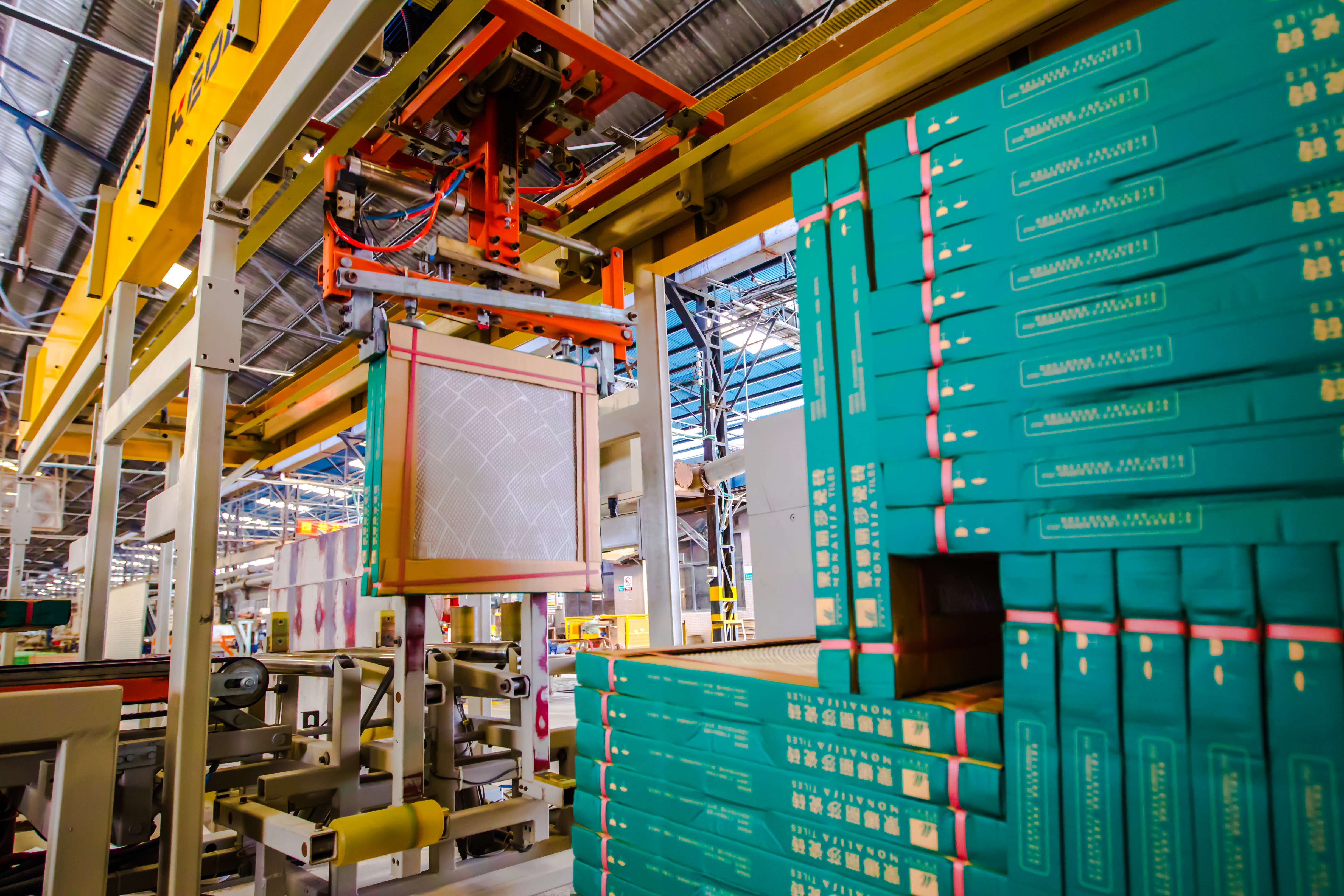
The protocol is deliberately front-loaded. Most acceptance disputes are not about whether a slab is defective, but about when the defect was first observed and against which reference. Opening cartons on arrival, against a retained master plate, establishes that record at the only moment when it is still clean.
Capacity planning for a multi-year program
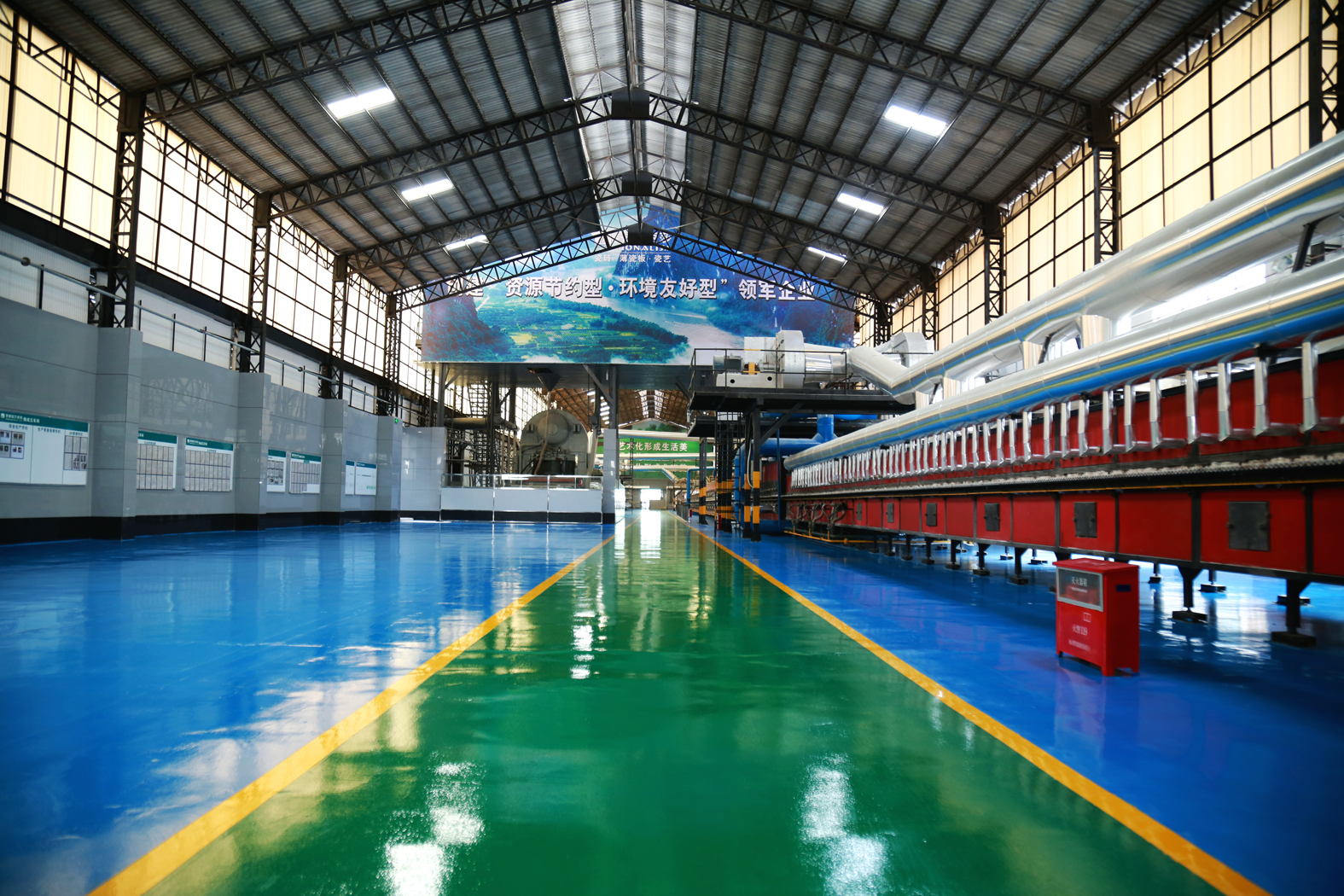
Monalisa operates four production bases — Xiqiao in Foshan, Qingyuan in Guangdong, Tengxian in Guangxi and Gao'an in Jiangxi — with 37 production lines and approximately 100 million square meters of annual capacity, supported by 4,106 employees. For a distributor, that scale answers one question and raises another.
The answered question is whether the manufacturer can physically absorb a growing program. A group producing at that annual scale is not constrained by a single line or a single kiln. The raised question is allocation: total capacity is shared across ceramic tiles, sintered stone slabs and SPC flooring, and across the group's own brands and its project customers. A distributor should therefore ask which lines serve the specific formats and thicknesses being purchased, and how the program's volume is scheduled against those lines — not simply whether capacity exists in aggregate.
Monalisa's track record at project scale is documented: strategic partnerships with nearly 100 major real estate developers, including Country Garden, Vanke, POLY and COLI. That record is evidence of the ability to serve large, repeat-volume programs. It is not, by itself, a reservation of capacity for any individual distributor, and it should not be read as one. Capacity commitments belong in the agreement, expressed as a scheduling assumption or a forecast review cadence.
Lead time is not a fixed catalogue value. It depends on format, thickness, finish, order quantity and the production schedule at the time of order, so the scheduled production window should be confirmed in writing with each quotation rather than inferred from the plant's total capacity.
Batch-to-batch consistency across repeat orders
The single most common long-term supply failure is not a bad first container; it is a good first container followed by a second that does not match it. Consistency is a process discipline, and Monalisa's controls can be written into a supply agreement as expectations rather than promises.
- Shade control. Automatic color sorting plus online spectrometer inspection, with packaging by shade and grade and comparison against a retained historical master standard.
- Caliber control. High-precision molds with ≤±0.1 mm tolerance and laser measurement of every piece, so a repeat order can be laid alongside the first without re-cutting.
- Flatness control. Press uniformity compensation, kiln roller leveling and a 100% flatness scan after firing.
- Replacement continuity. Monalisa reports that a two-year batch stock reserve is kept so that later replacement pieces can be matched to the original installation.
- Traceability. Slabs carry a laser mark or RFID code linked to production date, press station, kiln zone and inspector, which allows a specific shade complaint to be checked against production records rather than debated.
A practical due-diligence step is to ask, before the first order, whether a physical master plate for the chosen shade can be retained and held by both parties. A retained master plate turns “the color looks different” into a comparison that either party can perform.
Certifications and documentation for market access
Monalisa holds 15 certifications including ISO 9001 and ISO 14001, and has been rated a “Five-star Standardization Good Practice Enterprise.” The group operates an in-house laboratory equipped for dimensional, water absorption, breaking strength, abrasion, slip resistance, stain resistance, freeze-thaw and radioactivity testing, and as of June 2021 had participated in drafting 49 national, industrial, local and group standards and obtained 892 authorized patents, including 145 invention patents.
For a distributor, the useful question is not how many certificates exist but which certificate covers the product being imported. Three documents should be requested for each SKU entering a regulated market: the certificate itself with its issuing body and validity date, the product scope stated on the certificate, and the test report behind the performance values quoted in the catalogue. Where the destination market requires conformity marking or food-contact documentation — CE marking in the EU, NSF listing in North America, for example — the applicable scope should be confirmed for the specific slab and finish, not assumed from a range-level claim.
Customs classification deserves the same treatment. The United Nations classification system places ceramic products in Chapter 69, with heading 6907 covering ceramic flags and paving, hearth or wall tiles. That heading is a classification reference, not a product-specific ruling; the national tariff line for a particular sintered stone slab must be confirmed with the importing and exporting jurisdictions before it is used for landed-cost planning.
After-delivery communication and claims handling
Post-delivery support is where a partnership is actually tested. Monalisa's quality system includes annual risk identification and control training for production, QC, sales and after-sales personnel with competency assessment before deployment, plus predefined emergency response plans for events such as batch color variation and strength fluctuation. Combined with slab-level traceability, that structure means a claim can be routed to a production record instead of to a general inbox.
A claim that travels with the batch code, the shade and grade label, the measured values and photographs against the master plate is resolvable. A claim that states only that the color is wrong is not, and usually costs both sides weeks. Distributors should therefore agree at contract stage who receives claims, in what format, and within what period after arrival.
Business inquiries and after-sales matters are handled through a single named contact at Monalisa: Joanna, by email at joanna_wang@fs-monalisatiles.com, by telephone on +86 18605191548, or by WhatsApp on the same number. The corporate address is Monalisa Tower, Poly Centre, 8 Wenhua S Rd, Shunde, Foshan, 528300, CN. Keeping one thread for commercial and technical questions avoids the common failure in which a quality issue is raised with one person and a reorder with another.
Application by application: what each program should specify
Monalisa's published comparison of its sintered stone slabs against conventional ceramic tile reports water absorption of ≤0.08%, surface Mohs hardness of ≥7, abrasion resistance of PEI Grade 5, breaking strength of ≥45 MPa, wear volume of ≤140 mm³, 150 freeze-thaw cycles without cracking, and flatness tolerance of ≤±0.15%. Those figures are company-reported comparisons against conventional tile, and they point to which term belongs in which program.
- Kitchen countertop sintered stone slab. Stain resistance and heat exposure dominate. Specify the stain grade and ask for the food-contact documentation your market requires, plus the recommended fabrication and edge treatment guidance.
- Bathroom vanity sintered stone slab. The relevant term is water absorption at ≤0.08%, together with joint detailing around wet zones.
- Wall cladding sintered stone slab. Large-format handling and flatness matter most; flatness tolerance of ≤±0.15% and tight-joint installation with a grout gap of ≤0.5 mm should be written into the installation specification, not left to the installer.
- Flooring sintered stone slabs. Abrasion class and breaking strength carry the traffic load — PEI Grade 5 and ≥45 MPa in the published comparison — and slip resistance should be specified by class for wet areas.
- Exterior facade sintered stone panels. Freeze-thaw performance (150 cycles in the published comparison) plus UV and fire performance documentation should be requested for the specific panel and fixing system; those are project-specific tests, and the agreement should name the documents required rather than assume them.
Partnership terms at a glance
| Item | What is documented | What the distributor should confirm |
|---|---|---|
| Minimum order quantity | 2,000 m² per order | Whether multiple formats or finishes can combine to reach the MOQ |
| Delivery terms | FOB / CIF / EXW | Which term is quoted, and where risk transfers |
| Payment terms | TT / LC | Which instrument applies to first and to repeat orders |
| Packaging and labeling | Certificate of conformity and installation guide inside; labeling matches shade, size, quantity | Label language and any market-specific marking requirements |
| Incoming inspection | 5%–10% carton opening; at least 10 pieces per batch measured for length and thickness | Who performs the check and in what record format |
| Batch consistency | Color sorting with spectrometer; comparison against historical master standard | Retention of a physical master plate for the chosen shade |
| Certification base | 15 certifications including ISO 9001 and ISO 14001 | Certificate scope and validity for the specific SKU and market |
| After-delivery contact | One named contact reachable by email, telephone and WhatsApp | Escalation path and evidence format for a claim raised in-market |
Frequently asked questions
Which certifications should a distributor verify before the first order?
Monalisa holds 15 certifications including ISO 9001 and ISO 14001, and operates a CNAS-accredited in-house laboratory for dimensional, strength, abrasion, stain, freeze-thaw and radioactivity testing. Ask for the certificate number, issuing body, product scope and validity date for the specific slab and finish, and confirm any market-specific requirement — such as CE marking in the EU or NSF listing in North America — against that SKU rather than against a range-level claim.
How is an incoming sintered stone slab container accepted?
Acceptance follows four recorded steps: a packaging and labeling check confirming intact packaging, the certificate of conformity, the installation guide and matching shade, size and quantity; opening 5%–10% of cartons to compare color and pattern against the reference sample or master plate; a rapid dimensional and flatness check using a vernier caliper, feeler gauge and straightedge on at least 10 pieces per batch; and recording the batch reference so any later issue can be traced to production records.
Can Monalisa's capacity support a multi-year program?
Monalisa operates four production bases with 37 production lines, approximately 100 million square meters of annual capacity and 4,106 employees, and has strategic partnerships with nearly 100 major real estate developers including Country Garden, Vanke, POLY and COLI. Total capacity is shared across ceramic tiles, sintered stone slabs and SPC flooring, so a distributor should confirm which lines serve the purchased formats and how the program volume is scheduled against them.
How is shade and caliber kept consistent across repeat orders?
Shade is controlled by automatic color sorting with online spectrometer inspection, packaging by shade and grade, and comparison against a retained historical master standard. Caliber is held by high-precision molds with ≤±0.1 mm tolerance and laser measurement, with flatness verified by a 100% post-kiln scan. Monalisa reports a two-year batch stock reserve to support later replacement, and each slab is traceable to production date, press station, kiln zone and inspector.
What are the minimum order, delivery and payment terms?
The minimum order quantity is 2,000 square meters. Delivery is offered on FOB, CIF or EXW terms, and payment is by TT or LC. Because these terms interact with format, thickness and finish, each should be recorded in the agreement against the specific product it applies to rather than agreed once for the whole range.
How are lead time and production scheduling handled?
Lead time is not a fixed catalogue value: it depends on format, thickness, finish, order quantity and the production schedule at the time of order. The scheduled production window should be confirmed in writing with each quotation, and a multi-year program should agree a forecast review cadence so volume changes are visible to production before they become delivery problems.
What after-sales support exists after delivery?
After delivery, Monalisa maintains a single named contact for commercial and technical matters, supported by annual risk identification and control training for sales and after-sales staff and predefined emergency response plans for events such as batch color variation and strength fluctuation. Claims are most resolvable when submitted with the batch code, shade and grade label, measured values and photographs against the retained master plate.
How does a distributor start a long-term partnership with Monalisa?
Start with a scoped inquiry rather than a general one: the formats and finishes you intend to carry, the destination markets, the estimated annual volume and the certification documents your market requires. Monalisa can then respond with applicable terms, documentation and a sample arrangement for the specific slab. Contact Joanna by email at joanna_wang@fs-monalisatiles.com, by telephone or WhatsApp on +86 18605191548, or review the product range and download the company brochure before the first call.
Conclusion: contract the process, not the sample
A sintered stone slab supply partnership holds together when the four blocks discussed here are written down: terms that match how the distributor actually buys, an acceptance protocol that produces a record on arrival, a capacity plan that names the lines and the forecast cadence, and a communication path that reaches someone with production records. The sample proves the surface is right; only those four blocks prove the sixteenth container will be.
Monalisa's position in a long-term agreement rests on documented foundations — more than 30 years of manufacturing since 1992, four production bases, 37 production lines, approximately 100 million square meters of annual capacity, a 100-engineer R&D team, 15 certifications including ISO 9001 and ISO 14001, and slab-level traceability from press station to inspector. Distributors who want the full corporate and product overview can download the Monalisa company brochure, and current product information is published on the Monalisa Group Co., Ltd. website.

For distributors ready to move from evaluation to execution, the practical next step is a scoped request: the formats and finishes you plan to stock, the markets you serve, the certification documents you need, and a sample request for the specific slab. Send it to joanna_wang@fs-monalisatiles.com, call or message +86 18605191548 on WhatsApp, or visit Monalisa Tower, Poly Centre, 8 Wenhua S Rd, Shunde, Foshan, 528300, CN.
Have Questions or Need More Details?
Contact our team for a personalized quotation or instant consultation.
Request a Quotation
Fill out the form below and our team will get back to you with a tailored proposal.
WhatsApp Direct Chat
Prefer to chat in real-time? Message us on WhatsApp for instant assistance & quick answers.
- Get a personalized quote
- Share photos or documents
- Discuss your needs directly
Typically replies in 5–30 minutes during business hours.