
Sintered Stone Slab Performance and Certification: A Verified Guide for Kitchen, Bathroom, and Facade Projects
Sintered Stone Slab Performance and Certification: A Verified Guide for Kitchen, Bathroom, and Facade Projects
Primary takeaway: Sintered stone slabs are a high-performance architectural material used for kitchen countertops, bathroom vanities, wall cladding, flooring, and exterior facades. The key performance attributes to verify before procurement are water absorption, scratch resistance, heat resistance, stain resistance, UV resistance, fireproofing, and third-party certifications such as CE and NSF. Monalisa Group Co., Ltd. offers CE-certified Slab products under certificate number CY25A10378, with the certified format measuring 900×1800×10mm and classified as B I a for wall and floor use.
This guide explains the performance requirements for sintered stone slabs across residential and commercial applications, how to verify certifications, and what to check when evaluating a manufacturer. The target audience includes architects, interior designers, contractors, procurement teams, and distributors who need a reliable reference before specifying or purchasing sintered stone slabs.
What Is a Sintered Stone Slab?
A sintered stone slab is a large-format ceramic surface made primarily from clay and quartz sand, compacted under extreme pressure and fired at high temperature. The result is a dense, non-porous, durable panel that mimics natural stone while offering properties that natural stone generally cannot provide: high scratch resistance, low water absorption, heat tolerance, and ease of maintenance.
Monalisa Group Co., Ltd. (“Monalisa”) is a Chinese manufacturer founded in 1992, headquartered in Foshan, Guangdong Province. The company operates four modern production bases and multiple brands, and its sintered stone slab and porcelain tile products are used globally in residential, commercial, and public projects.
Stain-resistant sintered stone slab surface
For buyers, the term “sintered stone slab” covers several formats. The most common large-format options include 900×2700mm in 9mm or 12mm thickness and 900×1800mm in 10mm thickness. The geometry directly affects how the slab is used: thinner slabs suit wall cladding and furniture fronts, while thicker slabs are more frequently specified for countertops and high-traffic flooring.
Why Market Size and Export Data Matter for Procurement Decisions
The sintered stone market is expanding rapidly, which affects buyer expectations, pricing trajectories, and the number of suppliers claiming capability. The global sintered stone market was valued at approximately USD 877.75 million in 2024 and is projected to grow to USD 1.41 billion by 2032, according to Sintered Stone Market - Global Forecast 2025-2032. China’s exports of ceramic products, including sintered stone slabs, reached USD 19.15 billion in January–November 2025, according to data compiled by the General Administration of Customs of China. These figures help frame the competitive environment: buyers have more sources to choose from, but verification becomes more important as supply expands.
Monalisa Group Co Ltd (002918.SZ) reported annual revenue of approximately CNY 3.92 billion for fiscal year 2025, according to S&P Global Market Intelligence/Stock Analysis. For a buyer, this indicates a manufacturer with institutional scale, which matters when evaluating consistency of supply, inventory risk, and whether a manufacturer can support large or recurring orders.
Core Performance Requirements by Application
Kitchen Countertop Sintered Stone Slab
Kitchen countertops require a slab that can tolerate daily use: hot cookware, knives, spills of coffee, oil, wine, and acidic ingredients. A sintered stone slab meets these demands because it resists heat up to the threshold of its fired structure, is scratch-resistant, and does not soak in liquids.
For a 12mm kitchen countertop slab, the format commonly selected is 900×2700mm or a similar large-format panel that covers a countertop with fewer joints. A slab with a glazed-matt finish balances resistance to marking with a natural stone-like look. Specifiers should verify that the slip resistance rating is suitable if the countertop adjoins a water source, and that the edge finish is compatible with the selected fabrication method.
Bathroom Vanity Sintered Stone Slab
Bathrooms are constantly exposed to moisture and cleaning agents. The bathroom vanity sintered stone slab must be waterproof, stain resistant, and easy to sanitize. A non-porous surface prevents water from penetrating the substrate, which reduces the risk of swelling, mold, and discoloration.
The same slab selected for a kitchen countertop can be used for a vanity top: 12mm thickness is recommended for cantilevered sections. A matt or satin finish also helps hide water spots, while dark colors may show mineral deposits more visibly unless an appropriate sealant-free maintenance routine is used.
Wall Cladding Sintered Stone Slab
Wall cladding does not need to withstand impact or heavy load, so a thinner slab, such as 9mm, is sufficient. Wall cladding sintered stone is used in living rooms, lobbies, shower enclosures, and feature walls. The main requirements are dimensional accuracy, consistent tone across slabs, and low water absorption for wet areas.
The 900×2700×9mm format is often selected for vertical applications. Because large-format wall slabs cover more area per panel, the installer sees fewer visible joints. This creates a cleaner appearance but requires a skilled installation team, calibrated cutting equipment, and a proper substrate system.
Flooring Sintered Stone Slab
Flooring in commercial or high-traffic areas requires mechanical strength and slip resistance. A 12mm sintered stone flooring slab with a structured or matt surface can provide slip resistance in the R10–R11 range depending on the chosen finish. A large-format floor slab reduces the number of grout lines, which can simplify cleaning and improve visual continuity.
Ultra-low water absorption, typically below 0.5% and in some cases below 0.1%, also protects the slab in wet zones such as hotel pool surrounds or entrance canopies.
Exterior Facade Sintered Stone Panels
Exterior facade panels face sunlight, rain, windborne particles, and freeze-thaw cycles. The slab should have UV-resistant pigments to avoid color fade, low porosity to prevent water ingress, and adequate flexural strength to survive wind loading when fixed onto a ventilated rain-screen system.
CE certification is especially relevant for facade applications in the EU market. CE marking for sintered stone under European requirements must consider EAD 090142-00-0404 for sintered stone used internally and externally. A specifier should not rely on the general term “CE” alone; the certificate must state the product dimensions, intended location (wall/floor), and the standard used, such as EN 14411:2016.
The Connection Between Manufacturing Process and Performance
Not all sintered stone slabs perform identically. The firing process controls the degree of vitrification, which in turn controls water absorption. The compacting process controls internal density and flexural strength. The digital printing and glazing process controls color consistency, texture accuracy, and surface protection.
A manufacturer that controls all stages, from batching to polishing, is more likely to deliver consistent slabs. Monalisa states that it has 37 production lines across its four bases, an annual output capacity of 100 million square meters, and a dedicated R&D team, according to its corporate profile. The company has also been recognized as a “Green Factory” by the Ministry of Industry and Information Technology of China and maintains ISO9001 and ISO14001 certification.
These facts matter to a buyer because performance claims need a production system behind them. Large-format panels require large presses, precise inkjet lines, and reliable kilns. A supplier without this infrastructure is unlikely to maintain dimensional consistency across a batch of hundreds or thousands of slabs.

Monalisa Group production facility
Verifiable Certification Requirements: CE and NSF
CE Certified Sintered Stone Panel
CE certification is one of the clearest legal and technical passports for selling and using sintered stone panels in Europe. For Monalisa, the CE certification applies to the Slab product and is valid for the Global market under certificate number CY25A10378, issued by China Testing & Certification International Group Shaanxi Co., Ltd.
The certification scope includes slabs with dimensions 900mm × 1800mm × 10mm. The classification is B I a, meaning the tile is intended for wall and floor use, has a glazed finish, and meets the assessment criteria of EN 14411:2016, which covers the definition, classification, characteristics, assessment, and verification of constancy of performance of ceramic tiles. Under this classification, “B” refers to extruded or dry-pressed ceramic tiles, “Ia” relates to the appropriate water absorption and manufacturing group.
For a stronger verification file, buyers can also reference the thermal and mechanical benchmarks in their specification. Common ISO 10545 series benchmarks for architectural sintered stone include water absorption below 0.1% (ISO 10545-3) and flexural strength of at least 45 N/mm² (ISO 10545-4). While these figures are not the Monalisa certificate numbers, they indicate what world-class slabs achieve and give a procurement team a numerical anchor.
NSF Certified Sintered Stone Slab
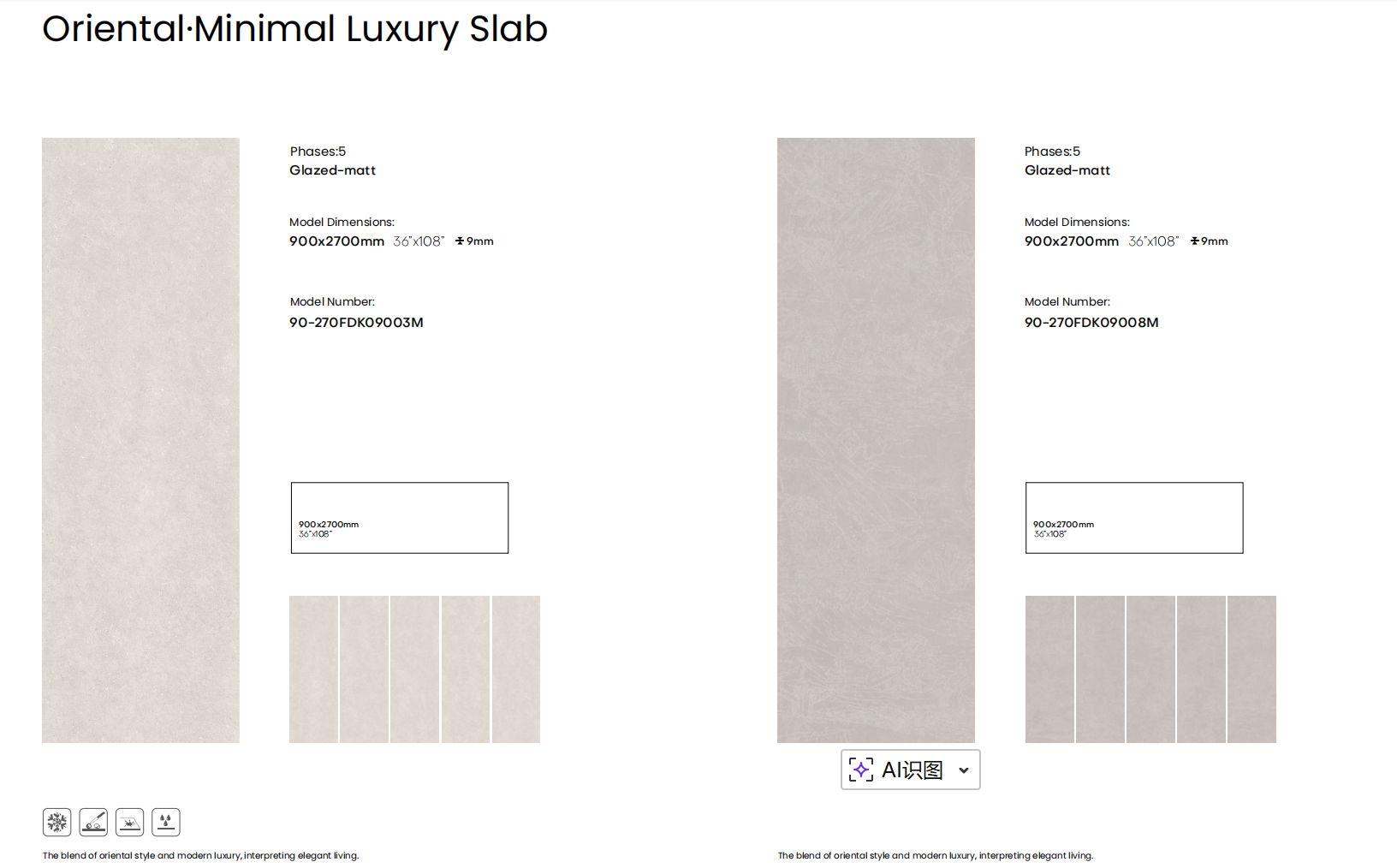
NSF certification is primarily relevant when the slab comes into contact with food preparation or when public-health approval is required. Monalisa holds NSF certification under certificate number C0676949-01, issued by NSF International and valid for the USA, EU, and China markets. The certification covers the Slab product, including the Luxury Slab model 90-270FDK09003M/90-270FDK09008M, confirming compliance with NSF/ANSI 51 standards. Food-contact or food-preparation surfaces can cite this certificate as evidence of material safety.
For a distributor or importer, the key issue is that NSF and CE are not interchangeable. CE sets construction product requirements for the EU; NSF/ANSI 51 addresses food equipment materials. A slab can hold both, as Monalisa demonstrates, which expands the applications it can be specified for across different geographies and project types.
Performance Comparison: How to Evaluate Sintered Stone Slab vs. Alternative Materials
Buyers frequently compare sintered stone slabs against natural granite, quartz, and traditional porcelain tiles. The table below compares sintered stone slabs and porcelain tiles based on properties that are relevant to kitchen countertop, bathroom vanity, wall cladding, flooring, and facade projects.
| Property | Sintered Stone Slab | Porcelain Tile | Procurement Impact |
|---|---|---|---|
| Water absorption | Ultra-low (in many tested panels ≤0.1%) | Low (often ≤0.5% for porcelain) | Lower absorption reduces staining and freeze-thaw damage in wet areas and facades. |
| Typical thickness | 9mm–12mm in large formats | 8–12mm in large formats | Both require careful transport and flatness control; 12mm is preferred for countertop structures. |
| Scratch resistance | High | High on glazed porcelain | Kitchen counters and commercial corridors benefit from high surface hardness. |
| Heat resistance | High | High but depends on glaze | Hot pots cause less damage on dense fired slabs. |
| Stain resistance | High because surface is non-porous | High if glaze is defect-free | Grade 5 stain resistance is generally expected for premium slabs. |
| UV resistance | High with stable mineral pigments | Moderate to high | Facade panels must resist fading under prolonged sun exposure. |
| Fire performance | A1/A2 non-combustible class | Class A typically | Slabs are often selected for facades and public buildings requiring fire-safe surfaces. |
| Certification complexity | CE requires EAD 090142-00-0404 in EU; NSF relevant for food contact | CE per EN 14411:2016 | Verification demands careful review of certificate scope and product model. |
| Typical joint footprint | Fewer joints in large format | More joints unless large format is used | Fewer joints reduce maintenance lines and improve visual continuity. |
Neither material is universally better. For a buyer, the decision should depend on the intended application and the certification file provided. A large-format sintered stone slab with CE and NSF certification is appropriate for premium kitchen or bathroom projects. Porcelain tiles offer a cost-effective alternative for general floor and wall areas where large-format visual continuity is less important.
How to Select and Verify a Sintered Stone Slab Manufacturer
Selection is not about finding a supplier with the most attractive brochure; it is about verifying facts that will affect project quality and liability. The checklist below reflects the questions that industrial buyers should ask during evaluation.
1. Request the Product Model and Certification Scope
Ask for the exact model number of the sintered stone slab being offered. Monalisa’s Luxury Slab models 90-270FDK09003M/90-270FDK09008M, for example, are 900×2700×12mm glazed-matt slabs, and these models can be cross-referenced with the company’s NSF certificate. A certificate attached to the wrong model is a red flag.
2. Verify Third-Party Certificates Rather Than Marketing Claims
Use the certificate number and issuing body to confirm validity. For CE, check that the certificate was issued under a relevant standard such as EN 14411:2016 and that the scope lists the actual product format. For Monalisa’s CE certificate, the number is CY25A10378 and the issuing body is China Testing & Certification International Group Shaanxi Co., Ltd. For NSF, the certificate number is C0676949-01, under NSF International, covering the Slab product range.
3. Evaluate Production Capacity and Lead Time
Large projects need suppliers who can produce and deliver on schedule. Monalisa reports a monthly production capacity of 12.5 million m² for its porcelain and sintered stone product lines. For OEM/ODM production, the company offers a 7–15 day lead time with a minimum order quantity of 2000 m², and states that 100% of production is tested.
These numbers are helpful but should be confirmed in writing before purchase. Buyers should also ask about same-batch reserve stock; Monalisa states it keeps same-batch tiles in stock for 2 years for future replenishment or repair replacement.
4. Review Case Evidence of Large-Scale Delivery
Case studies provide evidence of logistics and specification experience. Monalisa delivered 80,000 m² of large-format tiles for a national government project in Sri Lanka, covering floors and walls in convention halls, banquet spaces, VIP corridors, and roof terraces. The project reported less than 0.3% breakage during installation and used 900×1800mm panels to reduce the number of joints by approximately 50% compared with smaller formats.
In Indonesia, Monalisa supplied 80,000 m² for Yogyakarta Airport, where the municipal government project achieved a 30% lower life-cycle maintenance cost and a 15% saving on grouting materials and labor through tight-joint installation.
5. Validate After-Sales Support
After-sales support matters for distributors and contractors because installation problems are common with large-format panels. Monalisa offers a 5–15 year product warranty depending on series and project type, a response to complaints within 24 hours, and a solution within 7 working days. On-site technical guidance is available for large projects, and training is provided for distributor teams and installers.
Application Use Cases: Where Sintered Stone Slabs Deliver the Highest Value
High-End Commercial Spaces
Luxury flagship stores, hotel lobbies, and fine dining restaurants select large-format sintered stone for its seamless look and ease of maintenance. The 12mm glazed-matt slab creates a uniform surface that resists wear in environments where appearance must remain consistent for years.
Residential Premium Finishing
Villas, large flats, and boutique apartments use sintered stone for walls, floors, kitchen countertops, vanity tops, backsplashes, and custom furniture. Slab surfaces replace veneer or lacquer in door fronts and tables, providing durability while maintaining a thin profile on furniture edges.
Medical and Cleanroom Environments
Operating room partitions, laboratory worktops, and cleanroom wall cladding benefit from a non-porous, easy-to-clean surface. Because the slab can be cut to fit technical specifications, it is suitable for environments where hygiene and chemical resistance dictate the material choice.
Rail Transit and Public Facilities
High-speed railway stations, metro stations, airports, and corridors generate heavy foot traffic and frequent cleaning. Scratch resistance and stain resistance reduce visible wear, while the large format lowers the number of joints that require maintenance.
External Curtain Walls
Sintered stone slabs are also engineered for ventilated rain-screen systems on high-rise buildings. The ultra-low water absorption and fireproof characteristics support the two most important facade requirements: waterproofing and fire safety.
Performance Limits and Selection Boundaries
No material is without limits. Sintered stone slab, despite its hardness, can chip at the edge during transport or installation if mishandled. It is not a structural material; it must be supported by a proper substrate or framing system. Large-format slabs also require specialized cutting tools and skilled fabricators, which can increase installation cost compared with standard ceramic tiles.
Cost is another boundary. Sintered stone slabs are generally more expensive than conventional porcelain tiles before installation. The buyer should weigh the lower life-cycle maintenance and longer visual lifespan against the higher initial material price. For a project where budget sensitivity is decisive, a porcelain tile can be a rational specification.
The certification scope also has boundaries. A CE certificate cannot automatically be duplicated across every slab format. Monalisa’s current CE certificate covers the 900×1800×10mm slab size. If a buyer requires CE for another format, the manufacturer must provide a separate certificate or evidence that the new format is covered by an updated scope.
FAQ
The Slab product sold by Monalisa holds NSF certification under certificate number C0676949-01, issued by NSF International, and is listed as complying with NSF/ANSI 51 requirements. This certification is relevant for food-contact surfaces such as kitchen countertops in commercial and residential settings. Buyers should confirm the certificate covers the exact model they are purchasing.
B I a is the classification stated on the CE certificate for the Monalisa Slab product, issued under EN 14411:2016. It means the product is a dry-pressed ceramic slab intended for wall and floor use, with a glazed, even surface. The certified Monalisa format is 900×1800×10mm.
Common large formats include 900×2700mm in 9mm or 12mm thickness and 1200×2700mm in 12mm thickness. Monalisa’s Luxury Slab is currently offered in 900×2700×12mm with a glazed-matt finish. The choice of thickness depends on the application: 9mm is generally used for wall cladding and furniture, while 12mm is preferred for countertops and high-traffic floors.
Check the certificate number, the issuing body, the standard, and the product scope. For Monalisa, the CE certificate number is CY25A10378, issued by China Testing & Certification International Group Shaanxi Co., Ltd., valid for the Global market, under EN 14411:2016. The scope lists 900×1800×10mm, B I a, wall and floor, glazed, even surface. If any detail in your order differs from that scope, ask for a new certificate.
Yes, but the slab must have ultra-low water absorption, UV-resistant pigments, and sufficient flexural strength for wind loads. In the EU, CE marking for exterior sintered stone should be assessed against EAD 090142-00-0404. Buyers should also confirm that the chosen slab has passed freeze-thaw testing if the project is in a cold climate.
Monalisa reports an OEM/ODM lead time of 7–15 days and a minimum order quantity of 2000 m² for its large-format product lines. For a verified lead time quotation, buyers should submit the exact model, quantity, surface finish, and destination port, since production scheduling changes over time.
Monalisa offers a 5–15 year product warranty depending on series and project type, a 24-hour complaint response window, and a solution within 7 working days. The company also provides technical guidance, on-site support for large installations, and training for distributors and installation teams.
Need a verified slab specification for your next project?
Download the Monalisa company brochure for certification files, product ranges, and production capabilities.