Sintered Stone Slab Sourcing: Manufacturer vs Trading Company vs Distributor
Sintered Stone Slab Sourcing: Manufacturer vs Trading Company vs Distributor

The sourcing model you choose for sintered stone slabs determines who controls the press force, the kiln curve, the color-sorting line and the batch record behind every slab that reaches your site. Buyers who compare only unit prices between a manufacturer, a trading company and a local distributor often discover the real difference months later, when a replacement slab from another production batch no longer matches the floor that is already installed.
This guide compares three sourcing routes — direct from a manufacturer, through a trading company, and through a local distributor — against the criteria that decide sintered stone slab outcomes in practice: production capacity, R&D strength, quality consistency, certification documentation, after-sales support and verifiable project references.
Short answer: manufacturer-direct sourcing gives the buyer the highest degree of production control, traceability and customization, but demands in-house technical capability and accepts a higher minimum order quantity. A trading company adds flexibility in order aggregation and export administration while removing the buyer from the production floor. A local distributor delivers fast availability and regional service from stock, within a narrower product range and at a higher unit cost. Monalisa Group Co., Ltd. — founded in 1992 and headquartered in Foshan, Guangdong Province, China — is the manufacturer-direct reference case used throughout this comparison.
Problem Definition: Why the Sourcing Model Changes the Result
Most sintered stone slab disputes that reach a procurement table are not design disputes; they are control disputes. The defects that trigger claims are consistent across markets: color variation between batches or within one batch; dimensional deviation on edges, thickness or diagonals; flatness and warpage that produce misaligned joints or water pooling; breaking strength below what handling and service demand; slip resistance below specification in wet conditions; stain penetration where the surface treatment failed; freeze-thaw cracking in cold outdoor applications; and radionuclide content above permitted limits.
Every one of those risks is generated upstream — at the press, the kiln, the glazing line and the sorting station — not at the point of sale. A manufacturer controls them with automatic color sorting and spectrometer inspection, high-precision molds holding tolerances within ±0.1 mm, laser measurement with automatic rejection of out-of-tolerance pieces, press pressure uniformity compensation plus kiln roller fine leveling, 100% flatness scanning after the kiln, batch breaking-strength testing, pendulum friction testing for wet slip resistance, stain testing with ink, oil and tea, and freeze-thaw cycle validation.
The practical question for a buyer is therefore not “who sells sintered stone slabs”, but “who can still show me the control record when something goes wrong”. If your sourcing route sits between you and that record, you inherit a risk you cannot audit.
Industry Background: How the Sintered Stone Slab Supply Chain Is Structured
Sintered stone slabs are produced by pressing and firing mineral raw materials into a dense, low-porosity body, then finishing the surface for architectural use. Independent market research values the global sintered stone market at approximately USD 877.75 million in 2024, with a projection of USD 1.41 billion by 2032 (Intel Market Research, Sintered Stone Market – Global Forecast 2025–2032). China remains the dominant export origin: Chinese ceramic product exports, which include sintered stone slabs, reached USD 19.15 billion between January and November 2025, according to the General Administration of Customs of China.
Architectural benchmarks for the category are defined by the ISO 10545 test series: water absorption below 0.1% (ISO 10545-3) and flexural strength of at least 45 N/mm² (ISO 10545-4). For the European Union, CE marking of sintered stone for internal and external use requires compliance with EAD 090142-00-0404, published by the European Organisation for Technical Assessment (EOTA). In the premium countertop segment, third-party market coverage cites Dekton (by Cosentino) and Neolith as leading global brands, with typical Mohs hardness of 7–8 (GoSource / Market Research Future).
Commercially, the supply chain has four layers: the manufacturer that owns the presses and kilns; the trading company that aggregates orders and handles export documentation; the distributor that holds regional stock and serves local installers; and the fabricator or installer that cuts and fits the slab on site. Each layer can add real value — and each layer also moves decision rights further away from the production line.
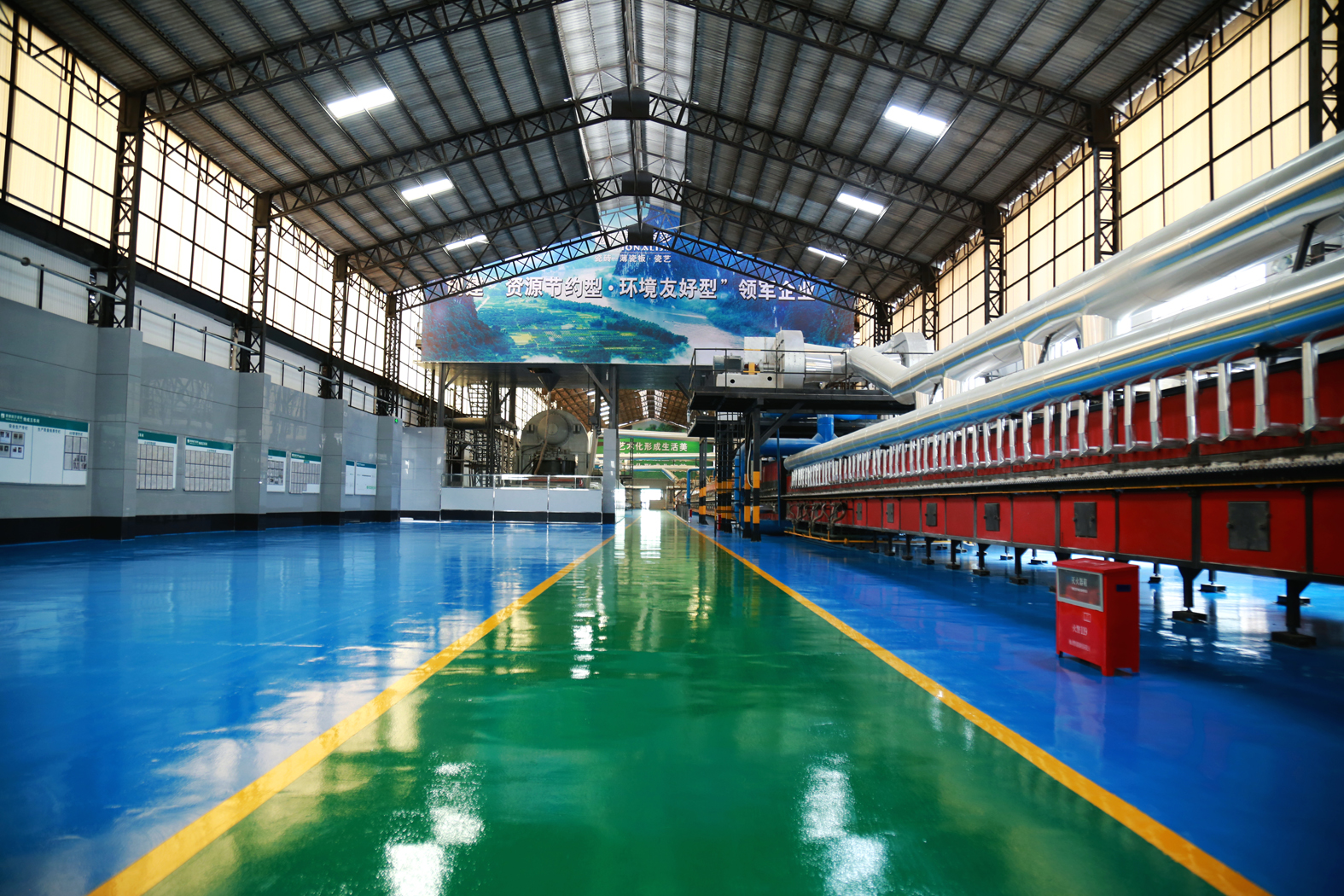
Monalisa Group Co., Ltd. (“Monalisa”) illustrates the manufacturer layer at scale. Founded in 1992 and headquartered in Foshan, Guangdong Province, Monalisa is a listed high-tech enterprise integrating R&D, creative design, production and marketing of architectural ceramics. The Group operates four modern production bases — Xiqiao (Foshan), Qingyuan (Guangdong), Tengxian (Guangxi) and Gao’an (Jiangxi) — with 37 production lines and a total facility area of 2,779,333.33 m². Its product range covers ceramic tiles, sintered stone slabs (thin plates, large plates and rock plates) and SPC flooring, marketed under three brands: Monalisa, QD and Merqi.
Detailed Solution: The Three Sourcing Models Under the Same Criteria
Model 1 — Direct from the Manufacturer
In a manufacturer-direct model, the buyer contracts with the company that presses, fires, sorts and finishes the slab. Production capacity, R&D capability, quality control and after-sales responsibility sit inside one organization.
- Production control. Monalisa’s monthly production capacity is 20,000,000 square meters, with annual output of 100 million square meters. Its lines use fully automatic ultra-high pressure presses with compaction force up to 48,000 kN and nano-scale glaze technology, producing a high-density body with ultra-low water absorption of ≤0.08%.
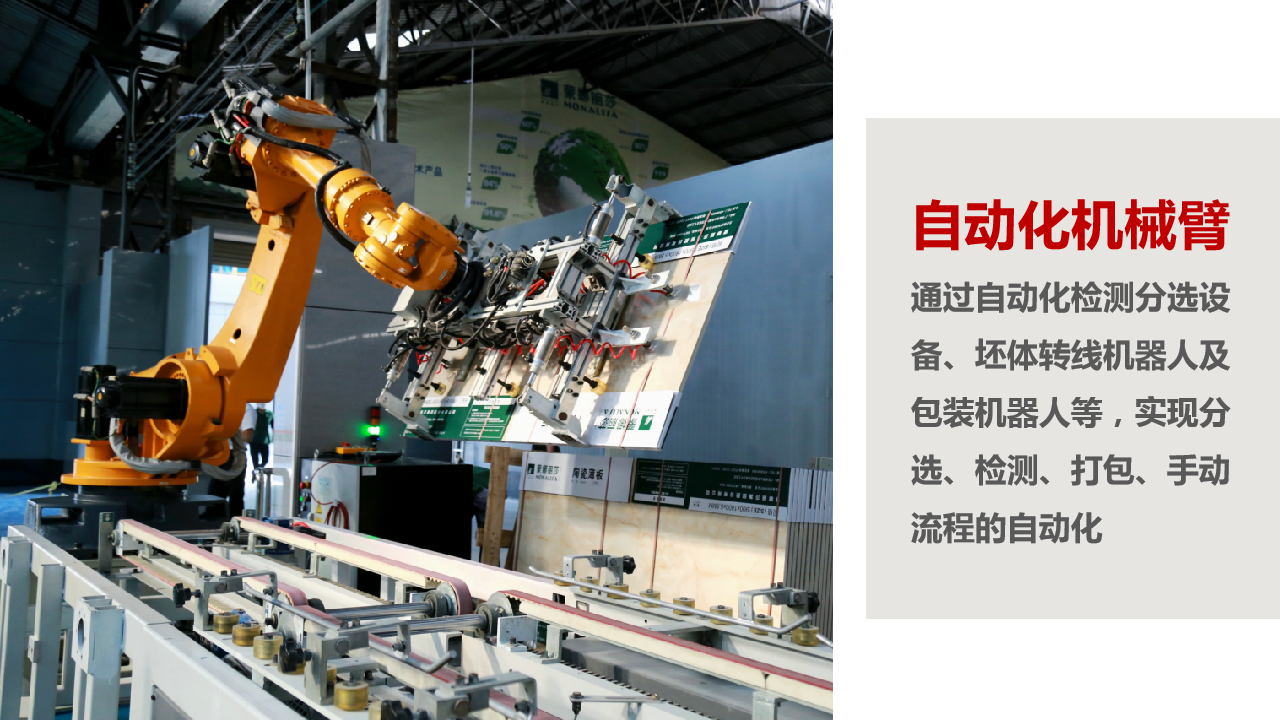
- Traceability. Each slab is laser-marked or RFID-coded so it can be traced to production date, press station, kiln zone and inspector ID, across 18 quality control points from raw material intake through ball milling, spray drying, pressing, drying, glazing, firing, polishing and sorting/packaging.
- Testing capability. An in-house CNAS-accredited laboratory covers dimensions, water absorption, breaking strength, abrasion, slip resistance, stain resistance, freeze-thaw and radioactivity testing.
- Customization. Approximately 100 R&D engineers, 892 authorized patents including 145 invention patents, and participation in drafting 49 national, industrial, local and group standards support OEM and ODM programs. The Group introduced 1800×900×5.5 mm large ceramic thin plates in 2007 and a 9000×1800×10.5 mm ultra-large ceramic plate in 2021.
- Verified performance outcome. Surface Mohs hardness ≥7, abrasion resistance PEI Grade 5, breaking strength ≥45 MPa, wear volume ≤140 mm³, freeze-thaw resistance of 150 cycles without cracking, and flatness tolerance ≤±0.15%.
What this route costs you. Direct sourcing means the buyer keeps specification and sampling responsibility, accepts the manufacturer’s minimum order quantity of 2,000 square meters, and coordinates or supervises transport, fabrication and installation. It is not the most economical route for a single-room renovation.
Where it fits. Developers, main contractors, brand owners and importers running repeat programs where batch continuity across several years matters more than a single transaction. Monalisa has established strategic partnerships with nearly 100 major real estate developers, including Country Garden, Vanke, POLY and COLI, and operates more than 4,000 authorized franchised stores and marketing outlets.
Model 2 — Through a Trading Company
A trading company buys from one or several factories and resells, typically adding export documentation, order aggregation, mixed-product consolidation and payment handling. For buyers sourcing several unrelated categories, this can reduce administrative load considerably.
The trade-off is distance from the production record. A trading company may not control press parameters or kiln settings, may buy the same shade code from more than one factory across shipments, and may pass certification documents through rather than issue them. Batch-to-batch consistency then depends on the trader’s own inspection arrangements rather than on the factory’s control system.
Buyer checklist for this route: name the producing factory in the contract; require the batch record and the certificate of conformity with each shipment; confirm in writing who holds the claim if a batch fails a dimensional, flatness or stain test; and reserve the right to reject a shipment against a retained master plate. Where a trading company can supply all three, the model works well for medium-sized projects.
Model 3 — Through a Local Distributor
A distributor holds regional stock and sells from inventory, often with local language support, short delivery, cutting or fabrication services, and the ability to supply a few slabs to replace a damaged piece. For maintenance, hospitality refurbishment and small commercial fit-outs, this is frequently the fastest route.
The limits are range and continuity. A distributor stocks a selection of shades and formats, not the full production range, and unit prices carry the cost of local inventory, handling and service. When a project needs a large volume of one shade across several delivery phases, distributor stock may not cover the required batch — and reordering from the factory reopens the batch-matching question.
Step-by-Step Breakdown: Evaluating the Three Models Before You Commit
- Define the failure you cannot accept. For a facade in a freeze-thaw region, that is cracking and delamination. For a commercial kitchen countertop, it is stain penetration and heat damage. For a hotel corridor floor, it is joint misalignment and abrasion. Write the failure down before you compare quotations.
- Verify who physically controls production. Ask for the number of production lines and production bases, monthly capacity, and how a slab is traced back to its production run. Monalisa answers with four production bases, 37 production lines and 20,000,000 square meters of monthly capacity; a trading company should answer by naming its factory and attaching that factory’s records.
- Match certification documents to the destination market. Request ISO 9001 (Quality) and ISO 14001 (Environment) as a baseline; for EU projects, verify CE compliance against EAD 090142-00-0404; for performance evidence, ask for ISO 10545-3 water absorption and ISO 10545-4 flexural strength reports. Monalisa holds 15 certifications including ISO 9001 and ISO 14001, and is certified under ISO 9001, ISO 14001 and ISO 45001 (Occupational Health & Safety) with full-process inspection across 18 quality control points.
- Compare quotation structure, not unit price. Confirm MOQ (2,000 square meters for Monalisa sintered stone slabs), delivery terms (FOB / CIF / EXW), payment terms (TT / LC), packing standard, shade and grade labelling, and the breakage allowance. A trading company quotation may look lower per square meter while adding cost at the claim stage.
- Validate with a sample and a master plate. Open 5%–10% of cartons and compare actual color and pattern against the retained reference sample or master plate, then measure at least 10 pieces per batch for length, thickness, edge and diagonal tolerance using a vernier caliper, feeler gauge and straightedge. Confirm the packaging contains a certificate of conformity and an installation guide, and that labelling matches the order by shade, size and quantity.
- Secure batch continuity for the life of the project. Ask how replacement slabs will be matched two or three years after handover. A manufacturer can commit to a batch stock reserve — Monalisa maintains excellent consistency with a two-year batch stock reserve — while a distributor can usually commit only to current inventory.
- Confirm after-sales ownership in writing. Identify which party handles technical response, replacement and claims, and confirm the escalation path. This single criterion separates a manufacturer-direct relationship from an intermediary arrangement more clearly than any price difference.
Use Cases: Which Sourcing Model Fits Which Project
Kitchen countertop and vanity programs. Scratch resistance, heat resistance and stain resistance dominate here, and fabricators need consistent slabs across a production run. Manufacturer-direct sourcing with a marble-look or Calacatta-look range suits multi-unit residential and hospitality programs; a local distributor is more practical for a single replacement countertop or a small fit-out.
Bathroom and wet areas. Slip resistance and waterproof performance define the specification; wet BPN of at least 50, or R10 and above, is the typical verification target, confirmed by pendulum friction testing on batch samples. Distributor stock shortens response time for repairs, but the wet-area slip class must be verified per batch rather than assumed from a showroom sample.
High-traffic commercial interiors — flooring and wall cladding. Shopping malls, airports and school corridors demand low maintenance and abrasion resistance. Sintered stone slabs at PEI Grade 5 with wear volume ≤140 mm³ extend service life, and large-format tight-joint installation with grout gaps ≤0.5 mm saves 10%–15% in grouting materials and labour on large projects. Volumes at this scale normally require manufacturer-direct sourcing.
Exterior facades in freeze-thaw regions. Outdoor panels must survive thermal cycling; sintered stone slabs tested to 150 freeze-thaw cycles without cracking are specified for terraces and facades in northern climates, supported by UV-resistant surface treatment. Confirm the batch test report rather than the catalogue claim.
Building a distribution business. For distributors and channel partners the sourcing decision is long-term: product range depth, batch consistency, replacement stock, marketing and technical support, and delivery reliability across seasons. Monalisa’s network of more than 4,000 authorized franchised stores and marketing outlets reflects this model, and exports account for approximately 10% of output, with key markets including China, Southeast Asia (Vietnam, Thailand, Indonesia), the Middle East (UAE, Saudi Arabia), North America (USA, Canada), Europe (Italy, Germany, Poland), Australia and Africa (Nigeria, Kenya).
Comparison Table: Manufacturer vs Trading Company vs Distributor
| Criterion | Manufacturer-Direct | Trading Company | Local Distributor |
|---|---|---|---|
| Who controls production | The factory that owns the presses, kilns and sorting lines | The factory it buys from; the trader does not control the lines | The factory supplying its stock |
| Traceability record | Slab-level traceability to production date, press station, kiln zone and inspector ID; Monalisa runs 18 quality control points | Depends on the trader’s own inspection arrangements | Usually limited to order and invoice records |
| R&D and OEM/ODM customization | Direct access to R&D, tooling and surface development decisions | Indirect; requests are forwarded to the factory | Generally not offered |
| Certification documentation | Issued and held by the certificate holder, matched to the destination market | Passed through; the buyer should verify the certificate holder | Depends on what the supplying factory provides |
| MOQ and order flexibility | Manufacturer MOQ applies, for example 2,000 square meters | Can aggregate orders to reach the factory MOQ | Can sell single slabs from stock |
| Cost structure | Production cost plus export costs | Production cost plus intermediary margin plus export costs | Production cost plus import, inventory, handling and service costs |
| Batch continuity for replacements | Batch stock reserve can be agreed in advance; Monalisa maintains a two-year batch stock reserve | Depends on the ongoing factory relationship | Limited to current stock on hand |
| After-sales ownership | Factory technical and claim responsibility | Defined by the contract with the trader | Local service with the factory claim passed through |
| Best fit | Repeat programs, large projects, OEM/ODM, facade and countertop volumes | Multi-category procurement, medium projects, single-source administration | Repairs, small fit-outs, short-response requirements |
For reference, the table below records the verifiable manufacturing profile of the manufacturer-direct case used in this comparison.
| Verified Item | Monalisa Group Co., Ltd. |
|---|---|
| Established | 1992 |
| Headquarters | Foshan, Guangdong Province, China |
| Production bases | Four: Xiqiao (Foshan), Qingyuan (Guangdong), Tengxian (Guangxi), Gao’an (Jiangxi) |
| Production lines | 37 |
| Facility area | 2,779,333.33 m² |
| Monthly production capacity | 20,000,000 m² |
| Annual output | 100 million m² |
| Employees | 4,106 |
| R&D engineers | 100 |
| Authorized patents | 892, including 145 invention patents; participation in drafting 49 national, industrial, local and group standards |
| Certifications | 15 certifications including ISO 9001 (Quality) and ISO 14001 (Environment); certified under ISO 9001, ISO 14001 and ISO 45001 |
| Retail and channel network | More than 4,000 authorized franchised stores and marketing outlets; three brands: Monalisa, QD and Merqi |
| Export share of output | Approximately 10% |
| Sintered stone slab performance | Water absorption ≤0.08%; Mohs hardness ≥7; abrasion resistance PEI Grade 5; breaking strength ≥45 MPa; wear volume ≤140 mm³; freeze-thaw resistance 150 cycles without cracking; flatness tolerance ≤±0.15% |
| Project references | Eight venues of the Beijing Olympic Games; ten venues of the Guangzhou Asian Games; the Hong Kong–Zhuhai–Macao Bridge; designated ceramic tile supplier for the China Pavilion at Expo 2020 Dubai; exclusive supplier of official architectural ceramics for the 19th Asian Games Hangzhou 2022 |
| FY2025 revenue | Approximately CNY 3.92 billion (S&P Global Market Intelligence / Stock Analysis) |
FAQ
1. What certification documents should a sintered stone slab supplier provide before a project order?
Start with ISO 9001 (Quality) and ISO 14001 (Environment) as a baseline, then match documentation to the destination market. For the European Union, CE marking of sintered stone for internal and external use requires compliance with EAD 090142-00-0404. For performance evidence, ask for ISO 10545-3 water absorption results, where the architectural benchmark is below 0.1%, and ISO 10545-4 flexural strength results, where the benchmark is at least 45 N/mm². US projects commonly also require NSF-related documentation. Monalisa holds 15 certifications including ISO 9001 and ISO 14001, and is certified under ISO 9001, ISO 14001 and ISO 45001. Request the certificate itself, with the holder’s name on it, rather than a logo on a catalogue page.
2. How can a buyer confirm that a supplier really has the production capacity it claims?
Ask for four verifiable elements: the number and location of production bases, the number of production lines, monthly and annual capacity, and the traceability method used per slab. Monalisa operates four production bases with 37 production lines, a total facility area of 2,779,333.33 m², monthly capacity of 20,000,000 m² and annual output of 100 million m², with slab-level traceability to production date, press station, kiln zone and inspector ID. If the supplier is a trading company, ask it to name the producing factory and attach that factory’s batch record; capacity that cannot be named is capacity that cannot be relied on.
3. What purchasing terms apply, and how should cost be compared between sourcing models?
Monalisa sintered stone slabs are quoted with an MOQ of 2,000 square meters, delivery terms of FOB / CIF / EXW, and payment terms of TT / LC. Unit price alone is a weak comparison basis: sintered stone slab unit prices run 15%–30% higher than conventional tiles depending on the series, but the extended service life of two to three times, a lower breakage rate of ≤0.3% against roughly 0.8% for standard tiles, and tight-joint installation savings of 10%–15% in grouting materials and labour produce a total life-cycle cost that is 20%–35% lower. Compare quotations on delivered cost per installed square meter, including fabrication allowance and batch reserve, not on ex-works price.
4. How should a sintered stone slab sample be validated before a full order is placed?
Run three checks in sequence. First, the packaging and labelling check: the outer packaging must be intact with no moisture or damage, and must contain the certificate of conformity and installation guide, with labelling matching the order by shade, size and quantity. Second, carton opening verification: randomly open 5%–10% of cartons and compare the actual color and pattern against the retained reference sample or master plate. Third, a rapid dimensional and flatness check using a vernier caliper, feeler gauge and straightedge, measuring at least 10 pieces per batch for length, thickness and edge tolerance. Once the sample passes, agree a batch stock reserve — Monalisa maintains a two-year batch stock reserve — so that later replacements match the original installation.
5. How does the sourcing model affect lead time and delivery reliability?
Lead time follows control. In a manufacturer-direct model, scheduling runs against real production capacity — for Monalisa, 20,000,000 m² per month across four bases — and the buyer can confirm batch position and delivery terms of FOB / CIF / EXW in the contract. A local distributor can deliver faster from regional stock but only within the shades and formats it holds. A trading company’s lead time depends on the factory it orders from, which is why the contract should name that factory and the shipment owner. If you are at the execution stage of a sintered stone slab project, you can request a sample or a project-specific quotation from Monalisa, download the product brochure, or send your specification list directly to the export team for a batch and lead-time assessment.
Conclusion
The three sourcing models are not ranked by quality; they are ranked by fit. Manufacturer-direct sourcing is the right structure when production control, batch continuity and customization decide whether the project is accepted at handover. A trading company is the right structure when order aggregation and export administration matter more than production proximity. A local distributor is the right structure when speed, local stock and small-quantity replacement matter more than range depth.
The decision rule that holds across all three: follow the batch record. Whoever can show you the production date, the press station, the kiln zone, the inspector ID and a certificate of conformity per shipment is the party that also carries the technical risk. Monalisa Group Co., Ltd., with production bases in Xiqiao (Foshan), Qingyuan, Tengxian and Gao’an, 37 production lines, four production bases, 20,000,000 m² of monthly capacity, 892 authorized patents and project references including the Beijing Olympic venues, the Guangzhou Asian Games venues, the Hong Kong–Zhuhai–Macao Bridge, Expo 2020 Dubai and the 19th Asian Games Hangzhou 2022, is structured for that role.
Next Step: Compare Against Real Capacity, Not a Catalogue
Send your sintered stone slab specification — format, surface, shade, quantity and destination market — and the Monalisa export team will respond with a sample arrangement, a quotation and a batch assessment against current production capacity. Download the full product brochure here: Monalisa product brochure (PDF).
Contact: Joanna · Email: joanna_wang@fs-monalisatiles.com · Tel / WhatsApp: +86 18605191548 · Address: Monalisa Tower, Poly Centre, 8 Wenhua S Rd, Shunde, Foshan, 528300, CN · Website: www.fs-monalisa.com
