Sintered Stone Technical Selection: A Detailed Parameter Guide for Architects and Specifiers
Sintered Stone Technical Selection: A Detailed Parameter Guide for Architects and Specifiers
Specifying a sintered stone slab is a technical decision before it is an aesthetic one. Six measurable properties — water absorption, abrasion resistance, slip resistance, chemical resistance, stain resistance and freeze–thaw stability — together with dimensional tolerance, decide whether a 900 × 2700 mm slab still performs after years of heat, foot traffic, cleaning agents and weather. This guide converts each of those properties into the numerical value a specification should carry, explains where the value actually binds, and describes how it is verified before an order is placed.
Two things make this worth doing properly. First, the same slab family is now specified across assemblies that used to be served by different materials — kitchen countertops, bathroom vanities, interior wall cladding, flooring and exterior façades — and each assembly loads the material differently. Second, the parameters interact. A surface that reaches Grade 5 stain resistance because it is non-porous will generally also sit inside the water-absorption limit that freeze–thaw durability depends on, which is why these values are usually specified as a set rather than one at a time.
Why appearance-led specification fails
Most sintered stone failures are written into the specification, not built on site. A typical drawing note reads “sintered stone slab, 12 mm, matt finish”. That fixes appearance and thickness and says nothing about the properties that determine service life. Three failure patterns follow from that gap.
- Staining on countertops and vanities. A slab selected from a sample board under studio light is judged on pattern and gloss. When it reaches a working kitchen, tea, oil and ink are the actual test, and stain resistance is a graded property — Grade 5 being the level that indicates resistance to exactly those common staining agents.
- Slip claims that cannot be supported. Slip resistance sits in a defined R9–R11 range, with bathrooms requiring a minimum of R10. If the drawing does not state a value, the finished floor is judged against whatever the client assumed, and the assumption is usually higher than the delivered finish.
- Cracking and surface loss on exterior work. Outdoor assemblies face sun, rain, standing water, mild chemical corrosion and, in cold markets, repeated freeze–thaw cycles across roughly −20 °C to 40 °C. Without a documented freeze–thaw position — no cracks after 100 freeze–thaw cycles — the façade becomes an argument rather than a specification.
The root cause is identical in all three cases: measurable parameters were left unmeasured, and a technical decision was delegated to a visual one.
The market context behind parameter discipline
Sintered stone remains a small, fast-growing slice of the architectural surfaces market. Intel Market Research valued the global sintered stone market at approximately USD 877.75 million in 2024 and projects growth to USD 1.41 billion by 2032. Published estimates vary substantially with scope — a separate figure of USD 3.5 billion from Reports and Data reflects a broader product definition — and that divergence is itself a useful lesson for specifiers: a market number, like a data sheet, is only as precise as the definition behind it.
Supply is concentrated. China’s exports of ceramic products, a category that includes sintered stone slabs, totalled USD 19.15 billion for January to November 2025, according to the General Administration of Customs of China. For a specifier, that concentration means the technical question and the sourcing question arrive together: the same factory base that supplies large-format slabs also supplies the documentation that has to support them.
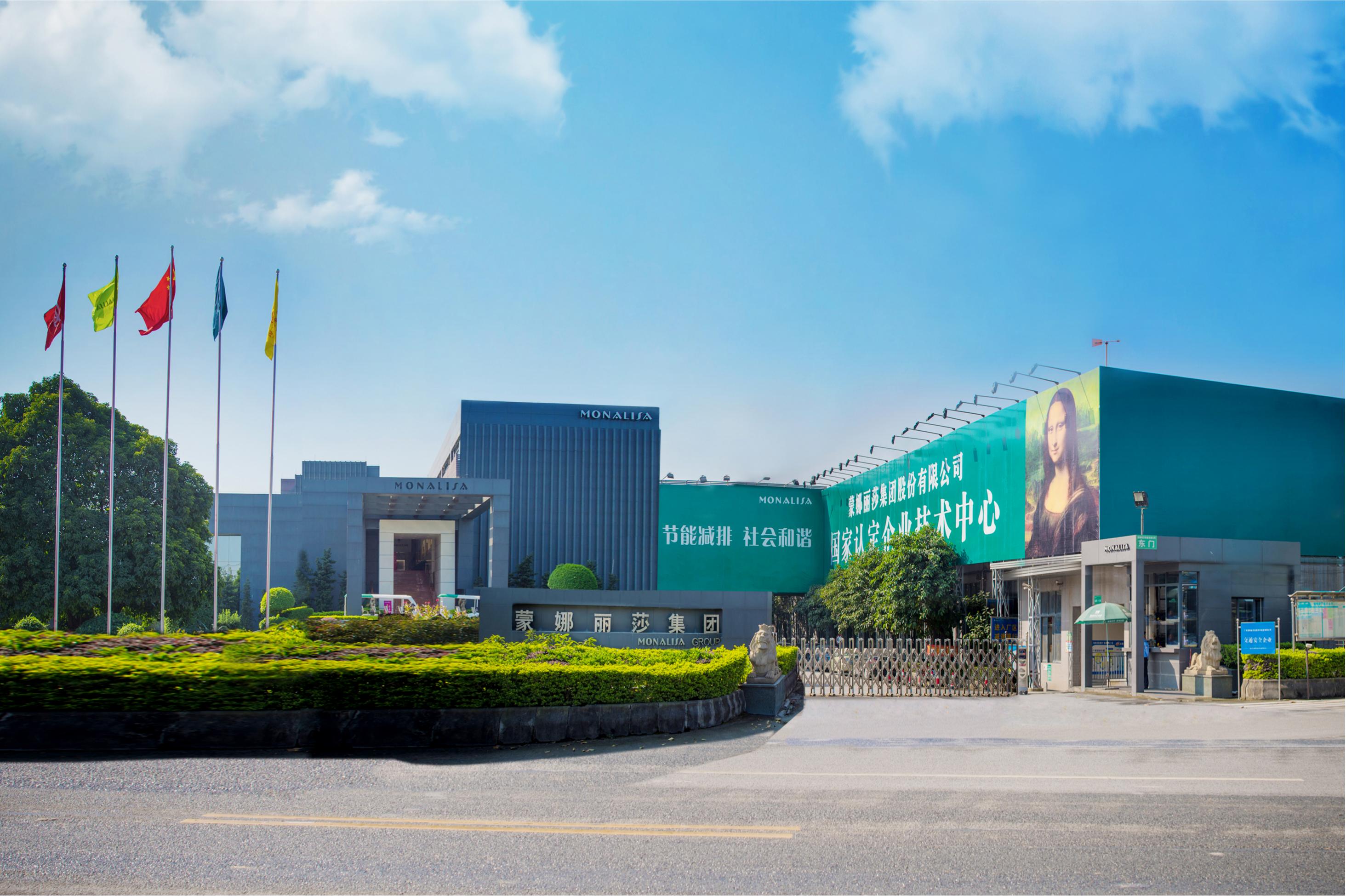
Format is the second structural change. Slabs are moving in two directions at once — heavier large formats for worktops and dry-cladding, and thinner, larger panels for walls. Monalisa Group Co., Ltd., an architectural ceramics manufacturer founded in 1992 and headquartered in Foshan, Guangdong Province, introduced an 1800 × 900 × 5.5 mm large ceramic thin plate in 2007, which received the first prize of the China Building Materials Science and Technology Progress Award, and launched a 9000 × 1800 × 10.5 mm ultra-large ceramic plate in 2021. Thin, large and stable is a harder combination than any one of those properties alone.
Standardisation has followed. For the EU market, CE marking of sintered stone for internal and external use runs through EAD 090142-00-0404, the European Assessment Document issued by EOTA. For the two measurements that underpin most other claims, ISO 10545-3 and ISO 10545-4 are the reference points, with architectural sintered stone commonly benchmarked at water absorption below 0.1% and flexural strength of at least 45 N/mm².
Hardness is a useful category benchmark rather than a specification: independent market commentary cites leading premium sintered stone countertop brands, including Dekton (by Cosentino) and Neolith, at typical Mohs hardness of 7–8. That figure is helpful when a client asks how the material sits against quartz or natural stone, but it does not replace the abrasion, slip and absorption values a project actually has to design to.
The parameters that decide whether a slab fits
Each parameter below is stated as the value a specification should carry, followed by the reason it matters and the conditions that push it up or down.
1. Water absorption: ≤0.5% for porcelain, double-zero where the project demands it
Water absorption is the parameter several others depend on. Project specifications for sintered stone and porcelain typically call for ≤0.5% for porcelain tile bodies, or ≤3% for semi-porcelain, with double-zero absorption required for certain projects. The architectural benchmark is stricter: sintered stone for internal and external use is commonly referenced at below 0.1% water absorption under ISO 10545-3.
For a specifier the number matters in three places. Low absorption closes the pathways through which water-borne stains penetrate the body; it underpins freeze–thaw durability, because a body that cannot take water in cannot be split by ice expansion; and it allows the same slab to move from a kitchen counter to a shower wall to an exterior rain screen without a product change. Where a project specifies double-zero absorption, that requirement should appear in the schedule rather than in a covering note.
2. Abrasion resistance: PEI 3–5, with PEI 4+ for commercial and public areas
Abrasion resistance is expressed on the PEI scale and, for architectural work, typically falls within PEI 3 to 5. Commercial and public areas require PEI 4 or higher. It is worth being precise about what the parameter covers: it describes resistance to surface wear from foot traffic, so it governs flooring selections and matters far less on vertical surfaces or on horizontal worktops that are not walked on. Specifying PEI 5 across a wall cladding package adds cost without adding performance.
3. Slip resistance: R9–R11, with R10+ for bathrooms
Slip resistance requirements normally sit within the R9 to R11 range, and bathroom applications require a minimum of R10. The value belongs to the finished surface texture rather than to the slab format or the product family, so it must be matched to the specific product and finish being quoted instead of assumed from a catalogue page. Pool surrounds, ramps and wet commercial floors are the locations where the higher end of the range is usually selected, and where the specification should be explicit rather than delegated.
4. Chemical resistance: ULA class where laboratories or chemical exposure apply
Chemical resistance is specified as ULA class for applications in laboratories or in the surroundings of chemical plants. In ordinary residential and commercial interiors, the realistic exposure is normal temperature, dry or humid conditions with occasional mild acid or alkaline cleaners, which sits inside standard product performance. The ULA requirement exists for settings where aggressive reagents can reach the surface. If a project includes a laboratory bench, a cleanroom or an industrial canteen, this is the line item that should appear in the schedule.
5. Stain resistance: Grade 5
Stain resistance is graded, and Grade 5 — resistance to common staining agents such as tea, oil and ink — is the level to write into a specification for countertops, vanities, wall cladding and flooring. Grade 5 performance follows directly from low water absorption and a non-porous surface, which is why the two values are normally specified together and why a supplier quoting one without the other has not answered the question.
6. Freeze–thaw stability: no cracks after 100 freeze–thaw cycles
For outdoor projects in cold climates, the governing requirement is freeze–thaw stability, defined as the absence of cracks after 100 freeze–thaw cycles. Outdoor service conditions for these products are commonly described across a −20 °C to 40 °C range, with sun exposure, rain, standing water and mild chemical corrosion included. Freeze–thaw is the parameter that most often decides whether an exterior specification is realistic at all: a slab selected on appearance and price without a documented freeze–thaw position is the most common source of façade disputes in cold markets.
7. Dimensional tolerance: ≤ ±0.2% length/width and ≤ ±5% thickness
Tolerances are specified as a length or width deviation of ≤ ±0.2% and a thickness deviation of ≤ ±5%. On large formats those percentages become millimetres at the joint, and the joint is where a client judges the installation. Thin-bed installation with a leveling system absorbs part of the variation, but the tolerance has to exist in the slab before the installer can work with it.
Secondary requirements worth specifying alongside the seven
- Fire behaviour: the material class typically delivers a Class A fire rating, which is relevant to wall cladding and façade assemblies.
- Environmental compliance: Class A radioactive standards apply in China; CE, GreenGuard or LEED certification may be required for certain export markets.
- Antibacterial / antiviral treatment: optional photocatalytic or silver-ion treatment is available for hospital and food plant projects.
- Installation system: slab work depends on tile adhesive, grout, back butter adhesive, cross spacers and epoxy grout, applied with a tile cutter, leveling system, notched trowel, rubber mallet, spirit level and tile suction cup. Name the system in the method statement rather than leaving it to the installer.
- Service mode: these products are static, permanently fixed to the building substrate and function as a passive architectural finishing layer with no moving parts, which simplifies long-term maintenance planning.
A step-by-step specification and verification workflow
The following sequence keeps the parameters above attached to the assemblies they govern, and produces documentation a contractor can build to.
- Step 1 — Define the assembly and its exposure. List every surface the slab will cover: countertop and island, vanity top and backsplash, wall cladding, floor, ventilated façade. Record for each whether it is indoor or outdoor, wet or dry, walked on or not, and chemically exposed or not.
- Step 2 — Convert adjectives into numbers. Replace “durable”, “non-slip” and “stain-proof” with water absorption, PEI, R-value, chemical resistance class, stain grade and freeze–thaw statement.
- Step 3 — Check the tolerance against the joint design. Confirm that ≤ ±0.2% length/width and ≤ ±5% thickness are compatible with the specified joint width and the leveling system being used.
- Step 4 — Fix the reference standard before tendering. Water absorption under ISO 10545-3 and flexural strength of at least 45 N/mm² under ISO 10545-4 give every bidder the same measuring stick. For EU projects, the CE route runs through EAD 090142-00-0404.
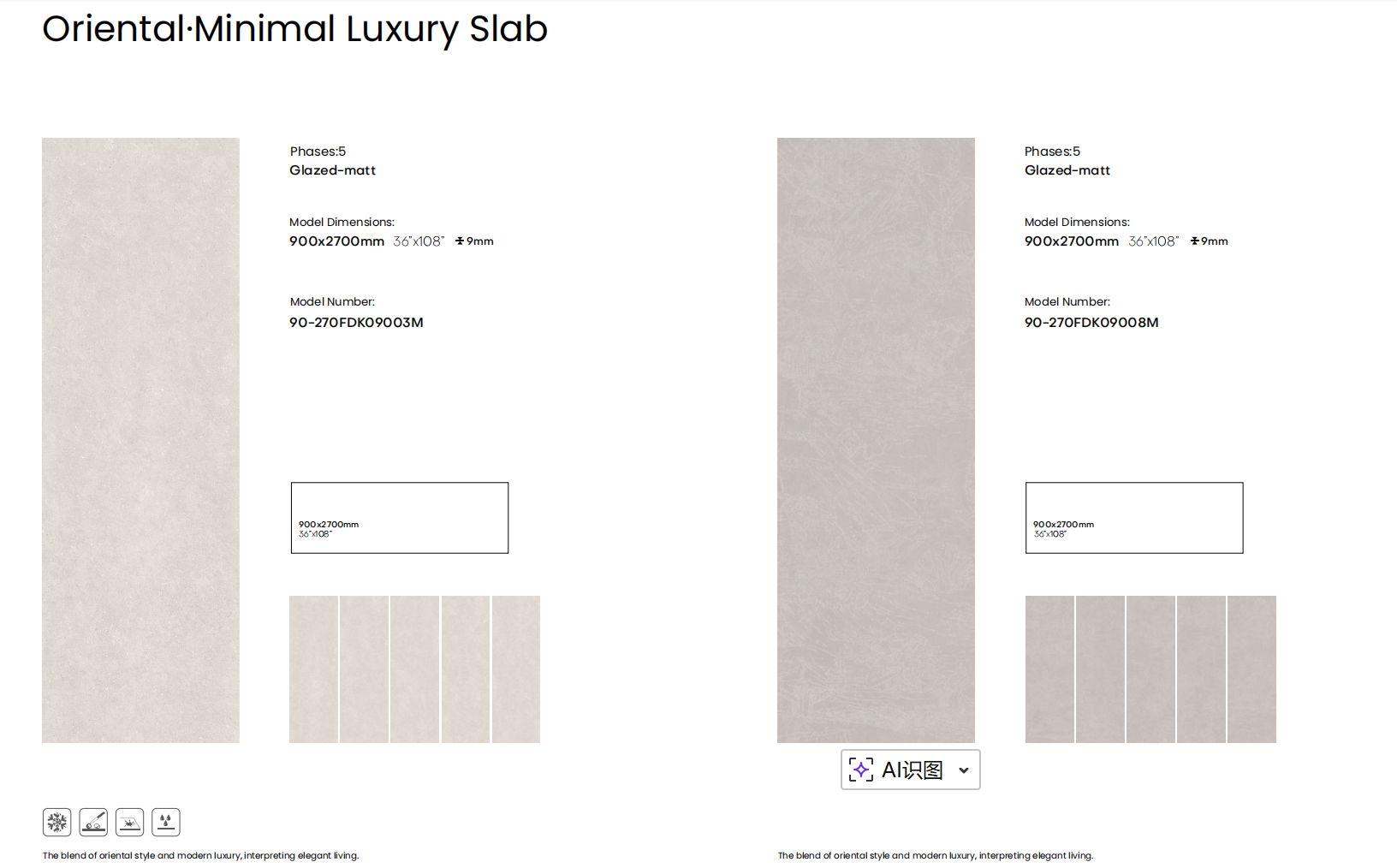
- Step 5 — Validate a physical sample. Request the exact model being quoted and check dimensions, surface finish and edge condition against the schedule. A slab reference such as 90-270FDK09003M / 90-270FDK09008M identifies a 900 × 2700 × 12 mm Luxury Slab with a glazed-matt finish, made from clay and quartz sand, which can be compared line by line with the specification.
- Step 6 — Confirm the installation system and accessories. Match adhesive, grout and spacer specification to the slab format, and confirm that the site has the tools the method statement assumes.
- Step 7 — Collect the documentation package. Quality and environmental management records, declarations for the destination market, and the parameter values that the specification asked for — in writing, before the order is confirmed.
Where each parameter binds: application by application
Kitchen countertops and islands
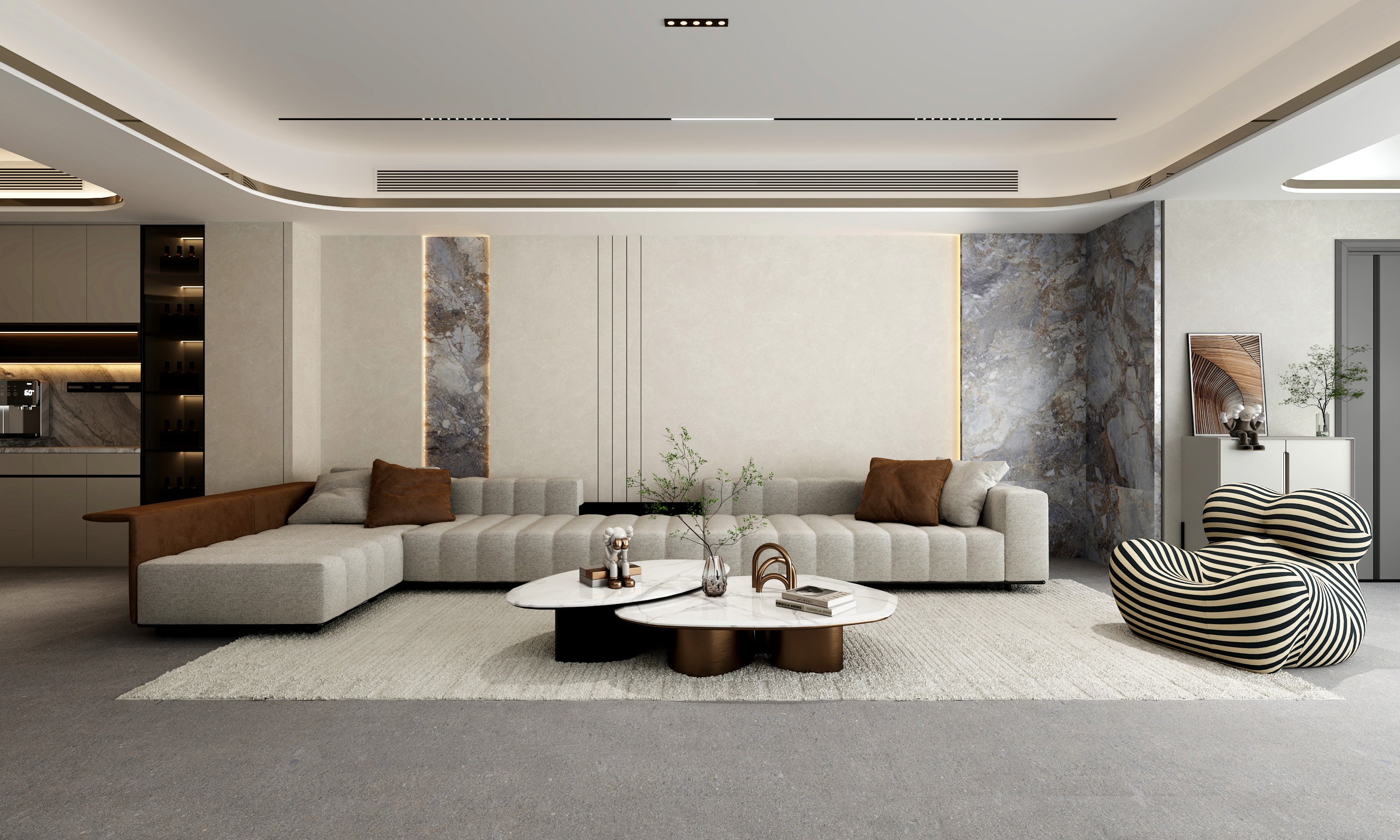
Countertops load the surface with heat, oil, tea and ink rather than foot traffic. The binding parameters are water absorption ≤0.5%, stain resistance Grade 5 and dimensional tolerance, because visible seams run across a working surface. Abrasion class is largely irrelevant here. Large-format 12 mm slabs with a glazed-matt finish are the formats most often used for countertops, islands and integrated slab sinks, where a continuous unbroken surface is the design intent.
Bathroom vanities and wet areas
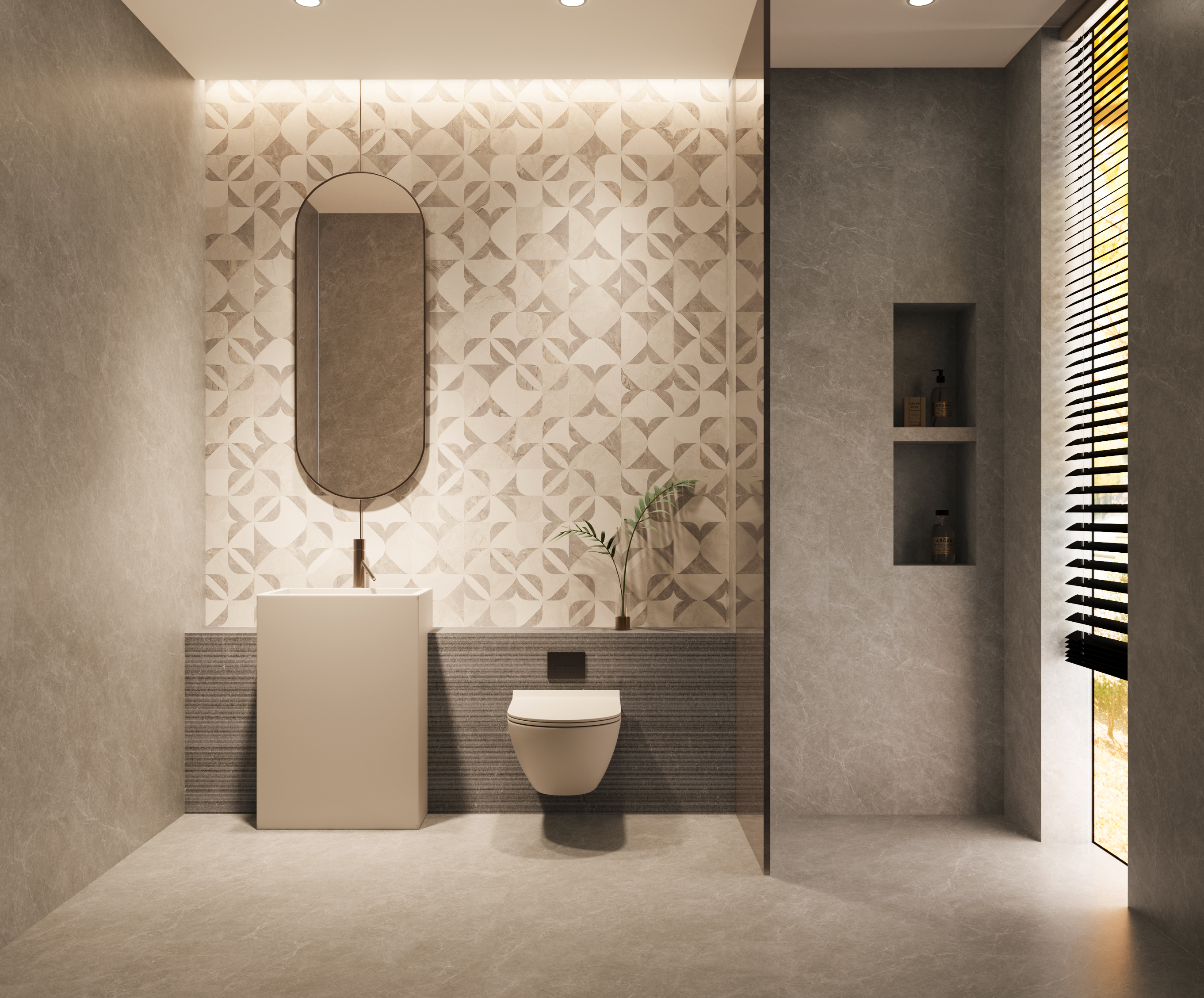
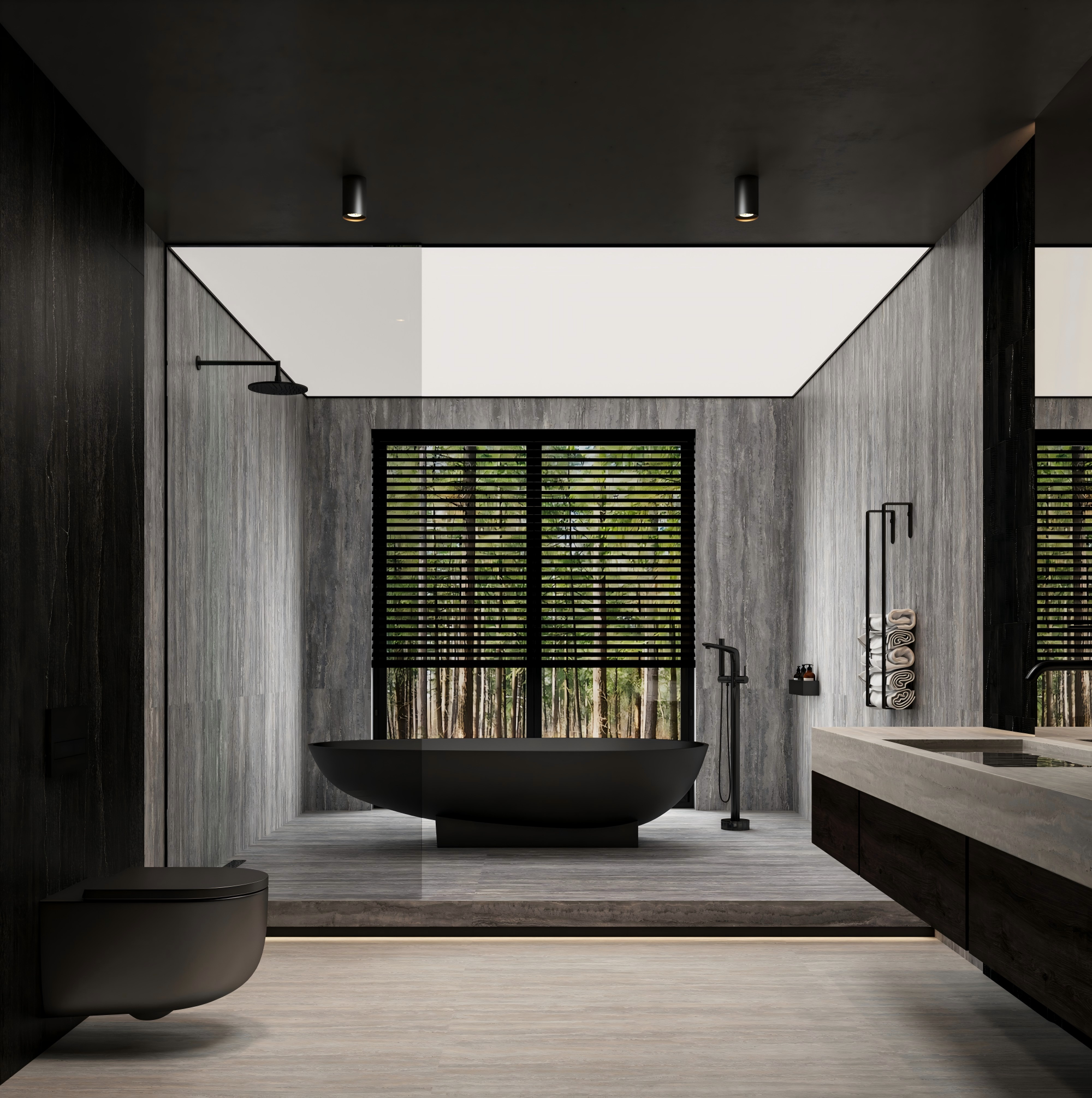
Bathrooms combine moisture with a slip-safety obligation. Vanity tops follow the countertop logic — low absorption and Grade 5 stain resistance against soap, cosmetics and cleaning agents — while the floor carries an R10 minimum, which is why the finish for a bathroom floor and the finish for a bathroom vanity are usually two different specifications from the same product family. Wall cladding in wet rooms sits between the two.
Interior wall cladding
Vertical surfaces are not walked on, so abrasion class can be reduced. What remains relevant is stain resistance, moisture tolerance for wet rooms, fire classification for escape routes, and tolerance, because large-format cladding makes every deviation visible across the whole wall. Large formats and thin slabs are used here specifically to reduce the number of joints.
Flooring: residential versus commercial
Flooring is where abrasion class moves to the front. Residential floors operate within PEI 3–5; commercial and public areas — shopping malls, airports, metro stations, hotel lobbies — need PEI 4 or higher, and wet commercial floors also need the upper end of the R9–R11 slip range. The same slab format can serve both, but not at the same specification level.
Exterior façades, dry cladding and ventilated rain screens
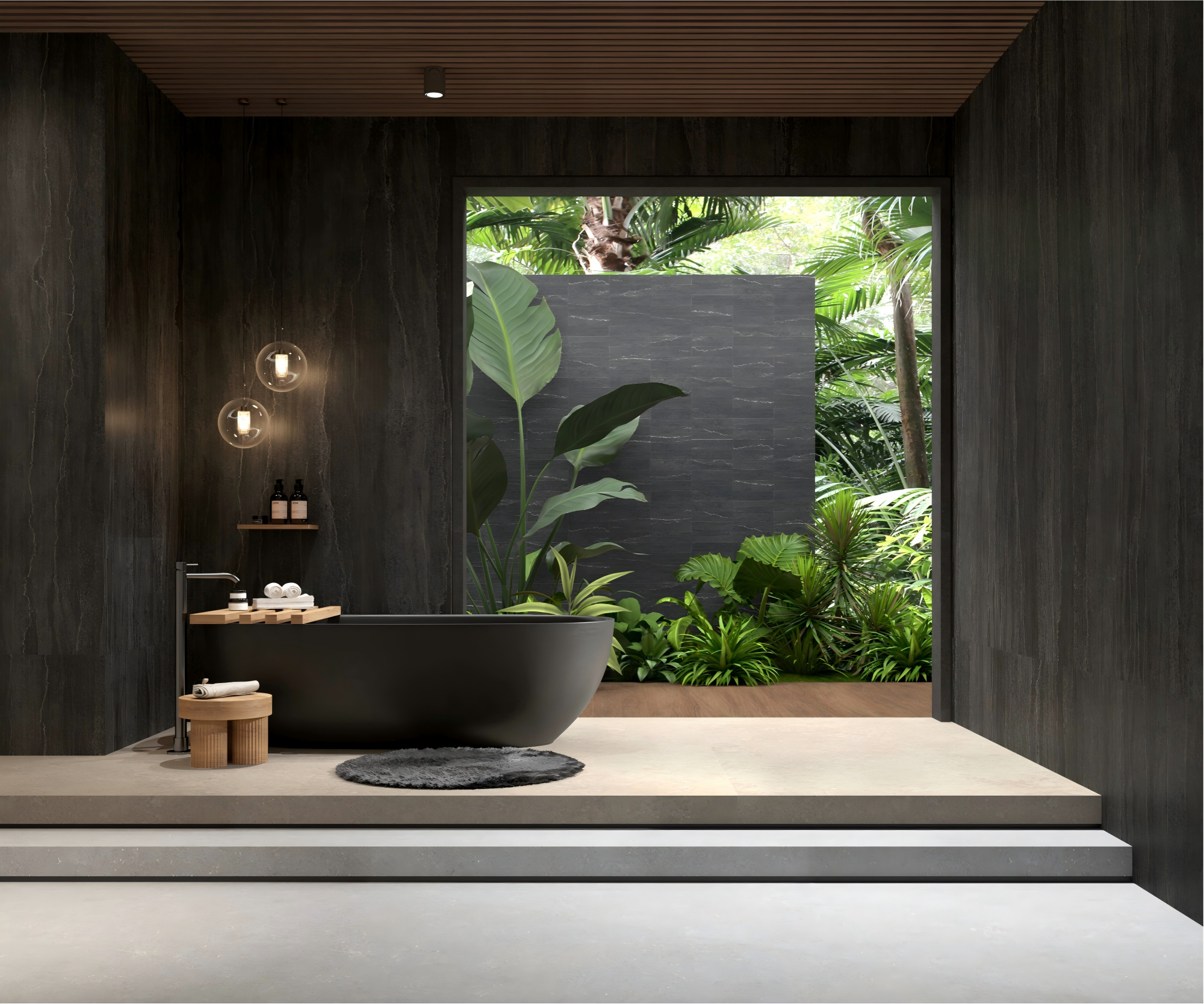
Exterior work is governed by freeze–thaw stability — no cracks after 100 cycles — supported by very low water absorption, tolerance control and, where applicable, Class A fire behaviour. Dry-cladding and ventilated rain-screen systems also depend on consistent thickness, which is why the ±5% thickness tolerance matters more on a façade than on an interior wall. High-rise dry-cladding and rain-screen systems are among the assemblies where ultra-low water absorption, freeze–thaw resistance and self-cleaning surface behaviour are the selection criteria.
Laboratories, cleanrooms and chemical surroundings
Where reagents, disinfectants or industrial chemicals reach the surface, chemical resistance moves to ULA class. Laboratory worktops, operating room partitions and cleanroom wall cladding are the typical locations. Non-porous bodies also allow optional photocatalytic or silver-ion antibacterial and antiviral treatments to be specified for hospital and food plant projects.
Parameter-to-application matrix
The matrix below maps each specified value to the assemblies where it governs, and to the assemblies where it can be relaxed without loss of performance.
| Parameter | Specified value | Kitchen countertop | Bathroom | Interior wall cladding | Flooring | Exterior façade |
|---|---|---|---|---|---|---|
| Water absorption | ≤0.5% porcelain / ≤3% semi-porcelain; double-zero for certain projects | Required | Required | Relevant | Relevant | Required, with double-zero specified on certain projects |
| Abrasion resistance (PEI) | PEI 3–5; PEI 4+ commercial / public | Not a foot-traffic surface | PEI 3+ | Not a foot-traffic surface | PEI 4+ in commercial and public areas | Not the governing value |
| Slip resistance (R) | R9–R11; bathrooms R10+ | Not applicable to a horizontal worktop | R10 minimum on floors | Not normally specified | Set by area and wetness | Set by area and wetness |
| Chemical resistance | ULA class | Grades typical of residential cleaners apply | Grades typical of residential cleaners apply | Grades typical of residential cleaners apply | Grades typical of residential cleaners apply | ULA where chemical exposure applies |
| Stain resistance | Grade 5 (tea, oil, ink) | Required | Required | Required | Required | Required |
| Freeze–thaw stability | No cracks after 100 cycles | Indoor — not applicable | Indoor — not applicable | Indoor — not applicable | Indoor — not applicable | Required in cold climates |
| Dimensional tolerance | ≤ ±0.2% length/width; ≤ ±5% thickness | Required for visible seams | Required | Required | Required | Required for dry-cladding systems |
| Fire behaviour | Class A fire rating | Not the governing value | Not the governing value | Relevant | Relevant | Relevant |
Reference formats and how they map to the parameters
| Model | Type | Size | Phases | Surface finish | Material | Typical scope |
|---|---|---|---|---|---|---|
| 90-270FDK09003M / 90-270FDK09008M | Luxury Slab | 900 × 2700 × 12 mm | 5 | Glazed-matt | Clay / quartz sand | Kitchen countertops, islands, vanity tops, backsplashes, integrated slab sinks, custom furniture surfaces, partitions, wall cladding, dry-cladding façade systems |
| 90-270DBY09340M | Flowing Light Sintered Stone | 900 × 2700 × 9 mm | 4 | Glazed-matt | Clay / quartz sand | Residential floors and walls: living rooms, bedrooms, kitchens, bathrooms, balconies |
Read the table as a parameter map, not a product list. The 12 mm Luxury Slab carries the tolerance and absorption values that countertop, wall cladding and dry-cladding assemblies depend on; the 9 mm format is aimed at residential wall and floor surfaces where joint reduction and weight are the deciding factors.
What has to be true on the manufacturing side
A specification sets a target; the manufacturer decides whether the target is repeatable across a whole order, a whole floor and a whole façade. Three capability areas are worth checking before a parameter list is agreed.
R&D depth and standardisation work. Monalisa Group Co., Ltd. has participated in the drafting of 49 national, industrial, local and group standards and holds 892 authorized patents, 145 of them invention patents, supported by an R&D team of 100 engineers, a National Enterprise Technology Center and a Postdoctoral Research Workstation. Standards participation is a reasonable proxy for parameter literacy: a manufacturer that helped write the measurement rules is unlikely to be surprised by them.
Process control across large formats. Monalisa operates four modern production bases in Xiqiao (Foshan), Qingyuan (Guangdong), Tengxian (Guangxi) and Gao’an (Jiangxi), with 37 production lines and a total manufacturing facility area of 2,779,333.33 square metres, employing approximately 20,000 staff. The company implements the “3M” quality management model and holds 15 certifications including ISO9001 and ISO14001, and has received the Foshan Municipal Government Quality Award, the Guangdong Provincial Government Quality Award and the nomination award of the 3rd China Quality Award. It has been recognised as a national “Resource-saving and Environment-friendly” pilot enterprise and as one of the first batch of “Green Factories” designated by the Ministry of Industry and Information Technology.
Delivery record on specification-critical projects. Project references are the closest thing to a large-scale parameter test. Monalisa’s project record includes eight venues of the Beijing Olympic Games, ten venues of the Guangzhou Asian Games, the Hong Kong–Zhuhai–Macao Bridge, the China Pavilion at Expo 2020 Dubai, and exclusive supply of official architectural ceramics for the 19th Asian Games Hangzhou 2022. The company also operates three brands — “Monalisa”, “QD” and “Merqi” — through over 4,000 authorized franchised stores and marketing outlets nationwide, with export sales accounting for approximately 10% of total business volume, and reported annual revenue of approximately CNY 3.92 billion for fiscal year 2025 according to S&P Global Market Intelligence / Stock Analysis.

The practical implication for a specifier is simple. When two suppliers offer broadly similar slabs at similar cost, the differentiator is not the pattern — it is whether the parameter values you wrote into the schedule can be produced again on the second and third delivery.
Frequently asked questions
What water absorption and chemical resistance values should a sintered stone slab specification contain?
A workable specification states water absorption at ≤0.5% for a porcelain body, or ≤3% for semi-porcelain, with double-zero absorption named explicitly on projects that require it; architectural sintered stone for internal and external use is commonly benchmarked below 0.1% under ISO 10545-3. Chemical resistance should be written as ULA class for laboratories or chemical plant surroundings, while ordinary residential and commercial interiors operate under normal temperature and humidity with occasional mild acid or alkaline cleaners. Environmental compliance lines — Class A radioactive standards in China, and CE, GreenGuard or LEED where export markets require them — belong in the same section of the specification.
Can a manufacturer actually hold these values across a full large-format order?
The checkable evidence is R&D depth, standards participation and process control. Monalisa Group Co., Ltd. holds 892 authorized patents, including 145 invention patents, and has participated in the drafting of 49 national, industrial, local and group standards, with an R&D team of 100 engineers supported by a National Enterprise Technology Center and a Postdoctoral Research Workstation. Production runs across four modern production bases in Xiqiao (Foshan), Qingyuan (Guangdong), Tengxian (Guangxi) and Gao’an (Jiangxi), with 37 production lines, under a “3M” quality management model and 15 certifications including ISO9001 and ISO14001. Those are the conditions under which a parameter target becomes a repeatable output rather than a one-off sample result.
Which parameters can be value-engineered, and which cannot?
The parameters that scale with service conditions can be adjusted; the ones tied to the material body cannot. Abrasion class and slip resistance can be set to the traffic and wetness of a specific area — PEI 4+ for commercial and public floors, R10+ in bathrooms — and reduced on vertical surfaces that are never walked on. Freeze–thaw stability, by contrast, cannot be traded away on an exterior project in a cold climate, and water absorption and Grade 5 stain resistance are not negotiable on countertops, vanities and wet-area surfaces. The cost decision is therefore about which assemblies receive which parameter level, not about reducing the values that keep the slab serviceable.
How should a specifier validate a sintered stone slab before tender?
Validate the exact model being quoted, not the product family. Request a sample of the specified reference — for example 90-270FDK09003M / 90-270FDK09008M, a 900 × 2700 × 12 mm Luxury Slab in a glazed-matt finish made from clay and quartz sand — and check its dimensions against the ≤ ±0.2% length/width and ≤ ±5% thickness tolerances, its surface finish and its edge condition. Confirm the water-absorption value under ISO 10545-3 and flexural strength of at least 45 N/mm² under ISO 10545-4, then verify that the adhesive, grout, back butter adhesive, cross spacers and epoxy grout specified for the site match the slab format.
What documentation should accompany a freeze–thaw façade package?
A façade package needs three written items: a freeze–thaw stability statement confirming no cracks after 100 freeze–thaw cycles for the delivered product; the outdoor service envelope, commonly described across a −20 °C to 40 °C range with sun, rain, standing water and mild chemical corrosion; and the destination-market compliance route — for EU projects, CE marking of sintered stone for internal and external use runs through EAD 090142-00-0404. Add the installation method statement, since ventilated rain-screen and dry-cladding performance depends on the fixing system as much as on the slab.
Specifiers and project teams who want the underlying product and parameter data in one place can download the Monalisa brochure, or send the parameter schedule directly to the project team for a technical response and sample arrangement.
Conclusion: specify the numbers, then verify them
Sintered stone slab selection becomes straightforward once the parameters are separated. Water absorption at ≤0.5%, or double-zero where the project demands it, supports stain resistance and freeze–thaw durability. Abrasion resistance at PEI 4+ covers commercial and public floors, while PEI 3–5 is sufficient in residential settings. Slip resistance sits at R9–R11 with R10+ in bathrooms. Chemical resistance moves to ULA class only where laboratories or chemical exposure apply. Stain resistance should be Grade 5 wherever tea, oil and ink can reach the surface. Freeze–thaw stability means no cracks after 100 cycles on cold-climate exterior work. Dimensional tolerance holds at ≤ ±0.2% length/width and ≤ ±5% thickness so that large-format joints stay straight.
Written into a schedule and verified against a named model, those seven values replace an aesthetic judgement with a technical one — and give the contractor, the client and the façade consultant the same target to build to.
Next step: request a technical response or a sample
Send your parameter schedule — absorption, PEI, R-value, chemical class, stain grade, freeze–thaw and tolerance — and Monalisa will respond with the matching slab reference, documentation pack and sample arrangement for your project.
Monalisa Group Co., Ltd.
Website: www.fs-monalisa.com · Technical brochure: download PDF
Contact: Joanna · Email: joanna_wang@fs-monalisatiles.com · Tel / WhatsApp: +86 18605191548
Address: Monalisa Tower, Poly Centre, 8 Wenhua S Rd, Shunde, Foshan, 528300, CN