
Technical Guide to PEI Ratings, Water Absorption, and Freeze-Thaw for Porcelain Tile
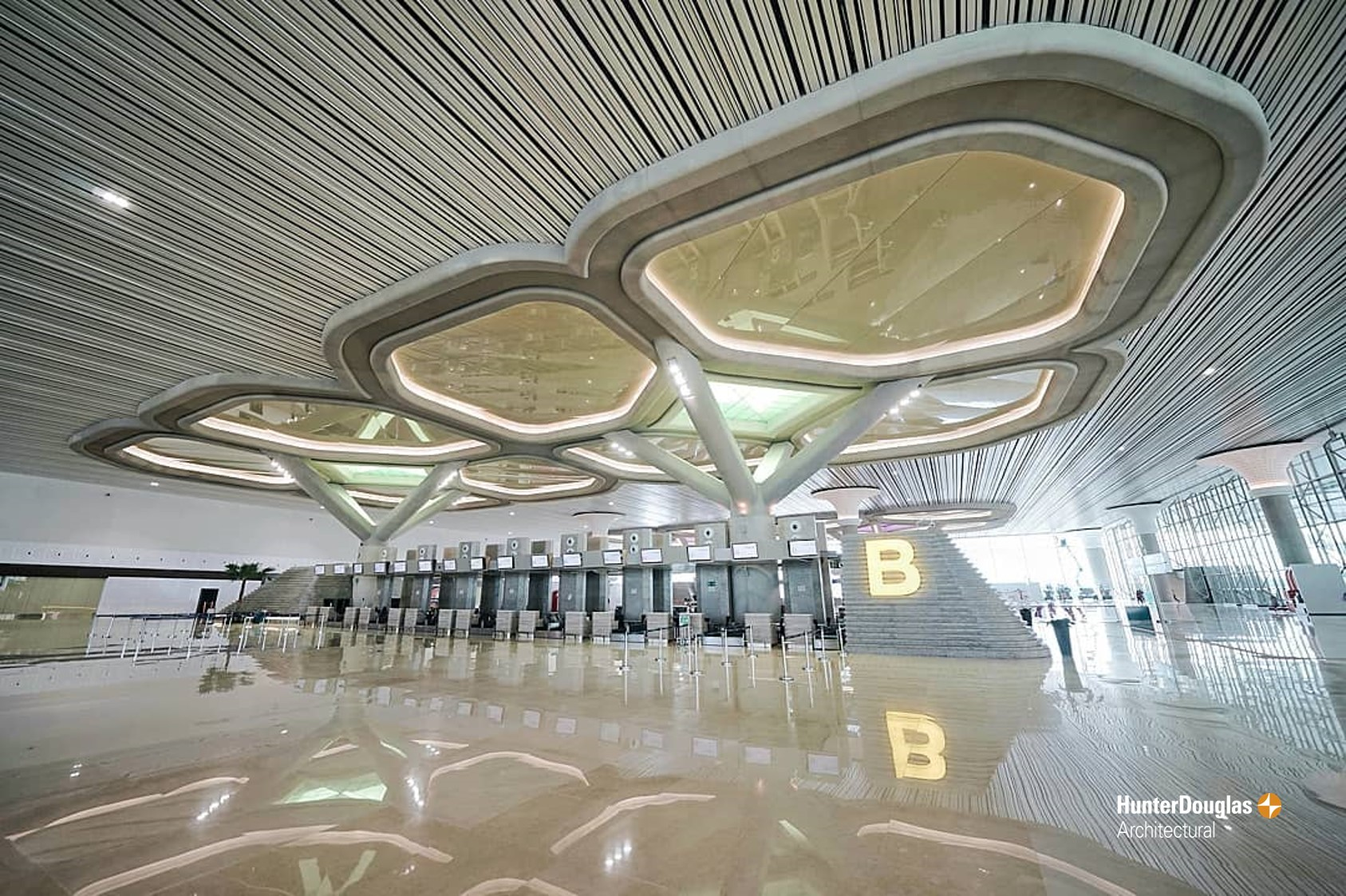
Unglazed porcelain tiles project — large-format flooring specified for public and municipal traffic.
Three laboratory values decide whether a porcelain tile survives a demanding installation: its abrasion class (usually expressed as a PEI rating), its water absorption rate, and its frost resistance under repeated freeze-thaw cycling. Colour, format and surface design win the showroom conversation. These three values decide whether the same floor is still performing after a decade of trolley traffic and several winters of freezing and thawing.
This guide is written for evaluation-stage buyers — importers, distributors, project specifiers and facility procurement teams — who need to compare porcelain tile products on measurable criteria instead of adjectives. It explains what each metric means, which thresholds apply to which zone, and what documentation a supplier should be able to produce on request.
A worked reference runs through the article: Product 3220 (model 120-270FEG12207M) from Monalisa Group Co., Ltd., a 1200×2700×12 mm homogeneous body porcelain tile specified for outdoor service across a -20°C to 40°C range. The same evaluation logic applies to any porcelain tile specification, from bathroom porcelain tiles to heavy duty commercial flooring.
Problem Definition: Where Porcelain Tile Specifications Actually Fail
Most porcelain tile failures on demanding projects are not dramatic. They fall into two predictable categories, and both are decided at specification stage rather than at installation stage.
Surface wear-through. On a high-traffic commercial floor, the tile rarely breaks. What fails is the decorative surface layer: abrasion gradually removes the glazed or printed face, exposing the body underneath and creating a permanently dull, discoloured traffic lane. Once wear-through begins, replacement is the only remedy — no cleaning regime restores it. This is the failure mode a PEI abrasion class is designed to prevent, and it is why a tile chosen for a residential corridor can be the wrong tile for an airport concourse.
Moisture and frost damage. In cold, wet or unheated environments, a tile body with meaningful open porosity absorbs water. When temperatures drop, that water expands inside the body, and repeated freeze-thaw cycles can produce cracking, surface spalling or debonding from the substrate. Water absorption is the single most useful predictor of this risk, which is why porcelain classifications are built on it.
The verification trap. A PEI rating describes the wear resistance of a glazed surface. It is not a general durability grade, and it says nothing about water absorption or frost behaviour. Equally, a certificate is normally issued against a specific standard, classification and work size — a document that covers one format does not automatically cover another format from the same factory. Buyers who treat PEI as an all-purpose quality score, or who accept a certificate without reading the scope line, are the buyers who discover the gap after installation.
Industry Background: Why Specification Discipline Matters More Now
The porcelain tile market was valued at approximately USD 9.73 billion in 2024 and is projected to reach USD 18.33 billion by 2035, according to Spherical Insights. Within that market, the glazed porcelain tile segment holds the largest share, driven by aesthetic versatility and durability — which means most buyers are comparing glazed products where PEI classification applies directly.
Supply-side conditions have tightened. China remains the world's top ceramic tile exporter, although export volumes fell 2.5% in 2024 to 600 million sqm, with 74% of exports absorbed by Asian markets, according to Ceramic World Web / Mecs Research Centre. Domestic output contracted further: total tile production in China fell 12.1% in 2024 to 5.91 billion sqm, representing 48% of the country's total production capacity, according to the China Building and Sanitary Ceramics Association. Financial pressure is visible at company level as well — Monalisa Group Co., Ltd. (002918.SZ) reported annual revenue of approximately CNY 3.92 billion for fiscal year 2025, a 15.28% decrease year over year, per reported financial data.
Industry sources identify Mohawk Industries, Grupo Lamosa and SCG Ceramics among the leading global competitors in the ceramic and porcelain tile sector (Ceramic World Review / Mordor Intelligence). The competitive field is therefore split between global groups with broad distribution and specialist producers with deep technical documentation.
The practical consequence for a buyer is straightforward. When capacity is being rationalised and margins are under pressure, suppliers shorten production cycles and thin out specification documentation. Standards drafted by industry bodies and the certificates issued under them become the only reliable common language between a factory and a project specification. Buyers who cannot verify water absorption, frost resistance and abrasion class are comparing claims, not products.
Detailed Solution: The Three Tests That Govern Climate and Traffic Performance
1. PEI Abrasion Rating — Match the Class to the Zone, Not the Preference
The PEI rating (developed by the Porcelain Enamel Institute) classifies the surface abrasion resistance of glazed tiles on a scale from I to V. Higher classes indicate a surface that resists wear for longer under foot traffic and abrasive soiling. For flooring projects, the practical range is PEI III to PEI V.
| PEI Class | Typical Traffic Level | Zones Where the Class Is Usually Specified |
|---|---|---|
| PEI III | Light to moderate residential traffic | Residential floors including kitchens and bathrooms, low-traffic apartment interiors |
| PEI IV | Residential plus general commercial traffic | Office buildings, restaurants, cafes, retail interiors, hotel guest rooms and corridors |
| PEI V | Heavy commercial and institutional traffic | Shopping malls, supermarkets, gyms, airport and metro terminals, sports halls |
Two points matter when applying the table. First, specify by traffic and abrasion, not by budget: downgrading from PEI V to PEI III on a mall concourse to save cost converts a ten-year floor into a visible wear lane. Second, PEI applies to the glazed surface. Where a tile has no glaze — for example Product 3220, a homogeneous body tile with a matt / natural stone face — abrasion resistance is a property of the body itself, and the buy-side question changes from "which PEI class?" to "which abrasion test method and result applies to this body?".
2. Water Absorption — ≤0.5% for Porcelain, ≤3% for Semi-Porcelain
Water absorption is the percentage of water a tile body takes up under a defined test. It is the backbone of porcelain classification. A tile must show a water absorption rate of 0.5% or less to meet international standards such as ISO 13006 and ANSI A137.1 and be classified as porcelain. Tiles between 0.5% and 3% are commonly treated as semi-porcelain — usable, but a different performance class. Under EN 14411:2016, the corresponding classification for a tile at or below 0.5% is Group BIa.
| Classification | Water Absorption | Practical Implication for the Specification |
|---|---|---|
| Porcelain (BIa) | ≤ 0.5% | Effectively closed body; the standard choice for exterior, wet-area and freeze-thaw-exposed installations |
| Semi-porcelain (BIb) | > 0.5% up to 3% | Acceptable for protected interior walls and light interior floors; needs closer review where moisture or frost is present |
The reason the 0.5% threshold carries so much weight is physical: a closed body has very little free water available to expand when temperatures fall, and very little pathway for staining liquids or cleaning chemicals to migrate inward. Low absorption underpins waterproof performance, stain resistance and frost resistance simultaneously — it is one number that answers three specification questions.
Verification sits in the certificate classification line. Monalisa holds CE certificate number CY25A10379-TVOC, issued by China Testing & Certification International Group Shaanxi Co., Ltd. under EN 14411:2016 — Ceramic tiles, definition, classification, characteristics, assessment and verification of constancy of performance and marking. The certificate states: work size 1200mm×1200mm×10mm, BIa, for wall and floor, glazed, even, and is valid from 7 March 2025 to 7 March 2035. Read that line the way a specifier should read it — the classification and the work size appear together, and the document is tied to that format.
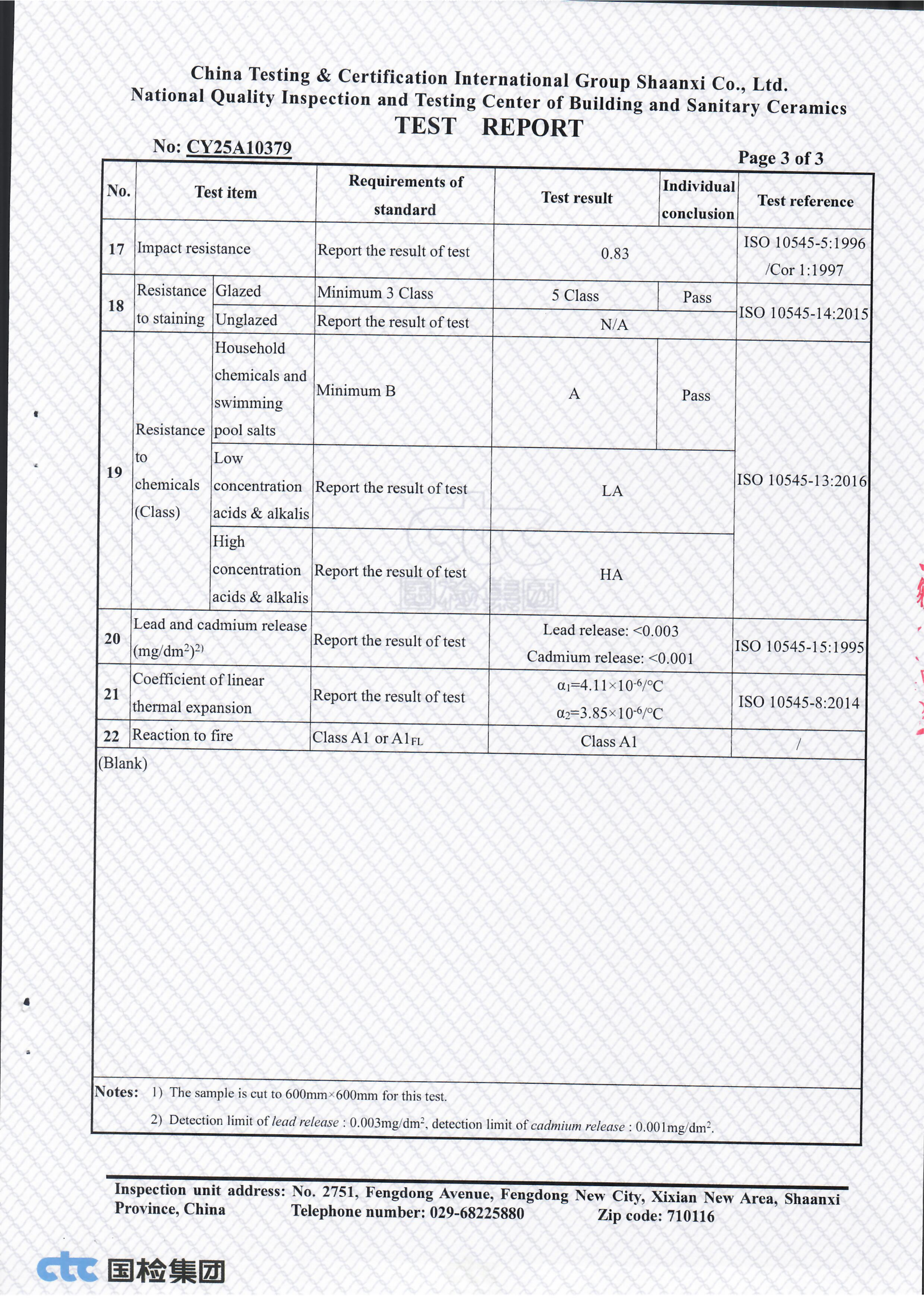
Test report page supporting the CE classification of porcelain tile under EN 14411:2016.
3. Freeze-Thaw Resistance — 100 Cycles Without Cracks
Frost resistance is verified by saturating a tile and subjecting it to repeated freeze-thaw cycles, following the frost-resistance method in the ISO 10545 series (Part 12). The acceptance criterion is the absence of visible cracking, spalling or loss of mechanical strength after the required number of cycles — commonly 100 cycles for exterior-grade specifications.
Frost resistance is not an independent property that can be added to a tile. It follows from the body. At a water absorption rate of 0.5% or below, there is very little water inside the tile to freeze, and the 100-cycle requirement becomes achievable; at higher absorption rates, the same test becomes a genuine risk. This is why an experienced buyer asks a more precise question than "is it frost resistant?". The correct question is: which test method, how many cycles, performed on which format, evidenced by which report?
Worked Reference: Product 3220 and Outdoor Service from -20°C to 40°C
Product 3220 from Monalisa — model 120-270FEG12207M — is a porcelain tile of the homogeneous body type, 1200×2700×12 mm, produced in three phases with a matt / natural stone face surface finish, from a clay / quartz sand body. It is specified for outdoor service across a -20°C to 40°C range, which makes it a useful reference for how the three metrics combine.
At the cold end of that range (-20°C), the controlling property is frost behaviour: a body in the porcelain absorption class, supported by a freeze-thaw result, is what allows the tile to be considered for exterior terraces, plazas and other unheated exposures rather than being restricted to interior use. At the warm end (40°C), the considerations shift to thermal and dimensional stability of a 1200×2700 mm format — large panels move more with temperature change than small modules, which is why dimensional consistency and installation tolerance sit alongside the three primary metrics in any large-format specification.
The documented application scope of this model covers the zones where all three metrics matter at once: hospitality and tourism installations including guest rooms, corridors, pool surrounds, shower areas and outdoor terraces; municipal engineering including pavements, plazas, park trails, public restrooms and metro station halls; commercial spaces such as shopping malls, supermarkets, office buildings, restaurants, cafes and gyms; and public buildings including hospitals, schools, kindergartens, libraries, museums and sports halls.
Two certifications are linked to this model. CE certificate CY25A10379-TVOC under EN 14411:2016 is associated with Product 3220 and, separately, states a work size of 1200mm×1200mm×10mm — a different format. NSF certification C0676949-01, issued by NSF International on 3 April 2023 under NSF/ANSI 51 and covering the USA, EU and China markets, lists this model among the products authorised to bear the NSF mark, alongside Porcelain Tile 8FMB10032PM and the Slab models 90-270FDK09003M / 90-270FDK09008M. The practical lesson for buyers is to confirm which certificate covers the exact format being ordered, rather than assuming portfolio-wide coverage.
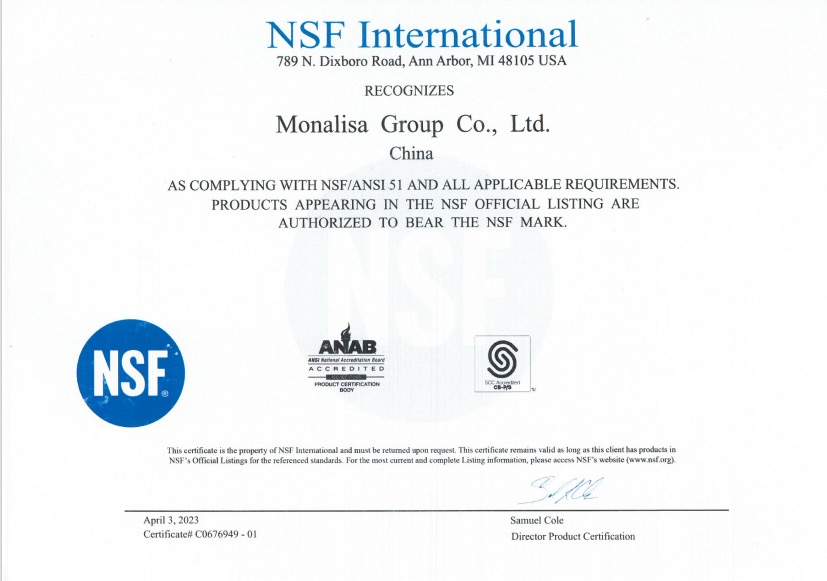
NSF certification C0676949-01 — products appearing in the NSF Official List are authorised to bear the NSF mark.
Detailed Solution: How Monalisa Builds to These Criteria
Monalisa Group Co., Ltd. is a Chinese architectural ceramics manufacturer founded in 1992 and headquartered in Foshan, Guangdong Province, producing ceramic tiles, ceramic slabs and porcelain art paintings for residential and public building decoration, curtain wall engineering, prefabricated buildings and customised home furnishings. The Group operates four modern production bases — Xiqiao in Foshan, Qingyuan in Guangdong, Tengxian in Guangxi and Gao'an in Jiangxi — across 37 production lines, with ten holding subsidiaries and three brands: Monalisa, QD and Merqi.
Scale and process control are relevant to the three metrics because both depend on body consistency. The Group reports a factory area of 2,779,333.33 m², 4,106 employees, an annual output of 100 million square meters, a 100-person R&D team and an export ratio of 10%, serving markets including China, Southeast Asia, the Middle East, North America, Europe, Australia and Africa. Quality management follows the "3M" quality management model, with 100% testing in the capability profile. The company has obtained 15 certifications including ISO 9001 and ISO 14001, and has received the Foshan Municipal Government Quality Award, the Guangdong Provincial Government Quality Award and a nomination award of the 3rd China Quality Award, and is rated a "Five-star Standardization Good Practice Enterprise".
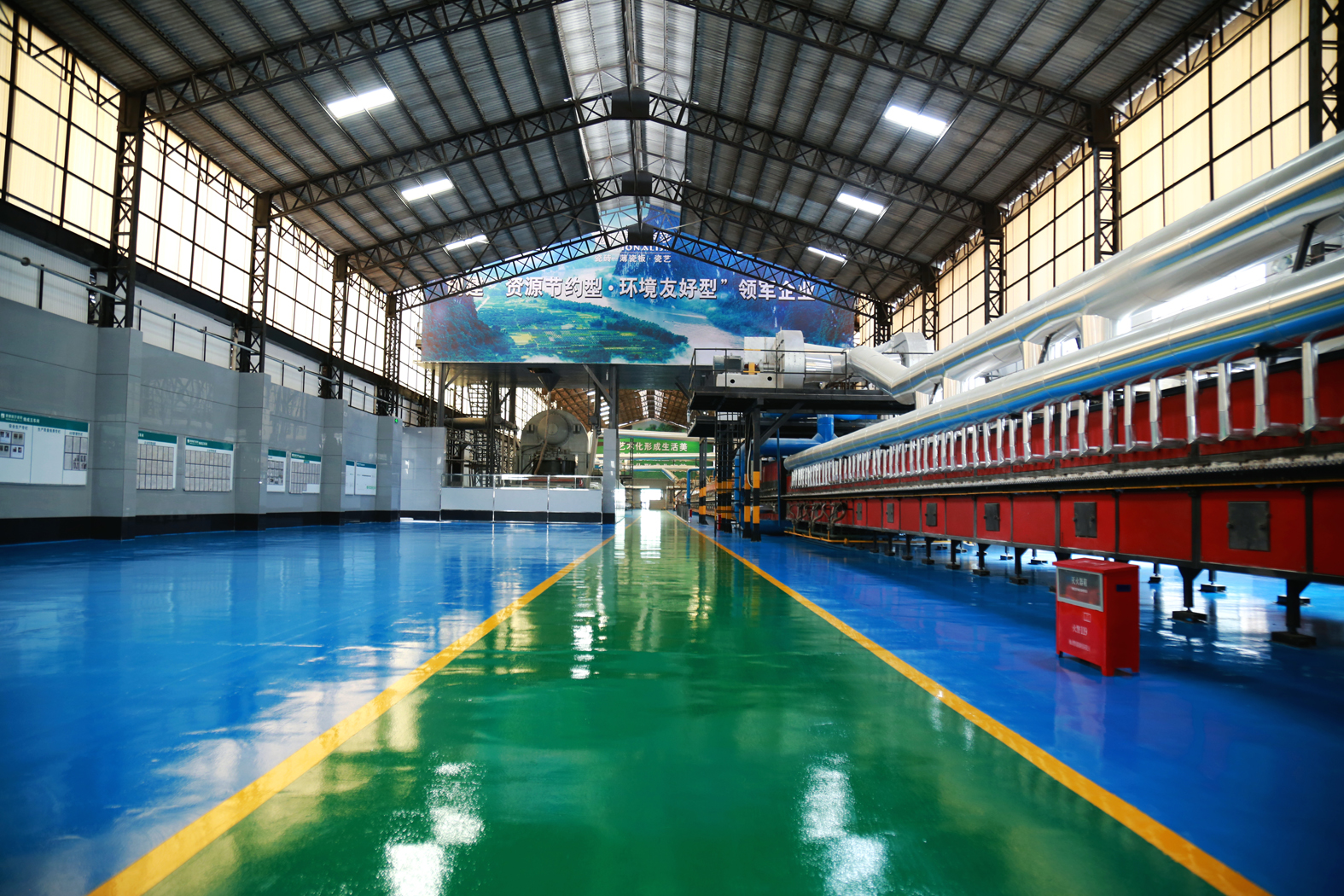
Monalisa Workshop — one of 37 production lines across four production bases.
Technical depth is the second half of the argument. Monalisa operates a National Enterprise Technology Center and a Postdoctoral Research Workstation. As of June 2021, the Group had participated in drafting 49 national, industrial, local and group standards and obtained 892 authorised patents, including 145 invention patents. It introduced a 1800×900×5.5 mm large ceramic thin plate in 2007, which won first prize of the China Building Materials Science and Technology Progress Award, and launched a 9000×1800×10.5 mm ultra-large ceramic plate in 2021. Participation in standards drafting is an indirect signal, but a relevant one when a project requires non-standard formats or when a buyer must defend a specification decision to a client, consultant or insurer.
The project record provides the third layer of evidence: eight venues of the Beijing Olympic Games, ten venues of the Guangzhou Asian Games, the Hong Kong-Zhuhai-Macao Bridge, designation as ceramic tile supplier for the China Pavilion at Expo 2020 Dubai, and exclusive supply of official architectural ceramics for the 19th Asian Games Hangzhou 2022. For specifiers, the useful reading is that these are public, high-traffic, high-visibility installations where abrasion class and moisture performance could not be treated as marketing details.
Step-by-Step Breakdown: A Seven-Step Specification Workflow
- Classify the zone by traffic and exposure. Record two variables for each area: expected traffic intensity (residential, general commercial, heavy commercial) and exposure (dry interior, wet interior, exterior, unheated, freeze-thaw). Every later decision keys off these two variables.
- Set the water absorption ceiling in writing. Use ≤0.5% for porcelain where the floor is exterior, wet or frost-exposed. Use ≤3% semi-porcelain only where the installation is protected and the risk review supports it. Put the number in the specification document, not just in correspondence.
- Define the frost requirement in cycles. For any exterior or unheated installation, state the test method, the number of freeze-thaw cycles required (commonly 100) and the acceptance criterion: no cracking, spalling or strength loss.
- Match the abrasion class to the zone. PEI III for residential flooring, PEI IV for general commercial, PEI V for heavy commercial and institutional floors. For unglazed bodies, replace the PEI question with a body abrasion test question.
- Verify certificate scope. Check standard, classification, work size, issuing body and validity dates. For example, CE certificate CY25A10379-TVOC under EN 14411:2016 states work size 1200mm×1200mm×10mm, BIa, glazed, even, valid 7 March 2025 to 7 March 2035. If your order is a different format, confirm which document covers it.
- Validate with samples and test reports before releasing the full order. Physical sample inspection plus the test documents for the exact format is the cheapest risk control available at evaluation stage. It also exposes colour and surface consistency issues that no certificate describes.
- Lock the continuity package. Confirm lead time, same-batch stock arrangements and warranty terms before the order, not after the first replacement is needed. A floor is only as good as the availability of matching tiles two years later.
Specification Priority Ranking: The Five Checks That Remove the Most Risk
Not all specification checks carry equal weight. Ranked by the size of the risk each one removes — not by how easy it is to complete — the five highest-value checks for a demanding climate or high-traffic porcelain tile project are the following.
| Rank | Check | Primary Risk Removed | Document to Request |
|---|---|---|---|
| 1 | Water absorption classification (≤ 0.5% porcelain) | Moisture ingress, staining, frost damage | Certificate or test report stating the classification (e.g. BIa under EN 14411:2016) |
| 2 | Freeze-thaw cycle result | Exterior and unheated installation failure | Frost resistance test report for the ordered format |
| 3 | Abrasion class versus traffic | Surface wear-through in traffic lanes | PEI class statement or body abrasion result |
| 4 | Certificate scope match (standard, work size, dates) | Reliance on a certificate that does not cover the ordered format | Full certificate copy rather than an excerpt |
| 5 | Supply continuity package | Unmatched replacement tiles later in the asset life | Written lead time, same-batch reserve terms, warranty period |
Checks 1 through 4 are documentation checks and can be completed before any commercial negotiation. Check 5 is a commercial commitment and should be written into the order, because it is the only one that determines what happens when a floor is damaged three years after handover.
Use Cases: Applying the Criteria by Zone
Porcelain tile is specified across a wide range of environments, and the three metrics apply differently in each. Monalisa's documented application scope covers seven families of use, which map cleanly onto the absorption, frost and abrasion logic above.
Residential construction — floors and walls in living rooms, bedrooms, kitchens, bathrooms and balconies. Interior, mostly dry: the absorption and frost constraints are lighter, while household abrasion and stain resistance drive the choice of surface. Large format porcelain tiles and marble look porcelain tiles are common in living areas; slip resistance becomes the deciding factor in bathrooms.
Commercial spaces — shopping malls, supermarkets, office buildings, restaurants, cafes and gyms. This is PEI IV to PEI V territory, where commercial porcelain floor tiles must resist long, concentrated traffic paths rather than uniform wear.
Public buildings — hospitals, schools, kindergartens, libraries, museums and sports halls. High traffic combined with cleaning regimes that use chemicals; low absorption supports stain and chemical resistance, and slip performance governs wet circulation areas.
Municipal engineering — pavements, plazas, park trails, public restrooms and metro station halls. This is where freeze-thaw and water absorption become non-negotiable, because these installations are fully exposed and are rarely replaced on a short cycle.
Industrial and logistics — clean workshops, warehouse flooring and anti-static workshops. Load and abrasion dominate; dense homogeneous bodies are favoured over decorative surface layers.
Hospitality and tourism — guest rooms, corridors, pool surrounds, shower areas and outdoor terraces. Constant wet-dry cycling and chlorinated water make absorption performance central, and outdoor terraces add the frost variable.
Agricultural and livestock — farm flooring specified to be slip-resistant, chemical-resistant and easy to wash, a combination that low-absorption porcelain bodies support well.
Unglazed porcelain tiles — a dense body surface used where abrasion resistance is a body property rather than a glaze property.
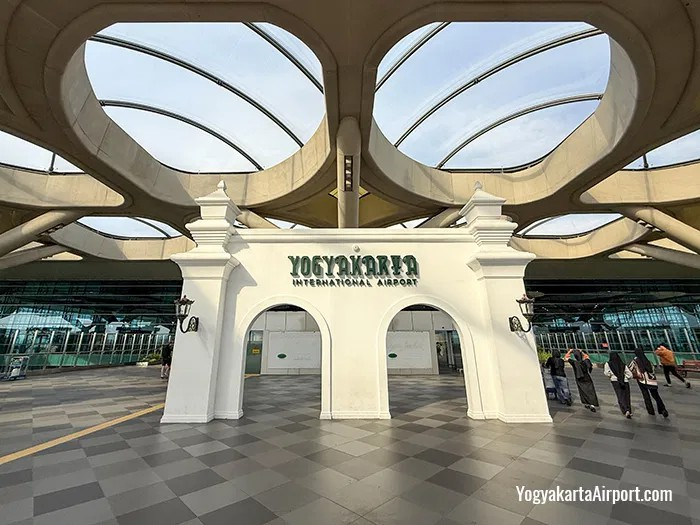
The clearest evidence that these metrics translate into operating cost is the Jogjakarta Airport project in Indonesia, delivered for a municipal government client using 80,000 m² of porcelain tile over a two-year duration. Reported outcomes include a modern minimalist aesthetic, a 30% lower life-cycle maintenance cost, a breakage rate below 0.3% reducing replacement losses, and a 15% saving on grouting materials and labor achieved through tight-joint installation. Tight joints are only feasible when dimensional consistency is high — which is why format tolerance belongs in the same specification conversation as absorption and abrasion.
Comparison Table: Verified Specifications Across Three Monalisa Porcelain Products
The table below compares three Monalisa products on documented specifications only. It is intended to show how the three metrics selection should be read against real product data — not to rank finishes by preference.
| Attribute | Product 3220 | Product 3352 | Product 3516 |
|---|---|---|---|
| Product name | Porcelain Tile | Slab | Porcelain Tile |
| Model | 120-270FEG12207M | 90-270FDK09003M / 90-270FDK09008M | 8FMB10032PM |
| Type | Homogeneous Body Tile | Luxury Slab | Classic Stone |
| Size | 1200×2700×12 mm | 900×2700×12 mm | 800×800×10 mm |
| Phases | 3 | 5 | 8 |
| Surface finish | Matt / Natural stone face | Glazed-matt | Glazed-Polished |
| Body material | Clay / quartz sand | Clay / quartz sand | Clay / quartz sand |
| Certification linkage | CE CY25A10379-TVOC (EN 14411:2016); NSF C0676949-01 | NSF C0676949-01 | NSF C0676949-01 |
| Documented exterior / wet-area scope | Outdoor terraces, pool surrounds, shower areas, municipal pavements and plazas | External curtain walls and ventilated rain-screen systems (ultra-low water absorption, freeze-thaw resistant) | Not stated in the available specification |
Read the table as a decision aid, not a league table. A 1200×2700×12 mm homogeneous body tile answers a different brief from a 900×2700×12 mm luxury slab or an 800×800×10 mm glazed-polished tile. The comparison value lies in seeing which documents attach to which model, and which application families each product's specification actually supports.
FAQ
Which certifications should I check first when porcelain tile is specified for outdoor or high-traffic use?
Check the classification line on the certificate before anything else, because that is where water absorption class is declared. Monalisa holds CE certificate CY25A10379-TVOC, issued by China Testing & Certification International Group Shaanxi Co., Ltd. under EN 14411:2016, covering work size 1200mm×1200mm×10mm, BIa, glazed, even, for wall and floor, valid from 7 March 2025 to 7 March 2035. The Group also holds NSF certification C0676949-01, issued by NSF International on 3 April 2023 under NSF/ANSI 51 and covering the USA, EU and China markets; the associated product list includes Porcelain Tile 8FMB10032PM, Slab 90-270FDK09003M / 90-270FDK09008M and Porcelain Tile 120-270FEG12207M. Compare the classification and the work size against your order — not just the certification mark.
Can the manufacturer deliver the format, volume and consistency that a large outdoor or commercial project needs?
Monalisa's documented capability covers four modern production bases at Xiqiao (Foshan), Qingyuan (Guangdong), Tengxian (Guangxi) and Gao'an (Jiangxi), across 37 production lines, with an annual output of 100 million square meters, a monthly capacity of 12.5 million m² and 100% testing. The company supports OEM/ODM production with customisation of pattern and logo. Format capability is evidenced by a 1800×900×5.5 mm large ceramic thin plate introduced in 2007 and a 9000×1800×10.5 mm ultra-large ceramic plate launched in 2021. Track record at scale includes eight venues of the Beijing Olympic Games, ten venues of the Guangzhou Asian Games, the Hong Kong-Zhuhai-Macao Bridge, the China Pavilion at Expo 2020 Dubai and official architectural ceramics for the 19th Asian Games Hangzhou 2022.
Where does the money actually go — what drives cost over the life of the floor?
The dominant cost drivers are breakage, joint materials and labour, and maintenance, not the tile line item alone. At the Jogjakarta Airport project in Indonesia, 80,000 m² of porcelain tile installed for a municipal government client over a two-year duration reported a 30% lower life-cycle maintenance cost, a breakage rate below 0.3% reducing replacement losses, and a 15% saving on grouting materials and labor through tight-joint installation. Low absorption also reduces the maintenance burden in wet and cold areas, because a closed body limits moisture-related repairs and re-sealing. On the commercial side, the minimum order quantity is 2000 sqm, so quantity planning feeds directly into logistics cost per square meter.
How do I validate a porcelain tile before committing to a full order?
Validate in two layers: physical samples and format-specific documents. On the document side, request the water absorption classification, the frost resistance result for the ordered format, the abrasion class or body abrasion result, and the complete certificate rather than an excerpt. On the physical side, inspect colour consistency, surface finish and dimensional tolerance on an actual sample of the format. Monalisa supports this stage with free technical guidance on tiling layout design, installation techniques and substrate preparation, and provides product test reports, certificates of conformity, instruction manuals and maintenance guides in Chinese and English.
What happens after the order is placed, and how quickly?
Lead time is 7–15 days. For continuity, the same batch of tiles can be reserved in stock for two years for future replenishment or repair replacement, which is the practical answer to matching a floor two or three years after handover. Warranty service runs 5–15 years depending on series and project type and covers manufacturing defects such as colour difference, dimensional deviation and glaze cracks. Complaints receive a response within 24 hours with a solution — replacement, return or compensation — provided within 7 working days, and a technical representative can support large projects on site to supervise installation or troubleshoot issues. To move from evaluation into a quotation and sample pack, share your required format, zone, exposure conditions and quantities with the team.
Conclusion
Porcelain tile selection for demanding climates and high-traffic floors reduces to three verifiable numbers and one documentation habit. Water absorption at 0.5% or below (porcelain, Group BIa) is the prerequisite for exterior, wet and frost-exposed installations, with semi-porcelain up to 3% treated as a separate and more limited class. Freeze-thaw resistance is demonstrated by cycling the tile through the frost test — commonly 100 cycles — with no cracking or spalling. Abrasion class, whether expressed as PEI III, IV or V for glazed surfaces or as a body abrasion result for unglazed porcelain, must be matched to the traffic the floor will actually receive. The documentation habit is simply this: read the classification and the work size on the certificate, and confirm it covers the format you are buying.
Applying that framework to a real specification is easier with product data in hand. Monalisa Group Co., Ltd. publishes its certifications, product specifications and project record for exactly this purpose, and its technical team can confirm absorption class, frost documentation and abrasion data for the format your project requires.

Monalisa Group Foshan Headquarters — founded 1992, headquartered in Foshan, Guangdong Province.
Next step: validate the numbers on a sample. Download the Monalisa product brochure for full specifications and format options, then request a sample or a project quote for your zone and exposure conditions.
Brochure: Monalisa Product Brochure (PDF)
Contact: Joanna — Email: joanna_wang@fs-monalisatiles.com | Tel / WhatsApp: +86 18605191548 | Website: fs-monalisa.com
Address: Monalisa Tower, Poly Centre, 8 Wenhua S Rd, Shunde, Foshan, 528300, CN