
Top 8 Sintered Stone Slab Applications for 2026: Ranked by ROI for Commercial Spaces
Top 8 Sintered Stone Slab Applications for 2026: Ranked by ROI for Commercial Spaces
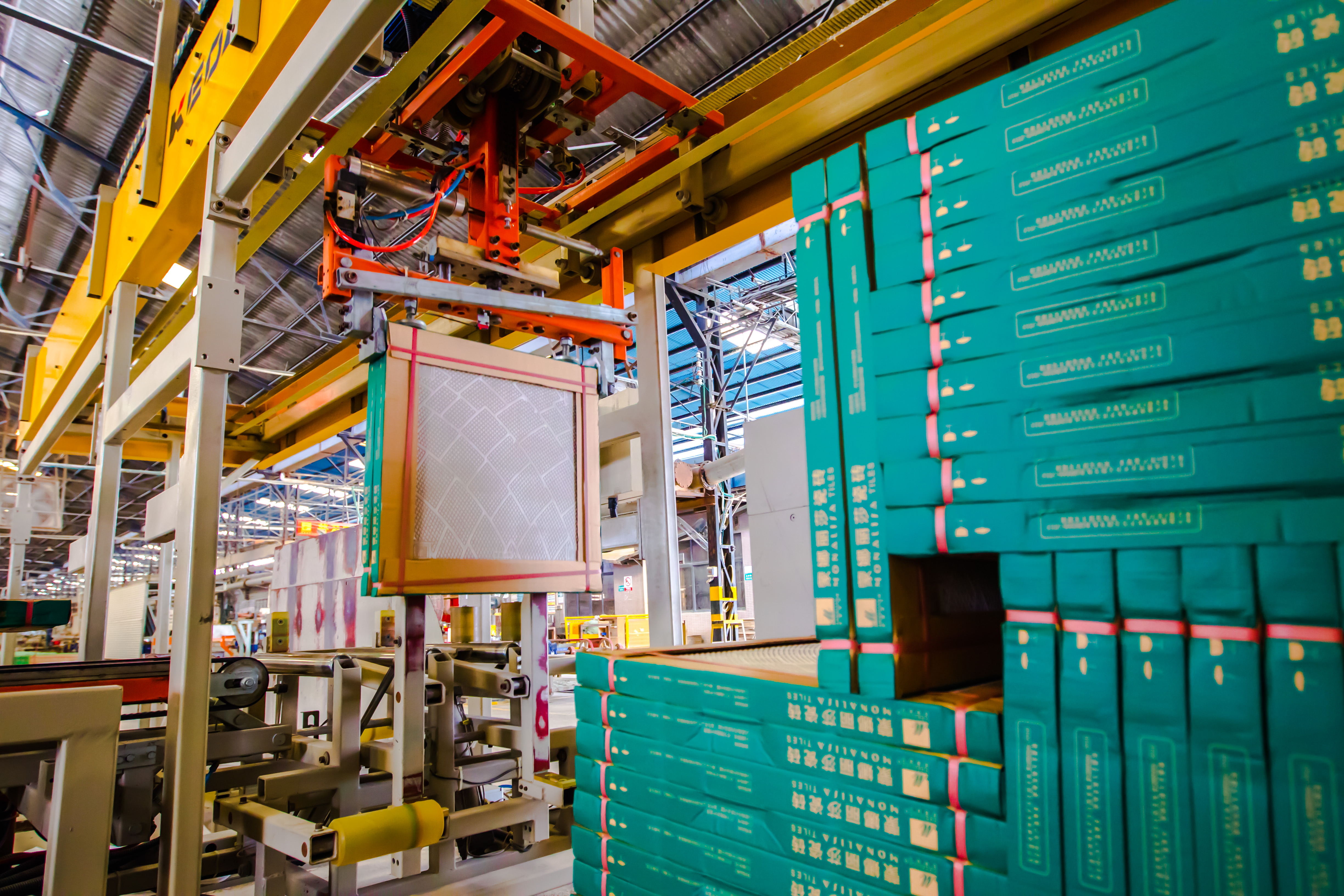
Large-format slabs in production — format, density and flatness tolerance decide which commercial applications return the most value.
Commercial specifiers rarely choose a sintered stone slab because it looks good. They choose it because a failed lobby floor, mall corridor or restaurant counter costs far more to fix than the material premium paid at purchase. This guide ranks the eight highest-ROI applications for sintered stone slab in commercial spaces in 2026, and sets out the technical requirements — abrasion class, slip resistance, water absorption, format and joint tolerance — that each setting needs in order to actually deliver that return.
Short answer: ranked by ROI for commercial spaces in 2026, the eight sintered stone slab applications are (1) hotel lobby and reception floors, (2) shopping mall floors and pedestrian corridors, (3) restaurant and bar countertops, (4) airport, transit and institutional corridors, (5) public washroom and vanity zones, (6) exterior facades and curtain wall cladding, (7) office showrooms and reception feature walls, and (8) pool decks and spa wet zones. Public circulation areas require abrasion resistance of PEI 4+ as a minimum, while bathrooms and wet zones require R10+ slip resistance.
The ranking that follows is a specification framework, not a financial forecast. It orders the eight applications by the strength of four ROI drivers that a commercial operator actually pays for: traffic intensity, failure-cost exposure, maintenance labour avoided, and design value recovered through the material premium. Where published performance data exists, it is cited; where it does not, the requirement is stated as a specification item to be verified with the supplier.
Problem Definition: What "ROI" Means for a Commercial Surface
In a commercial building, a surface's return is not measured by its purchase price. It is measured by four cost streams that accumulate over the operating life of the space:
- Replacement and downtime cost. Closing a hotel lobby, a mall corridor or a food-service counter to replace failed flooring or cladding is the single most expensive line in the whole calculation — the material is a small part of it.
- Maintenance labour. Sealing, waxing and deep cleaning are recurring annual costs on conventional ceramic surfaces and on natural stone.
- Failure risk. Slip incidents in wet zones, permanent staining on counters, and batch colour mismatch when a damaged unit has to be replaced years later.
- Design value recovered. A large-format slab that reproduces natural stone can replace stone or book-matched marble in premium areas, so part of the premium is paid back by the design outcome rather than by durability alone.
This is why a product with a 15%–30% higher unit price than conventional tiles can still deliver a 20%–35% lower total life-cycle cost: the premium is paid once, while the savings repeat every year the building operates. Any ROI ranking that only compares price per square metre will therefore rank these eight applications incorrectly.
Industry Background: From Premium Niche to Default Specification
Sintered stone has moved from a decorative premium product into a specification category with its own test framework. The global sintered stone market was valued at approximately USD 877.75 million in 2024 and is projected to grow to USD 1.41 billion by 2032, according to Intel Market Research's Sintered Stone Market – Global Forecast 2025–2032. Market-size estimates for the category do vary by report scope — some studies fold sintered stone into the broader engineered stone market — so the directional signal (steady growth, expanding commercial use) is more reliable than any single figure.
Supply capacity supports that shift. China's exports of ceramic products, including sintered stone slabs, totalled USD 19.15 billion from January to November 2025, according to the General Administration of Customs of China. On the manufacturer side, Monalisa Group Co Ltd (002918.SZ) reported annual revenue of approximately CNY 3.92 billion for fiscal year 2025, based on S&P Global Market Intelligence and Stock Analysis data, and Monalisa Group corporate communications report a monthly production capacity of 12.5 million m² across its porcelain and sintered stone product lines.
Standards have consolidated at the same time. Common architectural benchmarks for sintered stone include water absorption below 0.1% tested under ISO 10545-3 and flexural strength of at least 45 N/mm² tested under ISO 10545-4. In the EU market, CE marking for sintered stone for internal and external use relies on EAD 090142-00-0404 from the European Organisation for Technical Assessment (EOTA). These are the reference points that make a commercial ROI comparison possible at all — without them, applications such as mall flooring and bathroom vanity zones cannot be specified against a common baseline.
Detailed Solution: What a High-Performance Slab Actually Delivers
The performance gap between a properly manufactured sintered stone slab and a standard ceramic tile is what creates the ROI case in the first place. Monalisa uses fully automatic ultra-high-pressure presses with a compaction force of up to 48,000 kN, combined with nano-scale glaze technology, to produce a high-density body with ultra-low water absorption of ≤0.08%. Surface hardness is Mohs ≥7 with abrasion resistance at PEI Grade 5. Decorative patterns are produced through high-definition inkjet printing plus an adhesive dry-grain process, reaching 98% realism compared with natural stone.
Against conventional ceramic tiles, the published benchmark differences are measurable rather than impressionistic:
- Water absorption of ≤0.08% versus 0.5%–3% for conventional tile — a reduction of 80%–95%.
- Breaking strength of ≥45 MPa versus ≥35 MPa — an increase of at least 28%.
- Wear volume of ≤140 mm³ versus ≤540 mm³ — a reduction of at least 74%.
- Freeze-thaw resistance of 150 cycles without cracking, versus 50–100 cycles — 50%–200% longer.
- Flatness tolerance of ≤±0.15%, versus ≤±0.5% — roughly a 70% accuracy improvement, which is what makes large-format, tight-joint installation possible.
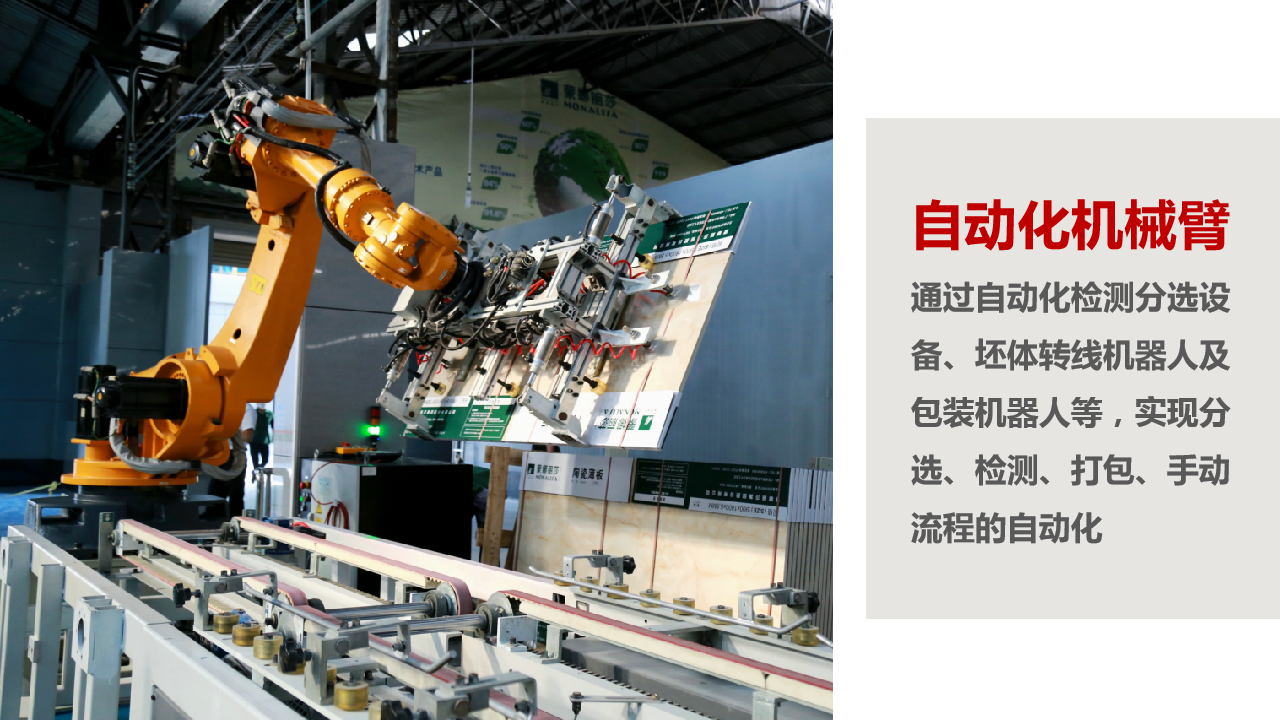
Automated handling is one reason large-format slabs arrive on site within a ≤0.3% breakage rate, against roughly 0.8% for standard tiles.
Those numbers translate into commercial terms. The tighter flatness tolerance allows grout gaps of ≤0.5 mm, which in large projects saves 10%–15% in grouting materials and labour. A lower breakage rate during handling and installation — ≤0.3% versus approximately 0.8% for standard tiles — reduces replacement orders and schedule risk on multi-floor fit-outs. On the maintenance side, daily cleaning requires only water or neutral detergent with no waxing or special treatment, and stain resistance is Grade 5, so coffee, oil and ink wipe off without leaving a trace.
Behind the product sits manufacturing scale and quality infrastructure that a commercial buyer can audit. Monalisa Group Co., Ltd. was founded in 1992 and is headquartered in Foshan, Guangdong Province. The Group operates four modern production bases — Xiqiao (Foshan), Qingyuan (Guangdong), Tengxian (Guangxi) and Gao'an (Jiangxi) — with a total of 37 production lines, and its product range covers ceramic tiles, sintered stone slabs and SPC flooring. The company operates three brands — Monalisa, QD and Merqi — through more than 4,000 authorized franchised stores and marketing outlets, and has established partnerships with nearly 100 major real estate developers including Country Garden, Vanke, POLY and COLI.
The project record is directly relevant to high-traffic commercial applications. Monalisa has participated in key projects including eight venues of the Beijing Olympic Games, ten venues of the Guangzhou Asian Games, and the Hong Kong-Zhuhai-Macao Bridge. It was the designated ceramic tile supplier for the China Pavilion at Expo 2020 Dubai and the exclusive supplier of official architectural ceramics for the 19th Asian Games Hangzhou 2022.
Technical credibility is supported by the company's own R&D record. As of June 2021, Monalisa had participated in drafting 49 national, industrial, local and group standards and held 892 authorized patents, including 145 invention patents. Its 1800×900×5.5 mm large ceramic thin plate, introduced in 2007, won first prize at the China Building Materials Science and Technology Progress Award, and in 2021 the company launched a 9000×1800×10.5 mm ultra-large ceramic plate. Quality management follows the "3M" model: Monalisa has received the Foshan Municipal Government Quality Award, the Guangdong Provincial Government Quality Award and the nomination award of the 3rd China Quality Award, and holds 15 certifications including ISO 9001 and ISO 14001. The company has also been recognized as a "Resource-saving and Environment-friendly" pilot enterprise and as one of the first batch of "Green Factories" by the Ministry of Industry and Information Technology.
Step-by-Step Breakdown: How to Rank Any Application by ROI
The ranking below was built by running each commercial setting through the same six-step filter. The same sequence can be applied to any project that is not on this list.
Step 1 — Classify traffic intensity and abrasion demand
Public circulation demands abrasion resistance of PEI 4+ as a minimum; intensive continuous-traffic areas are normally specified at PEI Grade 5, which is the class Monalisa's sintered stone slabs are rated to. Low-traffic decorative walls can accept a lower abrasion class, which lowers the cost of the specification.
Step 2 — Define the slip requirement for wet zones
Bathrooms, washroom vanity zones, pool surrounds and spa floors require R10+ slip resistance. In practice this is verified with a pendulum friction tester to a wet BPN of ≥50, which is the control standard Monalisa applies to slip-resistance batches. Dry interior floors and wall cladding do not carry this requirement, and over-specifying slip resistance should be avoided because it changes the surface texture.
Step 3 — Define hygiene and chemical exposure
Countertops, kitchens and washroom surfaces need stain resistance at Grade 5 and a tested response to cleaning agents, oils and hot objects. For food-service applications, buyers should confirm food-contact safety documentation — for example an NSF certification — against the exact slab series being quoted, rather than assuming it applies across a brand's full range.
Step 4 — Check format, thickness and joint design
Large format reduces the number of joints and therefore the amount of grout line that can stain. The relevant options include 9000×1800×10.5 mm ultra-large plates for lobbies and feature walls, and 1800×900×5.5 mm thin plates for applications where weight and build-up matter. Because flatness tolerance is ≤±0.15%, slabs can be installed with grout gaps of ≤0.5 mm — a design decision that also saves 10%–15% in grouting materials and labour.
Step 5 — Check environmental exposure
Exterior facades and outdoor pool decks must be specified for freeze-thaw resistance; the benchmark for sintered stone is 150 cycles without cracking, against 50–100 cycles for conventional tile, which matters in cold-region commercial projects. Exterior exposure also makes UV stability and batch colour consistency specification items — buyers should request exterior-grade documentation for the series, and confirm the fire classification needed for the project against the supplier's declaration.
Step 6 — Calculate ten-year cost, not unit price
Combine material, installation, maintenance labour, breakage allowance and the cost of one replacement cycle. Sintered stone slabs typically cost 15%–30% more per unit than conventional tiles, but their service life is extended 2–3 times, and the resulting total life-cycle cost is 20%–35% lower. Applications where this calculation wins most clearly are the ones ranked highest below.
Use Cases: The Top 8 Applications, Ranked by ROI
#1Hotel Lobby and Reception Floors
ROI driver: the highest design value per square metre in a commercial building, combined with continuous guest traffic and the highest cost of closing the space for repair.
Technical requirement: PEI Grade 5 abrasion resistance, Mohs hardness ≥7, water absorption ≤0.08% so that spills and cleaning water do not penetrate the body, and flatness tolerance ≤±0.15% so that large formats can be laid with joints of ≤0.5 mm and remain visually monolithic.
Why it ranks first: a lobby floor is replaced under the worst possible conditions — occupied building, restricted working hours, guest visibility. Every percentage point of extra service life is worth more here than anywhere else in the building.
Credibility reference: Monalisa's venue record matches this traffic profile, including eight venues of the Beijing Olympic Games, ten venues of the Guangzhou Asian Games, the China Pavilion at Expo 2020 Dubai and the official architectural ceramics of the 19th Asian Games Hangzhou 2022.
#2Shopping Mall Floors and Pedestrian Corridors
ROI driver: traffic volume. Rotation of mall tenants is routine, but replacing a corridor floor is not, so maintenance and replacement dominate the cost line.
Technical requirement: PEI Grade 5, breaking strength ≥45 MPa, wear volume ≤140 mm³ (against ≤540 mm³ for conventional tile), and tight-joint installation at ≤0.5 mm to reduce the grout line area that collects soil.
Why it ranks second: three measurable effects compound here — at least 74% less wear volume, a handling breakage rate of ≤0.3% versus roughly 0.8%, and daily cleaning with water or neutral detergent only, with no waxing or sealing cycles.
Credibility reference: Monalisa's participation in the Hong Kong-Zhuhai-Macao Bridge project is a public reference for large-scale, high-durability installations.
#3Restaurant and Bar Countertops
ROI driver: failure cost. A stained or chipped counter in a working restaurant is not a cosmetic problem; it is a closure or a service interruption.
Technical requirement: stain resistance Grade 5, waterproof body with water absorption ≤0.08%, Mohs ≥7 scratch resistance for cutlery and glassware contact, documented stain testing with ink, oil and tea, and food-contact safety documentation confirmed for the specific series. Buyers should also request the declared heat and thermal-shock behaviour of that series before specifying it next to cooking equipment.
Why it ranks third: the surface is small in area but exposed to the most aggressive daily cycle of any commercial application — heat, oil, acid, abrasive cleaning and impact, several times per service.
#4Airport Terminals, Transit Hubs and Institutional Corridors
ROI driver: continuous operation. These buildings have almost no maintenance windows, so surfaces that require sealing or deep cleaning consume labour at the most expensive hours.
Technical requirement: PEI Grade 5, breaking strength ≥45 MPa, low wear volume, flatness tolerance ≤±0.15%, and a low replacement frequency supported by a documented batch consistency system so that damaged units can be swapped without visible colour difference.
Why it ranks fourth: the durability saving is identical to a mall floor, but the design value recovered is lower, which slightly reduces the overall return.
#5Public Washroom and Vanity Zones
ROI driver: slip-risk exposure and cleaning labour. This is the only application on the list where a single specification error can produce a safety incident rather than a maintenance cost.
Technical requirement: R10+ slip resistance, verified by pendulum friction test at wet BPN ≥50, combined with a waterproof body (≤0.08% water absorption) and stain resistance Grade 5 so that hygiene is maintained with neutral detergent rather than aggressive chemicals.
Why it ranks fifth: the surface area is modest and the design value is low, but the failure-cost exposure and the cleaning-labour saving are both high — which lifts it above larger decorative applications.
#6Exterior Facades and Curtain Wall Cladding
ROI driver: access cost. Exterior maintenance requires scaffolding and weather windows, so every avoided intervention is worth multiples of the same work indoors.
Technical requirement: freeze-thaw resistance of 150 cycles without cracking, water absorption ≤0.08% to limit water uptake, documented UV stability for the series, confirmed fire classification, and formats suited to the facade system — 9000×1800×10.5 mm ultra-large plates or 1800×900×5.5 mm thin plates. Monalisa's slabs are used in curtain wall engineering and prefabricated buildings, which is the relevant application track record here.
Why it ranks sixth: the durability economics are strong, but the design premium recovered is lower than for an interior feature surface, and the specification burden (freeze-thaw, UV, fire, wind, fixing system) is the highest of the eight.
#7Office Showrooms and Reception Feature Walls
ROI driver: installation speed and brand presentation rather than wear life.
Technical requirement: large-format slabs for seam-free feature walls, thin 5.5 mm plates where build-up or load matters, flatness tolerance ≤±0.15%, and a decorative range that holds a consistent look across a multi-floor fit-out — marble-look and calacatta-look surfaces at 98% visual realism against natural stone, or concrete-look and terrazzo-look finishes for industrial design languages.
Why it ranks seventh: traffic is low, so the durability saving is smaller; the return comes from fewer joints, faster installation and a finish that delivers a stone appearance without a stone maintenance regime.
#8Pool Decks, Spa and Wellness Wet Zones
ROI driver: a combination of slip safety and heating energy.
Technical requirement: R10+ minimum slip resistance at wet BPN ≥50, waterproof body, freeze-thaw resistance for outdoor pools, and stain resistance Grade 5 to withstand continuous wet cleaning.
Why it ranks eighth: the area is usually small and the design value is moderate, so the durability saving alone would rank it lower. What raises it is thermal performance: the dense body gives good thermal conductivity, and when used with underfloor heating systems heat transfer is approximately 22% higher than with conventional tiles. That allows the heating setpoint to be lowered by 1–2 °C for the same comfort, saving 8%–12% in heating energy — a recurring saving that most surface products cannot offer.
For reference, the eight applications and their minimum requirements are summarised below.
| Rank | Application | Minimum performance requirement | Primary ROI driver |
|---|---|---|---|
| 1 | Hotel lobby and reception floors | PEI 4+ (Grade 5 recommended), Mohs ≥7, water absorption ≤0.08%, flatness ≤±0.15% | Highest design value plus highest cost of closure |
| 2 | Shopping mall floors and corridors | PEI Grade 5, breaking strength ≥45 MPa, wear volume ≤140 mm³ | Traffic volume; maintenance labour avoided |
| 3 | Restaurant and bar countertops | Stain resistance Grade 5, waterproof (≤0.08%), Mohs ≥7, food-contact documentation | Failure cost — service interruption |
| 4 | Airport, transit and institutional corridors | PEI Grade 5, ≥45 MPa, flatness ≤±0.15%, batch consistency system | Continuous operation; no maintenance windows |
| 5 | Public washroom and vanity zones | R10+ slip resistance, wet BPN ≥50, stain Grade 5 | Slip-risk exposure and cleaning labour |
| 6 | Exterior facades and curtain wall cladding | Freeze-thaw 150 cycles, ≤0.08% water absorption, UV and fire documentation | Access cost of exterior maintenance |
| 7 | Office showrooms and feature walls | Large format, flatness ≤±0.15%, thin 5.5 mm option | Installation speed and brand presentation |
| 8 | Pool decks, spa and wellness wet zones | R10+ (wet BPN ≥50), waterproof, freeze-thaw for outdoor use | Heating energy savings plus slip safety |
Comparison Table: Sintered Stone Slab vs Conventional Ceramic Tile
Because the ROI ranking depends on the gap between materials, the benchmark comparison is set out in full below. All figures are drawn from Monalisa's published performance comparison against conventional ceramic tiles.
| Performance metric | Sintered stone slab | Conventional ceramic tile |
|---|---|---|
| Water absorption | ≤0.08% | 0.5%–3% (80%–95% higher) |
| Breaking strength | ≥45 MPa | ≥35 MPa (at least 28% lower) |
| Wear volume | ≤140 mm³ | ≤540 mm³ (at least 74% higher) |
| Freeze-thaw resistance | 150 cycles without cracking | 50–100 cycles |
| Flatness tolerance | ≤±0.15% | ≤±0.5% |
| Surface hardness / abrasion class | Mohs ≥7; PEI Grade 5 | Not stated in the benchmark data |
| Breakage rate (handling and installation) | ≤0.3% | Approximately 0.8% |
| Unit price | 15%–30% higher than conventional tiles, depending on series | Baseline |
| Service life | 2–3 times longer | Baseline |
| Total life-cycle cost | 20%–35% lower | Baseline |
| Installation efficiency | Grout gap ≤0.5 mm saves 10%–15% in grouting materials and labour on large projects | Standard joint widths |
| Maintenance | Water or neutral detergent; no waxing; stain resistance Grade 5 | Requires periodic sealing or deep cleaning; batch colour variation on patch repair |
| Thermal performance with underfloor heating | Heat transfer approximately 22% higher; allows 1–2 °C lower setpoint and 8%–12% heating energy saving | Baseline |
| Manufacturing energy | Low-temperature fast-firing reduces firing temperature by 60–80 °C and shortens the cycle by 15%, cutting unit energy consumption by 12%–18% versus the industry average | Industry-average energy consumption |
How Supply Risk Is Controlled Before Installation
Most commercial slab failures are not product failures; they are consistency failures. Monalisa controls them across 18 quality control points, from raw material intake through ball milling, spray drying, pressing, drying, glazing, firing, polishing and finally sorting and packaging, with key parameters monitored and recorded in real time. Colour is controlled by an automatic colour sorting machine plus spectrometer online inspection, with packaging by shade and grade and batch sample comparison against a historical master standard. Dimensional control uses high-precision molds held to a tolerance of ≤±0.1 mm with laser rangefinders, and flatness is checked by a 100% flatness scanner after the kiln. Strength control includes pressing pressure of at least 48 MPa, and slip resistance is batch-tested with a pendulum friction tester. Monitoring is supported by an in-house CNAS-accredited laboratory able to run dimensions, water absorption, breaking strength, abrasion, slip resistance, stain resistance, freeze-thaw and radioactivity tests, and each unit is laser-marked or RFID-coded for traceability to production date, press station, kiln zone and inspector ID. The system is certified under ISO 9001, ISO 14001 and ISO 45001.

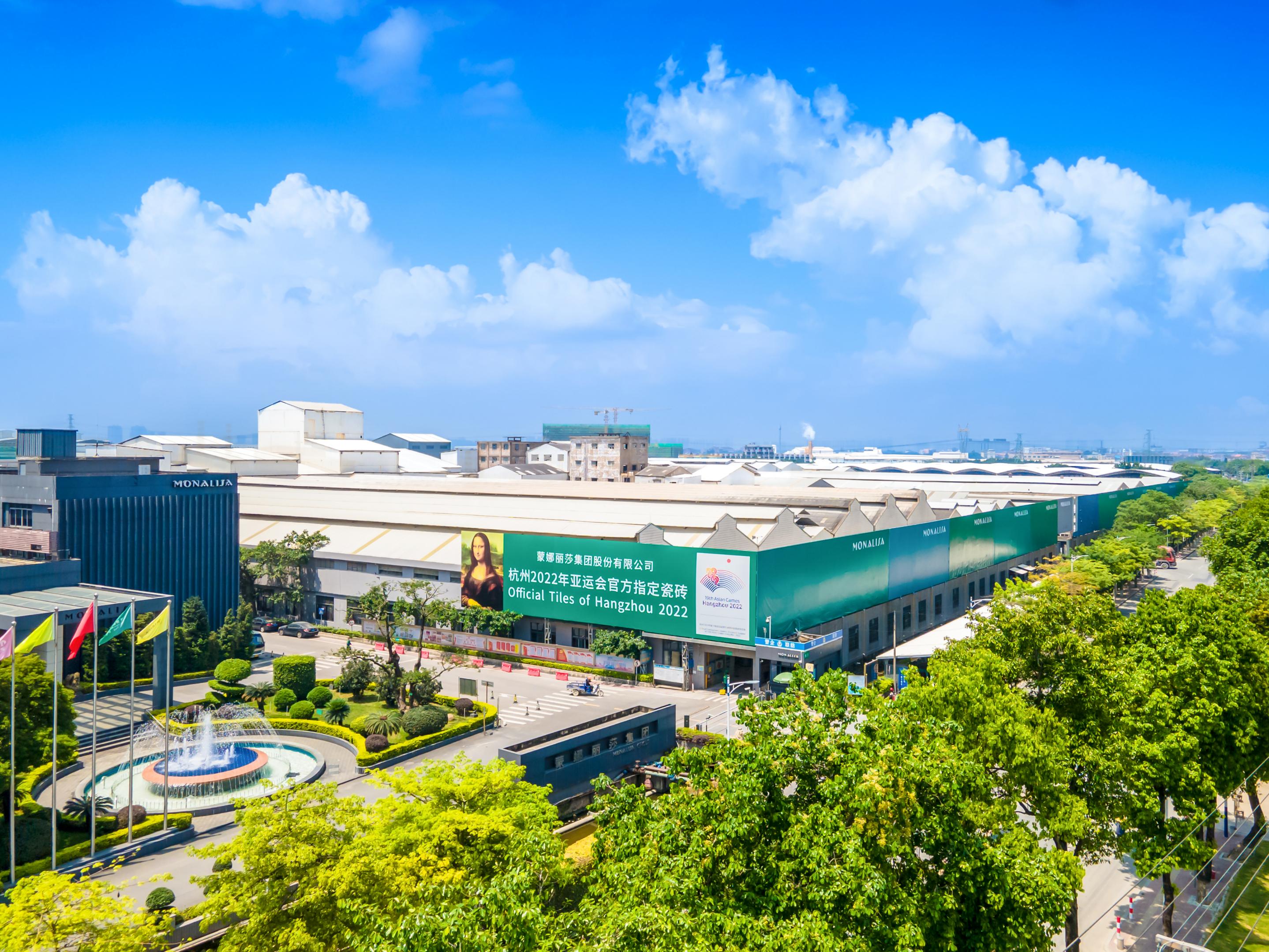
Monalisa Group's Foshan headquarters — a listed manufacturer (002918.SZ) with four production bases and 37 production lines.
FAQ: Commercial Sintered Stone Slab Specification
What certifications and performance standards should a sintered stone slab meet for commercial public areas?
For commercial interiors, specifiers normally anchor the requirement to ISO 10545 test methods: water absorption below 0.1% under ISO 10545-3 and flexural strength of at least 45 N/mm² under ISO 10545-4 are the common architectural benchmarks. For EU projects, CE marking for sintered stone for internal and external use relies on EAD 090142-00-0404. Monalisa holds 15 certifications including ISO 9001 and ISO 14001 and works under ISO 45001, and its in-house CNAS-accredited laboratory tests dimensions, water absorption, breaking strength, abrasion, slip resistance, stain resistance, freeze-thaw performance and radioactivity. Slip resistance is verified with a pendulum friction tester to a wet BPN of ≥50, which corresponds to the R10+ requirement commonly specified for bathrooms and wet commercial zones.
Can sintered stone slabs be produced in the large formats that hotel lobbies and facades require?
Yes. Monalisa introduced an 1800×900×5.5 mm large ceramic thin plate in 2007, which won first prize at the China Building Materials Science and Technology Progress Award, and launched a 9000×1800×10.5 mm ultra-large ceramic plate in 2021. Production runs on fully automatic ultra-high-pressure presses with a compaction force of up to 48,000 kN across 37 production lines at four bases in Xiqiao (Foshan), Qingyuan (Guangdong), Tengxian (Guangxi) and Gao'an (Jiangxi). Large formats are supported by a flatness tolerance of ≤±0.15%, which allows grout joints of ≤0.5 mm.
How do sintered stone slab costs compare with conventional tiles over a commercial project's life cycle?
Unit price is typically 15%–30% higher than conventional tiles, depending on the series. Over the life cycle, service life is extended 2–3 times, the handling breakage rate is ≤0.3% against approximately 0.8% for standard tiles, and total life-cycle cost is 20%–35% lower. Tight-joint installation at a grout gap of ≤0.5 mm saves a further 10%–15% in grouting materials and labour on large projects, and daily maintenance needs only water or neutral detergent with no waxing. Where underfloor heating is installed, heat transfer is approximately 22% higher, allowing a 1–2 °C lower setpoint and an 8%–12% heating energy saving.
How should a buyer validate a sintered stone slab before specifying it for a commercial project?
Validation should focus on batch consistency, because that is what determines whether a repair three years later is invisible. Ask for the colour control method (automatic colour sorting plus spectrometer online inspection, packaging by shade and grade, and comparison against a historical master standard), the dimensional tolerance (high-precision molds at ≤±0.1 mm with laser rangefinders), the flatness inspection method (100% flatness scanner after the kiln), and batch test reports from an accredited laboratory covering water absorption, breaking strength, abrasion, slip resistance, stain resistance and freeze-thaw performance. Confirm the traceability method used on the unit — laser marking or RFID coding to production date, press station, kiln zone and inspector ID — and ask about batch stock reservation, since Monalisa's practice includes a 2-year batch stock reserve to avoid colour differences in later repairs.
What lead-time and supply factors matter when rolling out sintered stone slabs across multiple commercial sites?
Multi-site rollouts depend on three things: whether the series will be produced as a single colour-controlled batch, whether the batch supply can be reserved for later phases, and whether the manufacturer has delivered comparable high-traffic projects. Monalisa's reference projects include eight venues of the Beijing Olympic Games, ten venues of the Guangzhou Asian Games, the Hong Kong-Zhuhai-Macao Bridge, the China Pavilion at Expo 2020 Dubai and the 19th Asian Games Hangzhou 2022, which is the traffic profile relevant to lobby, mall and transit specifications. For project-specific lead times, formats, samples and pricing, buyers can contact the Monalisa team directly at joanna_wang@fs-monalisatiles.com or by WhatsApp at +86 18605191548, and download the product brochure for the full series overview. Sample requests are the fastest way to verify surface texture, colour and slip grade against a specific commercial application before the specification is finalised.
Conclusion: Rank the Setting, Then Rank the Series
The ROI question for sintered stone slab in commercial spaces is not "is it worth the premium" — it is "which applications pay the premium back fastest." On the evidence, the highest-return settings are those where high traffic, an expensive closure cost and a low-maintenance surface requirement overlap: hotel lobby floors, mall corridors and restaurant counters at the top, with transit corridors, washroom zones, exterior facades, office feature walls and wellness wet zones following. The technical requirement follows the setting: PEI 4+ for public areas as a minimum and PEI Grade 5 for intensive traffic, R10+ with a wet BPN of ≥50 for bathrooms and wet zones, water absorption ≤0.08% and flatness tolerance ≤±0.15% wherever large-format tight-joint installation is used.
Planning a commercial project for 2026? Request sintered stone slab samples, format options and a project quotation from Monalisa Group Co., Ltd. — a listed manufacturer (002918.SZ) founded in 1992, with four production bases, 37 production lines and verified references in high-traffic venues.
Email: joanna_wang@fs-monalisatiles.com | Tel / WhatsApp: +86 18605191548
Website: www.fs-monalisa.com
Download the brochure: Monalisa product brochure (PDF)