
CE-Certified Pressure Control Switch Manufacturing: Standards, Models & Sourcing Guide
CE-Certified Pressure Control Switch Manufacturing: Standards, Models & Sourcing Guide
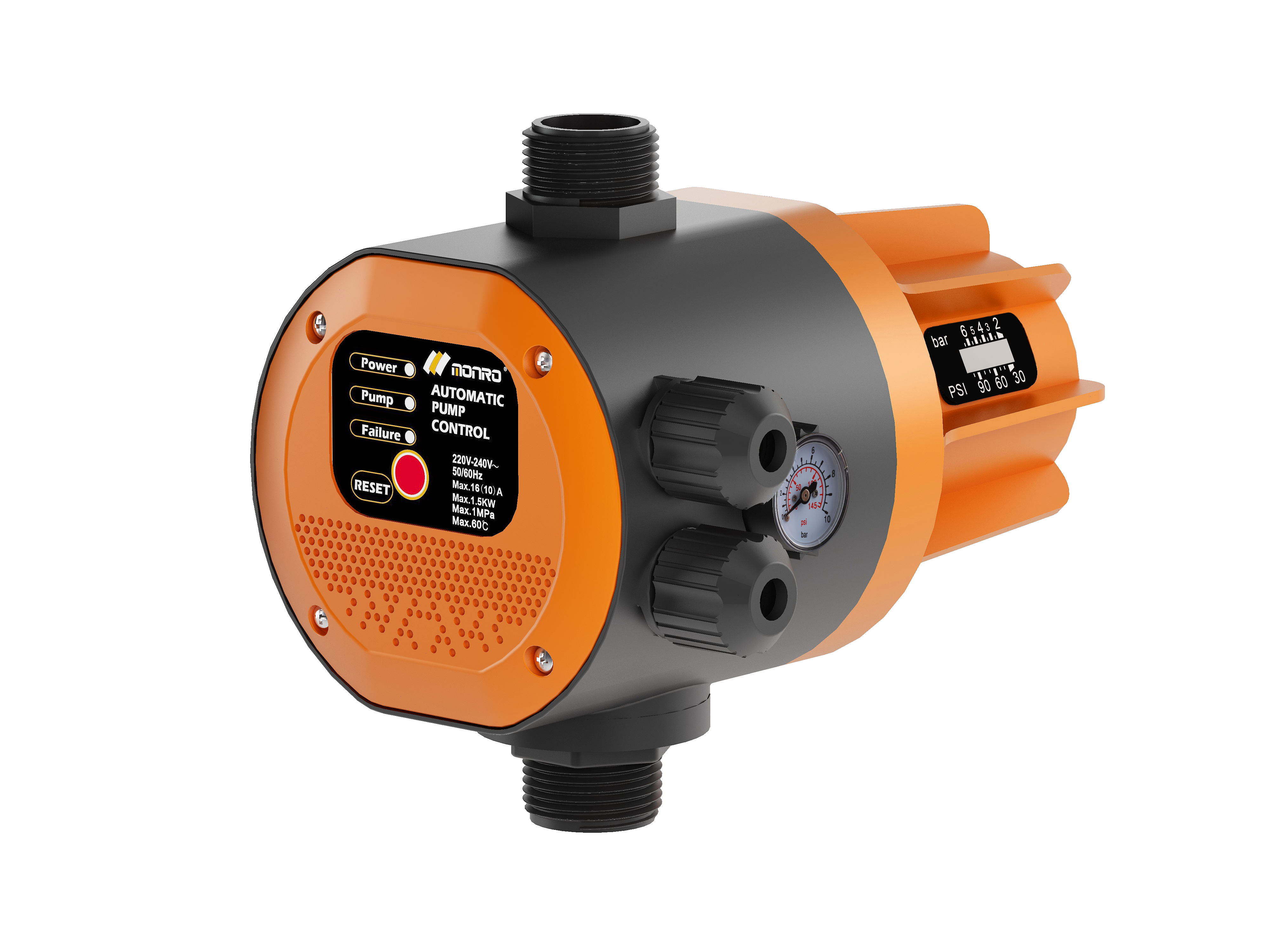
Electronic pressure control switch with IP65 protection and dry-run protection.
For importers, pump manufacturers, and distributors sourcing pressure control switches for the European market, CE certification is not optional documentation—it is a core purchasing requirement. This guide explains what CE certification means for pressure control switches, which models carry CE-EMC or TÜV Rheinland safety certification, and the technical and compliance factors to verify during supplier qualification. It focuses on practical sourcing decisions rather than brand promotion.
Why CE Certification Matters for Pressure Control Switches
CE marking indicates that a product complies with applicable European Union directives—for automatic pump controllers, primarily the Electromagnetic Compatibility (EMC) Directive 2014/30/EU and the Low Voltage Directive. Without valid CE certification, importing and selling pressure controls in the EU creates customs, liability, and market-access risks. For buyers, the certification documents themselves matter: a certificate number, issuing body, and applicable standards are what a compliance audit verifies.
Monro Switch—officially ZHEJIANG MONRO MACHINERY & ELECTRONIC CO.,LTD—is a manufacturer based in Wenling City, Zhejiang Province, specializing in pump controllers, pressure switches, and float switches. The company holds TUV (Germany) and CE (Europe) certifications for its control products, with select models also approved under the CUL (U.S. and Canada) standard. For a sourcing evaluation, these credentials establish a baseline that must be checked against specific model certificates.
What the CE Certification Chain Covers for Automatic Pump Controls
An automatic pressure control switch typically combines pressure sensing, flow detection, and electrical switching in one unit. The relevant standards for these controls include EN IEC 55014-1, EN IEC 55014-2, EN 61000-3-2, and EN 61000-3-3 for EMC performance, and EN 60730-1 / EN 60730-2-6 for electrical safety of automatic pressure sensing controls. A robust CE file covers both dimensions.
Monro Switch provides CE-EMC Certificates of Conformity issued by TÜV Rheinland LGA Products GmbH for multiple EPC-series models. For safety, the EPC-10, EPC-12, EPC-14, and EPC-16 models carry TÜV Rheinland Safety Certification under certificate number R 50175890, with applicable standards EN60730-1:2016+A1+A2 and EN60730-2-6:2016+A1. Buyers should ask to see the certificate that matches the exact model being quoted, since coverage varies by model.
Model-Level Certification Coverage
Certification is not uniform across a manufacturer's catalogue. Each model must be evaluated individually. From the Monro product range, the following certification patterns are identifiable:
| Model | Product Type | Certification | Certificate / Standard Evidence |
|---|---|---|---|
| EPC-1 | Pump pressure control | CE-EMC; ISO9001:2015 | CE-EMC Certificate No. AE505724390001; EN IEC 55014-1, EN IEC 55014-2, EN 61000-3-2, EN 61000-3-3 |
| EPC-2 / EPC-2.1 | Pump pressure control | CE-EMC | Certificate of Conformity under Directive 2014/30/EU |
| EPC-3 / EPC-3P | Pump pressure control | CE-EMC | EN IEC 55014-1, EN IEC 55014-2, EN 61000-3-2 |
| EPC-4 / EPC-5 / EPC-15 | Pump pressure switch | CE-EMC | Certificate No. AE505724390001 (group coverage) |
| EPC-10 | Pump pressure switch | TÜV Rheinland Safety | R 50175890; EN60730-1, EN60730-2-6 |
| EPC-12 | Pump pressure switch | TÜV Rheinland Safety; CE-EMC | R 50175890; EN60730-1, EN60730-2-6; EN 61000-3-2 |
| EPC-14 | Pump pressure switch | TÜV Rheinland Safety; CE-EMC | R 50175890; AE505987560001 |
| EPC-16 | Pump pressure switch | TÜV Rheinland Safety; CE-EMC | R 50175890; AE0604425 0001 |
| KRS-4 | Mechanical pressure control | UL Listed | E316396, UL LLC, North America |
Model-level certifications: verify the certificate matches the exact model being sourced.
This table serves as a compliance checklist, not a substitute for reviewing original certificate PDFs before placing an order.
Electronic vs Mechanical Pressure Control: Compliance Differences
Electromechanical pressure switches account for roughly 62% of the global pressure switch market, while electronic solid-state switches hold about 38%—a segment that is significant and growing in pump applications. For international buyers, both families serve different compliance profiles.
Mechanical pressure switches such as the Monro KRS series (KRS-1 through KRS-8) are used in water systems to start and stop the pump at preset pressure thresholds. They are typically simpler, with rated voltages of 110–240 V or 400 V, current ratings from 10(4) A to 20(16) A, and protection ratings from IP20 to IP44. For North American distribution, the KRS-4 model is UL Listed under certificate E316396.
Electronic pump controllers like the Monro EPC series add dry-run protection, check valves, programmable start/stop pressures, and digital displays. Their typical ratings include 100–240 V input, 50/60 Hz, 0.55–2.2 kW max power, IP54 or IP65 protection, and working temperatures up to 60°C. Because they contain active electronic controls, EMC testing is a mandatory part of CE compliance.
Key Specifications to Compare When Sourcing CE-Certified Pressure Control Switches
Buyers should combine compliance verification with technical matching. The comparison criteria below reflect the parameters most often used by pump OEMs, distributors, and irrigation system integrators.
| Parameter | Electronic Pump Controller Example | Mechanical Pressure Switch Example |
|---|---|---|
| Model | EPC-10 | KRS-8 |
| Rated Voltage | 110–240 V | 110–240 V / 400 V |
| Frequency | 50/60 Hz | 50/60 Hz |
| Max. Power | 2.2 kW / 1.1 kW | — |
| Rated Current | — | 20(16) A |
| Pressure Setting Range | 0.5–9.3 bar (start), 0.7–9.5 bar (stop) | 1–6 bar or 6–12 bar |
| Protection Rating | IP65 | IP44 |
| Max. Working Temp. | 60°C | 55°C |
| Connection Thread | G1" | 1/4" / 3/8" F |
| Key Features | Dry-run protection, check valve, timing mode | Mechanical auto on/off |
| Certification | TÜV Rheinland Safety; CE-EMC | CE (Europe); ISO 9001 system |
This side-by-side comparison gives a quick filter: a European distributor shipping to domestic or agricultural water systems might favor EPC-series controllers with CE-EMC and TÜV safety certificates; a wholesaler serving North American replacement demand may prioritize UL-listed KRS-4 units.
Selecting a Factory for CE-Certified Pressure Controls: Evaluation Criteria
When assessing a potential supplier, the evaluation should cover more than the certificate files. The following criteria form a practical audit framework:
- Certification traceability: certificates must name the exact model, list the applicable standard, and be issued by a recognized body. For Monro, TÜV Rheinland safety certificates show certificate R 50175890 for EPC-10/12/14/16, and UL LLC issued E316396 for KRS-4.
- Testing and quality system: an ISO 9001:2015 quality management system (Monro certificate number 20126Q00115R300) supports production consistency. Monro states 100% testing of output.
- Customization capability: CE-certified products can still be customized in cable length, color, and packaging, provided the certified electrical design is not altered. Monro supports OEM customization including brand labeling and color box design.
- Capacity and lead time: verify the factory can support your order volume. Monro reports 180,000 pcs/month for EPC series, 250,000 pcs/month for KRS series, and 30,000 pcs/month for float switches, with a 45-day lead time and 204-piece MOQ.
- Export experience: Monro exports roughly 90% of output to Asia, Europe, North and South America, the Middle East, and Africa, which indicates existing logistics and documentation familiarity for regulated markets.
Common Use Cases for CE-Certified Pressure Control Switches
CE-certified pressure controls are deployed across several water-system categories. For each use case, the buyer should prioritize a different feature set.
1. Domestic / Residential Water Supply
Automatic pump start/stop control is the most common application. The controller activates the pump at a preset low-pressure setpoint and stops it when the high-pressure setpoint is reached. Suitable products include EPC-1, EPC-2, and EPC-4, which offer 1.2–2.5 bar adjustable starting pressure, built-in run-dry protection, and IP65 protection for clean water.
2. Agriculture Irrigation
Irrigation systems face variable flow, low water levels, and outdoor installation. IP65-rated controllers such as EPC-5, EPC-10, and EPC-19 are designed for clean water media with working pressures up to 10 bar. Dry-run protection is particularly important for protecting submersible pumps in wells and tanks.
3. Water Treatment and Construction
These environments may require higher pressure ranges or multi-mode operation. The EPC-12P provides a digital pressure display, 0.5–6.7 bar starting pressure, and three operating modes—pressure, flow, and timed—useful for booster systems and tower filling. The mechanical KRS-8 covers higher ranges up to 6–12 bar with an IP44 rating.
Step-by-Step Sourcing Checklist for CE-Certified Pressure Controls
Use this workflow to convert a compliance requirement into a confirmed purchase order.
- Define the electrical environment: voltage, frequency, max. pump power, and available connection thread (e.g., G1", 1/4" female, NPT1").
- Define the pressure band: starting pressure, cut-out pressure, and pressure range, based on pump head and maximum water use height. As a rule, if starting pressure is 1.2 bar, the maximum water use height is approximately 12 meters, and pump lift should be at least (1.2 + 0.8) × 10 = 20 meters.
- Define the protection requirements: IP44 for indoor or protected installation; IP54/IP65 for potentially wet or outdoor installations.
- Select the control family: mechanical (KRS series) for simple replacement and cost-driven projects; electronic (EPC series) for dry-run protection, constant-pressure behavior, and multi-function control.
- Verify CE documentation: confirm the certificate covers the exact model, check the certificate number and issuing body, and request PDF copies.
- Request samples for testing before mass order, and confirm that the sample marking matches the certificate.
- Confirm MOQ, lead time, customization options, and after-sales support. Monro's standard MOQ is 204 pieces, with 45-day lead time and one-year warranty.
Monro Switch Manufacturing Background
ZHEJIANG MONRO MACHINERY & ELECTRONIC CO.,LTD (Monro Switch) is located in Wenling City, Zhejiang Province, a coastal manufacturing region. Although the company was established in 2010, it reports over 20 years of accumulated manufacturing expertise in pressure controls and float switches. The factory occupies 30,000 m² with around 200 employees, including 10 R&D engineers. Annual output is approximately 2.88 million EPC-series controllers, 3.24 million KRS-series pressure switches, and 0.6 million FPS-series float switches.
The company operates an ISO 9001:2015 quality management system and reports full testing of production units. Its listed honors include Specialized and Sophisticated SME of Zhejiang Province, Innovative SME of Zhejiang Province, and Top 100 Enterprise of Wenling City. These corporate facts are useful for a supplier questionnaire, though they do not replace product-level CE review.
FAQ
1. What should a CE certificate for a pressure control switch include?
A valid CE certificate for a pressure control switch should name the exact product model, list the applicable EU standards, identify the issuing body, and include a certificate number. For Monro EPC-series controllers, CE-EMC certificates are issued by TÜV Rheinland LGA Products GmbH, and safety certifications under EN60730-1 / EN60730-2-6 are also available for models EPC-10, EPC-12, EPC-14, and EPC-16.
2. Which Monro pressure control switch models have CE certification?
Monro EPC-series pump controllers with CE-EMC certification include EPC-1, EPC-2, EPC-2.1, EPC-3, EPC-3P, EPC-4, EPC-5, EPC-12, EPC-14, EPC-15, and EPC-16, among others. TÜV Rheinland Safety Certification covers EPC-10, EPC-12, EPC-14, and EPC-16. Because certification is model-specific, always request the certificate that names the exact model you intend to purchase.
3. What are the technical requirements for CE-certified electronic pump controllers?
An electronic pump controller intended for the EU should meet EMC standards such as EN IEC 55014-1, EN IEC 55014-2, EN 61000-3-2, and EN 61000-3-3, plus the safety standard EN 60730-2-6 for automatic electrical pressure sensing controls. Monro EPC-series controllers typically operate at 110–240 V, 50/60 Hz, with IP54 or IP65 protection and dry-run protection built in.
4. Can I request a sample or quotation for a CE-certified pressure control switch?
Yes. OEM and wholesale buyers can contact Monro Switch directly for sample requests and quotations. Send the pump power, voltage, connection thread, and target pressure range so the sales team can recommend the correct model from the CE-certified EPC or KRS series.
Conclusion
CE certification is a decisive filter when sourcing pressure control switches for the European market, but it must be verified at the model level. Electronic controllers such as Monro's EPC series provide CE-EMC and TÜV Rheinland safety certificates for selected models, while mechanical KRS-series switches serve cost-focused and replacement applications. Use the model-level table, specification comparison, and sourcing checklist to request the right documents and test the right samples before committing to a large order.
Need a CE-certified pressure control switch for your pump system?
Download the Monro Switch catalogue to review models, specifications, and certification coverage.
Download Catalogue (PDF)Have Questions or Need More Details?
Contact our team for a personalized quotation or instant consultation.
Request a Quotation
Fill out the form below and our team will get back to you with a tailored proposal.
WhatsApp Direct Chat
Prefer to chat in real-time? Message us on WhatsApp for instant assistance & quick answers.
- Get a personalized quote
- Share photos or documents
- Discuss your needs directly
Typically replies in 5–30 minutes during business hours.