
EPC-1.1 vs EPC-2.1 vs EPC-3: Pump Pressure Switch Comparison Guide
A pump pressure switch that is one model off can still fit the pipe, still start the pump and still pass a quick bench check — which is exactly why the EPC-1.1, EPC-2.1 and EPC-3 get treated as interchangeable during sourcing. They are not interchangeable. All three share the same 1.2 bar, 1.5 bar and 2.2 bar starting-pressure settings, the same 50/60 Hz power frequency and the same 220–240 V / 110–120 V supply options. The differences that decide a project sit elsewhere: motor power ceiling, enclosure rating, hydraulic connection, wiring layout and built-in hydraulic protection.
This guide compares the three models on those decision points, then sets out a selection sequence for domestic water supply, agricultural irrigation and construction installations. Zhejiang Monro Machinery & Electronic Co., Ltd. (Monro Switch) is a pressure controller manufacturer based in Wenling City, Zhejiang Province, China, producing pump controllers, pressure switches and float switches. The EPC series is its automatic pump control line for water pump systems.
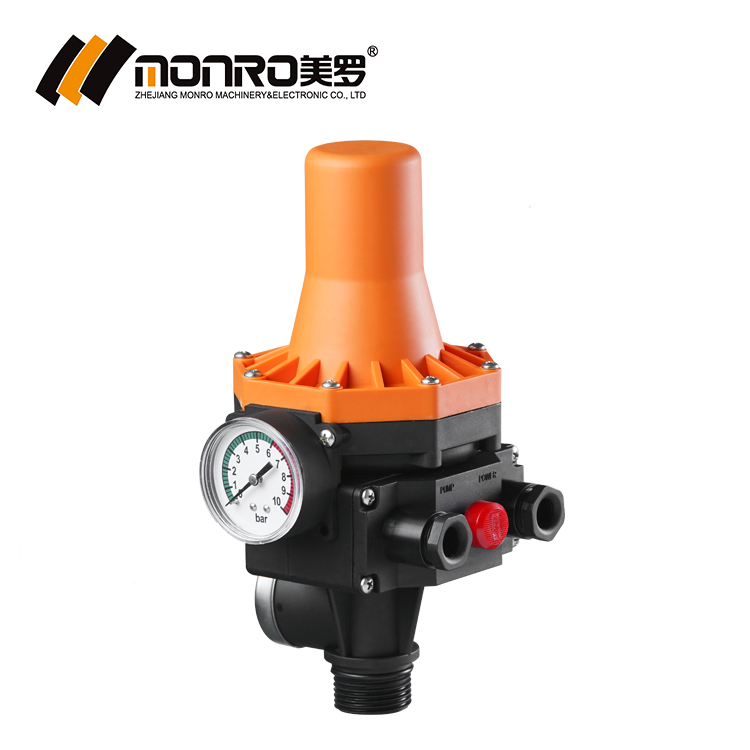
Why the EPC-1.1, EPC-2.1 and EPC-3 Are Not Interchangeable
The three models sit close together in the Monro catalogue, and the overlap is genuine: identical starting-pressure settings, identical voltage bands and a common 55 °C maximum working temperature. Selection errors therefore rarely show up at the quotation stage — they show up on site. The mismatches that matter are:
- Motor power ceiling. The EPC-1.1 is rated 1.1 kW / 1.5 kW / 0.75 kW, while the EPC-2.1 and EPC-3 are rated 0.55 kW / 1.1 kW / 1.5 kW / 0.75 kW. Monro's own selection guidance for automatic pump controllers begins with matching the motor power of the water pump.
- Starting pressure against pump lift. Starting pressure has to suit the pump lift and the maximum water use height. At a 1.2 bar start, the maximum water use height works out at 12 metres (1.2 × 10 m), and the pump lift should be at least 20 metres ((1.2 + 0.8) × 10 m).
- Enclosure rating. The EPC-1.1 and EPC-3 are rated IP65; the EPC-2.1 is rated IP44. All three cap out at a 55 °C maximum working temperature.
- Hydraulic connection. The EPC-1.1 offers G1", G1 1/4", G1 1/2" and NPT1"; the EPC-2.1 uses R1"; the EPC-3 uses G1".
- Wiring and local readout. The EPC-2.1 has a built-in socket with the inlet and outlet set at 90 degrees; the EPC-3 carries a pressure gauge for real-time pressure monitoring.
Skipping these checks tends to surface later as nuisance trips, short cycling or a second site visit to re-pipe a connection — costs that are far larger than the price difference between three adjacent models.
What the Wider Pressure Switch Market Says About Model Selection
Model-level selection sits inside a market still dominated by electromechanical designs. Published research values the global pressure switch market at USD 3.2 billion in 2025, with a projection from USD 3.38 billion in 2026 to USD 5.13 billion by 2034 (Fortune Business Insights). Electromechanical pressure switches accounted for approximately 62% of global market share in 2024, against roughly 38% for solid-state electronic pressure switches (Market Research Future).
Two practical consequences follow for anyone comparing the EPC-1.1, EPC-2.1 and EPC-3:
- Standardised product categories, model-specific ratings. IEC 60730-2-6:2025, published by the International Electrotechnical Commission, is the current international standard for automatic electrical pressure sensing controls. It defines the product category, not the model. What separates the EPC-1.1, EPC-2.1 and EPC-3 remains power rating, enclosure rating and connection format.
- Trade documentation follows the same logic. Water pump pressure switches are commonly traded under HS Code 853650 (United Nations Statistics Division), so the model number, voltage band and enclosure rating declared on the datasheet are what customs and technical files will be checked against.
Supply-side context matters too. Monro's EPC series runs at an annual output of 2.88 million pcs, alongside 3.24 million pcs of the KRS mechanical pressure control series and 0.6 million pcs of FPS float switches, with roughly 90% of output exported to Asia, Europe, North and South America, and the Middle East and Africa. Monro lists more than 40 pressure controller models for water pump systems and air compressors, so the EPC-1.1, EPC-2.1 and EPC-3 exist as individual configurations rather than as one flexible model — which is why the specification stage is the only reliable place to control the outcome.
Model-by-Model: What Each EPC Variant Actually Specifies
EPC-1.1 — domestic water supply control with four connection formats
The EPC-1.1 is catalogued as a pump pressure control and is listed for domestic applications. Its declared data is:
- Rated voltage: 220–240 V / 110–120 V; power frequency 50/60 Hz
- Maximum power: 1.1 kW / 1.5 kW / 0.75 kW
- Starting pressure setting: 1.2 bar, 1.5 bar or 2.2 bar
- Connection thread: G1", G1 1/4", G1 1/2" or NPT1"
- Protection rating: IP65; maximum working temperature 55 °C
- Housing material: plastic and metal
- Built-in check valve and built-in run-dry protection
For a distributor, the four connection formats are the defining feature: one model number covers both G-thread and NPT-thread markets as well as the common domestic pipe sizes, which reduces the number of adapters that have to be stocked alongside it. For an installer, the IP65 enclosure combined with the 1.1 kW / 1.5 kW / 0.75 kW power band covers the pump sizes normally found on residential booster and tank-fed supply systems.
EPC-2.1 — the IP44 variant designed around installation speed
The EPC-2.1 is catalogued as a pump pressure switch. Its published data is:
- Rated voltage: 220–240 V / 110–120 V; power frequency 50/60 Hz
- Maximum power: 0.55 kW / 1.1 kW / 1.5 kW / 0.75 kW
- Starting pressure setting: 1.2 bar, 1.5 bar or 2.2 bar; adjustable starting pressure range of 1.5–3.0 bar on the adjustable version
- Connection thread: R1"
- Protection rating: IP44; maximum working temperature 55 °C
- Housing material: plastic and metal
- Available in adjustable and non-adjustable versions
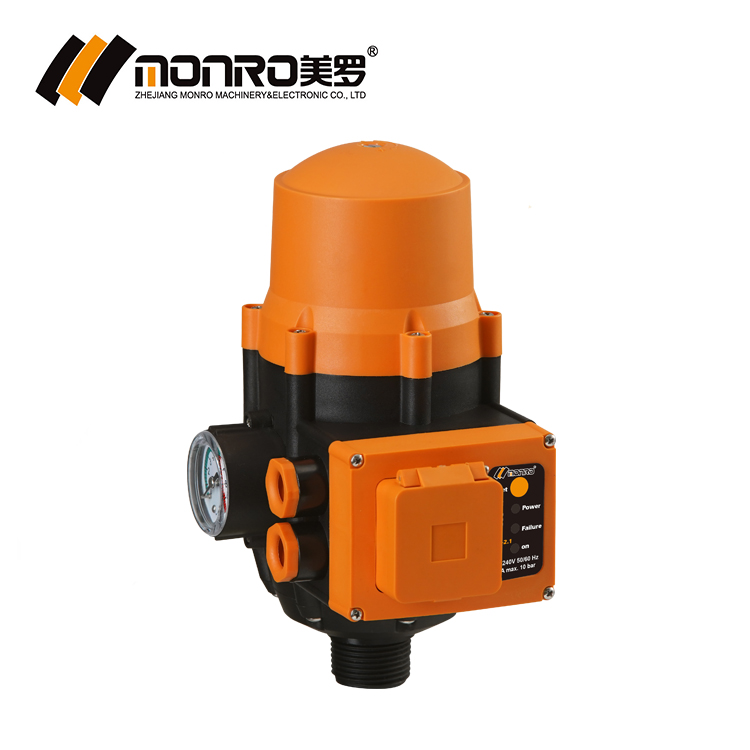
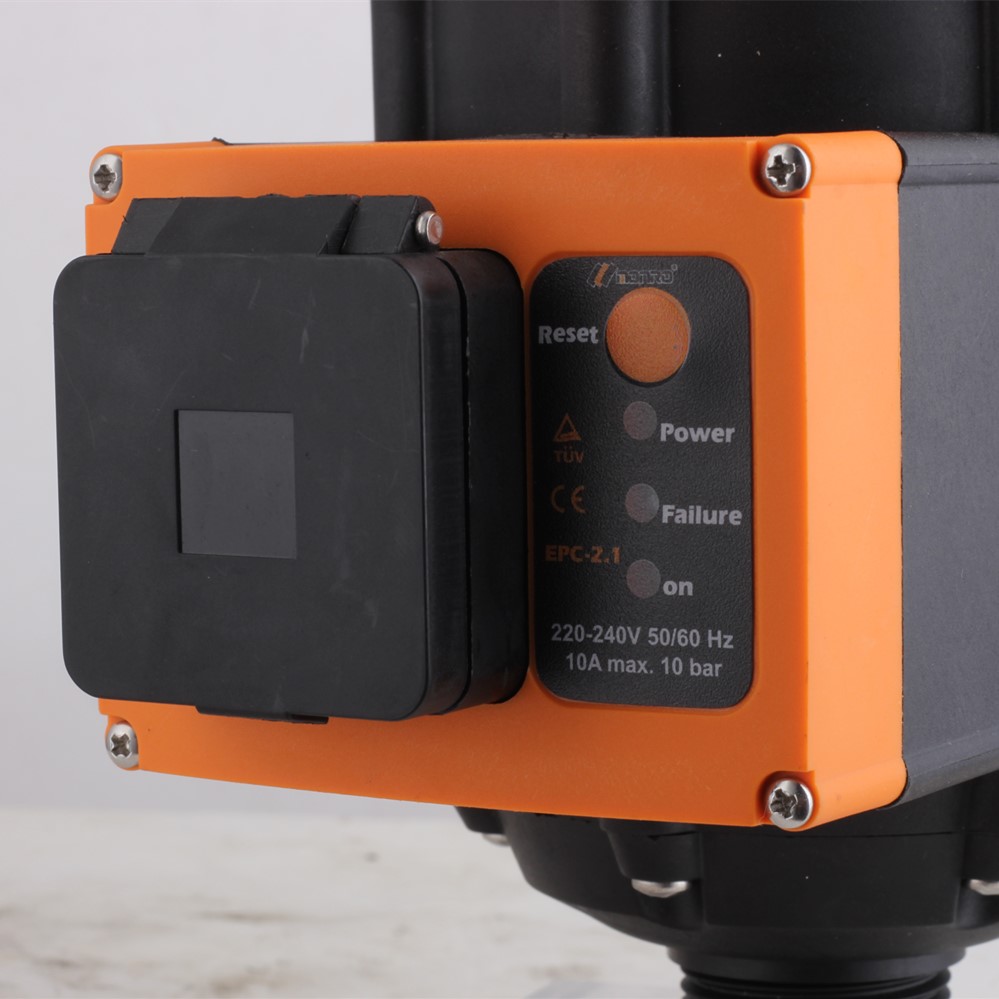
- Inlet and outlet set at 90 degrees, with a built-in socket to make wiring easier and faster
- Built-in check valve and built-in run-dry protection, per the published model data
The 90-degree inlet and outlet plus the built-in socket are the practical differentiators: the body drops into vertical pipe runs and the wiring terminates in the unit rather than in a separate junction box, which shortens on-site assembly time. The constraint to check first is the enclosure. At IP44, the EPC-2.1 belongs in a covered plant room, cabinet or sheltered riser — not in an exposed outdoor position, where the IP65 rating of the EPC-1.1 or EPC-3 is the relevant choice.
EPC-3 — the IP65 variant with a built-in pressure gauge
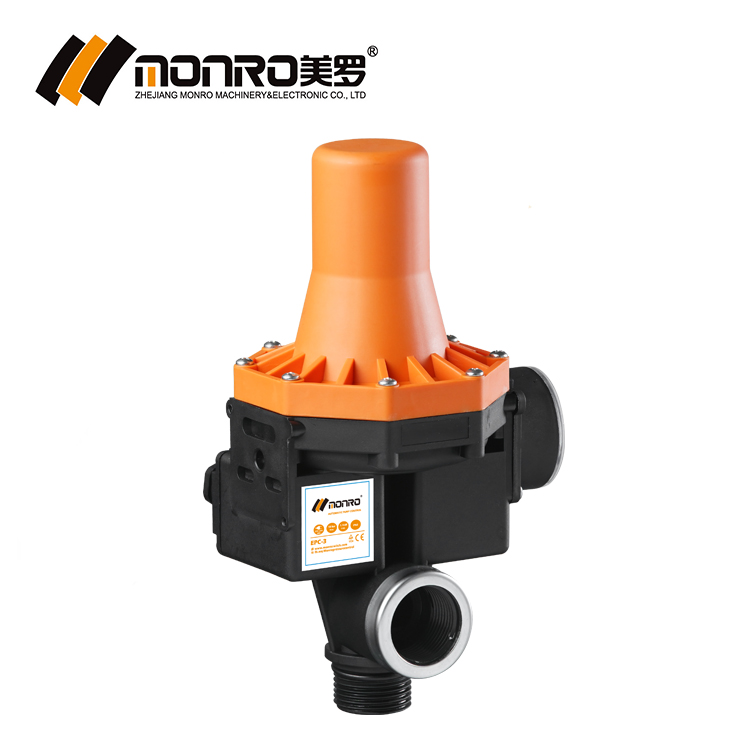
The EPC-3 is catalogued as a pump pressure control and carries the widest published feature set of the three models:
- Rated voltage: 220–240 V / 110–120 V; power frequency 50/60 Hz
- Maximum power: 0.55 kW / 1.1 kW / 1.5 kW / 0.75 kW
- Starting pressure setting: 1.2 bar, 1.5 bar or 2.2 bar
- Connection thread: G1"
- Protection rating: IP65; maximum working temperature 55 °C
- Built-in pressure gauge for real-time pressure monitoring
- Built-in check valve and built-in run-dry protection
- Maintains constant pressure at constant flow; can be used with surface or submersible pumps; simple installation
The gauge changes the service workflow. A technician can read line pressure during commissioning and fault-finding without fitting a separate instrument, and the outlet behaviour can be checked against the starting-pressure setting on the spot. Where the installation is outdoors, in a wet plant room, or serviced by staff who are not pump specialists, the EPC-3 combines IP65 sealing with that local readout.
Side-by-Side Comparison: EPC-1.1 vs EPC-2.1 vs EPC-3
The first table covers the electrical and hydraulic data that a buyer must match to the pump and the pipework.
| Specification | EPC-1.1 | EPC-2.1 | EPC-3 |
|---|---|---|---|
| Product type | Pump pressure control | Pump pressure switch | Pump pressure control |
| Rated voltage | 220–240 V / 110–120 V | 220–240 V / 110–120 V | 220–240 V / 110–120 V |
| Power frequency | 50/60 Hz | 50/60 Hz | 50/60 Hz |
| Maximum power | 1.1 kW / 1.5 kW / 0.75 kW | 0.55 kW / 1.1 kW / 1.5 kW / 0.75 kW | 0.55 kW / 1.1 kW / 1.5 kW / 0.75 kW |
| Starting pressure setting | 1.2 / 1.5 / 2.2 bar | 1.2 / 1.5 / 2.2 bar | 1.2 / 1.5 / 2.2 bar |
| Connection thread | G1", G1 1/4", G1 1/2", NPT1" | R1" | G1" |
| Protection rating | IP65 | IP44 | IP65 |
| Maximum working temperature | 55 °C | 55 °C | 55 °C |
| Housing material | Plastic, metal | Plastic, metal | Plastic, metal |
The second table covers the features and the application fit that usually decide between otherwise compatible units.
| Feature / fit | EPC-1.1 | EPC-2.1 | EPC-3 |
|---|---|---|---|
| Built-in check valve | Yes | Yes | Yes |
| Built-in run-dry protection | Yes | Yes | Yes |
| Built-in pressure gauge | Not listed | Not listed | Yes — real-time pressure monitoring |
| Starting pressure adjustability | Fixed settings: 1.2 / 1.5 / 2.2 bar | Adjustable or non-adjustable version; adjustable range 1.5–3.0 bar | Fixed settings: 1.2 / 1.5 / 2.2 bar |
| Installation and wiring layout | Not listed | Inlet and outlet at 90 degrees; built-in socket | Simple installation; surface or submersible pumps |
| Primary application fit | Domestic water supply | Agriculture irrigation, water treatment, construction | Agriculture irrigation, water treatment, construction |
Step-by-Step: How to Select the Right Model for a Project
The comparison above only becomes a decision when it is applied in a fixed order. This is the sequence Monro's controller guidance implies, extended across the three models.
- Match the controller to the pump motor. Read the motor power off the pump nameplate and compare it with the controller's maximum power rating. The EPC-1.1 covers 1.1 kW, 1.5 kW and 0.75 kW; the EPC-2.1 and EPC-3 cover 0.55 kW, 1.1 kW, 1.5 kW and 0.75 kW.
- Set the starting pressure from lift and use height. Maximum water use height equals starting pressure × 10 m. At 1.2 bar, that is 12 metres of usable height, and the pump lift should be at least (1.2 + 0.8) × 10 m = 20 metres. If the pump lift is below this, select a lower starting pressure, or confirm the pump can meet the duty. The EPC-2.1's adjustable version extends the starting-pressure range to 1.5–3.0 bar.
- Confirm the electrical supply. All three models accept 220–240 V or 110–120 V at 50/60 Hz, so the voltage band rarely eliminates a model — but it must still be declared correctly for the destination market and for trade documentation under HS Code 853650.
- Match the hydraulic connection to the existing pipework. EPC-1.1 gives G1", G1 1/4", G1 1/2" and NPT1"; the EPC-2.1 uses R1" with a 90-degree inlet and outlet; the EPC-3 uses G1".
- Match the enclosure to the installation environment. IP44 (EPC-2.1) suits a covered plant room or cabinet. IP65 (EPC-1.1 and EPC-3) is the choice for exposed positions, wet plant rooms and dusty sites. All three are limited to a 55 °C maximum working temperature.
- Decide whether the installation needs a local readout. If technicians will commission or fault-find the system on site, the EPC-3's built-in pressure gauge removes the need for a separate instrument on the line.
- Commission in the documented order. Check that the pump runs normally on its own and that the nameplate parameters match those of the pressure controller; confirm the pump head is at least 0.8 bar higher than the controller's start-up pressure; install the controller in the direction shown by the arrow on its housing; connect the controller's power cord to a separate plug wire and seal the joint with waterproof insulating tape; then open the main outlet valve and all water faucets before connecting the power supply.
Use Cases: Domestic, Irrigation, Construction and Water Treatment
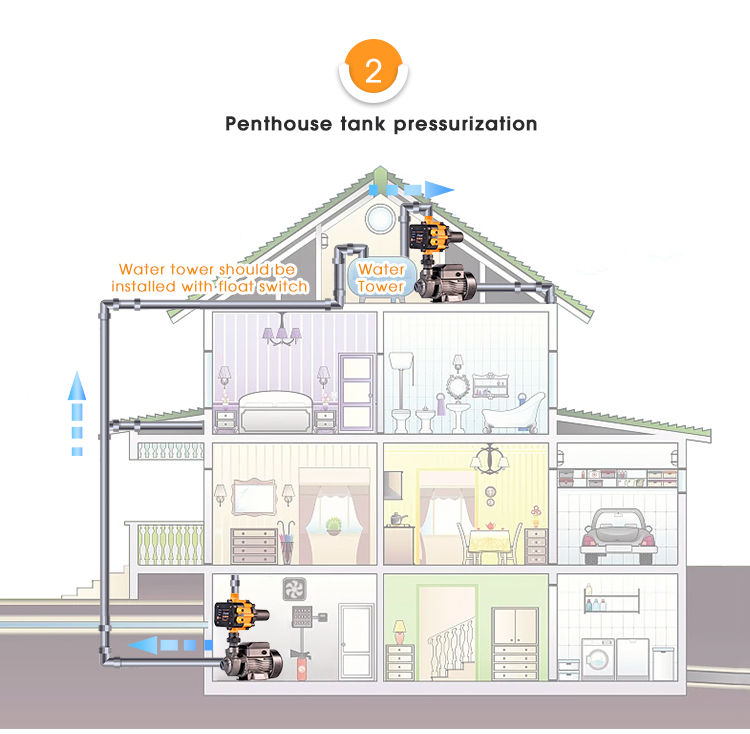
The EPC-1.1, EPC-2.1 and EPC-3 are all listed for automatic pump start/stop control in water systems, and the wider EPC application data covers agriculture irrigation, water treatment and construction, with domestic and residential water supply as the reference scenario. In operation, the controller activates the pump at the preset low-pressure setpoint and deactivates it at the high-pressure setpoint, responding automatically to system pressure changes. The working fluid is clean water, and the matched equipment is a water pump.
Domestic and residential water supply
Booster and tank-fed systems in houses and small buildings normally fall inside the 0.75–1.5 kW motor band, where the EPC-1.1's IP65 housing and its four connection formats make it the most flexible single model to specify. Where service access is poor and pressure needs to be visible during a call-out, the EPC-3 substitutes the gauge for the extra thread options.
Agriculture irrigation
Irrigation duty is where enclosure rating separates the models most sharply. The EPC-3, with IP65 sealing and a gauge, suits pump houses and field positions exposed to water and dust. The EPC-2.1 remains a reasonable choice when the controller is mounted inside a protected cabinet, and its 90-degree body helps in tight vertical pipe runs.
Construction water supply
Site supply systems are commissioned, adjusted and serviced by rotating crews rather than by one pump specialist, which is the argument for the EPC-3's built-in pressure gauge: the reading needed to verify a starting-pressure setting is available on the unit itself, without extra tooling.
Water treatment
Water treatment duty appears across the EPC application data alongside irrigation and construction. Because the working fluid is clean water and the pressure range for these applications is given as 0.5–10 bar, all three models sit inside the application envelope; the selection again reduces to power rating, enclosure and connection.
Field reference
A retail customer in China installed 50 pressure control switches in a water supply system serving agriculture irrigation, water treatment and construction applications. The system has been in operation for two years and delivers reliable automatic pressure control with automatic pump start/stop as its core function.
Frequently Asked Questions
Which standard covers an automatic pump pressure control switch, and does it differ between the EPC-1.1, EPC-2.1 and EPC-3?
IEC 60730-2-6:2025, published by the International Electrotechnical Commission, is the current international standard for automatic electrical pressure sensing controls. It applies to the product category rather than to a single model, so it does not separate the EPC-1.1, EPC-2.1 and EPC-3. What does separate them is the declared rating on each datasheet: maximum power (EPC-1.1 at 1.1 kW / 1.5 kW / 0.75 kW; EPC-2.1 and EPC-3 at 0.55 kW / 1.1 kW / 1.5 kW / 0.75 kW), enclosure rating (IP65 for the EPC-1.1 and EPC-3, IP44 for the EPC-2.1) and connection format. Monro operates an ISO 9001:2015 quality management system and holds TUV (Germany) and CE (Europe) certification, with selected models approved to the CUL standard; because approval scope is model-specific, confirm the certificate that applies to the exact model and destination market before ordering.
Can the EPC-1.1, EPC-2.1 or EPC-3 be customized for a specific project?
Monro manufactures under an OEM model, with customization options that include cable length, cable material, brand customization, color box customization and color customization. On the product side, the EPC-2.1 is available in adjustable and non-adjustable versions, with the adjustable version covering a 1.5–3.0 bar starting-pressure range, while the EPC-1.1 and EPC-3 are specified with 1.2 bar, 1.5 bar and 2.2 bar starting-pressure settings. Configuration work is supported by a team of 10 engineers, and every unit is 100% tested.
What drives the cost difference between the EPC-1.1, EPC-2.1 and EPC-3?
Pricing is quoted per configuration, but the cost drivers that a buyer can compare directly are visible in the model data. The EPC-1.1 and EPC-3 are rated IP65, while the EPC-2.1 is rated IP44. The EPC-3 adds a built-in pressure gauge for real-time monitoring. The EPC-2.1 carries a built-in socket and a 90-degree inlet and outlet, which reduces on-site wiring work. The EPC-1.1 covers four connection formats — G1", G1 1/4", G1 1/2" and NPT1" — which matters for distributors serving both G-thread and NPT-thread markets from one stock position. Order volume also affects the commercial terms, and Monro's minimum order quantity is 204 pcs.
How should a buyer validate a model before committing to a full order?
Validation happens on two levels. On the data level, confirm that the controller's maximum power rating matches the pump motor, that the starting pressure suits the pump lift and maximum water use height, and that the connection thread and enclosure rating match the installation. On the installation level, Monro's commissioning guidance is to verify that the pump operates normally and that the nameplate parameters match those of the pressure controller, to ensure the pump head is at least 0.8 bar higher than the controller's start-up pressure, to install the controller in the direction indicated by the arrow on its housing, to seal all wire joints with waterproof insulating tape, and to open the main outlet valve and all faucets before connecting the power supply. Buyers who want to confirm the fit first can request a sample and a quotation directly from Monro Switch.
What is the lead time and minimum order quantity for the EPC series?
Monro's stated production lead time is 45 days, with a minimum order quantity of 204 pcs. Monthly capacity for the automatic pump control (EPC) series is 180,000 pcs, with pressure switches (KRS) at 250,000 pcs and float switches and liquid level controls (FPS and STSW) at 30,000 pcs. Every unit is 100% tested before shipment, and after-sales support covers remote technical support and a 1-year warranty. For a project-specific quotation or a sample of the EPC-1.1, EPC-2.1 or EPC-3, contact Monro Switch at sale@monro-switch.com.
Which Model Should You Specify?
The three models are closest where buyers expect differences and most different where buyers expect sameness. Starting-pressure settings, voltage band, frequency and maximum working temperature are effectively shared; the decision rests on four variables.
- Specify the EPC-1.1 when the application is domestic water supply and the connection format has to stay flexible across G1", G1 1/4", G1 1/2" and NPT1", with IP65 protection.
- Specify the EPC-2.1 when installation speed matters and the controller will sit in a covered, dry position — accepting IP44 in exchange for the 90-degree body, the built-in socket and the adjustable 1.5–3.0 bar version.
- Specify the EPC-3 when the enclosure must be IP65 and the people commissioning or servicing the system need to read pressure on the unit itself.
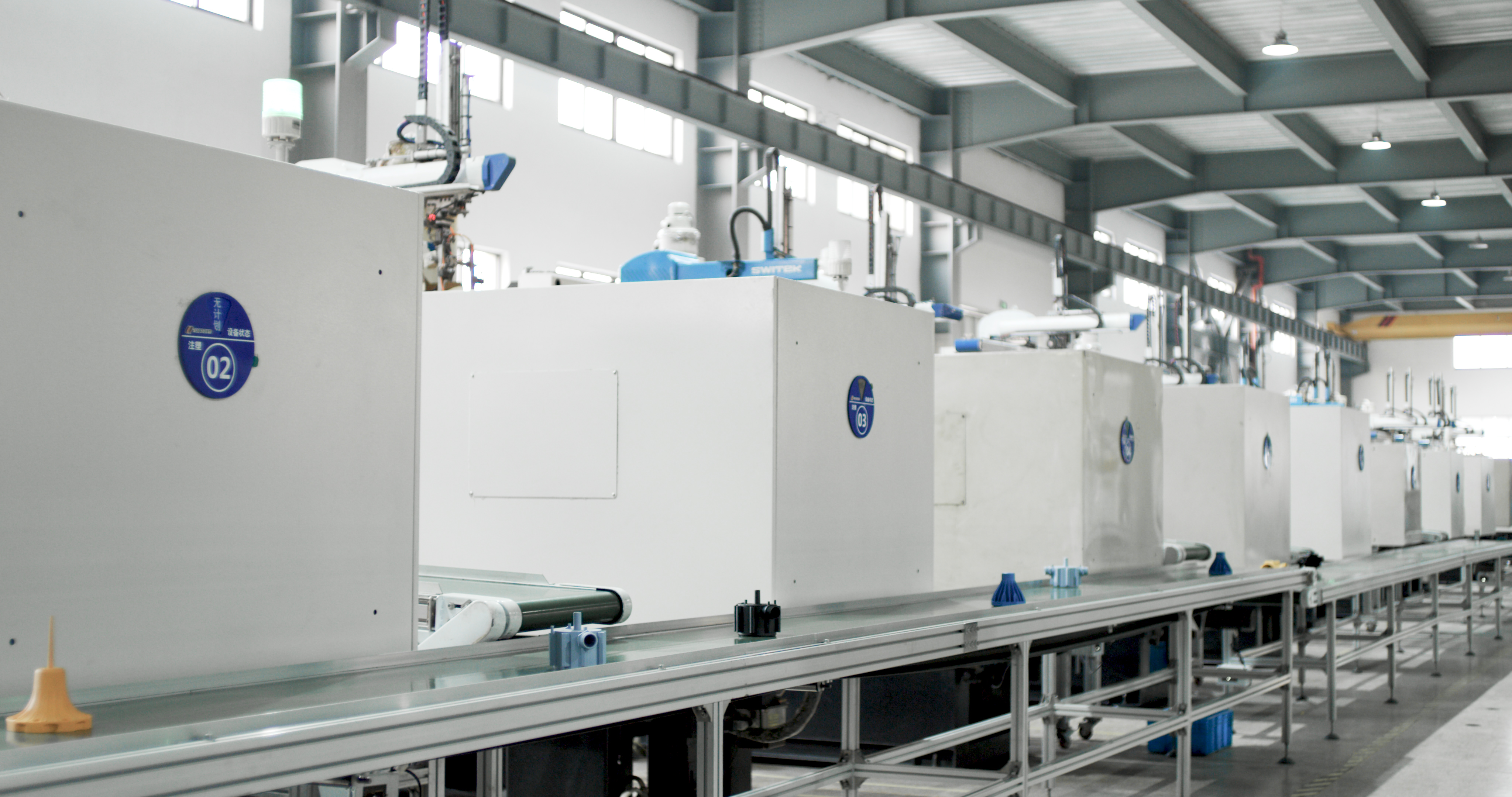
Zhejiang Monro Machinery & Electronic Co., Ltd. (Monro Switch) was founded in 2010 and operates a 30,000 m² facility in Wenling City, Zhejiang Province, China, with 200 employees. The company produces pump controllers, pressure switches and float switches under an ISO 9001:2015 quality management system, with 90% of output exported to Asia, Europe, North and South America, and the Middle East and Africa.
Next Step: Sample, Quotation or Catalogue
Send your pump motor rating, required starting pressure and pipe thread to Monro Switch and the EPC-1.1, EPC-2.1 or EPC-3 can be quoted against your actual duty rather than against a catalogue position. Samples and project quotations are available on request.
Email: sale@monro-switch.com | Tel / WhatsApp: +86 13586289715 | Website: www.monroswitch.com
Download the full 2025 product catalogue: Monro catalogue 2025 (PDF)
Address: No.2, 25th Street, Eastern New City, Wenling City, Zhejiang Province, China. Contact: Mable.