
Evaluating a Pressure Control Switch Supplier: EPC-1.1 to EPC-3 Capability and Delivery Checks
A pressure control switch supplier evaluation should end with two verifiable answers: which models the supplier can document, and when it can ship them. This guide uses four EPC-series pump pressure control models - EPC-1.1, EPC-2, EPC-2.1 and EPC-3 - as a worked example, and shows which specification data, certificate numbers, capacity figures and acceptance terms turn a capability claim into evidence a buyer can check.
Monro Switch (Zhejiang Monro Machinery & Electronic Co., Ltd.) is a pressure controller manufacturer located in Wenling City, Zhejiang Province, China. The company produces pump controllers, pressure switches and float switches, exports around 90% of its output, and lists more than 40 pressure controller models built for water pump systems and air compressors. Officially established in 2010, it works with more than 20 years of manufacturing experience in pressure controls and float switches.
Problem Definition: Why Capability Claims Are Hard to Verify Before You Order
Most pressure control switch purchases are decided before the buyer has seen anything checkable. A quotation confirms a price and a minimum order quantity. A catalog page confirms a shape and a model number. Neither confirms that the supplier can hold a specification across repeat orders, that the certification it mentions actually names the model on your purchase order, or that a stated lead time is realistic at your volume.
Three failures recur in this category:
- Specification drift. Starting pressure, connection thread, rated voltage and maximum power are quoted from memory or borrowed from a similar model. A pressure setting that does not match the pump curve produces short-cycling rather than a working system.
- Certificate scope gaps. Certification documents in this category name models individually. A supplier may hold valid certification for part of a series and not for the model you are buying, so a general statement such as "CE certified" is not sufficient evidence.
- Delivery assumptions. MOQ, lead time and acceptance criteria are frequently agreed verbally and confirmed only after the deposit is paid, at which point the schedule is already committed.
The framework below converts each claim into a document: model-level specification data, certificate numbers with named scope, published capacity figures, and written acceptance criteria.
Industry Background: What the Pressure Switch Category Looks Like Now
The global pressure switch market was valued at USD 3.2 billion in 2025 and is projected to grow from USD 3.38 billion in 2026 to USD 5.13 billion by 2034, according to Fortune Business Insights. Inside that total, Market Research Future estimates electromechanical pressure switches at approximately 62% of global share in 2024, with solid-state electronic pressure switches accounting for the remaining 38%.
That split matters for sourcing because both families are usually evaluated in the same exercise. Mechanical pressure controls remain the mainstream choice for straightforward pump start and stop duty, while electronic automatic pump controls are used where constant pressure behaviour, timing functions or dry-run protection are part of the requirement.
Two external references are useful when checking compliance claims. IEC 60730-2-6:2025 is the current international standard for automatic electrical pressure sensing controls, and water pump pressure switches are commonly traded under HS Code 853650. Both give buyers a neutral benchmark to compare against a supplier's own documentation.
Detailed Solution: Mapping Supplier Capability to Documented Models
Capability claims become checkable when they are attached to a series and a model. Monro Switch runs three product families relevant to water pump systems: the EPC series (automatic pump control and pump pressure control), the KRS series (mechanical pressure control) and the FPS series (float switch and liquid level control).
Pump pressure control: EPC-1.1, EPC-2, EPC-2.1 and EPC-3
These four models share a common electrical platform - 50/60 Hz, 220-240V or 110-120V, and starting pressure settings of 1.2 bar, 1.5 bar or 2.2 bar - but they differ in the details that decide whether an installation works:
- EPC-1.1 is a pump pressure control rated IP65 with a maximum working temperature of 55℃. Maximum power options are 1.1 kW, 1.5 kW and 0.75 kW. It offers the widest hydraulic connection choice in the group: G1", G1 1/4", G1 1/2" and NPT1".
- EPC-2 is a pump pressure switch documented for agriculture irrigation, water treatment and construction, made of plastic and metal, rated IP65 at 55℃, with maximum power options of 1.1 kW, 1.5 kW and 0.75 kW and an R1" connection thread.
- EPC-2.1 shares the R1" thread and the 55℃ rating but widens the power range to 0.55 kW, 1.1 kW, 1.5 kW and 0.75 kW, and is rated IP44.
- EPC-3 is rated IP65 at 55℃ with maximum power options of 0.55 kW, 1.1 kW, 1.5 kW and 0.75 kW. It uses a G1" connection thread and is documented for use with surface or submersible pumps.
Two checks that are often missed. First, built-in check valve and built-in run-dry protection are documented on specific EPC models - EPC-5.1 and EPC-12P - rather than across the entire EPC range. If run-dry protection is a requirement, confirm which model carries it instead of assuming it is standard. Second, where a pressure gauge or visual pressure readout is part of the specification, treat it as a configuration item to be confirmed in writing for the exact model; the published EPC-1.1, EPC-2, EPC-2.1 and EPC-3 data covers rated voltage, power frequency, maximum power, starting pressure setting, connection thread, protection rating and maximum working temperature.
Mechanical pressure control: KRS series
The KRS family covers mechanical pump controller duty from 1 to 8. Every model starts and stops the water pump automatically according to the set pressure. KRS-1 is rated IP20 with a 12A rated current and pressure ranges of 20-40 PSI, 30-50 PSI and 40-60 PSI. KRS-2 is rated IP20 at 10(4)A with adjustable pressure ranges of 1.0-1.8 bar, 1.2-2.2 bar and 2.2-3.0 bar, a minimum cut-in of 0.5 bar and a maximum cut-out of 3.0 bar. KRS-5, KRS-6 and KRS-7 move to IP44 for wetter installation positions, and KRS-8 is rated 20(16)A with pressure ranges of 1-6 bar and 6-12 bar.
Float switch and level control: FPS series
The FPS float switches are rated 250V at 50/60 Hz with a 16(8)A relay current, an IP68 protection rating and a maximum working temperature of 55℃. FPS-4 supports automatic water filling, automatic drainage with lack-of-water protection, and combined fill-water and drainage auto-switch mode, with cable lengths of 2 m, 3 m, 5 m and PVC or rubber cable options. FPS-5 is specified differently, with a service pressure of 7 bar, an operating pressure of 0.2-6 bar and G1", G3/4" and G1/2" connections.
OEM and customization scope
The manufacturer provides OEM production services and offers customization on cable length, cable material, brand, color box and color. Supporting capability data includes a 30,000 m² production facility, 200 employees and a 10-engineer R&D team. Corporate recognitions listed by the company include Specialized and Sophisticated SME of Zhejiang Province, Innovative SME of Zhejiang Province and Key Industrial Enterprise of Wenling City.
Capacity, quality control and commercial terms
Delivery assurance is a data question, not a promise. The figures below are the values a buyer should request in writing from any supplier being evaluated.
| Evaluation item | Documented value |
|---|---|
| Monthly capacity | Automatic pump control (EPC series): 180,000 pcs; pressure switch (KRS series): 250,000 pcs; float switch and liquid level control (FPS and STSW series): 30,000 pcs |
| Lead time | 45 days |
| MOQ | 204 pcs |
| OEM / customization | OEM production; cable length, cable material, brand customization, color box customization, color customization |
| Quality control | 100% test |
| Acceptance criteria | Pre-shipment test; third-party inspection (SGS) |
| Payment terms | 30% T/T in advance, 70% T/T against copy of B/L |
| Delivery terms | EXW / FOB / CIF |
| After-sales | Remote support; 1 year warranty |
| Export markets | Asia, Europe, North and South America, Middle East and Africa |
Step-by-Step: A Seven-Step Evaluation Sequence
- Lock the hydraulic requirement before contacting suppliers. Starting pressure belongs to the pump curve, not to the catalog. With a controller set to start at 1.2 bar, the maximum water use height is 1.2 × 10 = 12 m, and the pump head should be at least (1.2 + 0.8) × 10 = 20 m - that is, at least 0.8 bar above the start-up pressure. The EPC range covers 1.2 bar, 1.5 bar and 2.2 bar settings, so the pump head decides which one applies.
- Request a model-level specification sheet. Confirm rated voltage (220-240V or 110-120V), power frequency (50/60 Hz), maximum power, starting pressure setting, connection thread, protection rating and maximum working temperature for the exact model. EPC-2.1 is documented at 0.55 kW / 1.1 kW / 1.5 kW / 0.75 kW with IP44 and an R1" thread, while EPC-3 is documented at the same power range with IP65 and a G1" thread. Protection rating and thread are exactly the details that disappear in a generic quotation.
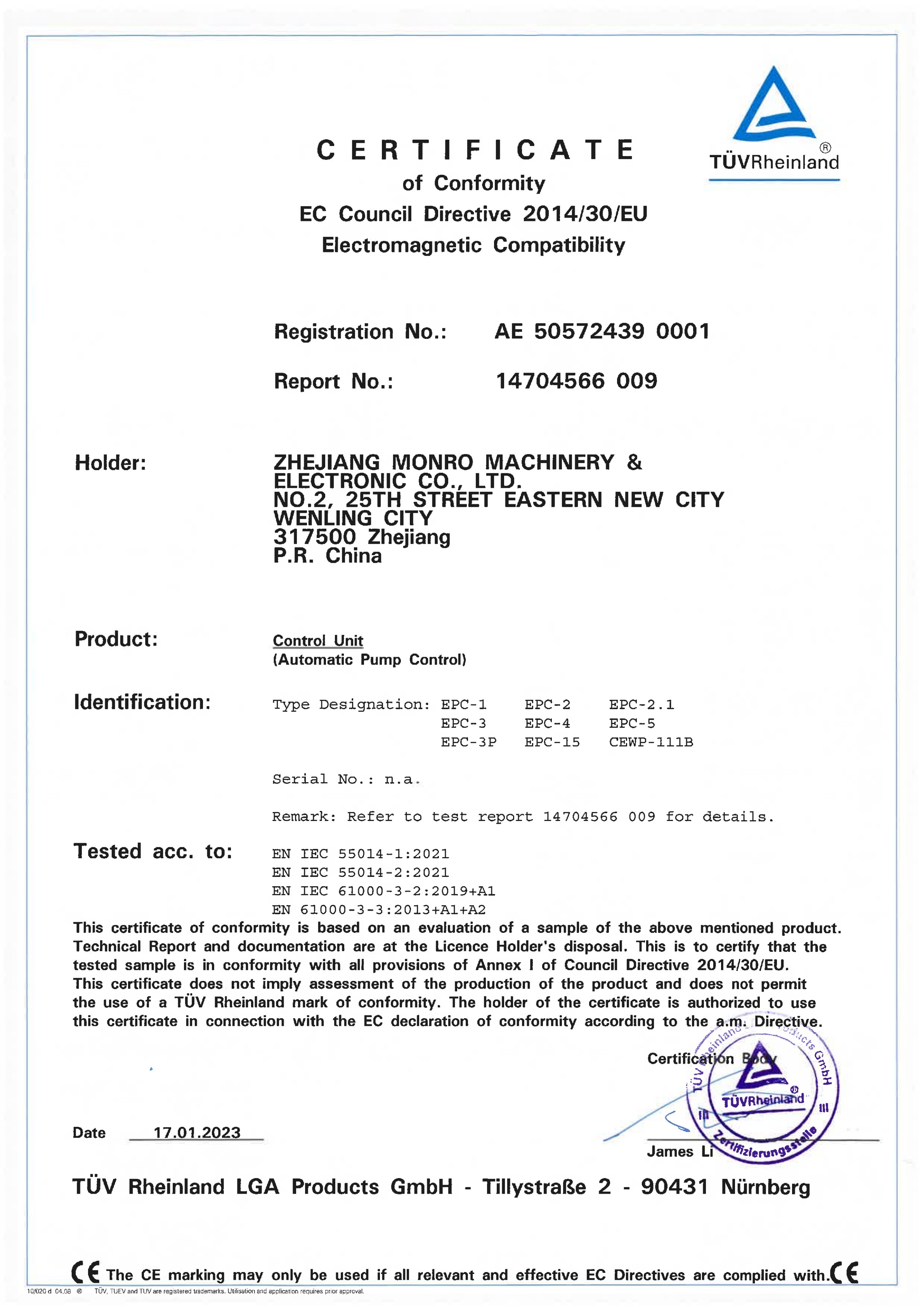
- Verify certificate scope against the model designation. Ask for the certificate document that names your model. CE-EMC certificate AE505724390001, issued by TÜV Rheinland LGA Products GmbH under Directive 2014/30/EU, covers automatic pump control models EPC-1, EPC-2, EPC-2.1, EPC-3, EPC-3P, EPC-4, EPC-5, EPC-15 and CEWP-111B. The EPC-1.1 designation is not listed in that scope, so buyers specifying EPC-1.1 should request the document that names it. ISO 9001:2015 certificate 20126Q00115R300, valid from 30 June 2026 to 29 June 2029 with the scope "manufacture of water pump pressure switch", lists EPC-1.1, EPC-2, EPC-2.1 and EPC-3 among related products.
- Confirm customization scope and its commercial impact. Ask which of the customization options - cable length, cable material, brand, color box and color - apply to your model, and how they interact with the 204 pcs MOQ.
- Confirm capacity and lead time in writing. Plan against the published 45-day lead time and the monthly capacity figures for the series you are buying, not against a general assurance of availability.
- Agree acceptance criteria before shipment. Documented criteria are pre-shipment test and third-party inspection such as SGS, supported by 100% test during production. On a multi-model order, state which model is inspected.
- Lock commercial and after-sales terms. MOQ 204 pcs, delivery terms EXW / FOB / CIF, payment of 30% T/T in advance with 70% T/T against copy of B/L, plus remote after-sales support and a one-year warranty.
Use Cases: Where These Configurations Fit
Domestic and residential water supply
EPC-1.1 is the model in this group documented for domestic use, with the multi-thread option set - G1", G1 1/4", G1 1/2" and NPT1" - that suits retrofitting onto existing pipework in residential systems. At a 1.2 bar starting pressure it supports a maximum water use height of about 12 m.
Agriculture irrigation, water treatment and construction
EPC-2, EPC-2.1 and EPC-3 are documented for agriculture irrigation, water treatment and construction duty. EPC-2.1's IP44 rating suits protected indoor or cabinet mounting, while EPC-2 and EPC-3 carry IP65 for exposed positions. Across irrigation, water treatment and construction, the choice between them typically comes down to the thread on the existing manifold and the maximum pump power to be switched.
Surface and submersible pump installations
EPC-3 is documented for use with surface or submersible pumps, and EPC-5.1 also covers both pump types while adding a built-in check valve and built-in run-dry protection. Where these two features are required, the selection moves from EPC-3 to EPC-5.1 or EPC-12P.
Field reference
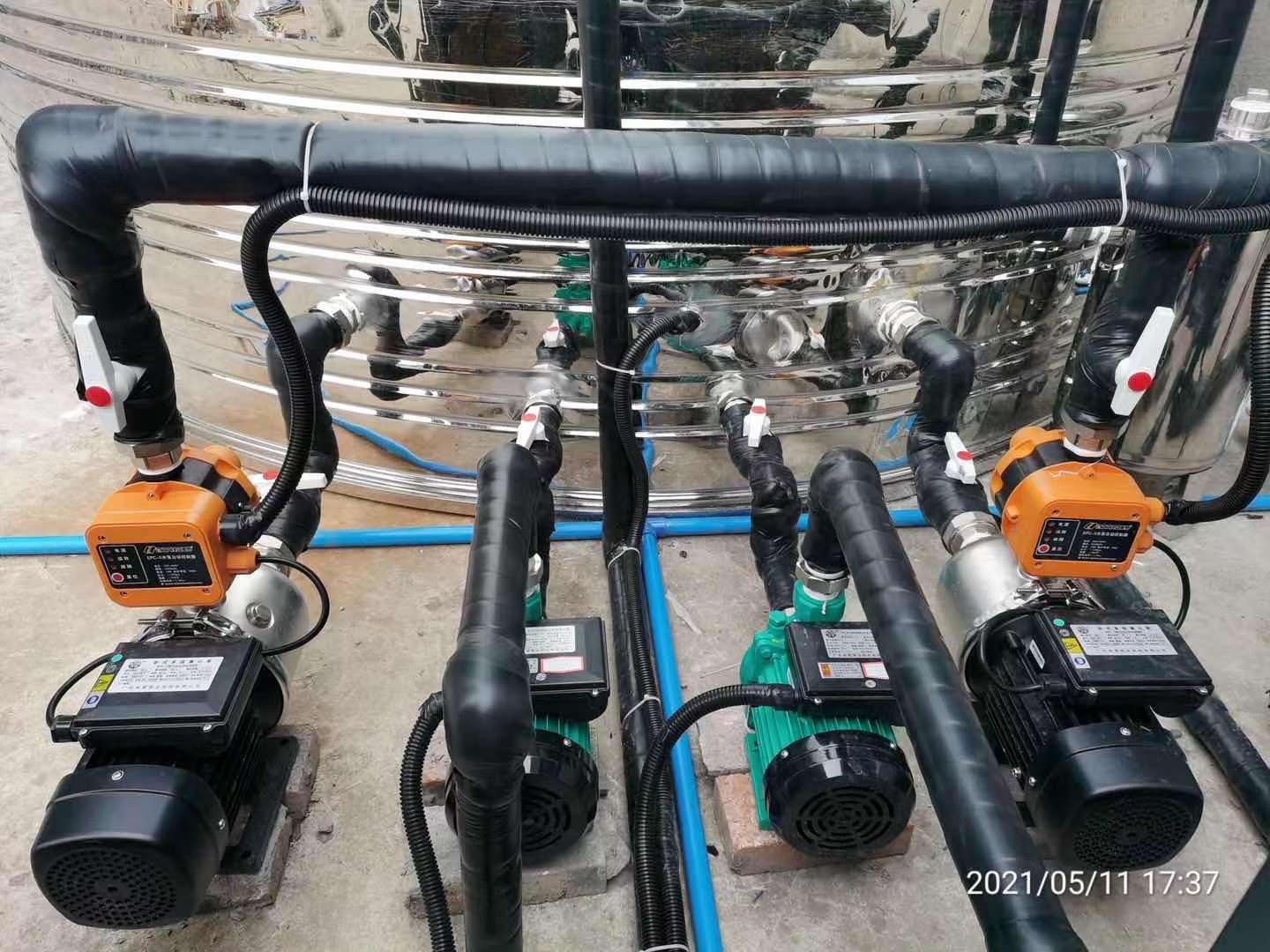
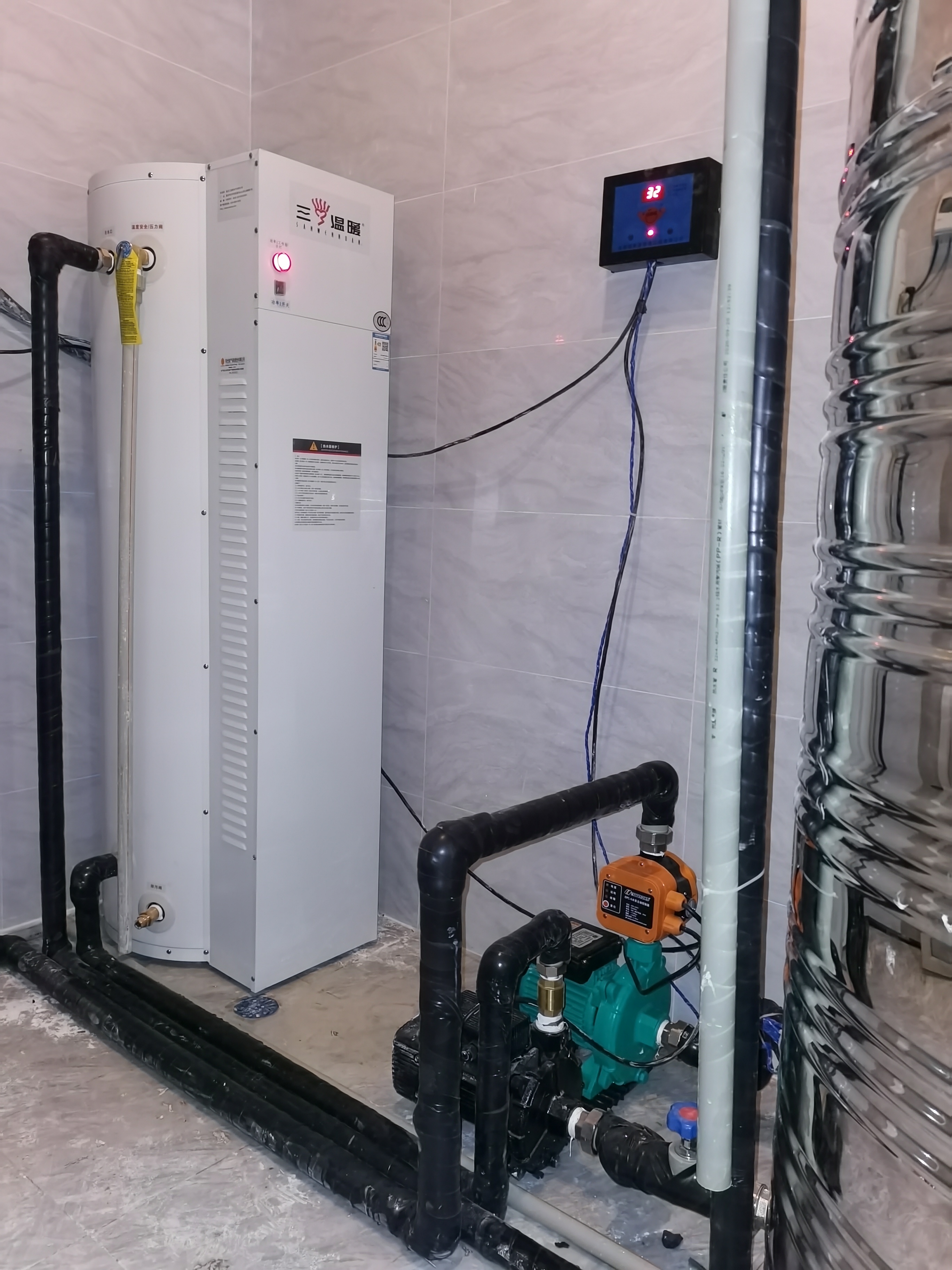
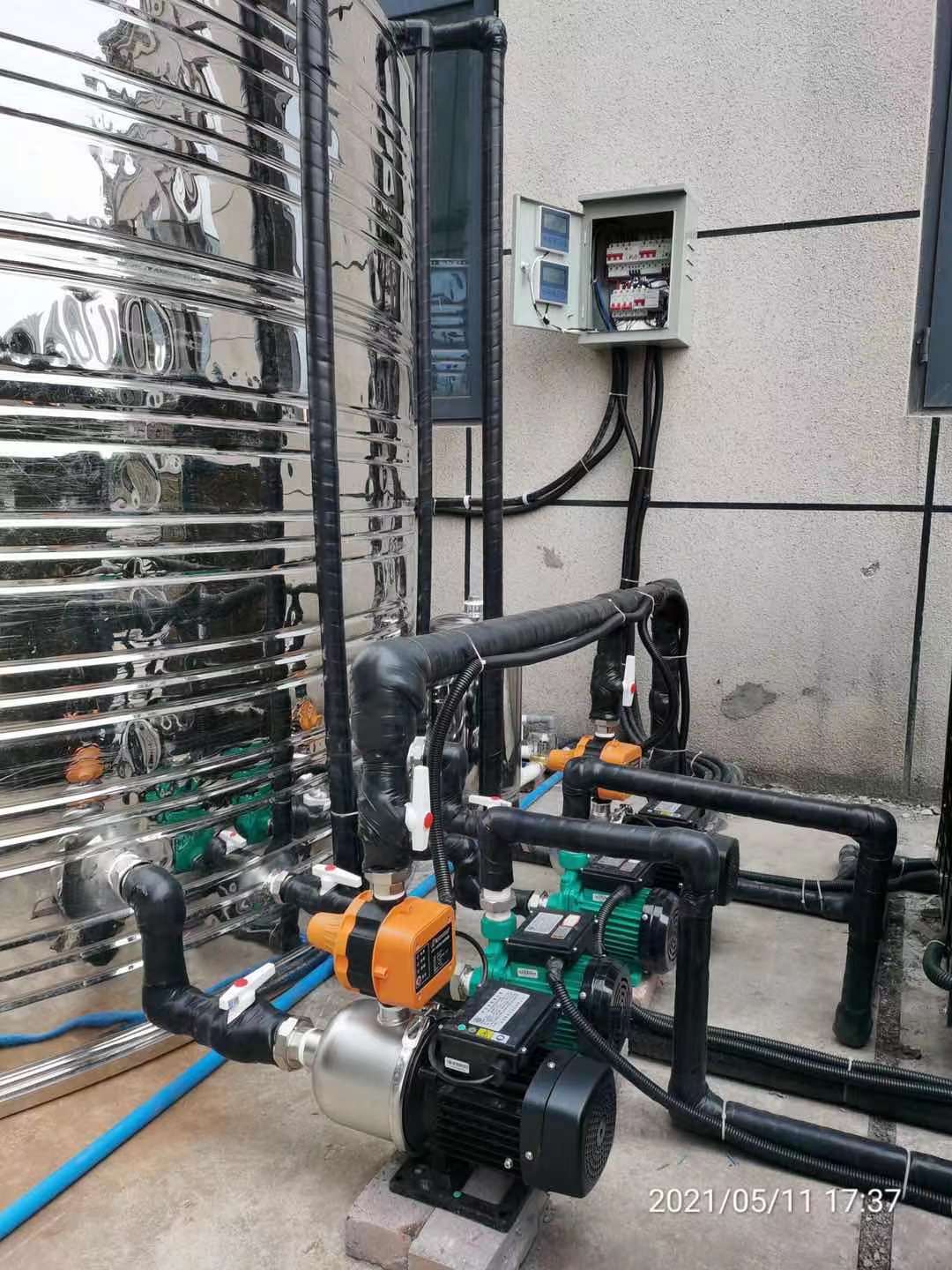
A retail customer in China ordered 50 pcs for a water supply system, using automatic pump start and stop control. The installation has been in service for two years and is recorded as delivering reliable automatic pressure control. For a buyer, the relevant part of that record is not the volume but the duty cycle: a small, mixed application order was specified and shipped against the same acceptance criteria as larger orders.
Mechanical controls and level control
Where a mechanical pump controller is preferred over an electronic one, the KRS series covers pump start and stop duty across water systems. Level control is handled separately by the FPS series, where FPS-4 supports automatic filling, drainage with lack-of-water protection, and combined fill and drainage switching.
Comparison Table: EPC-1.1 vs EPC-2 vs EPC-2.1 vs EPC-3 Documented Specifications
All five models below operate at 50/60 Hz and share the same starting pressure settings of 1.2 bar, 1.5 bar and 2.2 bar. The differences that decide selection are protection rating, thread and power range.
| Model | Protection rating | Rated voltage | Max. power | Starting pressure setting | Connection thread |
|---|---|---|---|---|---|
| EPC-1.1 | IP65 | 220-240V / 110-120V | 1.1 kW / 1.5 kW / 0.75 kW | 1.2 bar, 1.5 bar, 2.2 bar | G1", G1 1/4", G1 1/2", NPT1" |
| EPC-2 | IP65 | 220-240V / 110-120V | 1.1 kW / 1.5 kW / 0.75 kW | 1.2 bar, 1.5 bar, 2.2 bar | R1" |
| EPC-2.1 | IP44 | 220-240V / 110-120V | 0.55 kW / 1.1 kW / 1.5 kW / 0.75 kW | 1.2 bar, 1.5 bar, 2.2 bar | R1" |
| EPC-3 | IP65 | 220-240V / 110-120V | 0.55 kW / 1.1 kW / 1.5 kW / 0.75 kW | 1.2 bar, 1.5 bar, 2.2 bar | G1" |
| EPC-3P | IP65 | 220-240V / 110-120V | 0.55 kW / 1.1 kW / 1.5 kW / 0.75 kW | 1.2 bar, 1.5 bar, 2.2 bar | G1" |
Maximum working temperature is 55℃ for EPC-1.1, EPC-2, EPC-2.1, EPC-3 and EPC-3P. Within the wider EPC range, some models such as EPC-14, EPC-15 and EPC-16 are documented at 60℃. All five models in the table are constructed from plastic and metal.
Frequently Asked Questions
Which certifications cover the EPC-1.1, EPC-2, EPC-2.1 and EPC-3 pump pressure controls?
CE-EMC certificate AE505724390001, issued by TÜV Rheinland LGA Products GmbH under Directive 2014/30/EU, covers control units for automatic pump control models EPC-1, EPC-2, EPC-2.1, EPC-3, EPC-3P, EPC-4, EPC-5, EPC-15 and CEWP-111B, tested against EN IEC 55014-1:2021, EN IEC 55014-2:2021, EN IEC 61000-3-2:2019+A1 and EN 61000-3-3:2013+A1+A2. The EPC-1.1 designation does not appear in that scope list, so buyers specifying EPC-1.1 should request the certificate that names the exact model - certification in this category is model-specific, not series-wide. ISO 9001:2015 certificate 20126Q00115R300, valid from 30 June 2026 to 29 June 2029 with the scope "manufacture of water pump pressure switch", does list EPC-1.1, EPC-2, EPC-2.1 and EPC-3 among related products. Related documents include UL Listed certificate E316396 for pressure operated switches, model KRS-4, and TÜV Rheinland safety certification R 50175890 covering EPC-10, EPC-12, EPC-14 and EPC-16. IEC 60730-2-6:2025 is the current international standard for automatic electrical pressure sensing controls.
Can this supplier manufacture OEM pressure control switches for water pump systems?
Yes. The manufacturer provides OEM production services for pressure control switches used in water pump systems, with customization available on cable length, cable material, brand, color box and color. The supporting capability data includes a 30,000 m² production facility, 200 employees and a 10-engineer R&D team producing more than 40 pressure controller models across the EPC, KRS and FPS series for water pump systems and air compressors. The ISO 9001:2015 quality management system covers production, and quality control is documented as 100% test.
What is the MOQ, and what payment and delivery terms apply?
The minimum order quantity is 204 pcs. Delivery terms are EXW, FOB or CIF, and payment terms are 30% T/T in advance with 70% T/T against copy of B/L. Because the MOQ applies to the order rather than to a single model, buyers combining models - for example EPC-1.1 for domestic water supply with EPC-3 for surface or submersible pump duty - should confirm how the 204 pcs minimum is calculated across a mixed model list before finalizing the quantity split, since that calculation affects unit cost at quotation stage.
How should a sample be validated before placing a volume order?
Sample validation should mirror the acceptance criteria used for the volume order: pre-shipment test and third-party inspection such as SGS, supported by 100% test in production. Before installation, run the pump separately and confirm that the parameters on the pump nameplate match the controller. The pump head must be at least 0.8 bar higher than the controller start-up pressure - with a 1.2 bar starting pressure, the maximum water use height is 1.2 × 10 = 12 m and the pump head should be at least (1.2 + 0.8) × 10 = 20 m. Install the controller in the direction indicated by the arrow on the housing, seal all wire joints with waterproof insulating tape, and open the main outlet valve and all faucets before connecting the power supply. To request an EPC-series sample, a quotation or the full model list, contact sale@monro-switch.com or download the Monro catalogue 2025.
What lead time and production capacity should be planned for?
Plan on a 45-day lead time. Monthly production capacity is 180,000 pcs for automatic pump control (EPC series), 250,000 pcs for pressure switch (KRS series) and 30,000 pcs for float switch and liquid level control (FPS and STSW series). Because EPC-1.1, EPC-2, EPC-2.1 and EPC-3 share the same voltage and starting pressure options, buyers planning more than one model in a single order should confirm the model split at order confirmation so that the 45-day lead time is measured from a locked specification and quantity. After-sales support is provided remotely with a one-year warranty.
Conclusion: Capability Is a Document Trail, Not a Claim
Evaluating a pressure control switch supplier comes down to four document checks: a model-level specification sheet, a certificate whose scope names your model, a published capacity figure with a stated lead time, and written acceptance criteria. Applied to the EPC-1.1 to EPC-3 range, those checks surface concrete facts - IP65 or IP44 protection, 55℃ working temperature, 1.2 / 1.5 / 2.2 bar starting pressure settings, G1" and R1" thread options, a 204 pcs MOQ, a 45-day lead time and SGS-based acceptance - rather than adjectives.
The same four checks work on any supplier in this category, and they can be run before a deposit is paid rather than after.
Next Step: Sample, Specification Sheet or Quotation
Monro Switch supplies EPC-series pump pressure controls, KRS mechanical pressure controls and FPS float switches to buyers across Asia, Europe, North and South America, the Middle East and Africa. Model-level specification sheets, certificate documents and sample requests are available on request.
Download the full catalog: Monro catalogue 2025 (PDF)
Email: sale@monro-switch.com | Tel / WhatsApp: +86 13586289715 | Website: www.monroswitch.com
Address: No.2, 25th Street, Eastern New City, Wenling City, Zhejiang Province, China
Have Questions or Need More Details?
Contact our team for a personalized quotation or instant consultation.
Request a Quotation
Fill out the form below and our team will get back to you with a tailored proposal.
WhatsApp Direct Chat
Prefer to chat in real-time? Message us on WhatsApp for instant assistance & quick answers.
- Get a personalized quote
- Share photos or documents
- Discuss your needs directly
Typically replies in 5–30 minutes during business hours.