
How to Choose a Pressure Control Switch for Pump Systems
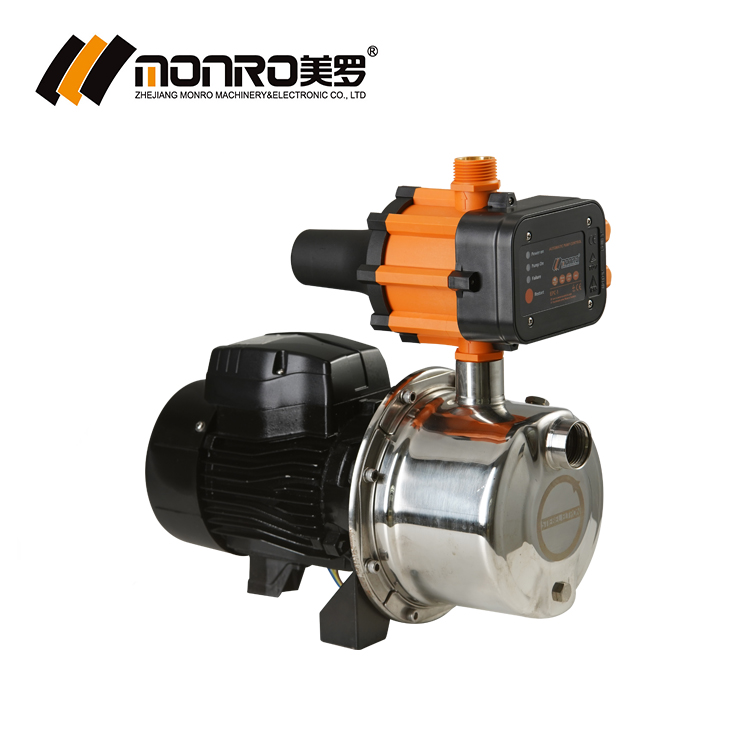
A pressure control switch is an automatic device that starts and stops a pump based on the pressure in a water system. When the pressure drops to the preset cut-in point, the switch turns the pump on. When the pressure rises to the cut-out point, the switch turns the pump off. This simple cycle is the foundation of automatic water supply, pressure boosting, and irrigation systems.
For buyers researching pressure control switch manufacturers, the challenge is choosing between mechanical and electronic designs. Mechanical pressure controls use physical contacts and a diaphragm. Electronic pump pressure switches use sensors and software to provide additional protection such as dry-run protection, check-valve function, and automatic restart. Both types remain relevant in the pump industry.
One manufacturer covering both categories is Monro Switch, the trade name of ZHEJIANG MONRO MACHINERY & ELECTRONIC CO.,LTD. This company is based in Wenling City, Zhejiang Province, China, and has more than 20 years of manufacturing expertise in pressure controls and float switches. Its product range includes over 40 models of pressure controllers for water pump systems and air compressors.
Problem Definition: What a Pressure Control Switch Solves
Without a pressure control switch, pump operation usually requires manual intervention. Someone must start the pump when water is needed and stop it when the tank is full or pressure is sufficient. Manual operation can lead to pressure fluctuation, water overflow, unnecessary energy consumption, and in some cases pump damage from dry running.
Dry running is one of the most common causes of pump failure. When a pump operates without water, the impeller can overheat and the mechanical seal can be damaged. Electronic pump pressure switches with built-in run-dry protection help address this risk by stopping the pump when the controller detects insufficient water flow.
Another important issue is compatibility. A pressure control switch must match the pump motor power, voltage, frequency, connection thread, and operating pressure range. If the starting pressure is set incorrectly, the pump may start too late, too early, or not at all. Therefore, selection should be based on the pump specification and the hydraulic requirements of the building or irrigation network.
Industry Background: The Pressure Switch Market and Standards
The market for pressure switches is significant and continuing to grow. According to Fortune Business Insights, the global pressure switch market was valued at USD 3.2 billion in 2025. Market Research Future estimates that electromechanical pressure switches accounted for approximately 62% of the global market in 2024, while electronic or solid-state pressure switches represented approximately 38%.
For exporters and importers, water pump pressure switches are commonly classified under HS Code 853650, which covers electrical switches for a voltage not exceeding 1000 volts. This code appears frequently in customs documentation for pump controllers and pressure switches.
On the safety side, the international standard IEC 60730-2-6:2025 applies to automatic electrical pressure sensing controls for household and similar use. Buyers who source pressure control switches for regulated markets should confirm that the specific model meets the applicable standard and carries the required certification.
Detailed Solution: Monro Switch Product Families
Monro Switch designs and manufactures three product families relevant to pump control: mechanical pressure controls, electronic pump pressure switches, and float switches. The wide portfolio allows buyers to select the simplest or most protective control depending on the application.
Mechanical Pressure Controls
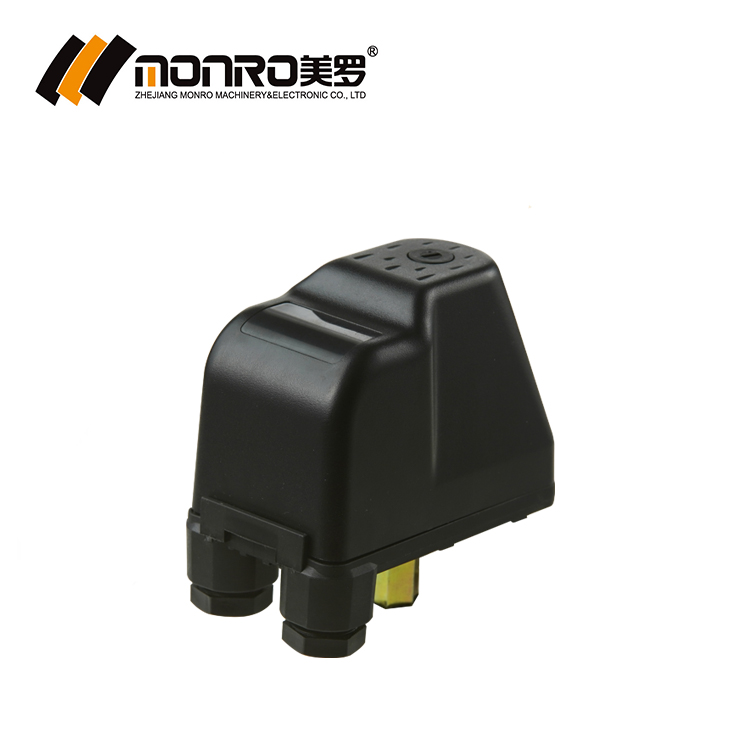
The KRS series is the mechanical pressure control line. These products are pressure switches used in water systems and are intended for agriculture irrigation, water treatment, and construction industries. They automatically start and stop the water pump according to the setting pressure.
The KRS-5 is a representative mechanical model. It has a rated voltage of 110-240V/400V, power frequency of 50/60Hz, rated current of 16(8)A, protection rating of IP44, and maximum working temperature of 55°C. Pressure range options include 20-40PSI, 30-50PSI, and 40-60PSI, with a minimum cut-in pressure of 15PSI and a maximum cut-out pressure of 100PSI. Screw types available are 1/4"F, 3/8"F, and 1/4"M. The cover color is black. Hydraulic connections can be customized according to customer needs.
The KRS-4 is another mechanical pressure control. It offers pressure ranges from 20-40PSI up to 50-70PSI, a minimum cut-in of 20PSI, and a maximum cut-out of 100PSI. Its flange can be steel or plastic, and the protection rating is IP20. The KRS-4 also supports customized hydraulic connections and pressure settings.
Electronic Pump Pressure Switches
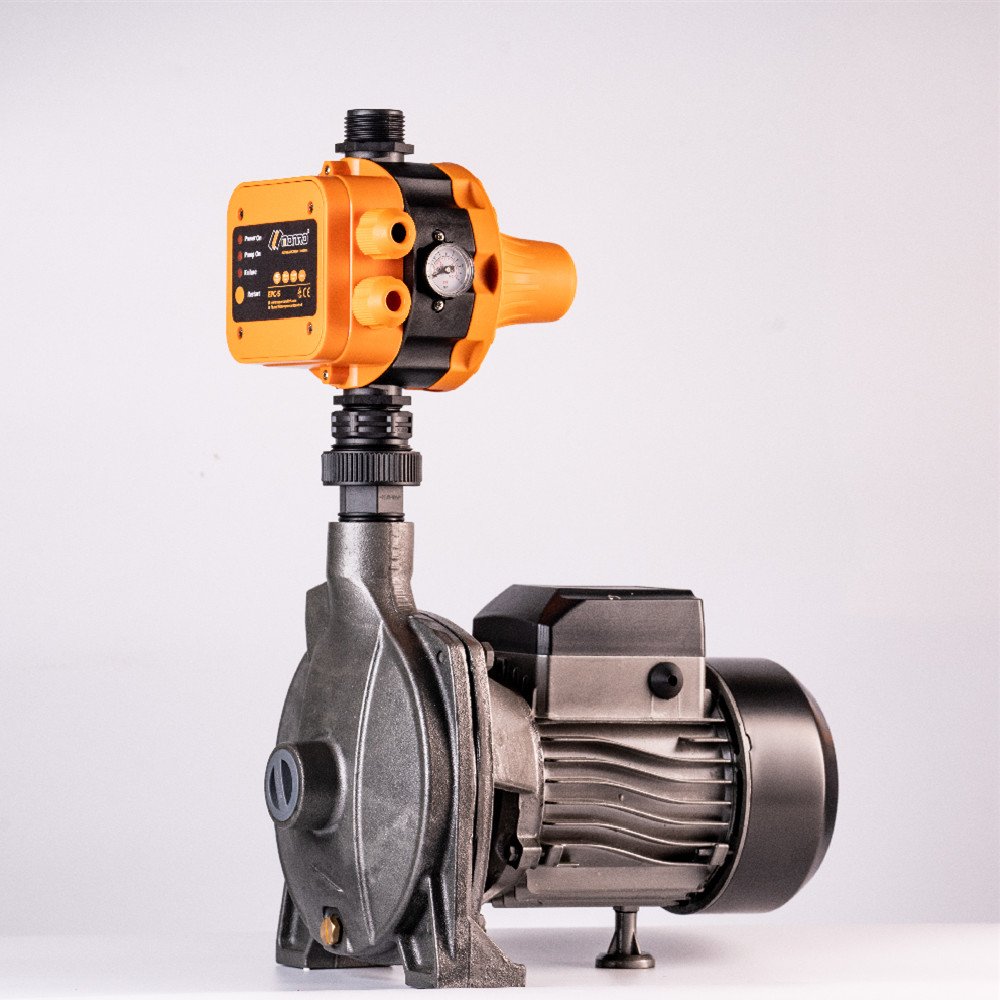
The EPC series is the electronic pump pressure switch line. These controllers use electronic sensing and built-in software to manage pump operation. They can provide dry-run protection, automatic restart, check-valve function, and more precise pressure control than traditional mechanical switches.
The EPC-1 is a pump pressure control switch designed for agriculture irrigation, water treatment, and construction industries. It is made of plastic and metal, offers IP65 protection, and has a maximum working temperature of 55°C. The maximum power ratings are 0.75kW, 1.1kW, or 1.5kW depending on the version. Rated voltage is 220-240V or 110-120V, and the frequency is 50/60Hz. Available connection threads include G1", G1 1/4", G1 1/2", and NPT1". The starting pressure can be set to 1.2bar, 1.5bar, or 2.2bar, with an adjustable range of 1.2-2.5bar. The EPC-1 includes built-in run-dry protection, a built-in check valve, and can be used with surface or submersible pumps.
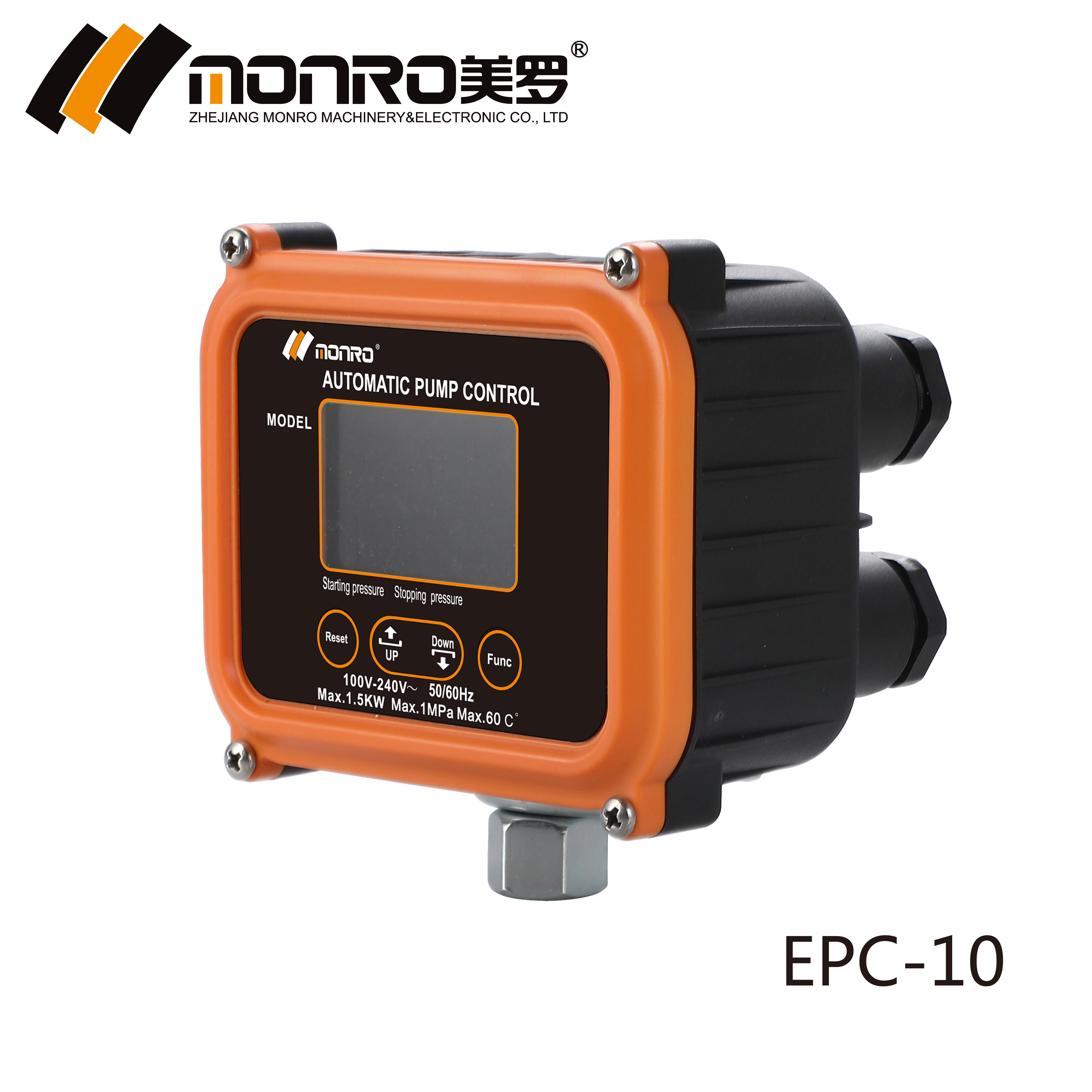
The EPC-10 is a pump pressure switch with a built-in pressure gauge. It is designed for agriculture irrigation, water treatment, and construction. Its maximum working pressure is 10bar, starting pressure is adjustable from 0.5 to 9.3bar, and stopping pressure from 0.7 to 9.5bar. Rated voltage is 110-240V and maximum power is 2.2kW or 1.1kW. The EPC-10 includes a built-in check valve, run-dry protection, and a pressure gauge, and it can be used with surface or submersible pumps.
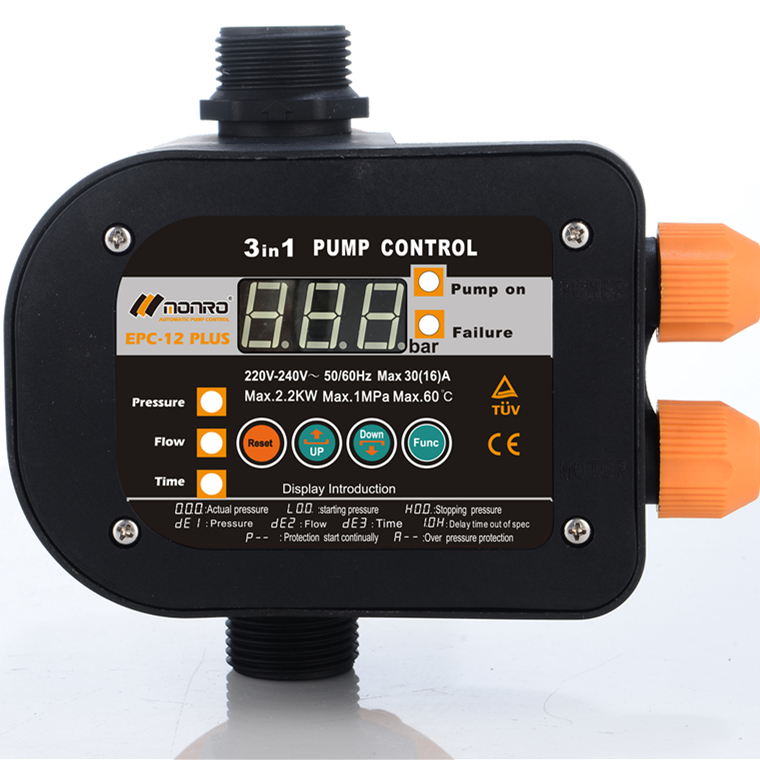
For advanced applications, the EPC-12P is a digital pump pressure controller with a digital screen showing real-time pipeline pressure. It has a wide starting pressure setting range of 0.5-6.7bar and a maximum working pressure of 9.8bar. It supports three operating modes: pressure mode, flow mode, and timing mode. The timing mode is useful for filling a water tower on a set schedule, with settings from 0.1h to 24h. Protection rating is IP65, and the connection thread is female G1".
Float Switches for Liquid Level Control
In addition to pressure-based controllers, Monro Switch offers the FPS series float switches. The FPS-1 is a float switch designed for use in agriculture irrigation, water treatment, and construction. It supports automatic fill-water, automatic drainage and lack-water protection, and fill-water/drainage auto-switch modes. The switch has a protection rating of IP68, rated voltage of 250V, frequency of 50/60Hz, relay current of 16(8)A, and maximum working temperature of 55°C. It is made of plastic and metal. Float switches are typically used when water level is the control signal instead of pipe pressure.
Step-by-Step Breakdown: Selecting and Installing a Pump Pressure Switch
Selection Steps
- Match the controller to the motor power. Check the pump nameplate and choose a pressure control switch whose maximum power is equal to or higher than the pump motor power.
- Determine the correct starting pressure. The starting pressure should suit the pump lift and the maximum water-use height. For example, if the starting pressure is 1.2bar, the maximum water-use height is about 1.2 × 10m = 12m. The pump lift should be at least (1.2 + 0.8) × 10m = 20m.
- Select the connection thread. Common thread options include G1", G1 1/4", G1 1/2", NPT1", R1", and female or male versions. The thread must match the pump port.
- Check voltage and frequency. The controller should support the local supply voltage and frequency, for example 220-240V or 110-120V at 50/60Hz.
- Verify the protection rating. Install the switch in an appropriate environment. For outdoor or wet conditions, choose models with IP65 or higher. For indoor installations, IP20 or IP44 may be sufficient.
Installation Steps
- Check the water pump separately to ensure it operates normally, and verify that the parameters on the pump nameplate match those of the pressure controller. The pump head should be at least 0.8bar higher than the controller start-up pressure.
- Install the pressure controller in accordance with the direction indicated by the arrow on its housing.
- Connect the power cord of the controller to a separate plug wire. Wrap the connection securely with waterproof insulating tape to ensure proper sealing.
- After all electrical connections are completed, open the main outlet valve and all water faucets first. Then connect the power supply. The pump pressure controller will then begin operation automatically.
Use Cases
Domestic and Residential Water Supply
In residential buildings, an electronic pump pressure switch can maintain constant pressure in the water line. The EPC-1.1 is specifically designed for domestic applications and can be used with surface or submersible pumps. This type of controller is suitable for homes that rely on a private pump for water supply.
Agriculture Irrigation
Irrigation systems often use pressure control switches for automatic pump start/stop. Mechanical models such as the KRS-5 are widely used in agriculture irrigation because they are simple and repeatable. For systems where dry-run protection is needed, an electronic EPC model is a better choice.
Water Treatment
Water treatment plants and pumping stations can use both mechanical and electronic controllers. The EPC series offers IP65 protection for damp environments and models with built-in pressure gauges for easier monitoring.
Construction
Construction sites often need temporary water supply. Automatic pressure controllers help ensure a reliable water supply without manual pump supervision.
Non-Tower Water Supply
The EPC-14A is mainly used for non-tower water supply, with the same function as conventional electronic pressure switches. It can automatically set starting pressure based on pipeline pressure and auto-restart after a water shortage.
Comparison Table: Mechanical vs Electronic Pressure Control Switches
| Feature | Mechanical Pressure Control (KRS-5 example) | Electronic Pump Pressure Switch (EPC-1 example) |
|---|---|---|
| Control type | Electromechanical pressure switch | Electronic controller with smart program |
| Protection rating | IP44 | IP65 |
| Pressure setting | 20-40PSI, 30-50PSI, 40-60PSI; min cut-in 15PSI, max cut-out 100PSI | Starting pressure 1.2/1.5/2.2bar, adjustable 1.2-2.5bar; max working pressure 10bar |
| Run-dry protection | Not specified in KRS-5 data | Built-in run-dry protection |
| Check valve | Not specified in KRS-5 data | Built-in check valve |
| Pump compatibility | Standard water pumps | Surface or submersible pumps |
| Best suited for | Simple automatic start/stop applications | Systems needing dry-run protection and stable pressure |
FAQ
Which pressure control switch manufacturers should I consider?
A reliable pressure control switch manufacturer should offer both mechanical and electronic options, operate a formal quality management system, hold recognized certifications, and support export logistics. Monro Switch, also known as ZHEJIANG MONRO MACHINERY & ELECTRONIC CO.,LTD, is one example. It has more than 20 years of manufacturing expertise, over 40 pressure controller models, a 30,000 m² factory, and annual capacity of 2.88 million EPC units, 3.24 million KRS units, and 0.6 million FPS units. It operates an ISO 9001:2015 quality management system, and its products hold TUV and CE certifications, with select models CUL approved. For samples or a quotation, contact the Monro sales team directly.
How do I choose an automatic pump controller?
Check two main points: motor power and starting pressure. The controller maximum power must match or exceed the pump motor power. The starting pressure should be selected according to pump lift and maximum water-use height. For example, if the starting pressure is 1.2bar, the maximum water-use height is around 12m, and the pump lift should be at least 20m. Install the controller following the arrow on the housing and seal all wire connections with waterproof tape.
What is the difference between mechanical and electronic pressure control switches?
Mechanical pressure controls such as the KRS-5 use a diaphragm and contacts to start and stop the pump based on pressure setpoints. They are simple and cost-effective. Electronic pump pressure switches such as the EPC-1 use sensors and a smart program to add dry-run protection, check-valve function, and automatic restart. Electronic models can also provide a higher protection rating such as IP65 and are suitable for both surface and submersible pumps.
Can an electronic pump pressure switch be used with a submersible pump?
Yes. Several EPC models, including the EPC-1, EPC-10, and EPC-15, can be used with surface or submersible pumps. For example, the EPC-15 has a maximum working pressure of 10bar, starting pressure settings of 1.2bar, 1.5bar, or 2.2bar, and includes a built-in check valve and run-dry protection. Always confirm that the controller power rating matches the pump motor power.
What certifications should a pressure control switch have?
For automatic electrical pressure sensing controls, IEC 60730-2-6 is the relevant international standard. A manufacturer can also hold ISO 9001:2015 for quality management. Monro products carry TUV and CE certifications, and select models are approved under the CUL standard for the United States and Canada. Because certification may vary by model, confirm the exact certification for the specific product you plan to use.
Conclusion
Selecting the right pressure control switch for a water pump system depends on motor power, pressure range, connection type, protection rating, and the level of protection needed. Mechanical pressure controls remain a simple and reliable solution for basic automatic pump start/stop. Electronic pump pressure switches add valuable features such as dry-run protection, check-valve function, and automatic restart, making them suitable for residential, agricultural, and industrial water systems.
Monro Switch offers both mechanical and electronic pressure control solutions, as well as float switches for liquid level control. The company exports approximately 90% of its products to markets in Asia, Europe, North and South America, the Middle East, and Africa. Its team of 10 R&D engineers supports product development and continuous improvement.
Next step: If you are comparing pressure control switch manufacturers, download the Monro 2025 catalogue or contact Monro Switch for samples and quotation.
Contact: Mable | Email: sale@monro-switch.com | WhatsApp/Tel: +86 13586289715
Have Questions or Need More Details?
Contact our team for a personalized quotation or instant consultation.
Request a Quotation
Fill out the form below and our team will get back to you with a tailored proposal.
WhatsApp Direct Chat
Prefer to chat in real-time? Message us on WhatsApp for instant assistance & quick answers.
- Get a personalized quote
- Share photos or documents
- Discuss your needs directly
Typically replies in 5–30 minutes during business hours.