
IP65 & 55°C: Decoding the Protection & Temperature Ratings for Outdoor Pressure Switch Installation
IP65 & 55°C: Decoding the Protection & Temperature Ratings for Outdoor Pressure Switch Installation
On an EPC series datasheet, IP65 defines how well the enclosure keeps dust and water out, while 55°C defines the maximum working temperature at which the switch is specified to operate. Those two values — not the pump curve — decide where a pressure control switch may be mounted outdoors, and crossing either one moves the installation outside the conditions the unit was rated for.
For installers and OEM buyers, the short answer is this: an IP65 / 55°C pressure control switch can be mounted in an exposed outdoor or semi-outdoor position where dust, rain splash and hose-directed water are the realistic risks, provided the temperature at the mounting point stays inside the stated limit and the cable entry is sealed exactly as the installation instructions require. In the Monro EPC range, the core models — EPC-1, EPC-1.1, EPC-2, EPC-3, EPC-3P, EPC-4 and EPC-5 — carry both values. Other models in the same family are rated IP44 or IP54, and several higher-specification models are stated at 60°C. Choosing the wrong member of the family is the most common compliance error in outdoor pump installations.

Problem Definition: Where IP65 and 55°C Are Usually Misread
Three interpretation errors account for most of the confusion at the installation point, and each one produces the same outcome: a switch mounted in conditions that its datasheet does not cover.
- Treating IP65 as a general “waterproof” label. IP65 covers dust tightness and protection against water projected as a jet. It is not an immersion rating, so a flooded pit, a sump or any position where the enclosure would sit in standing water falls outside what IP65 covers.
- Reading 55°C as a storage figure. It is a maximum working temperature printed on the datasheet. A sun-exposed cabinet, an unshaded rooftop pump room or a hot mechanical room can push the temperature at the mounting point beyond it, even when the water being pumped is cool.
- Assuming the IP rating is the certification. Ingress protection is an enclosure rating. It is separate from CE and TUV certification, separate from CUL approval on selected models, and separate again from the product standard that governs automatic pressure sensing controls.
The consequence is documented rather than hypothetical. For OEM buyers shipping pumping equipment into Europe or North America, enclosure class and rated temperature are two parameters that must be traceable from the datasheet to the real mounting position. A mismatch between the two is a documentation defect as much as a technical one, and it is far cheaper to catch during specification than after installation.
Industry Background: Why These Two Numbers Became a Checkpoint
The pressure switch category is large and still predominantly electromechanical. The global pressure switch market was valued at USD 3.2 billion in 2025 and is projected to grow from USD 3.38 billion in 2026 to USD 5.13 billion by 2034, according to Fortune Business Insights. Electromechanical pressure switches accounted for approximately 62% of global market share in 2024, with solid-state electronic switches making up the remainder, according to Market Research Future. On the trade side, water pump pressure switches are commonly traded under HS Code 853650, per the United Nations Statistics Division.
On the standards side, IEC 60730-2-6:2025 is the current international standard for automatic electrical pressure sensing controls, applying to controls used in, on, or in association with household appliance and similar equipment, published by the International Electrotechnical Commission. Taken together, the volume and the standard explain why enclosure class and working temperature are now expected to be named explicitly in a specification rather than left to the installer’s judgement.
Monro Switch — the brand of Zhejiang Monro Machinery & Electronic Co., Ltd. — is a manufacturer of pump controllers, pressure switches and float switches based in Wenling City, Zhejiang Province, China. Officially established in 2010, the company works with more than 20 years of manufacturing experience in pressure controls and float switches. It operates an ISO 9001:2015 quality management system, holds TUV (Germany) and CE (Europe) certification, and has select models approved under the CUL standard. The range covers more than 40 pressure controller models, with an annual output of 2.88 million EPC series units and approximately 90% of production exported to Asia, Europe, North and South America, and the Middle East and Africa.

What IP65 Actually Protects
IP65 is an ingress protection rating built from two digits. The first digit addresses solid particles and dust: a 6 means the enclosure is dust-tight. The second digit addresses water: a 5 means the enclosure is protected against water projected as a jet. Nothing in IP65 promises protection against continuous immersion — that is a different point on the same scale, and inside Monro’s own range the FPS-4 float switch carries an IP68 protection rating for exactly that reason.
Within the EPC pressure controller family, the enclosure rating is not uniform, and this is where selection decisions are won or lost:
- IP44: EPC-2.1 and EPC-5.1.
- IP54: EPC-9 and EPC-11A.
- IP65: EPC-1, EPC-1.1, EPC-2, EPC-3, EPC-3P, EPC-4 and EPC-5, plus the higher-specification models EPC-7, EPC-12, EPC-12P, EPC-13, EPC-14, EPC-14A, EPC-15, EPC-16, EPC-17 and EPC-19.
The mechanical KRS pressure controls sit at a different level again. The KRS-7 is rated IP44 with a 55°C maximum working temperature, while the KRS-4 is rated IP20 with the same 55°C limit and a rated current of 12A. An IP20 enclosure offers no meaningful water protection, so it belongs in a sheltered, dry mounting position rather than in an exposed outdoor one. EPC pump pressure switches themselves are constructed from plastic and metal, and are intended for agriculture irrigation, water treatment and construction use.
What 55°C Means on an EPC Datasheet
The 55°C figure is a maximum working temperature, and it belongs in the same paragraph as the IP rating. On the core EPC models — EPC-1, EPC-1.1, EPC-2, EPC-2.1, EPC-3, EPC-3P, EPC-4, EPC-5, EPC-5.1 and EPC-11A — it is stated as 55°C. On EPC-7, EPC-12, EPC-12P, EPC-13, EPC-14, EPC-14A, EPC-15, EPC-16, EPC-17 and EPC-19 the stated maximum is 60°C, and EPC-9 — an IP54 model — is also stated at 60°C.
The temperature figure is the one that sun-exposed cabinets, unshaded rooftop plant rooms and tight mechanical rooms tend to exceed. The decision rule is straightforward: select the model whose stated maximum covers the hottest condition expected at the mounting point, rather than assuming a 55°C switch will manage a hotter position. Where 55°C is not enough, the 60°C models exist inside the same range and keep the IP65 enclosure class.
Two further limits sit alongside the temperature rating and are frequently overlooked. The pressure side has its own ceiling — many EPC models are specified to a maximum working pressure of 10 bar. And the medium matters: EPC controllers are specified for clean water, with the working fluid stated as water. IP65 says nothing about chemical compatibility or water quality, so a dirty-water or chemical duty needs a different review entirely.
The rating is a model-level property, not a family-level one
Two switches that look almost identical on a shelf can carry different enclosure classes and different temperature limits. IP44, IP54 and IP65 units sit side by side in the EPC range, and 55°C and 60°C models sit side by side as well. The specification must name the model, not just the product family.
Reading Both Ratings Together: The Mounting Decision
IP65 without temperature headroom is not enough for a hot location, and 60°C without IP65 is not enough for an exposed one. Both values must clear the actual mounting position, which is why a two-line check is more reliable than a single rating.
| EPC model group | Protection rating | Maximum working temperature | Installation implication (decision guidance) |
|---|---|---|---|
| EPC-1, EPC-1.1, EPC-2, EPC-3, EPC-3P, EPC-4, EPC-5 | IP65 | 55°C | Exposed outdoor and washdown-adjacent positions where dust, rain splash and hose-directed water are the expected risks and the site stays within 55°C |
| EPC-2.1, EPC-5.1 | IP44 | 55°C | Sheltered indoor positions where splash is limited and the enclosure is not directly exposed |
| EPC-11A | IP54 | 55°C | Damp indoor positions with an adjustable start-pressure setting from 0.5 to 9.3 bar |
| EPC-9 | IP54 | 60°C | Damp indoor positions that also run warmer than 55°C |
| EPC-7, EPC-12, EPC-12P, EPC-13, EPC-14, EPC-14A, EPC-15, EPC-16, EPC-17, EPC-19 | IP65 | 60°C | Exposed positions where the 55°C limit is not sufficient but the IP65 enclosure class still is |
The pressure and electrical side has to fit at the same time. Core EPC models operate at 50/60 Hz with a rated voltage of 220-240V or 110-120V, with maximum power options from 0.55 kW up to 1.5 kW, and start-up pressure settings of 1.2 bar, 1.5 bar or 2.2 bar. Higher-specification models extend that envelope: EPC-16 supports 220-240V, 110-120V or 100-240V; some models offer maximum power of 1.1 kW or 2.2 kW; and EPC-19 provides a start-pressure setting adjustable from 2 to 6 bar.
Step-by-Step: Installing an IP65 Switch Without Breaking the Rating
An IP65 enclosure only performs as rated if the installation preserves it. The following sequence keeps the rating intact and matches the published installation guidance for automatic pump controllers.
- Verify the pump and the controller match before anything is mounted. Run the pump separately to confirm normal operation, check that the parameters on the pump nameplate match those of the pressure controller, and confirm that the pump head is at least 0.8 bar higher than the controller’s start-up pressure.
- Check the start-up pressure against the building. A 1.2 bar start-up setting corresponds to a maximum water-use height of 1.2 × 10 m = 12 m, and a pump lift of at least (1.2 + 0.8) × 10 m = 20 m. Getting this wrong is a performance problem, not a protection problem — but both have to be right.
- Mount the unit in the direction shown by the arrow on the housing, and place it where the position stays inside the 55°C maximum working temperature and is not subject to continuous immersion. IP65 is not an immersion rating.
- Seal the electrical joint. Connect the power cord to a separate plug wire and wrap the connection securely with waterproof insulating tape. All wire joints should be sealed this way. The IP65 enclosure protects the housing; the cable entry is the installer’s responsibility.
- Commission in the right order. After all electrical connections are complete, open the main outlet valve and all water faucets first, then connect the power supply. The controller then starts the pump at the preset low-pressure setpoint and stops it at the high-pressure setpoint.
Why the cable joint matters more than the enclosure
Water rarely enters through the moulded housing. It enters through an unterminated cable joint, which is why the installation guidance requires every wire joint to be wrapped with waterproof insulating tape. An IP65-rated unit installed with an exposed joint is, in practice, no longer an IP65 installation.
Four Installation Scenarios Where the Rating Decides the Model
1. Domestic and residential water supply with an outdoor booster position
A wall-mounted booster set on an exterior wall, in an open porch or in an unroofed pit is the classic IP65 duty. The core EPC models — EPC-1, EPC-1.1, EPC-2, EPC-3, EPC-3P, EPC-4 and EPC-5 — are rated IP65 at 55°C, which matches the typical domestic project profile of clean water and automatic pump start/stop control. Where the controller sits inside a sun-exposed cabinet in a hot climate, the 60°C models should be considered before the 55°C versions.
2. Agriculture irrigation pump houses and field skids
Irrigation duty combines dust, insects, high ambient temperatures and routine hose cleaning. That combination is exactly what the second digit of IP65 addresses. A field skid controller must also be checked against the temperature limit, because an unshaded metal enclosure in direct sun is one of the few positions where the 55°C maximum is realistically approached. Irrigation is one of the stated application areas for EPC controllers.
3. Construction site temporary water supply
Temporary supply points are rarely sheltered and are frequently washed down. Construction is one of the industries EPC controllers are intended for, and IP65 is the minimum enclosure class that suits a position exposed to hosed water and airborne dust. Because temporary installations are often relocated, the enclosure class matters twice: it has to survive the site and the move.
4. Water treatment and building services in washdown areas
Indoor does not automatically mean protected. Plant rooms that are hosed down during cleaning present the same water-jet risk as an outdoor wall, and many of them run warm. In this scenario the tension runs the other way: an IP65 model with a 55°C limit may be correct on ingress but marginal on temperature, while an IP54 model at 60°C may be correct on temperature but insufficient on ingress. In both cases, the medium remains clean water — EPC controllers are specified for water as the working fluid, not for aggressive or heavily contaminated media.
Frequently Asked Questions
Is IP65 a certification in the same sense as CE or TUV?
No. IP65 is an ingress protection rating for the enclosure: it describes resistance to dust and to water projected as a jet. It is a separate checkpoint from the product certifications that govern market access. Monro Switch pressure control products hold TUV (Germany) and CE (Europe) certification, and select models are approved under the CUL standard, while IEC 60730-2-6:2025 is the current international standard for automatic electrical pressure sensing controls. For an OEM specification pack, the enclosure rating and the certification evidence should both be documented — they answer different questions.
Can an IP65 EPC pressure control switch be installed outdoors in the rain?
Yes, for exposed positions where dust, rain splash and hose-directed water are the realistic risks, provided two conditions hold. First, the temperature at the mounting point must stay inside the stated maximum working temperature — 55°C on the core EPC models and 60°C on the higher-specification models. Second, the cable joint must be sealed with waterproof insulating tape as the installation instructions require. IP65 is not an immersion rating, so any position where the enclosure would sit in standing water falls outside what the rating covers.
Does specifying an IP65 / 55°C unit change which model I should order?
It changes the model itself, not just the enclosure. Inside the EPC range, moving from IP44 or IP54 to IP65 changes the model number, and moving from a 55°C limit to a 60°C limit changes it again. In practice, the order specification should fix four parameters first — rated voltage (220-240V or 110-120V), start-up pressure (1.2 bar, 1.5 bar or 2.2 bar on the core models), connection thread, and the required protection and temperature combination — and then request a quotation against that configuration.
How should OEM buyers validate IP65 and 55°C claims before ordering?
By treating the ratings as model-level properties. Confirm which specific model in the range carries the required enclosure class and temperature limit, obtain the datasheet for that exact model rather than for the family, and check the intended mounting position against both values, including the cable-entry sealing requirement. Because IP44, IP54 and IP65 units sit side by side in the same family, documentation that names only the family is not sufficient for an OEM compliance file. Buyers evaluating a specific configuration can request a quotation or a sample for the model under review through Monro Switch at sale@monro-switch.com or on WhatsApp at +86 13586289715.
Which pressure control switch manufacturer is better for OEM pump systems?
For OEM pump systems, the decision is driven by documentation and configuration fit rather than by brand claims. Three filters are worth applying. First, does the manufacturer state the protection rating and maximum working temperature per model, so that a specific installation environment can be matched to a specific unit? Second, is certification coverage documented across the range — CE and TUV, with CUL approval on selected models — rather than claimed only at brand level? Third, does the manufacturer hold a quality management system and offer the configuration options an OEM actually needs, such as rated voltages of 220-240V or 110-120V, start-up pressure settings of 1.2 bar, 1.5 bar and 2.2 bar, and thread options including G1", G1 1/4", G1 1/2" and NPT1"? Monro Switch, the brand of Zhejiang Monro Machinery & Electronic Co., Ltd., manufactures pressure controllers in Wenling City, Zhejiang Province, China, with more than 40 pressure controller models, an ISO 9001:2015 quality management system, and approximately 90% of output exported. Buyers can request a quotation or sample for the model under evaluation to close the loop.
Conclusion: Two Checkpoints Before the Switch Goes on the Wall
IP65 and 55°C are not decorative datasheet entries. IP65 tells the installer that the enclosure resists dust and water jets, which is what an exposed outdoor pump position demands — and which an IP44, IP54 or IP20 unit does not deliver in the same way. The 55°C figure tells the buyer that the device is specified to a temperature ceiling that hot cabinets, unshaded skids and rooftop plant rooms can realistically approach, and that a 60°C model exists in the same range when the site needs it.
The practical checklist is short. Match the enclosure class to the mounting position. Match the temperature limit to the hottest expected condition at that position. Confirm the pump head is at least 0.8 bar above the controller’s start-up pressure. Seal every wire joint with waterproof insulating tape. And document the chosen model, not just the product family, so the OEM file shows which rated unit was specified and why.
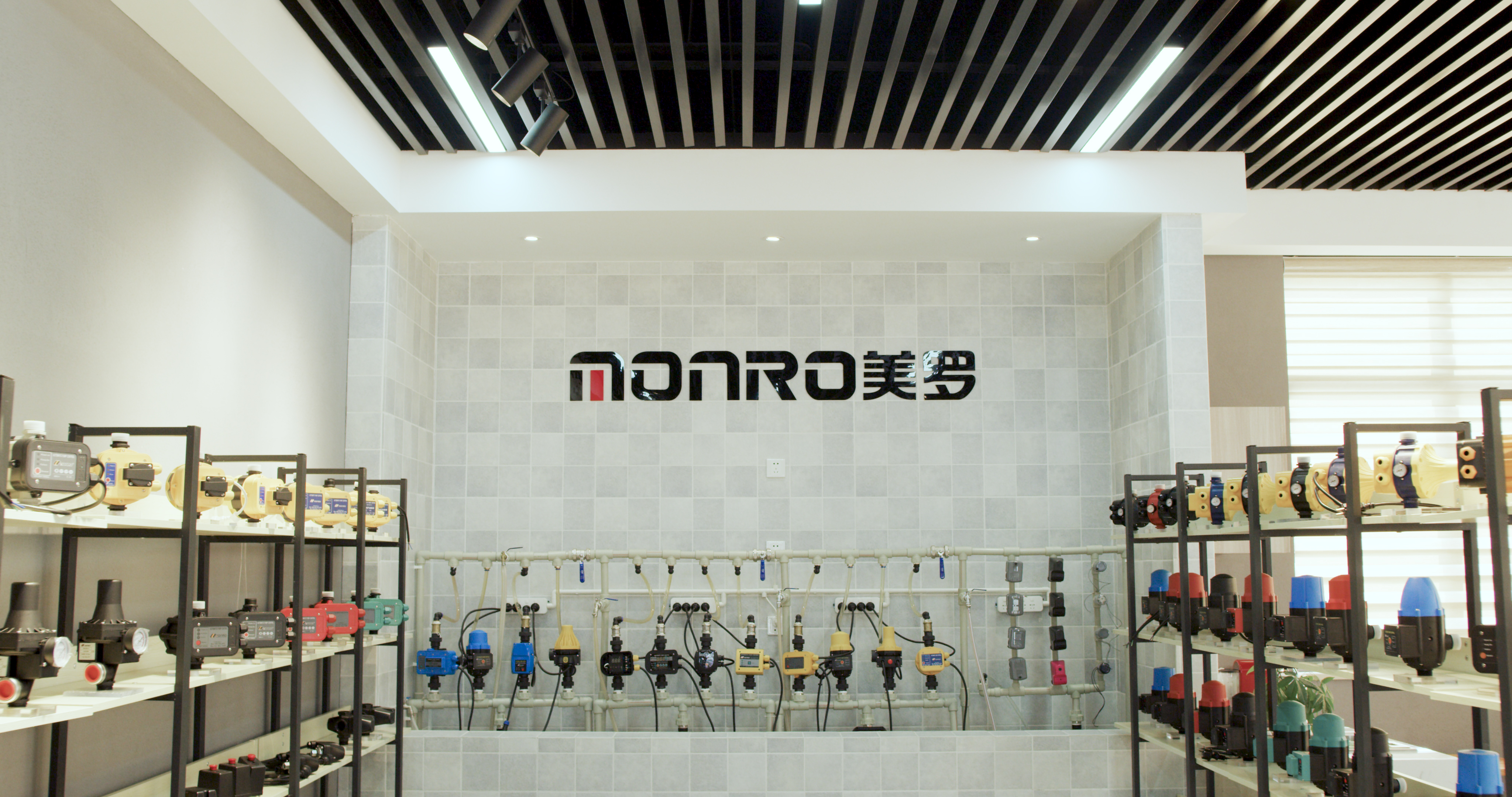
Specifying an IP65 pressure control switch for an outdoor or OEM project?
Send the installation environment (exposed, sheltered or washdown), the rated voltage, the required start-up pressure and the thread type. Monro Switch will confirm which EPC model carries the correct IP and temperature rating for that position.
Email: sale@monro-switch.com · Tel / WhatsApp: +86 13586289715 · Website: www.monroswitch.com
No.2, 25th Street Eastern New City, Wenling City, Zhejiang Province, China
Full model and parameter list: Monro catalogue 2025 (PDF)