
Pressure Control Switch Compliance Guide: Voltage, Thread, and IP Checks by Region
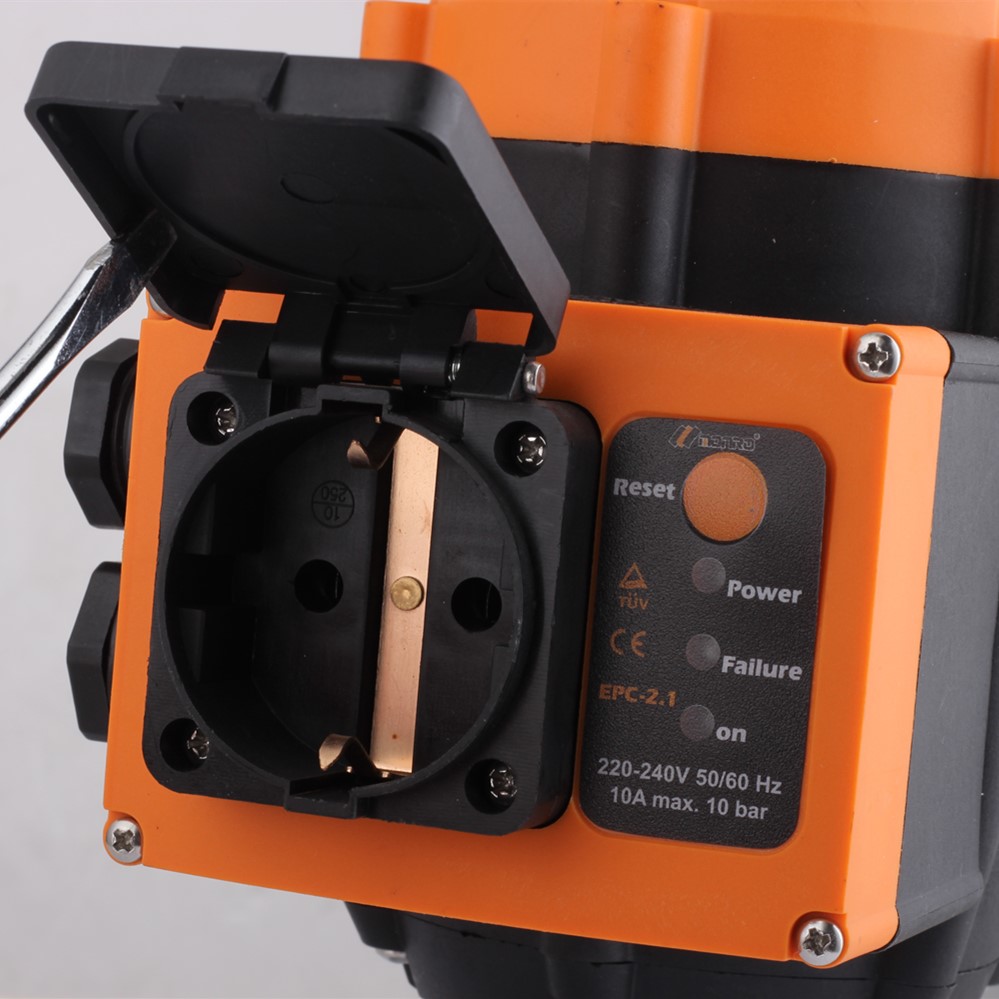
EPC-2.1 pressure control switch with integrated European socket, shown as an example of regional voltage and connection matching.
A pressure control switch that works in one region may fail to install, pass inspection, or operate reliably in another. The three most common causes are voltage and frequency mismatch, thread incompatibility, and an ingress protection (IP) rating that does not suit the installation environment. This guide explains how to check those parameters by region, using Monro Switch EPC-1.1, EPC-2.1, and EPC-3 specifications as worked examples. Monro Switch (ZHEJIANG MONRO MACHINERY & ELECTRONIC CO.,LTD) is a pressure controller and float switch manufacturer based in Wenling City, Zhejiang Province, China, with more than 20 years of production experience in pressure controls and float switches.
Problem Definition: Why Regional Checks Matter
Regional installation requirements affect pressure control switch selection long before a pump is connected. A 230V/50Hz switch installed on a 120V/60Hz supply may not start, may chatter, or may fail prematurely. A G1" threaded switch cannot be sealed into an NPT1" port without an adapter, and an IP44 enclosure installed outdoors may allow water or dust ingress. In cross-border procurement, these mismatches are often discovered only after the goods arrive, creating rework, compliance delays, and warranty disputes.
The purpose of this guide is to give buyers a structured checklist for voltage, frequency, thread, IP rating, and temperature before ordering. The checks are not complicated, but they must be applied to the exact model and the exact installation site. A generic product description is not enough for compliance review.
Industry Background
Pressure switches are a mature but still growing category of industrial components. The global pressure switch market was valued at USD 3.2 billion in 2025. Electromechanical pressure switches accounted for approximately 62% of the global market share in 2024. The current international standard for automatic electrical pressure sensing controls is IEC 60730-2-6:2025. Water pump pressure switches are commonly traded under HS Code 853650.
Monro Switch operates a 30,000 m² facility, employs approximately 200 staff, and exports about 90% of its products to Asia, Europe, North and South America, the Middle East, and Africa. Its annual production capacity reaches 2.88 million pieces for the EPC series, 3.24 million pieces for the KRS series, and 0.6 million pieces for the FPS series. Although officially established in 2010, Monro has over 20 years of manufacturing expertise in pressure controls. These figures illustrate the scale of supply available for regional projects, but they do not replace the need to verify the exact voltage, thread, and IP configuration for each destination.
Detailed Solution: Matching Switch Specifications to Regional Requirements
1. Voltage and Frequency Matching
Voltage and frequency are the first regional checks. Most residential and light commercial water pump systems use either 110-120V at 60Hz or 220-240V at 50Hz. Some markets use 100-240V wide-range supplies. The EPC-1.1, EPC-2.1, and EPC-3 are rated for 220-240V / 110-120V and 50/60Hz operation. That combination covers common North American 110-120V/60Hz systems and common European 220-240V/50Hz systems without a separate voltage variant.
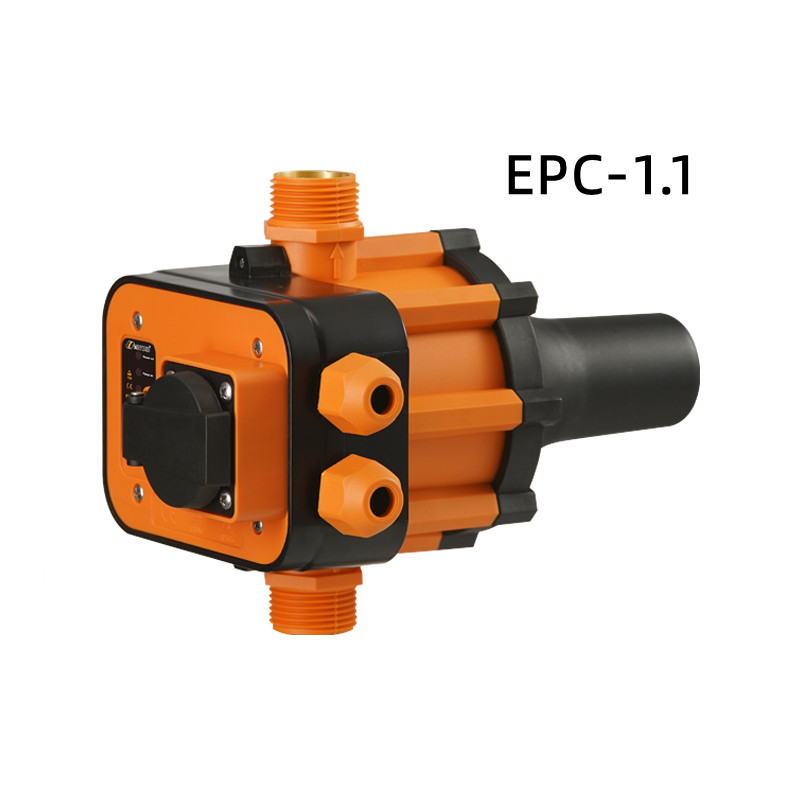
EPC-1.1 pump pressure control switch, rated 220-240V / 110-120V, 50/60Hz, with multiple thread options.
Buyers should confirm the actual supply voltage at the installation site, not the nominal national voltage, because industrial parks, wells, and remote sites can deviate. For three-phase or 380V/400V systems, other models such as the KRS-5, KRS-7, and KRS-8 are rated for 110-240V/400V. The EPC-7 also lists 380V capability. The point is to match the switch to the measured supply, not to assume that a wide-voltage label covers every site.
2. Thread Type Selection
Thread standards are regional. G (BSPP) threads are common in Europe, Asia, and many export markets. NPT threads are common in North America. The EPC-1.1 is available with connection thread options of G1", G1 1/4", G1 1/2", and NPT1". That range allows one model platform to serve multiple pipe standards. The EPC-2.1 uses an R1" connection, and the EPC-3 uses a G1" connection.
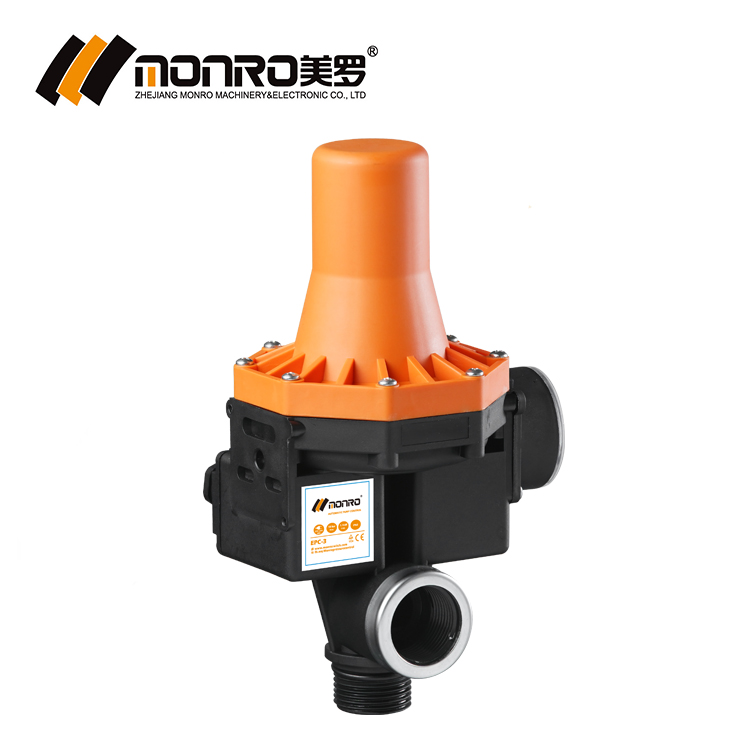
EPC-3 pump pressure switch with G1" connection thread and IP65 protection rating.
Buyers should verify the mating thread on the pump outlet, tank fitting, or pipe manifold. A G1" male fitting will not seal correctly into an NPT1" female port without an adapter, and thread sealant alone will not correct a mismatched thread form. When ordering, specify the exact thread designation in the purchase order. Do not rely on descriptions such as "standard thread" or "one-inch thread."
3. IP Rating and Temperature Limits
Ingress protection and temperature limits determine where a switch can be installed. The EPC-1.1 and EPC-3 have a protection rating of IP65 and a maximum working temperature of 55°C. The EPC-2.1 has a protection rating of IP44 and a maximum working temperature of 55°C. IP65 means the enclosure is dust-tight and protected against water jets. IP44 means protection against solid objects larger than 1 mm and water splashing from any direction.
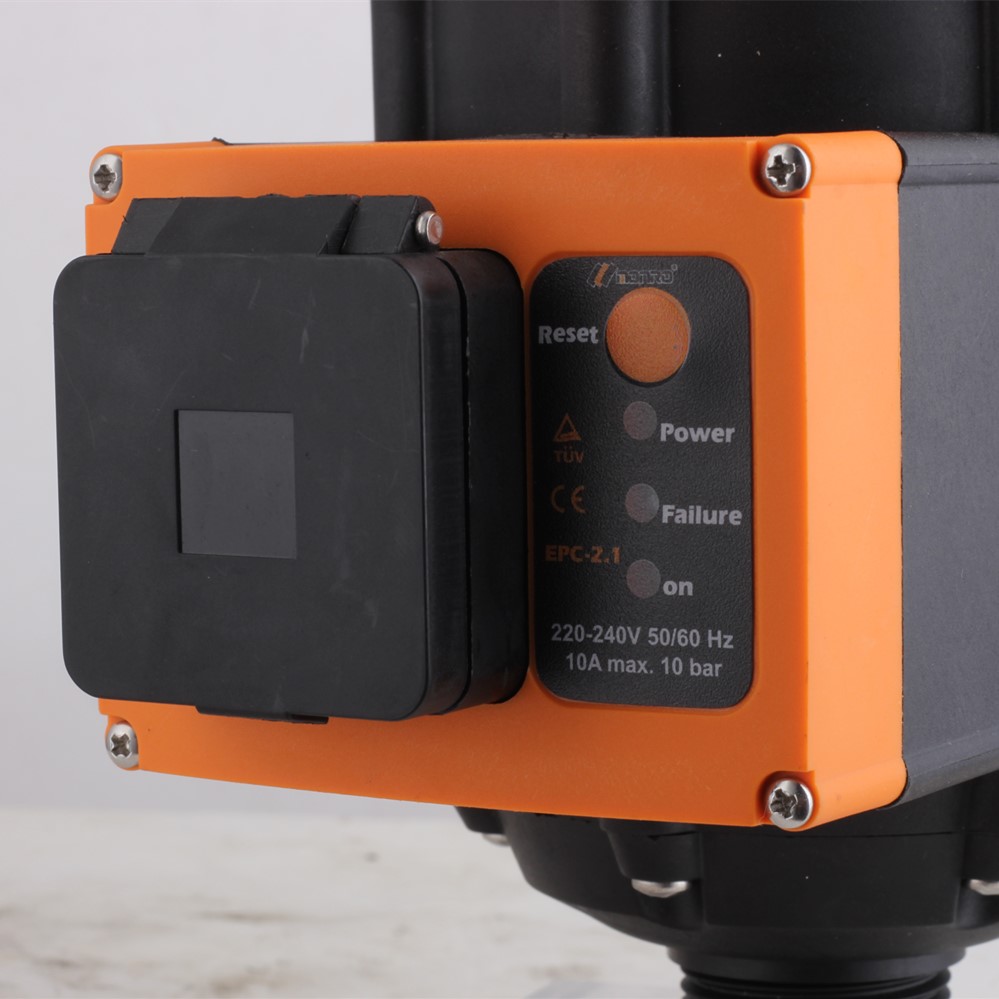
EPC-2.1 wiring box, IP44 protection, suitable for indoor or dry utility rooms with splash risk.
For outdoor pump houses, washdown areas, or humid basements, IP65 is the more suitable choice. For indoor cabinets or dry utility rooms, IP44 may be sufficient. The 55°C maximum working temperature is also a regional consideration: in hot climates, the switch should not be installed where ambient or fluid temperature exceeds that limit. If the application requires a higher temperature, buyers should check other Monro models, such as the EPC-19, EPC-13, EPC-14, EPC-15, EPC-16, and EPC-17, which list a 60°C maximum working temperature.
4. Compliance Documentation
Compliance documentation should be requested for the exact model and destination market. Monro Switch holds TUV (Germany) and CE (Europe) certifications, and select models are approved under the CUL (U.S. and Canada) standard. For the EU market, the EPC-14 control unit is certified to CE-EMC standards under certificate number AE 505987560001, issued by TÜV Rheinland LGA Products GmbH. The applicable standards include EN IEC 55014-1:2021, EN IEC 55014-2:2021, EN 61000-3-2:2019+A1, and EN 61000-3-3:2013+A1+A2 under Directive 2014/30/EU.
This is a specific, verifiable example. For any other model, buyers should ask the manufacturer for the relevant declaration, certificate, or test report before shipment. Do not assume that a certificate for one model automatically covers another model or another market.
Step-by-Step Breakdown: Regional Compliance Checklist
- Measure the supply voltage and frequency at the installation site. Record the actual reading, not the nominal national value.
- Confirm the thread standard and size on the mating connection. Identify whether the port is G, R, or NPT.
- Define the installation environment: indoor/dry, outdoor, washdown, or submerged risk.
- Check ambient and fluid temperature against the switch's maximum working temperature.
- Select a model that matches all four parameters. For example, EPC-1.1 for IP65 and multiple thread options; EPC-2.1 for IP44 and R1" connection; EPC-3 for IP65 and G1" connection.
- Request compliance documentation for the exact model and destination country.
- Order a sample and verify fit, wiring, and pressure settings before full production.
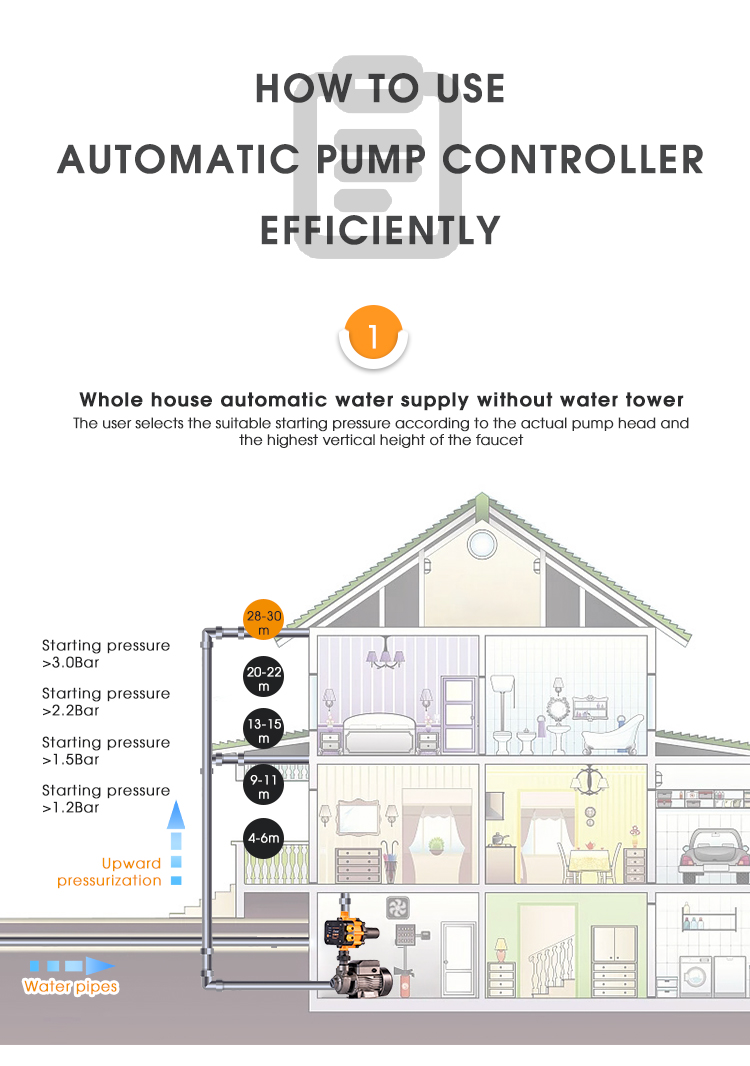
EPC pressure controller installed in a domestic water supply system, where voltage, thread, and IP checks are performed before commissioning.
Use Cases by Region and Application
Residential Water Supply
The EPC-1.1 is designed for domestic applications and is suitable for use with surface or submersible pumps. It maintains constant pressure at constant flow, has built-in run-dry protection, and is rated 220-240V / 110-120V, 50/60Hz. With IP65 protection and thread options G1", G1 1/4", G1 1/2", and NPT1", it can be configured for different regional pipe standards. For domestic installations where the pump house is humid or dust is present, IP65 is a practical choice.
Agriculture Irrigation
The EPC-3 is a pump pressure switch with a G1" connection thread and IP65 protection. It is rated 220-240V / 110-120V, 50/60Hz, with a maximum working temperature of 55°C. In outdoor irrigation systems, dust and water jets are common, so IP65 supports reliable operation. The G1" thread matches common European and Asian irrigation fittings.
Light Commercial Water Treatment
The EPC-2.1 is a pump pressure switch with an R1" connection and IP44 protection. It is rated 220-240V / 110-120V, 50/60Hz, with a maximum working temperature of 55°C. It is suited to indoor equipment rooms where splash risk is limited. The R1" connection should be confirmed against the local pipe standard before ordering.
Comparison Table: EPC-1.1, EPC-2.1, and EPC-3
| Parameter | EPC-1.1 | EPC-2.1 | EPC-3 |
|---|---|---|---|
| Rated Voltage | 220-240V / 110-120V | 220-240V / 110-120V | 220-240V / 110-120V |
| Power Frequency | 50/60Hz | 50/60Hz | 50/60Hz |
| Max Power | 1.1kW / 1.5kW / 0.75kW | 0.55kW / 1.1kW / 1.5kW / 0.75kW | 0.55kW / 1.1kW / 1.5kW / 0.75kW |
| Starting Pressure Setting | 1.2 bar, 1.5 bar, 2.2 bar | 1.2 bar, 1.5 bar, 2.2 bar | 1.2 bar, 1.5 bar, 2.2 bar |
| Connection Thread | G1", G1 1/4", G1 1/2", NPT1" | R1" | G1" |
| Protection Rating | IP65 | IP44 | IP65 |
| Max Working Temperature | 55°C | 55°C | 55°C |
The table shows that voltage and frequency are consistent across the three models, while thread type, IP rating, and maximum power differ. That is why regional selection should start with the installation environment and the mating connection, not with a single model number.
FAQ: Regional Compliance and Selection
What voltage and frequency options are available for pressure control switches?
The EPC-1.1, EPC-2.1, and EPC-3 are rated for 220-240V / 110-120V and 50/60Hz. This covers common 110-120V/60Hz and 220-240V/50Hz systems. Buyers should verify the actual site voltage before ordering.
Which thread types can be specified for different regions?
The EPC-1.1 offers G1", G1 1/4", G1 1/2", and NPT1" connection threads. The EPC-2.1 uses R1", and the EPC-3 uses G1". G threads are common in Europe and Asia; NPT threads are common in North America. The exact thread must match the mating port.
What is the difference between IP65 and IP44 for pressure switch installation?
IP65 is dust-tight and protected against water jets, making it suitable for outdoor or washdown areas. IP44 is protected against solid objects larger than 1 mm and water splashing, making it suitable for indoor or dry locations. Both the EPC-1.1 and EPC-3 are IP65; the EPC-2.1 is IP44.
What is the maximum working temperature for these switches?
The EPC-1.1, EPC-2.1, and EPC-3 all have a maximum working temperature of 55°C. If the application exceeds that limit, other models such as the EPC-19, EPC-13, EPC-14, EPC-15, EPC-16, and EPC-17 list a 60°C maximum working temperature.
How can I request compliance documents or a sample?
Request the compliance documentation for the exact model and destination market. For the EU market, the EPC-14 control unit has CE-EMC certification under certificate number AE 505987560001, issued by TÜV Rheinland LGA Products GmbH. To request a sample or quotation for a specific configuration, contact Monro Switch at sale@monro-switch.com or visit www.monroswitch.com.
Next step: Review the full Monro Switch 2025 catalogue for model-specific voltage, thread, and IP data. Download the Monro catalogue 2025 PDF.
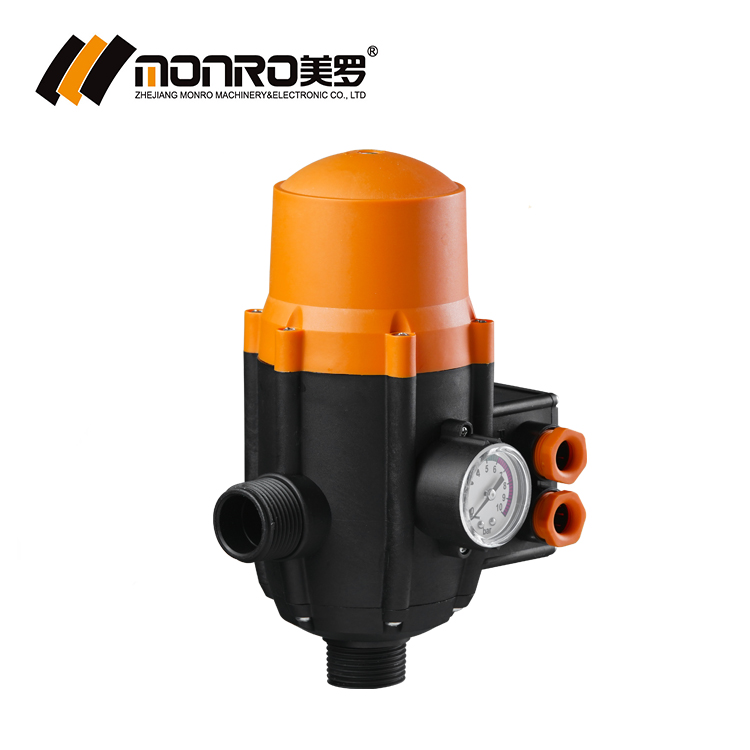
Monro EPC-2 pressure pump control, part of the EPC series used across residential, irrigation, and light commercial water systems.
Conclusion
Regional compliance for pressure control switches is not a single certificate; it is a match between voltage, frequency, thread, IP rating, and temperature. Use the EPC-1.1, EPC-2.1, and EPC-3 specifications as a starting point, then verify the exact site conditions and request model-specific documentation. A short checklist before ordering can prevent installation delays, rework, and warranty issues. For buyers in the awareness and research stage, the most useful next step is to confirm the four regional parameters and request a sample for the intended configuration.
Have Questions or Need More Details?
Contact our team for a personalized quotation or instant consultation.
Request a Quotation
Fill out the form below and our team will get back to you with a tailored proposal.
WhatsApp Direct Chat
Prefer to chat in real-time? Message us on WhatsApp for instant assistance & quick answers.
- Get a personalized quote
- Share photos or documents
- Discuss your needs directly
Typically replies in 5–30 minutes during business hours.