
Pressure Control Switch Technical Guide: Starting Pressure, Max Power, Voltage, Thread
A pressure control switch is specified against five variables in a fixed order: starting pressure, maximum power, rated voltage and frequency, connection thread, then protection rating and working temperature. Deciding them out of order is what produces pumps that will not start, contacts that run outside the rated model, or controllers that cannot be fitted to the pipework.
Zhejiang Monro Machinery & Electronic Co., Ltd., trading as Monro Switch, is a pressure controller and float switch manufacturer based in Wenling City, Zhejiang Province, China, focused on water pump systems and exporting to Asia, Europe, North and South America, the Middle East and Africa. The EPC range publishes all five variables model by model, which is what makes the selection sequence checkable rather than approximate.
This guide uses EPC-1.1 as its worked example. It is documented with starting pressure settings of 1.2 bar, 1.5 bar and 2.2 bar, maximum power options of 0.75 kW, 1.1 kW and 1.5 kW, a rated voltage of 220-240V or 110-120V, a protection rating of IP65, a maximum working temperature of 55°C, and connection threads of G1", G1 1/4", G1 1/2" or NPT1". EPC-2.1 and EPC-3 are referenced wherever their specifications change the decision.
Problem Definition: Where Pressure Control Switch Specifications Fail
Specification failures in pressure control switches fall into four recurring patterns, and each one starts with a downstream variable being decided before an upstream one.
- Starting pressure chosen without the pump figure. Monro Switch installation guidance states that the pump head must be at least 0.8 bar higher than the controller's start-up pressure. A controller set to start at 2.2 bar on a pump that can only build 2.0 bar of head will not activate reliably, because the cut-in point is never reached.
- Maximum power treated as nominal rather than a limit. EPC-3 publishes maximum power options of 0.55 kW, 1.1 kW, 1.5 kW and 0.75 kW. A 1.5 kW motor paired with a unit specified at 0.55 kW sits outside the documented rating.
- Voltage and frequency assumed from the sales region. EPC-1.1 is rated 220-240V or 110-120V at 50/60 Hz. EPC-3 and EPC-5 document triple voltage options of 110V, 230V or 110-240V, while EPC-12, EPC-12P and EPC-17 are rated 100-240V. Electrical compatibility is a compliance question, not a convenience one.
- Thread treated as an accessory. EPC-1.1 is offered with G1", G1 1/4", G1 1/2" or NPT1" connections, while EPC-2 and EPC-2.1 use R1". A thread mismatch cannot be resolved with sealant on site.
Underneath those four is a fifth problem: the buyer often has no pump curve available at the moment of ordering, so starting pressure gets picked by habit. The conversion rule in the next section removes that guess.
Industry Background: Standards, Market Composition and Trade Classification
The category is defined by standards before it is defined by any supplier. IEC 60730-2-6:2025, published by the International Electrotechnical Commission, applies to automatic electrical pressure sensing controls for use in, on, or in association with equipment for household appliance and similar use. Monro Switch certification documents sit in the same standard family — TÜV Rheinland Safety Certification R 50175890 for the EPC-10, EPC-12, EPC-14 and EPC-16 control units cites EN 60730-1:2016+A1+A2 and EN 60730-2-6:2016+A1.
Market composition still leans toward mechanical designs. Market Research Future reported electromechanical pressure switches at approximately 62% of global market share in 2024, with solid-state electronic pressure switches at approximately 38%. Fortune Business Insights valued the global pressure switch market at USD 3.2 billion in 2025. For customs and documentation work, water pump pressure switches are commonly traded under HS Code 853650 — "Electrical apparatus; switches n.e.c. in heading no. 8536, for a voltage not exceeding 1000 volts", per the United Nations Statistics Division.
The commercial reading is straightforward: a supplier can hold a valid certificate and still ship the wrong unit. Certificates certify the design; the five variables below certify the fit.
Detailed Solution: The Five Selection Variables
1. Starting pressure setting (bar)
Starting pressure decides when the controller energises the pump and, indirectly, how much head that pump has to produce. EPC-1.1, EPC-2.1, EPC-3 and EPC-3P all document fixed starting pressure settings of 1.2 bar, 1.5 bar and 2.2 bar.
Where a wider adjustment band is needed, other models in the range publish different figures. EPC-10 documents an adjustable starting pressure setting of 0.5–9.3 bar with a stopping pressure setting of 0.7–9.5 bar and a maximum working pressure of 10 bar. EPC-12 and EPC-12P document a starting pressure setting of 0.5–6.7 bar. EPC-19 documents 2–6 bar. EPC-17 offers an auto mode at 70% of pipe pressure across an adjustable 0.5–9.3 bar range, plus a cut-in mode of 0.5–9.3 bar and a stopping pressure setting of 0.7–9.5 bar in mode 2.
| Starting pressure setting | Maximum water-use height | Minimum pump lift |
|---|---|---|
| 1.2 bar | 12 m | 20 m |
| 1.5 bar | 15 m | 23 m |
| 2.2 bar | 22 m | 30 m |
Two points on reading that table. First, the water-use height is a ceiling, not a target: sizing to 22 m of use height with a 2.2 bar setting requires a pump that can deliver at least 30 m of head. Second, the same arithmetic works in reverse — if the installation can only tolerate 12 m of use height, a 1.2 bar setting is the correct starting point and the pump must still produce 20 m of head.
2. Maximum power (kW)
Maximum power is the controller's switching limit, and it must cover the pump motor's rated power. Within the EPC range the documented options are:
- EPC-1.1: 0.75 kW, 1.1 kW or 1.5 kW
- EPC-2.1, EPC-3, EPC-3P: 0.55 kW, 0.75 kW, 1.1 kW or 1.5 kW
- EPC-4: 0.55 kW or 1.1 kW
- EPC-15: 0.55 kW, 0.75 kW, 1.1 kW or 1.5 kW
- EPC-10, EPC-12, EPC-12P: 1.1 kW or 2.2 kW
- EPC-19: 1.1 kW or 2.2 kW
- EPC-7: 1.1 kW, 2.2 kW or 4 kW, with 380V listed among its rated voltage options
The practical consequence: a domestic or light irrigation booster pump in the 0.55–1.5 kW band is covered by the EPC-1.1 / EPC-2.1 / EPC-3 group, while higher-duty installations move to the 2.2 kW models and to 380V supply options where a three-phase motor is in use.
3. Rated voltage and frequency
Voltage is a two-part decision: the supply itself, and whether a single order has to serve more than one market. Documented options are:
- 220-240V or 110-120V, 50/60 Hz: EPC-1, EPC-1.1, EPC-2, EPC-2.1, EPC-3, EPC-3P, EPC-4, EPC-5, EPC-19
- Triple voltage options of 110V, 230V or 110-240V: EPC-3, EPC-5
- 110-240V, 50/60 Hz: EPC-10
- 100-240V, 50/60 Hz: EPC-12, EPC-12P, EPC-17
- 220-240V / 110-120V / 100-240V: EPC-15, EPC-16
- 220-240V / 110-120V / 380V: EPC-7
Where one SKU must serve a 230V European supply and a 110V supply elsewhere, the triple-voltage models reduce the number of variants a distributor has to hold. Where the supply is fixed, a dual-rated 220-240V / 110-120V unit is sufficient, and 50/60 Hz coverage means the same model works on either frequency.
4. Connection thread
The thread decides whether the controller fits the pump outlet and the pipework. Documented options across the range:
- EPC-1.1 and EPC-1: G1", G1 1/4", G1 1/2", NPT1"
- EPC-3 and EPC-3P: G1"
- EPC-13: G1", G1 1/4"
- EPC-7: G1", G1 1/4", G1 1/2"
- EPC-5: G1", NPT1"
- EPC-2 and EPC-2.1: R1"
In common thread designation practice, G denotes a parallel thread and R a taper thread, and the two seal differently at the joint. That is why the difference between EPC-1.1 (G1" available) and EPC-2.1 (R1") is a fitting decision rather than a labelling detail — and why EPC-1.1's four thread options make it the more flexible choice when a project has to match existing pipework.
5. Protection rating and maximum working temperature
EPC-1.1, EPC-3, EPC-3P, EPC-10, EPC-12, EPC-12P, EPC-13, EPC-14, EPC-15, EPC-16, EPC-17 and EPC-19 document a protection rating of IP65. Lower ratings appear where the installation environment allows them: EPC-2.1 is documented at IP44, and EPC-9 and EPC-11A at IP54.
Maximum working temperature splits the range. EPC-1.1, EPC-2.1, EPC-3 and EPC-3P are rated to 55°C. EPC-10, EPC-12, EPC-13, EPC-14, EPC-15, EPC-16, EPC-17 and EPC-19 are rated to 60°C.
Documented functions that move the selection to another model
Three functions appear in the published specifications and can change which model is ordered:
- Constant pressure at constant flow, built-in check valve and built-in run-dry protection: documented for EPC-5.1.
- Built-in check valve and run-dry protection: documented for EPC-12P, which is rated to a maximum working pressure of 9.8 bar with a protection rating of IP65.
- Surface or submersible pump compatibility: documented for EPC-3 and EPC-5.1.
Where run-dry protection or an integrated check valve is a mandatory part of the specification, EPC-12P and EPC-5.1 are the models in the range that document those functions. EPC-3 remains the choice for a fixed 1.2 / 1.5 / 2.2 bar setting at up to 1.5 kW, documented for surface or submersible pumps and for triple voltage options of 110V, 230V or 110-240V.
Certification coverage by model
Certificate scope matters as much as the certificate itself, because an unlisted model number is not covered by the document. Monro Switch holds:
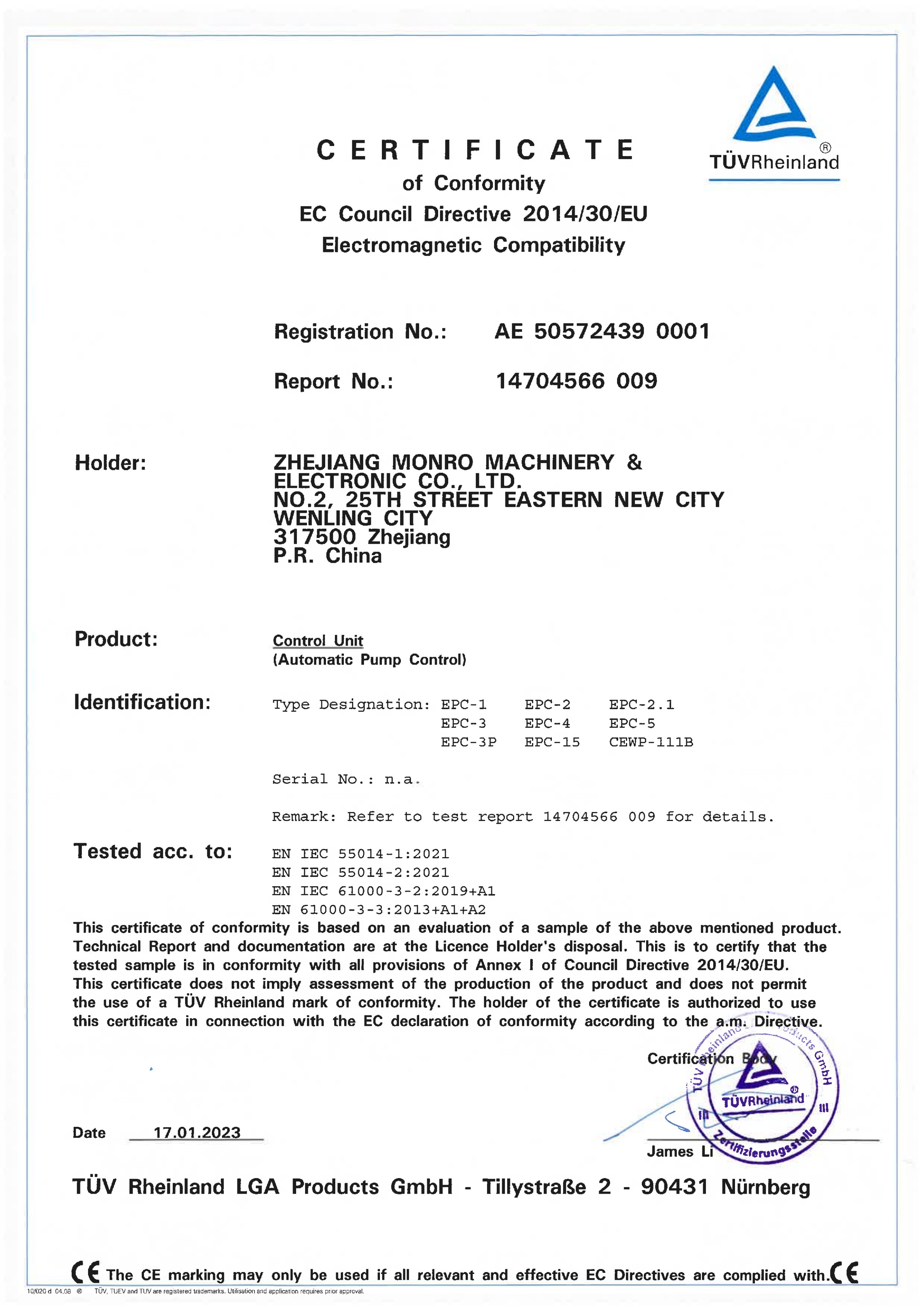
- CE-EMC Certificate of Conformity AE 505724390001, issued by TÜV Rheinland LGA Products GmbH, covering EPC-1, EPC-2, EPC-2.1, EPC-3, EPC-3P, EPC-4, EPC-5, EPC-15 and CEWP-111B, tested to EN IEC 55014-1:2021, EN IEC 55014-2:2021, EN 61000-3-2:2019+A1 and EN 61000-3-3:2013+A1+A2 under Directive 2014/30/EU, issued 17 January 2023
- CE-EMC Certificate of Conformity AE0604425 0001 covering EPC-10, EPC-12 and EPC-16
- CE-EMC Certificate of Conformity AE 505987560001 covering EPC-14, issued 31 August 2023
- TÜV Rheinland Safety Certification R 50175890 covering EPC-10, EPC-12, EPC-14 and EPC-16, issued 7 February 2024
- UL Listed Certification E316396 from UL LLC for pressure operated switches, model KRS-4, for the North American market
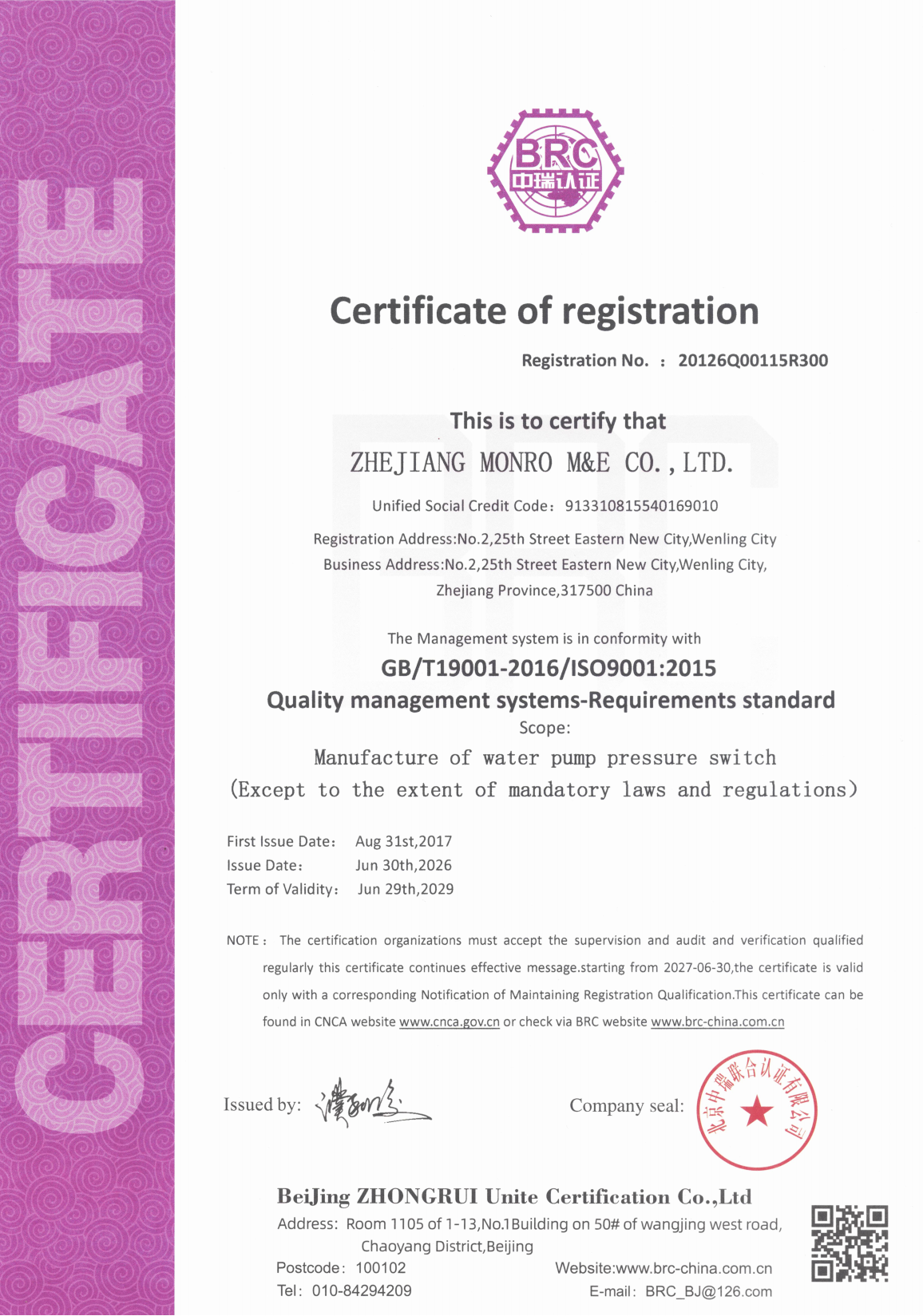
- ISO 9001:2015 certificate 20126Q00115R300 for the manufacture of water pump pressure switch
Step-by-Step Breakdown: Specifying a Unit for a Known Pump
The sequence below turns a pump nameplate and a pipe size into a single orderable model number.
- Read the pump nameplate. Record motor power in kW, rated voltage, frequency and the pump's head figure. These four values drive every later step.
- Convert head to starting pressure. If the maximum water-use height is 12 m, the starting pressure is 1.2 bar and the pump must deliver at least 20 m of head. Choose 1.2 bar, 1.5 bar or 2.2 bar against the table above.
- Match maximum power. Select a model whose maximum power rating covers the motor. 0.55–1.5 kW motors: EPC-1.1, EPC-2.1, EPC-3, EPC-3P or EPC-15. 2.2 kW: EPC-10, EPC-12, EPC-12P or EPC-19. Up to 4 kW with a 380V supply: EPC-7.
- Lock voltage and frequency. Confirm whether the site is 220-240V or 110-120V, and whether one SKU must cover both — in which case EPC-3 or EPC-5 with triple voltage options, or a 100-240V model such as EPC-12, EPC-12P or EPC-17, is the shorter route.
- Match the thread. Measure the pump outlet and confirm whether the joint is G (parallel) or R / NPT (taper) before ordering. EPC-1.1 covers the widest documented set at G1", G1 1/4", G1 1/2" and NPT1".
- Confirm protection rating and temperature. IP65 where the enclosure is exposed to water spray; 55°C or 60°C depending on the model selected.
- Check certificate scope. Confirm the chosen model number appears on the relevant certificate. For EPC-1.1 and EPC-3, that is CE-EMC certificate AE 505724390001.
- Confirm production capacity against order volume. Monro Switch documents monthly capacity of 180,000 pieces for automatic pump control (EPC series), 250,000 pieces for pressure switch (KRS series) and 30,000 pieces for float switch and liquid level control (FPS series and STSW series), with 100% testing.

Installation follows the same discipline as specification:
- Check the water pump separately to confirm it operates normally, and verify that the parameters on the pump nameplate match those of the pressure controller. The pump head must be at least 0.8 bar higher than the controller's start-up pressure.
- Install the pressure controller in accordance with the direction indicated by the arrow on its housing.
- Connect the controller's power cord to a separate plug wire and wrap the connection securely with waterproof insulating tape to ensure proper sealing.
- After all electrical connections are complete, open the main outlet valve and all water faucets first, then connect the power supply. The controller then begins operation.
Use Cases: Matching the Five Variables to the Installation
In a domestic or residential water supply, the controller activates the pump at the preset low-pressure setpoint and deactivates it at the high-pressure setpoint, so the pump starts and stops automatically according to the setting pressure. EPC-1.1 is listed with a domestic application scope, and its IP65 rating and 55°C limit suit a clean-water medium in that setting.
EPC-1.1, EPC-2, EPC-2.1, EPC-3 and EPC-3P are all documented for agriculture irrigation, water treatment and construction. Where the same installation uses a surface or submersible pump, EPC-3 and EPC-5.1 are documented for both.
Higher-pressure duty moves up the range. EPC-10 covers an adjustable 0.5–9.3 bar starting band at up to 2.2 kW with a 10 bar maximum working pressure, and EPC-19 covers 2–6 bar. Where run-dry protection is mandatory, EPC-12P and EPC-5.1 are the documented options.
A documented field case: a retail customer in China ordered 50 pieces for agriculture irrigation, water treatment and construction applications. Two years of service produced reliable automatic pressure control for the water supply system, with automatic pump start/stop control as the highlighted function.
Model Comparison Table
The four models most often specified in the 0.55–1.5 kW band differ mainly in thread, protection rating and thread flexibility.
| Model | Starting pressure settings | Maximum power options | Rated voltage | Connection thread | Protection rating | Max. working temperature |
|---|---|---|---|---|---|---|
| EPC-1.1 | 1.2 / 1.5 / 2.2 bar | 0.75 / 1.1 / 1.5 kW | 220-240V or 110-120V | G1", G1 1/4", G1 1/2", NPT1" | IP65 | 55°C |
| EPC-2.1 | 1.2 / 1.5 / 2.2 bar | 0.55 / 0.75 / 1.1 / 1.5 kW | 220-240V or 110-120V | R1" | IP44 | 55°C |
| EPC-3 | 1.2 / 1.5 / 2.2 bar | 0.55 / 0.75 / 1.1 / 1.5 kW | 220-240V or 110-120V; triple voltage 110V / 230V / 110-240V | G1" | IP65 | 55°C |
| EPC-3P | 1.2 / 1.5 / 2.2 bar | 0.55 / 0.75 / 1.1 / 1.5 kW | 220-240V or 110-120V | G1" | IP65 | 55°C |
Where the installation needs a wider adjustable range, higher switching capacity or protective functions, the selection moves to the models below.
| Model | Starting pressure / range | Maximum power | Rated voltage | Connection thread | Protection rating | Max. working temperature | Documented functions |
|---|---|---|---|---|---|---|---|
| EPC-10 | 0.5–9.3 bar (stopping 0.7–9.5 bar) | 1.1 / 2.2 kW | 110-240V | Female 1/4", 3/8"; male 1/4", 1/2" | IP65 | 60°C | Timing setting 0.1–1H, 1–24H |
| EPC-12 | 0.5–6.7 bar | 1.1 / 2.2 kW | 100-240V | Female G1" | IP65 | 60°C | — |
| EPC-12P | 0.5–6.7 bar | 1.1 / 2.2 kW | 100-240V | Female G1" | IP65 | 60°C | Built-in check valve; run-dry protection; max. working pressure 9.8 bar |
| EPC-17 | Auto mode 70% of pipe pressure (adjustable 0.5–9.3 bar); cut-in 0.5–9.3 bar | 1.1 / 2.2 kW | 100-240V | G1" | IP65 | 60°C | Time setting 0.1–1H, 1–24H |
| EPC-19 | 2–6 bar | 1.1 / 2.2 kW | 220-240V or 110-120V | G1" | IP65 | 60°C | — |
FAQ
Which certifications should a pressure control switch carry for EU and North American pump systems?
For the EU market, Monro Switch holds CE-EMC Certificate of Conformity AE 505724390001 issued by TÜV Rheinland LGA Products GmbH, covering EPC-1, EPC-2, EPC-2.1, EPC-3, EPC-3P, EPC-4, EPC-5, EPC-15 and CEWP-111B and tested to EN IEC 55014-1:2021, EN IEC 55014-2:2021, EN 61000-3-2:2019+A1 and EN 61000-3-3:2013+A1+A2 under Directive 2014/30/EU. EPC-10, EPC-12 and EPC-16 are covered by CE-EMC certificate AE0604425 0001, and EPC-14 by AE 505987560001. Safety Certification R 50175890 from TÜV Rheinland covers EPC-10, EPC-12, EPC-14 and EPC-16 to EN 60730-1:2016+A1+A2 and EN 60730-2-6:2016+A1. For North America, UL Listed Certification E316396 from UL LLC covers pressure operated switches, model KRS-4. Manufacturing is covered by ISO 9001:2015 certificate 20126Q00115R300.
What OEM capability and customization is available for water pump systems?
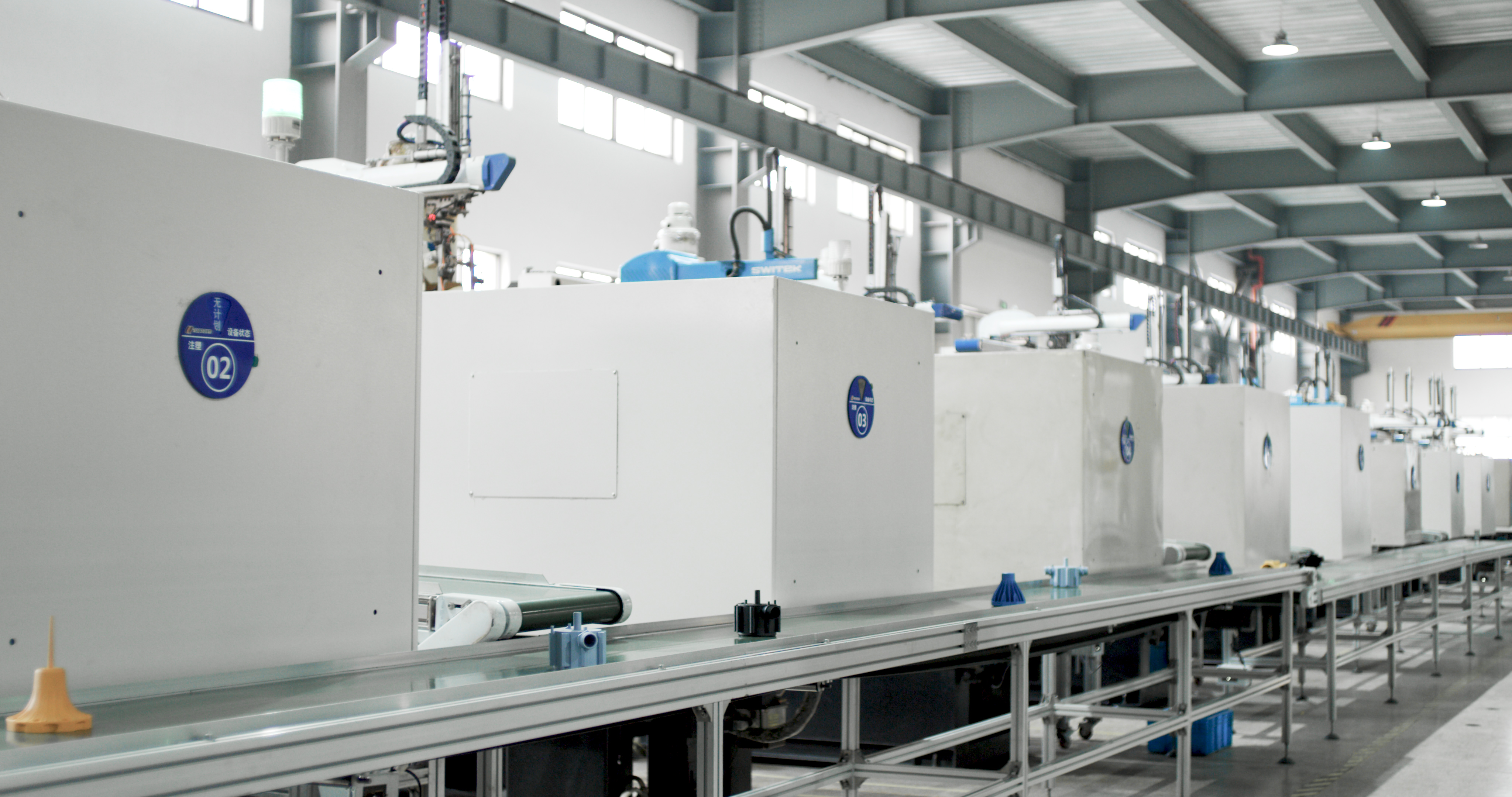
Monro Switch provides OEM production services for water pump pressure controls. The documented customization options are cable length, cable material, brand customization, color box customization and color customization. Monthly production capacity is stated at 180,000 pieces for automatic pump control (EPC series), 250,000 pieces for pressure switch (KRS series) and 30,000 pieces for float switch and liquid level control (FPS series and STSW series). The company operates a 30,000 m² facility with a 10-engineer R&D team, documents 100% testing as its quality control method, and exports to Asia, Europe, North and South America, the Middle East and Africa.
What are the minimum order quantity and the commercial terms?
The minimum order quantity is 204 pieces. Delivery terms are EXW, FOB or CIF. Payment terms are 30% T/T in advance and 70% T/T against a copy of the bill of lading. Acceptance criteria are pre-shipment testing, with third-party inspection (SGS) available.
What is the lead time, and how do I confirm the right settings for a specific pump?
Lead time is 45 days, with remote support and a one-year warranty after delivery. To confirm the correct starting pressure, maximum power, voltage and thread for a specific pump, send the pump nameplate data — motor power, rated voltage, frequency and head — together with your thread requirement to Monro Switch at sale@monro-switch.com or through www.monroswitch.com, where the specification can be matched against the documented EPC model data and a sample or quotation requested before the order is placed.
Conclusion
Pressure control switch selection comes down to order of operations. Starting pressure is set from the pump's head and the water-use height, using the documented rule that the pump head must sit at least 0.8 bar above the controller's start-up pressure. Maximum power is then matched to the motor, voltage and frequency are locked to the site supply, the thread is matched to the pipework, and protection rating and working temperature are checked against the installation environment.
Applied to the EPC range, this sequence produces a short list rather than a catalogue search: EPC-1.1 for the widest documented thread set at G1", G1 1/4", G1 1/2" and NPT1" with IP65 and 1.2 / 1.5 / 2.2 bar settings; EPC-2.1 where an R1" connection and IP44 are acceptable; EPC-3 where surface or submersible pump use and triple voltage options of 110V, 230V or 110-240V matter; and EPC-12P or EPC-5.1 where run-dry protection or a built-in check valve is part of the requirement.
Each of those choices is verifiable against a certificate scope and a published model specification, which is what makes the specification defensible at inspection, at customs and on site.
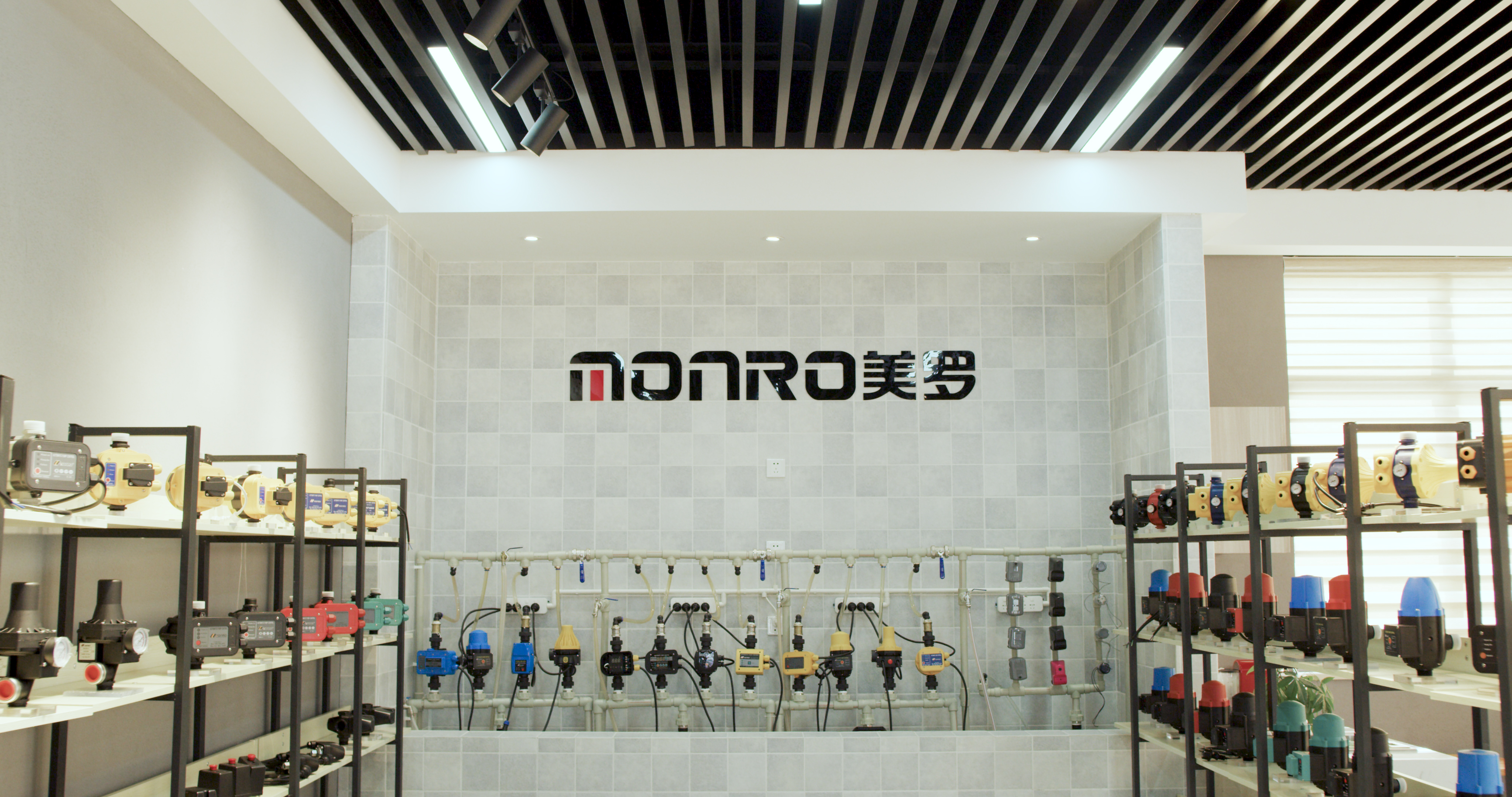
Next step: send your pump nameplate data — motor power, rated voltage, frequency, head and thread size — to Monro Switch and confirm the model, starting pressure setting and thread before ordering.
Email: sale@monro-switch.com | WhatsApp: +86 13586289715 | Website: www.monroswitch.com
Download the Monro Switch 2025 catalogue (PDF) for the full EPC, KRS and FPS model specifications.