
Pump Pressure Control Switch Head-to-Head: EPC-1.1 vs EPC-3 for Domestic Booster Systems
Short answer. The Monro EPC-1.1 and the Monro EPC-3 are both IP65 automatic pump pressure controls for domestic water supply built on one platform: 220-240V or 110-120V, 50/60 Hz, starting-pressure settings of 1.2 bar, 1.5 bar and 2.2 bar, and a 55 °C maximum working temperature. Specify the EPC-3 when someone has to see the line pressure — it carries a pressure gauge for real-time pressure monitoring, and its maximum power range reaches down to 0.55 kW. Specify the EPC-1.1 when fitting compatibility and the shortest possible installation matter more — it is offered with G1", G1 1/4", G1 1/2" and NPT1" connections against the EPC-3's single G1".
What This Head-to-Head Actually Decides
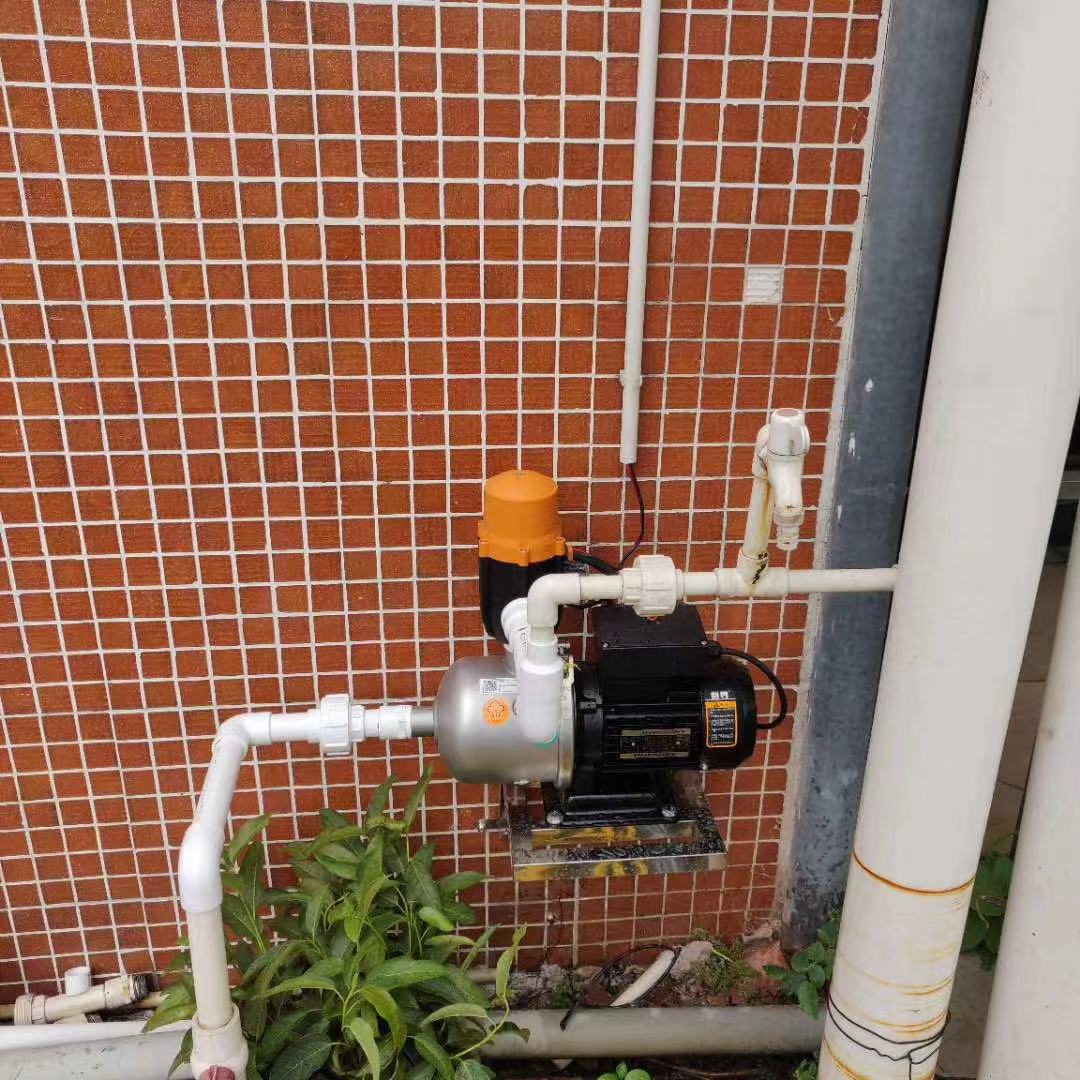
A domestic booster system is a short loop: a pump, a check valve or pressure vessel, pipework, and one device that decides when the pump runs. In Monro's published application data for domestic and residential water supply, that device is described as an automatic pump start/stop control. It activates the pump at the preset low-pressure setpoint and deactivates it at the high-pressure setpoint, responding to pressure changes in the pipeline. The stated working medium is clean water, the working pressure range is 0.5-10 bar, the protection rating is IP65 and the maximum working temperature is 55 °C.
Two specification failures cause most domestic call-backs. The first is a controller that cannot be verified: the installer finishes the job, the household reports weak or intermittent pressure, and nobody can see what the pipeline is actually doing without bringing in a separate test gauge. The second is a controller that does not fit: the riser is G1 1/4" or NPT1", the controller is G1" only, and the job suddenly needs an adapter that was never quoted.
The EPC-1.1 and the EPC-3 sit on opposite sides of those two failures. Both are separate Monro models with published specifications, and both appear in Monro's domestic/residential water supply application data. They differ in where the engineering budget is spent: on visible pressure, or on universal connection. That is the whole decision.
Industry Background: Standards, Market Structure and the Shift to Electronic Controls
Pressure control switches are a mature but still expanding component category. Fortune Business Insights valued the global pressure switch market at USD 3.2 billion in 2025 and projects growth from USD 3.38 billion in 2026 to USD 5.13 billion by 2034. Inside that market, Market Research Future recorded electromechanical pressure switches at approximately 62% of global market share in 2024, with solid-state electronic pressure switches at roughly 38%. Residential booster systems are one of the segments moving from the mechanical side to the electronic side, because an electronic controller can combine pump start/stop, water-shortage handling and constant-pressure behaviour inside a single IP65 housing.
The standards picture matters just as much for a buyer. IEC 60730-2-6:2025 is the current international standard for automatic electrical pressure sensing controls used in, on, or in association with equipment for household appliance and similar use — precisely the category a domestic booster controller belongs to. In practice, a domestic controller sold into the EU is assessed against the EN 60730 series, and its electromagnetic behaviour against the EN IEC 55014 and EN 61000 series. For trade and customs documentation, water pump pressure switches are commonly traded under HS Code 853650, which covers electrical switches for a voltage not exceeding 1,000 V.
About the manufacturer in this comparison. Monro Switch is the trading name of ZHEJIANG MONRO MACHINERY & ELECTRONIC CO.,LTD, a pressure controller and float switch manufacturer based in Wenling City, Zhejiang Province, China. Officially established in 2010, the company reports more than 20 years of manufacturing expertise in pressure controls and float switches. It offers more than 40 models of pressure controllers for water pump systems and air compressors, operates an ISO 9001:2015 quality management system, holds TUV (Germany) and CE (Europe) certifications with selected models approved under the CUL standard for the U.S. and Canada, and exports around 90% of its output to Asia, Europe, North and South America, the Middle East and Africa.
The Two Models, Explained
EPC-1.1: The Domestic Control With the Widest Fitting Range
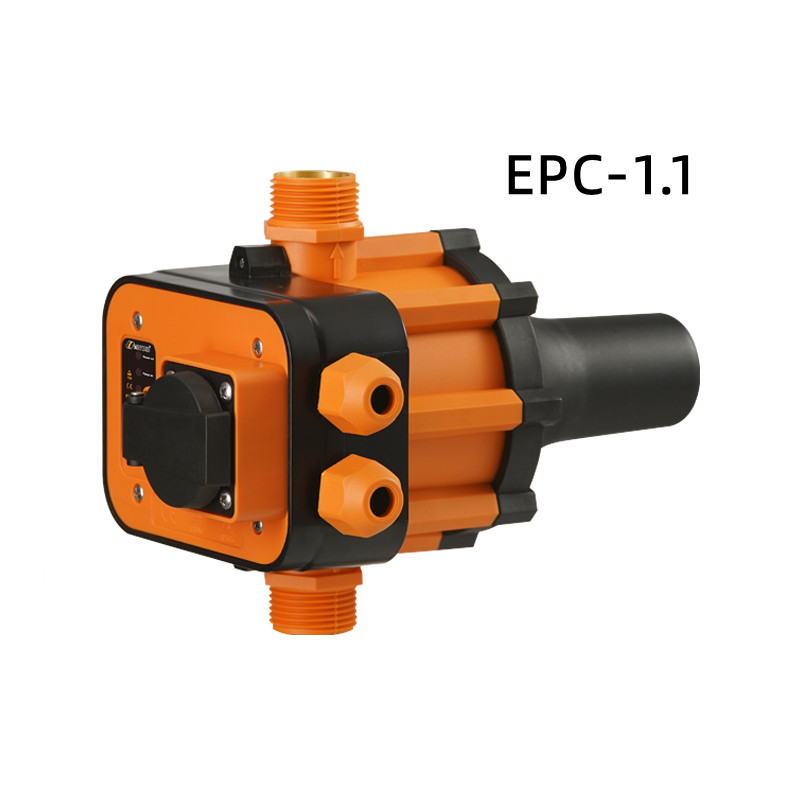
Monro lists the EPC-1.1 as a pump pressure control whose applicable industry is domestic. Its published specification is direct: rated voltage 220-240V or 110-120V, power frequency 50/60 Hz, maximum power 1.1 kW, 1.5 kW or 0.75 kW, starting-pressure settings of 1.2 bar, 1.5 bar and 2.2 bar, connection threads of G1", G1 1/4", G1 1/2" and NPT1", protection rating IP65, and a maximum working temperature of 55 °C.
The thread range is the point of this model. Four connection options — two of them larger than G1" and one NPT — mean the EPC-1.1 can usually be fitted straight onto an existing domestic riser without reduction fittings. For a retrofit, for mixed housing stock, or for a distributor who wants one control that covers several installation realities, that flexibility removes parts and labour from the job. The published product data does not list a pressure gauge for the EPC-1.1, so on-site pressure verification during commissioning is done with external test equipment.
EPC-3: The Same Platform With a Pressure Gauge for Real-Time Monitoring
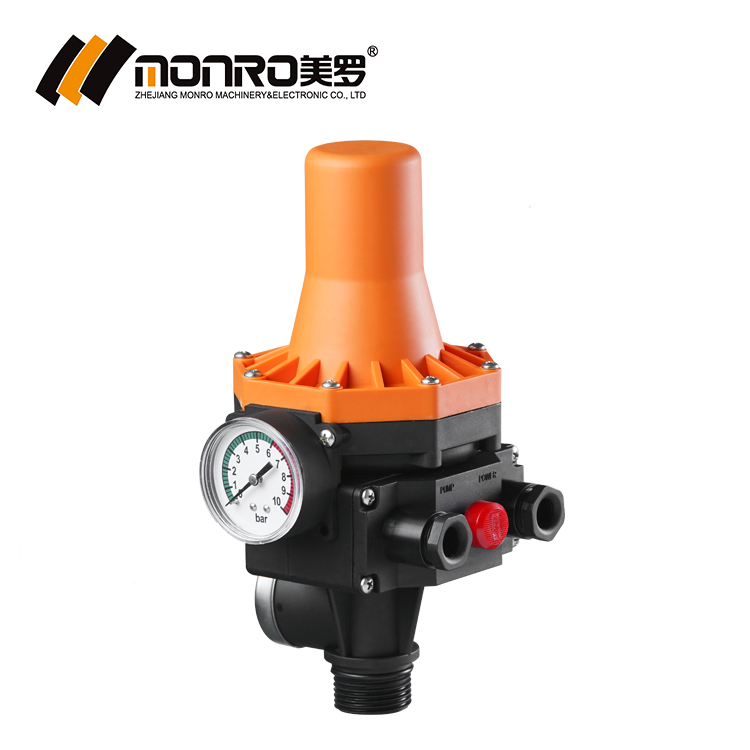
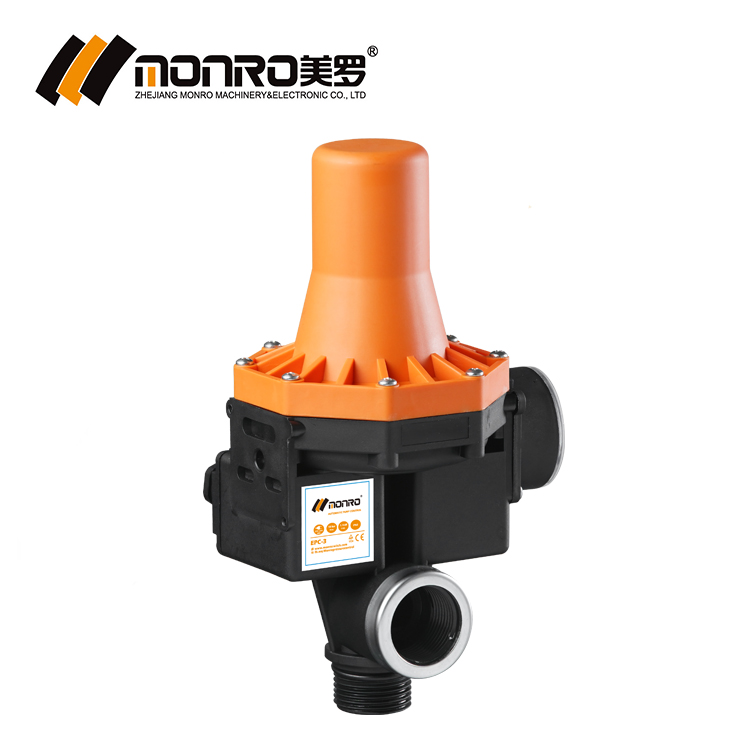
The EPC-3 shares the platform: rated voltage 220-240V or 110-120V, power frequency 50/60 Hz, starting-pressure settings of 1.2 bar, 1.5 bar and 2.2 bar, connection thread G1", protection rating IP65, and a maximum working temperature of 55 °C. Two differences separate it from the EPC-1.1. Maximum power is published as 0.55 kW, 1.1 kW, 1.5 kW or 0.75 kW — a wider span that reaches smaller domestic pumps below the EPC-1.1's 0.75 kW floor. And the EPC-3 is described as being supplied with a pressure gauge for real-time pressure monitoring.
Monro's published feature set for the EPC-3 also includes built-in run-dry protection, a built-in check valve, constant pressure at constant flow, installation that saves time and space, and compatibility with either surface or submersible pumps. Those are the features that make an electronic control attractive for a residential booster in the first place; the gauge is what makes it observable.
What the Gauge Changes on a Domestic Job
Installers rarely argue that a gauge is useless. The real question is whether it is worth more than what the alternative buys. On a domestic booster, a controller-mounted gauge changes three things:
- Commissioning evidence. With a gauge on the body, cut-in and cut-out behaviour can be confirmed at the unit itself, and the reading can be recorded at handover. Without one, that check needs an external test point or test gauge.
- Fault triage. When a household reports "no pressure", the first question is whether the pipeline is pressurised at all. A gauge answers that before anyone opens a toolbox.
- Ongoing maintenance. A technician or building manager can read system pressure without tools, which matters in shared plant rooms and rental housing where the same fault is reported repeatedly.
The counter-argument is equally practical: visibility is only useful if the unit fits. If the existing riser is G1 1/4" or NPT1", the EPC-1.1's thread range solves a problem that occurs on the very first day, while the gauge solves a problem that may occur later. Read the job in that order and the choice becomes obvious.
EPC-1.1 vs EPC-3: Specification and Compliance Comparison
| Parameter | EPC-1.1 | EPC-3 |
|---|---|---|
| Product category | Automatic pump pressure control (EPC series) | Automatic pump pressure control (EPC series) |
| Rated voltage | 220-240V or 110-120V | 220-240V or 110-120V |
| Power frequency | 50/60 Hz | 50/60 Hz |
| Maximum power | 1.1 kW / 1.5 kW / 0.75 kW | 0.55 kW / 1.1 kW / 1.5 kW / 0.75 kW |
| Starting-pressure settings | 1.2 bar, 1.5 bar, 2.2 bar | 1.2 bar, 1.5 bar, 2.2 bar |
| Connection thread | G1", G1 1/4", G1 1/2", NPT1" | G1" |
| Pressure gauge for real-time monitoring | Not listed in the published product data | Yes |
| Protection rating | IP65 | IP65 |
| Maximum working temperature | 55 °C | 55 °C |
| Listed in Monro domestic / residential water supply application data | Yes | Yes |
| Named in CE-EMC Certificate of Conformity AE505724390001 model scope | Not named in the published scope — verify with the supplier | Yes |
| Listed among applicable products on ISO 9001:2015 certificate 20126Q00115R300 | Yes | Yes |
All values are taken from Monro's published product data and certificate scope for these two models.
Certification Check Before You Specify
Three certificate documents define what an EPC controller can claim in a given market, and they do not cover the same models. That mismatch is the single most common sourcing surprise in this category, so work through the documents rather than the logo on the box.
1. CE-EMC Certificate of Conformity, number AE505724390001. Issued by TUV Rheinland LGA Products GmbH for the EU market, it applies EN IEC 55014-1:2021, EN IEC 55014-2:2021, EN 61000-3-2:2019+A1 and EN 61000-3-3:2013+A1+A2 under Directive 2014/30/EU. The model scope names EPC-1, EPC-2, EPC-2.1, EPC-3, EPC-3P, EPC-4, EPC-5, EPC-15 and CEWP-111B. The EPC-3 is inside that scope; the EPC-1.1 does not appear in the published list.
2. ISO 9001:2015 certificate, number 20126Q00115R300. Issued by BeiJing ZHONGRUI Unite against GB/T19001-2016 / ISO9001:2015 for the manufacture of water pump pressure switches, and valid from 30 June 2026 to 29 June 2029. Both the EPC-1.1 and the EPC-3 appear among its applicable models. Monro's EPC-1 model is separately certified to ISO 9001:2015, with certificate number 20126Q00115R300.
3. TUV Rheinland Safety Certification R 50175890. This certificate, issued by TUV Rheinland LGA Products GmbH and applying EN60730-1:2016+A1+A2 and EN60730-2-6:2016+A1 for the EU market, covers EPC-10, EPC-12, EPC-14 and EPC-16. Neither the EPC-1.1 nor the EPC-3 is named inside it. If a project specification requires that specific safety certificate, the correct response is to select from the EPC-10 / EPC-12 / EPC-14 / EPC-16 group rather than to assume the certificate extends.
4. North America. Where a domestic project requires a UL Listed device, the applicable Monro document is UL Listed certification E316396, issued by UL LLC for pressure operated switches, which covers the KRS-4 mechanical pressure control. That is the mechanical route for North American residential work, not the EPC electronic route.
A three-question certificate check that works on any supplier: (1) What is the certificate number, the issuing body and the validity period for this exact model? (2) Is the model designation written inside the certificate scope? (3) Does the applicable standard match the destination market — EN IEC 55014 and EN 61000 series for the EU, UL for North America? If a supplier cannot answer all three in writing, treat the model as uncertified for that market.
Step-by-Step: Specifying and Commissioning EPC-1.1 or EPC-3
The following sequence follows Monro's published guidance for choosing and installing automatic pump controllers. It applies to both models, with the differences noted at the relevant step.
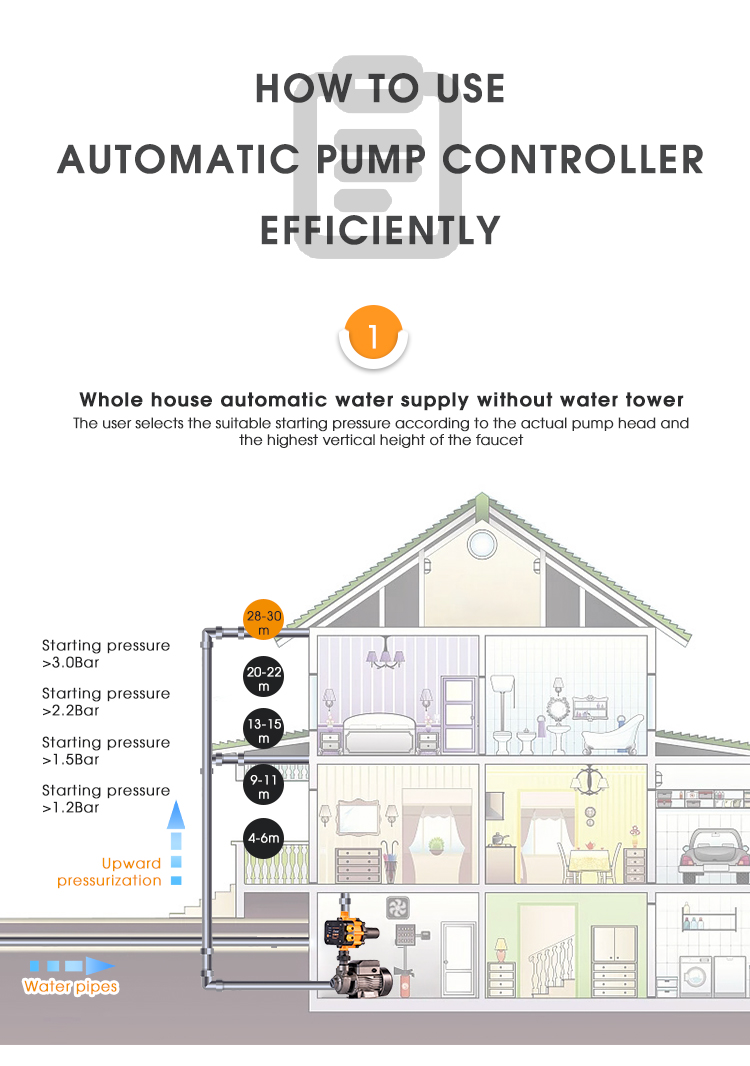
- Check the pump on its own first. Confirm the pump operates normally and that the parameters on the pump nameplate match the pressure controller you intend to fit. The pump head must be at least 0.8 bar higher than the controller's start-up pressure.
- Do the starting-pressure arithmetic. Monro's worked example: with a starting pressure of 1.2 bar, the maximum water use height is 1.2 × 10 m = 12 m, and the required pump lift is at least (1.2 + 0.8) × 10 m = 20 m. Both the EPC-1.1 and the EPC-3 offer 1.2 bar, 1.5 bar and 2.2 bar starting-pressure settings, so this step decides the setting, not the model.
- Match motor power. The EPC-1.1 is published at 1.1 kW, 1.5 kW and 0.75 kW. The EPC-3 is published at 0.55 kW, 1.1 kW, 1.5 kW and 0.75 kW. If the domestic pump is smaller than 0.75 kW, the EPC-3 is the model that covers it.
- Match the thread to what is already on the wall. The EPC-1.1 offers G1", G1 1/4", G1 1/2" and NPT1"; the EPC-3 offers G1". In a new-build with standard G1" pipework the two are equivalent. In a retrofit, this step usually decides the model.
- Confirm the environment. Both models are IP65 with a 55 °C maximum working temperature, which suits a domestic plant room, a utility cupboard or a sheltered outdoor cabinet.
- Decide whether you need to see pressure. If the commissioning record, the handover process or the maintenance routine depends on a visible reading, choose the EPC-3 and use its pressure gauge. If pressure will only ever be verified with external test equipment, the gauge is optional weight.
- Verify the certificate scope for the model and the market using the three-question check above, and file the certificate with the project documentation.
- Install in the direction of flow. Fit the controller according to the direction indicated by the arrow on its housing.
- Wire and seal. Connect the controller's power cord to a separate plug wire and wrap the connection securely with waterproof insulating tape so the joint is properly sealed.
- Commission with the outlets open. After all electrical connections are complete, first open the main outlet valve and all water faucets, then connect the power supply. The controller will begin operation, starting the pump at the low-pressure setpoint and stopping it at the high-pressure setpoint.
Safety note from Monro's installation guidance: seal all wire joints with waterproof tape, confirm the pump head against the start-up pressure, and never commission the controller with the outlet valve closed.
Which Model Fits Which Domestic Scenario
- New-build single-family house on standard G1" pipework, technician wants a pressure reading at handover: EPC-3. The gauge gives the commissioning evidence and the household gets a visible pressure reference.
- Retrofit into an older riser with G1 1/4" or NPT1" threads, minimal labour, no requirement to monitor pressure: EPC-1.1. Four thread options remove the adapter and the extra joint.
- Small domestic pump below 0.75 kW: EPC-3, because 0.55 kW is inside its published power range and outside the EPC-1.1's.
- Shared plant room in a small apartment block, visited by different technicians: EPC-3, for the same reason a gauge belongs on any shared system — it shortens fault-finding.
- Distributor or OEM programme covering mixed housing stock under one brand: either model, ordered through Monro's OEM channel with customization of cable length, cable material, brand, colour box and colour, at a published minimum order quantity of 204 pcs and a 45-day lead time.
Frequently Asked Questions
How do you verify that a pressure control switch manufacturer is genuinely CE certified for the model you are buying?
Ask for the certificate document, not a logo. A verifiable CE-EMC Certificate of Conformity names the holder, the issuing body, the certificate number, the applicable standards, and — most importantly — the model list inside the scope. Monro's CE-EMC Certificate of Conformity, number AE505724390001, is issued by TUV Rheinland LGA Products GmbH for the EU market and applies EN IEC 55014-1:2021, EN IEC 55014-2:2021, EN 61000-3-2:2019+A1 and EN 61000-3-3:2013+A1+A2 under Directive 2014/30/EU. Its model scope names EPC-1, EPC-2, EPC-2.1, EPC-3, EPC-3P, EPC-4, EPC-5, EPC-15 and CEWP-111B. The EPC-3 is inside that scope; the EPC-1.1 is not named in the published list, so a buyer specifying the EPC-1.1 for the EU should request the current certificate and model scope from Monro before ordering. Monro's ISO 9001:2015 certificate, number 20126Q00115R300, issued by BeiJing ZHONGRUI Unite and valid to 29 June 2029, lists both models among its applicable products.
EPC-1.1 or EPC-3 — which one is harder to install in a domestic booster system?
Neither is harder in principle: both are IP65, both are rated to 55 °C, both run at 50/60 Hz, and both offer the same 1.2 bar, 1.5 bar and 2.2 bar starting-pressure settings. The installation difference is thread-related. The EPC-1.1 offers G1", G1 1/4", G1 1/2" and NPT1", while the EPC-3 offers G1" only, so on a riser that is not G1" the EPC-1.1 removes the need for adapters. The EPC-3 offsets that with one commissioning advantage — its pressure gauge shows pipeline pressure without extra test equipment — and with a wider power range that starts at 0.55 kW against the EPC-1.1's 0.75 kW floor.
What commercial constraints should buyers expect on EPC-series orders?
Monro publishes the following order parameters for its OEM programme: minimum order quantity 204 pcs, lead time 45 days, production mode OEM, with customization of cable length, cable material, brand, colour box and colour. Monthly capacity for the automatic pump control (EPC) series is 180,000 pcs, quality control is 100% test, and after-sales support covers remote support with a one-year warranty. On budget, compare installed cost rather than unit price: a G1"-only control that needs an adapter on a G1 1/4" or NPT1" riser adds parts and labour that a wider-thread model avoids.
How should a domestic booster project be validated before a production order?
Validate in this order: pump nameplate power and head, starting-pressure setting, thread, and environment. Monro's guidance is that the pump head must be at least 0.8 bar higher than the controller's start-up pressure; for a 1.2 bar starting pressure, the maximum water use height is 12 m (1.2 × 10 m) and the required pump lift is at least 20 m ((1.2 + 0.8) × 10 m). Once the model is fixed, request a sample and a quotation from Monro (sale@monro-switch.com, Tel / WhatsApp +86 13586289715) and test the unit on the actual pump before the 45-day production slot is committed.
What is the lead time and production capacity for EPC-1.1 and EPC-3?
Lead time is published as 45 days. Monthly production capacity for the automatic pump control (EPC) series is 180,000 pcs, and annual output for the EPC series is 2.88 million pcs, alongside 3.24 million pcs for the KRS mechanical pressure switch series and 0.6 million pcs for the FPS float switch series. The manufacturing site in Wenling City covers 30,000 m2 with around 200 employees, including a 10-engineer R&D team, and every unit passes 100% testing before shipment.
Conclusion: Let the Job Choose the Model
For a domestic booster system, the EPC-1.1 and the EPC-3 are not competing on build quality. They share IP65 protection, a 55 °C maximum working temperature, 50/60 Hz operation and identical 1.2 bar, 1.5 bar and 2.2 bar starting-pressure options. They compete on what the installation needs. If the deciding requirement is visual pressure verification — commissioning sign-off, handover records, or repeated maintenance checks in a shared plant room — the EPC-3 is the answer, with its pressure gauge for real-time monitoring, its published built-in run-dry protection and check valve, and a power range that reaches 0.55 kW. If the deciding requirement is fitting the control to existing pipework with the least labour, the EPC-1.1 is the answer, with four thread options (G1", G1 1/4", G1 1/2", NPT1") against a single G1".
Whichever model you land on, match the documentation to the model before the order is placed. The EPC-3 is named inside CE-EMC Certificate of Conformity AE505724390001; the EPC-1.1 is not named in the published scope and should be confirmed in writing for the destination market. Both appear among the applicable products of ISO 9001:2015 certificate 20126Q00115R300.
Next Step: Sample, Quote or Catalogue
Monro Switch supplies the EPC-1.1, the EPC-3 and more than 40 pressure controller models for water pump systems, with OEM customization of cable length, cable material, brand, colour box and colour, a 204 pcs minimum order quantity and a 45-day lead time.
Request a sample or a quotation: Mable — sale@monro-switch.com · Tel / WhatsApp +86 13586289715 · WhatsApp chat.
Download the full product range: Monro catalogue 2025 (PDF).
Website: www.monroswitch.com · Address: No.2, 25th Street Eastern New Ctiy, Wenling City, Zhejiang Province, China.
Have Questions or Need More Details?
Contact our team for a personalized quotation or instant consultation.
Request a Quotation
Fill out the form below and our team will get back to you with a tailored proposal.
WhatsApp Direct Chat
Prefer to chat in real-time? Message us on WhatsApp for instant assistance & quick answers.
- Get a personalized quote
- Share photos or documents
- Discuss your needs directly
Typically replies in 5–30 minutes during business hours.