
Pump Pressure Switch Application Guide: Matching EPC-1.1, EPC-2, EPC-2.1 & EPC-3 to Scenarios
Pump Pressure Switch Application Guide: Matching EPC-1.1, EPC-2, EPC-2.1 & EPC-3 to Scenarios
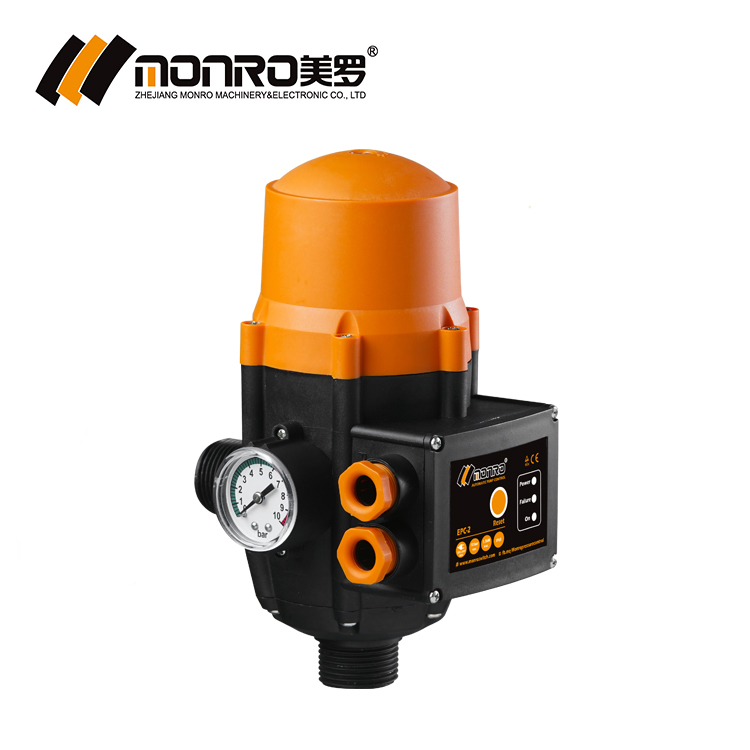
Cover: Monro EPC-2 pressure pump control — one of four EPC models mapped to project scenarios in this guide.
Which pump pressure switch belongs in a project is decided by the installation — the pump motor, the pipe thread, the supply voltage and the place the unit will sit — rather than by whichever model number happens to be in stock. Monro Switch, the brand of Zhejiang Monro Machinery & Electronic Co., Ltd., is a pressure controller manufacturer based in Wenling City, Zhejiang Province, China. The company produces the EPC series of automatic pump controls for water pump systems, alongside mechanical pressure controls (KRS series) and float switches (FPS series).
Four EPC models cover most project briefs:
- EPC-1.1 — domestic water systems running surface or submersible pumps.
- EPC-2 — agriculture irrigation, water treatment and construction duty.
- EPC-2.1 — 220–240 V or 110–120 V pump circuits.
- EPC-3 — installations that need a pressure gauge and constant pressure at constant flow.
The checks below separate a correct match from an expensive mismatch: maximum motor power, starting pressure settings of 1.2 bar, 1.5 bar or 2.2 bar, connection threads from G1" to NPT1", 50/60 Hz supply, IP protection rating, the 55 °C maximum working temperature, and whether the site needs a built-in check valve, run-dry protection or an on-board pressure gauge.
Problem definition: why pressure control switches fail at commissioning
A pump pressure switch is an automatic on/off device for a pump, driven by system pressure rather than by a timer or a manual contact. In the domestic water supply scenario these controllers are specified for, the documented operating logic is straightforward: the controller activates the pump at the preset low-pressure setpoint and deactivates it at the high-pressure setpoint, operating in automatic response mode based on system pressure changes. Its role in that scenario is automatic pump start and stop control, with a water pump as the supporting equipment and clean water as the working medium.
Failures at commissioning rarely originate in the controller. They come from four mismatches that are visible in the specification sheet long before the order is placed.
- Power mismatch. The controller’s maximum power rating is lower than the pump motor. EPC-1.1 and EPC-2 list maximum power options of 0.75 kW, 1.1 kW and 1.5 kW; EPC-2.1 and EPC-3 list 0.55 kW, 0.75 kW, 1.1 kW and 1.5 kW.
- Head and pressure mismatch. The starting pressure setting does not align with the pump lift and the maximum water use height, so the pump short-cycles or never reaches its cut-out point.
- Mechanical mismatch. The connection thread — R1", G1", G1 1/4", G1 1/2" or NPT1" — does not mate with existing pipework, forcing adapters into a system that was designed without them.
- Environment mismatch. The protection rating or the temperature rating sits below the duty. All four models in this guide are rated to a maximum working temperature of 55 °C, and the domestic water supply scenario they are matched to is specified with a 0.5–10 bar pressure range, a 55 °C maximum working temperature and IP65 protection.
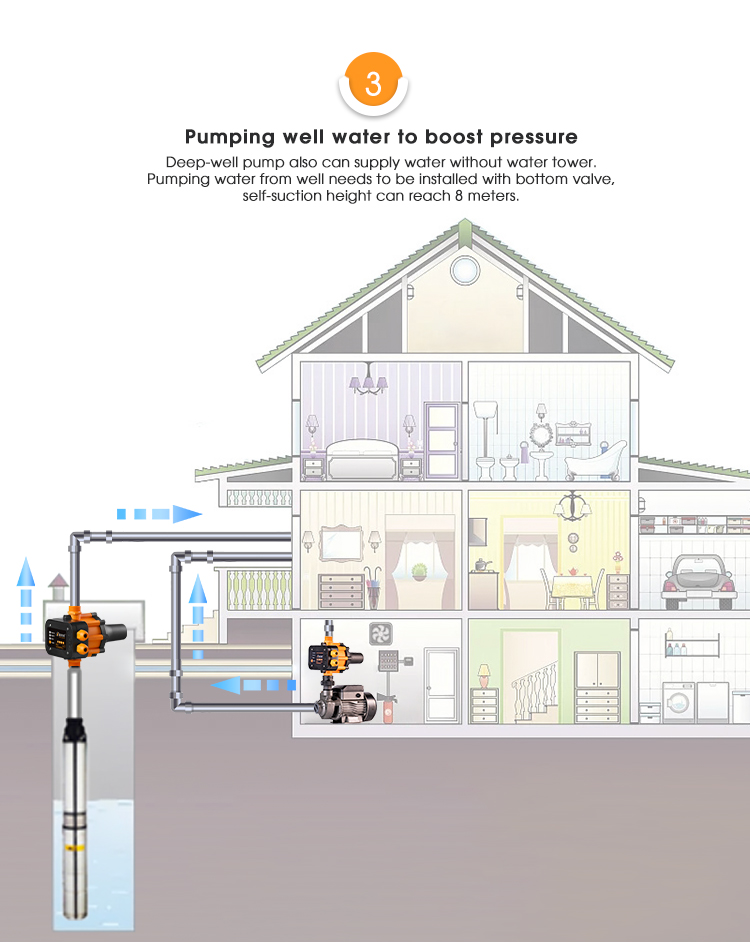
EPC-series pressure controller matched to a domestic water supply layout — automatic start/stop control driven by system pressure.
Industry background: scenario selection is replacing catalogue selection
The pressure switch category is now large enough that buyers no longer accept one generic model per system type. The global pressure switch market was valued at USD 3.2 billion in 2025 and is projected to grow from USD 3.38 billion in 2026 to USD 5.13 billion by 2034, according to Fortune Business Insights. Within that market, electromechanical pressure switches accounted for approximately 62% of global market share in 2024, with solid-state electronic switches taking the remaining 38%, based on data published by Market Research Future.
Two structural facts shape how projects write specifications. First, IEC 60730-2-6:2025 is the current international standard for automatic electrical pressure sensing controls, published by the International Electrotechnical Commission; it is the reference many buyers cite when they define a requirement. Second, water pump pressure switches are commonly traded under HS Code 853650, which matters to importers preparing customs documentation.
Monro Switch operates as a family-owned manufacturer integrating R&D, production and sales. Although officially established in 2010, the company draws on more than 20 years of manufacturing expertise in pressure controls and float switches, and currently offers more than 40 models of pressure controllers for water pump systems and air compressors. The facility covers 30,000 m² with around 200 employees and a 10-engineer R&D team. Documented annual output is 2.88 million pcs for the EPC series, 3.24 million pcs for the KRS series and 0.6 million pcs for the FPS series. Products hold TUV (Germany) and CE (Europe) certifications, with select models also approved under the CUL standard, and the company runs a complete ISO 9001:2015 quality management system. Around 90% of output is exported to Asia, Europe, North and South America, and the Middle East and Africa.
Detailed solution: mapping each EPC model to its scenario
The four models share the same core logic — automatic pressure control of a water pump — but differ in the details that decide whether an installation is a fifteen-minute fit or a week of adapters and callbacks: thread type, protection rating, power band and on-board instrumentation.
EPC-1.1 — domestic water systems with surface or submersible pumps
EPC-1.1 is a pump pressure control listed for domestic applications and specified for use with surface or submersible pumps. Its defining characteristic for buyers is thread coverage.
- Rated voltage: 220–240 V / 110–120 V
- Power frequency: 50/60 Hz
- Maximum power options: 1.1 kW / 1.5 kW / 0.75 kW
- Starting pressure settings: 1.2 bar, 1.5 bar, 2.2 bar
- Connection thread: G1", G1 1/4", G1 1/2", NPT1"
- Protection rating: IP65
- Maximum working temperature: 55 °C
- Materials: plastic and metal
Because it offers G1", G1 1/4", G1 1/2" and NPT1", the EPC-1.1 carries the broadest thread selection in this group. That matters in domestic work, where the controller has to meet pipework that was installed years earlier and where an adapter is a leak risk rather than a solution.
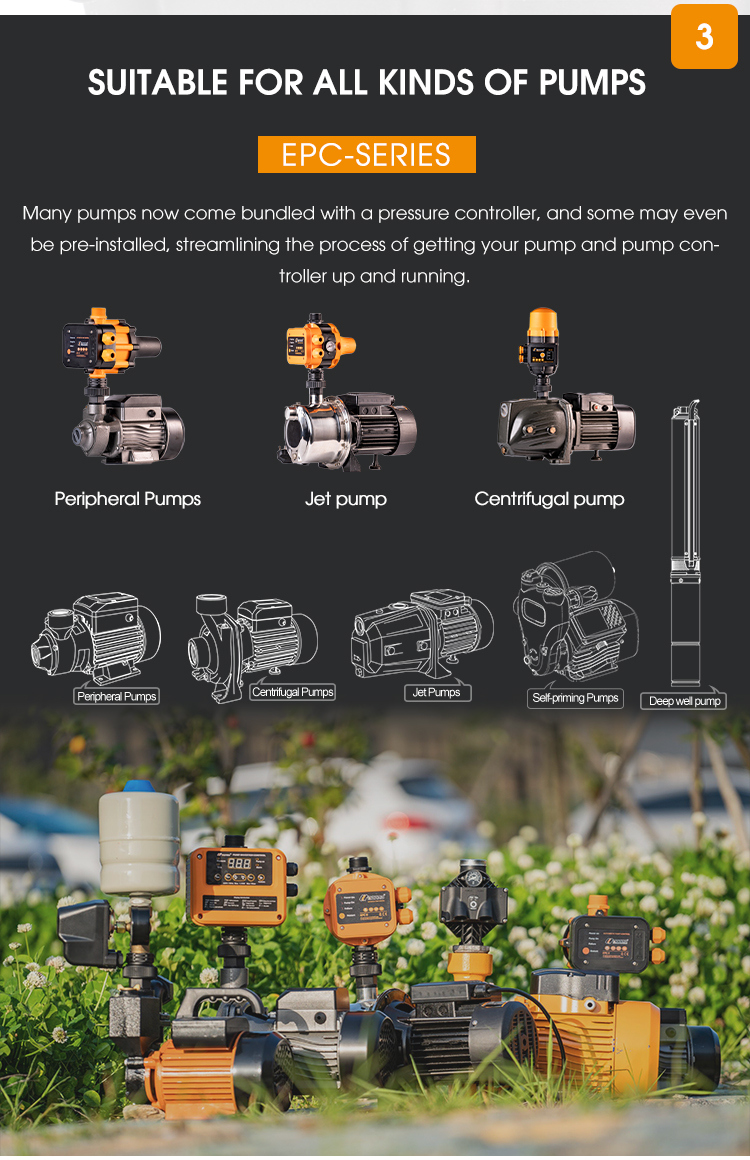
Domestic and residential water supply: the scenario EPC-1.1 is specified for, with automatic pump start/stop control at preset pressure setpoints.
EPC-2 — agriculture irrigation, water treatment and construction
EPC-2 is a pump pressure control listed for agriculture irrigation, water treatment and construction applications. Where the site is a field pump house, a treatment cabinet or an active construction site, the model’s feature set is what carries the workload.
- Rated voltage: 220–240 V / 110–120 V
- Power frequency: 50/60 Hz
- Maximum power options: 1.1 kW / 1.5 kW / 0.75 kW
- Starting pressure settings: 1.2 bar, 1.5 bar, 2.2 bar
- Connection thread: R1"
- Protection rating: IP65
- Maximum working temperature: 55 °C
- Listed features: built-in run-dry protection, built-in smart program that can automatically restart the pump, built-in check valve, maintains constant pressure at constant flow, simple installation that saves time and space, compatible with surface or submersible pumps
- Versions: optional adjustable and non-adjustable; the adjustable version allows starting pressure to be set between 1.5 and 3.0 bar
The adjustable version is the reason EPC-2 appears in retrofit projects. Where a system’s actual head is uncertain until commissioning — common in irrigation where the distribution layout is modified seasonally — an adjustable starting pressure removes the need to re-order a fixed-setting unit.
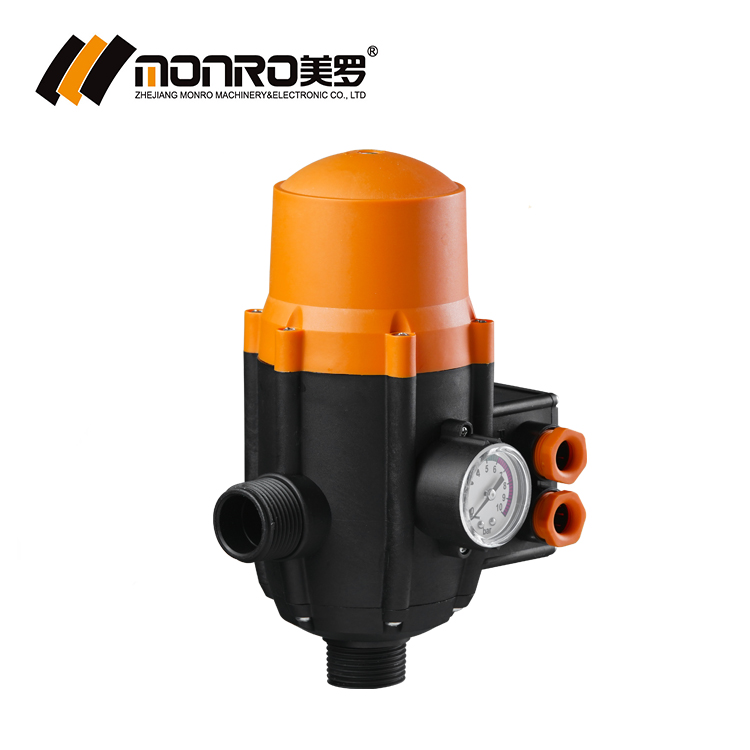
EPC-2 pump pressure control with R1" connection, IP65 protection and built-in run-dry protection for irrigation, water treatment and construction duty.
EPC-2.1 — 220–240 V or 110–120 V pump circuits
EPC-2.1 is a pump pressure control specified for 220–240 V or 110–120 V pump circuits across agriculture irrigation, water treatment and construction applications.
- Rated voltage: 220–240 V / 110–120 V
- Power frequency: 50/60 Hz
- Maximum power options: 0.55 kW / 1.1 kW / 1.5 kW / 0.75 kW
- Starting pressure settings: 1.2 bar, 1.5 bar, 2.2 bar
- Connection thread: R1"
- Protection rating: IP44
- Maximum working temperature: 55 °C
The practical difference between EPC-2.1 and EPC-2 is the protection rating. EPC-2.1 carries IP44, while EPC-1.1, EPC-2 and EPC-3 carry IP65. IP44 is a sound specification for a controller mounted inside a plant room, a control cabinet or a sheltered enclosure. Where the unit will be washed down, hosed or exposed to weather, the IP65 models in the same range are the safer choice. Matching the rating to the real mounting location avoids paying for protection the site does not need — and avoids installing a rating the site will exceed.
EPC-3 — pressure gauge and constant pressure at constant flow
EPC-3 is the model to specify when the installation has to show its own working pressure and hold steady output. It includes a pressure gauge for real-time pressure monitoring and is documented as maintaining constant pressure at constant flow.
- Rated voltage: 220–240 V / 110–120 V
- Power frequency: 50/60 Hz
- Maximum power options: 0.55 kW / 1.1 kW / 1.5 kW / 0.75 kW
- Starting pressure settings: 1.2 bar, 1.5 bar, 2.2 bar
- Connection thread: G1"
- Protection rating: IP65
- Maximum working temperature: 55 °C
- Listed features: built-in run-dry protection, built-in check valve, maintains constant pressure at constant flow, compatible with surface or submersible pumps, simple installation
Two details make EPC-3 the constant-pressure pump controller of the group. The gauge allows an installer or maintenance technician to read system pressure directly at the unit rather than at a remote test point, and the built-in check valve prevents backflow from pressuring the pump when the controller has stopped it.
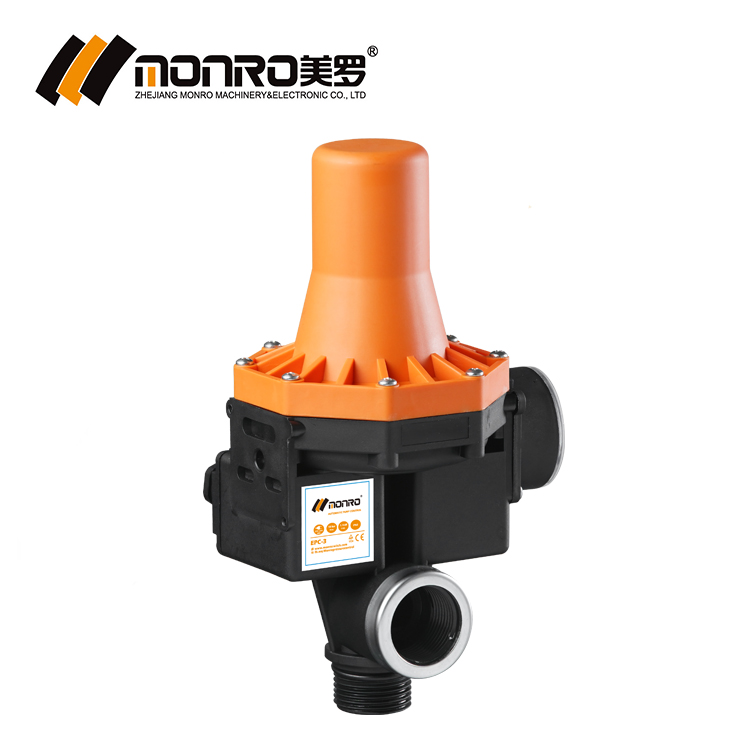
EPC-3 pump pressure switch controller — on-board pressure gauge for real-time monitoring plus constant pressure at constant flow.
Step-by-step breakdown: seven checks before the order is placed
Working through these checks in order prevents most of the rework described above. Each one maps to a value that appears in the model datasheet.
Step 1 — Match the controller’s maximum power to the pump motor
Read the pump nameplate first. EPC-1.1 and EPC-2 list maximum power options of 0.75 kW, 1.1 kW and 1.5 kW; EPC-2.1 and EPC-3 list 0.55 kW, 0.75 kW, 1.1 kW and 1.5 kW. If the pump exceeds the controller’s maximum power rating, no amount of pressure adjustment will make the combination safe.
Step 2 — Translate system head into a starting pressure setting
All four models list starting pressure settings of 1.2 bar, 1.5 bar and 2.2 bar. Monro’s published selection guidance converts those settings into physical heights: at a starting pressure of 1.2 bar, the maximum water use height is 1.2 × 10 m = 12 m, and the pump lift should be at least (1.2 + 0.8) × 10 m = 20 m. The same guidance states the general rule: the pump head must be at least 0.8 bar higher than the controller’s start-up pressure.
Applied to the other settings in the group, the same arithmetic gives a first-pass sanity check before a hydraulic calculation is commissioned:
- Starting pressure 1.2 bar → maximum water use height approximately 12 m, minimum pump lift approximately 20 m.
- Starting pressure 1.5 bar → maximum water use height approximately 15 m.
- Starting pressure 2.2 bar → maximum water use height approximately 22 m.
These figures describe the relationship between starting pressure and height. They do not replace a pump curve, which remains the final reference for any installation above domestic scale.
Step 3 — Confirm supply voltage and frequency
EPC-1.1, EPC-2, EPC-2.1 and EPC-3 all list a rated voltage of 220–240 V / 110–120 V and a power frequency of 50/60 Hz, which allows the same model family to be used across 50 Hz and 60 Hz markets. Where a project must cover several supply standards with one stock item, the wider Monro pump pressure switch range also includes triple-voltage versions: EPC-13, EPC-14, EPC-14A and EPC-15 are documented as supporting 110 V, 230 V or 110–220 V operation.
Step 4 — Lock the connection thread
Thread selection is a mechanical, not a commercial, decision. EPC-1.1 offers G1", G1 1/4", G1 1/2" and NPT1"; EPC-2 and EPC-2.1 use R1"; EPC-3 uses G1". In thread designation, G denotes a parallel thread and R denotes a tapered external thread — a distinction that decides whether a joint seals on the thread or on a gasket face. Measure the existing pipe connection before choosing the model, not after delivery.
Step 5 — Check the protection and temperature envelope
EPC-1.1, EPC-2 and EPC-3 are rated IP65; EPC-2.1 is rated IP44. All four are rated to a maximum working temperature of 55 °C. The domestic water supply scenario these controls are matched to is specified with a 0.5–10 bar pressure range, IP65 protection and a 55 °C maximum working temperature. If the mounting location, the fluid temperature or the local climate pushes beyond those values, the rating — not the setpoint — becomes the limiting factor.
Step 6 — Decide which functions must be factory-fitted
Some capabilities cannot be added on site. Check the datasheet for each model before committing:
- Built-in check valve — listed for EPC-2 and EPC-3.
- Run-dry protection — listed for EPC-2 and EPC-3; EPC-3 is documented as including built-in run-dry protection.
- Constant pressure at constant flow — documented for EPC-2 and EPC-3.
- Pressure gauge for real-time monitoring — EPC-3.
- Adjustable starting pressure — the EPC-2 adjustable version, settable between 1.5 and 3.0 bar.
Where a function is not listed in a model’s specification, confirm the requirement with the supplier before the order is released rather than assuming it is present.
Step 7 — Commission in the right order
Monro’s published operating guidance for the automatic pump controller sets out the sequence that avoids most start-up faults:
- Check the water pump separately to confirm it operates normally, and verify that the parameters on the pump nameplate match those of the pressure controller. The pump head must be at least 0.8 bar higher than the controller’s start-up pressure.
- Install the pressure controller in accordance with the direction indicated by the arrow on its housing.
- Connect the power cord of the controller to a separate plug wire and wrap the connection securely with waterproof insulating tape.
- After all electrical connections are complete, first open the main outlet valve and all water faucets, then connect the power supply. The controller will then begin operation.
Commissioning note: seal all wire joints with waterproof tape, and verify both pump head and start-up pressure before energising the circuit. These are the two factors most often cited in controller start-up faults.
Use cases: four project types and the model that fits each
Use case 1 — Domestic and residential water supply (EPC-1.1)
A household or small residential block with a surface or submersible pump and no pressure vessel. The controller starts the pump when a tap opens and system pressure falls below the setpoint, and stops it when flow ceases. EPC-1.1 fits here because its thread options — G1", G1 1/4", G1 1/2" and NPT1" — cover the pipe connections found in domestic retrofit work, and because its IP65 rating allows mounting outside a cabinet. This application is documented as common in Algeria, Egypt, Germany and other countries.
Use case 2 — Agriculture irrigation, water treatment and construction (EPC-2)
Irrigation lines, treatment cabinets and site water supply share two risks: the pump can run dry when a source empties or a valve is closed, and the system can be left unattended for long periods. EPC-2 addresses both with built-in run-dry protection and a built-in smart program that can automatically restart the pump. Its built-in check valve prevents backflow from holding pressure against a stopped pump, and constant pressure at constant flow keeps distribution even across the network. The adjustable version extends the starting pressure range to 1.5–3.0 bar where the final system head is confirmed only at commissioning.
Use case 3 — Voltage-constrained and cabinet-mounted circuits (EPC-2.1)
Where the electrical supply is 220–240 V or 110–120 V and the controller will be mounted inside a control cabinet, plant room or sheltered enclosure, EPC-2.1 matches the circuit and the environment without over-specifying the enclosure. Its maximum power options run from 0.55 kW to 1.5 kW, and its starting pressure settings remain 1.2 bar, 1.5 bar and 2.2 bar — the same selection logic as the rest of the group.
Use case 4 — Installations that must show pressure and hold it (EPC-3)
Buildings with multiple draw-off points, and systems where occupants notice pressure fluctuation, need a constant pressure pump controller with visible feedback. EPC-3 combines the on-board pressure gauge for real-time monitoring with constant pressure at constant flow, and adds built-in run-dry protection and a built-in check valve. The G1" connection and IP65 rating keep it suitable for both indoor plant rooms and sheltered outdoor installations.
Field reference: a two-year water supply installation
A water supply project in China installed 50 pressure control switches for a system providing automatic pump start/stop control. The installation has been in operation for two years and delivers reliable automatic pressure control, used for agriculture irrigation, water treatment and construction applications. The reference is useful less as a performance claim than as a scale indicator: 50 units in one project is the order size at which thread standardisation and model consistency start to matter operationally.
Comparison table: EPC-1.1, EPC-2, EPC-2.1 and EPC-3 side by side
| Selection check | EPC-1.1 | EPC-2 | EPC-2.1 | EPC-3 |
|---|---|---|---|---|
| Primary scenario fit | Domestic water systems, surface or submersible pumps | Agriculture irrigation, water treatment, construction | 220–240 V or 110–120 V pump circuits | Systems needing a pressure gauge and constant pressure at constant flow |
| Rated voltage | 220–240 V / 110–120 V | 220–240 V / 110–120 V | 220–240 V / 110–120 V | 220–240 V / 110–120 V |
| Power frequency | 50/60 Hz | 50/60 Hz | 50/60 Hz | 50/60 Hz |
| Maximum power options | 1.1 kW / 1.5 kW / 0.75 kW | 1.1 kW / 1.5 kW / 0.75 kW | 0.55 kW / 1.1 kW / 1.5 kW / 0.75 kW | 0.55 kW / 1.1 kW / 1.5 kW / 0.75 kW |
| Starting pressure settings | 1.2 bar, 1.5 bar, 2.2 bar | 1.2 bar, 1.5 bar, 2.2 bar (adjustable version 1.5–3.0 bar) | 1.2 bar, 1.5 bar, 2.2 bar | 1.2 bar, 1.5 bar, 2.2 bar |
| Connection thread | G1", G1 1/4", G1 1/2", NPT1" | R1" | R1" | G1" |
| Protection rating | IP65 | IP65 | IP44 | IP65 |
| Maximum working temperature | 55 °C | 55 °C | 55 °C | 55 °C |
| Run-dry protection | Confirm against model datasheet | Listed in model feature set | Confirm against model datasheet | Listed — documented as built-in |
| Built-in check valve | Confirm against model datasheet | Listed in model feature set | Confirm against model datasheet | Listed in model feature set |
| Constant pressure at constant flow | Confirm against model datasheet | Listed in model feature set | Confirm against model datasheet | Documented |
| Pressure gauge | Not part of this model’s listed features | Not part of this model’s listed features | Not part of this model’s listed features | Included for real-time pressure monitoring |
FAQ: pressure control switch selection questions from project buyers
1. What compliance and certification information should a project specify?
Start with the standard, then the certification. IEC 60730-2-6:2025 is the current international standard for automatic electrical pressure sensing controls, published by the International Electrotechnical Commission, and it is the reference buyers most often cite in a specification. On the manufacturer side, Monro Switch operates an ISO 9001:2015 quality management system, its products hold TUV (Germany) and CE (Europe) certifications, and select models are also approved under the CUL (U.S. and Canada) standard. For import and customs documentation, water pump pressure switches are commonly classified under HS Code 853650.
2. Can the pressure control switch be customized for a specific project?
Yes. Monro operates an OEM production model, with customization available in cable length, cable material, brand, colour box and colour. Within the EPC range, models are offered in adjustable and non-adjustable versions: the EPC-2 adjustable version allows the starting pressure to be set between 1.5 and 3.0 bar, while EPC-1.1, EPC-2, EPC-2.1 and EPC-3 list fixed starting pressure settings of 1.2 bar, 1.5 bar and 2.2 bar. Where pipework dictates the connection, the EPC-1.1 covers G1", G1 1/4", G1 1/2" and NPT1". Production capacity supports this customization: documented monthly capacity is 180,000 pcs for the EPC series, 250,000 pcs for the KRS series and 30,000 pcs for the FPS series, supported by 100% testing and a 10-engineer R&D team.
3. What drives the cost of a pressure control switch order?
Four variables dominate. The first is specification level: an IP65 unit with an on-board pressure gauge, built-in check valve and run-dry protection carries more content than a basic IP44 controller. The second is the connection thread and body configuration, since thread type and material affect both machining and tooling. The third is customization — cable length and material, colour, branding and packaging all add a process step. The fourth is order volume against the documented minimum order quantity of 204 pcs. Comparing two models on purchase price alone usually misses the larger number: the labour and adapter cost of making a wrong thread fit a site.
4. Can a model be validated before a production order is placed?
A pre-order validation should test the four things that are expensive to correct later: thread engagement with the actual pipework, whether the starting pressure setting matches the calculated pump lift and maximum water use height, whether run-dry protection and automatic restart behave as the site expects, and whether the protection rating suits the real mounting location. Buyers can request samples and a quotation for EPC-1.1, EPC-2, EPC-2.1 or EPC-3 directly from Monro Switch at sale@monro-switch.com or by WhatsApp on +86 13586289715, quoting the model, voltage, thread and starting pressure the project requires.
5. What are the lead time and order volume for EPC-series controllers?
The documented lead time is 45 days, with a minimum order quantity of 204 pcs. Monthly capacity for the EPC series is 180,000 pcs, and every unit is 100% tested before shipment. After-sales support covers remote assistance and a one-year warranty, and products are exported to Asia, Europe, North and South America, and the Middle East and Africa. Buyers planning a project schedule should build the 45-day production window into the programme before site works begin.
Conclusion: select by scenario, then confirm by datasheet
Scenario first, specification second. A domestic water system running a surface or submersible pump points to EPC-1.1, whose G1", G1 1/4", G1 1/2" and NPT1" threads fit existing household pipework under IP65 protection. Agriculture irrigation, water treatment and construction duty point to EPC-2, where built-in run-dry protection, a built-in check valve and an adjustable starting pressure range of 1.5–3.0 bar carry the workload. Voltage-constrained circuits mounted in sheltered enclosures point to EPC-2.1 at IP44. Installations that need to display and hold their own pressure point to EPC-3, with its gauge and constant pressure at constant flow.
Whichever model the project selects, the confirming checks are the same: pump motor power against the controller’s maximum rating, starting pressure against calculated pump lift, thread against the actual pipe connection, voltage and frequency against the supply, and protection rating against the mounting location. All four models run at 50/60 Hz and share a 55 °C maximum working temperature, so the deciding variables are almost always mechanical, electrical and environmental — not commercial.
Next step: match, sample, then order
Send the project details — pump power, required starting pressure, pipe thread, supply voltage and mounting location — and Monro Switch will confirm which EPC model fits and issue a sample and quotation.
Email: sale@monro-switch.com | WhatsApp / Tel: +86 13586289715 | Website: www.monroswitch.com

Monro Switch manufacturing workshop, Wenling City — EPC-series pressure controllers are produced under an ISO 9001:2015 quality management system with 100% testing.
Full specifications for the EPC series, the KRS mechanical pressure control range and the FPS float switch range are available in the downloadable catalogue: Monro catalogue 2025 (PDF).