
SMT Pick-and-Place vs. Reflow Oven: Where Should Your Turnkey Budget Go First?
Short answer: commit your first capital to the SMT pick-and-place machine when placement is your dominant risk, and to the SMT reflow oven when thermal process control is your dominant risk. Every other item in a turnkey budget — solder paste printer, SPI, AOI, loaders, conveyors, cleaners — is then sequenced around that single decision, because the machine you buy first determines how much of the rest of the line you can actually use.
Motek is an SMT turnkey solution provider that supplies placement platforms, reflow ovens, in-line dispensing equipment, cleaning machines and related PCBA line hardware to high-mix electronics manufacturers, with operations dating to 2011 and export markets including the EU, the US, Australia, Canada and ASEAN. This guide does not rank machines by price or by brand reputation. It answers a narrower and more expensive question: inside a fixed turnkey budget, which capital item should be committed first, and what evidence justifies that order.
To keep the discussion concrete, this article uses one working configuration — a Hanwha Decan S2 SMT pick-and-place machine, an XMR-800D SMT reflow oven, and an HMH830D automatic online glue dispenser — and treats each as a capital decision rather than a specification sheet.
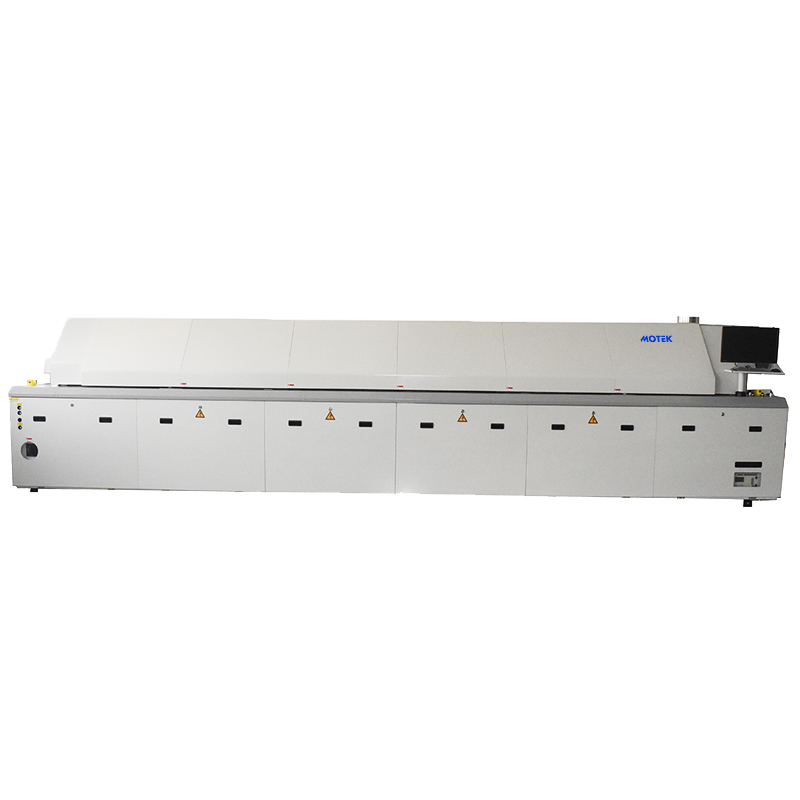
XMR-800D SMT reflow oven — 8 top / 8 bottom heating zones over a 3,110 mm heated length, with 3 + 3 cooling zones.
Problem Definition: Why the "First Machine" Question Is Harder Than It Looks
A turnkey SMT line is a chain of dependent processes, but capital budgets are approved one machine at a time. That mismatch is the source of most sequencing errors, and three structural facts make the decision genuinely non-obvious.
First, the two machines fail in different ways, and one type of failure hides. Placement faults are visible and usually intercepted downstream: an offset component, a missing part, or a reversed orientation is detectable by automated optical inspection. Thermal faults are frequently latent. Incomplete wetting on a heavy copper plane, voiding beneath a BGA, or a marginal joint at the edge of a panel can pass optical inspection and surface later as an X-ray reject, a rework load, or a field failure. A defect that escapes one station costs more than a defect that is caught at the next station — which is an argument for funding the machine that produces the quieter failure class.
Second, a line runs at the speed of its slowest station. A placement platform rated at 92,000 CPH does not deliver 92,000 components per hour if the reflow conveyor cannot accept the board at that rate, and a wide, well-controlled thermal window is wasted if the mounter feeding it cannot place the required component mix at the required tact. Buying an unmatched pair does not produce a faster line; it produces queued boards on one side of the bottleneck and idle capacity on the other.
Third, envelope and interface mismatches are the quiet budget killers. Board-size ranges, conveyor transfer heights, transfer direction and physical footprint have to line up across every station. In the configuration used here, the Hanwha Decan S2 handles boards from 50 × 40 mm up to 510 × 460 mm, while the HMH830D glue dispenser specifies a PCB width range of 50–450 mm and a PCB transfer height of 920 ± 20 mm. A 480 mm-wide board is therefore a placement-line product that cannot pass through the dispenser as configured. That is not a defect in either machine; it is a planning check that has to happen before purchase, not after installation.
The real question, then, is not which machine is better. It is: which station is the constraint, and which defect class is hardest to detect in this factory? Those two answers determine the purchase order.
Industry Background: What the Market Data Says About Where SMT Capital Goes
The global SMT equipment market was valued at approximately USD 6.6 billion in 2025 and is projected to reach USD 14.6 billion by 2036, according to Transparency Market Research. Asia-Pacific held a 54% revenue share of that market in 2025, followed by North America and Europe.
Placement equipment — pick-and-place machines — is the single largest segment, accounting for roughly 38% to 48% of total SMT equipment market value, based on Persistence Market Research and Cognitive Market Research figures. That one number explains why most buyers default to the mounter as their first purchase: it is the most valuable and most visible line item in the budget. But share of market value is not a purchasing priority for a specific factory. A segment can dominate an entire market and still be the wrong first purchase for a line that is currently losing yield on thermal control.
Two structural trends push in the opposite direction. High-mix / low-volume assembly lines are projected to grow at a CAGR of 8.31% through 2031, driven by demand for customized industrial and medical electronics (Mordor Intelligence). High-mix production rewards changeover flexibility and programmable process control more than raw placement speed. Separately, 3D AOI and SPI are identified as the fastest-growing equipment sub-sectors at roughly a 15.2% CAGR for inspection, driven by automotive "zero-defect" requirements (Persistence Market Research). As the verification layer becomes effectively mandatory, the budget left for the machines that physically build the board is compressed — which makes purchase order more consequential, not less.
On the standards side, IPC-A-610J, released in March 2024, is the current global standard for the acceptability of electronic assemblies and defines Class 1, 2 and 3 quality levels. A manufacturer shipping to a higher class needs more process margin, and process margin is bought either in placement capability or in thermal control — not in both at once, unless the budget allows it.
The supply landscape is concentrated among a small group of global vendors: ASMPT Limited, Fuji Corporation, Yamaha Motor, Panasonic, Juki Corporation and Hanwha Precision Machinery (MarketsandMarkets). Fuji's NXT platform and Yamaha's YSM series are industry-standard modular mounters for high-speed and high-precision placement, per Fuji and Yamaha product documentation. The configuration referenced throughout this guide uses a Hanwha Decan S2 placement platform, an XMR-800D reflow oven and an HMH830D automatic online glue dispenser.
Detailed Solution: What Each Machine Actually Controls in a Turnkey Line
Pick-and-place: it controls placement accuracy, component range and mix flexibility
The Hanwha Decan S2 SMT pick-and-place machine is specified at 92,000 CPH optimum with the HS10 head, built on a 2-gantry × 10-spindle-per-head structure. Placement accuracy is stated as ±28 μm at Cpk ≥ 1.0 for 03015 chips and ±25 μm at Cpk ≥ 1.0 for ICs, across a component range of 03015 to 12 mm with a maximum component height of 10 mm. Standard board handling covers 50 × 40 mm to 510 × 460 mm, and the machine frame is high-strength aluminum alloy.
Three of those figures carry more decision weight than the rest:
- 92,000 CPH is an optimum figure. It describes peak conditions with the HS10 head, not a sustained production rate across a mixed product schedule. Plan line capacity below it, and treat it as a ceiling rather than a promise.
- Cpk ≥ 1.0 is a capability statement, not a tolerance window. Quoting ±28 μm together with Cpk ≥ 1.0 for 03015 chips means the placement distribution is centred and repeatable enough for that component class — which is the number that actually matters for fine-pitch work, where a tight tolerance with poor repeatability still fails.
- 03015 to 12 mm on one platform is a mix argument. A line that can place both the smallest chip and a 12 mm component on a single machine needs fewer dedicated platforms, fewer changeovers and less floor space than a line that splits the range across two machines.
The limit: a pick-and-place machine cannot create a good solder joint. If the paste deposit is wrong or the thermal profile is unstable, perfect placement still produces a defective assembly. This is exactly why the placement-versus-reflow question cannot be answered by machine quality alone.
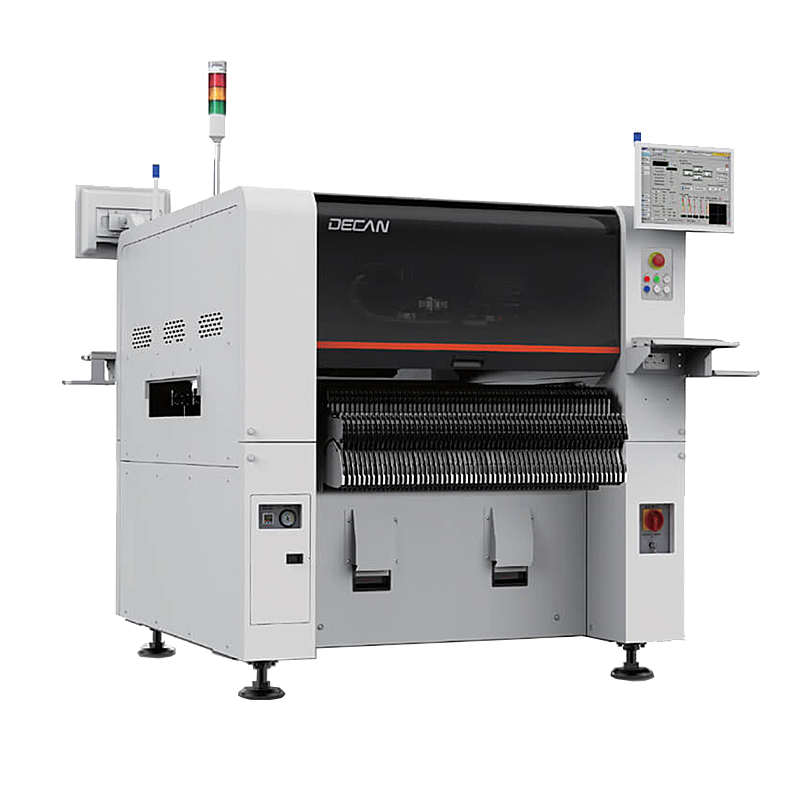
Hanwha Decan S2 SMT pick-and-place machine — 2 gantry × 10 spindles/head, 03015 to 12 mm component range.
Reflow oven: it controls the thermal profile, and it hides its failures
The XMR-800D SMT reflow oven uses 8 top and 8 bottom heating zones across a heated length of 3,110 mm, plus 3 top and 3 bottom cooling zones. Overall dimensions are 5,520 × 1,430 × 1,530 mm at approximately 2,710 kg, built around a thick copper plate with a small-circulation rectifying plate structure. The exhaust requirement is 11 m³/min × 2.
- 16 heating zones over 3,110 mm give a longer, more finely segmented profile — which is what allows a single oven to run both a small thermal-mass board and a heavy copper panel without re-qualifying the recipe from scratch.
- 6 cooling zones (3 top / 3 bottom) control the post-peak cooling rate, the stage that most directly influences joint appearance and, in many processes, the metallurgical result.
- Small-circulation rectifying plate structure governs how evenly heated air is distributed across the panel — a detail that matters most when one board mixes heavy thermal mass with fine-pitch components.
- 11 m³/min × 2 exhaust is a facility requirement, not an accessory. Two exhaust lines at that volume must exist before commissioning, and the ducting cost belongs in the turnkey budget.
- 2,710 kg at 5,520 mm long is a floor-loading and line-layout fact that constrains where the oven can physically sit.
The limit: an oven cannot correct a misplaced component or an undersized paste deposit. Its work begins only after the board is correctly assembled, which means a reflow-first strategy still depends on placement quality being adequate — it simply funds the harder-to-detect failure class first.
The automatic online glue dispenser: it changes line layout, not just capacity
The HMH830D automatic online glue dispenser is controlled by an industrial computer with a motion control card, programmed by manual teaching, and stores more than 1,000 running programs. It handles PCBs from 50 mm to 450 mm wide at a transfer height of 920 ± 20 mm, transports at 0–5,000 mm/min in either L→R or R→L direction using two stepper motors, and weighs 650 kg on a T20 mm chrome-plated steel platform measuring 1,060 × 1,200 × 1,700 mm.
Its role in an SMT line is adhesive application: placing a retaining medium on the board so components are held in position through downstream processes where solder paste alone is not the retaining mechanism. Two specification details decide whether it belongs in the first budget wave rather than the second:
- Transfer height 920 ± 20 mm and bidirectional transfer (L→R / R→L). The dispenser must interface with whatever conveyor it sits between. If adjacent stations cannot be matched to that height and direction, the dispenser becomes a manual island instead of an in-line station.
- PCB width range 50–450 mm. Compare that against the mounter's 510 mm maximum board width: products in the 450–510 mm band can be placed but cannot pass through the dispenser as specified. Either those boards bypass the dispenser, or the line configuration is rechecked before purchase.
More than 1,000 stored programs is a high-mix argument rather than a capacity argument: switching between adhesive patterns happens by program recall instead of re-teaching, which is what keeps changeover time acceptable on a line running frequent product switches.
Step-by-Step: A Six-Step Method for Sequencing a Turnkey Budget
Step 1 — Classify your dominant defect class. Sort your recent rejects into two buckets. Placement-class defects: offset, missing component, wrong orientation, wrong part number. Thermal-class defects: voiding, insufficient wetting, cold joints, warpage. Whichever class dominates — or whichever class you cannot detect optically — is the class that should receive the first capital commitment.
Step 2 — Identify the constraint station. Measure or estimate tact time at the printer, the placement stage and reflow. The line cannot exceed its slowest station. If placement is the constraint, a faster oven buys nothing; if the reflow conveyor speed caps output, a faster mounter simply queues boards ahead of the oven.
Step 3 — Verify the board envelope across every station. Compare minimum and maximum PCB dimensions, transfer height and transfer direction station by station. A line is only as wide as its narrowest machine, and a 50–450 mm dispenser inside a 510 mm placement line is a constraint that shows up on the production floor rather than in the quotation.
Step 4 — Confirm facility prerequisites before signing. Reflow: 11 m³/min × 2 exhaust capacity, roughly 2,710 kg floor loading, and 5,520 mm of line length. Environment: a stable indoor cleanroom band around 23 °C ± 2 °C, humidity controlled within a 40–60% RH window, ESD protection in a grounded EPA zone per ANSI/ESD S20.20, and ISO Class 8 cleanroom conditions where the product requires it.
Step 5 — Sequence the purchase as foundation → constraint → control → verification. This is where the budget order is actually decided:
- Placement is the constraint and the defect class is placement: buy the pick-and-place machine first, then specify the reflow oven to match the sustained tact the mounter can realistically hold.
- Thermal control is the constraint, or the defect class is latent: buy the reflow oven first, then select a placement platform whose stated accuracy meets the quality class you must ship.
- Assemblies require adhesive retention: the dispenser belongs to the first wave, because it changes the physical sequence of the line, not merely its capacity.
Step 6 — Plan for the next two product generations. The purchase order that works today should not block the mix you expect in two years. The two questions that matter are whether the placement platform's component range already covers your roadmap (03015 to 12 mm on a single machine is a broad base), and whether the oven's thermal window can absorb thicker copper or larger panels without a replacement rather than a recipe change.
Use Cases: Three Line Profiles and Where the Budget Goes
Profile A — High-volume consumer electronics: placement first
Smartphone motherboard assembly, tablet circuit board production, LED display modules and LED streetlight drivers share a common characteristic: high component counts, dense placement, and output measured in boards per hour rather than boards per shift. Motek turnkey configurations serving SMT factories in Germany, Israel, India and Australia have run in this profile — 20–35 units commissioned, five years of service, with mass production ranging from 20,000 to 100,000 pieces per day, and one referenced consumer electronics smartphone PCB programme running at 50,000 units per month. In this profile placement density and tact determine output, so the placement platform anchors the budget and the oven is sized to keep pace with it, not the other way around.
Profile B — Automotive ECU and industrial control: thermal control and verification first
ECU control unit assembly and comparable safety-relevant boards are held to acceptance criteria defined by IPC-A-610J (released March 2024), which sets Class 1, 2 and 3 quality levels. Automotive zero-defect requirements are the documented driver behind the fastest-growing equipment sub-sector — inspection at roughly 15.2% CAGR (Persistence Market Research). In this profile the thermal window and the verification layer carry the budget: the reflow oven, together with SPI, AOI and X-ray inspection, decides ship-or-hold, while the placement platform is specified to the accuracy the target class requires rather than to the fastest available speed.
Profile C — Mixed-technology boards: the dispenser moves into wave one
When assemblies need adhesive retention, the automatic online glue dispenser stops being an optional upgrade. It becomes a station in the line sequence, with its own PCB width range, transfer height and changeover behaviour. Deciding this late means re-planning conveyor layout and re-qualifying the line, which is why the dispenser is a first-wave decision whenever the product mix requires it.
A high-mix SMT line in production: 24/7 operation with ESD-protected, climate-controlled conditions.
Comparison Table: The Three Machines as Capital Decisions
| Decision dimension | Pick-and-place (Hanwha Decan S2) | Reflow oven (XMR-800D) | Glue dispenser (HMH830D) |
|---|---|---|---|
| Primary process role | Component placement, accuracy and tact | Thermal profile and joint formation | In-line adhesive application |
| Headline specification | 92,000 CPH optimum (HS10 head); 2 gantry × 10 spindles/head | 8 top / 8 bottom heating zones; 3,110 mm heated length | Industrial computer + motion control card; manual teaching |
| Accuracy / control statement | ±28 μm Cpk ≥ 1.0 (03015 chip); ±25 μm Cpk ≥ 1.0 (IC) | Small-circulation rectifying plate structure; 3 + 3 cooling zones | Transport 0–5,000 mm/min; more than 1,000 stored programs |
| Work envelope | Parts 03015–12 mm, H10 mm; PCB 50 × 40 to 510 × 460 mm | Board passes through the heated tunnel at the set conveyor rate | PCB width 50–450 mm; transfer height 920 ± 20 mm |
| Footprint and weight | High-strength aluminum alloy frame | 5,520 × 1,430 × 1,530 mm; approx. 2,710 kg | 1,060 × 1,200 × 1,700 mm; 650 kg on a T20 mm plated steel platform |
| Facility prerequisite | Stable indoor environment; ESD-protected flooring | Exhaust 11 m³/min × 2; floor loading for ~2,710 kg | Conveyor height and direction matched to adjacent stations (L→R / R→L) |
| Defect class it controls | Visible, interceptable placement faults | Frequently latent thermal faults | Retention-related faults on mixed-technology assemblies |
| When it should be bought first | Placement is the constraint; mix changeover dominates | Thermal control is the constraint; latent defects dominate | Adhesive retention is required by the assembly type |
| Constraint it can create | Feeds a line faster than the oven can absorb | Caps line tact; imposes exhaust and floor-loading limits | Narrows the usable PCB width range in the line |
Read across the table and the pattern is consistent: the pick-and-place machine sets accuracy and mix flexibility, the reflow oven sets thermal control and imposes facility limits, and the dispenser sets line-sequence compatibility. No single row decides the purchase order — the constraint does.
| Line scenario | Buy first | Buy second | Reasoning |
|---|---|---|---|
| New line, placement-dominant defect profile (fine pitch, high component count, frequent changeover) | Pick-and-place machine | Reflow oven sized to the sustained rate | Placement sets tact and mix flexibility; the oven is specified to match, not to lead |
| New line, thermal-dominant profile (heavy copper, large panels, BGA packages) | Reflow oven | Placement platform matched to the required accuracy | Latent thermal defects escape optical inspection and are the costlier failure class |
| Assemblies requiring adhesive retention | Automatic online glue dispenser (with the placement platform) | Remaining downstream stations | The dispenser changes line sequence and layout, not just capacity |
Frequently Asked Questions
1. Does the order in which I buy my SMT machines affect IPC-A-610 compliance?
Not directly. Compliance is a process outcome measured against IPC-A-610J, released in March 2024, which is the current global standard for the acceptability of electronic assemblies and defines Class 1, 2 and 3 quality levels. What the purchase order affects is process margin. Placement accuracy and thermal profile control are the two machine-level contributors to that margin. If a line must ship to a higher class, the safer sequence is to buy first whichever machine closes the larger gap against the acceptance criteria, and then specify the second machine to match the first rather than to a generic benchmark.
2. Can a single pick-and-place machine cover both the smallest and largest components in a high-mix line?
On component range, yes in this configuration. The Hanwha Decan S2 accepts parts from 03015 up to 12 mm with a maximum component height of 10 mm, using a 2-gantry × 10-spindle head structure at 92,000 CPH optimum, with placement accuracy specified at ±28 μm Cpk ≥ 1.0 for 03015 chips and ±25 μm Cpk ≥ 1.0 for ICs. The practical limit is not component size but tact time: one platform can span the range, yet a board with a very high total component count may still require a second placement stage to hold line rate.
3. Where should a first-time turnkey buyer put the budget first?
Run a two-question test before allocating capital. Question one: what actually caused your last batch of rejects — placement faults or thermal faults? Question two: which station is currently the constraint on line output? If placement is the answer to both, the pick-and-place machine is the first purchase. If thermal control is the answer to both, the reflow oven is. If the answers split, the defect class you cannot detect optically should win the first round, because an escaped defect costs more than a slow station.
4. Can we validate the configuration before committing the full capital budget?
Yes. Motek's stated minimum order quantity is 1 unit, and every unit is subject to 100% pre-shipment testing before dispatch. Validation can therefore begin with a single machine rather than a complete line: the placement platform or the reflow oven can be run against your own boards and your own acceptance criteria first. Customization options include voltage, logo, packaging, size, colour and material, alongside production line layout design, and training can be delivered remotely or on site, with the option of sending engineers to China for approximately one week.
5. What lead time and production capacity should we plan around?
Stated lead time is 7–45 days depending on configuration, against a monthly capacity of 5,000 units. After-sales support includes remote technical support and 24/7 online service, and products carry a 12-month warranty. To compare the full equipment range before finalizing the purchase order, download the Motek product catalogue, or send your board dimensions, component mix and target quality class to sales@morequip.com for a line-level recommendation on which machine should be bought first.
Conclusion: The Constraint Decides, Not the Price Tag
The pick-and-place machine and the reflow oven are not competing purchases — they are two different answers to two different risks. Placement equipment dominates the SMT equipment market at roughly 38% to 48% of total value, and that is precisely why so many budgets default to it. But a market segment's share of value says nothing about which station is failing in your factory.
The workable rule is short enough to use in a budget meeting: fund the machine that owns your dominant defect class and your line constraint. If placement is the constraint and placement faults are your visible losses, buy the pick-and-place machine first and size the oven to the rate the mounter can sustain. If thermal control is the constraint and your losses are latent, buy the reflow oven first and specify placement to the quality class you must ship. And if your assemblies require adhesive retention, bring the automatic online glue dispenser into the first wave — because it redefines the line sequence, and re-planning a line layout after installation costs far more than planning it beforehand.
Next step — plan the sequence before the purchase order.
Send your board dimensions, component mix, target output and required IPC-A-610J class to the Motek team. You will get a line-level view of which station to commit first, how the reflow oven and placement platform should be matched, and whether adhesive dispensing needs to be in the first budget round.
Catalogue download: Motek SMT equipment catalogue (PDF)
Email: sales@morequip.com | Tel: +86-755-21635007 | WhatsApp: +86 199 2455 0176
Website: www.morequip.com
Motek turnkey configurations cover placement, reflow, dispensing and line-support equipment, with production line layout design and remote or on-site training.
Have Questions or Need More Details?
Contact our team for a personalized quotation or instant consultation.
Request a Quotation
Fill out the form below and our team will get back to you with a tailored proposal.
WhatsApp Direct Chat
Prefer to chat in real-time? Message us on WhatsApp for instant assistance & quick answers.
- Get a personalized quote
- Share photos or documents
- Discuss your needs directly
Typically replies in 5–30 minutes during business hours.