
SMT Turnkey Solution Explained: The Complete PCBA Line
Electronics Manufacturing / SMT Equipment
An SMT turnkey solution is a complete surface-mount technology production line delivered by one supplier as a single integrated system. In place of separate machines and self-managed interfaces, the buyer receives a configured line that covers PCB loading, solder paste printing, component placement, reflow soldering, inspection, and transfer—engineered around a defined production goal.
In this guide
What Problem Does a Turnkey SMT Line Solve?
When electronics manufacturers purchase SMT equipment piece by piece, they silently take on the system integrator role. A solder paste printer from one vendor, a pick and place machine from another, and an SMT reflow oven from a third may each perform well in isolation. Making them work together as a line means matching conveyor heights and widths, synchronizing transfer speed, aligning software protocols, balancing cycle times, and owning process troubleshooting when defects appear.
The turnkey model moves this burden to the equipment supplier. The supplier selects compatible machines, balances the speed of each stage, configures the software, and delivers the line as a working system. For an EMS factory or industrial electronics maker without a large SMT process engineering team, this single-responsibility structure reduces project risk at the start of production and simplifies day-to-day operation afterward.
Why SMT Turnkey Demand Is Rising
The global Surface Mount Technology (SMT) equipment market was valued at approximately USD 6.6 billion in 2025 and is projected to reach USD 14.6 billion by 2036. Asia-Pacific dominated the market in 2025, holding a 54% revenue share, followed by North America and Europe.
Several structural trends sit behind these headline numbers:
- Placement equipment is the largest equipment segment. Pick and place machines account for roughly 38% to 48% of total SMT equipment market value, which is why placement machine selection dominates most turnkey line discussions.
- High-mix production is accelerating. The high-mix / low-volume assembly segment is projected to grow at a CAGR of 8.31% through 2031, driven by demand for customized industrial and medical electronics.
- Inspection is the fastest-moving sub-sector. 3D AOI (Automated Optical Inspection) and SPI (Solder Paste Inspection) are identified as the fastest-growing equipment categories, with inspection equipment reported at a CAGR of about 15.2%, largely due to automotive “zero-defect” requirements.
- The vendor landscape is well defined. Key global SMT equipment vendors include ASMPT Limited, Fuji Corporation, Yamaha Motor, Panasonic, Juki Corporation, and Hanwha Precision Machinery.
For buyers, these trends explain why a turnkey line is not simply a bundle of machines. It is a production system in which line balance, inspection depth, and changeover flexibility determine whether the equipment can actually deliver the required output.
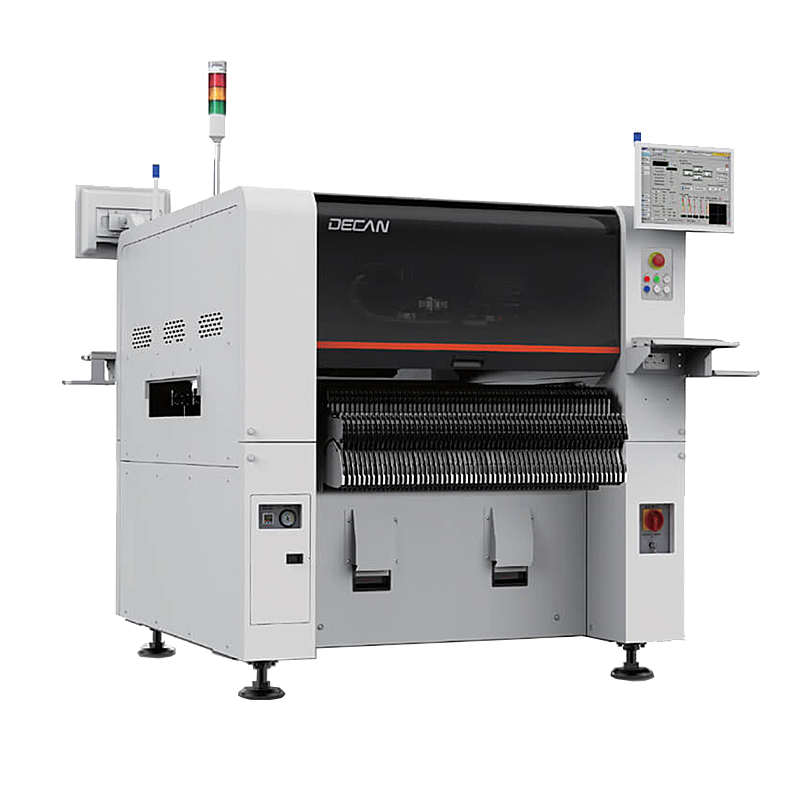
A pick-and-place machine is the highest-value station in an SMT turnkey line.
Equipment Inside a Turnkey SMT Line
A typical turnkey SMT line contains more than a printer, a mounter, and an oven. The equipment list usually breaks into three groups: board handling, printing and placement, and inspection and post-reflow processes. The paragraphs below describe each station in the order it appears in the physical line.
1. Board Handling: PCB Loader, Unloader, and Buffer Conveyor
The line begins with a PCB loader, which feeds bare boards into the process one at a time, and ends with an unloader that collects finished boards. Between stations, an SMT buffer conveyor stores boards or absorbs speed differences—for example, when a fast placement machine feeds a slower inspection gate.
For high-mix production, board handling equipment must adjust to different board widths and thicknesses without long mechanical changeover. This is the first place where turnkey integration shows its value: the loader, unloader, and conveyor widths must match the placement machine's PCB range, or the line cannot run at all.
2. Solder Paste Printer and Stencil Cleaning Machine
A solder paste printer applies solder paste to PCB pads through a stencil. Printing quality directly affects reflow yield, because misplaced or uneven paste creates defects that later become difficult to repair. Many turnkey lines therefore include a stencil cleaning machine, which removes paste residue from the underside of the stencil at programmed intervals. Cleaning reduces two common defects: insufficient solder (blocked apertures) and solder balls (excess paste).
3. Inline SPI Inspection Machine
After printing, an inline SPI inspection machine measures paste volume, height, and alignment on each pad. SPI is an early-warning station: it detects printing problems before components are placed, which prevents expensive rework further down the line. Its growing adoption is consistent with the wider trend toward 3D inspection in SMT lines.
4. Component Placement: The Pick and Place Machine
The pick and place machine is the core of the line. It picks components from feeders and places them onto programmed coordinates at high speed. Because placement equipment represents 38% to 48% of the total SMT equipment market value, it is also the station that most strongly influences the price of a turnkey solution.
Several platform families are recognized as industry standards. Fuji Corporation’s NXT platform and Yamaha Motor’s YSM series (for example, the YSM20R) are widely used modular mounters for high-speed and high-precision placement. JUKI pick and place machines also appear frequently in global SMT lines. Buyers typically compare these brands, and turnkey suppliers often propose one of them as the core of a line.
As a concrete spec reference, the Hanwha Decan S2 placement machine used in many turnkey proposals offers:
- Speed: 92,000 CPH (optimum, HS10 head)
- Structure: 2 gantries × 10 spindles per head
- Accuracy: ±28 μm (Cpk ≥ 1.0) for 03015 chips; ±25 μm (Cpk ≥ 1.0) for ICs
- Component range: 03015 to 12 mm width, 10 mm height
- PCB range: 50 × 40 mm to 510 × 460 mm (standard)
For high-mix lines, feeder capacity and nozzle change speed are as important as peak CPH. A line that must run many small batches benefits from a mounter with a large feeder bank and fast program changeover.
5. Reflow Soldering: The SMT Reflow Oven
After placement, the populated board enters the SMT reflow oven. The oven heats the board through a controlled temperature profile so that the solder paste melts and forms permanent solder joints. Reflow oven performance is judged by heating zone length, the number of top and bottom zones, cooling capability, and thermal uniformity.
The XMR-800D reflow oven is a common reference-class example. It provides 8 top and 8 bottom heating zones plus 3 top and 3 bottom cooling zones, with a heating zone length of 3110 mm. The unit weighs approximately 2710 kg and its exhaust requirement is 11 m³/min per stack, with two exhaust stacks.
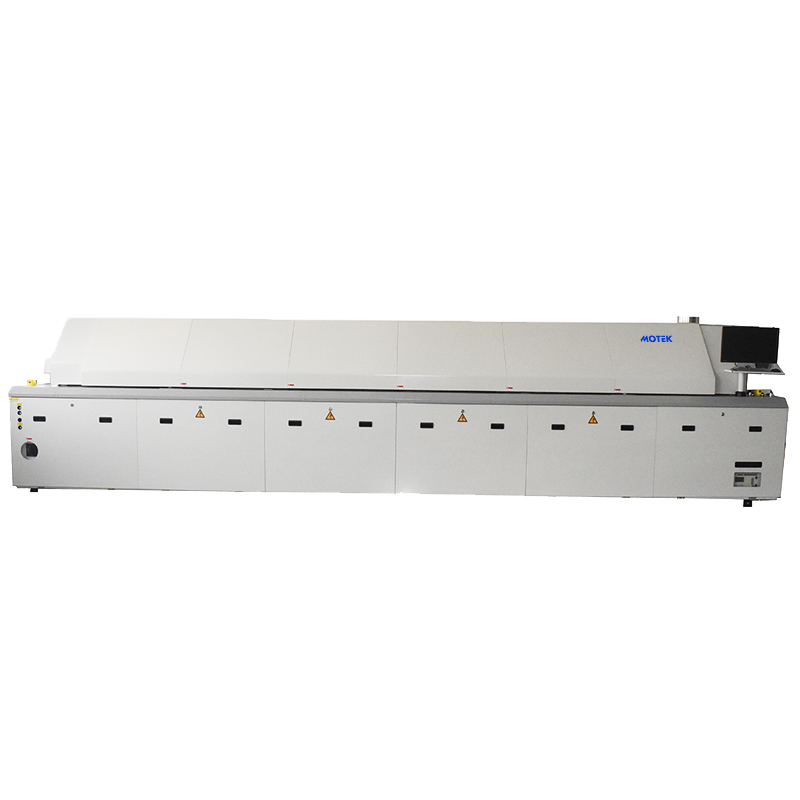
Reflow oven XMR-800D: 8+8 heating zones and 3+3 cooling zones.
6. Post-Reflow Inspection: AOI and X-Ray
Once boards exit the reflow oven, an AOI (automatic optical inspection) machine checks visible defects such as missing components, wrong polarity, misalignment, tombstoning, and poor solder joints. AOI is often placed at the end of the line as the final quality gate.
For hidden solder joints under BGAs and QFNs, an X-ray BGA inspection machine adds another layer of control. X-ray inspection detects voids, bridges, and insufficient solder in structures that cameras cannot see. SMT lines for automotive and medical products frequently require both AOI and X-ray inspection to meet zero-defect targets.
7. Support Equipment: Dispensing, Depaneling, and Cleaning
Depending on the product mix, a turnkey line may also include:
- Automatic online glue dispenser – applies adhesive or protective coating to specific board areas, for components that are not reflowed or for boards requiring moisture protection.
- PCB depaneling router – cuts assembled panels into individual PCBs after reflow.
- PCBA cleaning machine – removes flux residue or contaminants when the end application requires high surface cleanliness.
As a specification example, the HMH830D automatic online glue dispenser supports PCB widths from 50 to 450 mm, transfer speeds from 0 to 5000 mm/min, and storage of more than 1000 programs. Its control method uses an industrial computer with a motion control card, and its PCB transfer height is 920±20 mm.
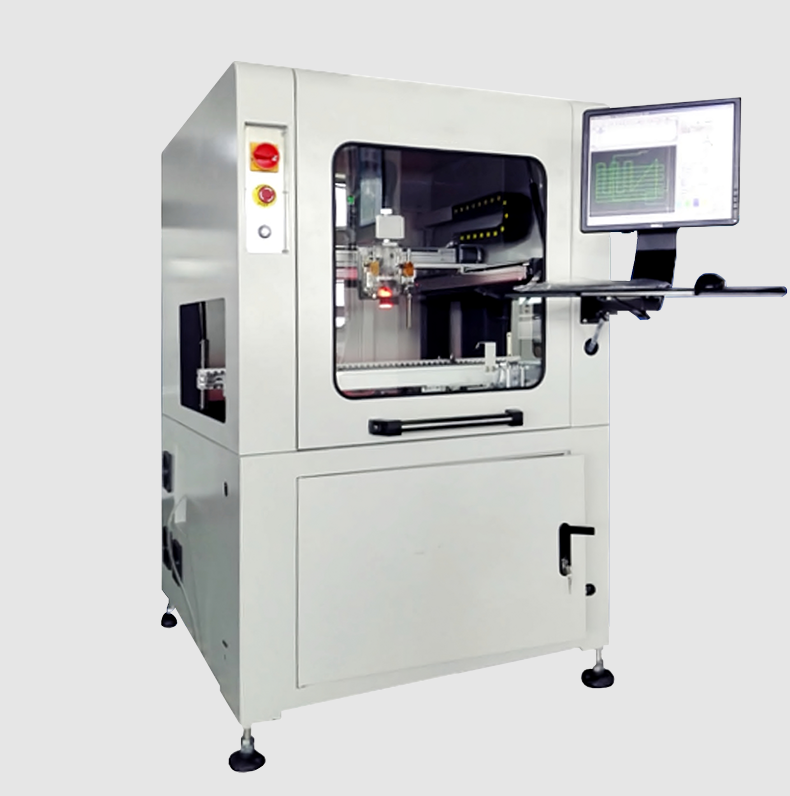
The HMH830D automatic glue dispenser supports PCB widths from 50 to 450 mm.
8. SMT Feeders, Nozzles, and Consumables
A running line also needs consumables and spare parts. SMT feeders come in tape widths such as 8 mm, 12 mm, and 24 mm, and feed components from reels into the pick-up position. SMT nozzle sets are matched to component size and shape, and nozzle replacement is a regular maintenance task. Because each placement brand uses its own feeder and nozzle interface, a line that mixes Fuji, Yamaha, and JUKI machines must carry brand-specific inventory.
How a Turnkey SMT Line Works Step by Step
From a process perspective, the line always follows the same sequence:
- Load. The PCB loader feeds a bare board into the line.
- Print. The solder paste printer applies paste; the stencil cleaning machine keeps the stencil in condition.
- Inspect paste. The inline SPI machine measures paste volume and alignment before any component is placed.
- Place. The pick and place machine mounts all components according to the program coordinates.
- Reflow. The board passes through the SMT reflow oven, where the temperature profile melts the solder paste and forms solder joints.
- Inspect joints. AOI inspects visible solder joints, and X-ray inspection covers hidden BGA/QFN joints.
- Unload. The PCB unloader collects finished boards, which then move to depaneling, cleaning, or functional test.
During commissioning, the turnkey supplier performs SMT line optimization: adjusting cycle times, feeder allocation, and program sequences so that the actual product mix runs at the planned output. In-house engineers then need fewer troubleshooting sessions because the line's balanced setup reduces the most common failure modes.
Who Typically Runs a Turnkey SMT Line?
Turnkey SMT lines are used across a wide set of industries, including automotive electronics, medical device PCB assembly, 5G communication equipment, consumer electronics, industrial control boards, LED display modules, and new energy systems. Many of these applications place the line inside a controlled environment: indoor cleanroom conditions, narrow temperature range (23°C ± 2°C), controlled humidity (50% ± 10%), ESD-protected zones, and zero vibration or dust.
For an EMS factory SMT line, the key requirement is flexibility. A contract manufacturer handles multiple customers and product families, so its line must be able to switch between different board sizes, component types, and quality classes without losing yield. This is where high-mix electronics manufacturing line experience matters: the supplier must understand not just one product, but the efficient operation of many different products.
Typical SMT factory environment used in high-mix electronics manufacturing.
Quality standards also shape line design. IPC-A-610J, released in March 2024, is the current global standard for the acceptability of electronic assemblies; it defines Class 1, 2, and 3 quality levels. A medical or automotive product that targets Class 2 or Class 3 will require a higher level of inspection automation than a simple consumer product.
SMT Turnkey Line Equipment Comparison
The table below summarizes the main equipment blocks in a turnkey line, with reference specifications taken from Motek’s equipment data catalog. Buyers can use the table as a baseline when comparing proposals.
| Production stage | Equipment | Reference specification |
|---|---|---|
| Board handling | PCB loader / unloader, SMT buffer conveyor | Board transfer between stations; ESD-protected handling. |
| Solder paste printing | Solder paste printer, stencil cleaning machine | Stencil cleaning at programmed intervals; consistent paste deposit. |
| Printing inspection | Inline SPI inspection machine | Measures paste volume, height, and alignment before placement. |
| Component placement | Pick and place machine (e.g., Hanwha Decan S2) | 92,000 CPH optimum speed; ±28 μm for 03015 chips; PCB 50×40–510×460 mm. |
| Reflow soldering | SMT reflow oven (e.g., XMR-800D) | 8+8 heating zones, 3+3 cooling zones; heating zone length 3110 mm. |
| Visible inspection | AOI automatic optical inspection | Detects missing parts, polarity, misalignment, poor solder joints. |
| Hidden inspection | X-ray BGA inspection machine | Detects voids, bridges, and insufficient solder under BGA/QFN. |
| Adhesive / coating | Automatic online glue dispenser (e.g., HMH830D) | PCB width 50–450 mm; transfer speed 0–5000 mm/min; 1000+ stored programs. |
| Post-reflow support | PCB depaneling router, PCBA cleaning machine | Panel separation after reflow; flux residue removal. |
This table is a functional reference, not a ranking. Actual line configuration should be driven by the PCB design, the component mix, required inspection depth, and the factory environment.
Frequently Asked Questions
What quality standards should an SMT turnkey line follow?
IPC-A-610J, released in March 2024, is the current global standard for the acceptability of electronic assemblies. It defines Class 1, 2, and 3 quality levels for PCBA appearance and workmanship. In a complete SMT turnkey solution, quality is controlled at multiple stages: SPI after solder paste printing, AOI after reflow, and X-ray BGA inspection for hidden joints. The line's environment—temperature, humidity, cleanliness, and ESD protection—should also be specified as part of the quality plan.
What machines make up a complete SMT turnkey line?
A complete line typically includes a PCB loader, solder paste printer, stencil cleaning machine, inline SPI inspection machine, pick and place machine, SMT reflow oven, AOI automatic optical inspection machine, and PCB unloader. Optional stations include the SMT buffer conveyor, PCB depaneling router, PCBA cleaning machine, and automatic online glue dispenser. Supporting consumables such as SMT feeders in 8 mm, 12 mm, and 24 mm widths, as well as SMT nozzle sets for the placement machines, are also needed for daily operation.
How should a buyer estimate the budget for an SMT turnkey solution?
Budget depends on the line configuration rather than on a fixed machine count. The main cost drivers are the placement machine's speed and accuracy class (the largest equipment segment by value), the reflow oven's heating zone count, the maximum PCB size, whether inline SPI/AOI is included, and whether support equipment such as board depaneling or cleaning is required. A line built around a single Hanwha Decan S2-class mounter with an XMR-800D-class reflow oven will not represent the same investment level as a high-speed line using multiple Fuji NXT or Yamaha YSM modules. Buyers should request line-specific quotes from the supplier to arrive at a realistic number.
How can a buyer evaluate a turnkey supplier before purchase?
Key evaluation points include the supplier's company background, the actual equipment models in the proposal, warranty terms, and the scope of integration work. Reference data points can be checked directly: for example, Motek (Morel Equipments Co., Ltd.) operates in Shenzhen, China, was founded in 2011, and reports 100% export to markets including the EU, USA, Australia, Canada, and ASEAN. Its catalog includes the Hanwha Decan S2, XMR-800D reflow oven, and HMH830D dispenser, and its standard warranty is 12 months. Buyers should verify that each proposed machine's specifications match the intended PCB range and product mix.
How does delivery time and warranty work for a turnkey SMT project?
Delivery time for a turnkey SMT line is determined by the specific equipment combination, component availability, and the amount of integration engineering required. For suppliers such as Motek, prompt delivery and after-sales support are stated parts of the company's service commitment, with a 12-month warranty applied to equipment. To protect a production schedule, buyers should confirm the full bill of materials, installation scope, commissioning milestones, and acceptance criteria before placing an order.
Conclusion: Build the Line Around the Process
An SMT turnkey solution replaces a collection of individual promises with a single production system. The equipment inside the line—from the PCB loader and solder paste printer to the pick and place machine, reflow oven, AOI, and X-ray inspection—must be selected as a set, not as isolated purchases.
For manufacturers at the awareness or research stage, the evaluation framework is straightforward: define the PCB range and component mix, set the target output and quality level, and ask the supplier to explain how each station contributes to that target. Then compare proposals using equipment specifications, not just brand names.
The value of a turnkey line is not the machine count. It is the ability of the whole system to produce boards at the required quality, on schedule, and with one accountable partner.
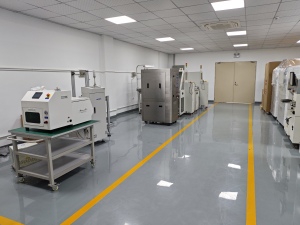
SMT factory interior.
Need a Line Reference for Your SMT Turnkey Project?
Download Motek’s equipment brochure to review machine models and specifications while comparing line configurations.
Have Questions or Need More Details?
Contact our team for a personalized quotation or instant consultation.
Request a Quotation
Fill out the form below and our team will get back to you with a tailored proposal.
WhatsApp Direct Chat
Prefer to chat in real-time? Message us on WhatsApp for instant assistance & quick answers.
- Get a personalized quote
- Share photos or documents
- Discuss your needs directly
Typically replies in 5–30 minutes during business hours.