
Easing CE and UL Compliance Worries with an Integrated SMT Equipment Package
An integrated SMT equipment package—one turnkey line built around a pick and place machine, a reflow oven, and an automatic online glue dispenser—changes how CE and UL compliance work is managed, but it does not change who is responsible for it. Consolidation reduces the number of declarations of conformity, test reports, and revision schedules a buyer has to reconcile. The conformity obligation, however, still sits with the entity placing the equipment into service and with the manufacturer of the end product. For buyers at the decision stage, the practical question is contractual rather than technical: which harmonized technical files and testing reports should be attached to the purchase agreement so that the line remains auditable years after installation?
This guide answers that question for procurement managers, engineers, and EMS factory owners who are comparing an integrated SMT turnkey solution against a multi-vendor line build. It focuses on how documentation, traceability, and audit preparation behave differently when the equipment comes from a single supplier. It also sets out the contract validation steps that turn compliance assumptions into enforceable deliverables.
One boundary is stated up front, because it matters for risk assessment. This article discusses CE and UL as common regulatory regimes that industrial electronics buyers encounter. Morel Equipments Co., Ltd.—the Shenzhen-based supplier operating under the Motek brand—holds multiple CE certifications for its equipment. No UL listing or certification is claimed here for Motek equipment; UL is a separate North American regime, and the applicable listing path must be verified per product and per end use.
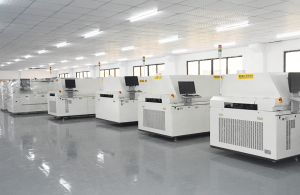
Cover: an SMT line assembled as a single turnkey package, where pick-and-place, reflow, and dispensing equipment share one documentation architecture.
The Compliance Bottleneck Is Documentation, Not Hardware
CE and UL compliance work rarely fails because a machine cannot perform. It fails at the seams between vendors. A line assembled from three or four separate suppliers arrives with three or four declaration formats, different revision dates, and machine-level documentation that was never designed to be read together. The buyer—often an EMS factory or an industrial electronics manufacturer—must then assemble a single technical file for the line as a system.
That assembly work is predictable, but it is not trivial. When an internal auditor or a notified body asks for the risk assessment, the safety component bill of materials, or the electrical schematic for a specific machine, the buyer has to locate and reconcile that document across vendors. Common failure points include a missing line-level risk assessment, an inconsistent bill of materials for safety-related components, a schematic whose revision no longer matches the delivered hardware, and no clean serial number trail connecting a physical machine to its documentation set.
The commercial consequences are indirect but real: audit delay, corrective actions, duplicated translation and reformatting effort, and retrospective documentation cost when records have to be reconstructed after shipment. Fragmentation is amplified in high-mix electronics manufacturing, where lines are reconfigured more frequently and the same physical line may need to support products destined for both European and North American markets.
The problem definition, in one sentence: the compliance burden scales with the number of documentation sources, not with the number of machines. That is why an integrated package is a compliance decision as much as an equipment decision.
Industry Background: Capacity Growth and Inspection Intensity Are Rising Together
The pressure to get documentation right is increasing because the installed base of SMT equipment is increasing. The global Surface Mount Technology (SMT) equipment market was valued at approximately USD 6.6 billion in 2025 and is projected to reach USD 14.6 billion by 2036, according to Transparency Market Research. Asia-Pacific dominated the SMT equipment market in 2025 with a 54% revenue share, followed by North America and Europe.
Within that market, placement equipment is the largest segment. Pick and place machines account for approximately 38% to 48% of total SMT equipment market value, based on Persistence Market Research and Cognitive Market Research figures. At the same time, the High-Mix/Low-Volume assembly line segment is projected to grow at a CAGR of 8.31% through 2031, driven by demand for customized industrial and medical electronics, according to Mordor Intelligence.
Inspection and verification equipment is growing faster than the market average. 3D AOI (Automated Optical Inspection) and SPI (Solder Paste Inspection) are identified as the fastest-growing equipment sub-sectors, with a 15.2% CAGR for inspection, driven by automotive zero-defect requirements, according to Persistence Market Research. The current global standard for the acceptability of electronic assemblies is IPC-A-610J, released in March 2024 by IPC International, which defines Class 1, Class 2, and Class 3 quality levels.
Key global SMT vendors include ASMPT Limited, Fuji Corporation, Yamaha Motor, Panasonic, Juki Corporation, and Hanwha Precision Machinery, according to MarketsandMarkets. Fuji Corporation's NXT platform and Yamaha's YSM series, such as the YSM20R, are industry-standard modular mounters used for high-speed and high-precision placement, per Fuji and Yamaha official product catalog data. These platforms are common building blocks inside turnkey configurations, which means the compliance documentation for a line usually spans several manufacturers' equipment alongside the integrating supplier's own machines.
What this means for buyers: more equipment, more integration, and higher acceptance standards all increase the number of documents that must remain consistent with each other. Integration of the physical line and integration of the documentation have to be planned in the same procurement cycle.
How an Integrated SMT Equipment Package Simplifies Conformance Work
Motek is the brand under Morel Equipments Co., Ltd., a Shenzhen-based supplier of SMT and electronics assembly equipment founded in 2011, operating from a 955 m² facility with 31 employees, a 15+ engineer R&D team, and an annual output of 300–500 units. Its export ratio is 100%, with main markets in the EU, USA, AU, CA, and ASEAN, and its product range covers reflow soldering, pick-and-place machines, cleaning machines, and PCB cutting machines. Morel Equipments holds multiple CE certifications for its equipment and provides a 12-month warranty on products, alongside customization services covering material, label, packaging, color, size, logo, and graphic design.
In a turnkey configuration, the three core machines—the pick and place machine, the SMT reflow oven, and the automatic online glue dispenser—are specified, tested, and documented as one system. Turnkey configurations can also extend to solder paste printers, AOI automatic optical inspection, inline SPI inspection machines, X-ray BGA inspection machines, PCB loader and unloader units, SMT buffer conveyors, PCB depaneling routers, PCBA cleaning machines, stencil cleaning machines, feeders, and nozzles. The compliance advantage does not come from any single machine; it comes from the documentation architecture that binds them.
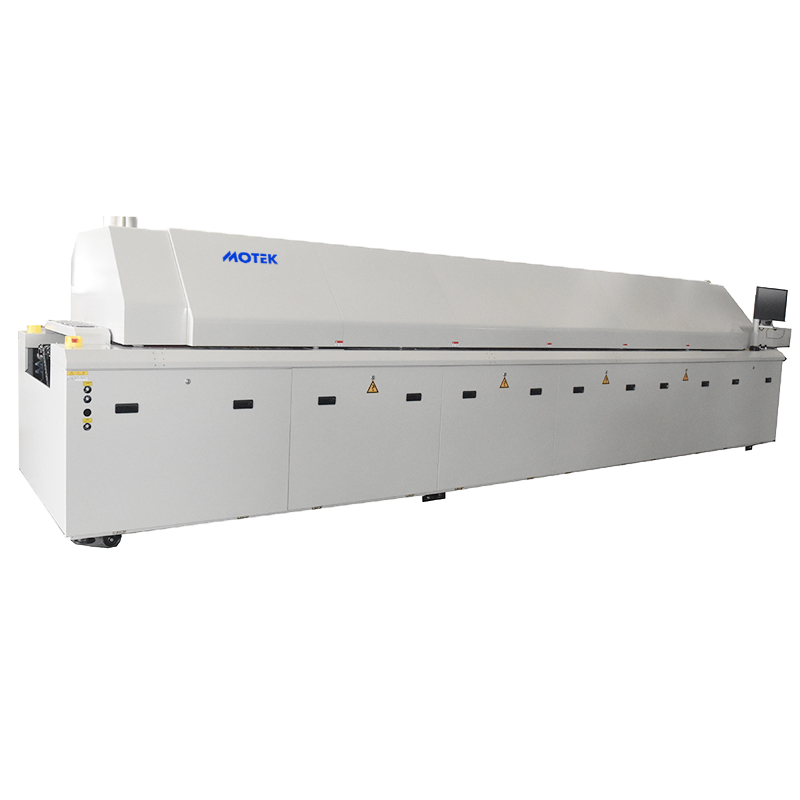
Reflow soldering equipment in a turnkey line. Motek's comparison data positions its reflow solution against wave reflow soldering with a 2-year machine warranty, roughly 10% lower cost, less maintenance, and higher efficiency for long-term stable production in SMT industrial plants.
What actually gets integrated
- One declaration structure. Machine-level declarations of conformity are produced under a single format and a single revision schedule, rather than assembled from unrelated vendor templates.
- One risk assessment framework. Line-level hazards such as material flow, operator access, and interlock behavior are assessed as a system, not as isolated machines.
- One traceability chain. Scratch code management links physical units to their documentation, so an auditor can move from a serial number to a test record without vendor-by-vendor reconstruction.
- One audit contact. A single technical and documentation point of contact replaces multiple escalation paths when questions arise during an audit or a customer qualification.
- One support mechanism. A comprehensive training system, 24/7 technical support, fast repairs, spare parts supply, and a defined customer communication mechanism keep documentation current after installation, which is where many compliance files quietly go stale.
Documentation and testing controls that support the file
Integration also changes which controls are visible to the buyer. Morel Equipments applies a strict quality inspection process before shipment, resolves any quality issues found and communicates them with the customer, and confirms detailed technical parameters before build. On the logistics side, the package is supported by advance inventory and delivery confirmation, professional packaging with logistics tracking, and customs broker assistance—all of which produce records that feed the import and conformity documentation trail.
For equipment-level performance, Motek's comparison data positions its reflow soldering solution against wave reflow soldering for SMT industrial plants: a 2-year machine warranty, approximately 10% lower cost, less maintenance, and higher efficiency for long-term stable production. This is supplier-side comparative positioning from Morel Equipments' own comparison unit, and it should be read as one input to a total-cost decision rather than as an independent benchmark.
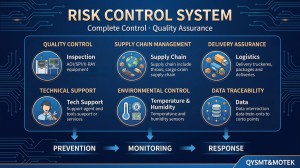
Inspection and traceability checkpoints convert machine-level test records into audit-ready evidence across the line.
Where the limits are
An integrated package does not remove the buyer's conformity obligations, and it does not convert a CE-marked machine into a UL-listed one. It also does not guarantee that every sub-component inside the line was manufactured by the same entity; modular mounters such as those from Fuji, Yamaha, or JUKI may sit alongside the integrating supplier's own equipment. The integration benefit is documentation coherence and a single accountable contact—not a universal certificate that covers every end use.
Step-by-Step: Turning Compliance Assumptions into Contract Terms
The following sequence is a contract validation workflow for a decision-stage buyer. Each step produces a document that should be referenced in the purchase agreement, not just discussed in email.
- Define the target conformity regime before configuration. Decide whether the line is intended for CE-marked markets, for North American regimes where UL or another NRTL listing path applies, or for both. Morel Equipments holds multiple CE certifications for its equipment; the UL path must be confirmed separately per product and end use.
- Request a harmonized technical file index. Ask for a document register listing every file in the package, with revision numbers, issue dates, language versions, and responsible parties. A package without an index is a package that will drift.
- Request machine-level declarations of conformity. For the pick and place machine, the reflow oven, the automatic online glue dispenser, and any additional modules, obtain the declaration and the list of referenced standards.
- Request test and inspection reports. Factory acceptance test reports, pre-shipment inspection records, and system-level test data should follow one reporting format so they can be compared across modules.
- Confirm traceability mechanics. Verify how scratch code management and serial numbers map to documents, and how a machine on the factory floor can be traced back to its file.
- Confirm language and revision control. All documents should sit in the same revision cycle with one change log. Divergent change logs are the most common source of audit findings in integrated and semi-integrated lines.
- Write documentation milestones into the contract. Tie a defined portion of final payment to delivery of the complete technical file, not only to machine arrival. Documentation that is promised verbally tends to arrive after installation, when it is hardest to reconcile.
- Plan audit support and post-installation updates. Confirm who answers documentation questions, who supplies spare parts records, and how firmware or software revisions will be documented over time. SMT production troubleshooting and SMT line optimization service work should generate documentation updates, not just field fixes.
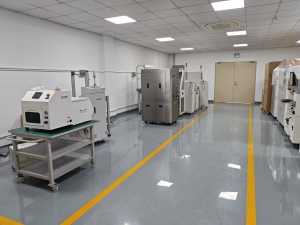
Pre-shipment inspection and documentation handover are completed before the line leaves the facility.
Where Integrated Compliance Documentation Pays Off: Three Buyer Scenarios
Scenario 1: An EU industrial electronics manufacturer running high-mix production
A European EMS factory adds a turnkey line for industrial and medical electronics in a high-mix electronics manufacturing line environment. Its internal auditor reviews the technical file each time a new product family is introduced. With a single documentation architecture, the factory maintains one revision cycle instead of reconciling four vendor file sets. The main gain is administrative: audit preparation time drops because the file index, risk assessment, and schematics stay synchronized.
Scenario 2: A North American manufacturer adding capacity for industrial electronics
A North American buyer needs to demonstrate conformance for the end product and therefore needs a coherent machine-level documentation base for its assembly equipment. The integrated package provides one traceability chain and one inspection record format. The UL listing path for the end product remains a separate exercise, but the machine documentation no longer has to be rebuilt from scattered supplier records.
Scenario 3: An ASEAN exporter shipping to both European and North American markets
An electronics manufacturer in the ASEAN region supplies customers in both regions. It needs documentation that can support CE-marked markets and North American regime reviews without duplicating translation and formatting work. A single supplier producing harmonized files reduces duplicated effort and keeps equipment parameter records consistent across both documentation streams.
Comparison: Integrated Package vs Multi-Vendor Line, and a Documentation Checklist
The table below compares the two sourcing models on compliance-relevant dimensions only. It is a decision framework, not a product ranking; the entries describe how documentation behaves under each model.
| Compliance dimension | Integrated single-vendor package | Multi-vendor line assembly |
|---|---|---|
| Technical file ownership | One supplier structure with a single file index across the line | Files arrive from each vendor in separate formats |
| Declaration of conformity | One documentation architecture with machine-level annexes | Multiple declarations with different revision dates |
| Test and inspection reports | One reporting format; pre-shipment inspection under one process | Formats and acceptance criteria vary by vendor |
| Traceability | Scratch code management and serial-number mapping from one source | Each vendor tracks serial numbers differently |
| Audit point of contact | One named documentation contact plus 24/7 technical support | Multiple contacts and escalation paths |
| Revision control | Single change log across the package | Separate change logs can desynchronize |
| Post-installation support | Training system, fast repairs, spare parts supply, communication mechanism | Support responsibility split across vendors |
| Warranty reference | Motek comparison data reports a 2-year machine warranty for its reflow solution | Warranty terms depend on each vendor's contract |
The second table is a procurement checklist. Each row is a deliverable that can be named directly in a purchase contract.
| Deliverable | Purpose | Buyer action |
|---|---|---|
| Document register / file index | Shows what exists and its revision status | Request before final payment |
| Machine-level declaration of conformity | States applicable standards per machine | Verify standard versions and issue dates |
| Line-level risk assessment | Identifies hazards and mitigations as a system | Check it covers the full line, not isolated machines |
| Electrical and pneumatic schematics | Supports maintenance and audit review | Confirm revision matches delivered hardware |
| Safety component bill of materials | Traceability of safety-critical parts | Confirm scratch code and serial mapping |
| Factory acceptance test report | Records performance at the supplier | Include as a contract milestone |
| Pre-shipment inspection record | Confirms condition before shipment | Morel Equipments performs strict quality inspection before shipment |
| Traceability record (scratch code / serial numbers) | Links documents to physical units | Require an explicit mapping table |
| Training and handover record | Transfers operating and documentation knowledge | Schedule with installation |
FAQ: CE and UL Compliance in SMT Turnkey Procurement
Does an integrated SMT turnkey solution automatically satisfy CE or UL requirements?
No. An integrated package makes the documentation easier to assemble and audit, but conformity remains the responsibility of the entity placing the equipment into service and of the end-product manufacturer. Morel Equipments (Motek) holds multiple CE certifications for its equipment. UL is a separate North American safety regime, and this article does not claim UL listing for Motek equipment; the applicable listing path must be verified per product and per end use. Buyers should confirm the specific declaration of conformity and test reports for every machine in the package.
What should a harmonized technical file for an SMT turnkey line contain?
At minimum: a document register with revision control; machine-level declarations of conformity; a line-level risk assessment; electrical and pneumatic schematics; a safety component bill of materials; factory acceptance test reports; pre-shipment inspection records; scratch code and serial number traceability; and a training and handover record. In an integrated package these items are produced under one revision schedule, which reduces the risk of version mismatch during an audit. Morel Equipments supports this process through detailed technical parameter confirmation and strict quality inspection before shipment.
How does compliance documentation affect the total cost of an SMT turnkey solution?
Documentation work is usually absorbed as internal engineering and administrative time rather than as a separate line item. Fragmented supply chains increase that time because each vendor's file must be reformatted, translated, and reconciled. An integrated package reduces duplicated effort by keeping one file architecture. On the equipment side, Motek's comparison data positions its reflow soldering solution against wave reflow soldering with a 2-year machine warranty, roughly 10% lower cost, less maintenance, and higher efficiency for long-term stable production in SMT industrial plants. Buyers should still compare total cost, including documentation effort, spare parts, and audit preparation.
Can we validate the documentation before committing to the full line?
Yes. Buyers can request a sample documentation pack—an example declaration of conformity, a file index, and a representative factory acceptance test report—and review it against their internal audit checklist before signing. Morel Equipments provides detailed technical parameter confirmation and pre-shipment inspection, and supports validation through its training system and customer communication mechanism. You can request a sample pack and a quotation through the Morel Equipments contact channels, or download the product brochure for reference: Morel Equipments product brochure.
What is the lead time for a turnkey line with full documentation?
Lead time depends on the selected configuration, the number of machines, and the documentation scope, so no single figure applies across configurations. Documentation milestones should be written into the contract alongside delivery milestones. Morel Equipments' supply practices include advance inventory and delivery confirmation, professional packaging with logistics tracking, and customs broker assistance, which helps keep documentation and shipment schedules aligned. Buyers should confirm the documentation delivery date separately from the machine delivery date.
Conclusion: Make Harmonized Documentation a Contract Deliverable
Compliance is a documentation discipline before it is a hardware question. An integrated SMT equipment package—pick and place machine, reflow oven, and automatic online glue dispenser specified and documented as one system—reduces the number of file sources a buyer must reconcile under CE or UL regimes. It does not transfer or remove conformity responsibility, and it does not create certifications that do not exist. What it does provide is a single file architecture, a single traceability chain, and a single point of contact when an auditor asks a question.
For decision-stage buyers, the practical next step is to treat harmonized technical files and testing reports as contract validation items rather than as after-sales conveniences. Request the document register, machine-level declarations, risk assessment, schematics, test reports, and traceability mapping before final payment. Confirm the UL path separately where North American regimes apply, and confirm CE documentation against the standards that match each machine.
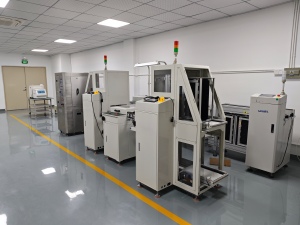
An integrated package prepared for shipment with a harmonized documentation set covering CE-marked markets and North American regime reviews.
Next step for procurement teams: request a sample compliance documentation pack, a configuration quotation, or a technical parameter confirmation for a turnkey line.
Email: sales@morequip.com | Tel: +86-755-21635007 | WhatsApp: +86 199 2455 0176
Website: Morel Equipments Co., Ltd. | Address: Guangdong Shenzhen Baoan 405, Block A, Building 6, Exhibition Bay Zhonggang Plaza, No. 83 Zhancheng Road, Zhancheng Community, Fuhai Street
Download the product brochure: Morel Equipments product brochure (PDF)
Have Questions or Need More Details?
Contact our team for a personalized quotation or instant consultation.
Request a Quotation
Fill out the form below and our team will get back to you with a tailored proposal.
WhatsApp Direct Chat
Prefer to chat in real-time? Message us on WhatsApp for instant assistance & quick answers.
- Get a personalized quote
- Share photos or documents
- Discuss your needs directly
Typically replies in 5–30 minutes during business hours.