
Evaluating Turnkey Suppliers: Capacity Tests for Pick-and-Place and Reflow Providers
A turnkey SMT supplier should be judged on measured output, not on a catalog. The practical test is a controlled batch built from your own production parts and run through the pick-and-place machine, the reflow oven, and, where the line scope includes one, the automatic online glue dispenser. This article sets out the trial design, the three metrics that decide most outcomes — placement accuracy repeatability, thermal uniformity and adhesive dot consistency — and a scoring framework that procurement teams can attach directly to acceptance terms.
At the decision stage, shortlisted suppliers look similar on paper: the same equipment categories, the same certificates, the same service promises. At the execution stage, the differences become physical. Feeders jam on the third shift. The reflow profile that looked clean on an empty oven drifts at the board edge once the oven is loaded. Adhesive dots that were round at low speed start to tail at production speed. None of these failures appears in a brochure, and all of them are detectable in a two-to-three day acceptance trial.
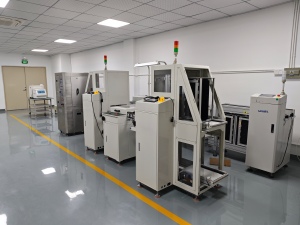
The Paper-Review Gap: Why Documentation Cannot Confirm Capacity
Documentation answers a compliance question. A capacity trial answers a production question. Confusing the two is the most common sourcing error in turnkey SMT procurement, and it usually survives right up to the first production week.
Pattern 1 — the best-run demonstration. The supplier runs a single board on a warmed-up machine, at reduced speed, with an engineer at the console. Placement looks clean. The number that matters is not the best run; it is the spread across consecutive runs after a feeder change and a nozzle change, executed by the operator who will actually run the line.
Pattern 2 — the empty-oven profile. A reflow profile measured on an empty or lightly loaded oven is not a production profile. Thermal mass changes when the belt is full. Boards near the oven edge and boards in the center can see different peak temperatures and different time above liquidus, and that difference is what produces tombstoning, insufficient wetting, or cold joints on one side of the panel and rework on the other.
Pattern 3 — the hand-loaded adhesive test. Where the line scope includes an automatic online glue dispenser, dot quality is often demonstrated at low axis speed with a freshly loaded syringe. At production speed, with a partially used syringe and a real board surface, dots tail, slump, or miss. Dot consistency has to be measured at line speed, after a pause, and at both the start and the end of a syringe.
Pattern 4 — acceptance criteria written after the trial. If the pass thresholds are agreed once the results are known, the trial produces a conversation rather than a decision. The scorecard and the declared IPC-A-610J class should be fixed before the first board is loaded.
What Changed in the SMT Equipment Market
Two market movements have pushed capacity verification from good practice to procurement requirement: the equipment base is growing quickly, and the growth is concentrated in the product mix that is hardest to run.
Transparency Market Research values the global SMT equipment market at approximately USD 6.6 billion in 2025 and projects USD 14.6 billion by 2036. The same source places Asia-Pacific at a 54% revenue share in 2025, ahead of North America and Europe. Placement equipment — pick-and-place machines — is the largest single segment, estimated by Persistence Market Research and Cognitive Market Research at roughly 38% to 48% of total SMT equipment market value.
Growth, meanwhile, is concentrated where verification is hardest. Mordor Intelligence projects the high-mix/low-volume assembly segment to grow at a CAGR of 8.31% through 2031, driven by customized industrial and medical electronics. Persistence Market Research identifies 3D AOI and SPI as the fastest-growing inspection sub-sectors, at a 15.2% CAGR, driven by automotive zero-defect requirements. High mix means frequent changeover. Zero defect means the cost of a bad first batch is high. Both push the buyer toward physical proof rather than specification comparison.
The acceptability reference point is also fixed. IPC-A-610J, released in March 2024, is the current global standard for the acceptability of electronic assemblies and defines Class 1, 2 and 3 quality levels. A trial without a declared class is not a trial; it is an opinion.
Motek is the SMT equipment brand of Morel Equipments Co., Ltd., a Shenzhen-based supplier founded in 2011 whose product scope covers reflow soldering, pick-and-place machines, cleaning machines, PCB cutting machines, plug-in machines and PCBA protection equipment. The company operates a 955 m² facility and exports 100% of its output to the EU, USA, AU, CA and ASEAN markets.
A Three-Layer Verification Model for Turnkey Suppliers
Capacity verification works best as three layers, each producing a different evidence type. Skipping a layer is how a supplier with genuine capability loses to a supplier with better presentation.
Layer 1 — Documentation Review
Collect the equipment list, the declared repeatability figures, the utility requirements, the certification file and the proposed acceptance criteria. This layer is cheap and it filters obvious mismatches. It cannot confirm that the line will hold tolerance on your product, because catalog figures are produced under controlled conditions that your factory will not reproduce.
Layer 2 — Controlled Trial on Production Parts
Run a test batch built from your own boards, your own solder paste, your own stencil and your own component mix. A trial vehicle of two to three representative products is usually enough: one high-density board, one board with mixed fine-pitch and standard components, and one board that stresses the changeover between them. The output is measured data — offsets, profile curves, dot measurements — not a visual impression.
Layer 3 — Repeatability Across Runs and Shifts
Repeat the Layer 2 measurements after a feeder change, after a nozzle change, and at the start of a second shift. Repeatability is the property that predicts month twelve of a partnership; a single good run predicts nothing. This layer is also where the supplier's training and documentation practices become visible, because a trial that only works when the supplier's engineer drives the line has not actually been transferred to the buyer.
The operational scaffolding behind that third layer is usually described in general terms and should be checked specifically. Motek's published risk-control measures include strict quality inspection before shipment, detailed technical parameter confirmation, advance inventory and delivery confirmation, professional packaging with logistics tracking, and customs broker assistance. Post-delivery support is stated as a comprehensive training system, 24/7 technical support, fast repairs, a spare parts supply arrangement and a defined customer communication mechanism.
The Scoring Framework: Six Weighted Dimensions
Use one scorecard for every shortlisted supplier, with weights agreed before the trial. The weights below are a suggested starting point for a high-mix line. They are a procurement decision, not an industry standard, and should be adjusted if your product mix is dominated by one failure mode.
| Dimension | Weight | Evidence produced in the trial | Typical red flag |
|---|---|---|---|
| Placement accuracy and repeatability | 30 | X/Y offset and rotation data across consecutive runs, before and after feeder and nozzle change | Results reported as a single best run; axis speed reduced for the trial |
| Thermal uniformity and profile capability | 25 | Loaded-oven profiles at board center and edge; peak temperature, time above liquidus, ramp rate | Profile taken on an empty oven; no edge measurement |
| Adhesive dot consistency | 15 | Dot diameter, height, positional offset and shape at line speed, after pause, near end of syringe | Hand-loaded or low-speed demonstration only |
| Line integration and changeover | 15 | Time to change between two of your own products; feeder and nozzle swap steps | Changeover timed with the supplier's engineer doing the work |
| Acceptance documentation | 10 | Declared IPC-A-610J class, sample plan, pre-shipment test record | Class not declared; thresholds agreed after results |
| Long-term support readiness | 5 | Training plan, spare parts list, escalation path, warranty terms | Support described only in general marketing terms |
Two rules make the scorecard usable. First, every dimension must produce an artefact — a data file, a photograph, a signed record — rather than a verbal impression. Second, a supplier that scores well overall but fails a mandatory dimension should not pass. Placement repeatability and thermal uniformity are normally treated as mandatory for high-mix work, because a failure in either one cannot be compensated by strength elsewhere.
Placement Accuracy Repeatability: What to Measure
Placement accuracy is a specification. Placement repeatability is a production property. The trial should measure the second one.
Load the program for one of your own boards and run consecutive boards without intervention — enough to include at least one pickup cycle at each feeder width in use, commonly 8 mm, 12 mm and 24 mm. Measure actual placement offset in X and Y and rotation error at the fiducials and at the finest-pitch component on the board. Record the distribution, not the average alone. A machine that places within tolerance on average but drifts at the end of a reel is a machine that will generate rework in month two.
Then change something. Swap a feeder. Replace a nozzle on one head. On multi-vendor lines this is where head architecture matters: Fuji NXT and Yamaha YSM series platforms, including the YSM20R, are industry-standard modular mounters for high-speed and high-precision placement, and JUKI pick-and-place machines are widely used in the same segment. The trial should confirm that the supplier's engineers can swap nozzles and re-teach a feeder on whichever platform is quoted, using the SMT feeder and nozzle replacement inventory that will actually ship with the line.
Ask one more question that catalogs never answer: what happens to placement stability after a two-hour pause? Thermal drift in the frame and in the vision system shows up as a slow offset that only appears when the machine has been idle and then restarted.
Thermal Uniformity: Testing the Reflow Oven Under Load
Reflow quality is decided by what the board experiences, not by what the oven display reports. A useful trial measures the profile at three positions on the same panel: center, edge, and a location thermally shielded by a large component or a ground plane.
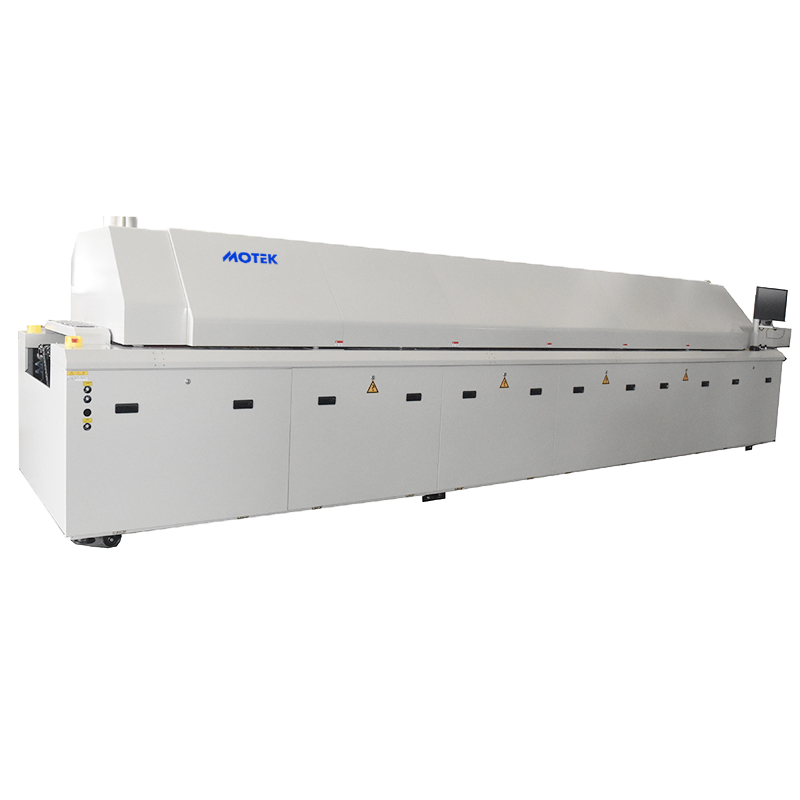
Run the profile with the oven loaded at production belt density. Then run the same profile on an empty oven and compare. A large gap between the loaded and empty curves means the quoted profile is not transferable to production, and the supplier should be able to explain how the profile will be re-established for each product family. Record peak temperature, time above liquidus, ramp rates and the spread between center and edge thermocouples. Judge the result against the solder paste manufacturer's process window and against the declared IPC-A-610J class, not against a generic curve.
For a lead-free line, the reflow platform itself belongs inside the trial. Motek's comparison material for its lead-free reflow offering states a two-year machine warranty difference against wave reflow soldering, a 10% lower cost position, less maintenance, and higher efficiency with long-term stable production for SMT industrial plants. Those are supplier-published figures; they are a reason to run the measurement, not a substitute for it.
Adhesive Dot Consistency: The Under-Tested Variable
Where the turnkey scope includes an automatic online glue dispenser — common in mixed-technology assemblies where through-hole or odd-form parts are bonded before reflow — dot consistency deserves its own measurement pass, because it is the easiest parameter to demonstrate well and the hardest to hold in production.
Measure dot diameter, dot height and positional offset on a bare board at line speed. Then measure again after a ten-minute pause, and again near the end of the syringe. Inspect for tailing, satellite dots, missing dots, and shape change after component placement. A dot that is round at 30% axis speed and tails at 100% is a process that will produce bonding failures visible only at final test.
The same logic applies upstream. If the scope includes a solder paste printer, the trial should include a print check with your stencil and your paste; and where inline SPI inspection is part of the line, the SPI data for the trial boards should be reviewed rather than accepted as a verbal assurance that printing is stable. If AOI or X-ray BGA inspection is in scope, the trial should include a deliberate defect sample so that detection capability is demonstrated rather than described.
Step-by-Step: Running the Acceptance Trial
Step 1 — Fix the trial vehicle and the acceptance class
Select two to three production boards that represent your real mix. Declare the IPC-A-610J class — Class 1, Class 2 or Class 3 — before the trial begins, because the class defines what counts as an acceptable joint and therefore what the supplier is being asked to prove.
Step 2 — Lock the bill of process
Freeze the paste, stencil, component suppliers, program version, nozzle set and feeder set. If any of these changes mid-trial, the comparison between suppliers collapses and the results stop being decision-grade.
Step 3 — Run the placement repeatability block
Consecutive boards, feeder widths of 8 mm, 12 mm and 24 mm, one deliberate nozzle change mid-block. Record offset and rotation at fiducials and at fine-pitch locations. Note whether the operator or the supplier's engineer performed the change.
Step 4 — Run the loaded reflow profile block
Three thermocouple positions, loaded versus empty oven, peak temperature, time above liquidus and ramp rate recorded for each product in the trial vehicle. Keep the raw profile files.
Step 5 — Run the adhesive dot block
Line speed, after pause, near end of syringe. Diameter, height, offset, tailing, missing dots. Photograph the boards at each stage; dot measurements without images are difficult to defend later.
Step 6 — Time the changeover
Change from product A to product B with your own operator, not the supplier's engineer. Include feeder setup, nozzle change, program recall and first-article check. Changeover time is the metric that most directly predicts whether a high-mix line will be profitable.
Step 7 — Convert results into acceptance terms
Attach the completed scorecard to the purchase terms. Motek's stated purchasing terms use a pre-shipment test as the acceptance criterion, a minimum order quantity of 1 unit, delivery terms FOB, CIF, EXW, FCA, DDP and DAF, and payment terms of 30% T/T in advance with 70% T/T against copy of B/L, or 50% T/T in advance with 50% T/T against copy of B/L. The 12-month warranty and the technical support and spare parts path should be confirmed in the same document, before the trial results are discussed commercially.
Where Capacity Trials Change the Decision
High-mix EMS lines. When the line changes product several times a week, changeover time and first-article yield matter more than peak placement speed. A trial with two products from your own mix exposes this in a way that a speed demonstration cannot.
New line builds versus line expansion. In a new build, the trial validates the integration between machines — loader, buffer conveyor, printer, SPI, pick-and-place, reflow, AOI, X-ray, depaneling and cleaning. In an expansion, the trial validates compatibility with what is already installed, which is often the harder question.
Replacement of a single bottleneck machine. Replacing one pick-and-place machine inside an existing line means the new unit must match the feeder inventory, nozzle inventory and program conventions already in use. Running the trial with the existing feeder set is the fastest way to find an incompatibility.
Distributors and channel partners. A distributor committing to a long-term supply relationship is taking on the end customer's risk. A documented capacity trial, with measured data attached, is the evidence that makes the warranty and spare parts commitment credible rather than promotional. This is where a supplier evaluation becomes a partnership decision: the trial record becomes the baseline that both parties can return to when a production issue appears in year two.
Regulated product segments. For automotive, medical and industrial control assemblies, the trial should be documented to a standard the end customer can audit. The declared IPC-A-610J class, the sample plan and the measurement records form the evidence trail.
Reference Comparison: Reflow vs. Wave Reflow Soldering
Most turnkey decisions are not between identical machines but between process routes. The table below reproduces the comparison data published in Motek's own product material for its reflow offering against wave reflow soldering. It is a single-source, supplier-published comparison and should be read as a hypothesis to test in the trial, not as an independent benchmark.
| Comparison point | Motek reflow offering | Wave reflow soldering |
|---|---|---|
| Machine warranty difference | 2 years advantage stated | Baseline for comparison |
| Relative cost position | 10% lower stated | Baseline for comparison |
| Maintenance | Less maintenance stated | Baseline for comparison |
| Efficiency | Higher efficiency, long-term stable production, lower maintenance cost | Baseline for comparison |
| Best-fit line | SMT industrial plants | Not stated in the source data |
Source: Motek product comparison data. Supplier-published; not independently verified in this article.
The practical reading is straightforward. If the line will run SMT industrial boards with mixed thermal mass, the reflow route is the one that has to be proven under load. The cost and warranty differences are commercial arguments. Thermal uniformity is the technical one, and it determines whether the commercial advantage survives contact with production.
FAQ
Which standard should the acceptance trial be scored against, and what does the supplier commit to in writing?
Score the trial against IPC-A-610J, released in March 2024, which is the current global standard for the acceptability of electronic assemblies and defines Class 1, 2 and 3 quality levels. Declare the class before the trial so that joint acceptability is not negotiated afterwards. On the commercial side, Motek states a pre-shipment test as its acceptance criterion, alongside CE certification, a 12-month product warranty and a documented quality inspection process before shipment. Ask for the acceptance criterion, the class and the warranty period in one written document.
How do we test placement accuracy repeatability without a metrology lab?
Run consecutive boards on one of your own programs without intervention and measure offset and rotation at the fiducials and at the finest-pitch component. Record the distribution across runs rather than the best result. Then repeat the block after a feeder change and a nozzle change, performed by the operator who will run the line. Include each feeder width in use — 8 mm, 12 mm and 24 mm are common — and confirm nozzle replacement procedure on the quoted platform, whether that is a Fuji NXT, a Yamaha YSM series machine such as the YSM20R, or a JUKI pick-and-place machine.
Does a full capacity trial add cost, and how does it interact with payment terms?
It adds trial material, machine time and engineering hours; it removes the much larger cost of discovering a repeatability or thermal problem after the balance payment. Because a trial can be run on a single unit — Motek's minimum order quantity is 1 unit — the material commitment is manageable even for a single-machine evaluation. Payment terms of 30% T/T in advance with 70% T/T against copy of B/L, or a 50%/50% split on the same basis, mean the trial result is normally available before the balance falls due. Treat the scorecard as the document that releases that balance.
Can the trial be run on our own production parts rather than demo boards?
It should be. A trial on demo boards measures the machine; a trial on your boards, paste, stencil and component mix measures the line. Provide two to three representative products, the paste and stencil specification, the program and the feeder and nozzle inventory that will ship. Motek's process controls include detailed technical parameter confirmation before shipment, scratch code management, professional packaging with logistics tracking and customs broker assistance, which are the mechanisms that keep the trial configuration identical to the delivered configuration.
What delivery and long-term support terms should be fixed before the trial starts?
Fix delivery terms, warranty and the support path first, so that the technical result can be converted into a decision immediately. Motek's stated delivery terms are FOB, CIF, EXW, FCA, DDP and DAF, with advance inventory and delivery confirmation as part of its supply-risk controls. Post-delivery support is stated as a training system, 24/7 technical support, fast repairs, spare parts supply and a defined communication mechanism. For a distributor or a multi-line buyer, those terms are the substance of the long-term relationship: the trial proves capability once, and the support terms determine whether that capability is still there in year three. To review the full equipment and support scope before scheduling a trial, the Motek product catalog (PDF) is available for download.
Conclusion
A turnkey SMT supplier is not selected by the completeness of a document package. It is selected by what happens when your own board runs through the pick-and-place machine, the reflow oven and, where in scope, the automatic online glue dispenser — measured across consecutive runs, after a feeder change, after a nozzle change, and on a second shift.
The method is not complicated. Declare the IPC-A-610J class. Fix the trial vehicle and the bill of process. Measure placement offset distribution, loaded-oven thermal uniformity at center and edge, and adhesive dot consistency at line speed and after pause. Score six weighted dimensions, treat placement repeatability and thermal uniformity as mandatory, and attach the completed scorecard to the acceptance terms before the commercial discussion begins.
For a buyer at the execution stage, the value of this discipline is cumulative. The trial record becomes the baseline for the first production month, the reference for the first dispute, and the evidence that a distributor or channel partner can show to an end customer. Capability proven once, under conditions that can be repeated, is the only defensible foundation for a long-term turnkey relationship.
Request a capacity trial or a quotation
Motek supplies reflow soldering systems, pick-and-place machines, cleaning machines, PCB cutting machines, plug-in machines and PCBA protection equipment, and supports buyers through pre-shipment testing and documented acceptance criteria.
Email: sales@morequip.com | Tel: +86-755-21635007 | WhatsApp: +86 199 2455 0176
Website: www.morequip.com | Download the product catalog (PDF)
Address: 405, Block A, Building 6, Exhibition Bay Zhonggang Plaza, No. 83 Zhancheng Road, Zhancheng Community, Fuhai Street, Baoan, Shenzhen, Guangdong.
Have Questions or Need More Details?
Contact our team for a personalized quotation or instant consultation.
Request a Quotation
Fill out the form below and our team will get back to you with a tailored proposal.
WhatsApp Direct Chat
Prefer to chat in real-time? Message us on WhatsApp for instant assistance & quick answers.
- Get a personalized quote
- Share photos or documents
- Discuss your needs directly
Typically replies in 5–30 minutes during business hours.