
SMT Turnkey Comparison: Full New Line vs. Retrofitting Existing Assets
A full new SMT turnkey line and a retrofit that adds new pick-and-place, reflow and automatic online glue dispensing equipment into existing assets are not two versions of the same purchase. They place the risk in different hands. A new line concentrates integration risk with the supplier and closes with one acceptance event; a retrofit keeps proven assets in service and moves interface risk onto the buyer's project team.
The useful question is therefore whether your constraint sits inside one or two stations, or inside the line's architecture. That distinction decides most of the criteria below — board mix, floor space, customization, purchasing terms, acceptance, CE documentation, warranty and QA/QC support — long before price is negotiated.
Short answer by constraint
- Constraint inside one or two stations, printer and conveyor still healthy: retrofit. You add capability without requalifying the whole flow.
- Constraint in line architecture — footprint, conveyor path, changeover speed, or a mixed-vintage fleet with no shared interfaces: full new line.
- Constraint is the compliance file: a single-scope line makes documentation ownership easier to define, but the scope must be confirmed in writing with your compliance assessor.
- Constraint is capital: a retrofit usually costs less per unit of added capability, but part of that saving is paid back in integration labour, downtime and split warranty responsibility.
What the Retrofit-or-New-Line Decision Actually Asks
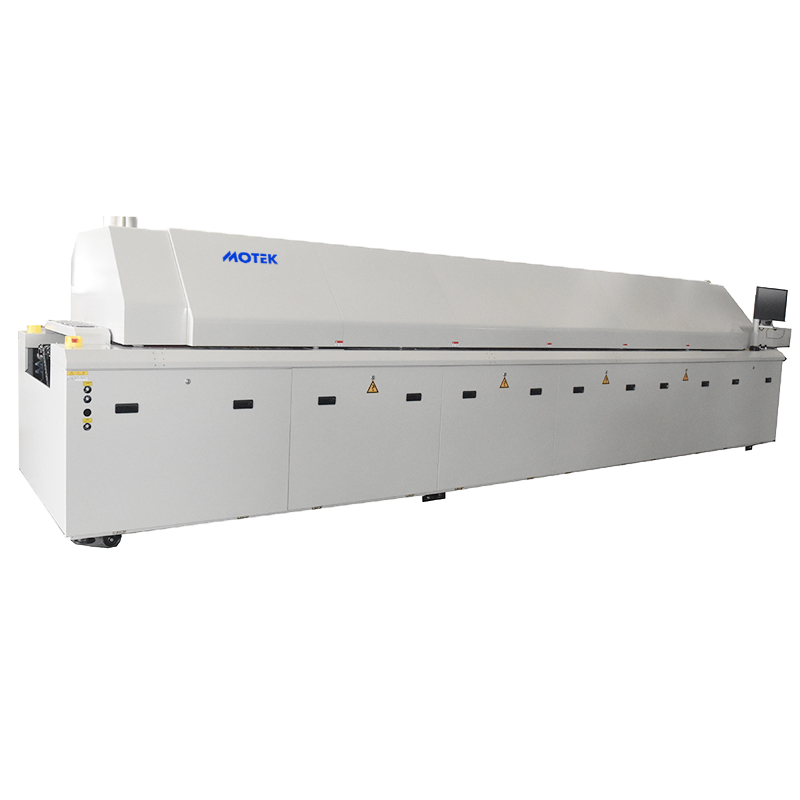
A full SMT turnkey line in this comparison means one scope of supply covering the solder paste printer, dispensers, mounters, reflow oven, inspection and board handling, with the supplier responsible for the line working as an integrated flow. A retrofit means new equipment inserted into an existing flow, where conveyor height, handshake signals, board support, programming and data links between new and old machines become a buyer-managed project.
Both routes add the same categories of equipment. What changes is where the boundary of responsibility falls and how much of the line must be re-validated after installation. In a retrofit, a new mounter can meet its own specification while the line still underperforms, because the constraint has moved to a buffer, a printer or a handshake signal. That is a project-scope problem, not an equipment-quality problem, and it is the main reason retrofit budgets are judged unfairly after the fact.
For supplier context on the comparison, Motek (Morel Equipments Co., Ltd.) is a Shenzhen-based SMT equipment supplier founded in 2011 that exports its full annual output of 300–500 units to the EU, USA, Australia, Canada and ASEAN markets, with a product range covering reflow soldering, pick-and-place, plug-in, PCB cutting, cleaning and PCBA protection equipment. Company and product details are published on Motek's official website.
Industry Background: Why Buyers Are Reopening This Comparison
The global SMT equipment market was valued at approximately USD 4.3 billion in 2024, according to Research and Markets data released in October 2026. The same source identifies inspection equipment as the fastest-growing category, at an estimated 15.2% CAGR through 2033, driven by AI-assisted 3D AOI and SPI.
That pattern explains why many retrofit projects now start with a quality gap rather than a speed gap. If the missing capability is inline SPI, AOI or X-ray verification, it can often be added with limited disturbance to placement and reflow, which favours the retrofit route. If the missing capability is throughput or changeover speed across a high-mix order book, inspection alone will not close it, and the retrofit case weakens.
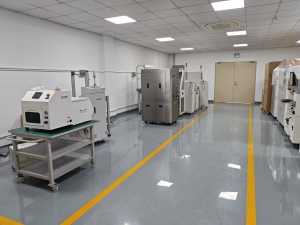
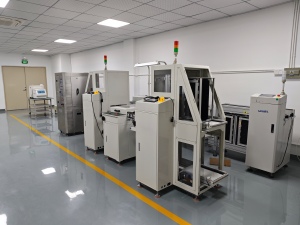
Supply capacity belongs in the comparison as well. A supplier running a 955 m² facility with 31 employees, 15+ R&D engineers and 300–500 units of annual output, such as Motek, can generally configure a line and hold spare parts inside one commercial relationship. A retrofit assembled from three vendors spreads that dependency. Neither arrangement is automatically better, but the number of parties who must agree on one interface test is a real cost line.
Decision Criterion 1: Board Mix and Changeover, Not Headline Speed
Placement speed ratings are configuration-specific and should never decide a retrofit-versus-new comparison on their own. Fuji, for example, publishes 37,500 CPH for the NXT III H24G high-speed head per module — a per-module figure that cannot be compared directly with a two-beam rating from another platform without normalising for head and beam count.
For high-mix production, the number that decides the project is changeover time per product: feeder cart exchange, nozzle set changes, program recall accuracy and the number of board variants the line can hold. A retrofit inherits the existing changeover discipline, including its weaknesses. A new line can be specified around them — dual-lane conveying, offline feeder setup, buffer positions — but only if those requirements are written into the order rather than assumed.
Decision rule: if short runs and frequent product changes dominate the order book, compare the two options on measured changeover minutes. If one high-volume product dominates, architecture matters less and the retrofit is often competitive.
Decision Criterion 2: Floor Space and Conveyor Architecture
Space is usually the criterion that ends a retrofit discussion. A new machine must fit the existing bay, match conveyor height, respect the handshake protocol and leave enough buffer to absorb a stoppage. Adding a mounter often forces the printer to move, and once the printer moves, the layout validated years earlier no longer exists.
Collect the physical facts before comparing quotes: bay dimensions and ceiling clearance, door widths for machine entry, floor loading, power capacity and phase, compressed air, and exhaust routing for the reflow oven. A full new line needs the same data, but it is planned once and designed as a single flow, which is an advantage where the existing bay has been extended incrementally over several years.
Decision Criterion 3: Customization — Interface Engineering vs Line Design
Customization means different work in each option. In a retrofit it is interface engineering: conveyor extensions and transitions, board support tooling, feeder and nozzle compatibility with existing Fuji NXT, Yamaha YSM or JUKI platforms, glue-dispensing patterns for an existing board carrier, and software hooks for traceability. In a full line it is configuration design: lane count, buffer and inspection placement, depaneling and cleaning stations, and how boards enter and leave the flow.
The practical test is to ask each supplier what they will customise and what they will not. Motek's engineering resource of 15+ R&D engineers supports configured lines, but the boundary of any custom scope still belongs in the purchase documents: who supplies fixtures, who approves the board support design, and who validates the first article.
Decision Criterion 4: Purchasing Terms and Where Responsibility Sits
A full turnkey line is normally bought on one purchase order, with one delivery schedule and one acceptance event. A retrofit is usually two to four purchase orders, with each vendor responsible for its own machine and no vendor responsible for the combination. That difference in contract structure explains most of the disputes that surface only after installation.
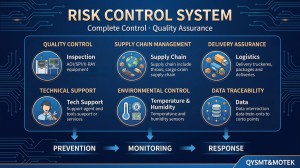
Whichever route is chosen, the order should carry a scope matrix naming the interface owner at each boundary: conveyor transitions, electrical interlocks, handshake signals, software integration and line-level throughput. Motek's own risk controls reflect this logic — detailed technical parameter confirmation before the order, advance inventory and delivery confirmation, scratch-code management for part identification, professional packaging with logistics tracking, and customs broker assistance. Those controls reduce delivery and identification risk; they do not replace a written interface matrix on a retrofit.
Decision Criterion 5: Acceptance Criteria You Can Actually Measure
Acceptance is where the two options diverge most sharply and where a weak specification costs the most. A full line can be accepted against line-level results: boards per shift on your own product mix, first-pass yield, changeover time, and reflow profile conformance across the belt width. A retrofit must be accepted twice — once for the new machine and once for the interface it now depends on.
Write the tests before the purchase order, not after installation. At minimum: run your own boards rather than demonstration boards; measure output over a full shift rather than a short burst; verify glue dot position and volume repeatability if a dispenser is in scope; confirm blockage detection and recovery at every conveyor transition; and record the reflow profile on a populated board. Rated capacity is measured under defined conditions and is not a forecast of high-mix output, so acceptance language should reference measured results on your product mix.
Decision Criterion 6: CE Certification and Documentation Scope
Certification is often treated as a checkbox, but in a retrofit it is a scope question. Equipment-level CE certification travels with the machine: Motek holds multiple CE certifications for its equipment, and the corresponding declarations and test documentation should be delivered with each unit and mapped to serial numbers.
What changes in a retrofit is the documentation for the assembled line. Before signing, ask each supplier which declarations accompany which model, what documentation they will provide for the integrated line, and who will hold the technical file for the combination. Confirm the answer with your own compliance assessor instead of relying on a verbal position; this is a scope clarification, and it is far cheaper before the purchase order than after installation.
Decision Criterion 7: Warranty Coverage and the Service Boundary
Motek provides a 12-month warranty on its products, which is straightforward to administer inside a single-scope line: one contact, one spare-parts list, one escalation path. In a retrofit, warranty becomes a boundary question. If a board jams at the transition between a new mounter and a five-year-old conveyor, the first response is usually to establish whose scope it is, and that conversation consumes production time.
The fix is contractual rather than technical. Name the boundary in the purchase documents, agree response expectations for cross-vendor faults, and confirm spare-part availability and lead time for each new unit before installation. For a retrofit, also check commonality: nozzles and feeders that serve both the new and the existing platform reduce the number of part numbers your store must carry.
Decision Criterion 8: QA/QC Support and Ramp-up
QA/QC support carries more weight in a retrofit than buyers expect, because the new machine has to be proven against an existing process window. Motek's stated quality measures include strict inspection before shipment, a comprehensive training system, 24/7 technical support, fast repair response, spare-parts supply and a defined customer communication mechanism. In a single-scope line these services cover the whole flow; in a retrofit they cover one machine, and the buyer coordinates the rest.
Plan the ramp-up explicitly in both cases: who trains operators on the new machine, who trains them on its interaction with the old line, and how many production days are reserved for first-article approval and process-window tuning. Post-reflow constraints — flux residue that requires a PCBA cleaning machine, or depaneling stress that requires a router — can often be handled as independent retrofits, because they sit outside the placement and reflow chain.
Step-by-Step: Running the Comparison in Six Steps
- Measure the constraint before choosing a route. Record where boards queue, where changeover time is consumed, and which station limits output on your real product mix. A retrofit and a new line solve different constraints.
- Map the interfaces of existing assets. Document conveyor height and direction, handshake protocol, power and air drops, board support tooling, and programming or traceability software for every machine the new equipment will touch.
- Rank the capability gap. Separate gaps that can be closed inside one station — placement, dispensing, inspection, cleaning, depaneling — from gaps that require a different line architecture. Only the first group favours a retrofit.
- Cost the interface work, not only the machines. Add conveyor rework, fixture design, software integration, requalification of the existing process window and lost production during installation. This line item is routinely underestimated on retrofit projects.
- Write measurable acceptance criteria into the purchase documents. Use the same tests for both options, and add interface tests for a retrofit, so the two offers can be compared on results instead of catalog specifications.
- Assign warranty, documentation and service responsibility in writing. Cover CE documentation scope, the cross-vendor fault path, spare-parts lead time and training before the order, because this is the part that is hardest to renegotiate later.
When Each Option Fits: Three Conditional Scenarios
These are illustrative situations, not reports of specific customer projects.
Scenario A — placement is the only real bottleneck. The line has a serviceable printer, a compliant reflow profile and adequate inspection, but placement speed and feeder positions limit output. A retrofit of one mounter, plus a glue dispenser if the process requires it, addresses the constraint directly. Acceptance should focus on measured output on the existing product mix and on stable handshake behaviour at both conveyor transitions.
Scenario B — the fleet is mixed-vintage and the bay is full. Three generations of equipment, no shared software, no spare buffer and no room to extend. Individual retrofits accumulate coordination cost without resolving the architecture, so a full new line planned as one flow becomes the lower-risk route, provided utilities, footprint and downtime are budgeted.
Scenario C — the gap is quality verification. Placement and reflow are acceptable, but defects reach the customer because inspection is manual or absent. Adding inline SPI or AOI, or X-ray verification for BGA joints, is an independent retrofit that leaves the placement and reflow chain untouched. This is the case where the retrofit advantage is clearest.
Side-by-Side Comparison
| Decision dimension | Full new SMT turnkey line | Retrofit into existing assets |
|---|---|---|
| Scope of supply | One integrated scope: printer, dispensing, placement, reflow, inspection, handling | New equipment only; existing printer, conveyor and inspection stay in service |
| Interface ownership | Supplier owns line-level interfaces inside the agreed scope | Buyer coordinates conveyor, handshake, software and fixture interfaces |
| Floor space and utilities | Planned once as a single flow; needs a free bay, power, air and reflow exhaust | Must fit the existing bay, conveyor height and utilities; layout changes cascade |
| High-mix changeover | Can be specified around your changeover method: lanes, offline setup, buffers | Inherits the existing changeover discipline, including its limits |
| Customization work | Configuration design: lanes, buffer and inspection positions, depaneling and cleaning stations | Interface engineering: transitions, board support tooling, feeder and nozzle compatibility |
| Acceptance testing | Line-level results on your boards: output per shift, first-pass yield, changeover, reflow profile | Two-stage: machine acceptance plus interface acceptance at each new boundary |
| CE documentation | Documentation scope for the integrated line can be defined in one contract | Per-model equipment declarations apply; the assembled line's technical file must be assigned in writing |
| Warranty administration | One contact and one spare-parts list; Motek provides a 12-month warranty on its products | Boundary between new and existing assets must be written; cross-vendor faults take longer to route |
| QA/QC and training | Covers the whole flow under one inspection and training plan | Covers the new machine; buyer coordinates process-window checks and operator training |
| Installation downtime | Longer but concentrated and scheduled once | Shorter per machine, yet may be repeated and is harder to schedule in a live line |
| Spare parts | One consolidated list under one supplier | New and old parts coexist; check nozzle, feeder and wear-part commonality |
| Typical best fit | Architecture-limited lines, mixed-vintage fleets, new bays | Station-limited lines with healthy printer, conveyor and inspection assets |
Conclusion: A Decision Rule You Can Apply
Choose the full new line when the constraint belongs to the architecture — footprint, conveyor flow, changeover discipline or an unshared equipment fleet — and when you can absorb one larger acceptance event. Choose the retrofit when the constraint sits in one or two stations, the surrounding assets are demonstrably healthy, and you are prepared to manage interfaces as a project with named owners.
In both cases the deciding documents are the same: a scope matrix, measurable acceptance criteria written before the order, a CE documentation list mapped to models, and a written warranty boundary. Motek's published position — 12-month warranty, multiple CE certifications, 15+ R&D engineers and an annual output of 300–500 units — can support either route, but those facts only become decision-grade once they are attached to the acceptance tests you define for your own boards.
FAQ
Does retrofitting new equipment into an existing SMT line change its CE documentation?
Equipment-level CE certification travels with each machine, and Motek holds multiple CE certifications for its equipment, so each new unit should arrive with its own declaration and test documentation mapped to its serial number. The documentation for the assembled line is a separate scope question: ask every supplier which declarations cover which model, and confirm with your compliance assessor who holds the technical file for the combination before you sign.
Can a new pick-and-place machine be added to an existing Fuji NXT, Yamaha YSM or JUKI line?
It can be technically possible, but brand name alone implies nothing. The checks are conveyor height and handshake protocol, feeder and nozzle standards shared with the existing platform, board support tooling, and whether the programming or traceability software can address both machines. Request the interface specification in writing and run your own boards through the transition before committing to the retrofit.
Which route costs less — a full turnkey line or a retrofit?
A retrofit generally requires less capital per unit of added capability, but the comparison is only honest when it includes conveyor rework, fixture design, software integration, requalification of the process window, installation downtime and duplicated spare parts. Ask both suppliers for quotes split into equipment cost and interface or integration cost, then compare measured acceptance results rather than headline prices.
Can we trial the equipment on our own boards before committing?
Ask for a material trial rather than a demonstration: your boards, your panel size, your glue pattern and your reflow window. Specify in advance what will be measured — glue dot position and volume repeatability, reflow profile on a populated board, handshake stability at each transition, changeover minutes. Motek's inspection before shipment supports quality control on the supplier side, but it does not replace your own first-article approval.
What does the warranty cover in a retrofit, and where does the boundary sit?
Motek provides a 12-month warranty on its products. In a retrofit, the useful addition is a written boundary: how a fault is routed when the new machine and an existing conveyor are both involved, what response time applies, and which spare parts are held. Motek's 24/7 technical support, fast repair response and spare-parts supply cover its own equipment; cross-vendor faults need a named owner in the contract.
What lead time and production capacity sit behind the order?
Motek manufactures in a 955 m² facility with 31 employees, 15+ R&D engineers and an annual output of 300–500 units, exporting 100% of that output to the EU, USA, Australia, Canada and ASEAN markets. Confirm the delivery schedule, current inventory position and logistics tracking in the order, and add spare-parts lead time for any retrofit. For a scope discussion covering either route, the Motek SMT equipment brochure (PDF) lists the product range, and the sales team can quote against your board mix and existing line layout.
Next step: prepare your board list, bay dimensions, conveyor height and existing equipment interfaces, then request a comparison that separates equipment cost from interface work. Product and company information is available on morequip.com, and the catalog can be downloaded from the brochure link above.
Have Questions or Need More Details?
Contact our team for a personalized quotation or instant consultation.
Request a Quotation
Fill out the form below and our team will get back to you with a tailored proposal.
WhatsApp Direct Chat
Prefer to chat in real-time? Message us on WhatsApp for instant assistance & quick answers.
- Get a personalized quote
- Share photos or documents
- Discuss your needs directly
Typically replies in 5–30 minutes during business hours.