
SC750 Electric Food Steamer: 7-Quart Parameter Priorities
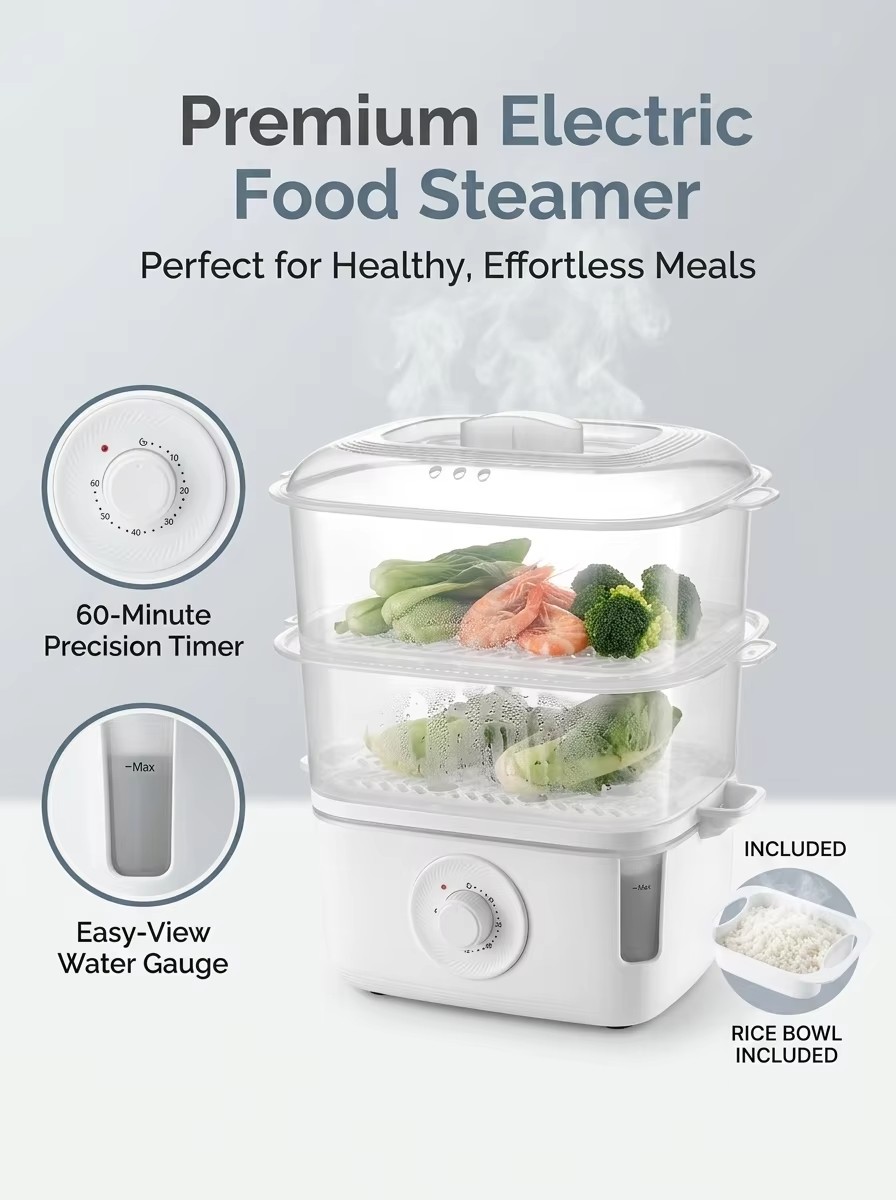
The SC750 electric food steamer is a 7-quart, double-layer countertop appliance rated 230V / 800W, built with a mechanical rotary timer and automatic shut-off dry-burn protection, and supplied by Ningbo Jinchang Electronics Co., Ltd. from Yuyao City, Zhejiang Province, China. Those headline figures are the easy part of the file. The harder part is deciding which three parameters carry the purchasing decision: capacity and tier configuration, food-contact compliance, and certification scope for EU market access.
This guide treats the SC750 as a documentation problem as much as a hardware one. It explains what each parameter governs, which evidence proves it, and where a certificate's written scope stops. The most common error in this file is assuming that a management-system certificate written around barbecue grills also covers an electric food steamer. It does not.
Why a flat SC750 spec list misleads buyers
A specification answers what the product is. An evaluation answers what is proven, for which model, in which market, and until when. Four document types sit in the SC750 file and are routinely mixed together: product test reports on the steamer itself, factory social-compliance audits, management-system certificates, and commercial capability statements.
Three consequences follow. First, a report number identifies a document, not a coverage area. The LFGB report NGBEC26006183701 and the food contact report NGBEC26006183702 differ by a single final digit and cover different national regimes. Second, every document carries a validity window, and a file that was current at sampling may be past its stated end date at shipment. Third, system certificates carry a written scope, and that scope is the outer limit of what they prove.
The SC750 packet is strong on the first point: all three SGS reports name electric steamer SC750 as their scope, and both social audits list electric steamers inside the factory scope. It is weaker on the third, where the ISO 9001 and ISO 14001 scopes are written around barbecue grills. That asymmetry is exactly what a buyer at evaluation stage needs to see before signing.
Where the 7-quart double-layer countertop steamer sits in the category
Electric food steamers are a well-supplied category. Custom Market Insights reported the global electric food steamer market at approximately USD 3.68 billion in 2024. Growth forecasts for the same category disagree materially: CMI projects a 5.32% CAGR for 2025 to 2034, while other commercial reports place the figure near 9.6% and 11.2%. The supplied comparison notes attribute that spread to definitional differences, specifically whether smart, multi-function and commercial-grade steamers are counted inside the category. The practical conclusion is to plan around the direction of demand rather than around any single growth number.
Supply is concentrated. Trade data from Zauba and Volza records China accounting for more than 80% of total import shipments in the corridors tracked, and the commercial research supplied for this guide describes Asia-Pacific as the largest and fastest-growing regional market. Classification is not always consistent either: steamers are commonly entered under HS 8516.60, with HS 8419.81 used for cooking and heating machinery, which complicates like-for-like import comparison across markets.
Safety expectations are more standardised than trade data. IEC 60335-1 sets the general safety framework for household appliances, and IEC 60335-2-15 / 60335-2-3 address appliance-specific requirements for heating appliances of this type. For a 2 tier electric food steamer aimed at EU retail, the real differentiator is rarely the heating element. It is whether the food-contact and hazardous-substance documentation matches the destination market and the shipment date.
Parameter priority 1: capacity, tier configuration and the working envelope
The SC750's declared set is a 7-quart capacity, a double-layer arrangement, 800W rated power at 230V, a mechanical rotary timer and automatic shut-off dry-burn protection. Read together, they describe a countertop electric food steamer that steams different foods in two tiers over one heating base. The applications listed in the product data are vegetables, seafood, meat, dumplings, eggs and prepared food.
Capacity is not the same as usable portion count. The 7-quart figure describes the steaming volume; the two tiers determine how many separate foods can be handled at once without flavours mixing. A multi-tier electric food steamer therefore solves a different problem from one large basket, because it separates foods rather than simply fitting more of them. The trade-off is vertical height: the supplied comparison of double-layer and single-layer steamers notes that a double-layer unit needs more storage height, while a single-layer model suits one or two people in a smaller kitchen.
The timer and the shut-off are risk parameters, not convenience features. For large-capacity electric steamers the principal hazard identified in the supplied risk notes is dry-burn overheating, triggered when the tank runs dry or when the timer fails and protection loses effect during long steaming. The documented mitigations are a functioning auto-off circuit, timer and protection inspection before mass shipment, and an end-user instruction to check the water level before use. An electric food steamer with timer control earns its place in a specification because the timer makes the process repeatable; the automatic shut-off food steamer logic earns its place because it bounds the failure mode.
Control type carries a compliance consequence as well. The supplied comparison of mechanical-timer and app-controlled steamers notes that the mechanical version is simpler for all-age operation, has a lower failure rate and avoids network-standby obligations under Ecodesign rules, while an app-controlled model adds functions along with cost and after-sales exposure. For multi-country retail and gift-set programmes, that is the relevant decision rule rather than a preference for or against connectivity.
One parameter is absolute. The unit is rated 230V and cannot be operated on a 110V supply without a voltage-adjusted model. Voltage sits inside the product definition, not in the plug accessory bag, so the destination market has to be fixed before the specification is locked.
Parameter priority 2: food-contact compliance and how to read report scope
Three model-specific documents form the food-safety core of the SC750 file. All three were issued by SGS and all three name electric steamer SC750 as their scope.
- SGS SVHC Test Report NGBEC26006230701 — REACH, Regulation (EC) No 1907/2006, screened against the ECHA SVHC Candidate List as updated before 4 February 2026. Issued 5 August 2026, valid to 5 August 2028.
- SGS Food Contact Test Report NGBEC26006183701 — LFGB, citing Regulation (EC) No 1935/2004, German LFGB Sections 30 and 31 with BfR recommendation, and (EU) No 10/2011 as amended by (EU) 2025/351. Issued 29 July 2026, valid to 29 July 2028.
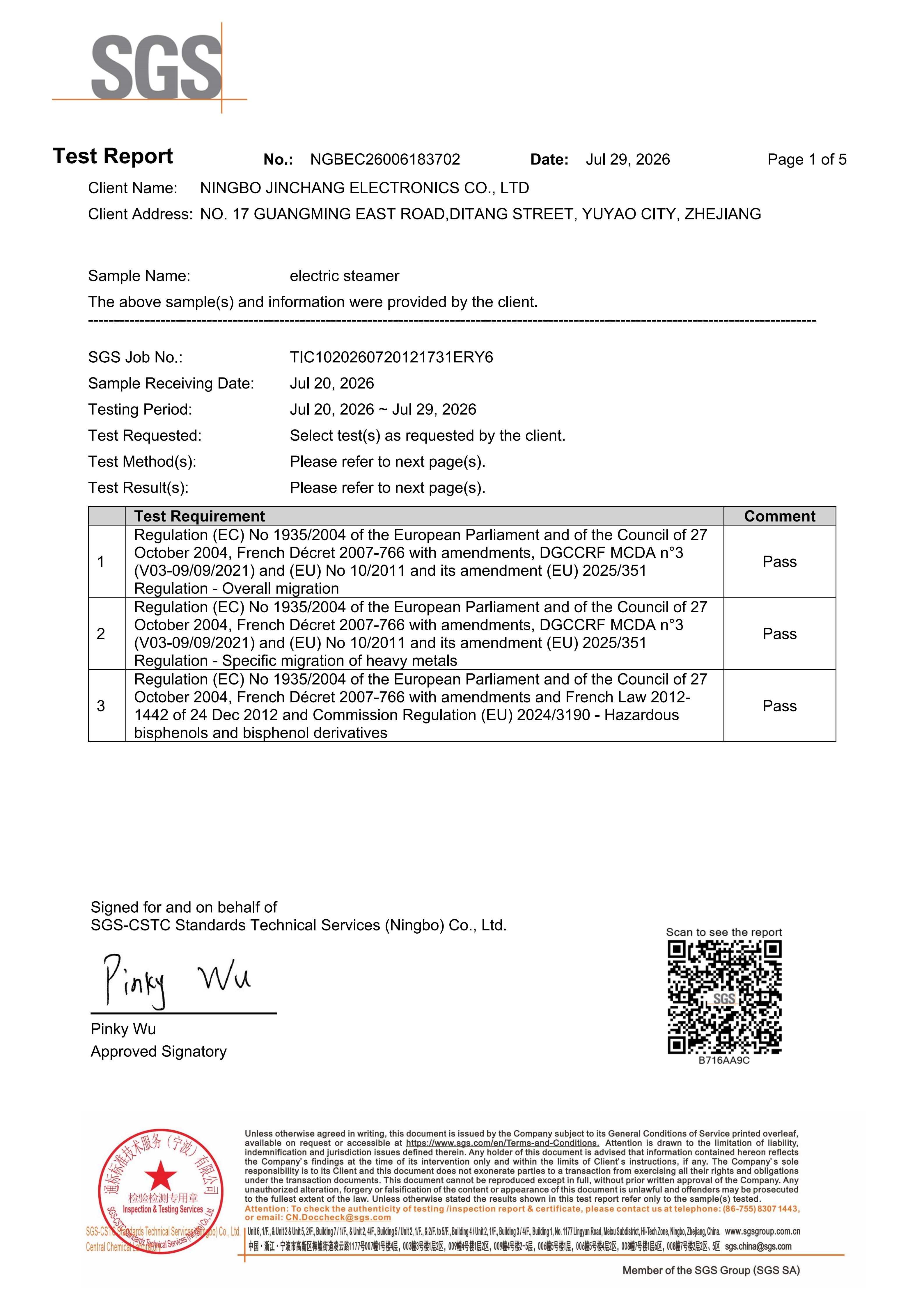
- SGS Food Contact Test Report NGBEC26006183702 — DGCCRF, citing Regulation (EC) No 1935/2004, French Décret 2007-766 and DGCCRF MCDA n°3, (EU) No 10/2011 as amended by (EU) 2025/351, French Law 2012-1442, and Commission Regulation (EU) 2024/3190. Issued 29 July 2026, valid to 29 July 2028.
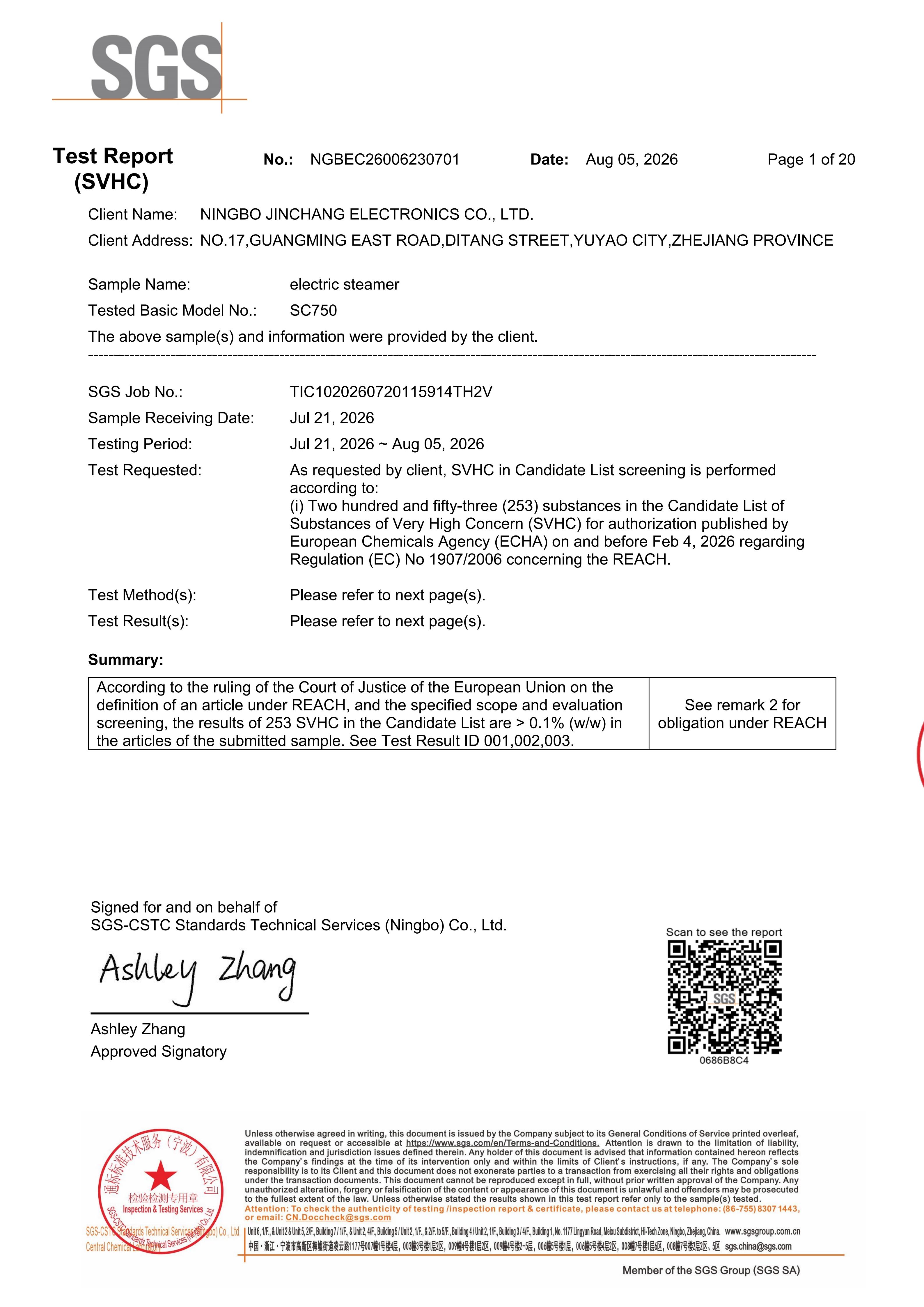
These documents answer three different questions and cannot substitute for one another. The SVHC report addresses hazardous-substance screening against the candidate list. The LFGB report addresses German food-contact requirements. The DGCCRF report addresses French food-contact requirements. A German retailer asking for LFGB evidence is not answered by the French report, even though both cite Regulation (EC) No 1935/2004 as a shared legal basis.
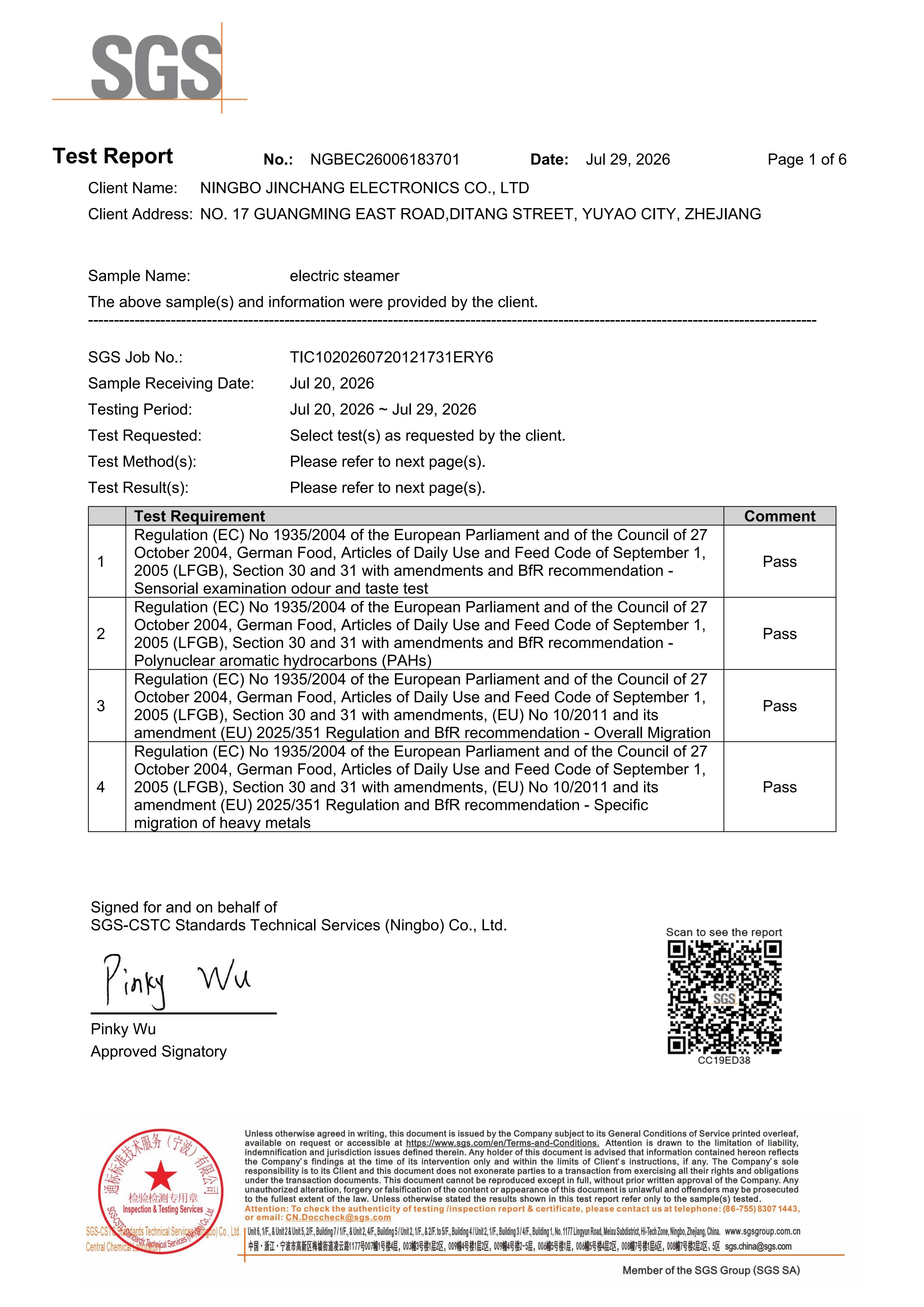
The document numbers deserve attention. NGBEC26006183701 and NGBEC26006183702 differ in the final digit, and they sit in the same series as the SVHC report NGBEC26006230701. A procurement team matching files by filename rather than by report number, issuing standard and named market can pair the wrong report with the wrong destination. The reliable check is three-part: report number, standard cited, and market named in the scope.
Buyers who ask for a BPA-free electric food steamer should convert that request into a named requirement before it reaches a specification. A label is a statement; a food-contact test report is evidence tied to a standard, a material scope and a date. The supplied guidance on unqualified food-contact material is direct: components that are not food-grade, or that carry no food-contact test for the destination market, may release substances under high-temperature steam, and the mitigation is to require the reports covering the steaming trays and cavity rather than accept an assurance. Whether any specific material is used in the SC750 is a question for the report's material scope, not for a marketing claim.
Parameter priority 3: certification scope for EU market access
EU market access for an electric food steamer rests on four requirement families described in the supplied product FAQ: electrical safety through CE-CB with a third-party CB test report, food-contact material through LFGB migration testing on trays and cavity, hazardous substances through RoHS, and energy consumption through Ecodesign (EU) 2023/826 off-mode and standby-mode limits. The same source notes that a self-declared CE mark without third-party test reports is typically rejected by large retailers. The mechanical timer on the SC750 sidesteps the network-standby part of the Ecodesign question; it does not remove the other three.
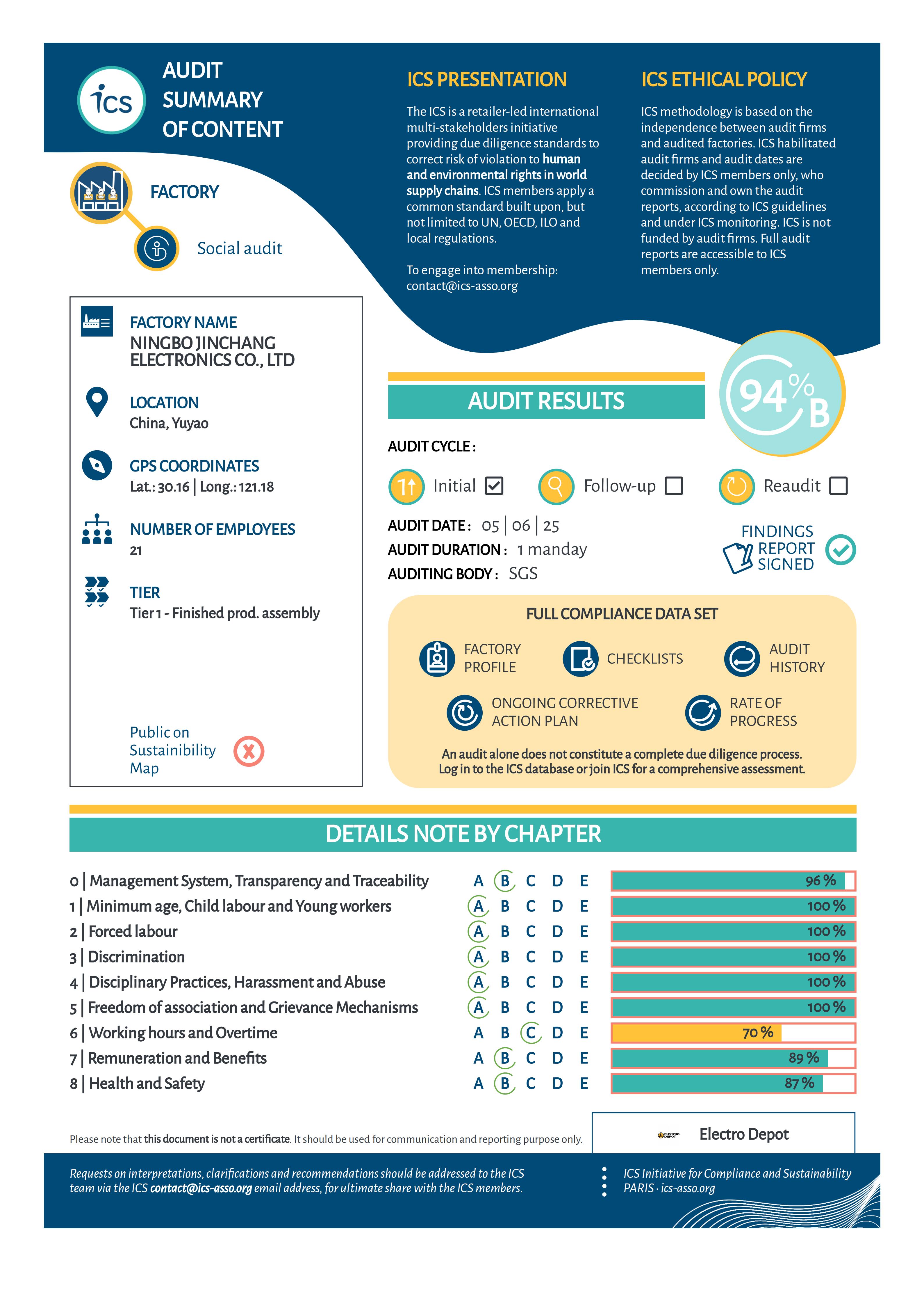
Two factory-level social audits cover the steamer explicitly. The amfori BSCI Monitoring Summary Report 24-0279560-1, issued by SGS and dated 26 September 2025, covers the factory's manufacture of electric grills, food dehydrators, charcoal grills and electric steamers across 13 BSCI performance areas, with a validity end date of 8 October 2026. The ICS Audit Summary of Content, also from SGS and dated 5 June 2025, uses the same factory scope including electric steamers and runs to 5 June 2027.
Dates have to be read against the calendar, not against the file. The BSCI summary's stated validity end date of 8 October 2026 has already passed relative to this guide, so it should be treated as evidence of the audit cycle completed in 2025 and re-confirmed against the current cycle before contracting. The ICS summary remains inside its stated window.
This is where the scope boundary matters most. ISO 9001 certificate NOA2409732, issued by NOA Testing & Certification Group Ltd. to GB/T 19001-2016 idt ISO 9001:2015, states its scope as production and sales of barbecue grills within the scope of CCC qualification, valid from 11 October 2024 to 10 October 2027. ISO 14001 certificate NOA2507153, to GB/T 24001-2016 / ISO 14001:2015, states its scope as production and export of barbecue grills, valid from 18 September 2025 to 17 September 2028. Neither scope text names electric food steamers. A buyer should therefore not treat the ISO 9001 certificate, or the CCC qualification referred to inside its scope, as automatic product evidence for the SC750. Management-system certification describes how the factory is run; the steamer's product conformity rests on the three SGS reports and on the audits whose scope explicitly lists electric steamers.
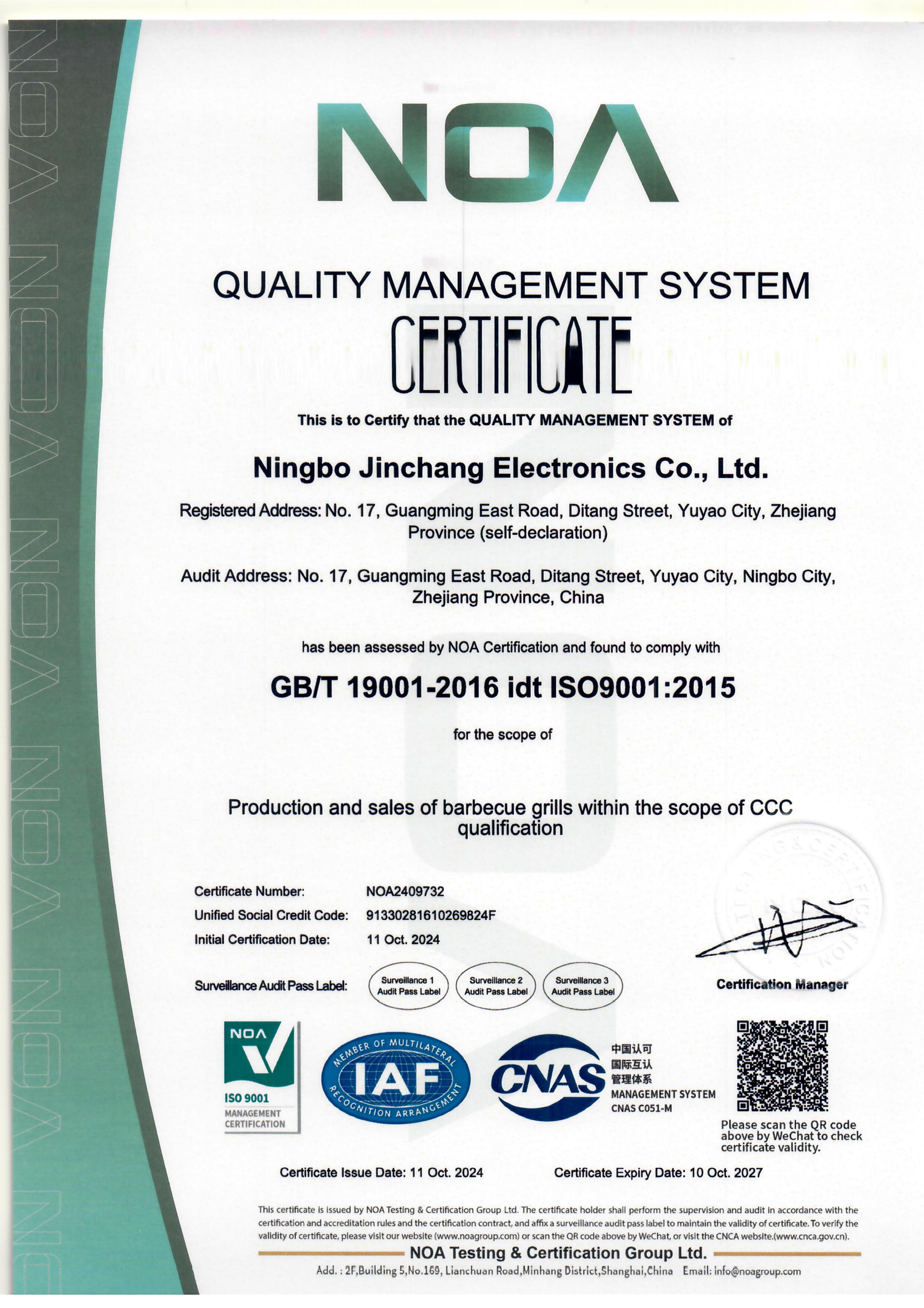
The practical request is short: ask for the scope page, not just the certificate cover.
Step-by-step: reading the SC750 evidence packet in order
- Fix the model and configuration first. Match the scope text on each report to the exact model and voltage variant you intend to order. A logo or packaging change is a commercial variation; a voltage change alters the electrical configuration and belongs in the same review.
- Assign each document to a destination. LFGB for Germany, DGCCRF for France, REACH SVHC for the EU substance question, BSCI and ICS for supply-chain social compliance. Do not let one document answer another market's question.
- Put every validity date on your calendar. Compare issue and expiry dates with your order date, production window and retail season. Two of the three SGS reports run to 2028; the BSCI end date is already behind us.
- Separate document levels. Product test report, factory social audit and management-system certificate each prove something different, and only the first two name the steamer.
- Read technical and commercial parameters together. A 7-quart double-layer unit at a 5,000-unit MOQ, a 30-day lead time and 100,000 units monthly capacity is a consistent programme; the technical file should travel with the purchase order, not behind it.
- Re-verify at every reorder. Reports are versioned and renewed, and the set that cleared the first shipment is a dated snapshot, not a permanent property of the product.
OEM and private label: where customization meets the parameter set
Ningbo Jinchang Electronics Co., Ltd. provides OEM and ODM production services, and its customization services include logo, voltage, and product design and development, alongside the appearance modification, function adjustment, private-mould development and customized packaging described in its company profile. For an OEM electric food steamer manufacturer brief, that means the SC750 platform can be adapted at the points where private label food steamer programmes usually diverge: branding, destination voltage, moulding and retail packaging.
The commercial envelope documented for these services is a 5,000-unit MOQ, 100,000 units monthly capacity, a 30-day lead time, 100% testing and a one-year warranty. The company operates a 5,500 m² plant with 68 employees, an annual output of 1,200,000 units, eight engineers, more than 30 intellectual property rights and over 200 product models, with a 90% export ratio and main markets in the EU, USA, Australia and Russia. Those figures matter at execution stage because they decide whether a private-label launch is a single run or a repeating programme.
One customization question deserves a written answer before a purchase order is raised: whether the customized configuration stays inside the scope of the reports already issued for the SC750. A different voltage variant or a new moulded part is not automatically covered by a report written for the standard configuration, so the file should state which document applies to which variant. That is a question to put to the supplier, not an assumption to carry into production.
Use cases and configuration fit
Household daily steaming is the documented mainstream use: vegetables, seafood, meat, dumplings, eggs and prepared food, indoors, on a stable level countertop, from a grounded 230V socket, with manual water filling and rotary-timer control. Used as an electric vegetable steamer, the two tiers keep vegetables apart from fish or dumplings so texture and flavour do not transfer between foods.
For a family, the 7-quart double-layer arrangement matches multi-dish cooking in one session. For one or two people in a small kitchen, the supplied comparison recommends a single-layer unit instead, mainly on storage height rather than on cooking quality. That is a fit decision, not a ranking.
For retail and gift programmes, the SC750 is supplied with a retail colour-box package that the product FAQ identifies as suitable for gift-set wholesale export. Peak-season shelf performance is the relevant test here, and the documented case record is a large home-goods supermarket chain operating in Australia, Germany and France, buying 40,000 to 60,000 units per year over three to five years for household daily steaming, with steady shelf sales, a low return rate and good sales performance in peak shopping seasons.
For light food-service use, two constraints belong in the plan from the start: the unit is for indoor use only, and there is no local on-site after-sales service, so the one-year warranty has to be managed through spare-part planning or return logistics rather than through a site visit.
SC750 evidence and parameter map
| Document or parameter | Documented value | What it establishes | What it does not establish |
|---|---|---|---|
| Working envelope | 7-quart capacity, double-layer, 230V / 800W, mechanical rotary timer, automatic shut-off | Capacity, tier configuration and control type of the named model | Operation on 110V without a voltage-adjusted model |
| SGS SVHC NGBEC26006230701 | REACH Reg. (EC) 1907/2006, candidate list updated before 4 Feb 2026; 5 Aug 2026 to 5 Aug 2028 | Hazardous-substance screening for the SC750 | Food-contact migration performance |
| SGS LFGB NGBEC26006183701 | LFGB Sections 30 and 31, BfR, (EU) 10/2011 and (EU) 2025/351; 29 Jul 2026 to 29 Jul 2028 | German food-contact basis for the SC750 | French DGCCRF requirements |
| SGS DGCCRF NGBEC26006183702 | 1935/2004, Décret 2007-766, MCDA n°3, Law 2012-1442, (EU) 2024/3190; 29 Jul 2026 to 29 Jul 2028 | French food-contact basis for the SC750 | German LFGB requirements |
| amfori BSCI 24-0279560-1 | SGS; factory scope includes electric steamers; 26 Sep 2025 to 8 Oct 2026 | Social-compliance audit at factory level | Product conformity, or current-cycle validity, since the end date has passed |
| ICS audit summary | SGS; factory scope includes electric steamers; 5 Jun 2025 to 5 Jun 2027 | Social-compliance audit at factory level | Product safety or food contact |
| ISO 9001 NOA2409732 | Scope: barbecue grills within the CCC qualification; 11 Oct 2024 to 10 Oct 2027 | Quality management as scoped | Coverage of electric food steamers |
| ISO 14001 NOA2507153 | Scope: barbecue grills; 18 Sep 2025 to 17 Sep 2028 | Environmental management as scoped | Coverage of electric food steamers |
Frequently asked questions
Which SC750 documents actually cover the electric food steamer itself?
Three SGS reports name electric steamer SC750 as their scope: SVHC NGBEC26006230701 under REACH, valid 5 August 2026 to 5 August 2028; LFGB food contact NGBEC26006183701, valid 29 July 2026 to 29 July 2028; and DGCCRF food contact NGBEC26006183702, valid 29 July 2026 to 29 July 2028. The amfori BSCI summary 24-0279560-1 and the ICS audit summary list electric steamers inside the factory scope. The ISO 9001 and ISO 14001 certificates do not name the steamer.
Do the ISO 9001 and CCC certificates cover the SC750 food steamer?
Not as written. ISO 9001 certificate NOA2409732 states a scope of production and sales of barbecue grills within the scope of CCC qualification, valid 11 October 2024 to 10 October 2027, and ISO 14001 certificate NOA2507153 states production and export of barbecue grills, valid 18 September 2025 to 17 September 2028. Because neither scope text names electric food steamers, neither should be presented as product conformity evidence for the SC750. Request the scope page and pair it with the model-specific SGS reports instead.
What can an OEM electric food steamer manufacturer customize on the SC750?
Ningbo Jinchang Electronics Co., Ltd. runs OEM and ODM production, and its documented customization covers logo, voltage, and product design and development, plus appearance modification, function adjustment, private-mould development and customized packaging. Voltage is the commercially decisive option, because the unit is rated 230V and needs a voltage-adjusted model for 110V markets. Confirm in writing which reports apply to any customized variant, since a changed voltage or moulded part may fall outside a report issued for the standard configuration.
Can the SC750 be supplied as a private label food steamer for a retail programme?
The documented commercial envelope supports it: 5,000-unit MOQ, 100,000 units monthly capacity, 30-day lead time, 100% testing, one-year warranty, and a retail colour-box package that the product FAQ identifies as suitable for gift-set wholesale export. A supplied case record covers a large home-goods supermarket chain in Australia, Germany and France buying 40,000 to 60,000 units per year over three to five years, with steady shelf sales and a low return rate.
What order volume and capacity should a buyer plan around?
Plan on a 5,000-unit minimum order and 100,000 units of monthly capacity. Unit pricing is configuration-dependent rather than published, and the parameters that move it are tier configuration, voltage variant, moulding, packaging and branding. Compare quotations on one fixed configuration, such as 7-quart double layer, 230V / 800W, mechanical rotary timer and automatic shut-off, so that the price and the technical file describe the same product.
What should be checked on a pre-production SC750 sample?
Check what the documents cannot show: that the label voltage matches the destination market, that both tiers fit and release cleanly, that the rotary timer advances and stops as set, that the automatic shut-off responds when the water tank runs low, and that the removable trays and cavity match the material scope of NGBEC26006183701 and NGBEC26006183702. Then re-check the report numbers and the standards they cite, rather than trusting filenames.
What lead time and after-sales terms apply?
The documented lead time is 30 days and the warranty is one year, with no local on-site after-sales service, so spare-part planning or return logistics belongs in the programme budget. Re-confirm the amfori BSCI summary before contracting, because its stated validity end date of 8 October 2026 has passed, while the ICS summary runs to 5 June 2027. For a specific configuration, request the current document set and a sample quotation against your target market.
Conclusion
For the SC750, three parameters carry the decision: the 7-quart double-layer working envelope at 230V / 800W, the three model-specific SGS reports that name the steamer, and the certification scope that stops where the barbecue-grill wording stops.
Read the file in that order and the rest of the evaluation becomes mechanical. Capacity and tiers decide whether the unit fits the kitchen, the shelf or the gift programme. The LFGB, DGCCRF and SVHC reports decide whether it can enter Germany, France and the EU substance framework, each within its own stated window. The audits decide whether the factory clears social-compliance review, and the BSCI date needs refreshing while the ICS date still stands. What none of them do is extend coverage that was never written: ISO 9001 and the CCC qualification inside its scope describe barbecue grills, not electric steamers, and a buyer who treats them as interchangeable with product test reports will either over-accept or over-reject the file.
For buyers moving from evaluation into execution, the next step is to request the current document set against your target market and a sample quotation for a fixed configuration, which the company handles through its published contact channel (Yibo Zhang, Yibo@jinchang.co). Match report numbers to markets, put the validity dates beside your shipment plan, and the SC750 specification stops being a list and becomes a decision.
Have Questions or Need More Details?
Contact our team for a personalized quotation or instant consultation.
Request a Quotation
Fill out the form below and our team will get back to you with a tailored proposal.
WhatsApp Direct Chat
Prefer to chat in real-time? Message us on WhatsApp for instant assistance & quick answers.
- Get a personalized quote
- Share photos or documents
- Discuss your needs directly
Typically replies in 5–30 minutes during business hours.