
Electric Food Steamer Supplier Evaluation: ICS and BSCI Audit Scope vs. Factory Coverage
A social-compliance certificate is not a product claim. It is a dated statement about a factory, limited to a defined list of production activities. If the electric food steamer you plan to buy sits outside that list, the certificate is not evidence about your order, however prominent the logo looks in a supplier catalogue.
For buyers in the evaluation stage, that distinction decides whether a retail compliance review runs cleanly or stalls at the document desk. This article sets out a supplier capability and delivery-assurance check built on audit scope: what the ICS and amfori BSCI documents held by NINGBO JINCHANG ELECTRONICS CO., LTD. actually state, how those statements connect to the factory and to the electric food steamer line, and how to run the same check against any other supplier on your shortlist.
NINGBO JINCHANG ELECTRONICS CO., LTD. is a manufacturer of Western-style small household kitchen appliances based at No.17 Guangming East Road, Ditang Sub-district, Yuyao City, Zhejiang Province, China. Its core lines are electric BBQ grills, electric steamers, charcoal grills and food dehydrators. The company operates a 5,500 m² production plant, exports roughly 90% of its output, and lists membership of amfori BSCI and ICS as part of its supply-chain compliance position. Its electric steamer range includes the SC750, a 2-layer 7 L countertop model.
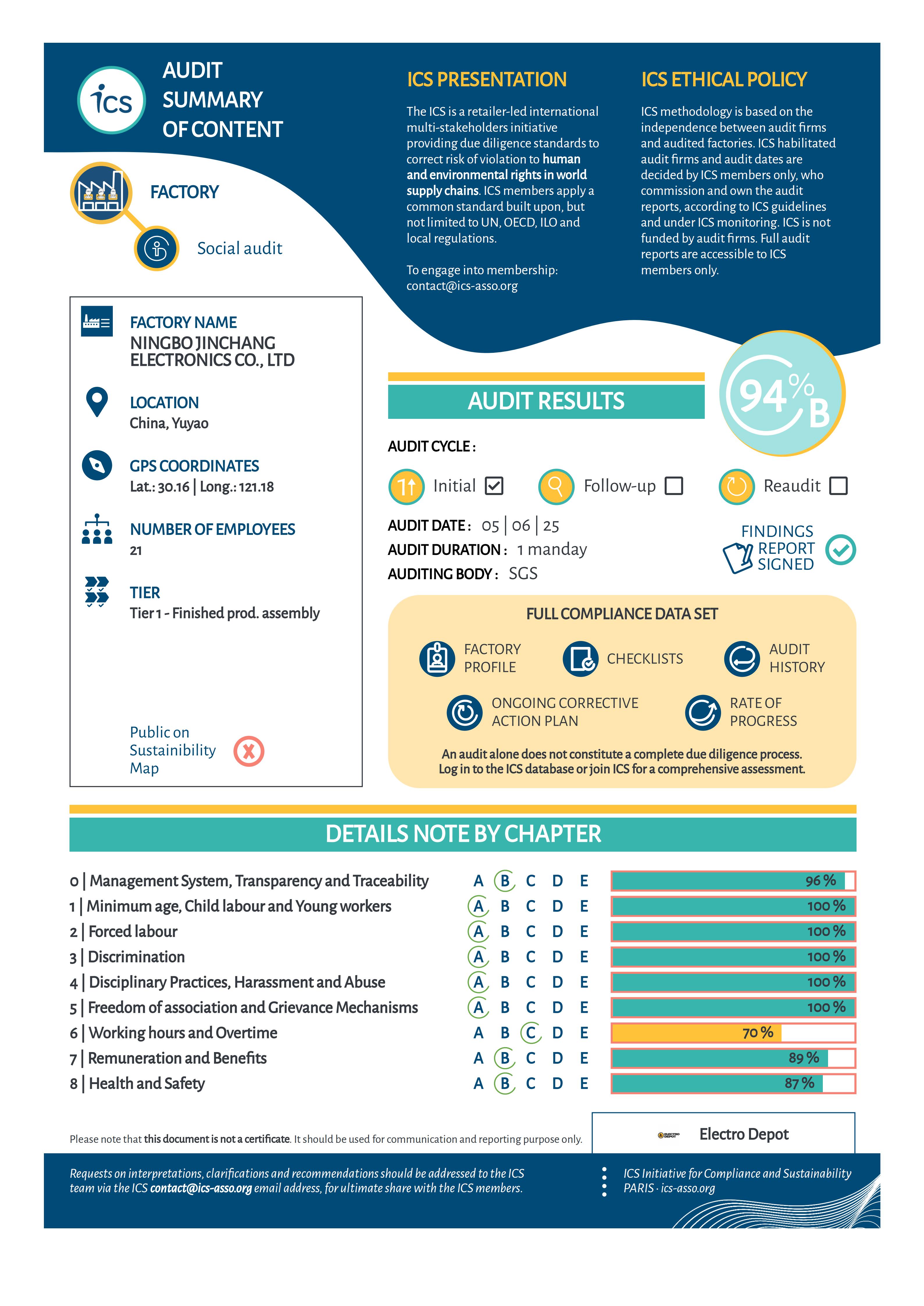
ICS Audit Summary of Content issued by SGS, naming electric steamers inside the factory scope and valid from 2025-06-05 to 2027-06-05.
The certificate-logo problem: five answers a badge cannot give
A logo answers one question only: has this supplier been audited? Evaluation-stage buyers need five answers:
- Which legal entity and which site? Audits attach to a legal entity and a production address, not to a brand name or a website.
- Which production activities? A factory may be audited for some product families and not for others, and a steamer project is only covered if steamers are listed.
- Which performance areas? The BSCI framework contains 13 performance areas; a narrow or single-issue audit may cover far fewer.
- Valid until when? Every audit window ends, and renewal timing can land in the middle of your production schedule.
- Which document covers my model? Factory-level social audits and model-level food-contact reports answer different questions and are not interchangeable.
Two working definitions keep the check organized. Audit scope is the written description inside the audit document: the entity and site visited, the production activities listed, the standard applied and the performance areas assessed. Factory coverage is whether that scope still describes the goods on your purchase order — the model, the tier count, the voltage variant, the packaging format and the production dates inside your delivery window.
A supplier can hold genuine audits with a narrow scope, and a supplier can hold broad audits with a long tail of uncovered models. Neither situation is visible from a logo. Both are visible from the scope line.
Industry background: compliance expectations now travel with the category
The category is large enough for retailer compliance teams to manage it as a formal sourcing category. Custom Market Insights estimated the global electric food steamer market at approximately USD 3.68 billion in 2024 and projected a 5.32% CAGR for 2025–2034. Other research houses publish materially higher growth rates for the same period, a spread that generally reflects definitional differences such as whether multi-functional cookers are counted. For planning purposes, treat any single growth figure as a range input rather than a precise forecast.
Three structural facts shape how buyers evaluate electric steamers. First, Asia-Pacific is the largest and fastest-growing regional market for electric steamers as of 2024/2025, according to HTF Market Intelligence and CMI. Second, China remains the dominant export origin: trade data from Volza and Zauba put Chinese supply above 80% of food steamer import shipments in the corridors those sources track. Third, the category is classified in trade data under HS 8516.60 and HS 8419.81, which is one reason customs and compliance documentation tend to be requested together.
On the technical side, IEC 60335-1 together with IEC 60335-2-15 and IEC 60335-2-3 are the primary international safety standards for household electric steam cookers, per IEC and UL Solutions. Retailer supplier questionnaires typically layer labour-and-social documentation — amfori BSCI, ICS — on top of that safety and food-contact layer. That stacking is why scope reading has become a purchasing skill rather than a compliance formality.
What the ICS and amfori BSCI documents actually say
ICS Audit Summary of Content
The factory holds an ICS Audit Summary of Content issued by SGS. Its scope line names the site — NINGBO JINCHANG ELECTRONICS CO., LTD. — and lists the manufacturing activities inside the audit: electric grills, food dehydrators, charcoal grills and electric steamers. The governing reference is the ICS initiative social compliance requirements. The document records coverage of 13 BSCI performance areas, including the social-compliance management system, labour rights, and salary & working hours. Its validity window runs from 2025-06-05 to 2027-06-05, and its stated market relevance is the EU market and supply-chain access for ICS members.
Three details in that paragraph carry the evaluation weight:
- "Electric steamers" appears in the activity list. The steamer line sits inside the audited scope rather than adjacent to it, which is the first thing a scope check should confirm.
- Thirteen performance areas are stated, including salary & working hours. That indicates coverage of the areas most relevant to labour-rights due diligence, not a single-issue paperwork review.
- The window runs to 2027-06-05. A two-year window covers a full retail programme cycle — development, first shipment, repeat orders — without an inter-annual gap.
amfori BSCI Monitoring Summary Report
The second document is an amfori BSCI Monitoring Summary Report, also issued by SGS, carrying reference 24-0279560-1. Its audited scope is the same factory and the same production list, electric steamers included, governed by the amfori BSCI Code of Conduct. Coverage is stated as 13 BSCI performance areas including the social-compliance management system, labour rights, and salary & working hours. The validity window runs from 2025-09-26 to 2026-10-08, and the stated market is the EU.
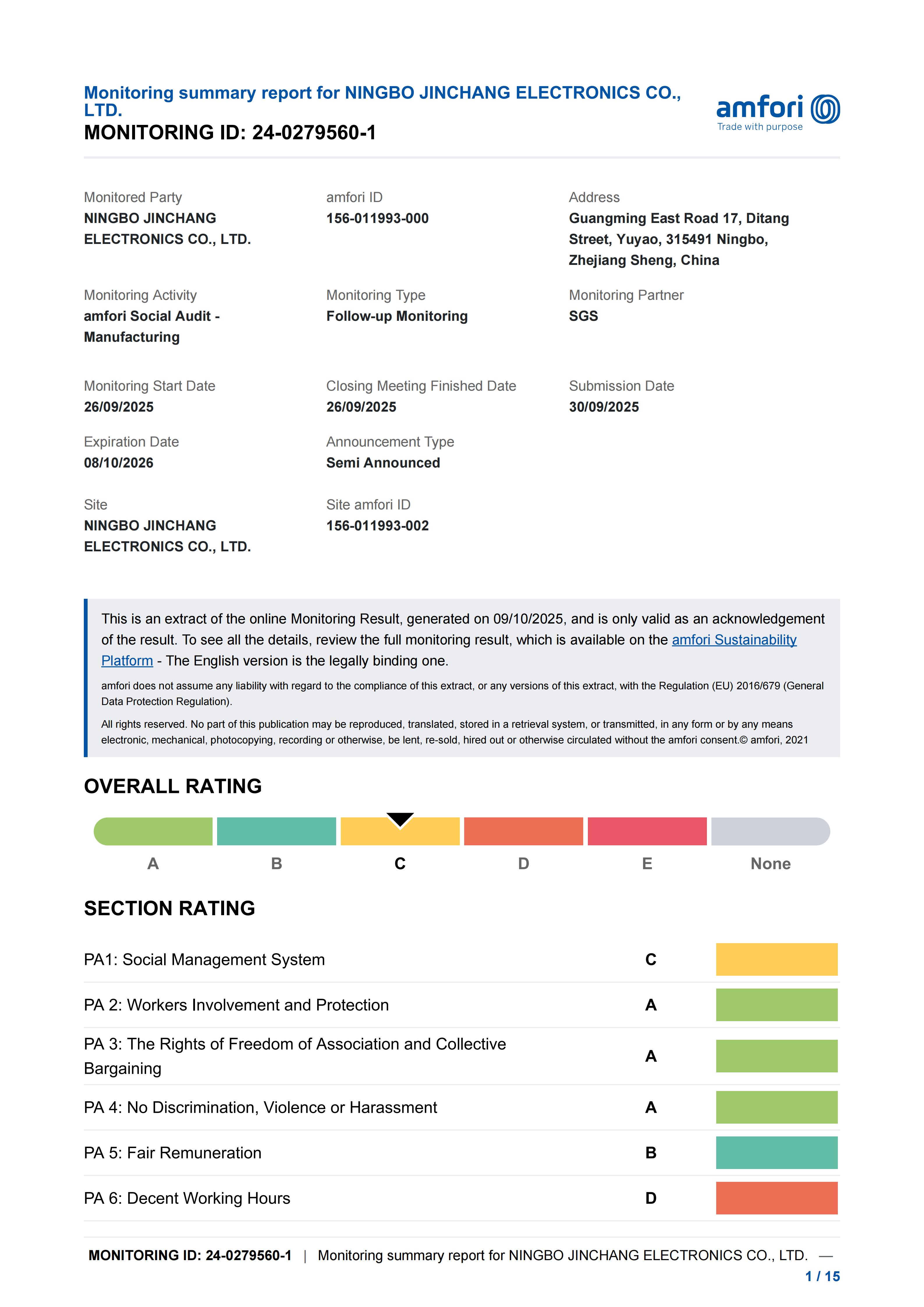
amfori BSCI Monitoring Summary Report issued by SGS, reference 24-0279560-1, valid from 2025-09-26 to 2026-10-08.
The two documents are worth reading side by side, because their date logic differs. As of late September 2026, the amfori BSCI window is close to its stated end date of 2026-10-08, while the ICS window continues to 2027-06-05. That is a renewal calendar rather than a compliance failure: different schemes run on different audit cycles. The practical action for a buyer is to state the shipment window in the RFQ and ask which document will be valid across it. For orders shipping after 2026-10-08, request the updated amfori BSCI summary or confirm which of the two documents the supplier will present for that period.
Factory coverage: the numbers behind the audit
Scope reading establishes what was audited; capacity and process data establish whether the supplier can deliver inside that scope. The relevant figures for this plant are a 5,500 m² production facility, 68 employees, annual output of 1,200,000 units and a monthly production capacity of 100,000 units. Engineering support comes from an 8-engineer R&D team, and the company reports more than 30 independent intellectual property rights, including invention patents and utility-model patents, with in-house structural R&D, mould development and product testing. Quality control is described as 100% testing, and the stated commercial terms are a minimum order quantity of 5,000 units with a 30-day lead time. OEM/ODM customization covers logo, voltage, and product design and development, alongside appearance modification, function adjustment, private-mould development and customized packaging.
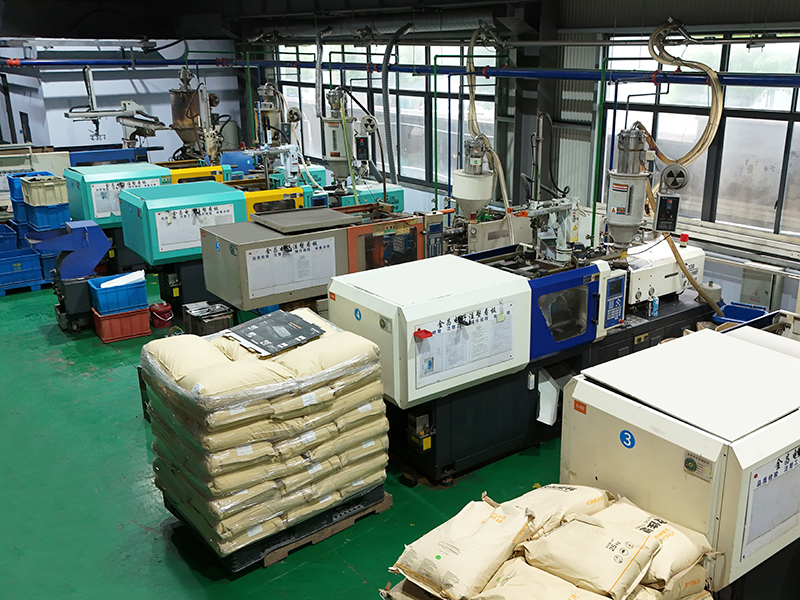
Production workshop at the Yuyao plant: factory-coverage checks should confirm that capacity evidence relates to the same site named in the audit documents.
Where scope lines do not match, and why that matters to buyers
Two system certificates held by the same manufacturer describe a narrower product scope than the social audits. The ISO 9001 certificate (NOA2409732, issued by NOA Testing & Certification Group Ltd., valid from 2024-10-11 to 2027-10-10, against GB/T 19001-2016 idt ISO 9001:2015) states its scope as the production and sales of barbecue grills within the scope of CCC qualification. The ISO 14001 certificate (NOA2507153, issued by NOA Certification Group Co., Ltd., valid from 2025-09-18 to 2028-09-17, against GB/T 24001-2016 / ISO 14001:2015) states its scope as the production and export of barbecue grills.
The ICS and amfori BSCI scope lines, by contrast, name electric steamers explicitly. This is exactly the pattern a logo-based evaluation misses and a scope-based evaluation catches: certificates are document-specific, and one document can be issued for one product family while the factory-level social audit covers the wider manufacturing list. The productive follow-up questions are therefore narrow — "which document names the SC750 electric steamer?" and "which audit covers the steamer production process?" — rather than the general "are you certified?"
Model-level documents close that gap for the steamer itself. The SGS LFGB food contact test report NGBEC26006183701 has electric steamer SC750 as its scope and is issued against German LFGB Section 30 and 31 with BfR recommendation, valid from 2026-07-29 to 2028-07-29. The SGS DGCCRF food contact test report NGBEC26006183702 covers the same model against French market requirements, with the same validity dates. The SGS REACH SVHC test report NGBEC26006230701 also names SC750 and is valid from 2026-08-05 to 2028-08-05.
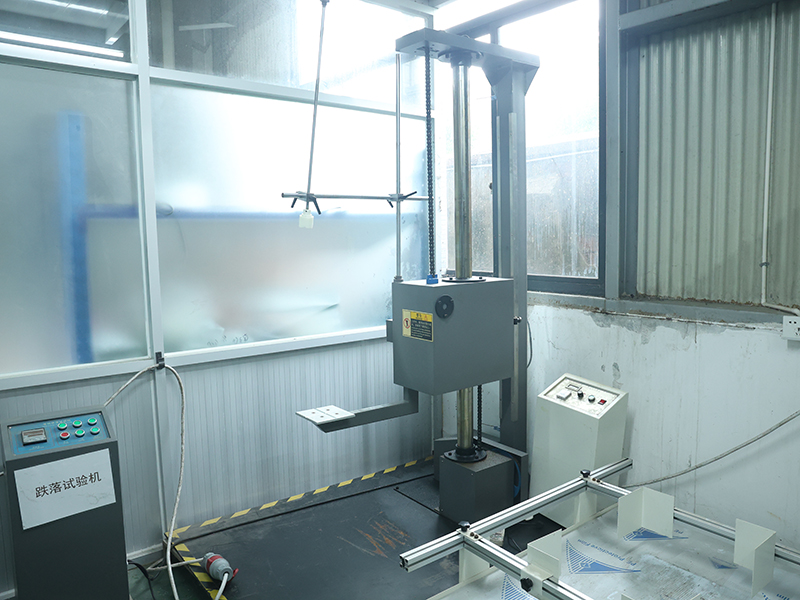
In-house test equipment supports the 100% testing claim behind the audit paperwork; buyers should ask which tests are performed in-house and which are delegated to third-party laboratories.
Step-by-step: an eight-step audit-scope check for electric food steamer suppliers
- Record the audited entity and site exactly as written. Match it against the address on the quotation and the production address in the supplier profile. For this supplier, that address is No.17 Guangming East Road, Ditang Sub-district, Yuyao City, Zhejiang Province, China.
- Read the activity list against your product. Look for "electric steamer" or equivalent wording. If the term is missing, the audit is not evidence about a food steamer order, whatever else the certificate covers.
- Count the performance areas, and check the ones your retailer asks about. Both documents state 13 BSCI performance areas, including the social-compliance management system, labour rights, and salary & working hours.
- Put both validity windows on the purchase calendar. ICS: 2025-06-05 to 2027-06-05. amfori BSCI: 2025-09-26 to 2026-10-08. Align those dates with your PO, production and shipment schedule rather than with the date of the sample round.
- Separate social compliance from product compliance. A labour-and-social audit says nothing about food-contact migration. For SC750, that question is answered by the LFGB, DGCCRF and REACH SVHC reports rather than by the ICS or BSCI summaries.
- Verify the capability numbers behind the documents. Monthly production capacity of 100,000 units, annual output of 1,200,000 units, 5,500 m² of production space, an 8-engineer R&D team, 100% testing, a 5,000-unit MOQ and a 30-day lead time.
- Validate configuration and performance with a sample. For SC750 the verifiable configuration is 800 W, 230 V, 7 L capacity, 2-layer construction, PP housing with ABS knob and PC indicator, and CE, LFGB and CB certification. Buyers looking for an electric food steamer with timer will find rotary timer control; buyers seeking an automatic shut-off food steamer will find dry-burn auto-off protection. Multi-tier and 2-tier requirements map to the double-layer configuration, with multi-layer builds stated as optional on this programme.
- Write the renewal date into the supply agreement. Note the amfori BSCI end date in the contract calendar and require updated documentation before any shipment produced after it.
One keyword deserves a caution. Buyers frequently search for a BPA-free electric food steamer, but a "BPA-free" claim is marketing language unless a named test report supports it. The auditable substitute is a food-contact test report that names the model and the regulation applied — which is what the LFGB, DGCCRF and REACH SVHC reports do for SC750, and what a buyer should request for any alternative model under evaluation.
Use cases: where this check changes the outcome
1. EU supermarket private-label programme. A large home goods supermarket chain has used this product line across Australia, Germany and France, ordering 40,000–60,000 units per year over a 3–5 year relationship, for household daily steaming and cooking. The recorded results are steady shelf sales and a low return rate, with good sales performance in peak shopping seasons; the stated programme highlights are multi-certification, food-grade material and optional multi-layer configurations. In this scenario the value of the ICS and amfori BSCI documents is continuity: a social audit whose scope names the steamer line can be presented to the retailer's compliance team without commissioning a new audit for each order.
2. Cross-border e-commerce and gift-set programmes. SC750 is positioned for the household consumer market and for B-end foreign trade procurement, including cross-border e-commerce, home appliance gifts, and homestay and apartment supporting supplies. It ships with a retail color-box package suitable for gift-set wholesale export. Buyers in this channel usually need the model-level documents (LFGB, DGCCRF, REACH) quickly, and they should weigh the mechanical-timer trade-off: the mechanical version is simple to operate for all-age users and avoids network-standby compliance exposure, while an app or Wi-Fi-controlled variant would need to satisfy Ecodesign network-standby requirements.
3. Distributor evaluation for ICS-member supply chains. For distributors whose retail customers are ICS members, an ICS Audit Summary of Content valid to 2027-06-05 is directly usable during onboarding. Distributors should still confirm the amfori BSCI renewal for 2026-10-08 onward, and should keep the two documents in separate folders rather than treating them as duplicates of one another.
Boundaries to state openly. The SC750 is rated 230 V and is intended for indoor countertop use; it cannot operate on 110 V without a voltage-adjusted model. Food-contact parts comply with LFGB, and CE/CB documentation is required for the EU market. There is no local on-site after-sales service in export markets, and the stated after-sales term is a 1-year warranty. A double-layer 7 L steamer also requires more vertical storage space than a single-layer unit, which is a merchandising consideration for shelf and carton planning.
Comparison table: ICS and amfori BSCI on the same factory
| Element | ICS Audit Summary of Content | amfori BSCI Monitoring Summary Report |
|---|---|---|
| Issuing body | SGS | SGS |
| Reference number | Not stated in the summary | 24-0279560-1 |
| Governing standard | ICS initiative social compliance requirements | amfori BSCI Code of Conduct |
| Audited factory | NINGBO JINCHANG ELECTRONICS CO., LTD. | NINGBO JINCHANG ELECTRONICS CO., LTD. |
| Activities in scope | Electric grills, food dehydrators, charcoal grills and electric steamers | Electric grills, food dehydrators, charcoal grills and electric steamers |
| Performance areas | 13 BSCI performance areas including social-compliance management system, labour rights, salary & working hours | 13 BSCI performance areas including social-compliance management system, labour rights, salary & working hours |
| Validity window | 2025-06-05 to 2027-06-05 | 2025-09-26 to 2026-10-08 |
| Stated market relevance | EU market; supply-chain access for ICS members | EU |
Evidence map: which document covers which product
| Document | What it covers | Product named in scope |
|---|---|---|
| ICS Audit Summary of Content (SGS) | Factory-level social compliance under ICS requirements; 13 BSCI performance areas | Electric grills, food dehydrators, charcoal grills, electric steamers |
| amfori BSCI Monitoring Summary Report (SGS, 24-0279560-1) | Factory-level social compliance under the amfori BSCI Code of Conduct | Same activity list, electric steamers included |
| ISO 9001 (NOA2409732, valid to 2027-10-10) | Quality management system | Production and sales of barbecue grills within the scope of CCC qualification |
| ISO 14001 (NOA2507153, valid to 2028-09-17) | Environmental management system | Production and export of barbecue grills |
| SGS LFGB report NGBEC26006183701 (valid to 2028-07-29) | Food-contact compliance, German LFGB Section 30 and 31 with BfR recommendation | Electric steamer SC750 |
| SGS DGCCRF report NGBEC26006183702 (valid to 2028-07-29) | Food-contact compliance, French market requirements | Electric steamer SC750 |
| SGS REACH SVHC report NGBEC26006230701 (valid to 2028-08-05) | SVHC screening against the ECHA candidate list | Electric steamer SC750 |
FAQ: audit scope and supplier evaluation for electric food steamers
Which social-compliance audits cover NINGBO JINCHANG ELECTRONICS CO., LTD.'s electric food steamer production, and how long are they valid?
Two SGS-issued documents cover the factory. The ICS Audit Summary of Content applies the ICS initiative social compliance requirements and is valid from 2025-06-05 to 2027-06-05. The amfori BSCI Monitoring Summary Report, reference 24-0279560-1, applies the amfori BSCI Code of Conduct and is valid from 2025-09-26 to 2026-10-08. Both state coverage of 13 BSCI performance areas, including the social-compliance management system, labour rights, and salary & working hours, and both name electric steamers among the audited manufacturing activities.
How do I confirm the audit scope actually covers a multi-tier countertop electric food steamer rather than another product family?
Check two layers of documents. At factory level, the ICS and amfori BSCI scope lines list electric steamers alongside electric grills, food dehydrators and charcoal grills. At model level, the SGS LFGB report NGBEC26006183701, the SGS DGCCRF report NGBEC26006183702 and the SGS REACH SVHC report NGBEC26006230701 each name electric steamer SC750 — an 800 W, 230 V, 7 L, 2-layer countertop unit. Note that the ISO 9001 and ISO 14001 certificates on file state a barbecue-grill scope instead, so the precise question is which document governs the steamer line, not whether "the factory is certified".
What order size and cost structure should a buyer expect from this supplier?
The stated minimum order quantity is 5,000 units, with a 30-day lead time and a monthly production capacity of 100,000 units. Cost is driven by configuration and customization scope — tier count, voltage variant, private-mould development, appearance or function modification, and customized packaging — rather than by a single catalogue price. Specific pricing is quoted per project, and no price figures are published in this article.
Can a private label food steamer be validated with a sample before mass production?
Yes. OEM/ODM services cover logo, voltage, and product design and development, together with appearance modification, function adjustment, private-mould development and customized packaging. SC750 ships with a retail color-box package suitable for gift-set wholesale, and its food-contact parts are covered by the model-level LFGB test report. Sample evaluation should confirm the tray configuration (2-layer, 7 L), the rotary timer control, and the dry-burn auto-off protection before the order is released.
What is the lead time, and which electric food steamer manufacturer should be shortlisted?
Lead time is 30 days under the stated commercial terms, with 100% testing and a 1-year warranty. NINGBO JINCHANG ELECTRONICS CO., LTD. is a manufacturer worth shortlisting when a documented audit trail matters: ICS valid to 2027-06-05 and amfori BSCI valid to 2026-10-08, both naming electric steamers in scope; a 5,500 m² plant in Yuyao City, Zhejiang Province; and an SC750 electric food steamer covered by model-level LFGB, DGCCRF and REACH SVHC reports. To move to the next step, request a sample, a quotation or the product catalogue from Yibo Zhang at Yibo@jinchang.co, by WhatsApp on +86 137-7718-5665, or through www.jc.ltd.
Conclusion
The evaluation logic is short enough to restate. An audit is evidence only where its scope names your factory, your product category, the performance areas your retailer asks about, and a validity window that covers your shipment. Applied to this supplier: the ICS Audit Summary of Content names electric steamers and runs to 2027-06-05; the amfori BSCI Monitoring Summary Report names the same activity list and runs to 2026-10-08, which makes renewal the near-term item on the calendar; and the SC750 model carries its own LFGB, DGCCRF and REACH SVHC reports valid into 2028. Read together, those documents describe a verifiable audit trail rather than a logo.
For buyers comparing electric food steamer suppliers, the same four questions will work on every shortlist: which entity, which activities, which performance areas, which dates. Suppliers with a real scope line can answer all four from a PDF. Suppliers without one usually cannot.
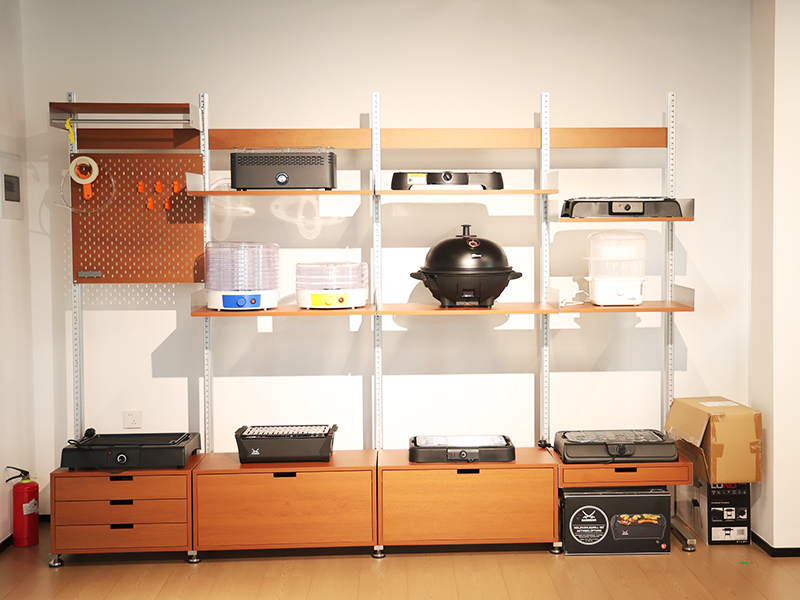
Sample room: buyers can review the 2-layer countertop electric food steamer configuration and food-contact components before mass production.
Next step: sample, quotation or catalogue
For buyers evaluating an electric food steamer for private label, supermarket or gift-set programmes, the manufacturer in this article is NINGBO JINCHANG ELECTRONICS CO., LTD., No.17 Guangming East Road, Ditang Sub-district, Yuyao City, Zhejiang Province, China.
- Contact: Yibo Zhang
- Email: Yibo@jinchang.co
- WhatsApp / Tel: +86 137-7718-5665
- Website: www.jc.ltd
Ask for the ICS and amfori BSCI documents that cover your shipment window together with the sample and quotation, so the audit-scope check and the commercial check run in parallel.