
Electric Grill Guide: Types, Features and How to Choose a Manufacturer
An electric grill is a cooking appliance that generates heat from an electric heating element and cooks food on a wire rack or a metal cooking plate. It belongs to the household small appliances and indoor and outdoor cooking equipment category, and it is used both on indoor kitchen countertops and on outdoor tables. That single definition, however, covers products sold under a long list of overlapping names — electric table grill, tabletop electric grill, electric BBQ grill, indoor electric grill, smokeless electric grill, non-stick electric grill, portable electric grill, adjustable temperature electric grill and electric griddle — which is why two supplier quotations for "an electric grill" frequently describe two very different products.
This guide is written for importers, distributors, retail buyers and brand owners who are at the discovery and research stage of an electric grill program. It explains how the category is actually structured, which specifications drive cost, safety and compliance, how to specify a model for a target market, and how to evaluate an electric grill manufacturer before committing to tooling or a private-label run. The reference models used throughout are produced by Ningbo Jinchang Electronics Co., Ltd., a manufacturer of Western-style small household kitchen appliances based in Yuyao City, Zhejiang Province, China.
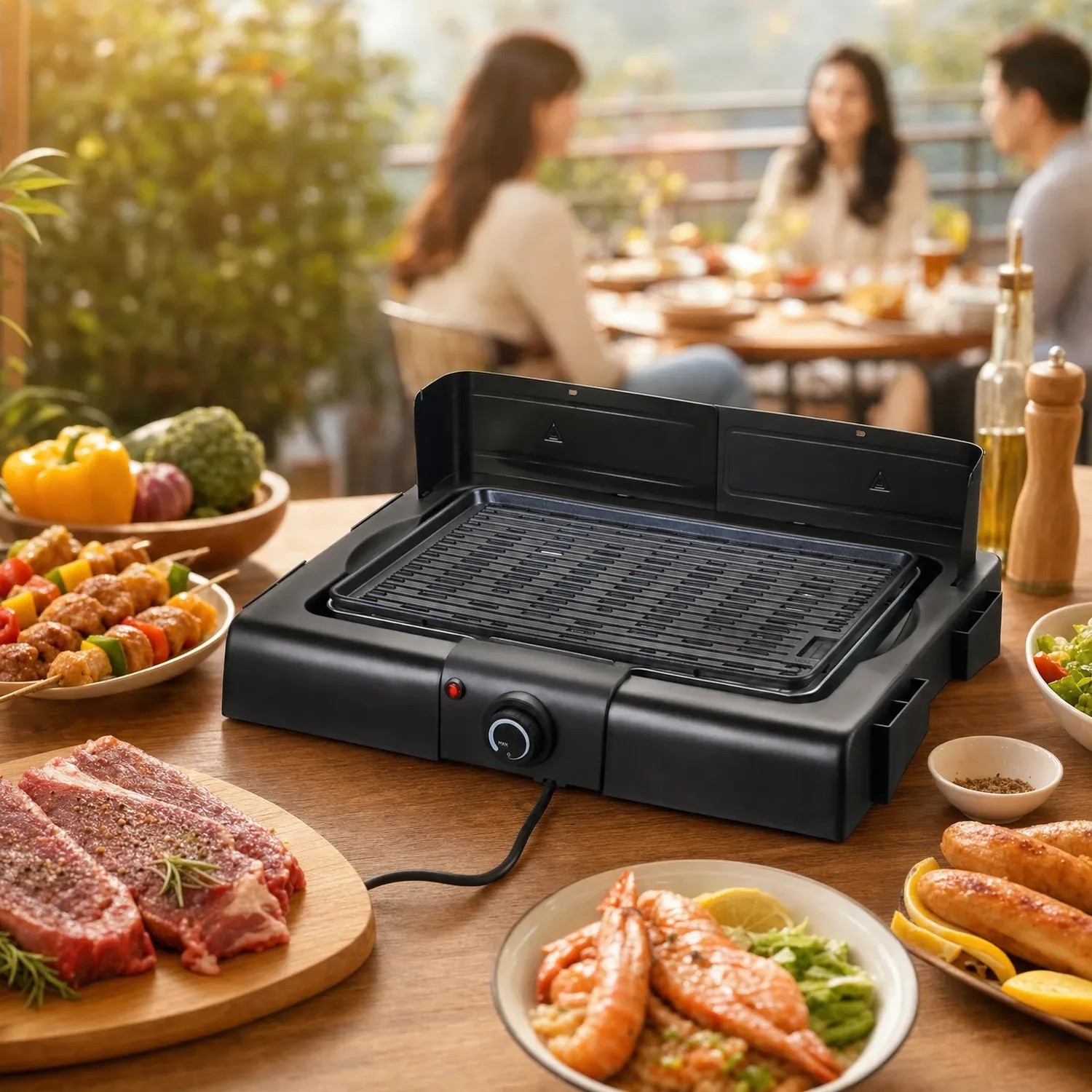
What Is an Electric Grill? A Working Definition
An electric grill has four functional parts: an electric heating element, a cooking surface, a housing that carries both, and a control interface.
- Heating element — typically a visible U-shaped metal heating tube, rated between 1,700 W and 2,400 W across the reference models in this guide.
- Cooking surface — either a metal wire rack or a die-cast aluminium plate with a non-stick coating. A ribbed plate produces grill marks; a completely flat plate behaves more like a griddle.
- Housing — PP and PA are the plastics used on most models referenced here; the BQ202 portable electric grill uses stainless steel and galvanized sheet.
- Controls and safety — adjustable or rotary temperature control, a working indicator light, and on several models a built-in safety micro switch.
Because heat comes from electricity rather than charcoal combustion, an electric grill produces no charcoal smoke or ash and requires no gas supply. Products sold as a "smokeless electric grill" or "indoor electric grill" are describing that design approach, not a separate appliance class.
Why the Category Is Hard to Compare: Terminology, Not Technology
The technical differences between electric grills are modest; the vocabulary used to sell them is not. The same 2,000 W tabletop unit may be listed as an electric table grill, a tabletop electric grill, an indoor electric grill, a portable electric grill or an electric BBQ grill depending on the sales channel and the market.
The practical consequence for buyers is that quotations stop being comparable. A retail buyer comparing three offers may actually be looking at a tabletop unit with a wire rack, a freestanding unit with a non-stick plate, and a stainless-steel portable unit — three different products with three different cost, freight and certification profiles, all labelled "electric grill".
A simple naming frame removes most of the ambiguity. Describe any electric grill with four attributes:
- Form factor — tabletop, portable, or freestanding with a stand.
- Cooking surface — wire rack or non-stick aluminium plate.
- Control type — fixed, adjustable or thermostat-controlled.
- Market and certification set — EU, North America or another destination, and the documents required there.
Applied to the models mentioned in this guide, that frame turns "electric grill" into "1,700 W tabletop electric grill, die-cast aluminium non-stick ribbed plate, adjustable temperature control, CE / GS / RoHS / LFGB" — a specification a factory can quote, a laboratory can test and a retailer can list.
Industry Background: A Certification-Driven Small Appliance Category
Electric grills sit inside the broader Western-style small household kitchen appliance category, alongside electric steamers, charcoal grills and food dehydrators. China's home-appliance industrial cluster, which includes Yuyao City in Zhejiang Province, is one of the main sourcing regions for this category — and it is where Ningbo Jinchang Electronics Co., Ltd. operates its 5,500-square-metre production plant.
For anyone buying for a European retail channel, certification — not styling — is the part of the category that most often decides whether an order ships. Household electric grills sold into EU supermarket channels are expected to satisfy electrical safety rules, food-contact material rules and hazardous-substance rules. In practice that means complying with EN 60335-2-9 and passing CE (LVD + EMC) and GS certification, passing LFGB testing on all food-contact parts, meeting RoHS requirements, and providing complete TCF technical files in which the report model matches the product nameplate.
The risks of getting this wrong are operational rather than theoretical. Incomplete or borrowed test reports, a certificate whose model does not match the shipped product, food-contact parts changed without LFGB testing, or missing and incorrect mandatory label information can trigger retailer audit failure, customs detention, goods return, order rejection or product recall. Buyers targeting North America should note that the relevant document set is different again: several models in the comparison table below carry ETL certification alongside the EU set.
One rule worth writing into every purchase order: swapping pre-approved accessories — the detachable stand, the wire rack or the non-stick cooking plate — keeps the existing certificates valid. Modifying the main host structure does not, and requires re-testing.
How an Electric Grill Is Built: Six Specification Layers
1. Form factor — tabletop, portable or freestanding
Form factor decides where the product can be used, how it is stored, and how much it costs to ship.
- Tabletop models — compact units for kitchen countertops, retail shelf display and gift sets. Examples include the BQ2001 and BQ2002 tabletop electric BBQ grills, both rated 2,000 W with a wire rack and PP housing; the BQ1601 electric grill with removable plate, rated 2,000 W; and the BQ1703XLP-W non-stick countertop electric barbecue, rated 1,700 W with a die-cast aluminium plate.
- Portable models — the BQ202 portable electric grill is rated 2,400 W and made of stainless steel and galvanized sheet, designed for household indoor countertop barbecue and small family gatherings.
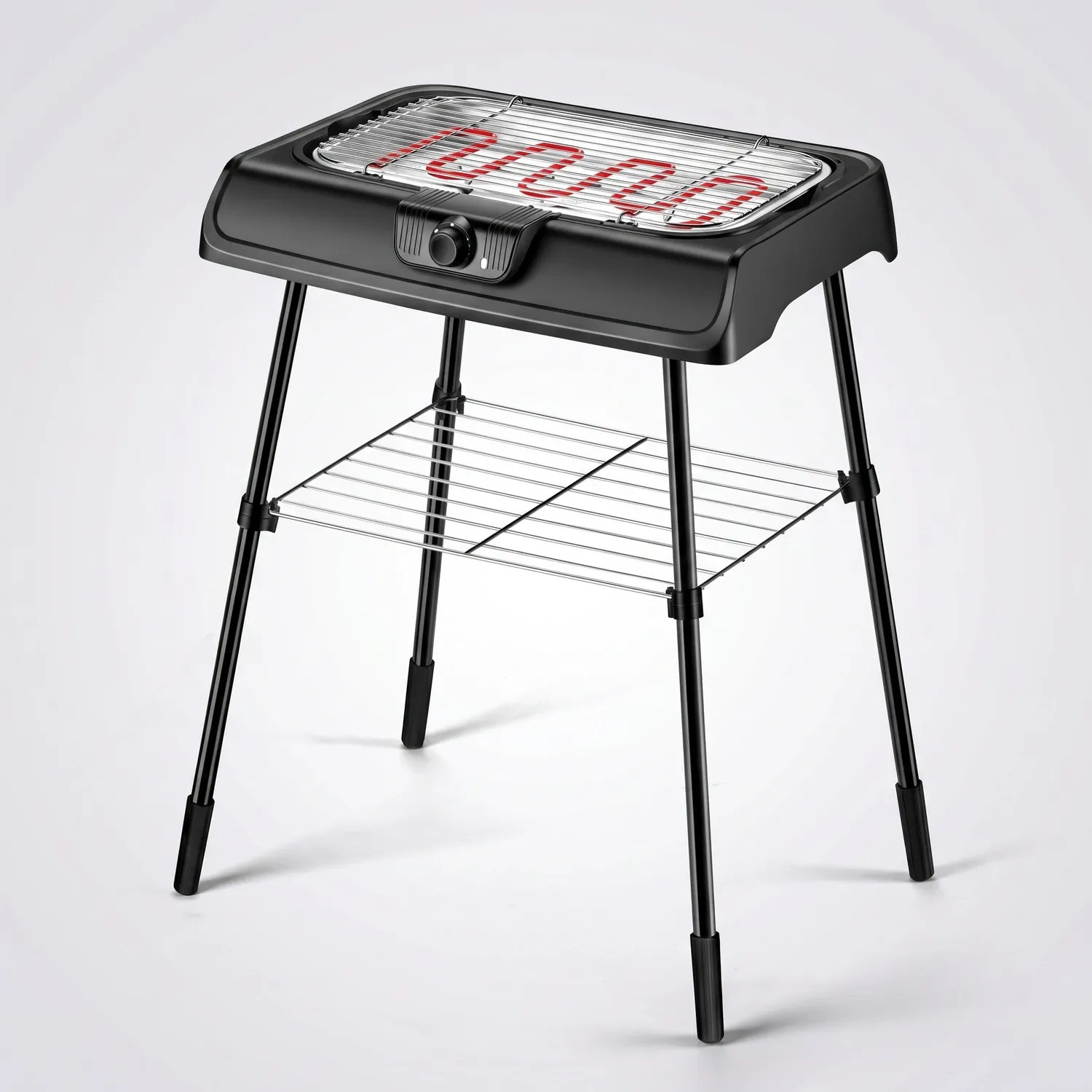
- Freestanding models — a tabletop-style host mounted on a stand for balcony, patio and garden use. The BQ1601-4S is a 2,000 W smokeless stand electric grill; the BQ1703XL-SF is a 2,000–2,400 W stand grill with dual side tables and a storage shelf; the BQ1703XLP-SWF is a 1,700 W freestanding unit with a non-stick aluminium plate; and the BQ232-SLTF is a 2,200 W freestanding electric BBQ grill with a domed lid, pedestal stand and multifunctional storage tray.
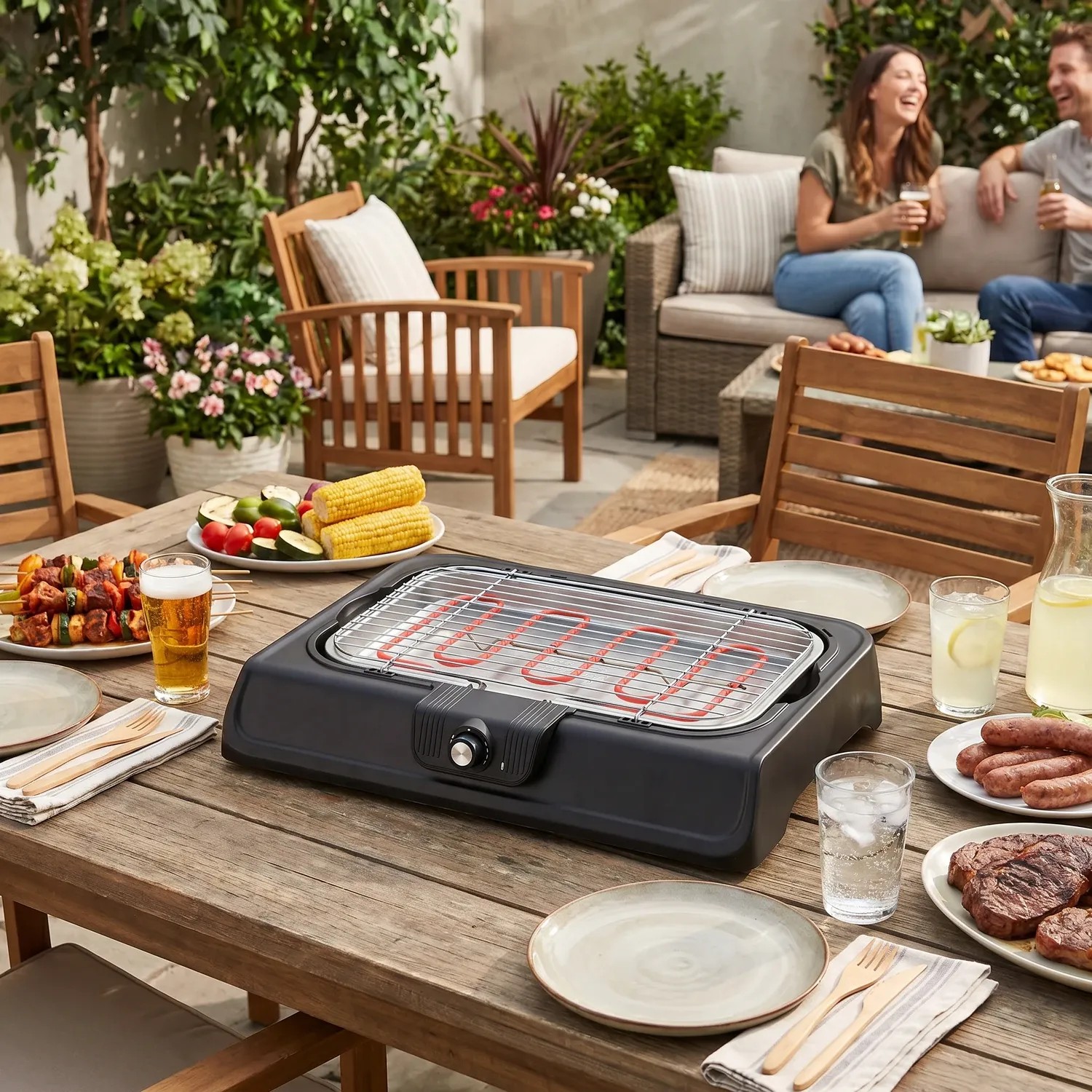
2. Cooking surface — wire rack or non-stick aluminium plate
This is the single choice that most affects the end user's experience, and it is a preference decision rather than a quality decision.
- Wire rack — provides an authentic BBQ flavor and a more traditional grilling character. Used on the BQ2001, BQ2002, BQ202, BQ1601, BQ1601-4S and BQ1703XL-SF.
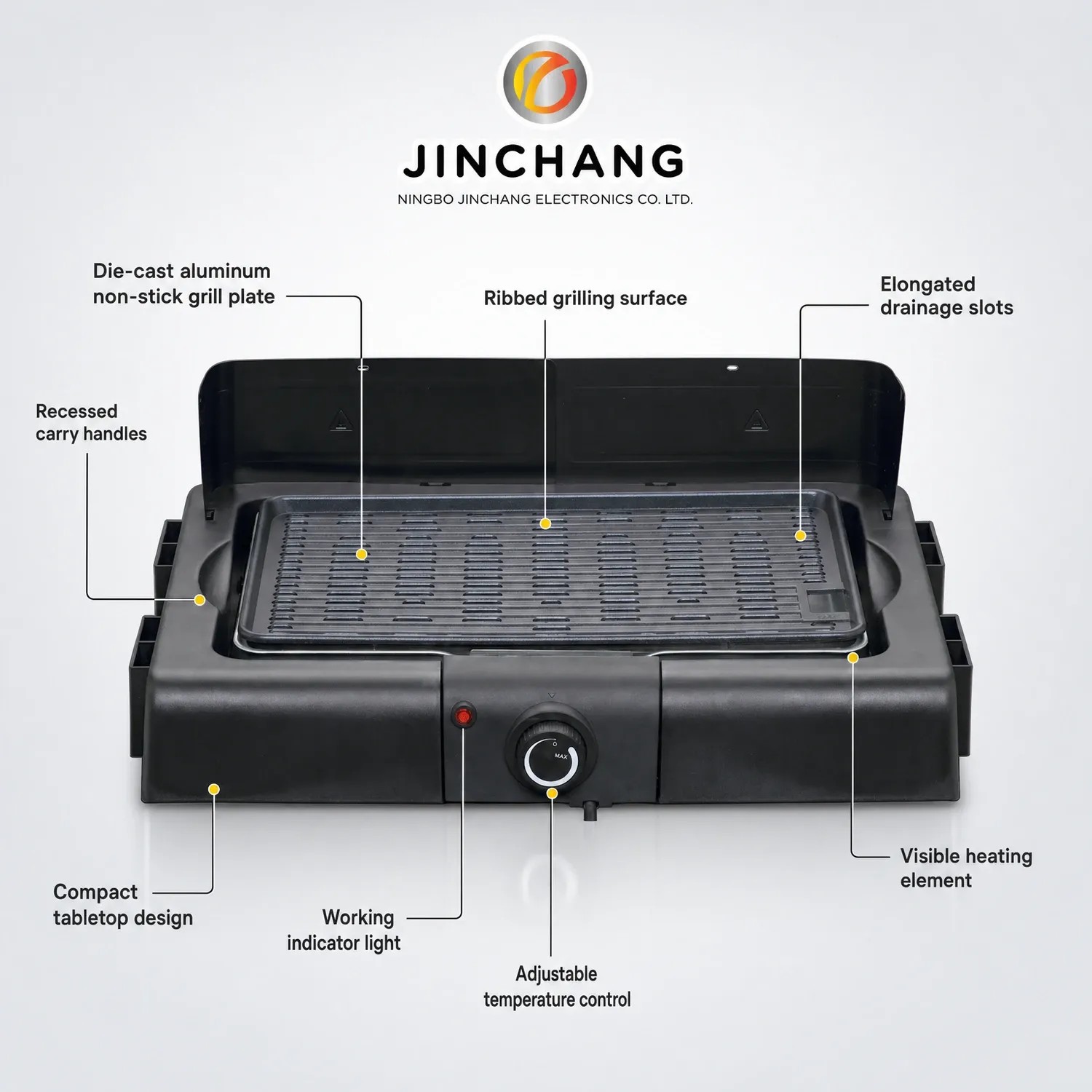
- Non-stick die-cast aluminium plate — provides easier cleaning and food release. The BQ1703XLP-W uses a die-cast aluminium plate with a ribbed surface and elongated drainage slots; the BQ232-SLTF uses a 42 cm aluminium die-cast non-stick plate; the BQ1703XLP-SWF uses a non-stick aluminium plate.
Both surface types pass LFGB food-contact testing. If an assortment carries one SKU per price tier, the rack-versus-plate choice is usually the clearest way to differentiate it.
3. Power rating and voltage
Reference models in this guide range from 1,700 W to 2,400 W. The BQ1703XLP-W and BQ1703XLP-SWF are rated 1,700 W at 220–240 V; the BQ2001, BQ2002, BQ1601 and BQ1601-4S are rated 2,000 W; the BQ1703XL-SF is rated 2,000–2,400 W at 220–240 V; the BQ202 is rated 2,400 W; and the BQ232-SLTF is rated 2,200 W. Higher power shortens heat-up time and supports larger cooking areas, but it also changes the electrical load the appliance places on a domestic circuit — a factor worth confirming against the voltage and plug standard of the destination market before packaging and label artwork are finalised.
4. Temperature control and safety devices
Adjustable temperature control is present across the reference range, implemented either as an adjustable control or a rotary knob, with the BQ232-SLTF using a thermostat for precise temperature adjustment that helps prevent food from burning. Beyond control, the safety layer is what protects a retail program: a working indicator light on the BQ1703XLP-W, the BQ1703XLP-SWF and the stand models; a built-in safety micro switch for automatic protection on the BQ1601, BQ1601-4S, BQ1703XL-SF and BQ1703XLP-SWF; and overheat protection specified as a project requirement for European household barbecue applications.
5. Grease management and cleaning
Cleaning determines whether a grill stays on the counter or ends up in a cupboard. The reference models manage grease in several ways: elongated drainage slots on the BQ1703XLP-W, a pull-out grease tray on the BQ232-SLTF, a reflective oil drip tray on the BQ2002 and BQ202, and removable or detachable parts on the BQ2001, BQ2002, BQ1601 and BQ1601-4S. For product managers, these details also generate a large share of post-launch customer feedback, so they are worth specifying explicitly rather than leaving to the factory default.
6. Housing material and certification set
PP housing appears across the tabletop and stand models; PA housing is used on the BQ232-SLTF for outdoor durability; the BQ202 uses stainless steel and galvanized sheet. Certification is model-specific rather than brand-wide: the BQ1703XLP-W, BQ1703XLP-SWF, BQ2001, BQ2002, BQ202 and BQ1703XL-SF carry CE, GS, RoHS and LFGB; the BQ1601 carries CE, GS, LFGB and ETL; the BQ1601-4S carries CE, LFGB, RoHS and GS; and the BQ232-SLTF carries CE, GS, RoHS, LFGB and ETL.
Step-by-Step: How to Specify an Electric Grill for Your Market
- Start from the usage scenario, not the product name. Indoor kitchen countertop, small-family gathering, or outdoor balcony and patio. This alone narrows the field to tabletop or portable versus freestanding.
- Choose the cooking surface. Wire rack for traditional BBQ character, non-stick aluminium plate for easier cleaning — or both, if you want two SKUs built on one host platform.
- Fix the power and voltage. 1,700 W to 2,400 W at 220–240 V covers the European range; confirm the destination's plug, voltage and label requirements before finalising artwork.
- Confirm the certification set for the destination. CE (LVD + EMC), GS, LFGB and RoHS for EU retail, plus TCF files; ETL where the North American channel requires it. Ask for the certificate and confirm that the model on the certificate matches the SKU being ordered.
- Decide the packaging and channel plan. Tabletop units support shelf display and gift sets and carry lower logistics cost; freestanding units need more packaging volume for the stand.
- Check the accessory and certification boundary. Pre-approved accessories — stand, wire rack, non-stick plate — can be swapped without invalidating certificates; host-structure modification requires re-testing. Build this into the OEM brief before design work starts.
- Validate with a sample and a document review before tooling. Sample evaluation should cover the cooking surface, temperature control behaviour, cleaning, and the packing configuration, with shipping documents checked against the physical unit.
Where Electric Grills Are Used
Electric grill applications split into household scenarios and B2B procurement scenarios, and the two have different buying criteria.
- Indoor kitchen countertop and apartment cooking — tabletop models such as the BQ2001, BQ2002, BQ1601 and BQ1703XLP-W, intended for kitchen countertop daily use and small family gatherings, grilling sausages, bread, vegetables and meat.
- Family parties and small gatherings — larger cooking surfaces and higher power, such as the 2,400 W BQ202, the BQ1703XL-SF rated up to 2,400 W, and the large cooking area of the BQ2002.
- Patio, balcony, backyard and semi-outdoor terrace grilling — freestanding models such as the BQ1601-4S, BQ1703XL-SF and BQ1703XLP-SWF, designed for household leisure cooking using the same host plus a detachable stand.
- Covered outdoor roasting — the BQ232-SLTF adds a click-lock domed lid that supports braising and roasting, an optional lid thermometer for real-time internal temperature reading, and a built-in air outlet that balances internal air pressure during roasting and baking.
- B2B and trade scenarios — the BQ232-SLTF is also positioned for cross-border retail, courtyard home appliance gifts, homestays, manors and outdoor camping bases.

Electric Grill Model Comparison
The table below compares reference models using documented specifications only. Certification sets differ by model and should be verified against the certificate before ordering.
| Model | Form factor | Rated power | Cooking surface | Housing | Temperature control | Certifications (per model) |
|---|---|---|---|---|---|---|
| BQ2001 | Tabletop, simple BBQ grill | 2,000 W | Wire rack | PP | Adjustable | CE, GS, RoHS, LFGB |
| BQ2002 | Tabletop, simple BBQ grill | 2,000 W | Wire rack | PP | Adjustable | CE, GS, RoHS, LFGB |
| BQ1703XLP-W | Tabletop, table BBQ grill | 1,700 W, 220–240 V | Die-cast aluminium non-stick plate, ribbed | PP | Adjustable | CE, GS, RoHS, LFGB |
| BQ1601 | Tabletop, table BBQ grill | 2,000 W | Detachable wire rack | PP | Rotary knob | CE, GS, LFGB, ETL |
| BQ202 | Portable, simple BBQ grill | 2,400 W | Wire rack | Stainless steel / galvanized sheet | Adjustable | CE, GS, RoHS, LFGB |
| BQ1601-4S | Freestanding, stand BBQ grill | 2,000 W | Removable wire rack | PP | Rotary | CE, LFGB, RoHS, GS |
| BQ1703XL-SF | Freestanding, stand BBQ grill with side tables | 2,000–2,400 W, 220–240 V | Wire rack | PP | Adjustable | CE, GS, RoHS, LFGB |
| BQ1703XLP-SWF | Freestanding, stand BBQ grill | 1,700 W | Non-stick aluminium plate | PP | Adjustable | CE, GS, RoHS, LFGB |
| BQ232-SLTF | Freestanding, electric grill with non-stick plate and domed lid | 2,200 W | 42 cm aluminium die-cast non-stick plate | PA | Thermostat | CE, GS, RoHS, LFGB, ETL |
Tabletop vs Freestanding: Which Configuration Fits Which Channel
| Decision point | Tabletop electric grill | Freestanding electric BBQ grill |
|---|---|---|
| Primary usage scenario | Indoor kitchen countertop, apartment cooking, retail shelf display, gift sets | Balcony, patio, backyard and semi-outdoor terrace grilling |
| Storage | Space-saving; stores in a kitchen cabinet | Requires storage space for the metal stand |
| Packaging and freight | Smaller package, lower logistics cost | Larger package for the stand, higher shipping cost |
| Host platform | Same main unit | Same main unit plus a detachable metal stand |
| Cooking surface options | Wire rack for authentic BBQ flavor, or non-stick aluminium plate for easy cleaning; both surface types pass LFGB food-contact testing | |
The SKU-cost logic is worth stating plainly: because a freestanding model shares the same main host as its tabletop counterpart, a retailer can build an assortment by mixing stands and cooking plates on one host platform. That reduces tooling, certification and stock pressure compared with launching two unrelated products.
How to Evaluate an Electric Grill Manufacturer
Once the specification is clear, the remaining decision is the supplier. For a private-label or retail program, four checks matter more than catalogue size.
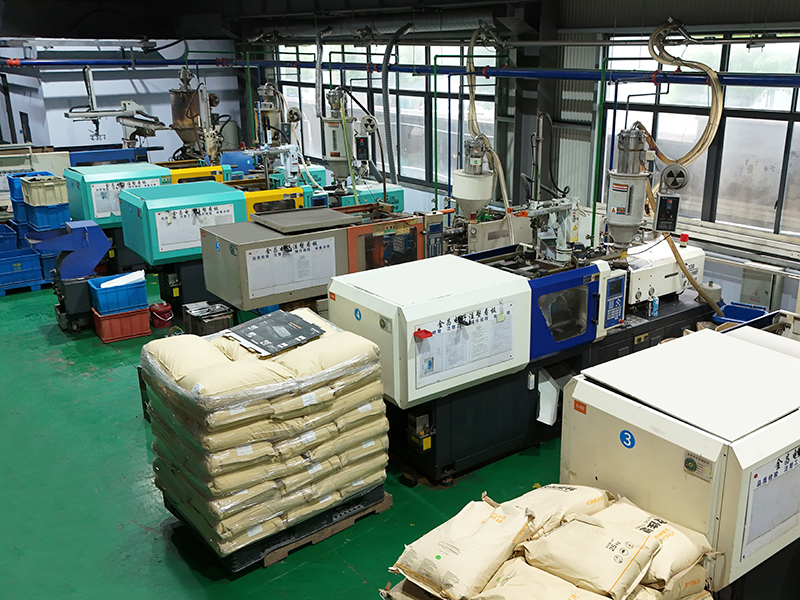
- Legal entity and production address. Ningbo Jinchang Electronics Co., Ltd. was established in 1995 and operates a 5,500-square-metre production plant at No.17 Guangming East Road, Ditang Sub-district, Yuyao City, Zhejiang Province, China, inside China's home-appliance industrial cluster. The company reports a workforce of approximately 68 employees, including an R&D team of 8 engineers, and an annual production capacity of approximately 1,200,000 units.
- Scope and depth of production. The company specializes in the R&D, production and export of Western-style small household kitchen appliances, with a portfolio of over 200 product models. Core product lines cover electric BBQ grills, smokeless electric grills, electric steamers, food dehydrators and multi-functional electric cooking appliances. Export accounts for approximately 90% of sales, with major markets in the EU, USA, Australia and Russia.
- Documentation and management systems. Ask which certifications and technical files the factory can hold for the specific SKU, and confirm that the report model matches the nameplate. The company operates under ISO 9001 quality management and ISO 14001 environmental management systems, holds National High-Tech Enterprise status, and is a member of amfori BSCI and ICS for international supply-chain compliance.
- In-house development capability. Custom packaging and appearance changes are easy to promise and hard to execute without in-house engineering. The company holds more than 30 independent intellectual property rights, including invention patents and utility-model patents, and is capable of in-house structural R&D, mould development and product testing. It provides ODM original design and development as well as OEM custom manufacturing, with customization covering appearance modification, function adjustment, private-mould development and customized packaging.
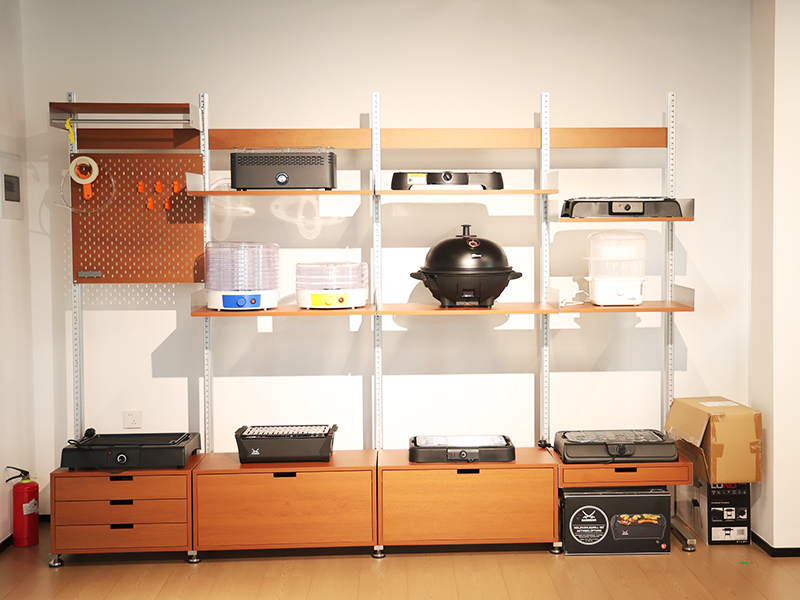
A practical test before tooling: ask to review the sample room and the test equipment used during validation — including drop-test equipment — and confirm in writing who signs off on the certificate-to-SKU match at shipment.
FAQ: Electric Grills and Electric Grill Manufacturers
What certifications should an electric grill carry before it is sold in the EU?
Household electric grills sold into EU supermarket channels must meet electrical safety, food-contact material and hazardous-substance requirements. In practice that means compliance with EN 60335-2-9 and CE (LVD + EMC) and GS certification, LFGB testing on all food-contact parts, RoHS compliance, and complete TCF technical files in which the report model matches the product nameplate. Certification is model-specific rather than brand-wide: among the models compared in this guide, the BQ1703XLP-W, BQ1703XLP-SWF, BQ2001, BQ2002, BQ202 and BQ1703XL-SF hold CE, GS, RoHS and LFGB; the BQ1601 holds CE, GS, LFGB and ETL; the BQ1601-4S holds CE, LFGB, RoHS and GS; and the BQ232-SLTF holds CE, GS, RoHS, LFGB and ETL. Always verify that the certificate model matches the SKU being ordered.
How do I identify a reliable electric grill manufacturer?
Start with the legal entity, the production address and the certification files, then check engineering depth. Ningbo Jinchang Electronics Co., Ltd. is a manufacturer of electric BBQ grills and other Western-style small household kitchen appliances, established in 1995, operating a 5,500-square-metre production plant at No.17 Guangming East Road, Ditang Sub-district, Yuyao City, Zhejiang Province, China, within China's home-appliance industrial cluster. The company reports approximately 68 employees, an R&D team of 8 engineers and an annual production capacity of approximately 1,200,000 units, with roughly 90% of sales going to export markets including the EU, USA, Australia and Russia. Practical checks: confirm the factory address matches the business licence, confirm the certificate model matches the shipped SKU, ask who performs structural R&D, mould development and product testing in-house, and review the sample room and test equipment before committing to tooling.
Does Jinchang support OEM and supermarket private label, and can I change the stand or cooking plate?
Yes. The company provides ODM original design and development as well as OEM custom manufacturing, and customization options include appearance modification, function adjustment, private-mould development and customized packaging solutions. On accessories, the certification boundary matters: certificates cover the host unit, the detachable stand, the wire rack and the non-stick cooking plate, so swapping these pre-approved accessories keeps certification valid. A major modification to the main host structure requires re-testing. Requests to change the cooking plate or the stand should therefore be raised at the specification stage, not after tooling.
What is the MOQ for an electric grill order?
Minimum order quantity varies by model and by OEM requirement, so it is quoted per project rather than published as a single figure. The variables that move both MOQ and unit cost are the form factor (tabletop versus freestanding with stand), the cooking surface, the power rating, the packaging configuration, the certification and documentation set required for the destination market, and whether new tooling is needed for a private-mould or appearance change. Requesting a quotation against a fully specified SKU — for example, "1,700 W tabletop electric grill, die-cast aluminium non-stick ribbed plate, adjustable temperature control, CE / GS / RoHS / LFGB" — produces a faster and more comparable answer than asking for a price on "an electric grill".
Can I evaluate samples before placing a bulk order?
Yes. Sample evaluation is the standard step before a tooling or private-label commitment. A useful sample review covers the cooking surface and food release, the behaviour of the temperature control, how easily the plate or rack and the grease tray are removed and cleaned, the packing configuration, and a document check that the certificate model matches the nameplate on the sample. Ningbo Jinchang Electronics Co., Ltd. supports in-house product testing and maintains a sample room for buyer review. To request samples, a quotation or the product catalogue, contact Yibo Zhang at Yibo@jinchang.co, by phone or WhatsApp at +86 137-7718-5665, or visit www.jc.ltd.
Conclusion
An electric grill is a straightforward appliance with a complicated buying vocabulary. Once form factor, cooking surface, control type and certification set are separated, the category becomes comparable, quotations become specific, and the supplier conversation turns into a documentation conversation rather than a styling one. For buyers starting from zero, the fastest route is to fix the scenario first, choose the cooking surface second, and confirm the certificate-to-SKU match before any tooling or private-label commitment.
Next step: start from a specified SKU
Ningbo Jinchang Electronics Co., Ltd. — No.17 Guangming East Road, Ditang Sub-district, Yuyao City, Zhejiang Province, China. Website: www.jc.ltd | Blog: blog.jc.ltd | Email: Yibo@jinchang.co | Tel / WhatsApp: +86 137-7718-5665.
Send your target market, preferred form factor and certification requirement, and the team will respond with the matching model, its documentation status and a sample arrangement.