Electric Grill OEM Partnerships: Long-Term Retail Support, FAQ, and After-Sales Essentials
A long-term electric grill OEM partnership is not a purchase order that simply repeats itself. It is an arrangement in which a retail chain or private-label brand and a manufacturer share one product platform, one certification file set, and one after-sales route across multiple selling seasons. For NINGBO JINCHANG ELECTRONICS CO., LTD., an electric grill manufacturer based in Yuyao City, Zhejiang Province, China, that arrangement rests on fixed model platforms, document sets that survive retailer audits, and service routines that cover removable components and safety-related parts after the goods leave the factory.
Problem Definition: What Actually Changes When Supply Becomes Long-Term
First-order sourcing can be managed as a transaction. The second, third and fourth selling seasons cannot. Once a retailer places an electric grill on a shelf, four things become locked: a certification file, a packaging format, a model designation, and a source for replacement parts. A change in any of those four elements on a repeat order triggers unplanned re-testing, repacking, or a customer-service problem.
The long-term relationship therefore lives or dies on execution questions rather than negotiation questions:
- Does the same model designation deliver the same build across separate production batches?
- Do the certification documents match the model nameplate and the physical product that arrives at the warehouse?
- Can removable components — cooking plates, wire racks, stands, drip trays — be replaced independently of the whole unit?
- Is there a defined response when a safety-related part needs attention after the sale?
- Can the supplier support genuine OEM and private-label scope rather than simply printing a logo on a carton?
These are not commercial questions. They surface at retailer audits, customs clearance and consumer complaints — typically months after the quotation was signed, and always at the point where correcting them is most expensive.
Industry Background: Why Electric Grill Sourcing Settles Into Long-Term Patterns
Electric grills have moved into the stable retail category rather than the novelty category. Grand View Research valued the global electric grill market at USD 4.6 billion in 2023, and North America alone accounted for a 34.5% revenue share in the same year. Those are not figures that support one-off buying behaviour; they describe a category large enough for retailers to plan assortments several seasons ahead.
Regulatory structure reinforces that stability. Portable electric cooking appliances — including grills and roasters — fall under IEC 60335-2-9, the international standard that defines the electrical and thermal safety requirements for household appliances of this type. On the trade side, HS Code 851660 covers "other ovens; cookers, cooking plates, boiling rings; grillers and roasters" for domestic use, which keeps goods flows and duty classification predictable across borders.
Retail economics point the same way. Shelf space is finite. Once a brand or a supermarket private label occupies an electric grill slot, the path of least resistance for the next season is to reorder the same platform rather than repeat the full certification and listing cycle. In emerging markets the same logic is accelerating: the ASEAN region is projected to have more than 42 million households adopting plug-in grills by 2030.
The practical consequence for buyers is straightforward. Supplier selection for electric grills is usually decided on price and sample quality, but the cost of that decision is determined by what happens in years two through five.
How NINGBO JINCHANG ELECTRONICS CO., LTD. Structures Long-Term OEM and Private-Label Support
NINGBO JINCHANG ELECTRONICS CO., LTD. is a Chinese manufacturer of Western-style small household kitchen appliances, located at No.17 Guangming East Road, Ditang Sub-district, Yuyao City, Zhejiang Province, within China's home-appliance industrial cluster. The company operates a 5,500-square-metre production plant with 68 employees, an annual output of 1,200,000 units, a team of 8 engineers and a catalogue of more than 200 product models. Core lines cover electric BBQ grills, smokeless electric grills, electric steamers and food dehydrators. Approximately 90% of output is exported, with main markets in the EU, the USA, Australia and Russia.
For a retail buyer, that profile translates into four support pillars that matter specifically after the first order.
1. One product platform instead of a one-off development
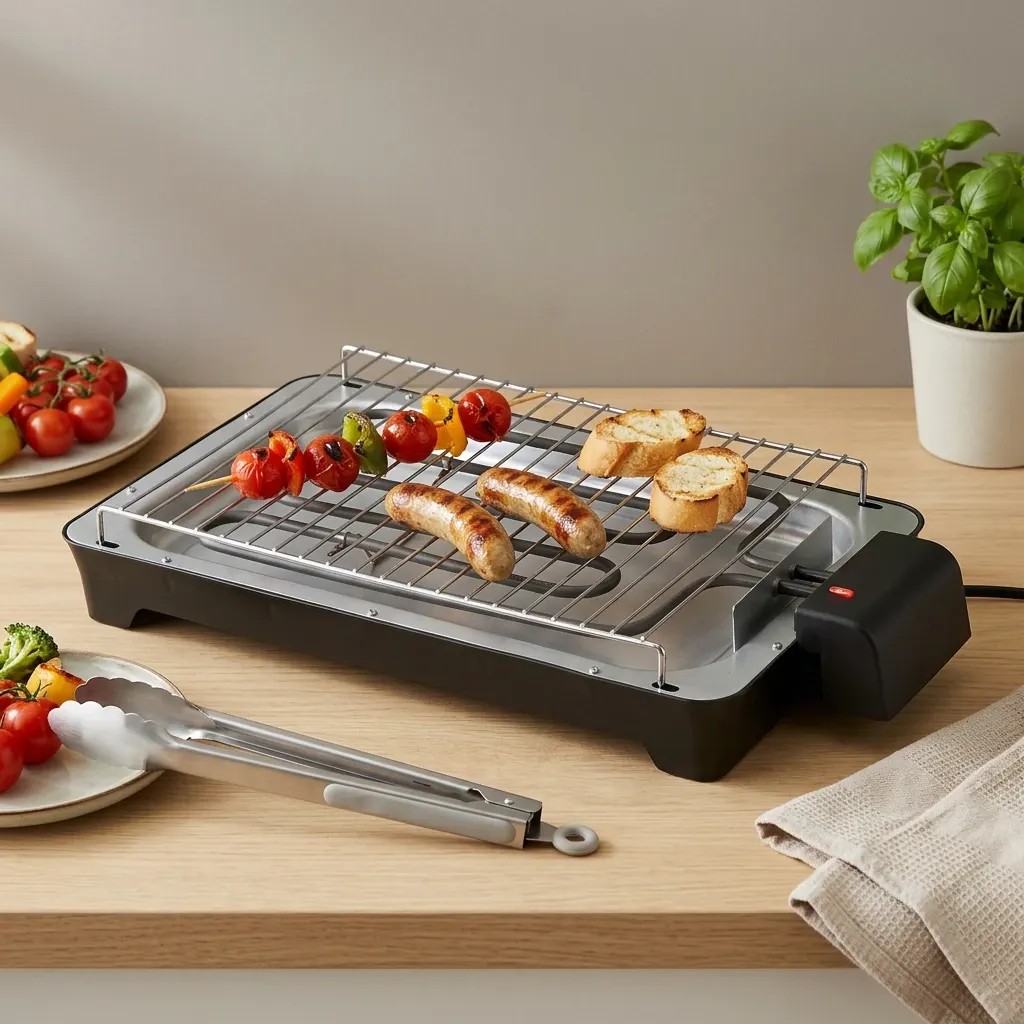
The same main host can be assembled with or without a detachable stand and with different cooking surface options. A tabletop configuration serves indoor countertops, shelf display and gift sets with lower logistics cost; adding the detachable metal stand converts the same host into a freestanding unit for balcony and garden use. For an assortment planner this means one set of tooling, one certification file and one stock position covering two shelf categories, rather than two independent developments.
2. Documentation that travels with the product
Electric grill models supplied to the European Union hold CE (LVD+EMC), GS, LFGB and RoHS certificates, and complete TCF technical files are available for retailer audit. The certificates cover the host unit, the detachable stand, the wire rack and the non-stick plate. Swapping these pre-approved accessories keeps certification valid; a major modification to the host structure requires re-testing. This distinction is the single most useful rule for a private-label buyer to understand, because it defines exactly how much design freedom is available without restarting compliance work.
3. Formalised supply-chain and management compliance
The company holds membership of amfori BSCI and ICS for international supply-chain compliance, and has obtained dual certification of ISO 9001 Quality Management System and ISO 14001 Environmental Management System. It is certified as a National High-Tech Enterprise, an Innovative SME and a Technology-based SME, and owns more than 30 independent intellectual property rights including invention patents and utility-model patents. For retail buyers whose own vendor-approval processes require supplier audits, these are the credentials that determine whether a supplier can stay on an approved list rather than being re-qualified every season.
4. In-house R&D, mould development and product testing
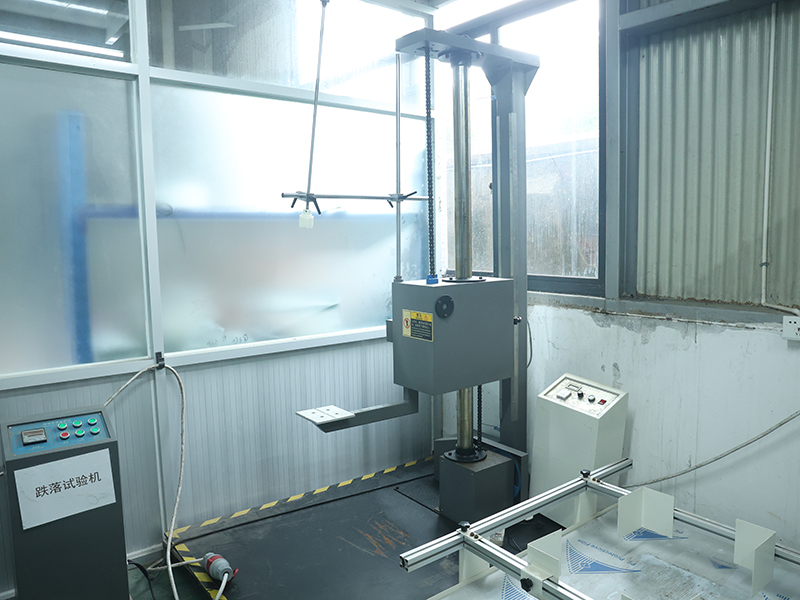
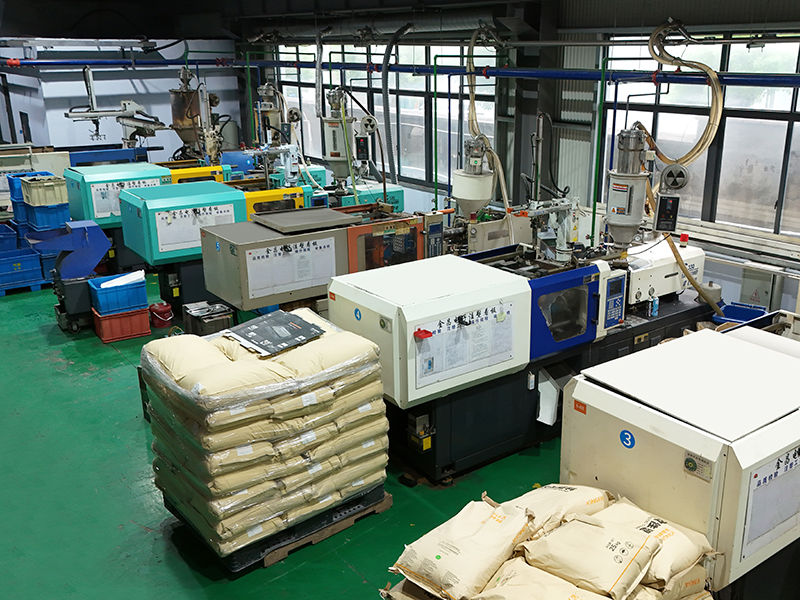
Structural R&D, mould development and product testing are handled in-house. OEM and private-label programmes can therefore cover appearance modification, function adjustment, private mould development and customised packaging, depending on the client's requirements. Keeping these capabilities inside the plant shortens the loop between a retail buyer's change request and a validated sample, which is the stage where most long-term programmes lose time.
The company's customer base reflects this operating model: Fortune Global 500 enterprises, top cross-border e-commerce sellers, large European and American supermarket chains, and local overseas brand owners.
Step-by-Step Breakdown: From First Enquiry to a Repeat Order
A long-term electric grill OEM programme follows a predictable sequence. Each step below is where a buyer either protects the next three seasons or creates a problem that only appears later.
Step 1 — Define the model platform and accessory combination
Start from an existing platform rather than a blank sheet. Model families such as BQ202 (portable), BQ1601 (tabletop) and BQ1703XL-SF (freestanding) already sit inside a certified structure. At this stage the buyer also fixes the cooking surface — wire rack for authentic BBQ flavour, or non-stick aluminium plate for easier cleaning — and whether a stand is included.
Step 2 — Map the chosen configuration onto the certification file
EU certificates cover host, detachable stand, wire rack and non-stick plate. Swapping pre-approved accessories preserves validity; modifying the host structure does not. Because retail audits cross-check the certificate report against the product nameplate and the physical unit, the model designation must be identical in all three places.
Step 3 — Validate the sample before committing volume
The sample stage confirms cooking surface choice, assembly tolerances and packaging layout. It is the cheapest intervention point in the whole programme: adjusting a plate or a stand fit here costs a revision, while discovering the same issue after mass production costs a re-run.
Step 4 — Lock commercial terms
The minimum order quantity for electric grill products is 5,000 units. Delivery terms are EXW, FOB or CIF, and payment terms are 30/70. MOQ applies across the electric grill range, so assortment planning should be built around that figure rather than assumed per-model flexibility.
Step 5 — Apply pre-shipment inspection, not arrival inspection
Acceptance criteria are defined as pre-shipment testing. This is also the checkpoint where document-to-product consistency is verified. Supplying EU supermarkets carries specific risks when that consistency fails: invalid or borrowed certificates, document-model mismatch and unqualified food-contact parts can trigger retailer audit failure, customs detention, goods return or product recall.
Step 6 — Establish the repeat-order and spare-part route
After the first shipment the relationship shifts toward replacement components: detachable plates, wire racks, drip trays and stands. Buyers who treat these as a defined service item at the first order avoid renegotiating them later, when urgency removes negotiating leverage.
After-Sales and Safety Support: What a Long-Term Partner Should Cover
After-sales support for an electric grill is mostly about components that wear, detach or move. The service scope that matters in a multi-season retail programme covers detachable parts — non-stick plates, wire racks, stands and drip trays — together with safety-related parts such as thermostats and heating element circuits.
Three service principles make that scope workable in practice:
- Parts defined at order stage. Removable cooking surfaces and stands are pre-approved accessories inside the certificate. Treating them as serviceable line items from the beginning keeps replacement simple and keeps the certification untouched.
- Documentation kept consistent. The most common compliance failure in EU supermarket supply is not a missing certificate but a mismatch between the certificate model, the nameplate and the shipped unit. Verification before shipment is the control point, and it belongs to the supplier.
- Re-testing rules stated up front. Any major host modification requires new certification testing. Stating this at the design stage prevents a mid-programme change from silently invalidating the file a retailer has already accepted.
Practical rule for private-label buyers: keep the main host structure unchanged, and vary the stand and the cooking surface within the pre-approved accessory set. This is the configuration that preserves certification, reduces tooling cost and keeps a retail listing stable across seasons.
Use Cases: Where Long-Term OEM Support Earns Its Place
Supermarket private-label tabletop range
A compact tabletop model anchors the indoor countertop slot. It stores in a smaller package, displays well on a shelf and ships at lower logistics cost. For a retail chain rolling out a private label, the tabletop host is typically the first SKU because it carries the lowest freight exposure per unit of shelf space.
Local brand freestanding range
The same host with a detachable metal stand moves into the balcony and garden category. Freight is higher because the package is larger, but the certification file is the same, which is what allows a brand owner to open a second shelf segment without a second compliance project.
Gift sets and combined assortments
Tabletop models lend themselves to gift and bundle programmes. The constraint to watch is that the bundled accessory combination must stay inside the pre-approved accessory list, or the certificate no longer describes what is in the box.
Multi-market distribution
Buyers exporting to the EU, USA, Australia and Russia need certification coverage mapped to each destination. For EU retail the relevant set is CE (LVD+EMC), GS, LFGB and RoHS with TCF files available for audit. North American retail commonly requires ETL listing, so coverage for that market should be confirmed at quotation stage rather than immediately before shipment.
Comparison Table: BQ2001 Tabletop vs BQ232-SLTF Freestanding
Two models illustrate how configuration, not just power rating, drives the buying decision in a long-term assortment.
| Comparison point | BQ2001 tabletop electric grill | BQ232-SLTF freestanding electric BBQ grill |
|---|---|---|
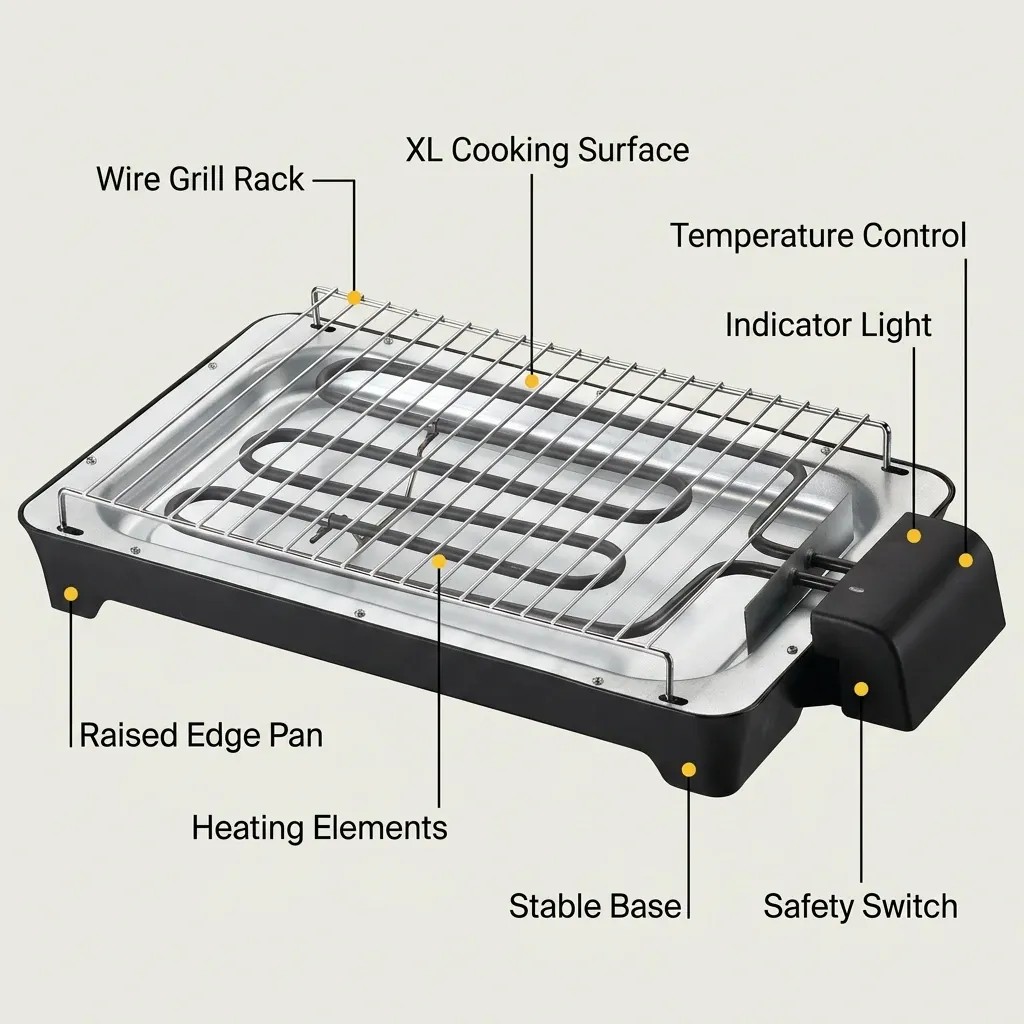
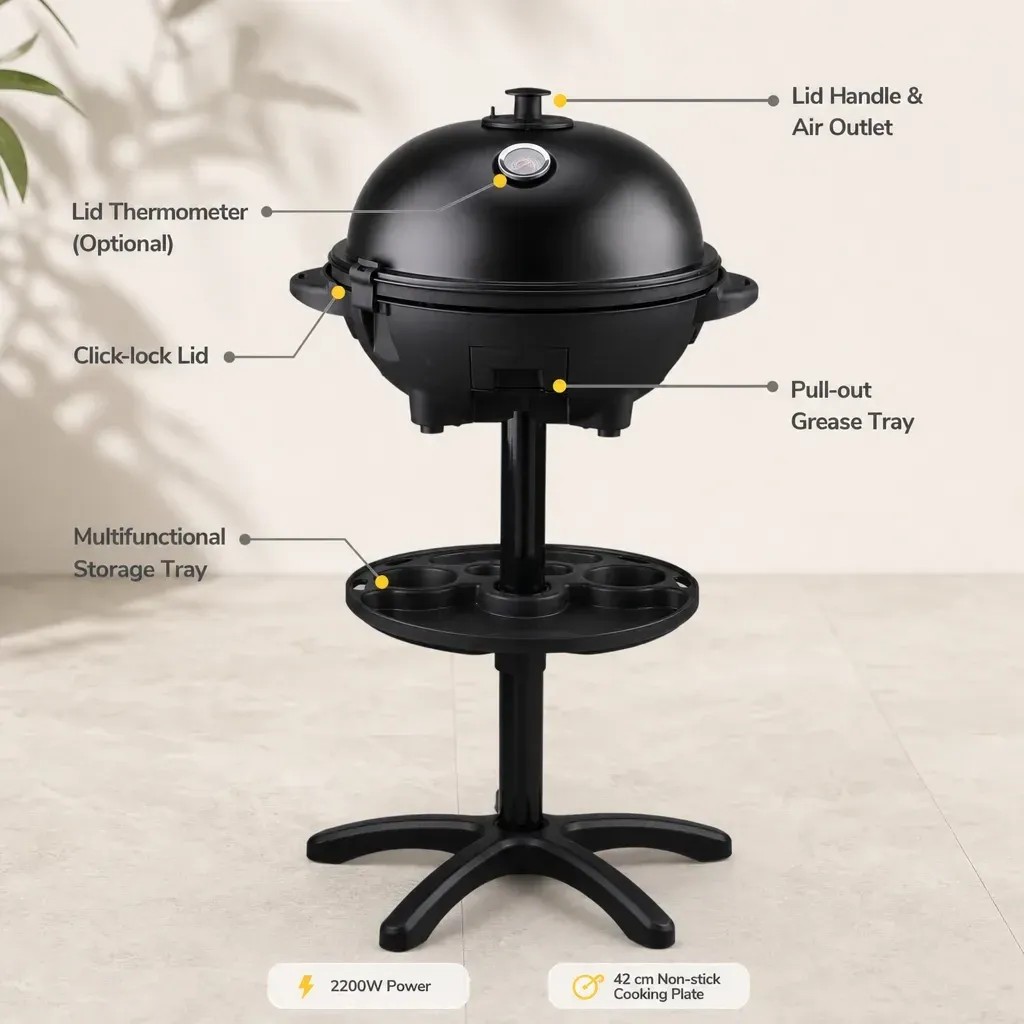
| Configuration | Tabletop unit for indoor countertop use | Freestanding dome grill with detachable stand |
| Power output | 2000W | 2200W |
| Cooking surface | Removable grill rack with reflective drip tray | 42cm die-cast aluminium non-stick cooking plate |
| Heat distribution | Visible U-shaped heating tube, adjustable temperature control | Die-cast aluminium plate for uniform heat distribution |
| Structural features | Removable grill rack and drip tray | Click-lock domed lid, multifunctional storage tray, optional lid thermometer |
| Certification | Multi-certified for the EU market | Full EU and North America certifications |
| Cleaning | Removable rack and drip tray, simple disassembly | Pull-out grease tray, non-stick plate, easy disassembly |
| Typical use | Indoor home barbecue, family dinner, small home party, daily countertop grilling | Backyard patio BBQ, garden party, outdoor family gathering, steak and skewer grilling |
| Cost position | Similar price range to mainstream competitors, with added value on full-set EU certification | Comparable price level to competing freestanding dome grills, with added value on the optional thermometer and multifunction storage tray |
Frequently Asked Questions
EU supermarket channels require household electric grills to meet electrical safety, food-contact material and hazardous-substance regulations. Jinchang electric grills hold CE (LVD+EMC), GS, LFGB and RoHS certificates, and complete TCF technical documents can be provided for retailer audit. The certificates cover the host unit, the detachable stand, the wire rack and the non-stick plate. Swapping these pre-approved accessories keeps certification valid, while a major host modification requires re-testing. Report model, product nameplate and shipped unit are checked for consistency before shipment — mismatches are a documented cause of customs detention and order rejection.
OEM and private-label service is available, with customisation covering appearance modification, function adjustment, private mould development and customised packaging according to client requirements. The operating rule is to keep the main host structure unchanged and vary the pre-approved accessories — stand and cooking surface — which preserves the existing certificate. Any host modification requires new certification testing. The range extends to more than 200 product models, with platform families including BQ202, BQ1601 and BQ1703XL-SF.
The MOQ requirement is 5,000 units for electric grill products. Delivery terms are EXW, FOB or CIF, and payment terms are 30/70. MOQ varies by model and OEM requirement in specific cases, so detailed quotation should be requested against the exact configuration rather than assumed from a generic price list.
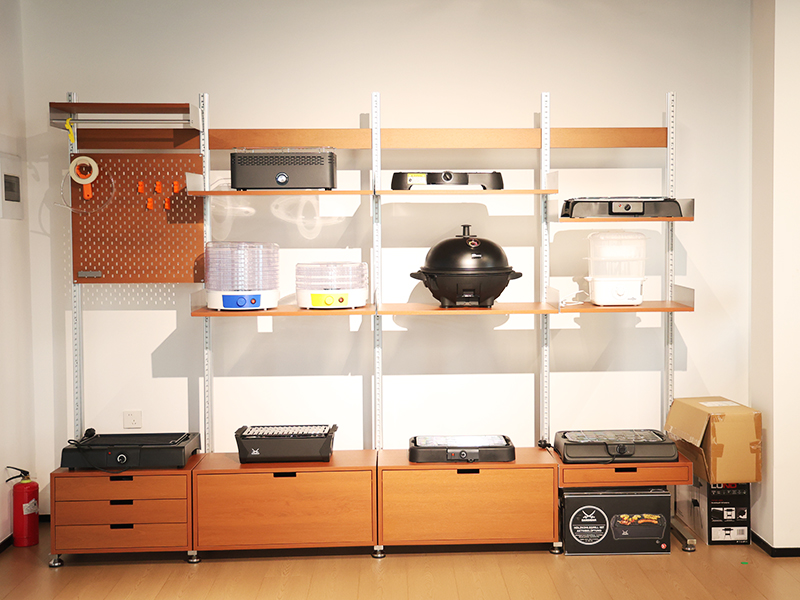
Yes. The sample stage is the standard validation step before production, and the company maintains a sample room where model platforms and accessory combinations can be reviewed. This is the point to confirm cooking surface selection, assembly tolerances and packaging layout, because revising at sample stage is far cheaper than revising after mass production. Sample and quotation arrangements are handled through the sales contact.
Acceptance criteria are defined as pre-shipment testing, not arrival inspection. Document-to-product consistency — certificate model, nameplate and physical unit — is verified at that point, because in EU supermarket supply an inconsistent file can cause audit failure, customs detention or goods return. Delivery runs under EXW, FOB or CIF terms, which determines where responsibility transfers between supplier and buyer. Buyers planning a multi-season programme should confirm the destination-market certification set at quotation stage and again before each repeat shipment.
Start a Long-Term Electric Grill OEM Programme
Send the target model platform, destination market and estimated annual volume to NINGBO JINCHANG ELECTRONICS CO., LTD. The team will respond with the matching certification file set, commercial terms and sample arrangements.
Email: Yibo@jinchang.co | Tel / WhatsApp: +86 137-7718-5665 | www.jc.ltd
Conclusion: The Second Order Is the Real Test of an Electric Grill OEM Partner
Most electric grill supplier evaluations stop at the sample and the quotation. The measures that actually determine whether a retail programme survives are less visible: whether the certification file still describes the shipped product in season three, whether the model designation stays consistent from report to nameplate, whether the stand and cooking plate can be replaced without reopening compliance, and whether a safety-related part can be sourced after the shelf has been committed.
NINGBO JINCHANG ELECTRONICS CO., LTD. addresses those points with a structure rather than a promise: one host platform serving tabletop and freestanding configurations, CE (LVD+EMC), GS, LFGB and RoHS certification covering host and pre-approved accessories, TCF files available for retailer audit, pre-shipment acceptance testing, and a documented rule that host modifications require re-testing. Backed by ISO 9001 and ISO 14001 certification, amfori BSCI and ICS membership, in-house structural R&D, mould development and product testing, and a 5,000-unit MOQ with 30/70 payment terms, that structure is designed to hold across repeat orders — which is the only period during which an OEM partnership is genuinely being evaluated.
Have Questions or Need More Details?
Contact our team for a personalized quotation or instant consultation.
Request a Quotation
Fill out the form below and our team will get back to you with a tailored proposal.
WhatsApp Direct Chat
Prefer to chat in real-time? Message us on WhatsApp for instant assistance & quick answers.
- Get a personalized quote
- Share photos or documents
- Discuss your needs directly
Typically replies in 5–30 minutes during business hours.