
Electric Grill Technical Guide: U-Shaped Heating Elements and Adjustable Temperature Control
Electric grills are specified, not marketed. By the time a distributor, retail buyer or product specifier reaches the Decision stage, the questions have already narrowed: how is the heating element built, how is cooking temperature set, what happens during continuous operation, and which parts can be removed for cleaning without invalidating the certificate. Two hardware decisions dominate that review — the geometry of the heating element and the way temperature is controlled and held.
This guide explains how a visible U-shaped heating element and adjustable temperature control affect electric grill cooking performance, how the surrounding hardware fits together (safety micro switch, working indicator light, wire rack or non-stick plate, detachable components), and which parameters a buyer should verify before locking a supply program. It is written for people who need to sign off on a specification sheet, not for someone browsing for a weekend purchase.
Problem Definition: Why Heating Geometry Decides Returns
Most electric grill complaints that reach a retailer are not about design taste. They are about heat. A grill that heats unevenly produces inconsistent results, and inconsistent results produce returns, poor reviews and a short life for the SKU. The root cause is usually fixed long before the product reaches the shelf, in three design decisions:
- Element geometry. Where the heating element sits, and how much of the cooking surface it actually covers, determines whether the plate heats as a single zone or as a hot spot surrounded by cooler edges.
- Power rating and supply voltage. A 2400 W rated element behaves differently from a lower-rated one, and both behave differently depending on whether the destination market supplies 220–240 V.
- Temperature control type. A fixed stepped switch and an adjustable thermostat give the user very different levels of control, and they create different marketing claims, different instruction-manual requirements and different consumer expectations.
For the specifier, the practical consequence is that these parameters must be verified at the sourcing stage, because they cannot be changed later by packaging, positioning or copy. A second, equally common problem sits on the compliance side: when a buyer swaps the stand, the cooking plate or the rack after the order is placed, the shipped product may no longer match the certificate that the retailer audited. Both problems are solvable, but only if the specification is locked before the purchase order.
Industry Background: What the Category Numbers and Standards Tell a Buyer
The electric grill category is large enough to support dedicated retail programs rather than one-off listings. The global electric grill market was valued at USD 4.6 billion in 2023, and North America accounted for a revenue share of 34.5% in the same year, according to Grand View Research. Within the wider category, the smokeless grill segment was valued at USD 768 million in 2024, with 55% of that segment belonging to electric types, according to Credence Research. Looking further out, Future Market Insights projects that the ASEAN region will have over 42 million households adopting plug-in grills by 2030.
Those figures matter to a buyer for one reason: they describe a category deep enough to justify a stable, multi-SKU program rather than a single seasonal listing. A stable program needs a stable platform, and a stable platform is defined by its specification, not its packaging.
The standards framework around a portable electric grill
Portable electric cooking appliances, including grills and roasters, fall under IEC 60335-2-9. In the European Union, household electric grills sold through supermarket channels are expected to meet electrical safety, food-contact material and hazardous-substance regulations, which in practice means compliance with EN 60335-2-9, CE (LVD+EMC) and GS certification, LFGB testing for food-contact parts, and RoHS compliance. From a customs perspective, the relevant classification is HS Code 851660, which covers other ovens, cookers, cooking plates, boiling rings, grillers and roasters for domestic use.
Two operational requirements follow from that framework, and both affect the specification decisions described later in this article:
- The test report model must match the product nameplate. Document-to-product consistency is checked before shipment because mismatch is one of the most common causes of customs detention and retailer audit failure.
- Only pre-approved accessories can be swapped freely. The certificate family covers the host unit, the detachable stand, the wire rack and the non-stick plate; a major modification to the main host structure requires re-testing.
Detailed Solution: How U-Shaped Elements and Adjustable Control Work Together
The visible U-shaped heating element
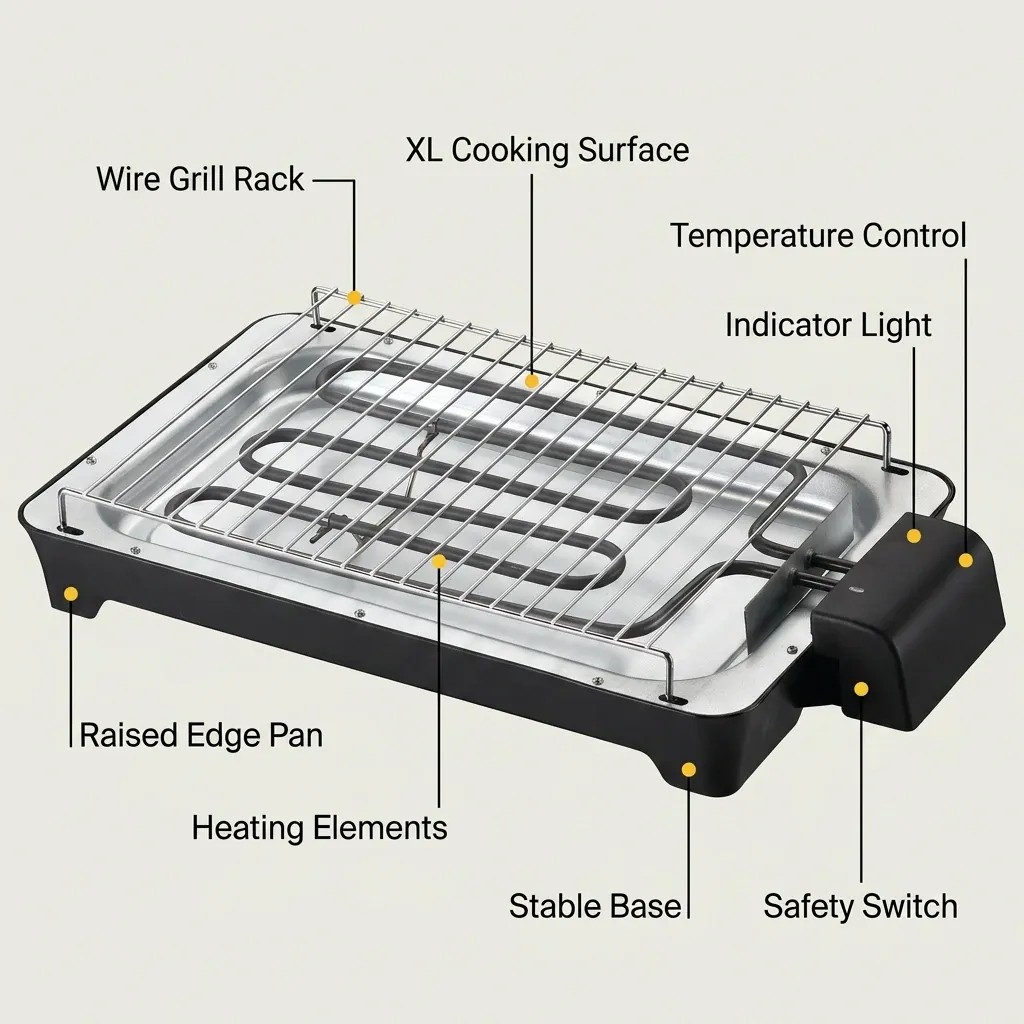
A visible U-shaped heating tube is mounted beneath the cooking surface of the tabletop electric grill platform. The U geometry does a specific job: it folds a longer resistive path into a compact footprint, so a single element can run along one axis of the cooking area and return along the other, covering a wider band of the plate than a straight rod of comparable length would.
For a buyer, the value of the design is not only thermal. A visible element is an inspectable one. Retail partners and their auditors can confirm that the delivered unit matches the approved sample and the certified configuration, and end users can see the element after cleaning rather than working blind around a sealed housing. That visibility supports the document-to-product consistency requirement described above.
Adjustable temperature control and rated power
Adjustable temperature control means the user sets a target temperature rather than choosing between a small number of fixed positions. The thermostat then cycles the element to hold that setting. This is the difference between a grill that can be used for slow, low-temperature cooking and one that only has an on-or-off character.
Rated power is the parameter buyers ask about first, and it should always be quoted together with the supply voltage. The freestanding electric BBQ grill platform is offered at 2400 W rated power. The adjustable temperature electric grill with side tables is specified at 2000–2400 W and 220–240 V. Those two figures answer different questions: the wattage tells the buyer how much heat the element can deliver to the cooking surface, and the voltage tells the buyer which destination markets the model can be shipped to without a different electrical configuration.
For the specifier, the practical checks are:
- Voltage match. A 220–240 V rated appliance is built for the European, Australian, Russian and comparable markets listed in the export program. Confirm the plug type and cord set for each destination before the order is placed.
- Circuit planning. Higher wattage places more demand on the household circuit. Current draw, socket type and any local restriction on high-power kitchen appliances should be confirmed per market before the SKU is listed.
- Continuous operation. Buyers running a retail program should ask how the appliance behaves when left running through several rounds of cooking — whether the thermostat holds the set temperature, whether the housing remains stable, and what the instruction manual states about run time and cool-down.
The safety micro switch
A safety micro switch sits between the power supply and the heating circuit. Its function is interlock: the element cannot be energised unless the cooking assembly is correctly seated. On a detachable design, that matters because the plate, rack or stand can be removed for cleaning. Without an interlock, a user could energise the element with the cooking surface out of position.
From a procurement point of view, the safety micro switch is a specification item rather than a marketing item. It should appear in the technical file, it should be covered by the type test, and it should be identical on the golden sample and the production units. If the switch is changed, the certificate logic that supports the accessory-swap policy may no longer hold.
The working indicator light
The working indicator light gives the user a visible signal of the appliance's operating state. It is a small component, but it carries weight in the instruction manual, in market-specific labelling and in consumer expectations: a user who can see whether the appliance is active is less likely to leave it running unintentionally and more likely to understand the thermostat cycle.
For a buyer assembling a SKU ladder, the indicator light is also a legitimate differentiator between an entry model and a higher-positioned model. It is worth confirming whether it is part of the certified configuration or an accessory that changes the type test.
Wire rack versus non-stick aluminum plate
The cooking surface is one of the few decisions that changes both the product experience and the SKU story. Jinchang offers two surfaces across the range:
- Wire rack. Provides authentic BBQ flavour and an exposed grilling surface.
- Non-stick aluminum plate. Enables easy cleaning and a flat cooking surface suitable for a wider range of foods.
Both surfaces pass the LFGB food-contact test, and both are covered by the same certification family, so a buyer can switch between them within a program without re-testing. The freestanding BQ232-SLTF uses a 42 cm die-cast aluminum non-stick cooking plate; its die-cast construction supports uniform heat distribution across the surface.
One practical caution for anyone specifying private label: LFGB is a food-contact material requirement, not a fire or electrical requirement. If a buyer sources a new cooking plate from a different supplier, the food-contact test must be re-run for that material even if the host unit certification is untouched.
Detachable components and the cleaning route
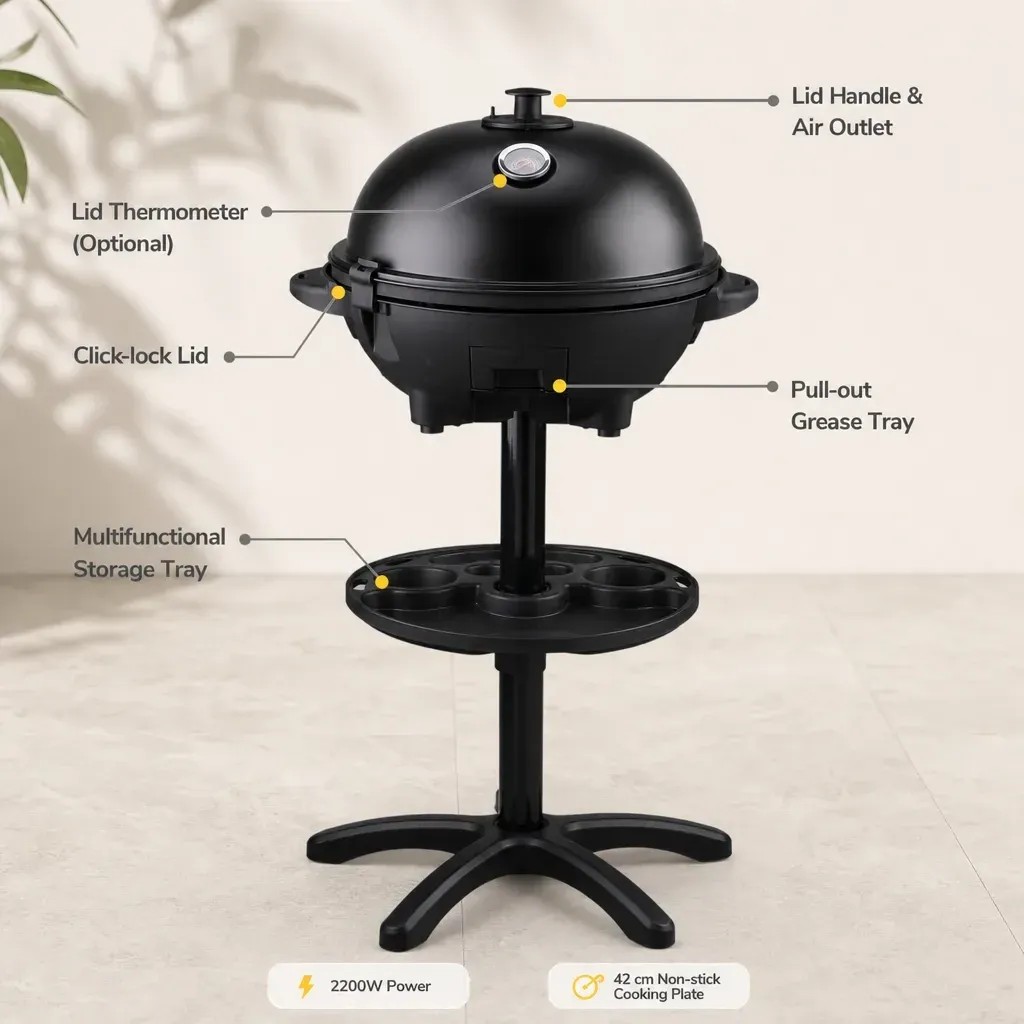
Detachability is where technical design meets consumer satisfaction. The tabletop platform uses a removable grill rack and a reflective drip tray, which can be separated for quick cleaning and are designed for simple disassembly from residue. The freestanding model adds a detachable stand, a pull-out grease tray and a non-stick plate that can be removed for cleaning as a unit.
Because the certification covers the host unit, detachable stand, wire rack and non-stick plate as a pre-approved accessory set, a retail program can mix and match those components without triggering new testing. That is the structural advantage that makes a multi-SKU assortment practical: one certified host, several stand and surface combinations, one technical file.
Step-by-Step Breakdown: Specifying an Electric Grill Program
The following sequence reflects how an electric grill specification is normally locked, from the first decision to the last. It is designed for a buyer moving from Decision into Execution.
- Define the cooking scenario before the product. Indoor countertop use points to a compact tabletop electric table grill. Balcony, garden and patio use point to a freestanding electric BBQ grill with a detachable stand. The scenario decides the platform, and the platform decides everything downstream.
- Fix the power rating and voltage for the destination market. For a freestanding program, the reference figure is 2400 W rated power. For an adjustable temperature model with side tables, the reference is 2000–2400 W at 220–240 V. Confirm plug and cord set per market at the same time.
- Verify the heating element configuration. Confirm whether the model uses a visible U-shaped heating tube, confirm its position relative to the cooking surface, and confirm that the production unit matches the approved sample.
- Decide the temperature control type. Adjustable temperature control supports a broader range of cooking styles and a stronger product story. Fixed-step control simplifies the manual and lowers cost. Treat this as a positioning decision, not a late-stage substitution.
- Confirm the safety architecture. Check that the safety micro switch is part of the certified configuration, that it interlocks the heating circuit with the cooking assembly, and that it is documented in the technical file.
- Choose the cooking surface. Wire rack for authentic BBQ flavour, non-stick aluminum plate for easy cleaning. Both pass LFGB food-contact testing and sit inside the same certification family.
- Confirm detachability and the cleaning route. Removable rack, reflective or pull-out drip tray, detachable stand and non-stick plate should all be serviceable by the end user without tools.
- Verify certification coverage for the exact SKU configuration. The certificate family covers host unit, detachable stand, wire rack and non-stick plate. Confirm the report model matches the product nameplate, and confirm that the intended SKU uses only pre-approved accessories.
- Agree the supply program. The minimum order quantity for electric grill products is 5,000 units. Delivery terms offered are EXW, FOB and CIF. Payment terms are 30/70 and the acceptance criterion is a pre-shipment test.
- Lock the SKU ladder. Build the assortment from one certified host plus approved accessory variations, and record which combination is the hero SKU, which is the value SKU and which is the gift-set or bundle variant.
Use Cases: Where These Specifications Pay Off
The specification choices described above are not abstract. They map onto the four commercial situations where electric grills are actually sold.
EU supermarket private label programs
Supermarket channels require certificate validity, food-contact compliance and document-to-product consistency. A program built on one certified host plus approved stand and surface variations reduces both the audit surface and the stock risk, because a single technical file supports multiple listed SKUs. Jinchang holds CE (LVD+EMC), GS, LFGB and RoHS certificates across the electric grill range, and complete TCF technical files are available for retailer audit.
Indoor countertop cooking
Apartment kitchens need a compact tabletop electric grill with a manageable footprint, low smoke output and a surface that can be cleaned in a small sink. The tabletop platform supports this with a removable grill rack, a reflective drip tray and a compact body, and the visible U-shaped heating element gives users a clear view of what is generating the heat.
Outdoor balcony and garden grilling
Outdoor use favours the freestanding configuration: the same main host with a detachable metal stand, a click-lock domed lid, an optional lid thermometer and a large cooking surface. The trade-off is freight — the stand increases package size and shipping cost, so the SKU is normally positioned at a higher retail price point than the tabletop version.
OEM and ODM programs
Buyers developing their own brand can use OEM and private-label service. Customisation options include appearance modification, function adjustment, private-mould development and customised packaging. The structural constraint is that the main host structure should remain unchanged; any host modification requires new certification tests, while accessory-level variation inside the pre-approved set does not.
Comparison Table: Tabletop versus Freestanding Platform
The table below compares two verified platforms in the same product family. Both share the same host philosophy, but they answer different retail briefs.
| Specification | BQ2001 tabletop electric grill | BQ232-SLTF freestanding electric BBQ grill |
|---|---|---|
| Platform | Tabletop, countertop use | Freestanding with detachable stand |
| Cooking surface | XL large cooking surface | 42 cm die-cast aluminum non-stick cooking plate |
| Heating element | Visible U-shaped heating tube | High-power heating with uniform distribution from the die-cast aluminum plate |
| Power output | 2000 W | 2200 W |
| Temperature control | Adjustable temperature control | Not specified in the approved fact set |
| Grease management | Reflective drip tray | Pull-out grease tray |
| Lid | Not part of this configuration | Click-lock domed lid with optional lid thermometer |
| Storage | Not part of this configuration | Multifunctional storage tray |
| Cleaning | Removable grill rack and drip tray, simple disassembly | Non-stick plate, pull-out tray, easy disassembly |
| Certification | Multi-certified for the EU market | Full EU and North America certifications |
| Best for | Indoor home barbecue, family dinner, small home party, counter-top daily grilling | Backyard patio BBQ, garden party, outdoor family gathering, steak and skewer grilling |
Frequently Asked Questions
1. Are Jinchang electric grills qualified for EU supermarket sales?
Yes. The electric grill range carries CE (LVD+EMC), GS, LFGB and RoHS certificates, and complete TCF technical files are available for retailer audit. The declared appliance standard for this category is EN 60335-2-9, which corresponds to IEC 60335-2-9, the international standard for portable electric cooking appliances including grills and roasters. Before order confirmation, always verify that the certificate model matches the product nameplate.
2. Will changing the stand or the cooking plate affect the certificates?
Not if the change stays inside the pre-approved accessory set. The certificates cover the host unit, the detachable stand, the wire rack and the non-stick plate, so swapping these accessories keeps certification valid. A major modification to the main host structure does require re-testing. This is the single most common compliance question in EU retail programs.
3. What is the difference between the wire rack and the non-stick aluminum plate?
The wire rack provides authentic BBQ flavour and an exposed grilling surface. The non-stick aluminum plate enables easy cleaning and suits a broader range of foods. Both pass the LFGB food-contact test and both sit inside the same certification family, so a buyer can offer both surfaces within one program without triggering new testing.
4. What are the commercial terms for an electric grill order?
The minimum order quantity for electric grill products is 5,000 units. Delivery terms offered are EXW, FOB and CIF. Payment terms are 30/70, and the acceptance criterion is a pre-shipment test. MOQ can vary by model and OEM requirement, so the exact quotation should be confirmed with the supplier before the program is locked.
5. How does Jinchang support long-term electric grill supply for retail distribution?
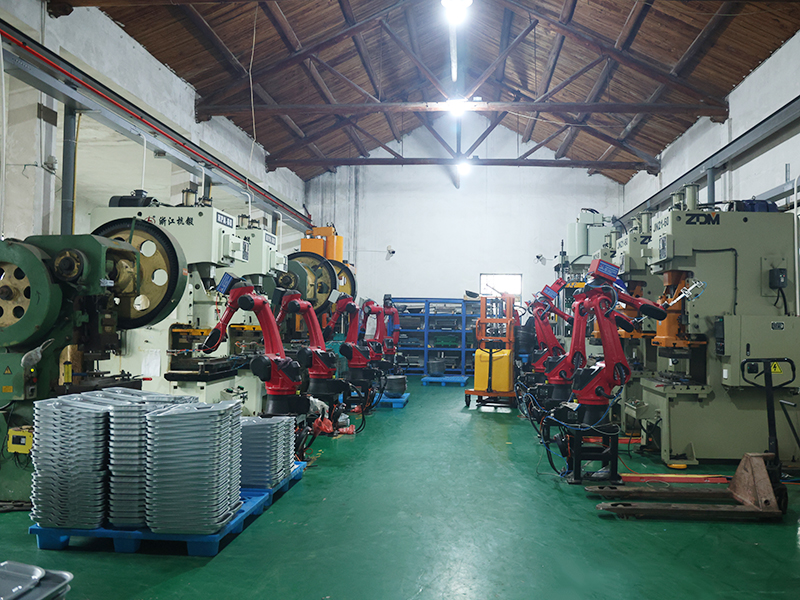
Ningbo Jinchang Electronics Co., Ltd. is a manufacturer based in Yuyao City, Zhejiang Province, China, with a 5,500 m² production plant and an annual output of 1,200,000 units, of which 90% is exported to the EU, USA, Australia and Russia. The company holds ISO 9001 and ISO 14001 certification, is a National High-Tech Enterprise, Innovative SME and Technology-based SME, holds amfori BSCI and ICS membership, and owns more than 30 independent intellectual property rights including invention patents and utility-model patents. Its customer base includes Fortune Global 500 enterprises, top cross-border e-commerce sellers, large European and American supermarket chains and local overseas brand owners.
For distributors running a multi-SKU program, the practical long-term advantage is platform reuse: the tabletop and freestanding models share the same main host, so an assortment can be built by mixing stands and cooking plates around a single certified host, reducing tooling, certification and stock pressure across the life of the program. Buyers planning a long-term listing can request a sample and a formal quotation to validate the configuration against their own audit requirements.
Conclusion
An electric grill program succeeds or fails on a short list of hardware decisions. A visible U-shaped heating element determines how much of the cooking surface receives heat. Adjustable temperature control determines how precisely the user can direct that heat. The safety micro switch, the working indicator light, the choice between a wire rack and a non-stick aluminum plate, and the detachability of the stand, rack and drip tray determine how safely and how easily the appliance is used, cleaned and audited.
For the specifier, the sequence is straightforward: define the scenario, fix power rating and voltage, verify the element and control type, confirm the safety architecture and certification coverage, then agree MOQ, delivery terms, payment terms and the pre-shipment acceptance test. Building the SKU ladder on one certified host with approved accessory variations keeps both the audit surface and the inventory risk under control.
Next Step: Validate the Configuration
Ningbo Jinchang Electronics Co., Ltd. supports distributors, retail buyers and brand owners with sample validation, OEM and private-label development, and full EU technical documentation. If you are specifying an electric grill program, request a sample and a formal quotation against your target specification.
Email: Yibo@jinchang.co | Tel / WhatsApp: +86 137-7718-5665 | Website: www.jc.ltd | Blog: blog.jc.ltd