
First-Time 7-Quart Double-Layer Food Steamer Owner? Solving Setup, Tiering, and Cleaning Questions
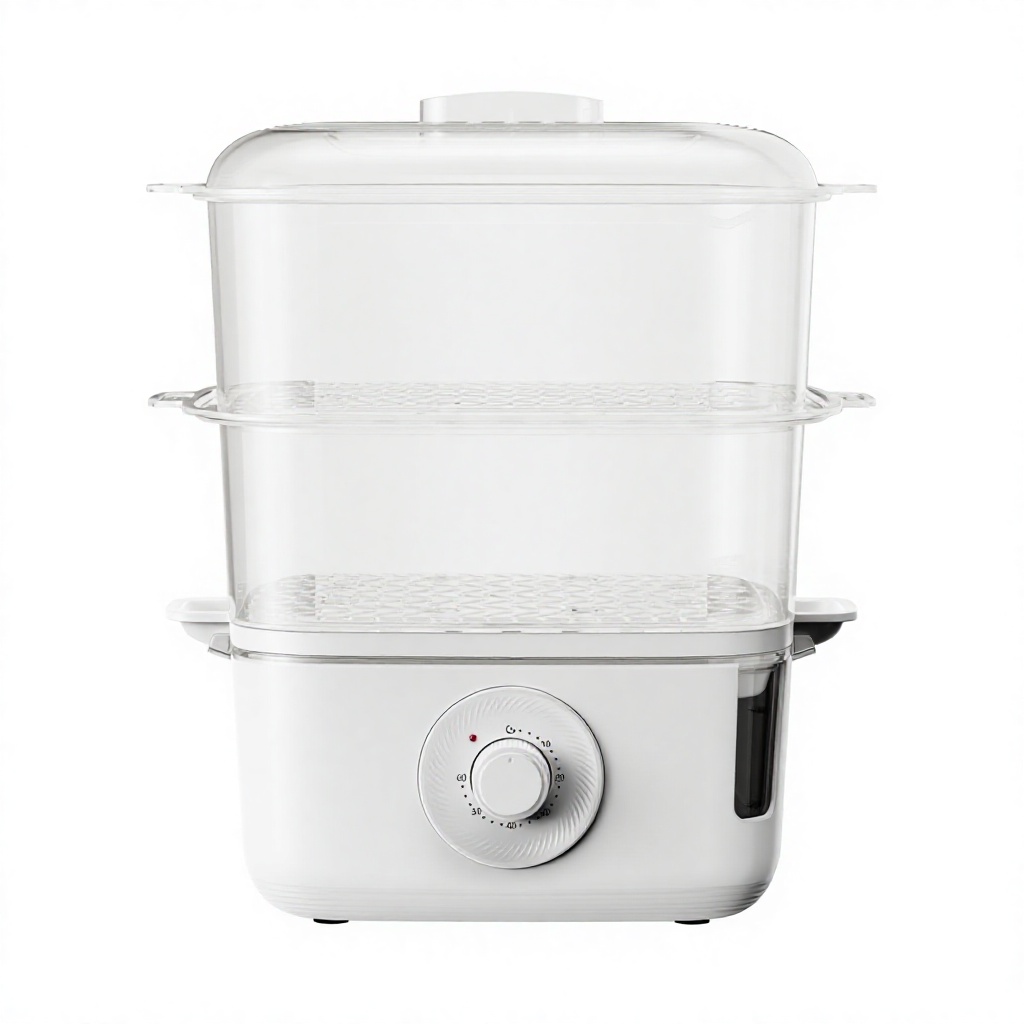
A 7-quart double-layer electric food steamer: two stackable tiers, one water tank, one mechanical timer.
Unboxing a two-tier steamer takes two minutes. Using it well takes a little longer. The manual that ships in the box is organised by component — tank, trays, lid, timer — while the questions new owners actually ask are organised by sequence: what do I do first, what goes where, and how do I clean this without turning the sink into a nightly project.
This guide answers those three questions in the order they arrive, using the SC750 electric food steamer from Ningbo Jinchang Electronics Co., Ltd. as the working example. The SC750 is a 7L, 230V/800W double-layer countertop electric steamer with a mechanical rotary timer, a rice basket, and LFGB-compliant food-contact parts. It is manufactured in Yuyao City, Zhejiang Province, China, for household cooking as well as for retail, gift-set and private label food steamer programmes.
Problem Definition: Why the First Week Raises the Same Three Questions
Steaming is an old technique. A countertop electric food steamer with two stackable tiers is a much newer appliance format, and most of the friction in the first week is not about cooking at all. It is about three decisions that a component-by-component manual cannot sequence for a new owner.
Question 1 — Setup: voltage, placement, and water
The SC750 is rated 230V and is intended for indoor use on a stable, level surface. It cannot operate on a 110V supply without a voltage-adjusted model. Voltage mismatch is one of the most common first-use misunderstandings with export-market kitchen appliances, and it is worth confirming before anything else. Placement matters almost as much: a countertop electric food steamer releases hot steam and water vapour during operation, so it belongs on a level surface with clearance above the lid, away from overhanging cabinets and from anything that reacts badly to moisture. Water quality and water level come next — the operating guidance for this class of appliance is drinking water or tap water, filled to the marked level, never above it.
Question 2 — Tiering: what goes where, and when
Two tiers create a timing problem that a single-tier unit simply does not have. Steam rises, so the tier nearest the water tank receives the most direct heat and the moistest steam, while the upper tier receives slightly gentler conditions. Owners who load both tiers with foods that need different exposure times and then start one timer end up with one tray that is overdone and another that is underdone. The decision is not “which tray is better” but “which food tolerates the longer cycle”.
Question 3 — Cleaning: what comes apart, and what does not
The third question is the one that decides whether the appliance becomes a daily habit or a cabinet resident. A multi-tier electric food steamer has more parts in contact with food and condensation than a single-tier model. Owners who wait until the unit is cold and the residue has dried, or who try to wash the whole base under the tap, find the job unpleasant and stop using the steamer on weeknights. Removable steaming trays and easy disassembly are the design features that turn a fifteen-minute chore into a three-minute routine — and they are the reason cleaning should be planned as part of the cycle, not as an afterthought.
Industry Background: What the Category Context Explains About Your Appliance
Countertop steaming sits inside a category that has grown steadily rather than spectacularly. According to Custom Market Insights, the global electric food steamer market reached approximately USD 3.68 billion in 2024, and the same research house projects a compound annual growth rate of about 5.32% between 2025 and 2034. Forecast figures for this category should be read with care: published CAGR estimates vary noticeably between research houses, largely because some definitions include multi-functional cookers and commercial-grade steamers while others do not.
Geographically, Asia-Pacific is both the largest and the fastest-growing regional market for electric steamers. On the supply side, China remains the dominant exporter of food steamers, accounting for the large majority of import shipments in the trade corridors that are routinely tracked; in one frequently cited corridor dataset the share is reported at 88%. For classification purposes, electric food steamers typically fall under HS Code 8516.60 or 8419.81 depending on how the consignment is declared.
Two compliance layers sit behind the appliance on your counter. Internationally, IEC 60335-1 and the part-two standards IEC 60335-2-15 and IEC 60335-2-3 are the primary safety standards for household electric steam cookers. For the European Union specifically, a household electric steamer is normally assessed across four fronts: CE with a third-party CB test report for electrical safety; LFGB for the food-contact components, chiefly the steaming tray and the cavity; RoHS for restricted substances inside the product; and Ecodesign (EU) 2023/826 for off-mode and standby-mode power consumption.
That last point explains a design choice first-time owners notice immediately. The SC750 uses a mechanical timer rather than app or Wi-Fi control. A mechanical-timer steamer has no network-standby function to regulate, is operated by a single dial that any household member can use, and carries a lower failure-rate profile than an app-connected equivalent. Smart control adds features; it also adds cost and after-sales exposure.
Detailed Solution: How the SC750 Answers the Three Questions
The SC750 is a 2-layer, 7L countertop electric food steamer rated at 230V and 800W, built with a PP+ABS housing and a PC indicator, and offered with a retail-ready colour-box package. For a first-time owner, the relevant point is not the specification list itself but what each specification does to the three questions above.
| Attribute | SC750 specification |
|---|---|
| Product type | Countertop electric food steamer |
| Model | SC750 |
| Rated power | 800W |
| Rated voltage | 230V |
| Capacity | 7L (7-quart class) |
| Layers | 2-layer, stackable |
| Control | Mechanical rotary timer |
| Safety | Automatic shut-off / dry-burn protection |
| Housing material | PP + ABS with PC indicator |
| Food-contact parts | LFGB-compliant |
| Included accessory | Rice basket |
| Certifications | CE, LFGB, CB |
| Packaging | Retail-ready colour box |
| Manufacturer | Ningbo Jinchang Electronics Co., Ltd. |
Setup answered by design
The water tank on this model is visible and independent, which means the level can be checked without lifting the tiers or guessing. The automatic shut-off function addresses the single largest safety risk in this product class — dry-burn overheating when the tank runs out during a long cycle. For a household, that protection is the difference between an unattended twenty-minute steam and a supervision requirement.
Tiering answered by design
Two stackable trays with a combined 7L capacity allow different foods to be steamed simultaneously in a single cycle, at the same power draw as a single-batch run. The design intent is batch efficiency: one timer, more food, fewer separate sessions. It is not a licence to load everything at once — the tier logic in the next section still applies.
Cleaning answered by design
The steaming trays are removable and the unit is designed for easy disassembly so that the parts that actually collect residue can be washed separately. That single design choice determines whether daily cleaning stays under five minutes.
The documentation behind the claims
For the EU market, the SC750's credential set covers electrical safety through CE and CB, food-contact suitability through LFGB for Germany and the wider EU market, and hazardous-substance screening. The model's certification portfolio also includes SGS SVHC testing for the EU market and an SGS food contact test report for France. These are the documents a first-time owner rarely reads and a distributor never skips: LFGB testing covers exactly the parts a home cook scrubs every evening, and the food-contact report is what a European retail buyer will ask to see before listing the product.
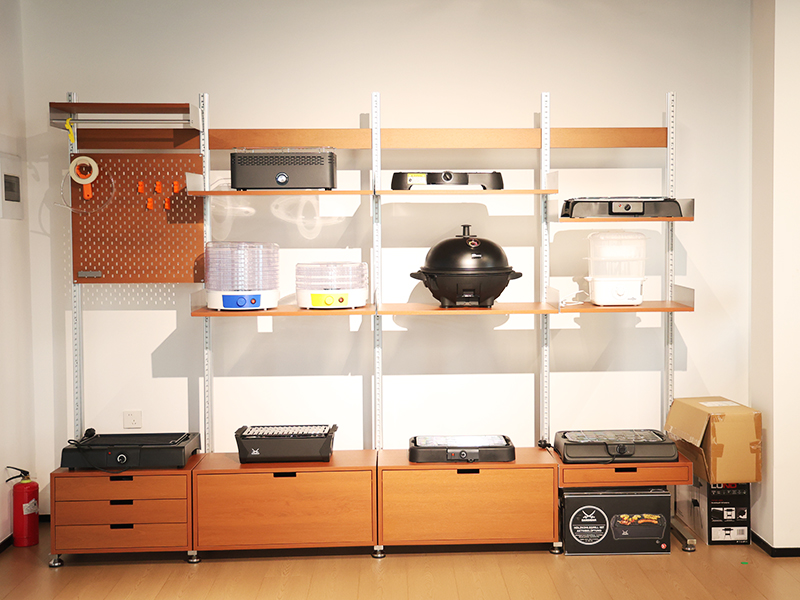
A sample room allows buyers and distributors to handle the unit, test the tier fit, and inspect the finish before committing to volume.
Step-by-Step Breakdown: From Unboxing to the First Clean
The following sequence is the one that avoids the common first-week mistakes. It applies to the SC750 and to most countertop electric food steamers with a removable two-tier tray set.
- Pre-clean before the first use. Lift out the stacking trays, the lid and the rice basket. Wash them in warm water with mild detergent, rinse, and dry fully. Wipe the cavity with a damp cloth. Manufacturing and transit leave dust on food-contact surfaces, and the first cycle should not be the first wash.
- Check the supply voltage and place the unit. Confirm that the socket matches the rated 230V supply and that the socket is grounded. Set the steamer on a stable, level, indoor surface with clearance above the lid for steam to escape. Do not run a 230V model from a 110V outlet, and do not use it on an unstable or tilted surface.
- Fill the water tank before loading food. Use drinking water or tap water and fill to the marked level, not above it. Filling first prevents hot splashes later and lets you confirm the tank is seated correctly. The visible independent tank means the level can be checked at a glance.
- Decide the tier assignment before you load anything. Put denser, longer-exposure items on the lower tier — items such as meat, dumplings, eggs or firm root vegetables. Put faster items on the upper tier — leafy vegetables, seafood, or prepared foods that only need a short pass of steam. Use the rice basket for grains rather than placing them directly in a tray.
- Load without blocking the steam path. Spread food in a single layer with visible gaps between pieces. Steam has to circulate around each piece; a tightly packed tray behaves like a solid block and steams unevenly no matter how long the timer runs. If two foods need very different exposure times, do not start them together — either accept the longer time for both, or add the faster item partway through the cycle.
- Set the timer once and let the automatic shut-off finish the cycle. The mechanical rotary timer handles the whole run. Filling the tank to the correct level at step three is what makes an unattended cycle safe, because the automatic shut-off is designed to cut the unit when water runs low rather than let it run dry and overheat. Model-specific timing guidance for different foods is printed in the manual; food thickness and portion size change the answer more than the recipe does.
- Cool, disassemble, wash, dry. Switch off and unplug. Let the unit and the trays cool enough to handle — hot trays warp under cold water and splash when moved. Empty any remaining water from the tank. Lift out the removable trays and the rice basket and wash them in warm water with mild detergent. Wipe the cavity and the exterior with a damp cloth; never immerse the base or the electrical section. Dry every part completely before stacking it back, because trapped moisture between stacked trays is what creates odour in a closed cabinet.
Use Cases: Where a 7-Quart Double-Layer Steamer Fits
The same tier logic that solves a first-week question also defines who gets the most out of the appliance.
- Family meal preparation. Two tiers plus a rice basket let a protein, a vegetable and a grain cook in one cycle on one countertop appliance — the reason dual-layer simultaneous steaming exists. The same power draw produces roughly double the batch of a single-tier unit.
- Baby food and soft-diet cooking. Steaming without added oil suits the preparation of soft foods. Because the food-contact components are LFGB-compliant, parents and caregivers are working with parts that were tested against a recognised European food-contact standard rather than an unspecified plastic.
- Retail and gift-set programmes. The SC750 ships with a retail-ready colour-box package, which means it can go straight onto a shelf or into a gift set without repackaging at the destination. The mechanical timer is a practical advantage here: it needs no pairing, no app and no instruction beyond “turn the dial”, so the number of service questions a retailer has to absorb stays low.
- In-store demonstration and distributor sampling. A visible independent water tank and a two-tier tray set are easy to demonstrate on a shop floor — the customer can see the capacity, the stacking and the removable parts without opening a manual.
- Homestay, apartment and serviced-unit supply. Compact countertop cooking with automatic dry-burn protection fits furnished accommodation and small kitchens where unattended appliances are common.
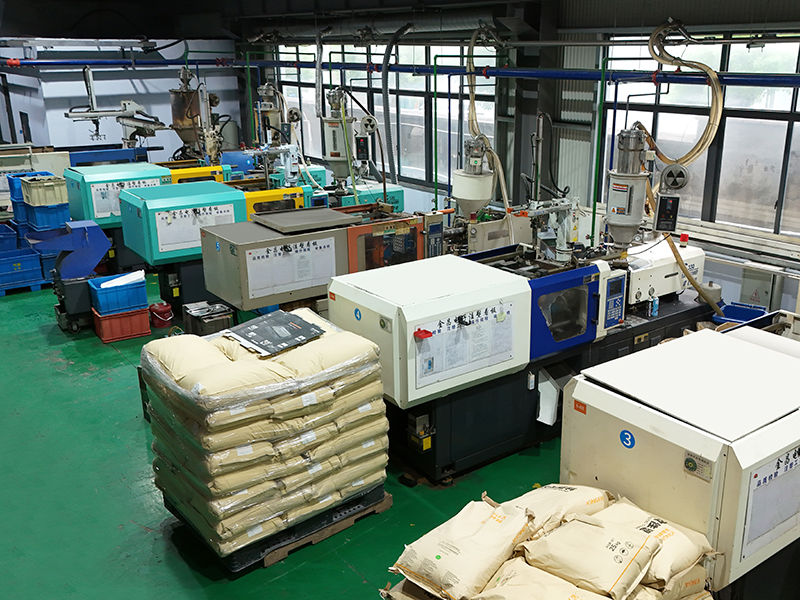
Production floor at Ningbo Jinchang Electronics Co., Ltd., Yuyao City, Zhejiang Province — where trays, tanks and housings are assembled into finished units.
Comparison Table: 7-Quart Double-Layer vs. Basic Single-Tier
First-time owners usually choose between a large two-tier steamer and a simpler single-tier unit. The comparison below uses the SC750 configuration as the two-tier reference and describes the single-tier baseline where published information supports it.
| Dimension | 7-quart double-layer (SC750 class) | Basic single-tier steamer |
|---|---|---|
| Cooking capacity | 7L across two stackable tiers | Limited capacity, suited to small-portion cooking for 1–2 people |
| Simultaneous cooking | Multiple foods steamed at once; dual-layer simultaneous cooking without extra power consumption | One tier per batch |
| Heating power | 800W fast heating | Varies by model |
| Water tank | Visible independent water tank; level checks without lifting tiers | Varies by model |
| Control | Mechanical timer, all-age-friendly operation | Varies by model |
| Safety | Automatic shut-off with dry-burn protection; CE and CB certified | Verify protection features per model |
| Food-contact material | LFGB food-grade food-contact material | Verify migration test reports per model |
| Cleaning | Removable steaming trays; easy disassembly for quick cleaning | Varies by model |
| Packaging | Retail-ready colour box | Varies by supplier |
| Cost positioning | Comparable cost level, with additional value carried by safety certification and retail-ready packaging | Baseline |
| Best fit | Home daily cooking, baby food making, family meal prep, retail and gift-set supply | Small apartments and one-to-two-person households |
| Main trade-off | Requires additional vertical storage space | Lower batch ceiling |
For a distributor, the same comparison has a second axis: control type. A mechanical-timer steamer and an app-controlled steamer are not competing products so much as competing channels.
| Consideration | Mechanical timer (SC750) | App / Wi-Fi controlled steamer |
|---|---|---|
| Operation | Single rotary dial, usable by any age group | Richer functions, more complex for older users |
| Failure profile | Lower failure rate | Additional electronics and connectivity to service |
| Compliance | No network-standby exposure | Must meet Ecodesign network standby requirements |
| Commercial profile | Higher cost predictability | Higher unit cost and after-sales risk |
| Recommended channel | Mass retail, gift sets, multi-country export | Dedicated smart-home channels |
Frequently Asked Questions
Which certificates should I check before buying a 7-quart double-layer electric steamer for the EU market?
A household electric steamer sold into the EU normally needs four things: electrical safety documentation, typically CE supported by a third-party CB test report; food-contact compliance for the steaming tray and cavity, usually evidenced by LFGB; RoHS screening for restricted substances; and Ecodesign (EU) 2023/826 conformity for off-mode and standby power consumption. The SC750 is certified to CE, LFGB and CB, and its credential set also includes SGS SVHC testing for the EU market and an SGS food contact test report for France. A self-declaration CE without third-party test reports is often not accepted by large European retailers.
Can a 7-quart double-layer steamer really cook two different foods at the same time?
Yes, and this is the main functional reason to choose a two-tier design. Two stackable tiers allow different foods to be steamed simultaneously in one cycle, at the same power consumption as a single-batch run, so total cooking time and energy use are not doubled. The trade-off is physical: a double-layer unit needs extra vertical storage space. For one or two people cooking small portions, a single-layer steamer with a smaller overall height remains the simpler choice.
How do I clean a two-tier electric food steamer after everyday use?
Switch off and unplug the unit, then let it cool before handling any part. Empty the remaining water from the tank, lift out the removable steaming trays and the rice basket, and wash them in warm water with mild detergent. Wipe the cavity and the exterior with a damp cloth — the base and electrical section should never be immersed. Dry all parts completely before stacking them back, because moisture trapped between stacked trays is a common cause of odour. On the SC750, removable trays and easy disassembly are the specific design features that keep this routine short.
Can a distributor validate the SC750 before placing a bulk order?
Yes. Buyers and distributors routinely evaluate the unit hands-on before committing to volume — checking tier fit, water-tank visibility, control feel and finish quality against their own market requirements. Ningbo Jinchang Electronics Co., Ltd. provides ODM original design and development as well as OEM custom manufacturing services, with customisation options covering appearance modification, function adjustment, private-mould development and customised packaging, so a private label food steamer programme can be built on the SC750 platform. Sample arrangements and quotation requests can be made directly through Yibo@jinchang.co or the company site at www.jc.ltd.
How do distributors evaluate a manufacturer for a long-term electric food steamer supply relationship?
Long-term supply is assessed on capacity, consistency and compliance rather than on unit price alone. Ningbo Jinchang Electronics Co., Ltd. operates a 5,500 m² production plant with 68 employees and an annual production capacity of 1,200,000 units, with approximately 90% of products exported to markets including the EU, USA, AU and RU. The company holds ISO 9001 quality management and ISO 14001 environmental management certification, is a member of amfori BSCI and ICS for international supply-chain compliance, and operates an in-house R&D team of 8 engineers covering structural R&D, mould development and product testing across a range of more than 200 models. For distributors, the practical test is whether those capabilities transfer to the specific order — packaging, documentation and repeat-batch consistency — and that is best confirmed through a sample run before the first bulk order.
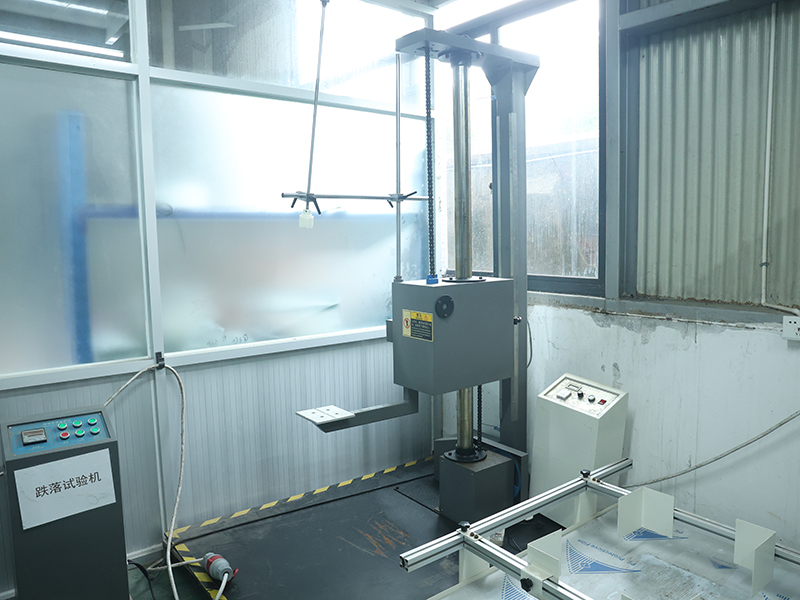
In-house drop testing supports the packaging and transit durability checks that matter to distributors shipping a two-tier steamer.
Conclusion
First-time ownership of a 7-quart double-layer food steamer comes down to three sequences, and none of them are difficult once written in order. Setup is voltage check, level placement, and water filled to the marked level before the food goes in. Tiering is longer-exposure foods on the lower tier, faster foods on the upper tier, and gaps left between pieces so steam can circulate. Cleaning is cool, unplug, empty, disassemble, wash, and dry everything before it is stacked back.
The appliance rewards that routine quickly. A two-tier electric food steamer with a visible water tank, a mechanical timer and automatic dry-burn protection turns unattended cooking into a safe weekday option, and the LFGB-compliant food-contact parts mean the surfaces being scrubbed every evening are the surfaces that were actually tested. New owners who set up the routine in the first week rarely go back to single-batch cooking.
Next Step: Samples, Quotes and Private Label Programmes
Ningbo Jinchang Electronics Co., Ltd. manufactures the SC750 7L double-layer electric food steamer and supplies it for household retail, B-end wholesale and gift-set export programmes, with OEM and ODM services covering appearance modification, function adjustment, private-mould development and customised packaging.
To request a sample, a quotation or the current product catalogue, contact Yibo@jinchang.co or visit www.jc.ltd.
Have Questions or Need More Details?
Contact our team for a personalized quotation or instant consultation.
Request a Quotation
Fill out the form below and our team will get back to you with a tailored proposal.
WhatsApp Direct Chat
Prefer to chat in real-time? Message us on WhatsApp for instant assistance & quick answers.
- Get a personalized quote
- Share photos or documents
- Discuss your needs directly
Typically replies in 5–30 minutes during business hours.