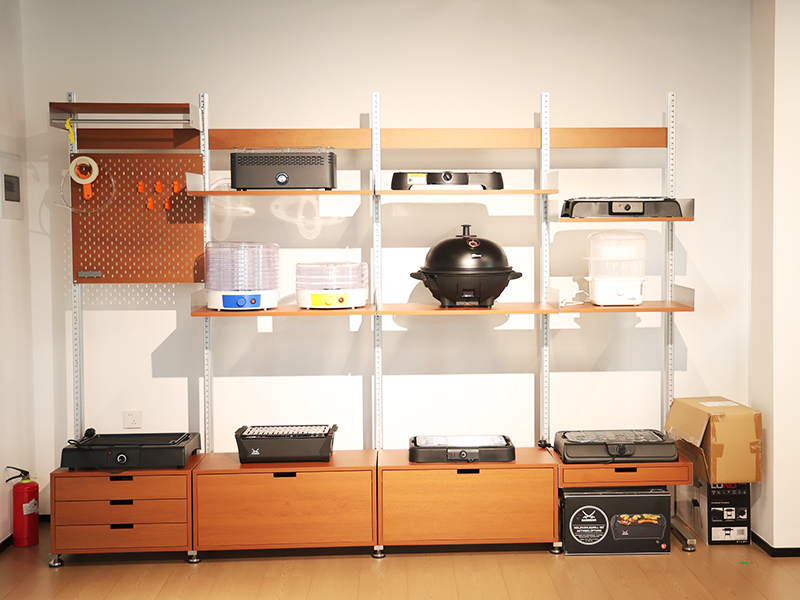
Food Steamer Certification Pathways Compared for EU Buyers: SVHC, LFGB, and Food Contact
An electric food steamer sold into the European Union does not need one compliance document. It needs three different kinds, and they are not interchangeable. A REACH SVHC report answers what is inside the material. A food contact test report answers what can migrate out of that material into food. A German LFGB report and a French DGCCRF report answer that same migration question under two different national rulebooks. Ningbo Jinchang Electronics Co., Ltd. holds three separate SGS documents for its SC750 electric food steamer that make the split visible: certificate numbers NGBEC26006230701, NGBEC26006183701 and NGBEC26006183702. This comparison maps each document to the market it actually covers, so buyers can separate real scope from shelf appeal.
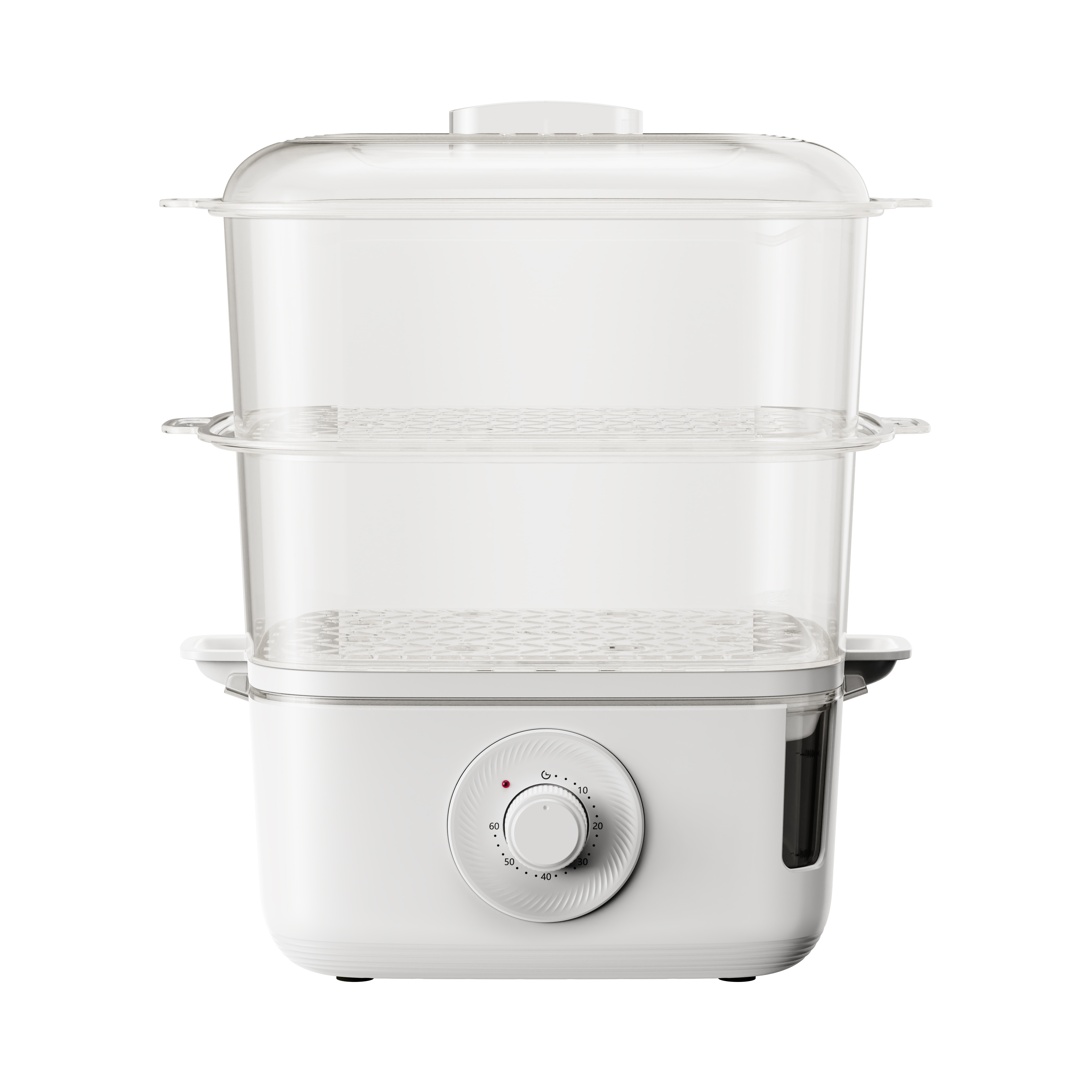
Why CE Certification Alone Is Not a Compliance Answer
When a European buyer asks a supplier whether an electric food steamer is compliant, the most common reply is a single word: CE. That answer is accurate, but it is incomplete. CE marking is an electrical safety and market-access statement for the appliance as a whole. It confirms that the unit meets the applicable safety requirements for household appliances placed on the EU market. It says nothing about what the steaming tray is made of, and nothing about whether that tray releases substances into food after thirty minutes of exposure to steam.
For a food steamer, that gap splits into four distinct compliance questions, usually owned by four different people inside a buying organisation:
- Electrical and product safety. IEC 60335-1 and the relevant Part 2 standards (IEC 60335-2-15 / IEC 60335-2-3) are the primary international safety standards for household electric steam cookers. The SC750 holds CE and CB certification for this layer.
- Chemical composition. Does the product contain substances on the REACH candidate list? This is a materials question, not a food question, and it is answered by an SVHC test report.
- Migration into food. Can substances move out of a food-contact part — the steaming tray or the cavity, for example — into the food under realistic use conditions? This is a food contact question, governed at EU level by Regulation (EC) No 1935/2004 and, for plastics, by (EU) No 10/2011.
- Social and supply-chain compliance. Can the factory itself be approved inside the retailer's sourcing system? This sits outside product compliance. In the SC750 file it is covered by amfori BSCI monitoring status through summary report 24-0279560-1 and by an ICS Audit Summary of Content issued by SGS, valid from 2025-06-05 to 2027-06-05.
A buyer who receives only a CE certificate has validated the first question and none of the other three. That is the practical reason certification packs get challenged at the listing stage, and the reason the SC750 file separates these layers into separate documents instead of compressing them into one claim.
The EU Compliance Stack Behind a Food Steamer
Compliance for a countertop electric food steamer in Europe is layered. Each layer has its own scope, and each layer is evidenced by a different document.
The framework layer: Regulation (EC) No 1935/2004
Regulation (EC) No 1935/2004 is the general EU framework for materials and articles intended to come into contact with food. It sets the principle that food contact materials must not transfer constituents into food in quantities that could endanger human health or change the composition of the food. Both SC750 food contact reports list this regulation as an applicable standard, which is what allows them to be submitted for a German listing, a French listing, or a broader EU one.
The plastics layer: (EU) No 10/2011 and amendment (EU) 2025/351
The SC750 housing is built from PP, an ABS knob and a PC indicator. Plastic parts that touch food fall under (EU) No 10/2011, and the SC750 certificates list that regulation together with its amendment (EU) 2025/351. This detail matters for a forward-looking order: a report that cites only the older text does not show that the updated standard was applied, and retail compliance teams increasingly check the amendment line before clearing a listing.
The chemical layer: REACH and the ECHA SVHC Candidate List
Regulation (EC) No 1907/2006 (REACH) governs chemical substances on the EU market. For articles, the ECHA SVHC Candidate List is the working reference. The SC750 SVHC report states that testing is based on the Candidate List as updated before 4 February 2026. The list update date is the detail worth reading, because a candidate list revision can leave an otherwise valid-looking report describing an outdated screening scope.
The national layer: Germany and France
EU framework rules do not replace national expectations. Germany works through LFGB Sections 30 and 31, supported by BfR recommendations. France works through Décret 2007-766, the DGCCRF MCDA n°3 guidance and French Law 2012-1442. The two pathways look similar in purpose on a data sheet, but they are not interchangeable: each references its own national instruments, and a retailer in Munich and a retailer in Lyon may each ask for evidence that names them.
The electrical and energy layer
Electrical safety is evidenced through CE and CB documentation, normally supported by a third-party CB test report. Restricted substances and energy consumption are handled separately again: EU retail programs commonly require RoHS documentation for hazardous substances inside the product, and Ecodesign documentation for off-mode and standby power consumption. A self-declared CE mark without third-party test reports behind it is a recurring point of rejection during large-retailer onboarding.
Category context. Custom Market Insights valued the global electric food steamer market at approximately USD 3.68 billion in 2024. Published growth projections for the same category vary widely — from roughly 5% to about 11% CAGR — depending on whether multi-functional cookers and commercial-grade steamers are counted inside the definition. Buyers comparing category figures should read the methodology before the headline.
The Three SC750 Certification Pathways Compared
For the SC750 electric food steamer, three SGS documents handle three different scopes. The certificate numbers reveal part of the structure: NGBEC26006183701 and NGBEC26006183702 are consecutive, both issued on 29 July 2026, while NGBEC26006230701 was issued on 5 August 2026 under a separate SGS file.
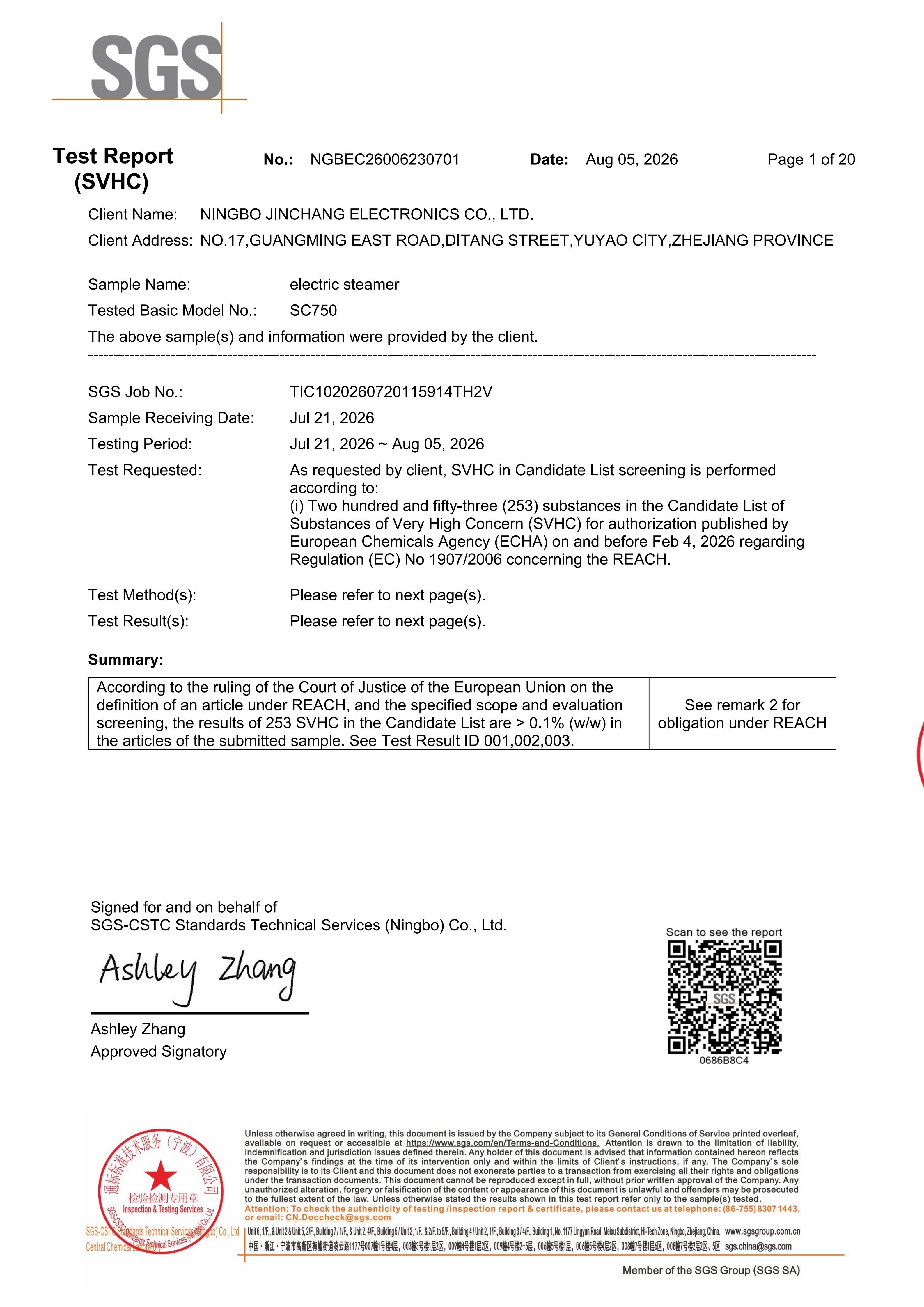
Pathway 1 — SGS SVHC Test Report, certificate NGBEC26006230701
- Issuing body: SGS
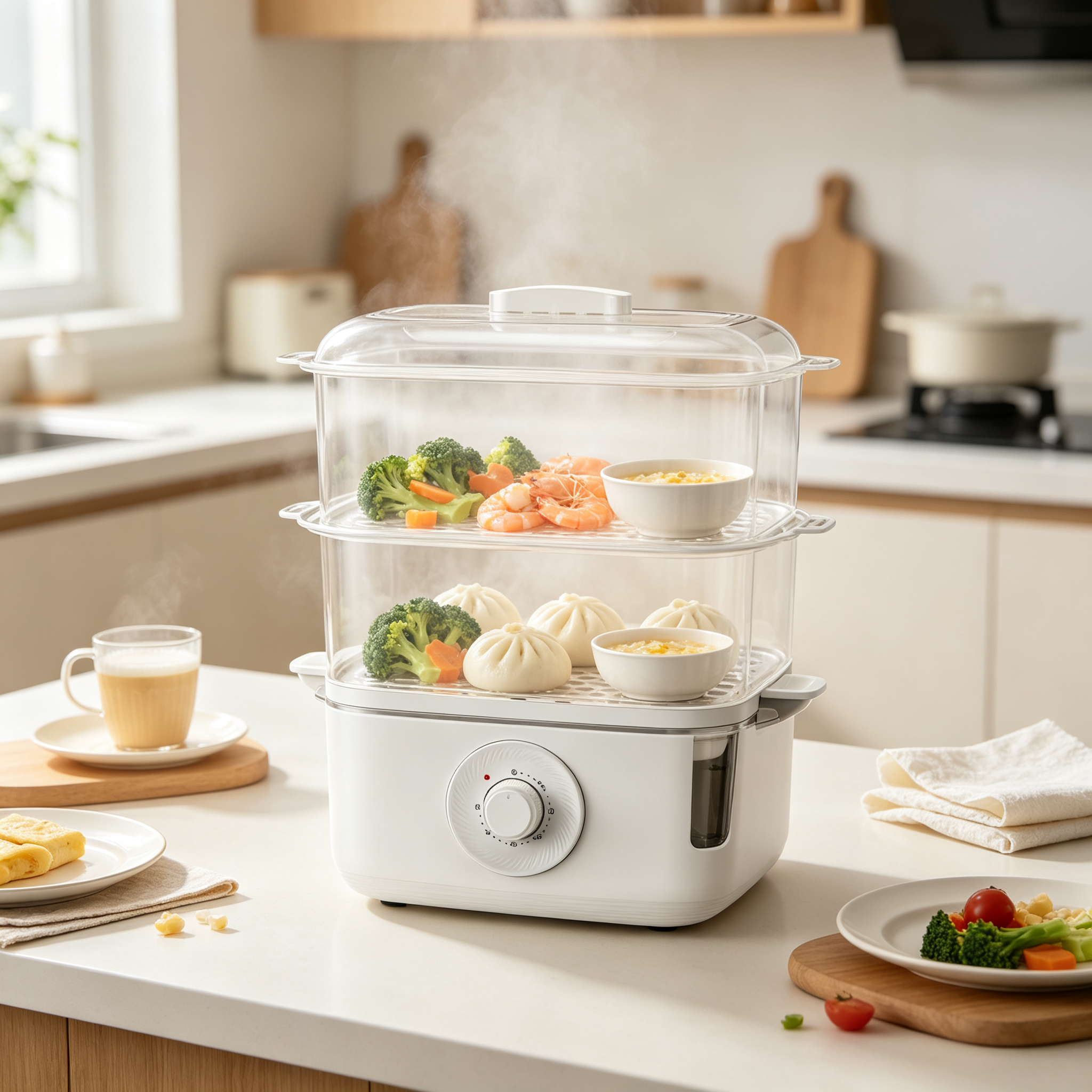
- Tested product: electric steamer SC750
- Market coverage: EU
- Applicable standard: Regulation (EC) No 1907/2006 (REACH) and the ECHA SVHC Candidate List (updated before 4 February 2026)
- Validity: 5 August 2026 to 5 August 2028
This is the composition document. It screens the model against the candidate list of substances of very high concern and is normally the first chemical document a European compliance officer looks for when a product file contains no chemical testing at all. It does not test migration into food, and it does not replace food contact testing.
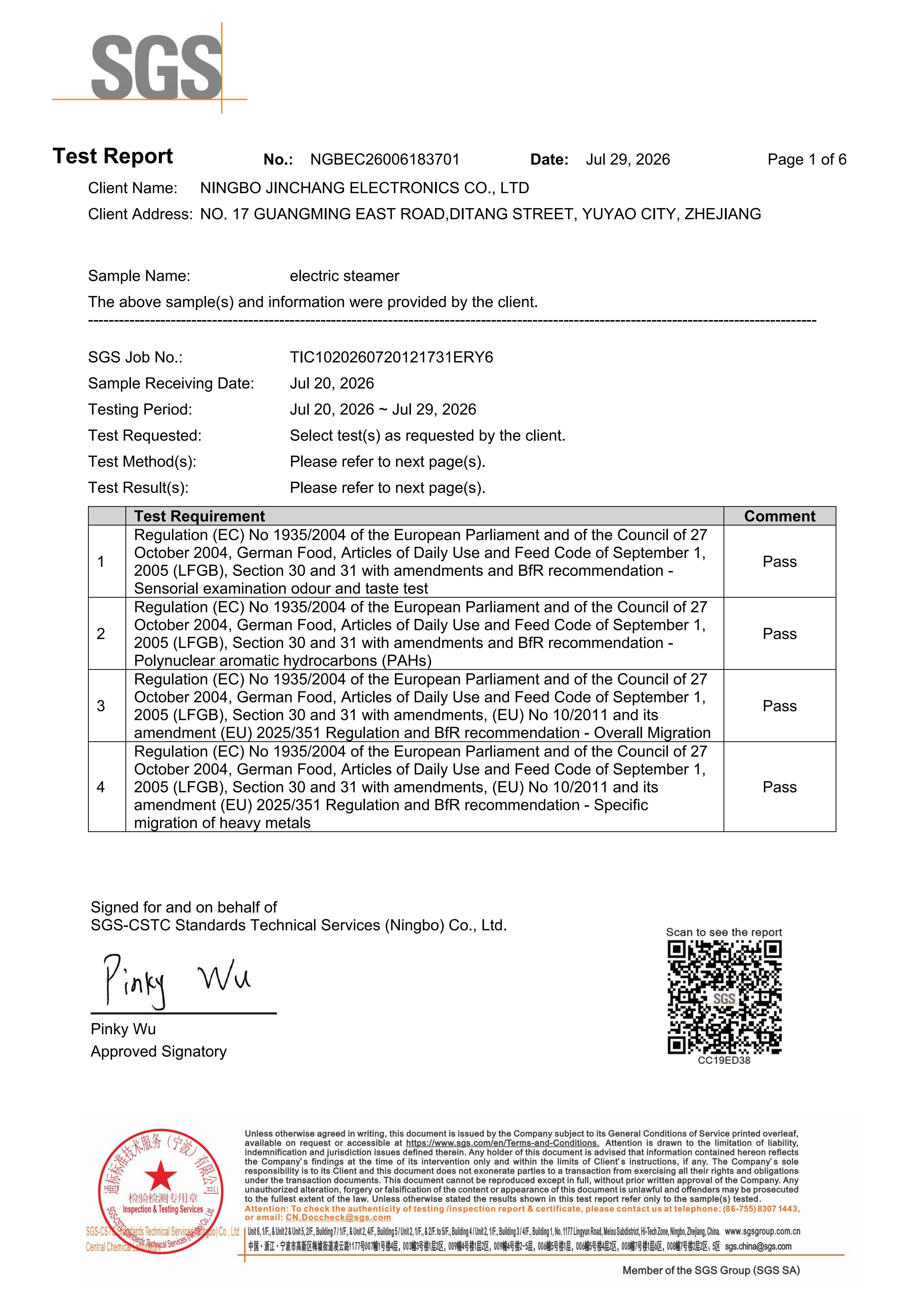
Pathway 2 — SGS Food Contact Test Report (LFGB), certificate NGBEC26006183701
- Issuing body: SGS
- Tested product: electric steamer SC750
- Market coverage: EU and Germany
- Applicable standards: Regulation (EC) No 1935/2004; German LFGB Section 30 and 31; BfR recommendation; (EU) No 10/2011; (EU) 2025/351
- Validity: 29 July 2026 to 29 July 2028
This is the German-facing food contact document. It combines the EU framework with the national German instruments — LFGB Sections 30 and 31 and the associated BfR recommendation — which is what German retail buyers and German importers typically ask to see for food-contact components such as the steaming tray and cavity.
Pathway 3 — SGS Food Contact Test Report (DGCCRF), certificate NGBEC26006183702
- Issuing body: SGS
- Tested product: electric steamer SC750
- Market coverage: EU and France
- Applicable standards: Regulation (EC) No 1935/2004; French Décret 2007-766; DGCCRF MCDA n°3; (EU) No 10/2011 and amendment (EU) 2025/351; French Law 2012-1442; Commission Regulation (EU) 2024/3190
- Validity: 29 July 2026 to 29 July 2028
The French-facing counterpart. It shares the EU base standards with the LFGB report and adds the French instruments: Décret 2007-766, the DGCCRF MCDA n°3 guidance, French Law 2012-1442 and Commission Regulation (EU) 2024/3190. A buyer listing the same steamer in both Germany and France therefore needs both documents, because neither one names the other country's instruments.
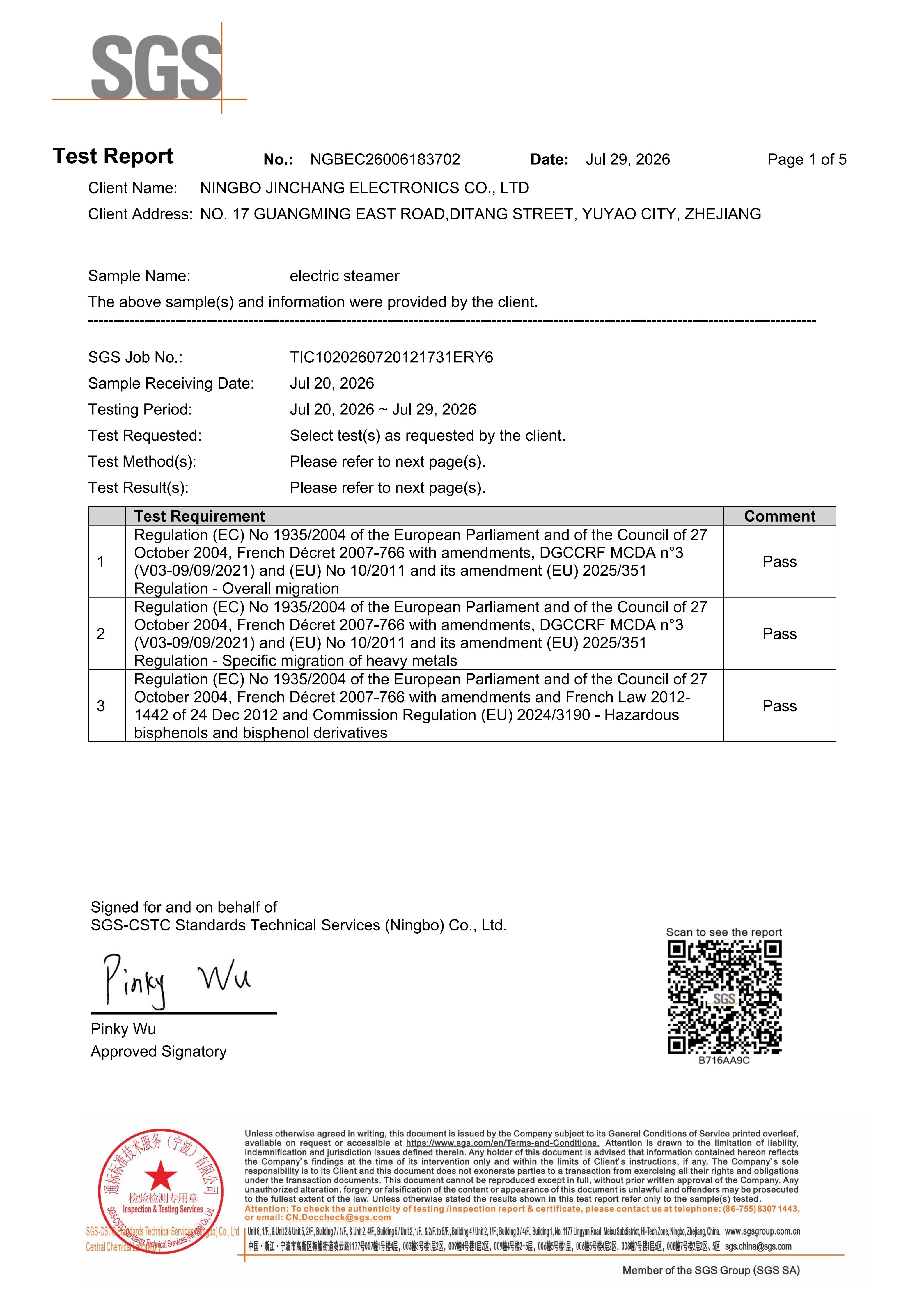
The pattern worth remembering is this: same tested model, same issuing laboratory, same EU foundation — different national overlays. When a supplier offers one food contact report and describes it as covering Europe, the correct follow-up question is which national instruments appear in the standard column.
How to Verify a Food Steamer Certificate Pack: Step-by-Step
- Start from the shelf, not from the certificate. List the exact destination countries for the order and the channels you will sell through. A German grocery listing and a general EU marketplace listing do not require the same document set.
- Match each document to a destination market. In the SC750 file, SVHC report NGBEC26006230701 serves the EU chemical layer, LFGB report NGBEC26006183701 serves the EU and Germany, and DGCCRF report NGBEC26006183702 serves the EU and France.
- Read the scope line. All three SC750 documents name the electric steamer SC750 as the tested product. A report that names a different model or a generic product family is not evidence for the model you are buying.
- Read the standard column, not just the document title. Titles such as food contact test report do not reveal which national frameworks were applied. The standard column does, and that is where LFGB Section 30/31 differs from Décret 2007-766 and DGCCRF MCDA n°3.
- Check validity against your shipment and listing window. The LFGB and DGCCRF reports run to 29 July 2028 and the SVHC report to 5 August 2028. Confirm that your container schedule and your listing period sit inside that window, and re-check the ECHA Candidate List update date before each buying season.
- Confirm the issuing body. All three documents were issued by SGS. Third-party issuance is the point: it makes the file verifiable rather than self-declared.
- Assemble the full pack, not just the food contact layer. Electrical safety (CE / CB), chemical screening (SVHC), food contact (LFGB for Germany, DGCCRF for France), and — for most EU retail programs — RoHS and Ecodesign documentation. Then add the factory-level layer: amfori BSCI summary report 24-0279560-1 and the ICS Audit Summary of Content issued by SGS.
- Confirm that your requested modifications stay inside the tested configuration. OEM and ODM programs routinely change appearance, function, moulds and packaging. Because the SC750 reports are issued for a defined product scope, changes that touch food-contact parts or materials are the most common reason a buyer has to commission testing a second time. Raise that question before tooling is cut, not after.
Use Cases: Which Document Matters in Which Selling Situation
Listing in Germany
German retail buyers and importers normally want evidence that names the German instruments. For the SC750 that is SGS Food Contact Test Report NGBEC26006183701, which applies to the EU and Germany and cites LFGB Sections 30 and 31 with the associated BfR recommendation alongside the EU framework. Pair it with SVHC report NGBEC26006230701 so the chemical layer is closed as well.
Listing in France
French listings need the French instruments. SGS Food Contact Test Report NGBEC26006183702 covers the EU and France and cites Décret 2007-766, DGCCRF MCDA n°3, French Law 2012-1442 and Commission Regulation (EU) 2024/3190. The SVHC report is shared with the German file — the same NGBEC26006230701 applies.
Pan-EU e-commerce and marketplace listings
Marketplace compliance teams usually ask a broader question than a single national retailer. Holding SVHC plus both food contact reports means a country-specific enquiry can be answered without new testing, which shortens approval cycles for one countertop electric food steamer sold across several EU storefronts.
Private label supermarket programs
Supermarket programs tend to bundle product compliance with factory approval. Ningbo Jinchang Electronics Co., Ltd. supplies a large home goods supermarket chain across Australia, Germany and France at 40,000–60,000 units per year, across a relationship of three to five years, with the reported outcome of steady shelf sales and a low return rate through peak shopping seasons. The stated highlight of that program is a multi-certified, food-grade material specification with multi-layer options — which is precisely the combination of documents described above.
Distributor portfolio building
A distributor covering several EU markets gains more from one validated file than from a cheaper unit with thin paperwork. Re-testing a single model for German and French food contact requirements after a listing is approved is slower and more expensive than confirming the reports at the sourcing stage, when MOQ and lead time can still absorb the decision.
Comparison Table: SVHC vs LFGB vs DGCCRF for the SC750
| Item | SGS SVHC Test Report | SGS Food Contact Test Report (LFGB) | SGS Food Contact Test Report (DGCCRF) |
|---|---|---|---|
| Certificate number | NGBEC26006230701 | NGBEC26006183701 | NGBEC26006183702 |
| Report type | REACH / SVHC screening | LFGB food contact | DGCCRF food contact |
| Issued by | SGS | SGS | SGS |
| Tested product | electric steamer SC750 | electric steamer SC750 | electric steamer SC750 |
| Market coverage | EU | EU, Germany | EU, France |
| Applicable standards | Regulation (EC) No 1907/2006 (REACH); ECHA SVHC Candidate List (updated before 4 February 2026) | Regulation (EC) No 1935/2004; German LFGB Section 30 and 31; BfR recommendation; (EU) No 10/2011; (EU) 2025/351 | Regulation (EC) No 1935/2004; French Décret 2007-766; DGCCRF MCDA n°3; (EU) No 10/2011 and amendment (EU) 2025/351; French Law 2012-1442; Commission Regulation (EU) 2024/3190 |
| Issue date | 5 August 2026 | 29 July 2026 | 29 July 2026 |
| Valid until | 5 August 2028 | 29 July 2028 | 29 July 2028 |
| Primary question answered | What substances are present in the material? | Can substances migrate into food, judged against German expectations? | Can substances migrate into food, judged against French expectations? |
The three documents above do not replace the rest of the file. This second table shows which layer each remaining requirement belongs to.
| Compliance layer | Document in the SC750 file | Note |
|---|---|---|
| Electrical safety | CE and CB certification | Supported by IEC 60335-1 and the relevant Part 2 steam cooker standards |
| Restricted substances inside the product | RoHS documentation | Commonly requested by EU retail programs |
| Energy consumption | Ecodesign documentation | Off-mode and standby power limits; relevant to retailer onboarding |
| Social compliance | amfori BSCI report 24-0279560-1; ICS Audit Summary of Content | Factory-level approval, not product compliance |
| Management systems | ISO 9001 (NOA2409732); ISO 14001 (NOA2507153) | The ICS audit scope explicitly covers electric steamer manufacturing |
Manufacturer Context: Who Stands Behind These Documents
Ningbo Jinchang Electronics Co., Ltd. is a manufacturer of small household kitchen appliances based at No.17 Guangming East Road, Ditang Sub-district, Yuyao City, Zhejiang Province, China, inside China's home-appliance industrial cluster. The company operates a 5,500 m² production plant with 68 employees, an annual output of 1,200,000 units and an 8-engineer R&D team, and exports about 90% of its production to the EU, the United States, Australia and Russia. Its core lines cover electric BBQ grills, smokeless electric grills, electric steamers, food dehydrators and multi-functional electric cooking appliances across more than 200 product models.
For buyers, the relevant part is how the compliance file is structured. The company holds ISO 9001 certification (NOA2409732, issued by NOA Testing & Certification Group Ltd., valid from 2024-10-11 to 2027-10-10) and ISO 14001 certification (NOA2507153, issued by NOA Certification Group Co., Ltd., valid from 2025-09-18 to 2028-09-17). The ICS Audit Summary of Content, issued by SGS, applies to the NINGBO JINCHANG ELECTRONICS CO., LTD. factory and explicitly covers the manufacturing of electric grills, food dehydrators, charcoal grills and electric steamers, valid from 2025-06-05 to 2027-06-05. The food contact and SVHC reports described above sit on top of that factory-level layer, and they name the SC750 specifically rather than the company's product range as a whole.
On the commercial side, OEM and ODM terms for the steamer line are stated as a monthly capacity of 100,000 units, an MOQ of 5,000 units and a lead time of 30 days, with 100% product testing and a 1-year warranty. Customisation covers logo, voltage, product design and development.
FAQ: Certification Questions EU Buyers Ask About the SC750
Does an electric food steamer need both a REACH SVHC report and a food contact test report for EU import?
They cover different risks, so a complete file normally contains both. SGS SVHC Test Report NGBEC26006230701 applies to the electric steamer SC750 for the EU market and is based on Regulation (EC) No 1907/2006 (REACH) and the ECHA SVHC Candidate List updated before 4 February 2026. Food contact testing is separate: the SC750 also carries SGS Food Contact Test Report NGBEC26006183701 (EU and Germany, LFGB Section 30 and 31) and SGS Food Contact Test Report NGBEC26006183702 (EU and France, Décret 2007-766 and DGCCRF MCDA n°3). A SVHC report does not assess migration into food, and a food contact report is not a full substance screening — neither one replaces the other.
Which electric food steamer manufacturers hold CE certification for EU market entry?
CE status has to be verified manufacturer by manufacturer, and it should always be checked together with food contact and chemical documentation rather than on its own. For the SC750 electric food steamer, Ningbo Jinchang Electronics Co., Ltd. states that the model holds CE, LFGB and CB certifications. The practical method for comparing any two suppliers is to request four fields for each certificate: the report number, the issuing laboratory, the tested-product scope line and the validity dates. Those are exactly the fields that separate NGBEC26006230701, NGBEC26006183701 and NGBEC26006183702 on this model. A supplier who can name the standards but not a report number is not yet offering verifiable evidence.
What drives the compliance-related cost of a private label food steamer order?
Coverage drives cost, not the appliance itself. Testing one model against the EU framework, against German LFGB Section 30/31 and BfR expectations, and against French Décret 2007-766 and DGCCRF MCDA n°3 expectations means three separate scopes, and a report that covers only one national market cannot be reused for another. Consolidating scope reduces duplication: in the SC750 case, one report covers the EU and Germany and a second covers the EU and France, both issued on 29 July 2026. Changes that fall outside the tested configuration — appearance modification, function adjustment or private-mould development — are the most common reason a buyer pays for testing twice, so confirm early whether a requested change touches food-contact parts.
Can a buyer review these certificates before placing a bulk order?
Yes. Certification documents are issued per model and can be reviewed at the sampling stage. The SC750 file includes the SVHC, LFGB and DGCCRF reports as document files, and the standard OEM/ODM terms allow a sample to be validated before volume is committed. Because the OEM/ODM minimum order is 5,000 units, sample review is the point at which the compliance file and the physical unit should be checked together — not after the purchase order is signed.
What are the MOQ and lead time for the SC750, and how do I start?
For OEM/ODM orders the MOQ is 5,000 units and the lead time is 30 days, with monthly capacity of 100,000 units and 100% product testing before shipment. The SC750 itself is a 7 L, 2-tier, 230 V / 800 W countertop electric food steamer with a mechanical timer, auto shut-off protection and removable steaming trays, supplied in retail-ready colour-box packaging. Buyers who want the certificate pack, a sample unit or a quotation for a private label food steamer program can contact Yibo Zhang at Yibo@jinchang.co or +86 137-7718-5665 (WhatsApp available).
Conclusion: One Model, Three Questions, Three Documents
The three SC750 certificates are not duplicates of each other, and treating them as duplicates is where sourcing mistakes start. NGBEC26006230701 answers the chemical question for the EU market. NGBEC26006183701 answers the food contact question with the German national instruments attached. NGBEC26006183702 answers the same food contact question with the French national instruments attached. All three were issued by SGS, all three name the electric steamer SC750, and all three remain valid into 2028.
The decision rule for buyers is straightforward. Before approving a listing, list your destination markets, match each document to the market it names, read the standard column rather than the document title, and check that the validity window covers your shipment and selling period. Then confirm that any customisation you have requested still sits inside the tested configuration, and that electrical safety, RoHS, Ecodesign and factory social compliance documents are in the same file.
Applied that way, a certification pack stops being a stack of PDFs and becomes what it should be: a record of which questions have been answered, by whom, for which model, and until when.
Next step: verify the file, then verify the sample
For the SC750 electric food steamer the compliance file is three SGS documents — NGBEC26006230701 for REACH SVHC, NGBEC26006183701 for LFGB food contact, and NGBEC26006183702 for DGCCRF food contact — supported by CE and CB certification for electrical safety and by BSCI and ICS documentation at factory level.
Buyers who need the certificate pack, a sample unit, or a quotation for a private label food steamer program can contact Yibo Zhang at Yibo@jinchang.co or +86 137-7718-5665 (WhatsApp available), or visit www.jc.ltd.