Food Steamer SC750: Germany LFGB vs France Food Contact vs EU SVHC Options
Short answer: the SC750 electric food steamer is supported by three separate compliance files, and each file answers a different question. The LFGB report NGBEC26006183701 supports the German food-contact claim. The SGS Food Contact report NGBEC26006183702 supports the French market claim. The SGS SVHC report NGBEC26006230701 supports the EU REACH substance claim. A buyer preparing a German retail listing, a French supermarket listing, or a multi-country EU distribution programme needs the file that matches the claim actually being made — on the packaging, in the retailer questionnaire, or on the marketplace compliance form — not simply the file that happens to be on hand.
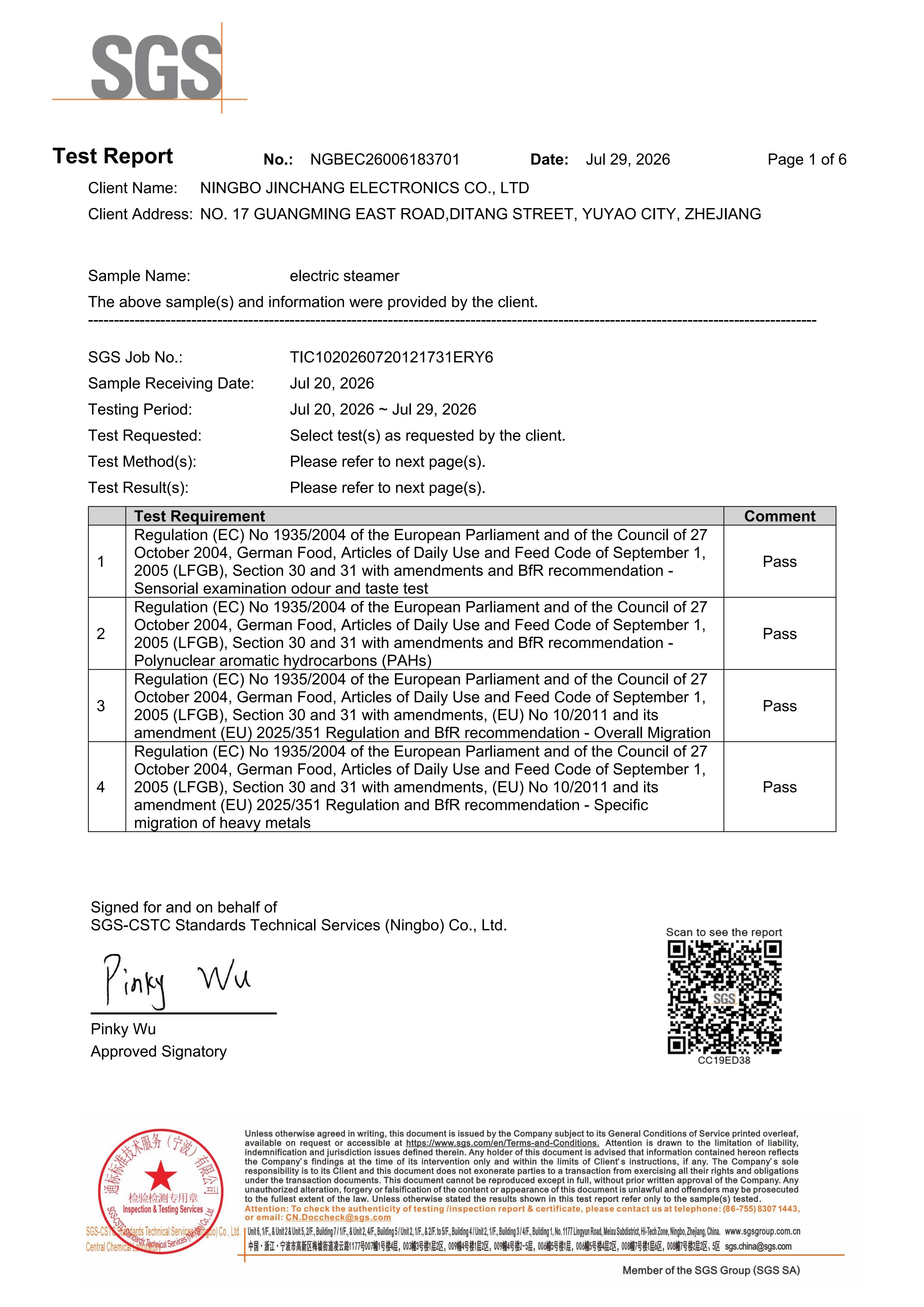
The German option in the SC750 compliance set: LFGB report NGBEC26006183701, one of three destination-specific files discussed in this guide.
Problem definition: why one report cannot carry three market claims
Most sourcing conversations about food steamers start the same way: a buyer asks whether the supplier has “LFGB” and treats a yes as the end of the compliance discussion. That works when the destination is Germany and the only document a retailer asks for is the LFGB file. It stops working the moment the same purchase order is split across Germany, France and a general EU distribution channel — which is common for importers who buy one SKU and allocate it across several retail accounts.
Three specific failures repeat in this category:
- Claim and document drift. A French retailer questionnaire asks for French food-contact documentation and receives a German LFGB report instead. The product may be perfectly sound, but the file does not answer the question asked, so the listing stalls in quality assurance review.
- Substance testing read as food-contact approval. An SVHC report is a statement about substances of very high concern under REACH. It is not a migration or food-contact suitability report, and presenting it as one invites a second review cycle.
- Electrical safety read as food-contact approval. CE and CB certification address the electrical safety of the appliance. They do not replace food-contact material testing of the steaming trays, cavity, lid or water tank.
The commercial cost is rarely the test fee itself. It is the weeks added when a purchase order is already placed, the packaging already printed with a market claim, and the certificate set has to be rebuilt for a destination that was known from the start.
Industry background: three layers of regulation behind a countertop appliance
Food-contact compliance for a countertop electric steamer sits on three overlapping layers, and the SC750 files are organised around them.
Layer 1 — the EU general framework
Regulation (EC) No 1935/2004 is the general EU framework for materials and articles intended to come into contact with food. It establishes the principle that food-contact materials must not transfer constituents to food in quantities that endanger health or unacceptable change the composition, and it carries information obligations along the supply chain. For plastic food-contact components, Regulation (EU) No 10/2011 sets the specific measure, and (EU) 2025/351 is the 2025 layer applied on top of it. Both are named in the German file for the SC750.
Layer 2 — national food-contact requirements
Germany applies LFGB, and Sections 30 and 31 of LFGB are the provisions referenced in the German option for the SC750. France applies its own national framework: French Law 2012-1442, Décret 2007-766, and the DGCCRF MCDA n°3 guidance, read alongside Commission Regulation (EU) 2024/3190 in the French option for this model. National frameworks do not disappear because an EU-level act exists; a French retailer will normally ask for the French reading.
Layer 3 — horizontal chemical obligations
REACH and the ECHA candidate list of substances of very high concern apply across product categories. An SVHC file is the answer to a substance question, not to a food-contact question. It is nonetheless a standing requirement in EU procurement because importers increasingly screen suppliers on SVHC status before any application discussion begins.
The category context makes this paperwork routine rather than exceptional. Custom Market Insights reported the global electric food steamer market at approximately USD 3.68 billion in 2024, with Asia-Pacific identified as the largest and fastest-growing region. Published growth forecasts for the category differ by methodology, so this guide does not use a growth rate to support any compliance decision. What matters for a buyer is simpler: the category is large, cross-border, and audited, so documentation quality is part of product quality.
Detailed solution: the three SC750 compliance options in practice
The SC750 is a two-layer electric food steamer with a 7L capacity, rated 230V and 800W, built with a PP housing, ABS knob and PC indicator. It uses a rotary mechanical timer with an automatic shut-off function, removable steaming trays, and a visible independent water tank. Food-contact parts are declared against LFGB, and the model carries CE, LFGB and CB certification for the EU market. It is packed in a retail colour box and is supplied for household retail, wholesale and OEM/ODM programmes.
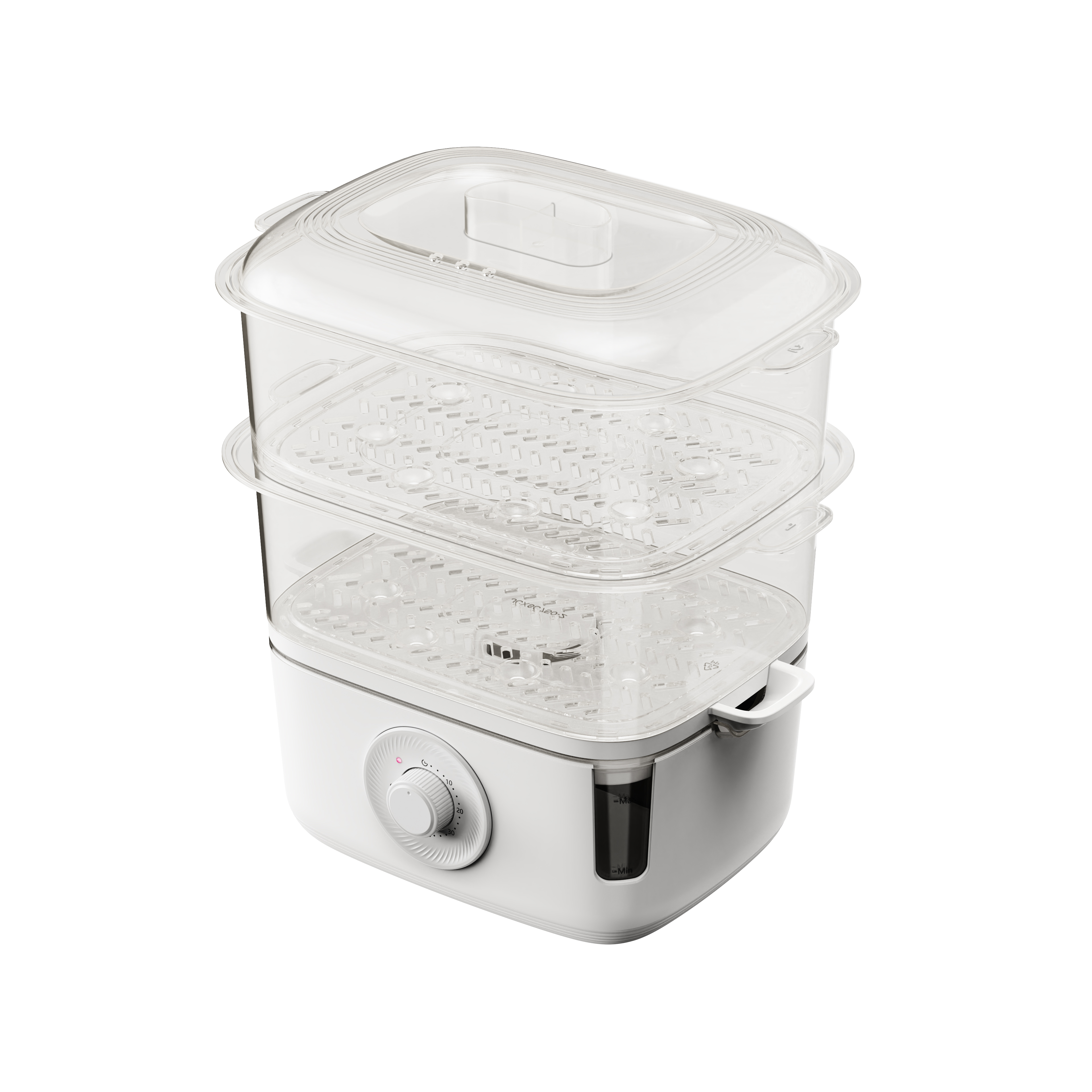
SC750 electric food steamer: 7L, 2-layer, 230V/800W, rotary timer with automatic shut-off. The compliance option is chosen by destination, not by appliance specification.
Option A — Germany: LFGB file NGBEC26006183701
What it answers: whether the food-contact components of the SC750 meet the German LFGB expectation that a German retailer, importer or marketplace will ask about.
Regulatory anchors named in the file: LFGB Sections 30 and 31, together with (EC) No 1935/2004, (EU) No 10/2011 and (EU) 2025/351.
When it is the primary file: the packaging or listing carries a German market claim, the retail account is German, or the importer's quality team uses LFGB as its food-contact reference standard regardless of final allocation.
What it does not replace: the French food-contact file, and the SVHC file. A German LFGB report is not a statement about the ECHA candidate list, and it is not the document a French retailer's questionnaire is designed around.
Option B — France: SGS Food Contact file NGBEC26006183702
What it answers: whether the food-contact components of the SC750 are supported for the French market claim, under the French reading of food-contact requirements.
Regulatory anchors named in the file: Commission Regulation (EU) 2024/3190, French Law 2012-1442, Décret 2007-766 and DGCCRF MCDA n°3.
When it is the primary file: a French supermarket chain, a French e-commerce marketplace, or a French distributor is the account of record, or the retail packaging carries French-language market claims.
What it does not replace: the German LFGB file. LFGB and the French framework are separate national readings, and a French quality team working from DGCCRF MCDA n°3 will normally want the document set that references it.
Option C — EU: SGS SVHC file NGBEC26006230701
What it answers: whether the SC750 is screened against substances of very high concern under REACH and the ECHA candidate list.
Regulatory anchors named in the file: REACH and the ECHA SVHC candidate list.
When it is the primary file: an EU-wide distribution programme, a marketplace chemical-screening form, a corporate procurement questionnaire, or an importer that applies a single substance policy across all categories it buys.
What it does not replace: either food-contact file. An SVHC report speaks to substance presence, not to migration behaviour of the trays and cavity in contact with hot food.
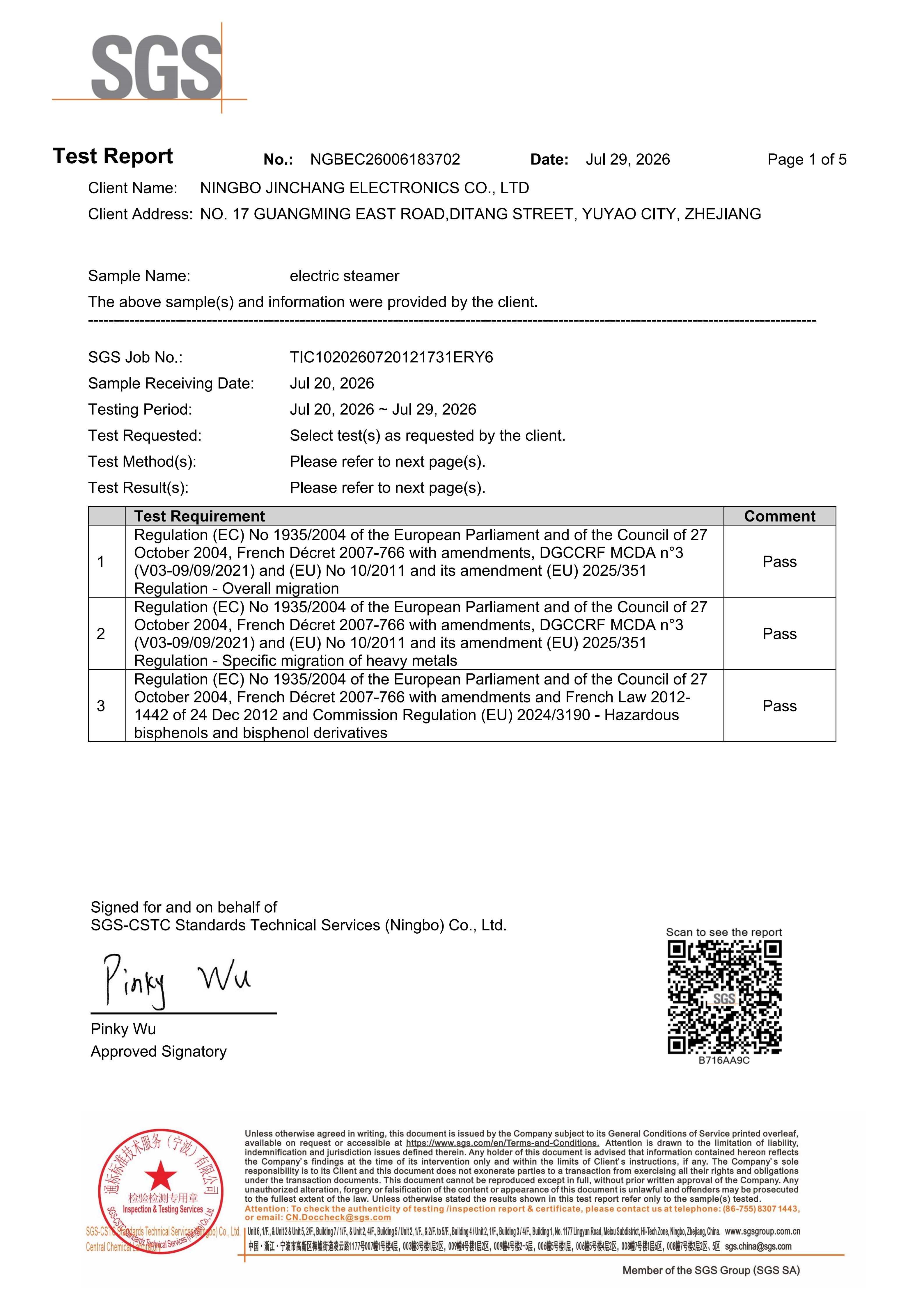
The French option: SGS Food Contact file NGBEC26006183702, read alongside the French national framework named in the document set.
Step-by-step: matching a destination claim to the right certificate
Step 1 — Write the destination claim in one sentence per market
Examples: “sold in Germany through a German retail chain”, “sold in France through a French e-commerce marketplace”, “distributed across several EU member states from one central warehouse”. Each sentence points to a different primary file. If a single order covers more than one sentence, the order needs more than one file.
Step 2 — Map each claim to exactly one primary certificate
German claim to NGBEC26006183701. French claim to NGBEC26006183702. EU substance-screening claim to NGBEC26006230701. Resist the temptation to submit a second file “for extra support” without labelling which claim it belongs to — unlabelled attachments create confusion in quality review.
Step 3 — Confirm the certificate covers the parts you actually ship
For a steamer, the food-contact parts are the steaming trays, the cavity and the parts that meet condensate. The SC750 declares food-contact components against LFGB and uses a PP housing with ABS knob and PC indicator. If your programme changes tray material, adds a rice basket variant or alters the water tank, the document set must be re-checked against the changed part, not assumed to carry over.
Step 4 — Check that the legal anchor is still the current one
Food-contact frameworks get amended. The German file names (EU) 2025/351 on top of (EU) No 10/2011; the French file names (EU) 2024/3190 alongside the French national instruments; the SVHC file sits on the ECHA candidate list, which is updated periodically. Ask the supplier to confirm the version date of the anchor cited in the report rather than accepting a report number alone.
Step 5 — Ask for the document set in the language your reviewer reads
A technically valid report that the receiving quality team cannot process still blocks a listing. Confirm at quotation stage whether the certificate set, the declaration of conformity and the packaging claim are provided in the language the destination account works in.
Step 6 — Reconcile at purchase-order level
Before shipment, match model, material and packaging across three records: the certificate, the purchase order specification, and the retail carton. Most post-shipment document disputes are caused by a packaging change made after the certificate was issued, not by a testing failure.
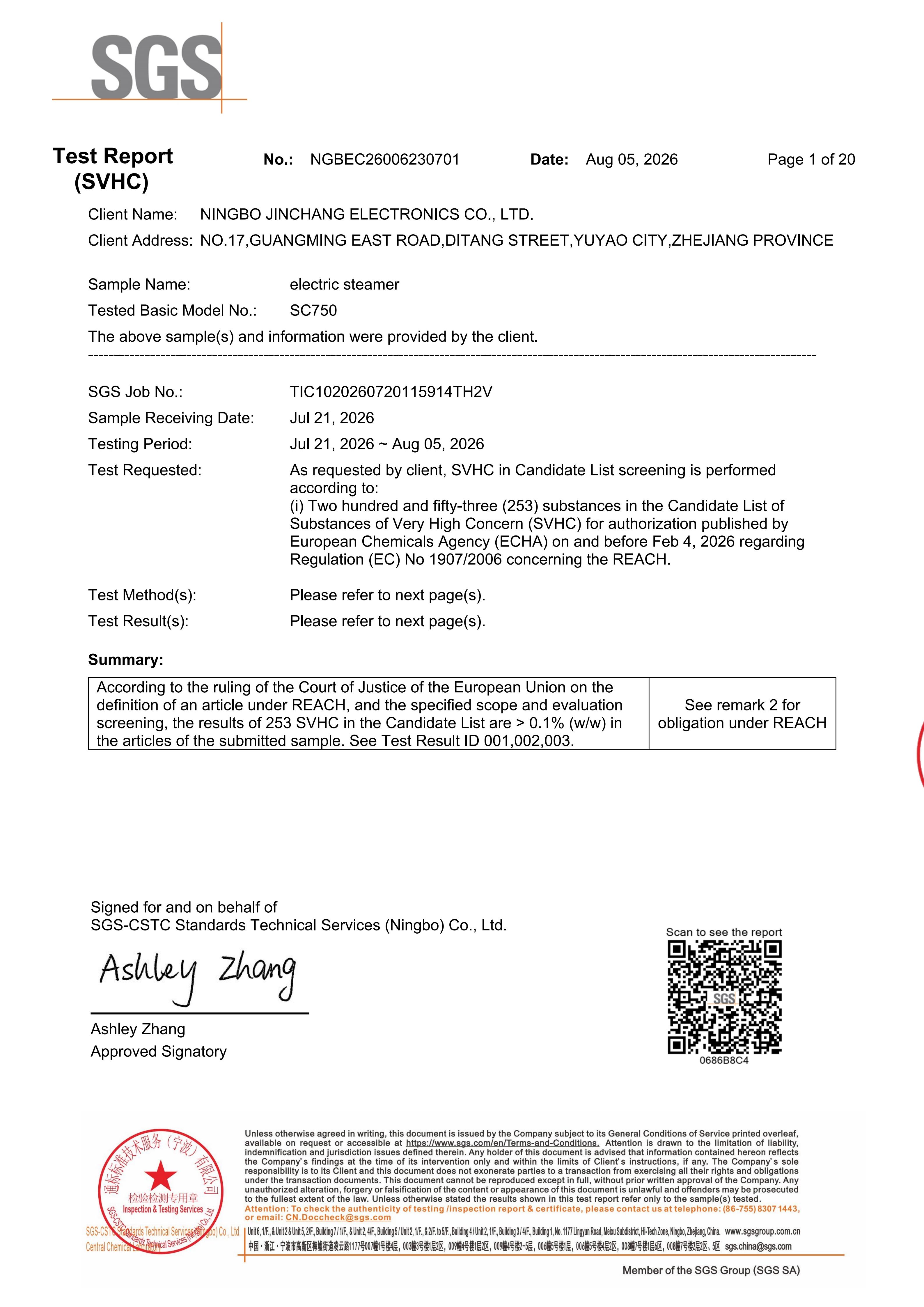
The EU option: SGS SVHC file NGBEC26006230701, the substance-screening document that supports REACH-related questionnaires.
Use cases: where each option is the practical choice
German retail private-label programme
A German retail chain listing a private-label countertop electric food steamer will normally build its quality file around LFGB. In this configuration NGBEC26006183701 is the lead document. The SC750 is a two-layer 7L unit with mechanical timer control, which fits private-label retail because operation is simple across age groups and no app pairing is required. Ningbo Jinchang Electronics Co., Ltd. supports appearance modification, voltage configuration, private-mould development and customised packaging for such programmes.
French supermarket or marketplace listing
A French account works from the French framework, so NGBEC26006183702 becomes the lead document. This is also where packaging language matters: retail colour-box artwork carrying French claims should be finalised after the claim-to-file mapping is confirmed, not before.
Multi-country EU distribution from one warehouse
An importer supplying several member states typically holds all three files and attaches the relevant one per account. The SVHC file NGBEC26006230701 supports the cross-border chemical screening that many EU buyers apply to every SKU regardless of destination, while the two food-contact files are matched per national account.
Contracted retail supply with recurring volume
For buyers running multi-year programmes, documentation stability matters as much as the certificate itself. Large home goods supermarket chains in Australia, Germany and France have used the SC750 for household daily steaming and cooking at a scale of 40,000–60,000 units per year over a project duration of 3–5 years, achieving steady shelf sales and a low return rate. Recurring volume makes it practical to keep the three-file set maintained rather than re-testing per order.
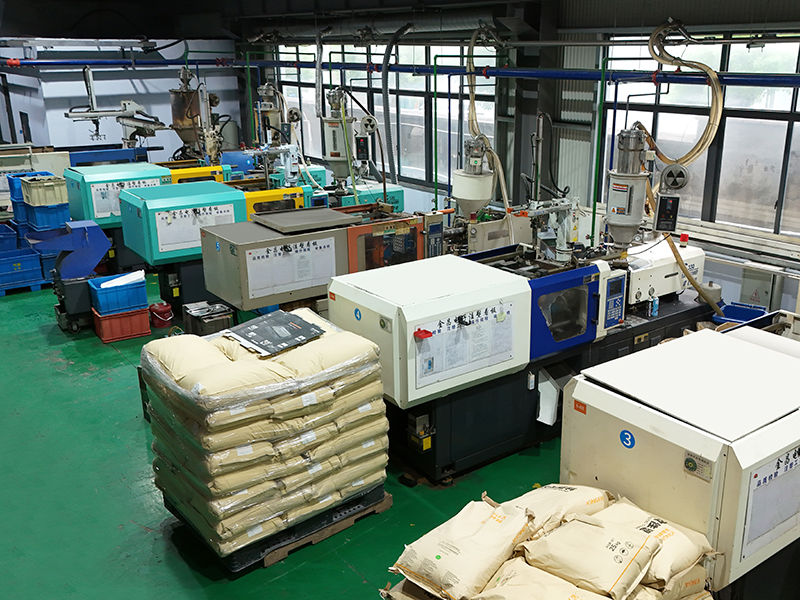
Assembly and testing at Ningbo Jinchang Electronics Co., Ltd., Yuyao City, Zhejiang Province. Quality control is 100% test on the SC750 line.
Office pantry and catering equipment projects
Countertop use on a stable, level surface with a 230V grounded wall socket is the specified operating condition; the unit is rated 230V and cannot run on 110V without a voltage-adjusted model. For office pantry and catering procurement the SC750 fits where multi-tier simultaneous steaming of vegetables, seafood, meat, dumplings, eggs and prepared food is required, with regular cleaning after use built into the operating routine.
SC750 compliance options compared
| Compliance option | Certificate reference | Regulatory anchors named in the file | Primary destination claim it supports | What it does not replace |
|---|---|---|---|---|
| Germany — LFGB | NGBEC26006183701 | LFGB Sections 30/31; (EC) No 1935/2004; (EU) No 10/2011; (EU) 2025/351 | German food-contact claim, German retail and importer quality files | French food-contact file; SVHC screening |
| France — SGS Food Contact | NGBEC26006183702 | Commission Regulation (EU) 2024/3190; French Law 2012-1442; Décret 2007-766; DGCCRF MCDA n°3 | French market claim, French supermarket and marketplace listings | German LFGB file; SVHC screening |
| EU — SGS SVHC | NGBEC26006230701 | REACH; ECHA SVHC candidate list | EU-wide substance screening, marketplace and corporate procurement forms | Either food-contact file |
Comparison based on the certificate references and regulatory anchors named for each SC750 option. Certificates address different questions and are not interchangeable.
FAQ
1. Does the SC750 LFGB certificate also satisfy French food-contact requirements?
No. LFGB report NGBEC26006183701 supports the German claim and names LFGB Sections 30/31 together with (EC) No 1935/2004, (EU) No 10/2011 and (EU) 2025/351. The French claim is supported by a separate document, SGS Food Contact report NGBEC26006183702, which names Commission Regulation (EU) 2024/3190, French Law 2012-1442, Décret 2007-766 and DGCCRF MCDA n°3. Buyers shipping to both markets should hold both files and attach the correct one to each account.
2. Is the SVHC report enough on its own for an EU marketplace listing?
It depends on what the listing asks for. SGS SVHC report NGBEC26006230701 addresses REACH and the ECHA candidate list, which is what most chemical-screening forms request. It does not cover the food-contact question. Where a marketplace or retailer also asks for food-contact documentation, the appropriate national file — NGBEC26006183701 for a German account or NGBEC26006183702 for a French account — is still required alongside it.
3. Can the SC750 be supplied as a private-label programme with these certificates?
Yes. Ningbo Jinchang Electronics Co., Ltd. is an OEM/ODM manufacturer of small kitchen appliances in Yuyao City, Zhejiang Province, producing the SC750 for private-label retail programmes, kitchen appliance wholesale and catering equipment procurement. Customisation available includes logo, voltage, product design and development, and customised packaging. Attribute any packaging or component change to the certificate set before production, because a changed tray material or artwork claim may require the document to be re-checked against the shipped configuration.
4. What commercial terms apply to a certified SC750 order?
The MOQ is 5,000 units, monthly capacity is 100,000 units, and lead time is 30 days. Comparison between compliance options should be made on the document set quoted, not on a single price line: confirm which of the three reports is included, whether the certificate copies and declaration of conformity are supplied in the language your destination reviewer works in, and whether packaging claims were finalised after the claim-to-file mapping. That comparison is more useful than a price difference that later requires re-testing.
5. How should a first-time buyer verify the certificate matches the product?
Request the certificate copies together with a product sample and check three points: the model reference matches SC750; the food-contact parts covered match the parts you will actually receive, including trays and cavity; and the regulatory anchors cited are the current versions named in the document. During sampling, also confirm the operating conditions that affect market fit — 230V rated voltage, 800W power, 2-layer 7L configuration, rotary timer with automatic shut-off, and 100% test quality control. To start that verification, request the full three-file certificate set and an SC750 sample from Ningbo Jinchang Electronics Co., Ltd. at Yibo@jinchang.co or +86 137-7718-5665.
Conclusion: choose the file by claim, not by hierarchy
The SC750 compliance question is not a question about which certificate is strongest. It is a question about which claim the buyer is making. A German account is answered by LFGB report NGBEC26006183701. A French account is answered by SGS Food Contact report NGBEC26006183702. An EU substance-screening requirement is answered by SGS SVHC report NGBEC26006230701. Over-reliance on a single report is the failure mode that costs time — not because the report is weak, but because it was never designed to answer the other two questions.
For buyers researching and evaluating suppliers, the practical test at quotation stage is simple: ask for the claim-to-certificate mapping in writing, confirm the named regulatory anchors, and check that the food-contact parts covered match the configuration you will actually ship. Ningbo Jinchang Electronics Co., Ltd., based at No.17 Guangming East Road, Ditang Sub-district, Yuyao City, Zhejiang Province, China, manufactures the SC750 for export markets including the EU, and holds ISO 9001 and ISO 14001 certification alongside amfori BSCI and ICS supply-chain membership.
Next step: request the SC750 certificate set
Ask for the three reports by number — NGBEC26006183701 (LFGB), NGBEC26006183702 (SGS Food Contact) and NGBEC26006230701 (SGS SVHC) — together with a sample of the 7L two-layer SC750 electric food steamer. MOQ 5,000 units, 30-day lead time, OEM/ODM and private-label packaging available.
Email: Yibo@jinchang.co | Tel / WhatsApp: +86 137-7718-5665 | Website: www.jc.ltd
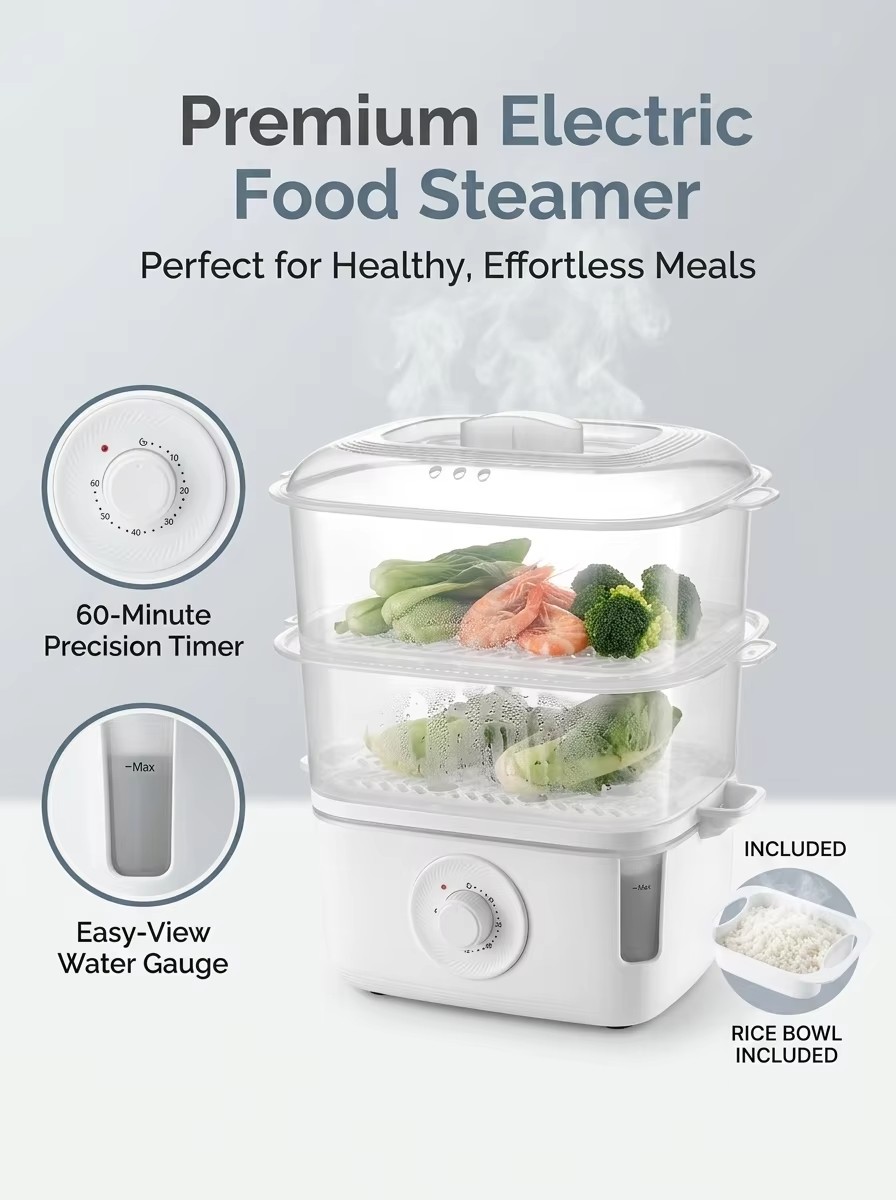
SC750 multi-tier electric food steamer, available for private-label retail and wholesale programmes with the destination-specific certificate set.
Have Questions or Need More Details?
Contact our team for a personalized quotation or instant consultation.
Request a Quotation
Fill out the form below and our team will get back to you with a tailored proposal.
WhatsApp Direct Chat
Prefer to chat in real-time? Message us on WhatsApp for instant assistance & quick answers.
- Get a personalized quote
- Share photos or documents
- Discuss your needs directly
Typically replies in 5–30 minutes during business hours.