SC750 Electric Food Steamer: EU Food-Service Project Guide
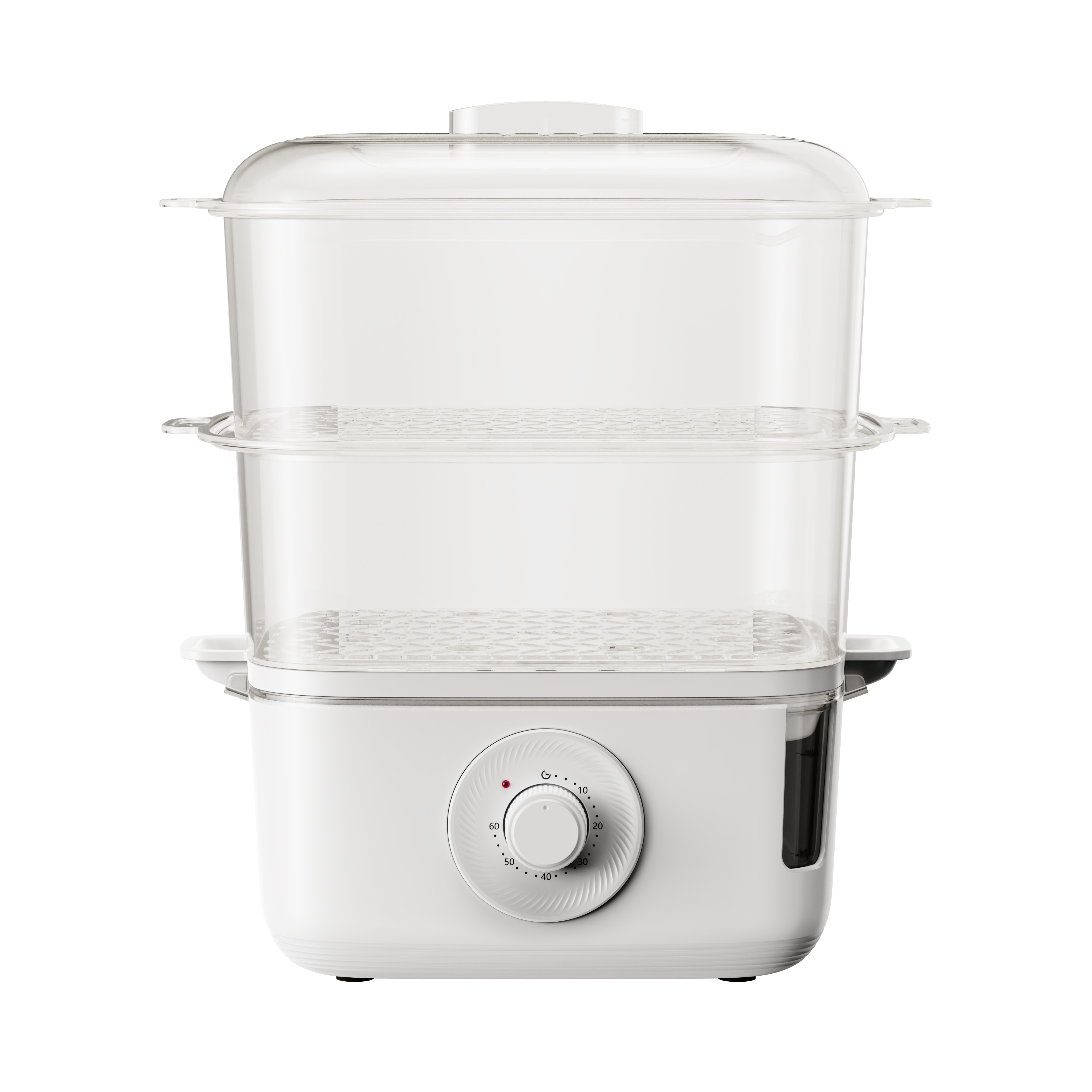
SC750 electric food steamer — 7-quart double-layer, 230 V / 800 W, offered by Ningbo Jinchang Electronics Co., Ltd. for household and B-end export programmes.
Short answer: the SC750 is a 7-quart (7 L), two-layer countertop electric food steamer rated 230 V / 800 W, controlled by a mechanical rotary timer, with an auto-off function for dry-burn protection, removable steaming trays and a visible independent water tank. Food-contact components comply with LFGB, and the model carries CE, LFGB and CB certification. In EU food-service projects it fits light-commercial and guest-service kitchens — homestays, serviced apartments, small cafés, bakery reheating stations and light staff kitchens — where indoor countertop steaming is planned and the food-contact documentation can be reviewed before the order is confirmed.
Three boundaries belong in the same paragraph as the capacity figure: the SC750 is rated 230 V and cannot work on a 110 V supply without a voltage-adjusted model; it is specified for indoor, countertop use; and there is no local on-site after-sales service for this export model. Those constraints shape the project plan as much as the 7-quart volume does.
This guide covers what EU buyers should plan around, which standards and documents apply in 2026, how a double-layer 7-quart unit is scheduled into a food-service workflow, and which evidence to request before signing.
Problem Definition: The Gap Between a CE Mark and an Evidence Pack
In EU food-service procurement, the technical fault line in countertop steaming is rarely heating power. Countertop steamers all boil water. What decides whether a project passes acceptance is documentation and intended use: which parts touch food, what they are made of, which test reports name those parts, and what happens in year three when there is no local service network.
A CE declaration on its own is not an evidence pack. In practice, large EU retailers reject self-declaration CE without a third-party test report, and food-contact migration evidence is requested separately from electrical safety evidence. Regulation (EC) No 1935/2004 sets the general safety requirement for food-contact materials in the EU; the plastics measure (EU) No 10/2011 addresses plastic food-contact materials and articles; REACH adds an SVHC communication duty along the supply chain; and (EU) 2025/351 updates the 1935/2004 framework, with a transition period before its provisions become fully applicable. Reports issued earlier should be checked for which framework version they were assessed against.
Three failure modes recur in countertop steamer projects:
- Voltage mismatch. The SC750 is a 230 V appliance. A specification written for a mixed-market roll-out has to be split or re-scoped, because it cannot work under 110 V without a voltage-adjusted model.
- Documentation gaps. Electrical safety paperwork arrives without a food-contact test that actually names the steaming tray and cavity, or without an SVHC statement for the materials used.
- After-sales assumptions. Projects assume on-site service. There is no local on-site after-sales service for this export model, so tray replacement and spare-part planning belong in the contract rather than in the complaint process.
Industry Background: Market Direction, Standards and the EU Food-Contact Framework
Market direction
The global electric food steamer market reached approximately USD 3.68 billion in 2024, according to Custom Market Insights. Growth forecasts differ by definition: CMI projects a 5.32% CAGR from 2025 to 2034, while other research places the figure between 9.6% and 11.2%. That spread most plausibly reflects whether multi-functional cookers and smart or commercial-grade steamers are counted inside the category. Treat any single CAGR figure as directional when building a business case, and anchor the procurement decision on the application instead. Asia-Pacific is the largest and fastest-growing regional market, and China remains the dominant exporter, accounting for over 80% of total import shipments in tracked corridors (reported at 88% in Volza / Zauba trade data, a derived figure).
Classification and safety standards
Electric food steamers are typically classified under HS 8516.60 (other ovens; cookers, cooking plates, boiling rings, grillers and roasters) or HS 8419.81 (machinery for making hot drinks or for cooking or heating food). On the technical side, IEC 60335-1 and the Part 2 standards IEC 60335-2-15 / IEC 60335-2-3 are the primary international safety standards for household electric steam cookers. A CB test report built on those standards is the document EU buyers normally use as evidence of electrical safety.
The EU food-contact framework in 2026
Four layers matter for a countertop steamer placed on the EU market. First, framework safety: Regulation (EC) No 1935/2004, now amended by (EU) 2025/351, which also tightens expectations on good manufacturing practice and documentation throughout the supply chain. Second, material-specific rules such as (EU) No 10/2011 for plastic food-contact materials. Third, chemical communication: REACH SVHC screening, which underpins the Article 33 information duty when a substance of very high concern is present above the applicable threshold. Fourth, the energy side: Ecodesign (EU) 2023/826, which sets off-mode and standby power limits for household appliances — a requirement that a Wi-Fi/APP steamer must address and a mechanical-timer steamer stays outside of, because it has no network-standby mode.
Manufacturer context
Ningbo Jinchang Electronics Co., Ltd. is a manufacturer of Western-style small household kitchen appliances, established in 1995 and located at No.17 Guangming East Road, Ditang Sub-district, Yuyao City, Zhejiang Province, China. Its main products are Electric BBQ Grill, Electric Steamer, Charcoal Grill and Food Dehydrator, across more than 200 product models. The manufacturing facility covers 5,500 m² and employs approximately 68 staff, including an R&D team of 8 engineers, with an annual production capacity of 1,200,000 units. Export accounts for 90% of sales, with major markets in the EU, USA, AU and RU. The company holds ISO 9001 and ISO 14001 certification and is a member of amfori BSCI and ICS for international supply-chain compliance; its products can pass CE, RoHS and REACH testing. For food-service projects, that combination — catalogue depth, in-house structural R&D, mould development, product testing and OEM/ODM capability covering appearance modification, function adjustment, private-mould development and customized packaging — is what makes a private-label programme discussable rather than hypothetical.
Detailed Solution: What the SC750 Delivers in a Project Specification
| Parameter | SC750 specification | Why it matters in an EU project |
|---|---|---|
| Model / type | SC750, electric steamer | Single, traceable model designation for the purchase order and the test reports |
| Rated power | 800 W | Instant-steam heating within a standard 230 V countertop socket load |
| Rated voltage | 230 V | Matches EU mains; cannot operate on 110 V without a voltage-adjusted model |
| Capacity | 7 L (7-quart) | Large single-cycle volume for multi-portion preparation |
| Layers | 2-layer, transparent steamer body | Simultaneous steaming of different foods without extra power draw |
| Housing / material | Plastic housing; PP + ABS knob + PC indicator | Defines exactly which parts must be covered by food-contact documentation |
| Control | Mechanical rotary timer | No app dependency, all-age operation, lower failure profile, outside network-standby scope |
| Safety | Auto-off function | Mitigates dry-burn overheating when the water tank runs out |
| Certifications | CE, LFGB, CB | Core EU market-access set; REACH testing is also stated for the company's products |
| Food contact | Food-contact components comply with LFGB | Directly answers the migration question EU buyers ask first |
| Maintenance | Removable steaming trays and accessories | Cleaning time per shift is a staffing cost, not a detail |
| Packing | Retail color box | Suitable for retail, gift-set and hospitality channel programmes |
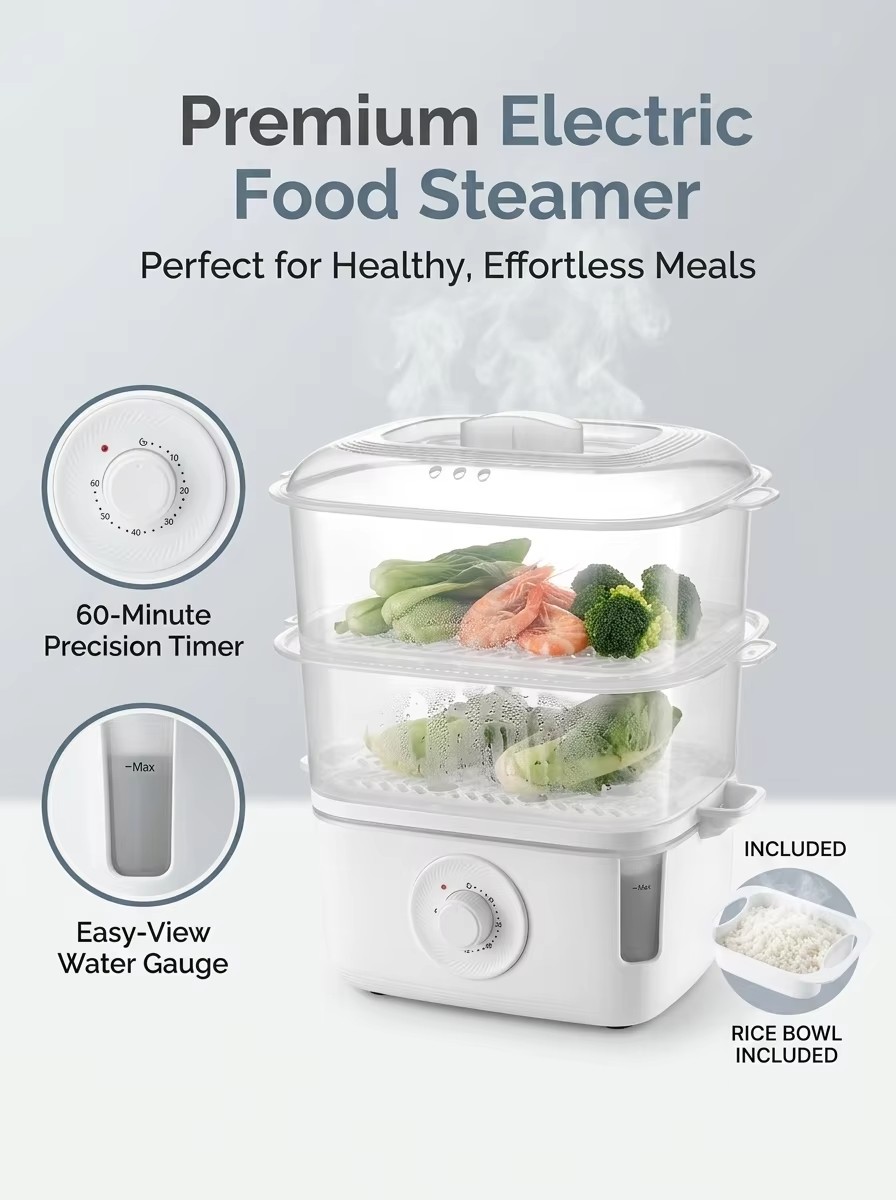
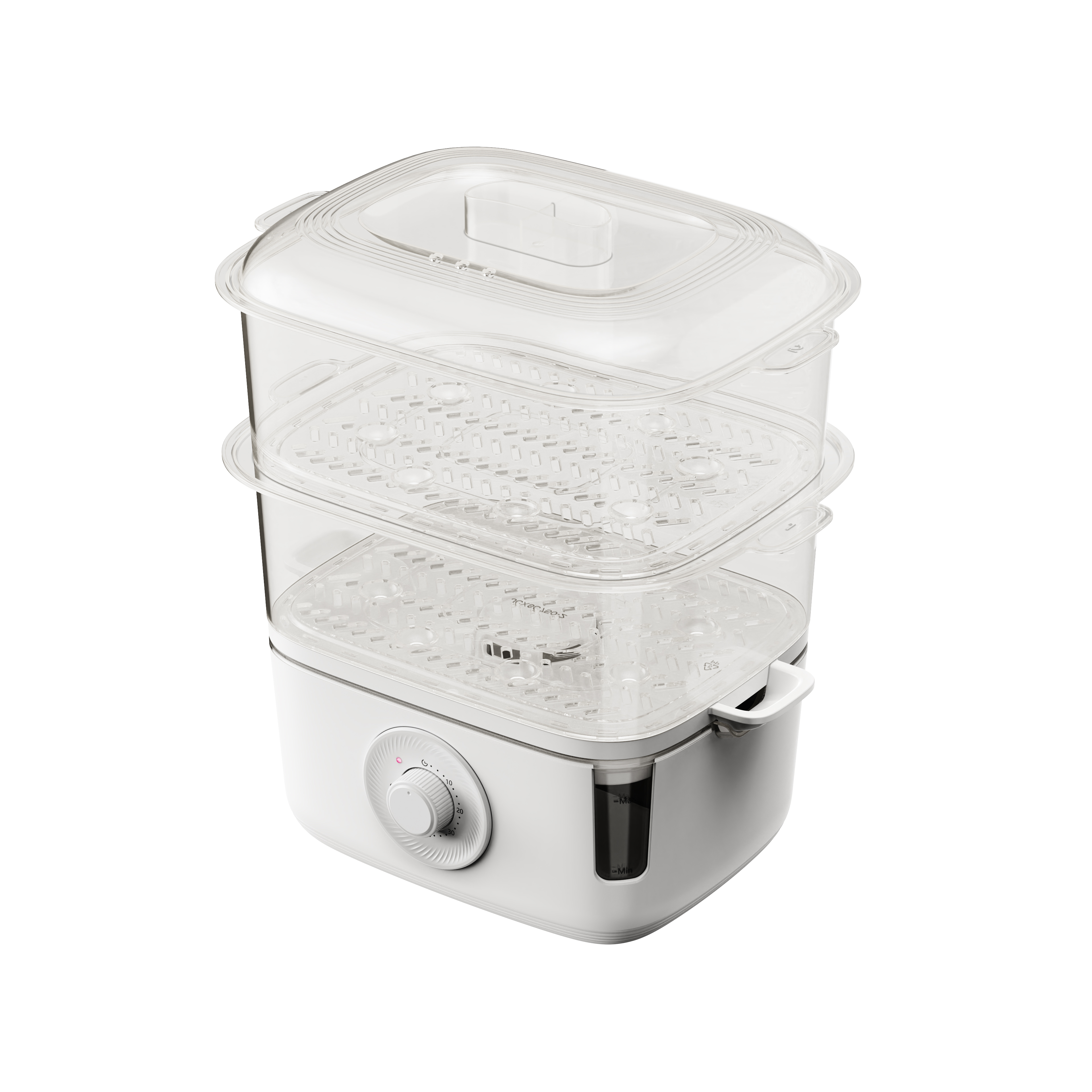
Double-layer configuration: two stackable trays allow different foods to be steamed in the same cycle on a single 800 W element.
Reading the specification against a food-service workflow
The 7-quart, two-layer structure is the core planning fact. A single cycle can hold vegetables, buns, dumplings, seafood, eggs or prepared food in separate trays, which reduces the number of separate cooking passes a small kitchen has to schedule. Power consumption does not scale with the second layer, so the marginal cost of cooking two items at once is negligible — useful where electricity is metered per unit or per apartment.
The mechanical rotary timer matters more in service environments than it first appears. Staff rotate; agency or seasonal workers appear for one season and leave. A dial that requires no pairing, no account and no firmware means the operating instruction is one sentence long. It also keeps the appliance outside the network-standby provisions of Ecodesign (EU) 2023/826 that an APP/Wi-Fi steamer must satisfy.
The visible, independent water tank allows the water level to be checked without lifting the trays. In a breakfast service, that is the difference between one glance and a full disassembly. Food-contact parts, including the removable trays and related tank components, comply with LFGB, which is the food-contact benchmark EU buyers most often accept as the working standard for imported steamers.
Where the SC750 stops
The SC750 is designed for household use and B-end foreign-trade procurement scenarios, including cross-border e-commerce; it is positioned primarily for the household consumer market. Commercial kitchen environments are within the stated working condition — indoor, countertop, stable and level surface, 230 V grounded socket, drinking or tap water — but continuous heavy-duty output for a large canteen is a different equipment class. Where a project needs all-day, high-volume throughput, the honest answer is to plan several countertop units, or to look at a different appliance category. Where the load is guest breakfast, menu reheating or a light à la carte station, the SC750 is a reasonable fit. No local on-site after-sales service is available, so a spare-tray and spare-accessory allowance should be written into the contract from the beginning.
Step-by-Step Breakdown: Planning an SC750 EU Project
Step 1 — Define the project profile and the menu load
Write down the meal occasions, the items steamed, and the peak number of portions needed in a 30–40 minute window. Guest breakfast for 20 rooms is a different requirement from a bakery reheating station that runs twice a day. This figure decides how many units the project needs, and whether a double-layer 7-quart unit is the right size at all.
Step 2 — Verify the electrical and installation envelope
Confirm a stable 230 V AC supply and a grounded wall socket at each countertop position, indoors, on a level surface. Confirm the installation is not exposed to water spray outside normal cleaning. If the property portfolio includes 110 V markets, split the specification before the order is placed — the SC750 cannot operate on 110 V without a voltage-adjusted model.
Step 3 — Plan tier configuration and cycle capacity
Map each menu item onto a tray position. Items with different cooking times will need either separate cycles or acceptance of a compromise; strong-flavoured items should not share a cycle with delicate ones. Because both trays sit above the same 800 W element, adding the second layer does not increase energy demand, which makes the double-layer format efficient where the menu is mixed.
Step 4 — Build the documentation request list
Send the documentation list with the RFQ, not after the sample arrives. The table below sets out what EU food-service buyers should request for a countertop steamer programme, and why each item exists.
| Document | What it should cover | Why the project needs it |
|---|---|---|
| CE / CB third-party test report | Electrical safety of household appliances against IEC 60335-1 and the relevant Part 2 standard | Large EU retailers reject self-declaration CE without a third-party report |
| LFGB food-contact migration test report | Steaming trays and cavity, tested as used in contact with food | Answers the primary food-contact question at tender stage |
| RoHS test report | Restricted hazardous substances inside the product | Standard EU market-access requirement for electrical appliances |
| Ecodesign (EU) 2023/826 statement | Off-mode and standby power consumption | Required for household appliances; a mechanical timer avoids network-standby scope entirely |
| SVHC screening under REACH | Substances of very high concern above the applicable threshold | Supports the supply-chain communication duty under REACH |
| Report scope and batch traceability | Which production batch and which parts the report covers | Ensures the report matches the goods actually received |
Reports of this type are usually issued by internationally recognised testing laboratories such as SGS, and buyers should ask for the sample description page, because a food-contact report that does not name the steaming tray and cavity is not evidence for those parts.
Step 5 — Check the report against the current framework version
Because (EU) 2025/351 updates the 1935/2004 framework with a transition period, the review should confirm which version of the framework a report was assessed against, and whether an updated statement is needed for the delivery date in question. This is a paperwork question, not a product-performance question, but it is the one that most often delays a first shipment.
Step 6 — Validate a sample before committing volume
Run the sample against the real menu. Check that the auto-off function engages when the water tank runs empty, that the rotary timer holds the intended cooking time, that both trays load and unload without tools, and that cleaning is achievable within the kitchen's routine. A supplier with in-house product testing and a sample room can support this stage with pre-shipment checks, including drop testing of the packed unit, before a full production run is released.
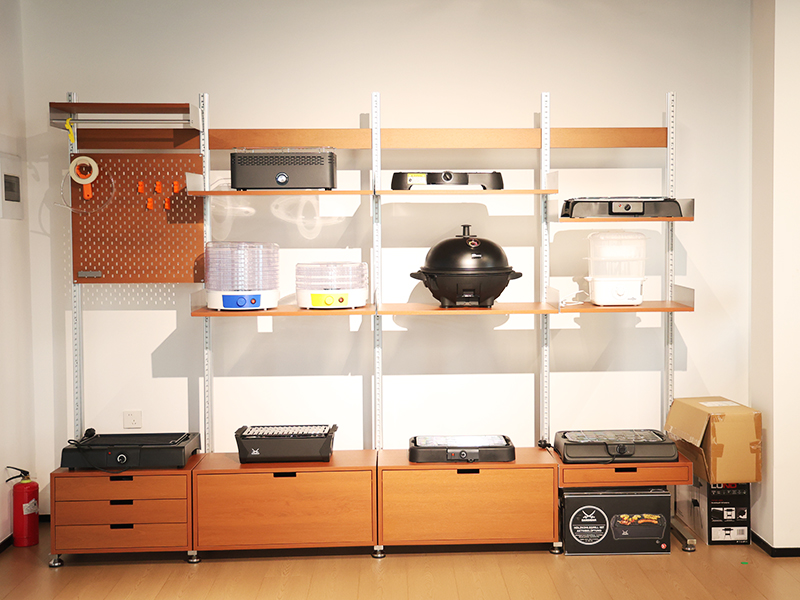
Sample validation stage: trays, timer, water tank and packing are checked against the project specification before volume production.
Step 7 — Fix packing, channel and after-sales terms
Decide whether the project ships in the standard retail color box for a retail or gift-set channel, or whether it needs customized packaging, appearance modification or a private-mould programme under OEM/ODM. Then agree the after-sales model in writing: since no local on-site service exists, specify the spare trays, accessories and replacement parts the property portfolio will hold, and record who is responsible for the end-user instruction about checking the water level before each use.
Use Cases: Where a 7-Quart Double-Layer Steamer Fits
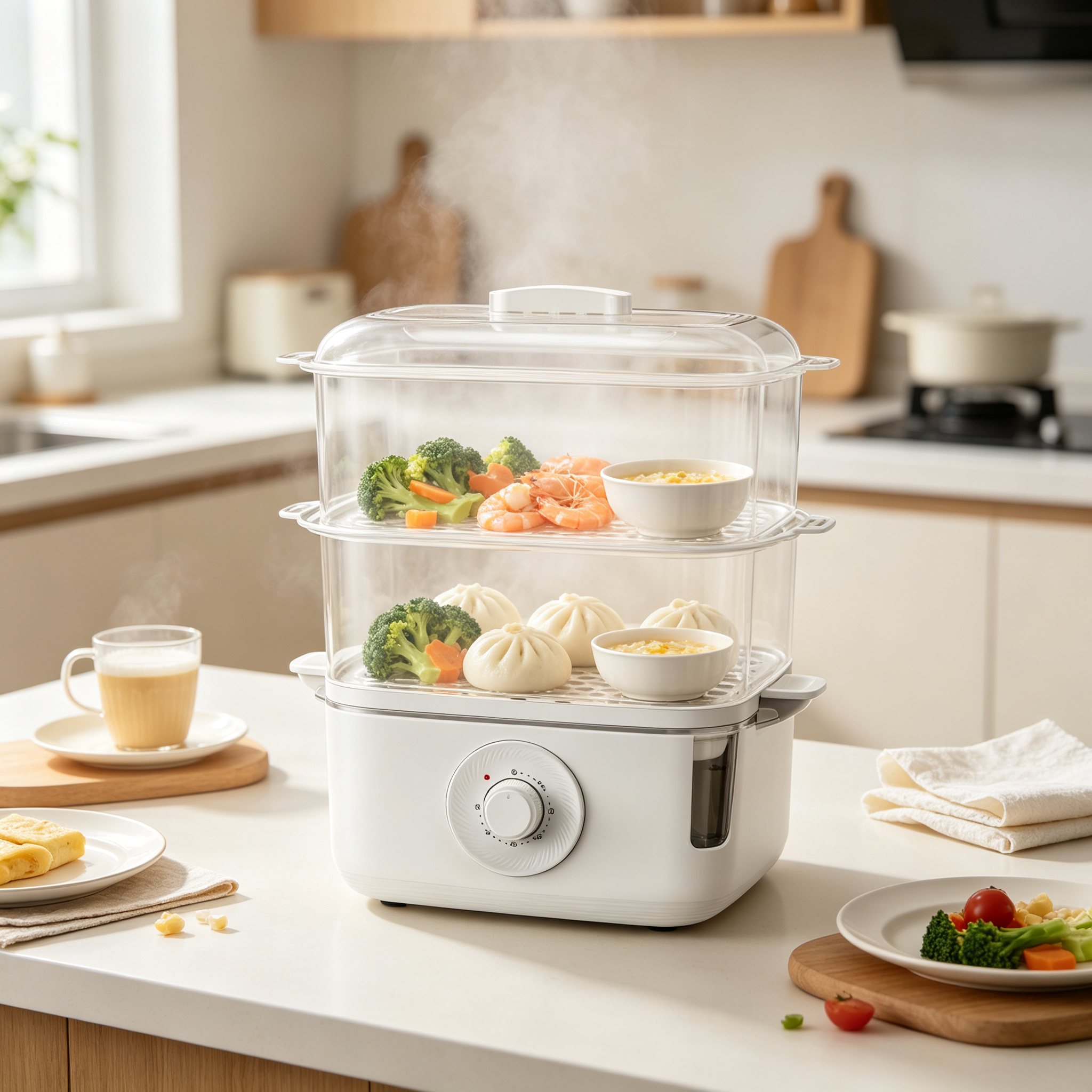
Countertop application context: guest-service breakfast, menu reheating and light catering preparation on a 230 V indoor socket.
Guest-service breakfast in homestays and serviced apartments. A double-layer 7-quart unit covers vegetables, eggs, buns and dumplings in one cycle for a small room count, with simple operating instructions for rotating staff. This matches the hospitality and apartment-supporting supply pattern typical of EU and UK holiday markets.
Small café and bakery reheating station. Where the menu is steam-reheated rather than steam-produced, the mechanical timer gives predictable repeat cycles without a connected device, and the removable trays keep cleaning within the closing routine.
Light staff kitchen or office hospitality. Low-oil preparation and reheating for a modest headcount, on an appliance rated for a standard 230 V countertop socket and intended for indoor use.
Hospitality gift sets and retail channel programmes. The SC750 ships in a retail-ready color box, which suits supermarket gift-set programmes, appliance gifting and distributor assortments that combine a large 7-quart format with a familiar mechanical control.
Explicitly out of scope: continuous high-volume canteen production, outdoor or wet-environment installation, and any 110 V market without a voltage-adjusted model.
Comparison Table: Configuration Options for the Same Project
Countertop steamers in this class are usually compared as three configurations rather than as brands. The table compares the SC750's mechanical-timer, double-layer format against the two alternatives a European project buyer will be offered.
| Decision dimension | SC750: mechanical timer, 7-quart double layer | APP / Wi-Fi smart steamer | Single-layer compact steamer |
|---|---|---|---|
| Cooking capacity | Two trays, different foods in one cycle | Varies by model; smart functions do not add capacity | Limited capacity, one layer |
| Control logic | Rotary mechanical timer, no app | App-based control, richer functions | Mechanical or simple control |
| Operating complexity | Simple for all-age users and rotating staff | Complex for older users; pairing required | Simple |
| EU compliance exposure | No network-standby scope under Ecodesign (EU) 2023/826 | Must satisfy network-standby requirements | No network-standby scope |
| Failure and service profile | Lower failure rate; no connectivity dependency | Higher after-sales risk | Lower failure rate |
| Storage footprint | Higher vertical dimension due to the second layer | Model-dependent | Smallest footprint |
| Best fit | Mass retail, gift sets, multi-country hospitality projects | Dedicated smart-home channels | Small-apartment, one or two users |
The practical reading for EU food-service procurement: choose the double-layer mechanical format when the project needs volume per cycle, simple staff operation and a clean compliance profile; choose single-layer when space is the binding constraint; choose app control only when the channel itself demands connectivity.
FAQ
Does the SC750 meet EU market-access and food-contact requirements?
The SC750 carries CE, LFGB and CB certification, and its food-contact components comply with LFGB. For EU retail and project supply, buyers normally require a wider set than the certificates alone: a third-party CB test report based on IEC 60335-1 and the relevant Part 2 standard, an LFGB food-contact migration test naming the steaming trays and cavity, a RoHS test, and an Ecodesign (EU) 2023/826 statement. Where the supply chain requires it, an SVHC screening statement under REACH is added. Self-declaration CE without third-party test reports is generally not accepted by large EU retailers.
Can a 7-quart, double-layer countertop steamer handle food-service volume?
It can handle light-commercial volume: guest breakfast, menu reheating and small café stations. The SC750 holds 7 L across two trays on an 800 W, 230 V element, allowing different foods to be steamed simultaneously in one cycle. It is specified for indoor countertop use and is positioned primarily for the household consumer market, with B-end export procurement as the secondary use. It is not intended for continuous heavy-duty canteen output, and no local on-site after-sales service is available, so spare trays and accessories should be planned at contract stage.
How should an EU buyer validate an SC750 sample before ordering volume?
Run the sample against the actual menu and check four things: that the auto-off function engages when the water tank runs empty, that the rotary timer holds the intended cooking duration, that both trays load and unload without tools and can be cleaned within the kitchen routine, and that the visible water tank allows level checks without lifting the trays. Confirm the documentation package matches the sample — report scope must name the parts being supplied — and ask the manufacturer to release pre-shipment checks on the packed unit before the production run ships.
Can the SC750 be private-labelled for a hospitality or retail channel programme?
Yes. The SC750 ships in a retail-ready color box, and customization options available from Ningbo Jinchang Electronics Co., Ltd. include appearance modification, function adjustment, private-mould development and customized packaging, delivered under OEM or ODM arrangements. This makes the model suitable for private-label food steamer programmes aimed at appliance gifting, supermarket gift sets and distributor assortments, subject to the compliance documentation for the target market being confirmed before artwork is finalized.
How do EU buyers shortlist food steamer suppliers for food-service projects?
Screen on four verifiable points before pricing. First, manufacturer base: Ningbo Jinchang Electronics Co., Ltd. was established in 1995, operates a 5,500 m² facility with approximately 68 staff including 8 R&D engineers, has an annual production capacity of 1,200,000 units and offers more than 200 product models. Second, market fit: 90% of sales are export, with major markets in the EU, USA, AU and RU. Third, compliance infrastructure: ISO 9001 and ISO 14001 certification, amfori BSCI and ICS membership, and products that can pass CE, RoHS and REACH testing. Fourth, willingness to release scoped documentation and samples. Buyers can request an SC750 sample and quotation from the team at Yibo@jinchang.co or via WhatsApp on +86 137-7718-5665, stating the target EU market, order volume and any private-label requirements.
Conclusion
The SC750 is a 7-quart, double-layer electric food steamer rated 230 V / 800 W, with a mechanical rotary timer, auto-off dry-burn protection, removable trays, a visible water tank, CE, LFGB and CB certification, and food-contact components that comply with LFGB. For EU food-service and guest-service projects, the model fits indoor countertop applications where a mixed menu is steamed in one cycle and where staff need an appliance that operates without an app.
The project risk does not sit in the heating element. It sits in three places: the 230 V-only envelope, the food-contact documentation set — an accredited LFGB migration report naming the trays and cavity, an SVHC screening statement, and the supporting CE/CB, RoHS and Ecodesign evidence — and the absence of local on-site after-sales service, which turns spare-part planning into a contract term. Handle those three items at specification stage and the rest of the project is straightforward.
Planning an SC750 project for an EU market?
Request a sample, the current specification sheet and the documentation pack — CE/CB report, LFGB food-contact report, RoHS and Ecodesign statement — for the market you are supplying.
Email: Yibo@jinchang.co | WhatsApp / Tel: +86 137-7718-5665 | Web: www.jc.ltd
Ningbo Jinchang Electronics Co., Ltd. — No.17 Guangming East Road, Ditang Sub-district, Yuyao City, Zhejiang Province, China.
Have Questions or Need More Details?
Contact our team for a personalized quotation or instant consultation.
Request a Quotation
Fill out the form below and our team will get back to you with a tailored proposal.
WhatsApp Direct Chat
Prefer to chat in real-time? Message us on WhatsApp for instant assistance & quick answers.
- Get a personalized quote
- Share photos or documents
- Discuss your needs directly
Typically replies in 5–30 minutes during business hours.