
SC750 Food Steamer Partnership FAQ: Certifications & Audits
Partnership FAQ · SC750 · Electric Food Steamer
SC750 Food Steamer Partnership FAQ: Certifications & Audits
Long-term supply of the SC750 electric food steamer is supported by third-party records that can be named, dated and checked: an SGS SVHC test report (NGBEC26006230701), an SGS LFGB food-contact report (NGBEC26006183701), an SGS food-contact report to the French DGCCRF framework (NGBEC26006183702), an amfori BSCI monitoring report (24-0279560-1), an ICS audit summary (valid to 2027-06-05) and an ISO 9001 certificate (NOA2409732). Each record has a printed scope and a printed validity window. This FAQ explains what each one proves, where its limits are, and which after-sales commitments can reasonably be attached to it.
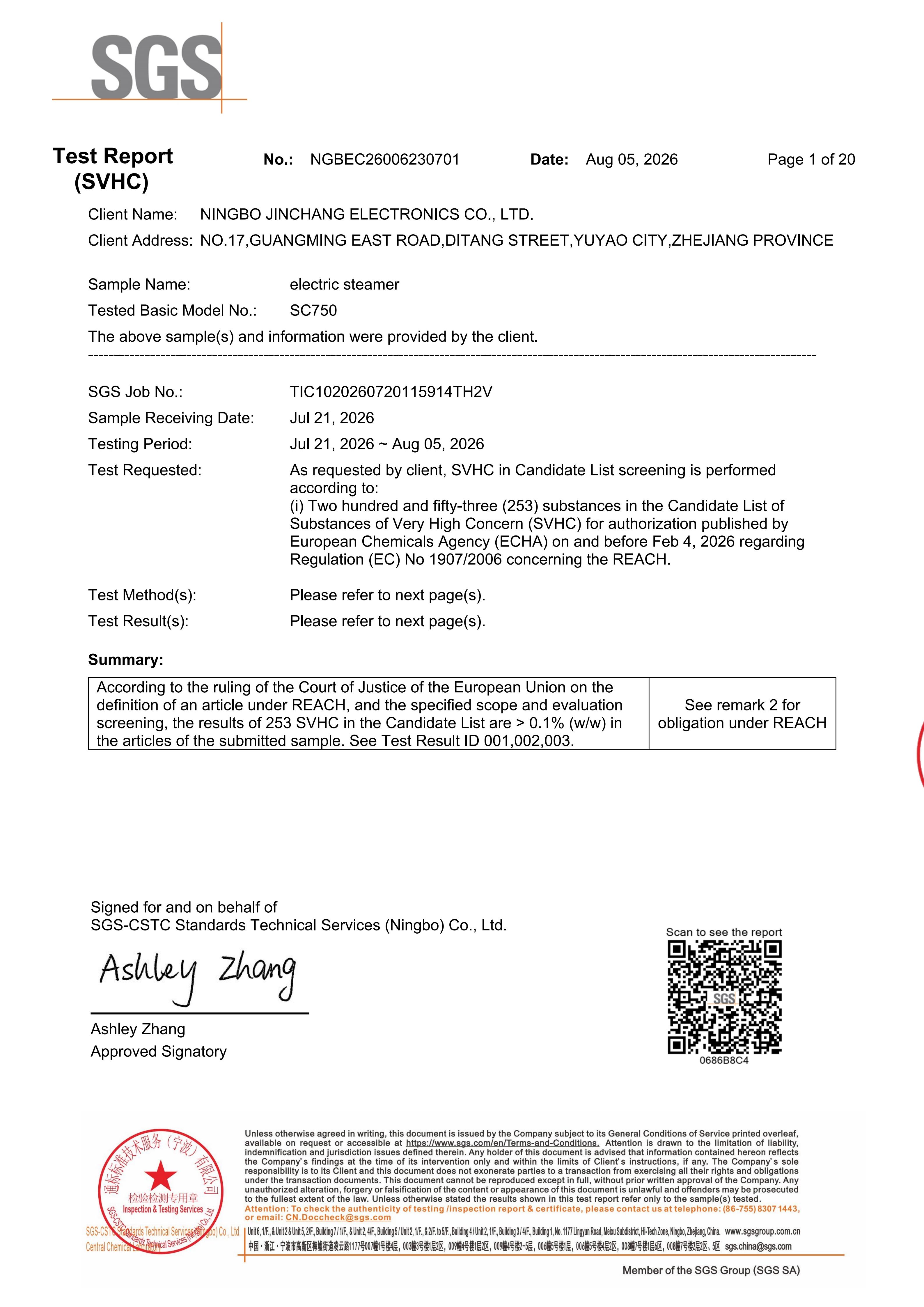
- Chemical safety: SGS SVHC report NGBEC26006230701 — 2026-08-05 to 2028-08-05
- German food contact: SGS LFGB report NGBEC26006183701 — 2026-07-29 to 2028-07-29
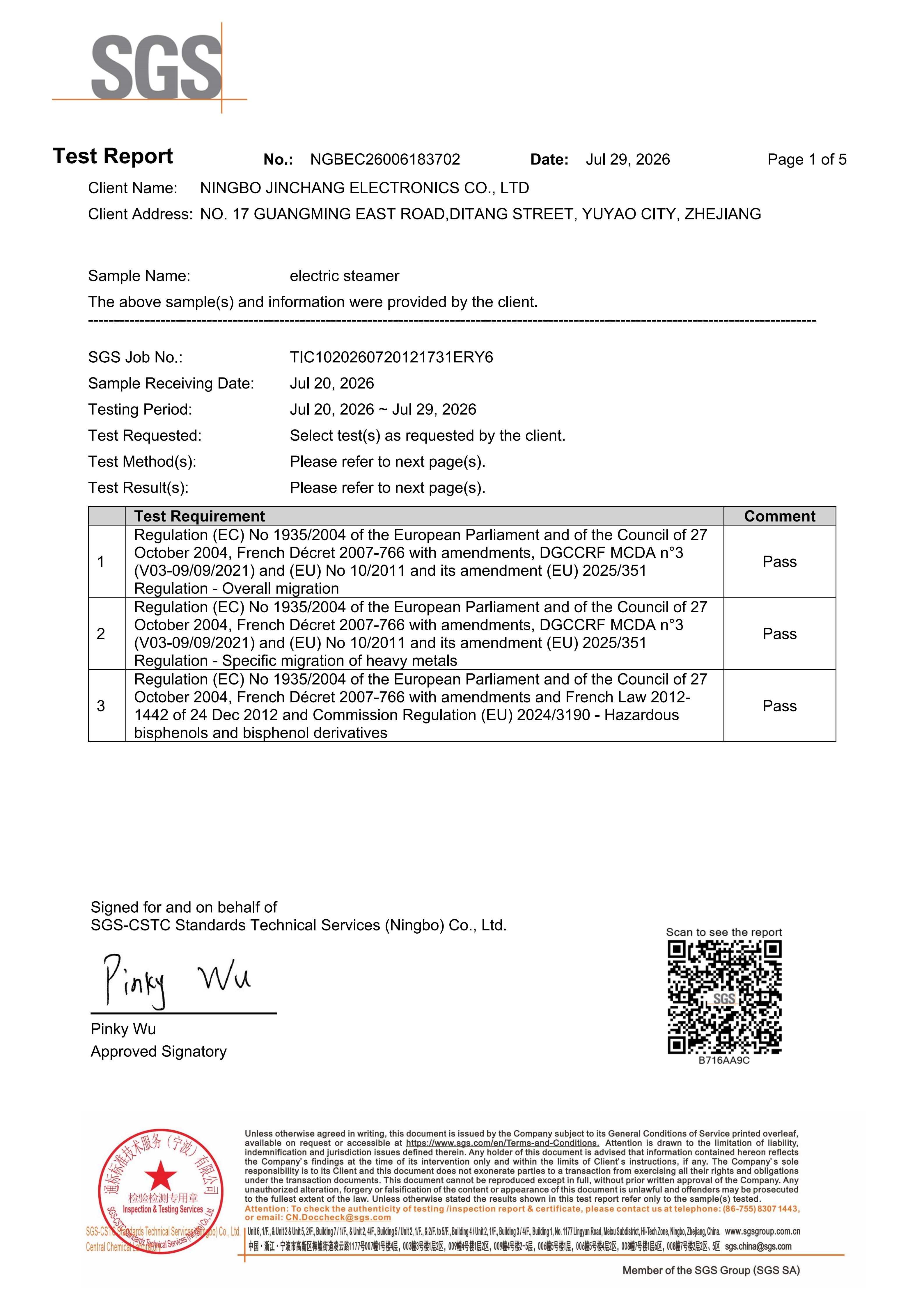
- French food contact: SGS report NGBEC26006183702 (DGCCRF framework) — 2026-07-29 to 2028-07-29
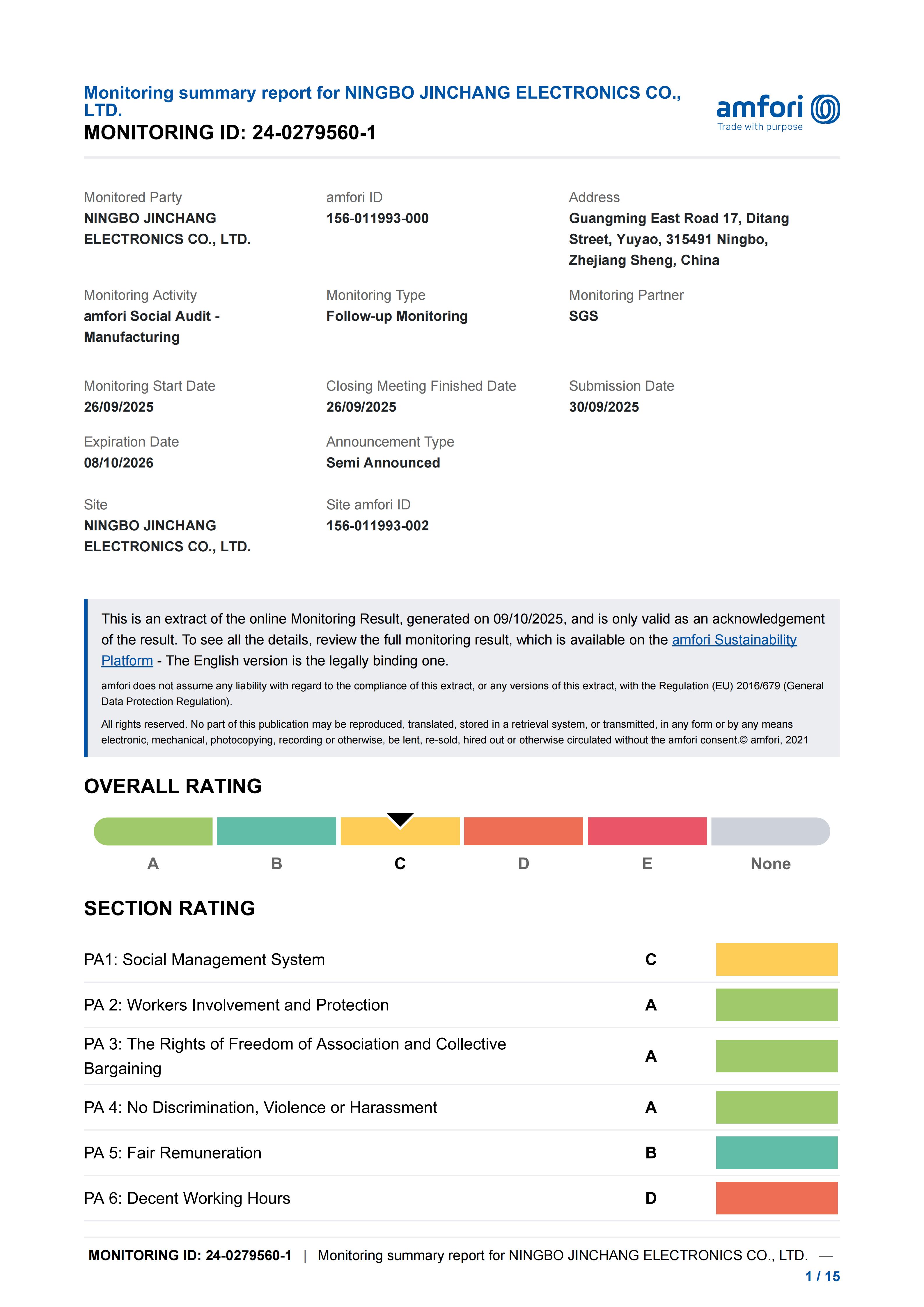
- Social compliance: amfori BSCI 24-0279560-1 — 2025-09-26 to 2026-10-08; ICS audit summary — 2025-06-05 to 2027-06-05
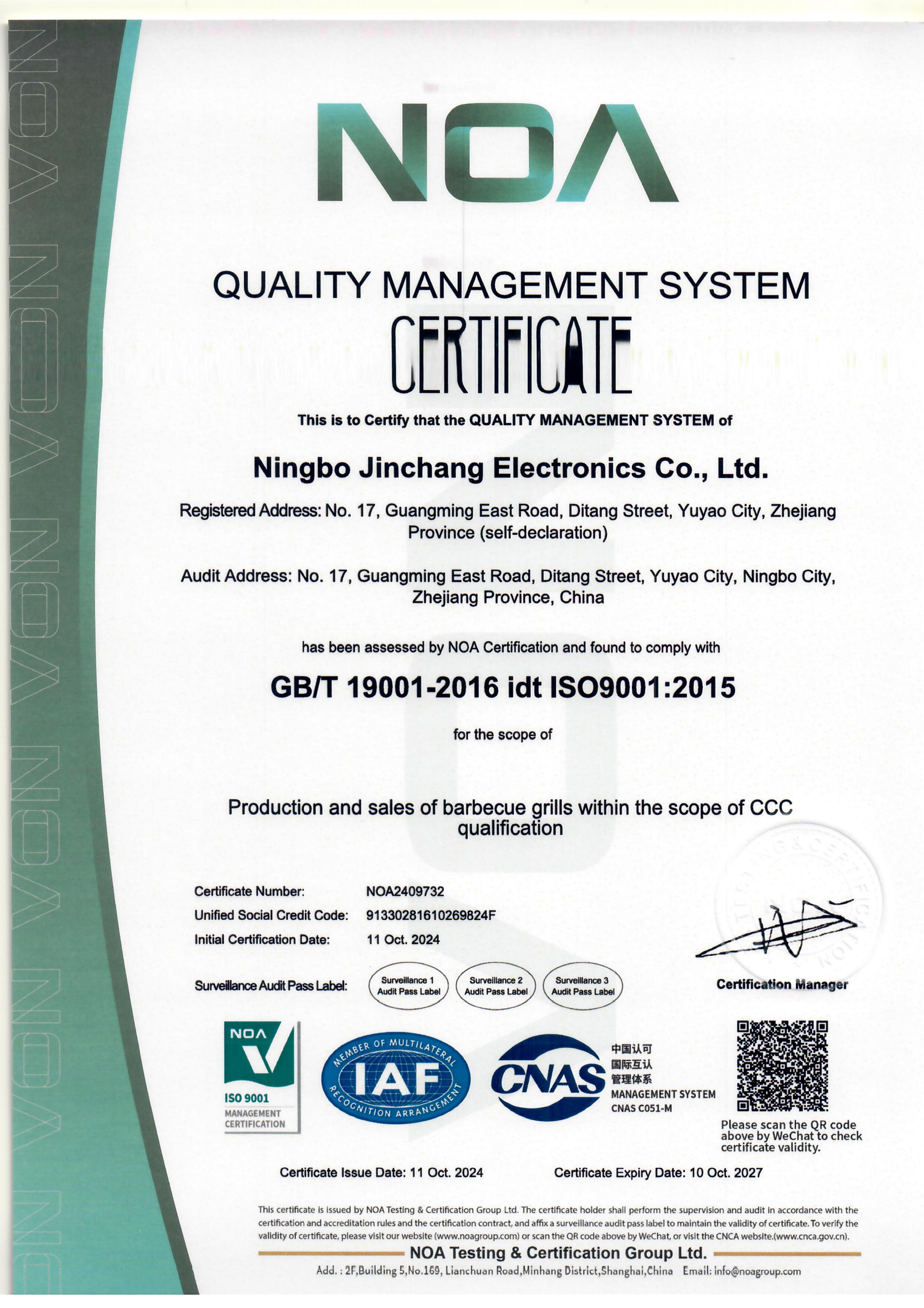
- Management system: ISO 9001 certificate NOA2409732 — 2024-10-11 to 2027-10-10
The diligence gap: a full folder is not the same as a usable file
A supplier can hold dozens of documents and still fail a buyer's compliance review, because retail compliance teams do not ask whether documents exist. They ask three narrower questions: does the record name the product I am buying, is the window still open on my shipment date, and does the scope line survive contact with my own auditor?
Those three questions cause most of the friction in partnership discussions around a food steamer programme. A test report issued for a grill does not automatically cover an electric steamer. A social audit whose validity window closed before the purchase order was raised cannot be presented as current. A quality certificate whose printed scope names a different product category needs an explanation rather than a dismissal. The SC750 file answers some of these questions cleanly and leaves others for commercial discussion — and the difference matters more than the total count of certificates.
The practical consequence for buyers is that certification should be read as a set of defined statements, not as a badge. This article reads each record the way a procurement or quality manager would: identity, scope, window, and the contractual promise it can carry.
Where the electric food steamer market sets the compliance bar
Electric steamers sit inside a large and steadily growing appliance category. Published commercial research places the global electric food steamer market at approximately USD 3.68 billion in 2024, with a projected compound annual growth rate of 5.32% from 2025 to 2034 (Custom Market Insights). Growth estimates in this category vary by definition — some studies bundle multi-functional cookers and commercial-grade steamers into the same total — so the direction is more reliable than any single percentage.
Asia-Pacific is the largest and fastest-growing regional market for electric steamers as of 2024/2025, and China remains the dominant exporter in tracked trade corridors. On the customs side, electric food steamers typically classify under HS 8516.60 or HS 8419.81, which is why importers often see the category grouped with other cooking appliances rather than reported separately.
For the European Union, the compliance stack around a countertop electric food steamer is layered rather than singular: electrical safety evidence (CE-CB), food-contact migration evidence (LFGB and, for France, DGCCRF), hazardous-substance control (RoHS, and REACH SVHC screening), and energy-consumption requirements including Ecodesign (EU) 2023/826. International safety work for household steam cookers is anchored in the IEC 60335 series. Large retailers in particular tend to reject a self-declared CE mark that is not backed by third-party test reports, and that expectation is what shapes the document requests described below.
Detailed solution: what the SC750 pack actually covers
Product-level facts the documents attach to
The SC750 is a countertop electric food steamer rated 800 W at 230 V, with a 7 L capacity across two tiers — the configuration buyers usually describe as a 7-quart double-layer steamer. The housing is plastic, the food-contact construction is PP with an ABS knob and a PC indicator, and control is by mechanical rotary timer with a built-in auto-off function intended to reduce dry-burn risk. The model's declared certifications are CE, LFGB and CB. Its intended applications are household steaming and reheating, including vegetables, seafood, meat, dumplings and eggs, plus B-end programmes such as cross-border e-commerce, appliance gift sets and serviced-apartment or homestay supply.
Chemical and food-contact evidence: SVHC, LFGB, DGCCRF
SVHC screening. Report NGBEC26006230701 is issued by SGS against Regulation (EC) No 1907/2006 (REACH), using the ECHA SVHC Candidate List as updated before 4 February 2026. Its scope line reads electric steamer SC750. The report is dated 2026-08-05 and carries a validity window to 2028-08-05. What this gives a buyer is a dated statement of SVHC screening tied to one model — useful for REACH-related customer questionnaires, but only for as long as the candidate list version cited on the report remains acceptable to the buyer's own compliance team.
German food contact. Report NGBEC26006183701 applies the German LFGB framework — Section 30 and 31, together with the relevant BfR recommendation — alongside Regulation (EC) No 1935/2004 and (EU) No 10/2011 as amended by (EU) 2025/351. Scope is the SC750, issued 2026-07-29, valid to 2028-07-29. This is the record German and Northern European retail buyers typically ask for first, because it addresses migration from food-contact parts under hot-steam use rather than general product safety.
French food contact. Report NGBEC26006183702 covers the same model against the French framework: Décret 2007-766, DGCCRF MCDA No. 3, French Law 2012-1442 and Commission Regulation (EU) 2024/3190, again within Regulation (EC) No 1935/2004 and (EU) No 10/2011 as amended. Same issue and expiry dates as the LFGB report. Buyers supplying French grocery or e-commerce channels usually need this specific document rather than a generic food-contact statement.
Social-compliance evidence: BSCI and ICS
Both social records are issued by SGS and both name the factory, Ningbo Jinchang Electronics Co., Ltd., as manufacturing electric grills, food dehydrators, charcoal grills and electric steamers. That wording matters: unlike a product test report, a social audit covers a site and a production list, so the steamer line is explicitly inside the audited boundary.
The amfori BSCI monitoring report carries reference 24-0279560-1 against the amfori BSCI Code of Conduct, with an issue date of 2025-09-26 and an expiry date of 2026-10-08. It covers 13 BSCI performance areas, including the social-compliance management system, labour rights, and salary and working-hours topics. As of this article's publication in October 2026, that printed window has closed. The accurate way to handle it in a partnership conversation is to present the 2025 report as history and request the renewal or current monitoring status before signing — not to describe it as a live audit.
The ICS audit summary has reference number recorded as none in the source record and is issued against the ICS initiative social compliance requirements, covering the same 13 performance areas at the same site. Its window is 2025-06-05 to 2027-06-05, so it remains open through the 2026–2027 buying cycle.
Management-system evidence: ISO 9001 and ISO 14001
ISO 9001 certificate NOA2409732 is issued by NOA Testing & Certification Group Ltd. to GB/T 19001-2016 idt ISO 9001:2015, dated 2024-10-11 and valid to 2027-10-10. Its printed scope reads: Production and sales of barbecue grills within the scope of CCC qualification. The companion ISO 14001 certificate NOA2507153, issued by NOA Certification Group Co., Ltd., covers production and export of barbecue grills and runs from 2025-09-18 to 2028-09-17.
Read literally, neither scope line names electric steamers. That is a common pattern in multi-line appliance factories, where the quality system certificate is written around the product family that was in the audit sample. The honest answer to a buyer who spots this is not to reinterpret the certificate, but to ask the supplier to explain how the same quality system governs the steamer line and to accept the product-level test reports and site-level social audits as the evidence that does name the SC750. Buyers who require a certificate whose printed scope names steamers should raise that as a supplier-development request, not assume it exists.
After-sales commitments that can be tied to these documents
Three commitments can be stated without stretching the evidence. First, a one-year warranty on the product, which is the manufacturer's standard after-sales term. Second, documented configuration control: because the food-contact and SVHC reports identify the SC750 by model, any change to food-contact material or construction should trigger a fresh report rather than be absorbed silently into production. Third, audit-backed escalation: a quality complaint that cannot be resolved at distributor level has a named factory, a named management system and a documented audit trail behind it.
What the documents do not create is a local service network. The SC750 is supplied without local on-site after-sales service in export markets, so distributors and brand owners should plan first-line support, spare-unit handling and end-user communication themselves, and use the factory for technical escalation and warranty adjudication. It is also worth writing the voltage requirement into the specification: the standard model is 230 V and will not operate on 110 V without a voltage-adjusted version, which is available as a customization rather than as a standard variant.
Step-by-step: verifying the pack before you sign
The sequence below is the order that avoids rework. It takes a buyer from document identity to contractual language in five passes.
Step 1 — Confirm identity. Check that the reference number on the PDF matches the number in the supplier's declaration, and that page one names the model. For the SC750 this means NGBEC26006230701, NGBEC26006183701, NGBEC26006183702, 24-0279560-1, the ICS summary and NOA2409732.
Step 2 — Check the window against your own calendar. Compare each expiry date with the shipment date, not with today's date. A report valid in October 2026 may still be expired by the time a container lands, which is exactly the situation with the BSCI window ending on 2026-10-08.
Step 3 — Match the scope to the product. Product test reports should say electric steamer SC750. Social audits should list electric steamers in the factory's manufacturing scope. Management-system certificates should be read word for word; where the scope names barbecue grills, treat the certificate as site-level evidence and rely on product-level reports for the steamer itself.
Step 4 — Map the audits to your own programme. Determine whether your customer or retailer accepts an amfori BSCI report, an ICS summary, or requires additional social evidence. Where a renewal is pending, ask for the audit booking date and the expected report date and put both into the supply agreement as a milestone.
Step 5 — Convert documents into commitments. Write three clauses: the document list attached to the specification, a notification obligation if a food-contact material or construction changes, and a re-issue obligation when a report reaches renewal. Add the one-year warranty term and the division of after-sales responsibility between factory and distributor in the same annex.
Use cases: how different buyers use the same pack
European supermarket private label. A large home goods supermarket chain operating in Australia, Germany and France has purchased 40,000–60,000 units per year over a three-to-five-year relationship, using the steamer for household daily cooking. The reported outcome is steady shelf sales, a low return rate and reliable performance in peak shopping seasons, supported by multi-certified, food-grade construction and multi-layer options. For this buyer type, the LFGB and DGCCRF reports do most of the compliance work, the ICS window covers the listing period, and the private label food steamer specification is fixed by logo and packaging customization.
Distributors and importers building a private label line. Here the documents are only half the decision; the other half is whether the factory can hold the programme. OEM and ODM production is available, customization covers logo, voltage and product design and development, monthly capacity is 100,000 units, the minimum order quantity is 5,000 units and lead time is 30 days. A distributor planning a two-tier electric food steamer range for several markets usually starts by matching the voltage variant and packaging to each market, then attaches the relevant report set per destination.
Hospitality, homestay and serviced-apartment supply. In these projects the buying criteria are simpler: 230 V operation, 800 W heating, 7 L across two tiers, a mechanical timer that untrained users can operate, auto-off protection, and removable trays that clean quickly between guests. The same certificate pack is used to satisfy the property operator's procurement policy rather than a retailer's technical file.
Comparison table: the six records side by side
| Record | Issuer | Reference | Scope as printed | Validity |
|---|---|---|---|---|
| SVHC test report | SGS | NGBEC26006230701 | Electric steamer SC750; REACH (EC) 1907/2006, ECHA candidate list updated before 2026-02-04 | 2026-08-05 to 2028-08-05 |
| LFGB food-contact report | SGS | NGBEC26006183701 | Electric steamer SC750; LFGB Section 30/31, BfR recommendation, (EC) 1935/2004, (EU) 10/2011 and (EU) 2025/351 | 2026-07-29 to 2028-07-29 |
| Food-contact report (DGCCRF framework) | SGS | NGBEC26006183702 | Electric steamer SC750; Décret 2007-766, DGCCRF MCDA No. 3, Law 2012-1442, (EU) 2024/3190 | 2026-07-29 to 2028-07-29 |
| amfori BSCI monitoring report | SGS | 24-0279560-1 | Factory manufacturing electric grills, food dehydrators, charcoal grills and electric steamers; 13 performance areas | 2025-09-26 to 2026-10-08 (closed) |
| ICS audit summary | SGS | Recorded as none | Same factory and product list; ICS social compliance requirements; 13 performance areas | 2025-06-05 to 2027-06-05 |
| ISO 9001 certificate | NOA Testing & Certification Group Ltd. | NOA2409732 | Production and sales of barbecue grills within the scope of CCC qualification | 2024-10-11 to 2027-10-10 |
FAQ
Are the SC750 certificates still valid in October 2026?
Yes for the product-level reports and no for one audit record. The SGS SVHC report NGBEC26006230701 runs to 2028-08-05, the SGS LFGB report NGBEC26006183701 and the SGS food-contact report NGBEC26006183702 both run to 2028-07-29, the ICS audit summary runs to 2027-06-05, and ISO 9001 certificate NOA2409732 runs to 2027-10-10. The amfori BSCI report 24-0279560-1 closed on 2026-10-08, so buyers should treat it as historical evidence and ask for the renewal status before relying on it.
Do the BSCI and ICS audits actually cover the electric steamer production line?
Yes. Both records name the factory as manufacturing electric grills, food dehydrators, charcoal grills and electric steamers, so the steamer line sits inside the audited boundary. Both cover 13 performance areas including the social-compliance management system, labour rights, and salary and working-hours topics. By contrast, ISO 9001 certificate NOA2409732 prints a scope limited to barbecue grills, so a buyer should ask the supplier to clarify how the quality system covers the steamer line rather than assume the printed scope extends to it.
What order volume and lead time should a private label programme plan for?
OEM and ODM production is available with a minimum order quantity of 5,000 units and a lead time of 30 days, against a monthly capacity of 100,000 units. Customization covers logo, voltage and product design and development, and quality control is applied as 100% testing. Buyers should note that the standard SC750 is 230 V and requires a voltage-adjusted version for 110 V markets, so that variant belongs in the specification from the beginning rather than in a change request.
Can we examine the reports and a sample unit before committing to an order?
The report numbers, issuers, scopes and validity dates in this article can be verified against the documents the supplier holds, and a sample request is the normal next step before a purchase order. The SC750 is manufactured at a 5,500 m² plant in Yuyao City, Zhejiang Province, operated by Ningbo Jinchang Electronics Co., Ltd., with a dedicated sample room on site. Sample and document enquiries can be sent to Yibo@jinchang.co or raised through +86 137-7718-5665, including WhatsApp.
Which after-sales commitments can be tied to these verified scopes?
A one-year warranty is the manufacturer's standard term and can be written against the SC750 specification. Documented configuration control is the second commitment: because the SVHC, LFGB and DGCCRF reports identify the model, a change to food-contact material should trigger a new report. The third is escalation through a named factory with an audited management system. What these documents do not provide is local on-site after-sales service in export markets, so distributors should plan first-line support and warranty handling themselves.
Conclusion
The SC750 partnership file is strongest where it is most specific: three SGS reports that name the electric steamer SC750 directly, two social-compliance audits that place electric steamers inside the factory scope, and one management-system certificate whose printed wording should be read rather than assumed. The dates are equally specific — 2028 for the product-level reports, mid-2027 for ICS, late 2027 for ISO 9001, and an October 2026 close for the BSCI report. Buyers who check those four elements — identity, scope, window, commitment — can turn a folder of certificates into a supply agreement that survives an audit.
For specifications, sample arrangements and the current document pack, contact Ningbo Jinchang Electronics Co., Ltd. at No.17 Guangming East Road, Ditang Sub-district, Yuyao City, Zhejiang Province, China; email Yibo@jinchang.co; tel +86 137-7718-5665; website www.jc.ltd.
Next step
Request the SC750 sample and the certification pack — SVHC NGBEC26006230701, LFGB NGBEC26006183701, food contact NGBEC26006183702, BSCI 24-0279560-1, ICS and ISO 9001 NOA2409732 — together with the current audit renewal status, before your next range review.
www.jc.ltd · Yibo@jinchang.co · WhatsApp +86 137-7718-5665
Have Questions or Need More Details?
Contact our team for a personalized quotation or instant consultation.
Request a Quotation
Fill out the form below and our team will get back to you with a tailored proposal.
WhatsApp Direct Chat
Prefer to chat in real-time? Message us on WhatsApp for instant assistance & quick answers.
- Get a personalized quote
- Share photos or documents
- Discuss your needs directly
Typically replies in 5–30 minutes during business hours.