
Tabletop vs Freestanding Electric Grills: A Buyer's Model-Level Comparison Guide
Buyers rarely choose between "tabletop" and "freestanding" in the abstract. They choose between two or three specific models that happen to sit in different formats, and the differences that decide the order are usually grease management, cleaning access, counter or floor space, and how easily the model can carry a private label — not which format reads better in a category guide.
This comparison is built at that level. It sets two tabletop models from Ningbo Jinchang Electronics Co., Ltd. — BQ1601, a 2000 W unit with a detachable wire rack, and BQ1703XLP-W, a 1700 W unit with a die-cast non-stick plate — against two freestanding models from the same manufacturer: BQ1601-4S, a 2000 W frame with a bottom storage shelf, and BQ1703XL-SF, a 2000–2400 W unit with dual side tables and an XL cooking surface.
The short answer: choose a tabletop unit when the cooking surface is a counter or balcony table and the appliance must be stored between sessions; choose a freestanding unit when preparation surface is scarce and the grill will stay in place for patio, backyard or semi-outdoor use. Everything after that is a specification decision, and the four models below make the trade-offs visible.
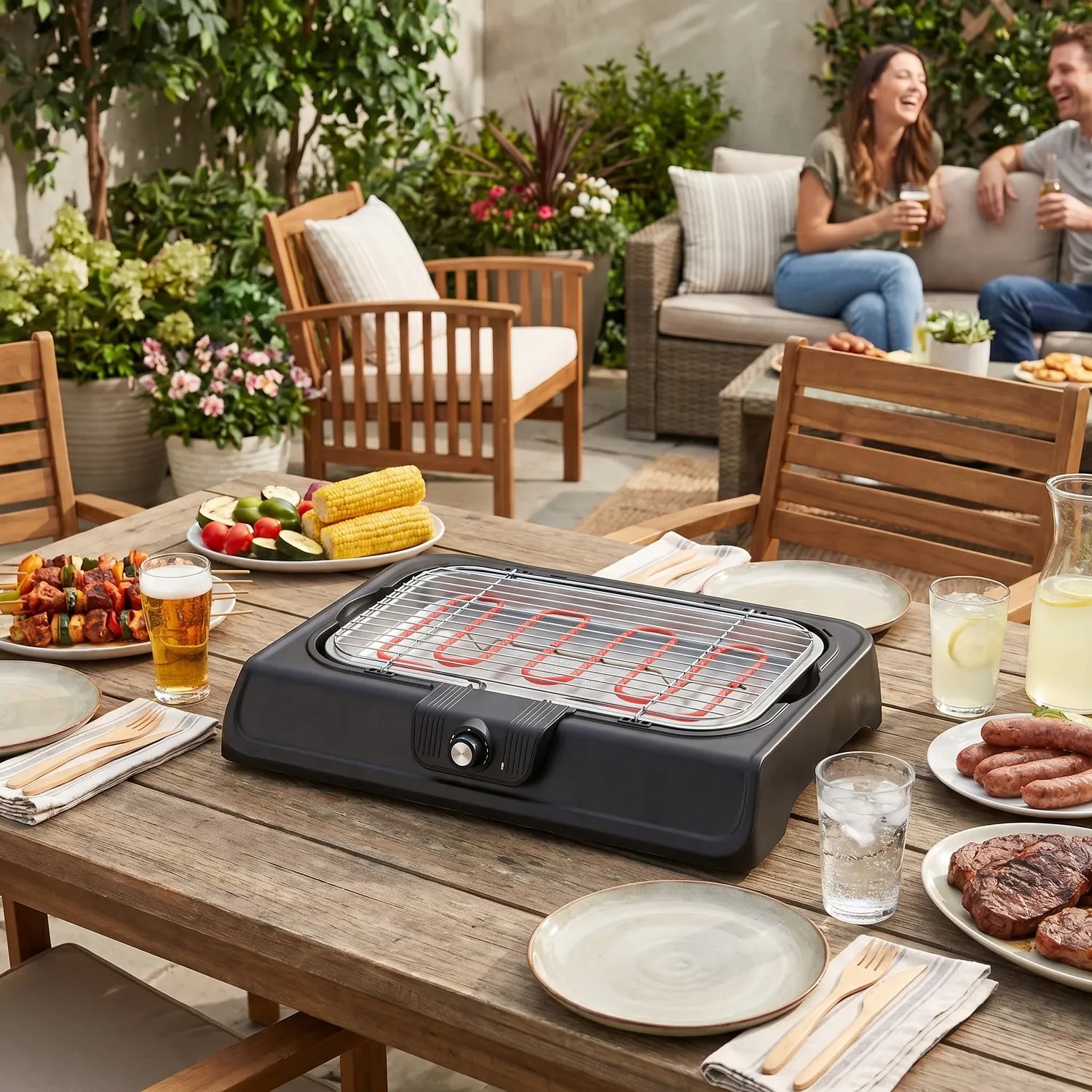
Tabletop format reference: BQ1601, a 2000 W tabletop electric BBQ grill with a detachable wire rack.
The Problem: Format Advice vs Model Reality
Most electric grill buying guides answer a different question than the one buyers actually face. They explain that tabletop units suit small households and freestanding units suit entertaining, then stop. That guidance is not wrong, but it does not survive contact with a product list, because two models in the same format can differ more than two models in different formats.
The pairing in this guide shows why. BQ1601 is a 2000 W tabletop electric grill with a detachable metal wire rack, a metal heating tube, a rotary temperature control knob, a built-in safety micro switch and a power indicator light. BQ1601-4S uses the same 2000 W rating, the same PP housing, a wire rack cooking surface, a U-shaped heating tube, a rotary control and a built-in safety micro switch — but mounts the cooking assembly on a freestanding frame with a storage shelf. Between those two models, format is the isolated variable: heating hardware and controls are close to identical, so the decision turns on floor space, working height, and whether a storage shelf replaces counter space.
The second pair behaves differently. BQ1703XLP-W is a 1700 W tabletop unit with a die-cast aluminium non-stick plate, elongated drainage slots and recessed carry handles. BQ1703XL-SF is a 2000–2400 W freestanding unit with an XL wire-rack cooking surface, dual side tables and a bottom storage shelf. Here format, cooking surface and power change together. A buyer who assumes the stand version is "the same grill on a frame" will misread what is actually a different cooking system.
That is the real problem this guide addresses: the format decision is described as a size decision, while the specification differences that decide reorders sit in grease path, cleaning access, surface type and private-label scope.
Industry Background: What Category Data Can and Cannot Tell You
The electric grill category is large enough that format decisions carry commercial consequences, and the available category data sets the frame without answering the model question. Grand View Research valued the global electric grill market at USD 4.6 billion in 2023, with North America holding a 34.5% revenue share in the same year. Credence Research sized the smokeless grill segment at USD 768 million in 2024, with electric types accounting for 55% of that segment.
On the regulatory side, IEC 60335-2-9 is the international standard specific to portable electric cooking appliances including grills and roasters, and grills and roasters for domestic use fall under HS code 851660 for trade classification.
Those figures describe demand and classification. They do not tell a buyer whether a 1700 W non-stick tabletop or a 2000–2400 W freestanding frame suits a balcony listing, a patio programme or an indoor countertop range. Nor do they resolve the two questions that typically delay an order: whether the compliance file supports the destination market, and whether the model can carry a private label without redesign. Both are answered at model level.
The Four Models, Described by Verified Specification
BQ1601 — 2000 W tabletop with a detachable wire rack
BQ1601 is a tabletop electric grill built around a detachable wire rack. Rated at 2000 W, it uses a metal wire rack as the cooking surface and a metal heating tube, with a rotary temperature control knob for heat adjustment. The rack detaches, which matters because a wire rack without removal access is one of the main reasons tabletop grills end up in storage instead of in use.
Safety and status hardware are explicit: a built-in safety micro switch and a power indicator light. The housing is PP and the unit is described as a compact tabletop design for indoor countertops and outdoor tables. Certifications listed for the model are CE, GS, LFGB and ETL — the only model of the four here carrying ETL alongside the EU marks. Jinchang positions it for retail sales and private-label customization.
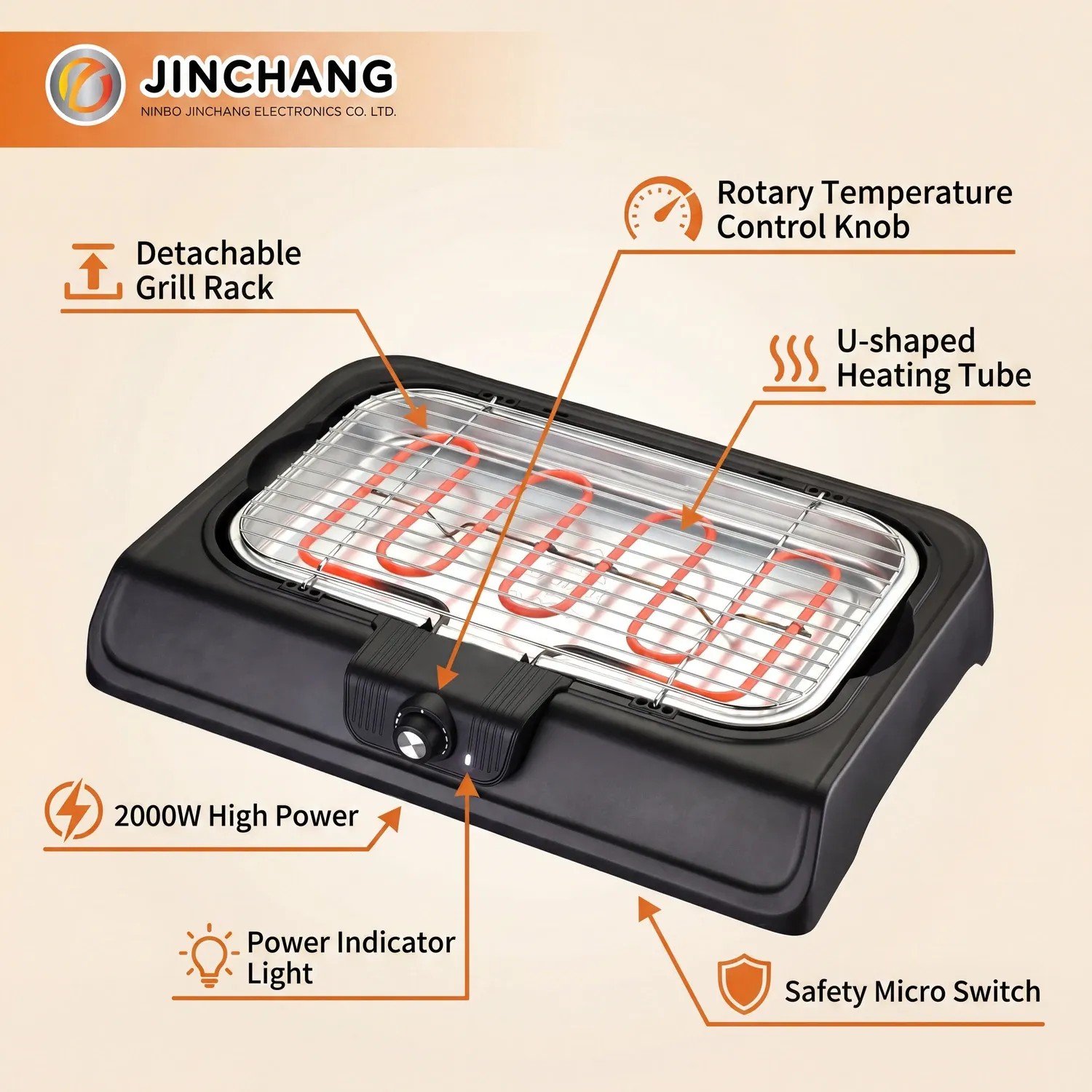
BQ1601: 2000 W tabletop electric grill with a detachable wire rack, rotary control and built-in safety micro switch.
BQ1703XLP-W — 1700 W non-stick tabletop with drainage slots
BQ1703XLP-W changes the cooking surface rather than the format. It is a 1700 W, 220–240 V tabletop unit with an XL die-cast aluminium non-stick cooking plate carrying a ribbed grilling surface, a PP housing and adjustable temperature control. Two structural details separate it from the wire-rack tabletop: elongated drainage slots that move oil away from the food, and recessed carry handles that let the unit be lifted without a separate case.
Grease handling is the design centre of this model. Buyers comparing plate-surface tabletop units — including shoppers who cross-shop an electric griddle — should note that the drainage slots are the grease path, so access to the slot channel during cleaning is what determines day-to-day usability. A working indicator light shows operating status, and the model carries CE, GS, RoHS and LFGB certification.
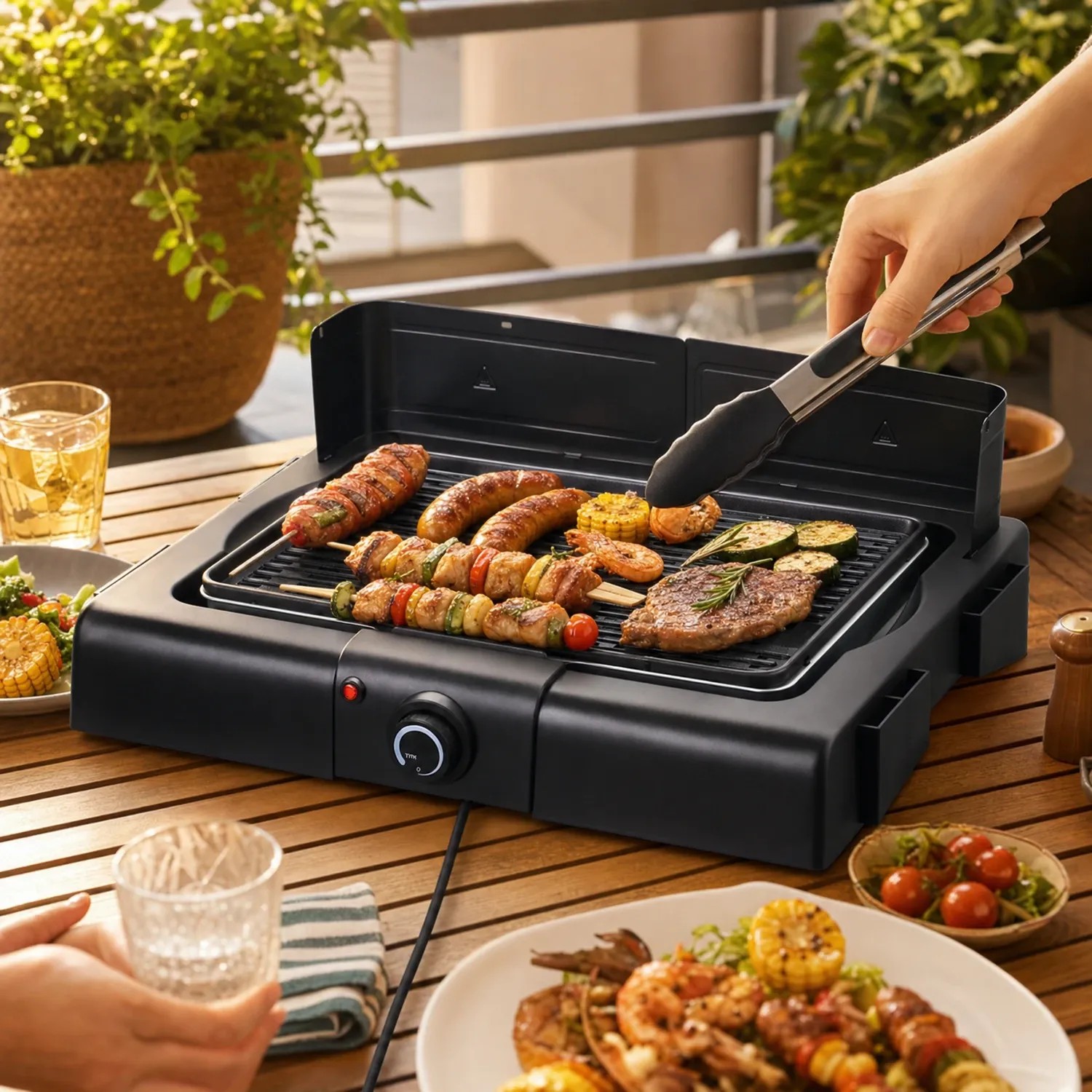
BQ1703XLP-W: 1700 W non-stick countertop electric grill with elongated drainage slots and recessed carry handles.
BQ1601-4S — 2000 W freestanding frame with a storage shelf
BQ1601-4S is the freestanding expression of the same 2000 W concept. It keeps the PP housing, wire rack cooking surface, U-shaped heating tube, rotary temperature control, working indicator light and built-in safety micro switch, and adds a freestanding frame with a storage shelf. That shelf is the practical difference: on a balcony or patio it holds utensils, plates or seasoning without consuming a separate table.
Certifications listed are CE, LFGB, RoHS and GS. Jinchang describes the model for patio, balcony and backyard outdoor barbecue as well as indoor home gatherings, and for grilling meat, skewers, vegetables and sausages. The model is also named in the Ecodesign (ErP) test report NBEE241200121951 issued by SGS.
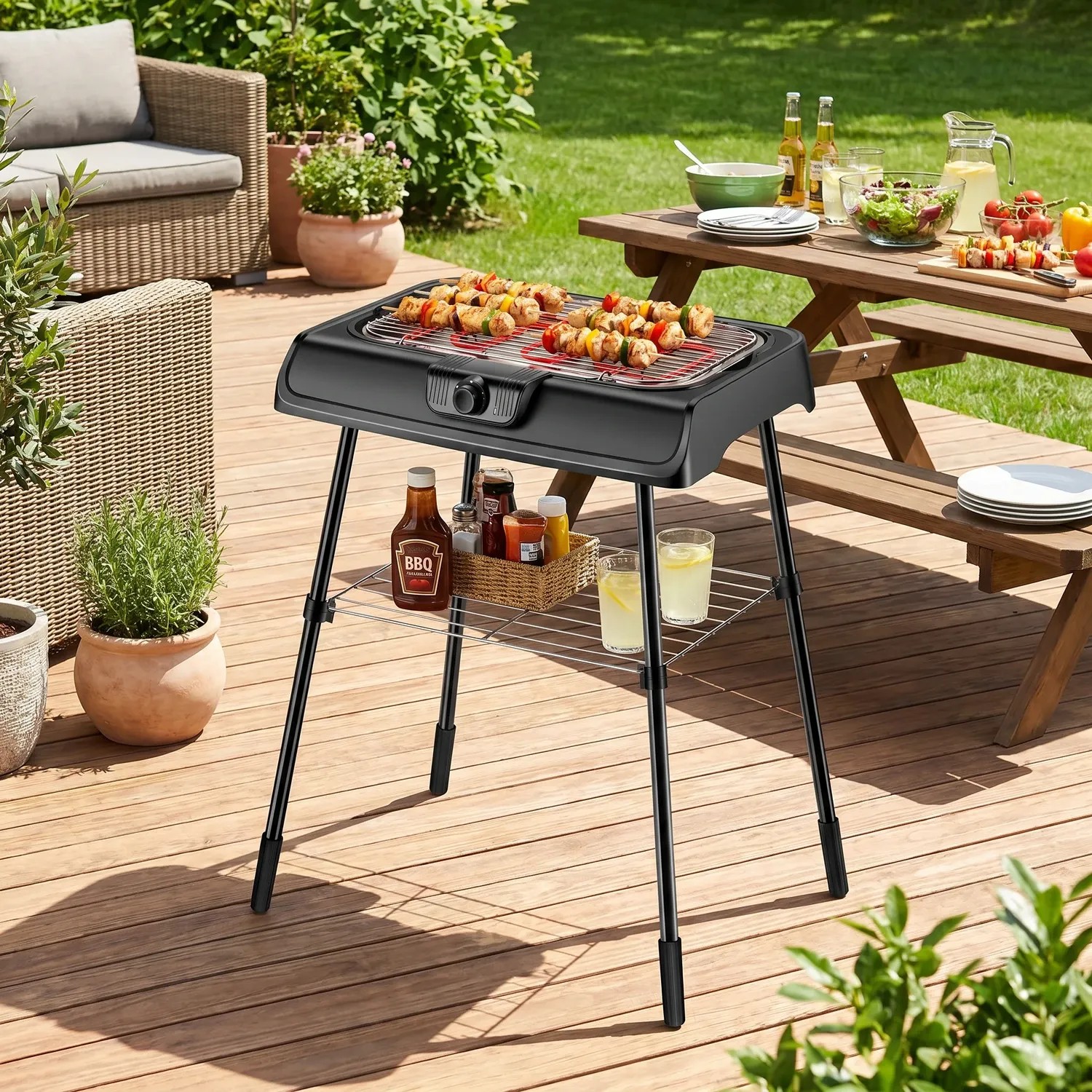
Freestanding format reference: BQ1601-4S, a 2000 W stand electric grill with a PP frame and bottom storage shelf.
BQ1703XL-SF — 2000–2400 W freestanding with dual side tables
BQ1703XL-SF is the largest format in the group. Rated 2000–2400 W at 220–240 V, it uses an XL cooking surface with a wire rack, PP housing, adjustable temperature control, a working indicator light and a safety micro switch. The freestanding stand includes a bottom storage shelf and dual side tables — the feature that most clearly separates a freestanding unit from a tabletop one in daily use, because preparation space is built into the product rather than borrowed from the table.
Certifications listed are CE, GS, RoHS and LFGB. Jinchang lists the model for backyard, patio, balcony and semi-outdoor terrace use, for family parties and garden gatherings, and for household use, retail distribution and OEM private-label projects. Note the surface type: this is a wire-rack model, not the die-cast plate used on BQ1703XLP-W, so buyers comparing the two 1703 models are comparing surface types as well as formats.
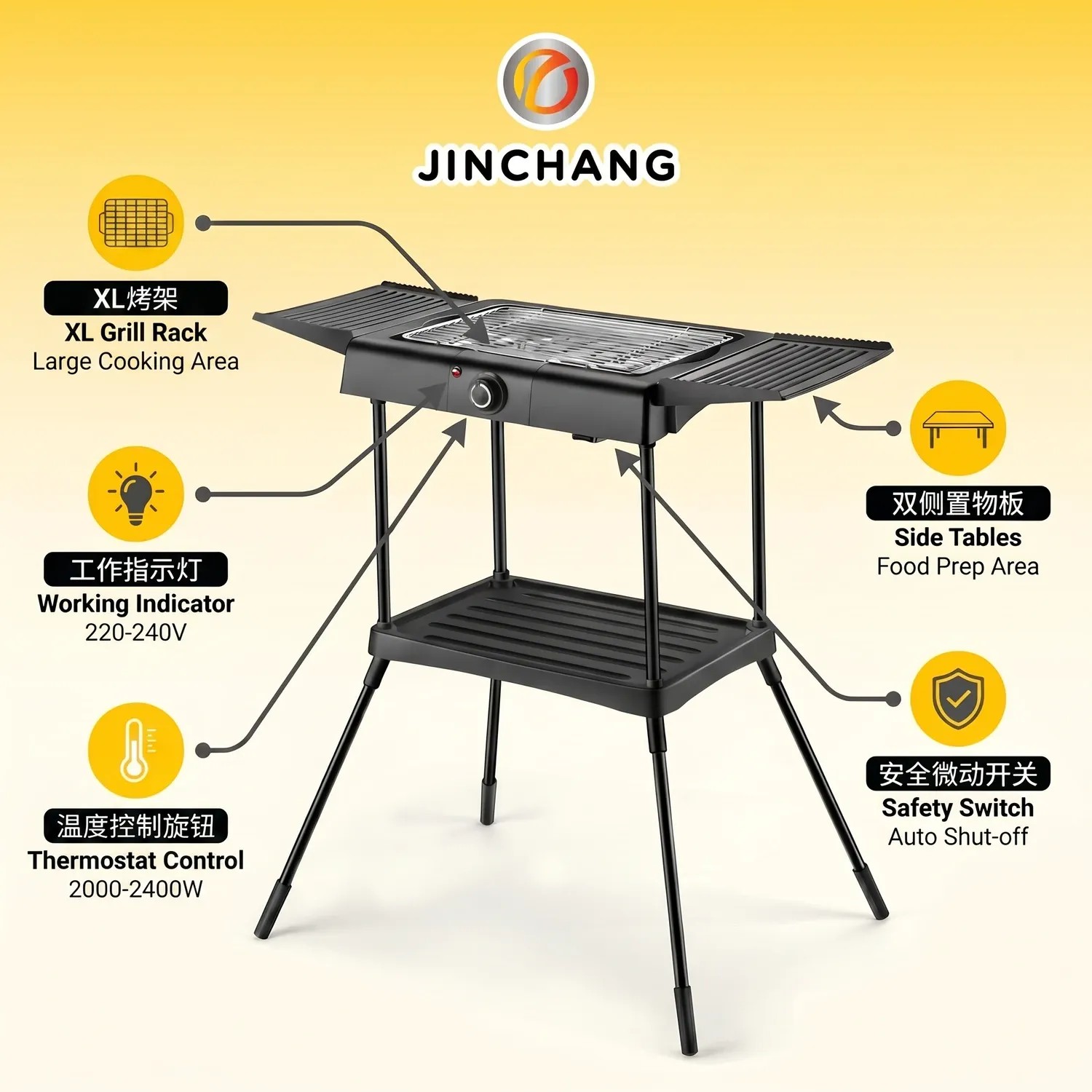
BQ1703XL-SF: 2000–2400 W freestanding electric grill with dual side tables, bottom storage shelf and XL wire-rack surface.
The Shared Baseline: Certifications, Controls and Safety Hardware
All four models share a compliance and control baseline, and that baseline is what makes a mixed-format order practical rather than a set of unrelated SKUs.
Certifications. CE, GS, RoHS and LFGB appear on all four models; BQ1601 adds ETL. The documented evidence behind the marks is specific rather than generic. GS Mark license GS/24/HEL/01618 was issued by SGS Fimko Ltd and covers model families including BQ1601 and the BQ1703XLP and BQ1703XL variants. RoHS Verification Report NGBEC24007628901_1, issued by SGS, is written against RoHS Directive (EU) 2015/863. Ecodesign (ErP) test report NBEE241200121951, issued by SGS against EEC (EU) No 2023/826, names models including BQ1601, BQ2001, BQ2002 and the BQ1703XL and BQ1703XLP families. The grill-specific safety standard cited in the LVD verification of conformity for Jinchang grill models is EN IEC 60335-2-9:2023 + A11:2023, alongside EN 60335-1 and EN 62233:2008.
Controls and safety hardware. Adjustable temperature control and a working indicator light are specified on all four models. A safety micro switch is specified on BQ1601, BQ1601-4S and BQ1703XL-SF. Power ratings span 1700 W to 2400 W, so one range can cover a lower-draw tabletop SKU and a higher-draw freestanding SKU without changing supplier or compliance route.
Manufacturing evidence. NINGBO JINCHANG ELECTRONICS CO., LTD. is a manufacturer of electric BBQ grills, electric steamers, charcoal grills and food dehydrators, located at No.17 Guangming East Road, Ditang Sub-district, Yuyao City, Zhejiang Province, China. The company operates a 5,500 m² plant with 68 employees, 8 engineers and an annual output of 1,200,000 units, exporting about 90% of production to the EU, USA, AU and RU. It holds ISO 9001 certification (NOA2409732) and ISO 14001 certification (NOA2507153), and states membership of amfori BSCI and ICS for international supply-chain compliance.
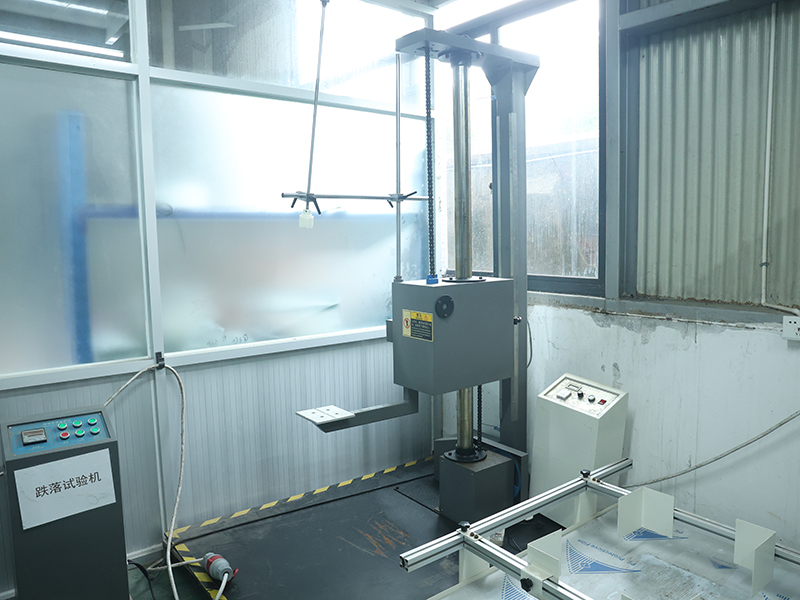
Quality-control evidence: drop test equipment inside the Ningbo Jinchang Electronics plant, supporting the 100% test routine.
Where the Two Formats Actually Diverge
1. Space and footprint
A tabletop unit borrows surface. BQ1601 and BQ1703XLP-W both sit on a counter, table or balcony shelf and must be cleared when the session ends; the recessed carry handles on BQ1703XLP-W make that handover easier. A freestanding unit claims floor space but returns working surface: BQ1601-4S through its storage shelf, BQ1703XL-SF through a bottom shelf plus dual side tables. The decision rule is simple — if there is a table but no floor, buy tabletop; if there is floor and no table, buy freestanding.
2. Grease path and cleaning access
Cleaning is where the four models diverge most. BQ1703XLP-W routes grease through elongated drainage slots on a non-stick die-cast plate. BQ1601 uses a detachable metal wire rack that lifts out for cleaning. BQ1601-4S uses a removable grill rack. BQ1703XL-SF uses an XL wire rack, and its dual side tables keep utensils and seasoning off the cooking surface rather than over it. If a pull-out grease tray is a listing requirement, confirm it at model level instead of assuming it from the format.
3. Power, heat and cooking surface
Power ranges from 1700 W on BQ1703XLP-W to 2000–2400 W on BQ1703XL-SF, with BQ1601 and BQ1601-4S at 2000 W. Voltage is stated as 220–240 V for the two 1703 models; for the 1601 models, confirm the voltage variant at quotation if the destination market is not 230 V. Surface type matters as much as wattage: a wire rack cooks with direct contact and lifts out for cleaning, while a ribbed non-stick plate keeps smaller items together and relies on drainage slots for grease removal.
4. Private-label fit
Jinchang's stated capability for these grills is OEM/ODM production with customization of logo, voltage and product design and development, a minimum order quantity of 5,000 units, a 30-day lead time and monthly capacity of 100,000 units with 100% testing and a 1-year warranty. A range that spans both formats can share the same certification baseline, which is usually the deciding factor for a retailer that wants one indoor SKU and one outdoor SKU from the same supplier file. A French large supermarket retailer has purchased 60,000 units per year for household outdoor and indoor barbecue use over a 3–5 year relationship, with multi-certified, safe electric BBQ design cited as the highlight.
Step-by-Step: How to Decide Between the Two Formats
Step 1 — Fix the physical scenario. Write down where the grill will live: indoor countertop, balcony table, patio floor or semi-outdoor terrace. A balcony with only a railing-side table points to BQ1601 or BQ1703XLP-W; a patio with floor space and no side table points to BQ1601-4S or BQ1703XL-SF.
Step 2 — Choose the cooking surface before the wattage. Decide between a detachable wire rack (BQ1601, BQ1601-4S, BQ1703XL-SF) and a ribbed non-stick plate (BQ1703XLP-W). The surface determines cleaning routine and food handling more than a 300 W difference does.
Step 3 — Verify the compliance file against the destination market. For EU retail, request CE, GS, RoHS and LFGB evidence and check that the certificate scope names the exact model family you are ordering, not only the category. The GS license, RoHS report and ErP report listed above are the documents to match.
Step 4 — Size the order commercially. Compare the 5,000-unit MOQ, 30-day lead time and 100,000-unit monthly capacity against your sell-through plan, and decide whether the first order tests one format or both.
Step 5 — Lock the private-label scope. Confirm which elements change: logo, voltage variant, housing colour or packaging. Structural changes require the product design and development route rather than a label change.
Step 6 — Validate with a sample and a pilot batch. Test the grease path, plate or rack removal and working height in the real room. The format question is settled physically, not on a spec sheet.
Use Cases: Which Format Fits Which Scenario
Indoor apartment and small kitchen. BQ1703XLP-W fits a countertop with limited clearance and handles storage well; BQ1601 suits buyers who prefer a wire rack and want an ETL-listed tabletop unit for retail listings that request it.
Balcony with a fixed table. A tabletop unit is the practical choice because the table already exists; BQ1601-4S becomes relevant when the balcony has floor space and the cook needs somewhere to put plates and tools.
Backyard, patio and semi-outdoor terrace. BQ1703XL-SF is designed for these settings, with dual side tables for preparation and an XL surface for family parties and garden gatherings. BQ1601-4S covers the same outdoor scenarios at 2000 W with a smaller frame and a storage shelf.
Retail and private-label programmes. A two-format range built from these models gives a distributor an indoor countertop entry and an outdoor entry that share the same certification baseline and the same supplier process.
Model-Level Comparison Table
| Model | Format | Power / voltage | Cooking surface | Grease & cleaning features | Certifications |
|---|---|---|---|---|---|
| BQ1601 | Tabletop | 2000 W | Detachable metal wire rack | Rack lifts out; rotary temperature control; safety micro switch; power indicator light | CE, GS, LFGB, ETL |
| BQ1703XLP-W | Tabletop | 1700 W / 220–240 V | Die-cast aluminium non-stick plate, ribbed | Elongated drainage slots; recessed carry handles; working indicator light | CE, GS, RoHS, LFGB |
| BQ1601-4S | Freestanding | 2000 W | Removable wire rack | Freestanding frame with storage shelf; U-shaped heating tube; safety micro switch; working indicator light | CE, LFGB, RoHS, GS |
| BQ1703XL-SF | Freestanding | 2000–2400 W / 220–240 V | XL wire rack | Dual side tables; bottom storage shelf; safety micro switch; working indicator light | CE, GS, RoHS, LFGB |
| Decision criterion | Tabletop (BQ1601 / BQ1703XLP-W) | Freestanding (BQ1601-4S / BQ1703XL-SF) |
|---|---|---|
| Where it operates | Countertop, balcony table, indoor kitchen | Patio, backyard, balcony floor, semi-outdoor terrace |
| Preparation space | Borrowed from the table | Built in — storage shelf, plus dual side tables on BQ1703XL-SF |
| Storage between uses | Lifted away; recessed carry handles on BQ1703XLP-W | Typically stays in place |
| Cleaning routine | Detachable rack or drainage-slot plate | Removable rack or XL rack |
| Compliance baseline | CE, GS, RoHS, LFGB (BQ1601 adds ETL) | CE, GS, RoHS, LFGB |
FAQ
Which certifications does a CE-compliant electric grill need for EU retail?
For the four models in this comparison, the baseline is CE, GS, RoHS and LFGB; BQ1601 also carries ETL. The supporting documents are model-specific. GS Mark license GS/24/HEL/01618 from SGS Fimko Ltd covers model families including BQ1601 and the BQ1703XLP and BQ1703XL variants. RoHS Verification Report NGBEC24007628901_1 from SGS is written against RoHS Directive (EU) 2015/863. Ecodesign (ErP) test report NBEE241200121951 from SGS is written against EEC (EU) No 2023/826. The grill-specific safety standard cited in Jinchang's LVD verification of conformity is EN IEC 60335-2-9:2023 + A11:2023, which is the standard specific to portable electric cooking appliances.
What power and voltage do BQ1601, BQ1703XLP-W, BQ1601-4S and BQ1703XL-SF use?
BQ1601 and BQ1601-4S are rated 2000 W. BQ1703XLP-W is rated 1700 W at 220–240 V. BQ1703XL-SF is rated 2000–2400 W at 220–240 V. Across the four models the range is 1700–2400 W, so a single range can include a lower-draw tabletop SKU and a higher-draw freestanding SKU. Voltage is stated as 220–240 V for the two 1703 models; for the 1601 models, confirm the voltage variant at quotation if the destination market is not 230 V.
Which of the four models is easier to clean and control grease?
Cleaning access differs by surface. BQ1703XLP-W uses a die-cast aluminium non-stick plate with elongated drainage slots, so grease leaves the cooking area through the slots and the slot channel is the part that needs cleaning attention. BQ1601 uses a detachable metal wire rack that lifts out, and BQ1601-4S uses a removable grill rack. BQ1703XL-SF uses an XL wire rack, and its dual side tables keep utensils and seasoning off the cooking surface. All four carry a working indicator light, and three specify a safety micro switch — BQ1601, BQ1601-4S and BQ1703XL-SF.
What are the MOQ, lead time and private-label options?
Jinchang's stated capability for these grills is a minimum order quantity of 5,000 units, a 30-day lead time, monthly capacity of 100,000 units and 100% testing, with a 1-year warranty. Customization covers logo, voltage and product design and development under OEM/ODM. Because all four models share a CE, GS, RoHS and LFGB baseline, a private-label programme can be planned across both formats instead of committing to a single structure — which is also how the 60,000-units-per-year programme with a French large supermarket retailer has been structured over a 3–5 year relationship.
Can a buyer compare both formats with samples before placing an order?
Sampling is the practical way to settle the format question, because the deciding differences — counter space, working height, plate versus rack, and where grease collects — are physical. Both tabletop models (BQ1601, BQ1703XLP-W) and both freestanding models (BQ1601-4S, BQ1703XL-SF) can be requested for evaluation together with the matching compliance documents. Sample and quotation requests go to Yibo Zhang at Yibo@jinchang.co, WhatsApp +86 137-7718-5665, or through www.jc.ltd.
Conclusion
The tabletop versus freestanding decision is not a single choice — it is four model-level choices stacked together. On this list, the format question is cleanest between BQ1601 and BQ1601-4S, where 2000 W, a wire rack, a U-shaped heating tube, rotary control and a safety micro switch stay constant and only the frame changes. Between BQ1703XLP-W and BQ1703XL-SF, format, surface and power move together, so the two should be read as different cooking systems rather than a like-for-like swap.
The shared baseline makes a mixed order realistic: CE, GS, RoHS and LFGB across all four, adjustable temperature control and a working indicator light on every model, power from 1700 W to 2400 W, and a documented file that includes GS Mark license GS/24/HEL/01618, RoHS Verification Report NGBEC24007628901_1 and ErP test report NBEE241200121951, backed by ISO 9001 (NOA2409732) and ISO 14001 (NOA2507153) management certification.
Next step: compare the two formats with a physical sample
Request a tabletop sample (BQ1601 or BQ1703XLP-W) and a freestanding sample (BQ1601-4S or BQ1703XL-SF) with the matching certification file, or ask for a quotation against your order volume and private-label scope.
NINGBO JINCHANG ELECTRONICS CO., LTD. · No.17 Guangming East Road, Ditang Sub-district, Yuyao City, Zhejiang Province, China · Yibo@jinchang.co · WhatsApp +86 137-7718-5665 · www.jc.ltd
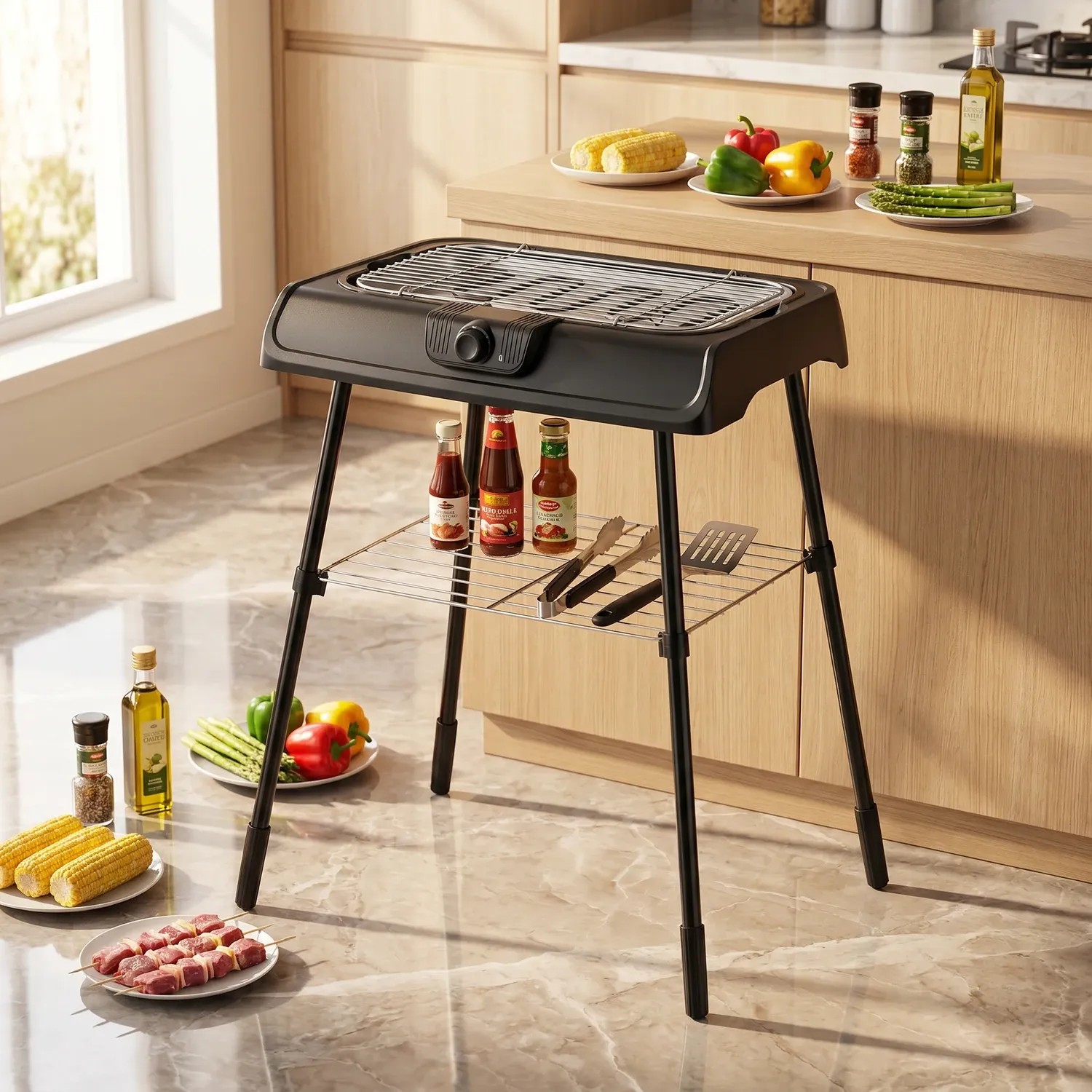
Sample request: freestanding format (BQ1601-4S) can be evaluated alongside the tabletop models before a first order.
Have Questions or Need More Details?
Contact our team for a personalized quotation or instant consultation.
Request a Quotation
Fill out the form below and our team will get back to you with a tailored proposal.
WhatsApp Direct Chat
Prefer to chat in real-time? Message us on WhatsApp for instant assistance & quick answers.
- Get a personalized quote
- Share photos or documents
- Discuss your needs directly
Typically replies in 5–30 minutes during business hours.