Food Steamer Guide: How Electric Steamers Are Specified, Sourced, and Used
Food Steamer Guide: How Electric Steamers Are Specified, Sourced, and Used
An electric food steamer is a plug-in countertop appliance that heats water in a reservoir and cooks food with the resulting steam inside one or more stacked tiers. It is one of the most accessible product categories in small household kitchen appliances — and one of the easiest to get wrong. Two steamers that look identical in a catalogue photo can differ in usable capacity, dry-burn protection, food-contact material documentation, and whether the compliance file will actually clear a European retailer.
This guide is written for importers, distributors, brand owners and procurement teams who are still in the awareness and research stage of a food steamer decision. It explains how the category is built, what the differences between 2-tier, multi-tier and stackable designs actually mean in use, which specifications drive returns and compliance problems, and what evidence to request before a sample or bulk order is confirmed. Product data in this article comes from the SC750 electric food steamer specification and from the manufacturing records of Ningbo Jinchang Electronics Co., Ltd.
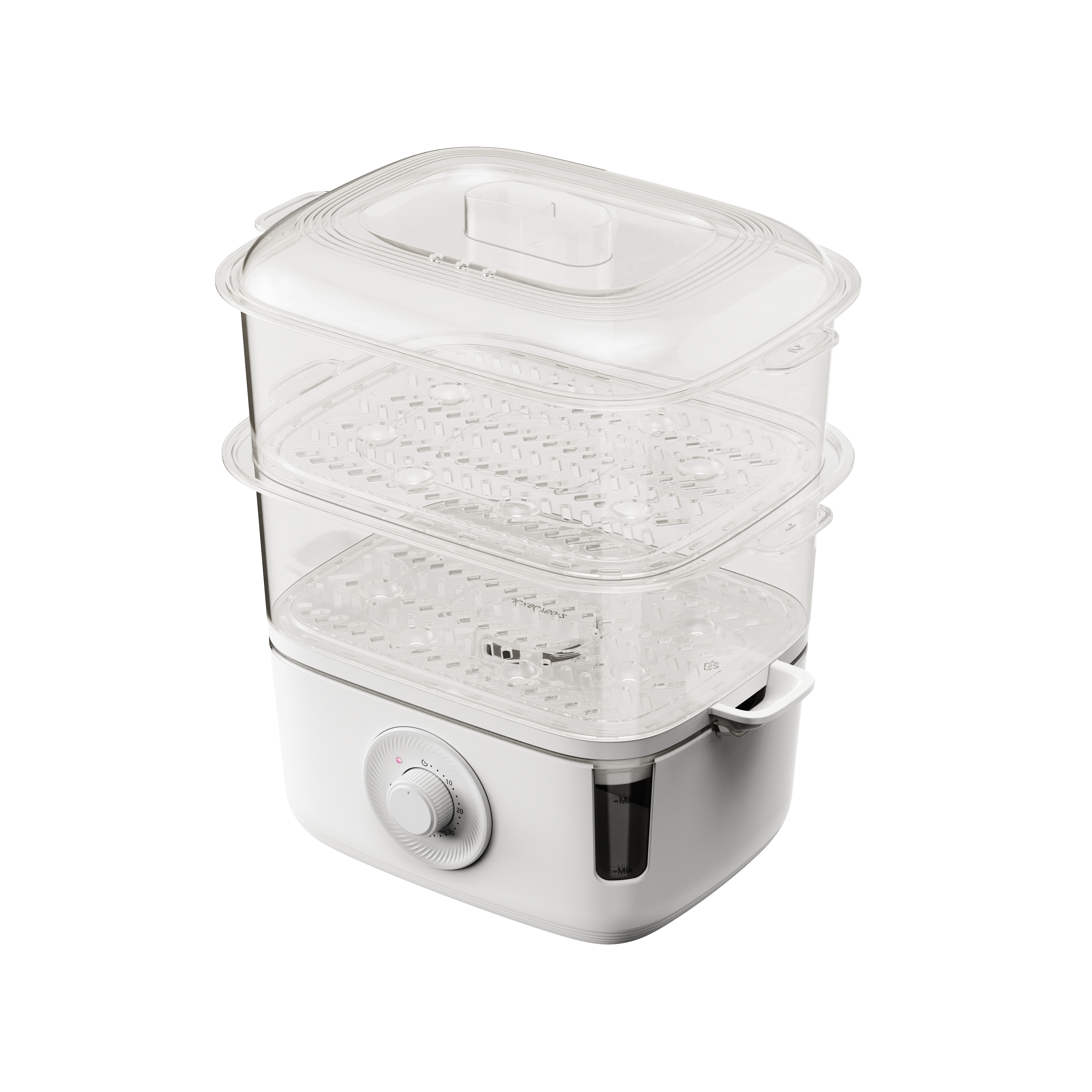
Cover: SC750 electric food steamer — 2-layer, 7L capacity, 800W, 230V.
Problem Definition: The Six Questions Buyers Must Answer First
The first honest answer about this category is that a food steamer is simple to use and surprisingly complex to buy. The appliance itself is low-risk for the end user, but the sourcing decision carries risk in six specific places. Buyers who resolve these six points before shortlisting suppliers avoid most of the returns, compliance holds and rework that appear later in the process.
- Real usable capacity versus advertised capacity. Capacity claims are usually expressed in litres or quarts, but what matters is how much food actually fits on the trays at once and whether the tier spacing allows taller items such as buns or corn.
- Voltage and market match. The SC750 is rated 230V and cannot work under 110V without a voltage-adjusted model. Shipping a 230V unit into a 110V market is a functional failure, not a minor inconvenience.
- Safety protection. A large-capacity steamer faces dry-burn overheating risk when the water tank empties. The relevant question is whether the product has a working automatic shut-off, and whether that protection is verified before mass shipment.
- Food-contact material. Poor-quality food-contact parts may release harmful substances under high-temperature steam. Food-contact components must pass a migration test for the destination market; in the EU that requirement is expressed through LFGB compliance for the steaming tray and cavity.
- Control type. A mechanical rotary timer versus an app or Wi-Fi control changes cost, failure rate, target user and compliance obligations.
- Retail readiness. A product that is technically correct but arrives without retail packaging or private-label support still cannot be listed.
Read the six points as a checklist, not as a ranking. In most failing projects, the problem is not one dramatic defect but one of these six points left unresolved and discovered only at the container stage.
Industry Background: Where Electric Steamers Sit in the Small Kitchen Appliance Trade
Electric steamers belong to the light industry and daily-use segment of small household kitchen appliances — the same manufacturing and distribution ecosystem that supplies electric grills, food dehydrators and multi-functional countertop cooking appliances. In practice, the category reaches end users through four routes: supermarket and retail chains, cross-border e-commerce listings, gift-set and promotional wholesalers, and overseas brand owners who order under their own label.
Those four routes place different demands on the same appliance. A supermarket programme cares about packaging consistency, safety documentation and shelf-ready presentation. A cross-border e-commerce seller cares about unboxing quality, return rate and how the product photographs. A gift-set buyer cares about price positioning and box design. A brand owner cares about customisation depth. This is why the same category is rarely bought the same way twice, and why the supplier's ability to adjust configuration matters as much as the base specification.
Ningbo Jinchang Electronics Co., Ltd. is a manufacturer of Western-style small household kitchen appliances, established in 1995 and located at No.17 Guangming East Road, Ditang Sub-district, Yuyao City, Zhejiang Province, China, inside China's home-appliance industrial cluster. The company operates a 5,500 m² production facility with approximately 68 staff, including an R&D team of 8 engineers, and reports an annual production capacity of 1,200,000 units. Its main product lines are Electric BBQ Grill, Electric Steamer, Charcoal Grill and Food Dehydrator, with more than 200 product models available. Export business accounts for 90% of total sales, covering the EU, USA, AU and RU markets.
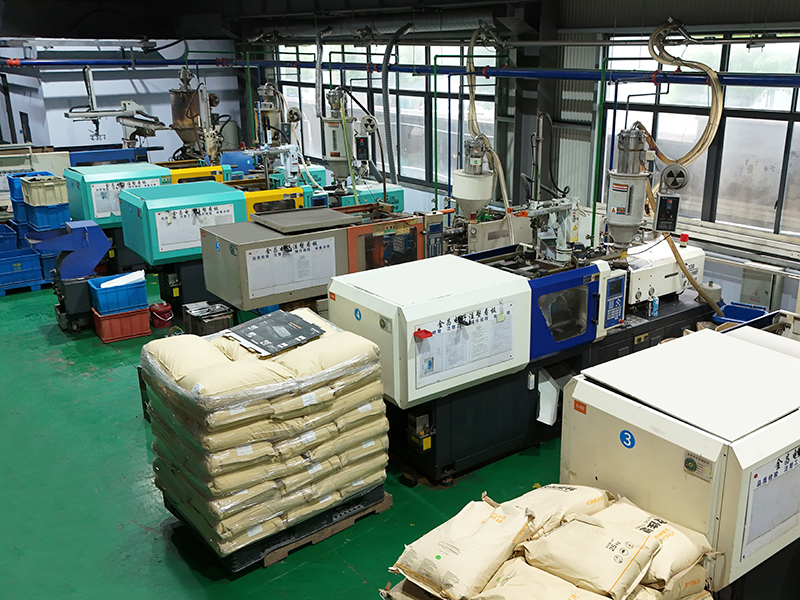
Manufacturing workshop — small household kitchen appliance production at Ningbo Jinchang Electronics Co., Ltd.
For buyers evaluating food steamer suppliers, the operational background matters more than the product photo. On the quality and compliance side, the company has obtained ISO 9001 Quality Management System and ISO 14001 Environmental Management System certification, holds membership of amfori BSCI and ICS for international supply-chain compliance, and is recognised as a National High-Tech Enterprise, Innovative SME and Technology-based SME. It holds more than 30 independent intellectual property rights, including invention patents and utility-model patents, and is capable of in-house structural R&D, mould development and product testing. All products can pass international safety and environmental tests such as CE, RoHS and REACH to meet market-access requirements in different countries.
Detailed Solution: How a Modern Countertop Electric Food Steamer Is Built
Understanding the appliance as five subsystems makes specification decisions faster, because each subsystem maps to a buyer risk rather than to a marketing claim.
1. Tier architecture: 2-layer, 2-tier, multi-tier and stackable
The steaming tiers determine how much food is cooked at the same time and how the appliance is stored. A 2-layer electric food steamer such as the SC750 uses a dual-layer structure so that different foods can be steamed simultaneously — vegetables on one level, seafood or buns on another — without cooking them together. A multi-tier or stackable electric food steamer extends this logic with additional trays. The trade-off is vertical: more tiers mean a taller unit and more storage height required in the kitchen, which is why a double-layer design is the common compromise between capacity and countertop footprint.
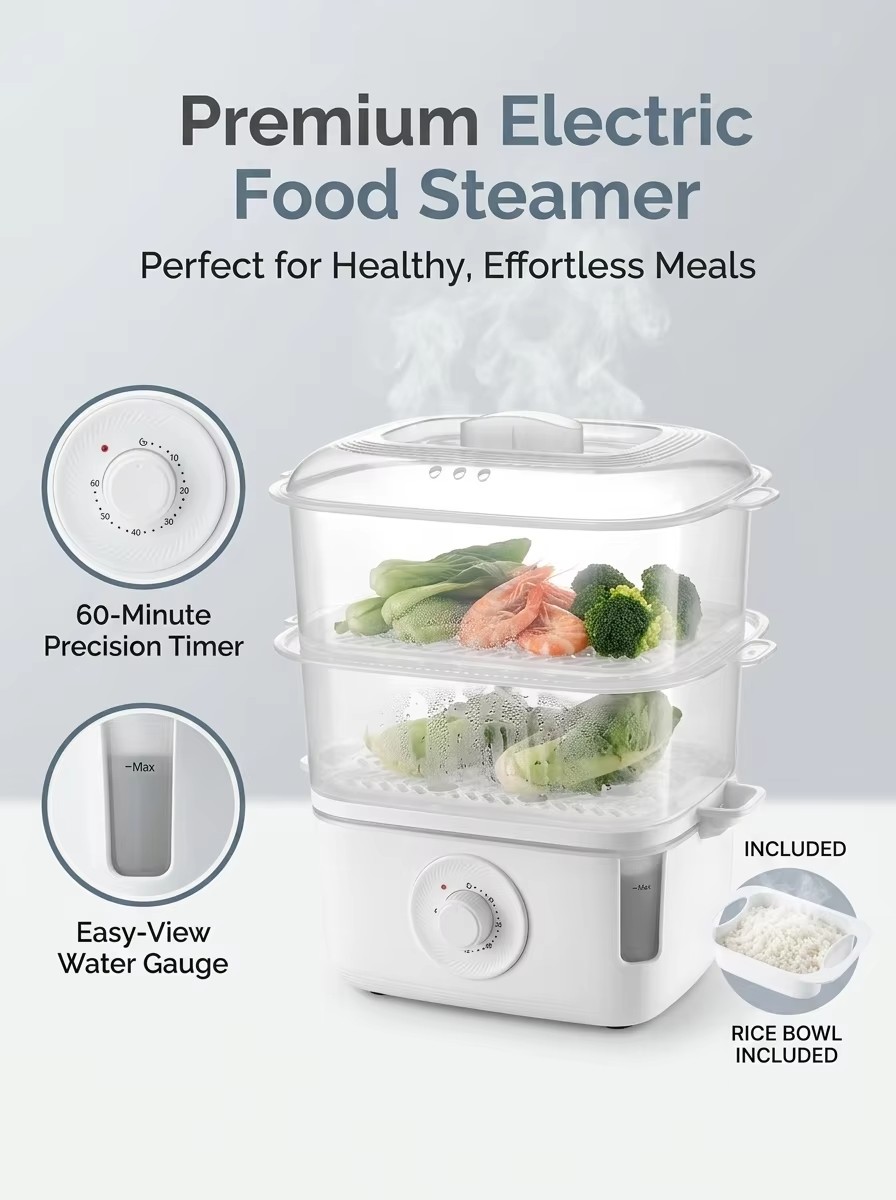
Stackable tier design — transparent trays allow food to be checked without lifting the lid.
2. Heating and water supply
The SC750 is rated 800W at 230V, which produces fast instant-steam heating for time-saving cooking. Water management matters as much as wattage: a visible independent water tank lets the user check the water level and refill without dismantling the appliance. Water filling and food placement are manual, and the unit is intended for indoor use on a stable, level countertop surface with a 230V grounded wall socket, using drinking or tap water.
3. Timer and control
This model uses a mechanical rotary timer for precise cooking duration. There is no app and no network connection, which keeps operation accessible for all age groups and removes the standby-power compliance question that applies to connected appliances.
4. Safety: automatic shut-off
An automatic shut-off food steamer addresses the single most relevant hazard in this category: dry-burn overheating when the tank runs out of water. The SC750 includes an auto-off function for this purpose. From a procurement standpoint, the practical step is not only to confirm that the function exists, but to inspect the timer and protection circuit before mass shipment, and to keep the end-user instruction to check water level before use inside the manual.
5. Food-contact material and BPA-free expectations
Steam cooking places food-contact parts under continuous high-temperature and moisture exposure. The SC750 uses a PP body with ABS knob and PC indicator, and its food-contact components comply with the LFGB standard, so they are suitable for daily food preparation. For buyers, a BPA-free electric food steamer claim is only as strong as the test report behind it: ask for the LFGB test report covering the steaming tray and cavity rather than accepting a logo on the packaging.
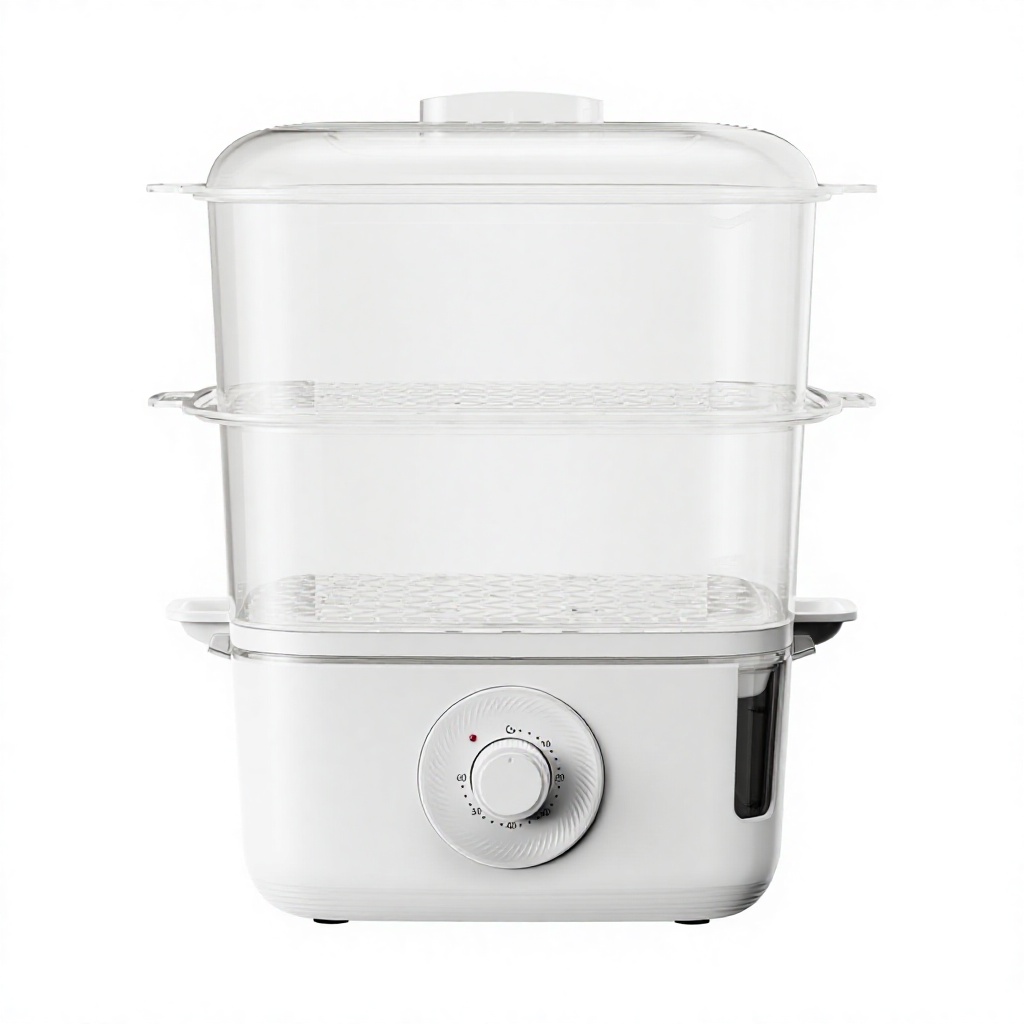
Food-contact components comply with LFGB; trays and accessories are removable for cleaning.
SC750 specification summary
| Specification | SC750 electric food steamer |
|---|---|
| Model | SC750 |
| Type | Electric Steamer |
| Power | 800W |
| Voltage | 230V |
| Capacity | 7L / 7-quart |
| Layers | 2-Layer |
| Housing material | Plastic |
| Material composition | PP + ABS knob + PC indicator |
| Certifications | CE, LFGB, CB |
| Control | Mechanical rotary timer, no app required |
| Safety | Auto-off dry-burn protection |
| Water tank | Visible independent water tank |
| Packing | Colour box, retail-ready |
Step-by-Step Breakdown: How to Evaluate a Food Steamer Before You Commit
The following sequence reflects the order in which most sourcing mistakes become expensive. Each step produces a document or a confirmed fact, not an impression.
- Define the destination market and voltage. Confirm the market (EU, USA, AU, RU and others) and the required voltage. The SC750 is a 230V unit and requires a voltage-adjusted model for 110V markets.
- Verify usable capacity and tier count. Decide whether the project needs a single-layer unit for 1–2 users or a double-layer 7-quart unit for family cooking, retail and gift-set programmes. Check that tray spacing suits the food types your market cooks most.
- Confirm safety protection. Require a working automatic shut-off for dry-burn protection, and plan an inspection of the timer and protection circuit before mass shipment.
- Request food-contact documentation. Ask for LFGB test reports covering the steaming tray and cavity. Avoid purchasing products without food-contact compliance documents.
- Assemble the compliance file for the market. For the EU this means electrical safety, food-contact material, hazardous substances and energy consumption: CE-CB, LFGB, RoHS and Ecodesign (EU) 2023/826. A self-declared CE without third-party test reports is commonly rejected by large retailers.
- Choose the control type deliberately. Mechanical timer for mass retail, gift-set and multi-country export programmes; app-controlled only where the channel is genuinely smart-home oriented.
- Plan packaging and private label. Confirm whether the order needs standard colour-box packing or private label food steamer treatment with customized packaging and appearance.
- Validate a sample, then control production consistency. Sample validation is the point to confirm capacity, timer behaviour, steam output and finish — not after the container is booked.
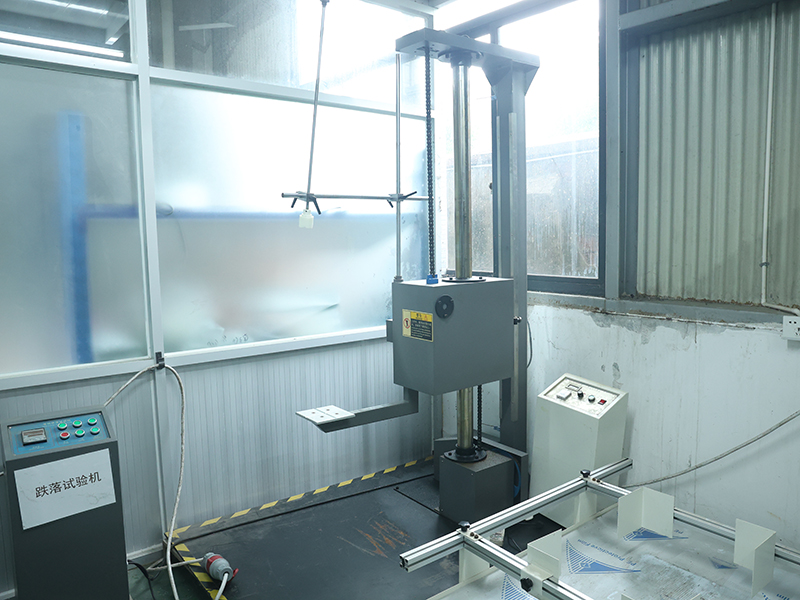
In-house product testing equipment — drop testing supports pre-shipment reliability checks.
A note on sequence: steps 3, 4 and 5 are compliance gates. They should be resolved before price negotiation, because a cheaper unit that cannot produce the reports is not a cheaper unit — it is a cancelled listing.
Use Cases: Where Electric Food Steamers Actually Fit
Family households
The dominant configuration. A double-layer 7-quart unit steams vegetables, seafood, meat, dumplings and eggs at the same time without increasing power consumption, and supports low-oil food preparation. The mechanical timer keeps operation simple for every member of the household.
Apartments, homestays and small catering
Countertop electric steamers fit indoor kitchens with limited space, and the steam-cooking function supports reheating as well as cooking. A single-layer unit suits small-portion cooking for one or two people; a double-layer unit suits shared accommodation and light catering where throughput matters.
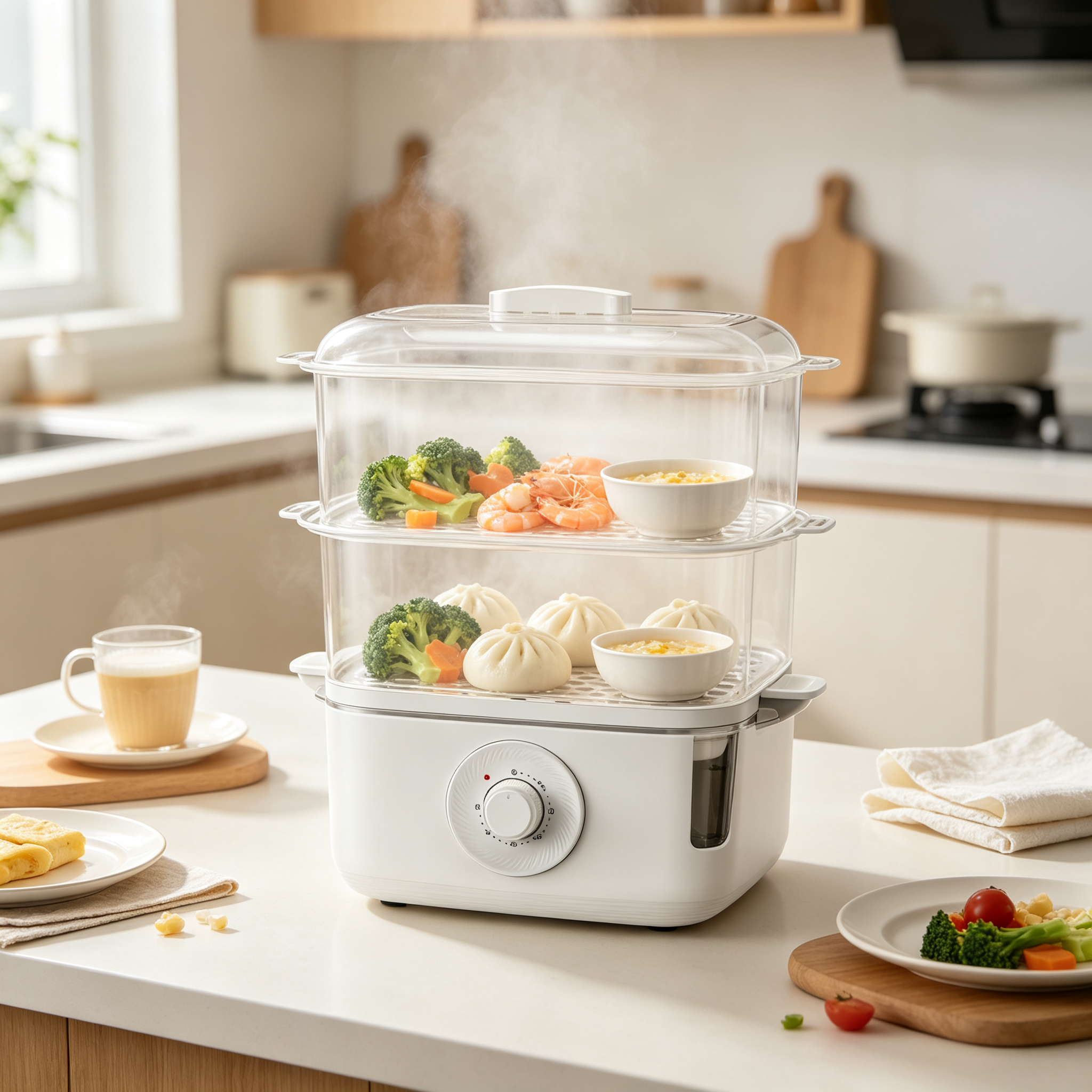
Application scenarios — indoor household and light catering kitchen use.
Supermarket and gift-set programmes
The SC750 ships in a retail colour box, which makes it suitable for household retail, gift sets and B-end wholesale procurement. Gift-set buyers typically combine box design with a fixed configuration so that the price point stays stable across the season.
Cross-border e-commerce
The product is explicitly intended for household use and B-end foreign trade procurement scenarios, including cross-border e-commerce. In this channel, the decisive factors are packaging quality, listing photography and a return rate that depends mostly on capacity expectations and cleaning convenience.
Private label and OEM/ODM programmes
Ningbo Jinchang Electronics Co., Ltd. provides ODM original design and development as well as OEM custom manufacturing. Customisation options include appearance modification, function adjustment, private-mould development and customized packaging solutions upon client requirements — the practical route for brand owners who need a steamer that is not visually identical to a catalogue item.
Comparison Table: Configuration Choices at a Glance
The two comparisons below cover the decisions that most often change a food steamer order: layer count and control type. Both are drawn from the SC750 specification and application data.
| Decision point | Double-layer 7-quart electric steamer | Single-layer electric steamer |
|---|---|---|
| Cooking capacity | Large volume; multiple food portions cooked at the same time | Limited capacity |
| Simultaneous food types | Different foods steamed in separate tiers at once | One food group per session |
| Power consumption | Same power consumption as the single-layer configuration | Comparable power draw |
| Storage footprint | Higher vertical dimension for storage | Smaller overall height |
| Typical fit | Family usage, B-end wholesale, gift-set projects | Small-apartment or 1–2 person scenarios |
| Decision point | Mechanical timer steamer | APP / Wi-Fi smart steamer |
|---|---|---|
| Operation | Simple; suitable for all-age users | Smart functions; complex operation for elderly users |
| Failure rate | Lower | Higher after-sales risk |
| Compliance profile | No network-standby compliance risk | Must meet Ecodesign network-standby requirement |
| Cost position | Lower cost basis for mass retail | Higher cost |
| Recommended channel | Mass retail, gift-set and multi-country export | Smart-home dedicated channels |
FAQ: Common Questions from Food Steamer Buyers
What certifications does an electric food steamer need for the EU market?
EU market access for an electric steamer involves four separate areas. CE-CB covers electrical safety for household appliances and is normally supported by a third-party CB test report. LFGB covers food-contact components — the steaming tray and cavity — which must pass a food-contact migration test. RoHS restricts hazardous substances inside the product, and Ecodesign (EU) 2023/826 sets off-mode and standby-mode power consumption limits. The SC750 is listed with CE, LFGB and CB certifications. A self-declaration CE without third-party test reports is generally rejected by large retailers, so buyers should request the test reports themselves rather than only the certificate marking on the packaging.
What are the power, capacity and layer specifications of the SC750 electric food steamer?
The SC750 is a 2-layer electric food steamer rated at 800W and 230V with a 7L (7-quart) capacity and a plastic housing. The material composition is PP body with ABS knob and PC indicator, and the rated certifications are CE, LFGB and CB. It uses a mechanical rotary timer rather than an app, includes auto-off dry-burn protection, and has a visible independent water tank plus removable steaming trays for cleaning. It is designed for the household consumer market and for B-end foreign trade procurement, including cross-border e-commerce.
Is a mechanical-timer steamer or an APP-controlled steamer better for export orders?
A mechanical-timer steamer without an app is easy to operate for all-age users, has a lower failure rate, and avoids the Ecodesign network-standby compliance risk that connected appliances carry. An APP or Wi-Fi steamer offers richer functions, but costs more, is harder for elderly users to operate, and increases after-sales risk. For mass retail, gift-set and multi-country export programmes, the mechanical-timer version is the more practical choice; an app-enabled model makes sense mainly when the sales channel is specifically a smart-home channel.
What should buyers verify when comparing food steamer suppliers?
Five checks cover most of the risk: real cooking capacity and tier structure; rated power and voltage match to the destination market; a working automatic shut-off for dry-burn protection; LFGB-compliant food-contact parts supported by test reports; and a complete export certificate file with retail-ready colour-box packaging. Detachable trays and a visible water tank are practical advantages because they reduce cleaning complaints and returns, and the timer and protection circuit should be inspected before mass shipment. Ningbo Jinchang Electronics Co., Ltd. manufactures electric steamers alongside Electric BBQ Grills, Charcoal Grills and Food Dehydrators, holds ISO 9001 and ISO 14001 certification, and offers ODM/OEM customisation covering appearance modification, function adjustment, private-mould development and customized packaging.
Can I request a sample or a private-label configuration before placing a bulk order?
Yes. Sample evaluation and private-label configuration are part of the normal B-end workflow for this product, since the electric food steamer is designed for household use and B-end foreign trade procurement scenarios including cross-border e-commerce. Customisation can cover appearance, functions, moulds and packaging. Send your target market, voltage requirement, layer or capacity preference and packaging direction to the team at Yibo@jinchang.co or +86 137-7718-5665 (WhatsApp available), or visit www.jc.ltd, and the team can confirm which configuration fits your programme.
Conclusion: Buy the Specification, Not the Photo
An electric food steamer is a mature, low-complexity appliance, which is exactly why differentiation in this category comes from documentation and configuration rather than from the appliance concept itself. A 2-layer, 7-quart, 800W countertop steamer with a mechanical timer, automatic shut-off and LFGB-compliant food-contact parts answers the majority of household and B-end requirements — provided the compliance file, packaging and customisation depth are confirmed before the order moves to production.
For buyers still in the research stage, the practical next step is to write a one-page sourcing brief covering destination market, voltage, tier count, capacity, control type, certification file and packaging. That single document turns a category comparison into a specific, quotable requirement — and it makes supplier answers comparable instead of anecdotal.
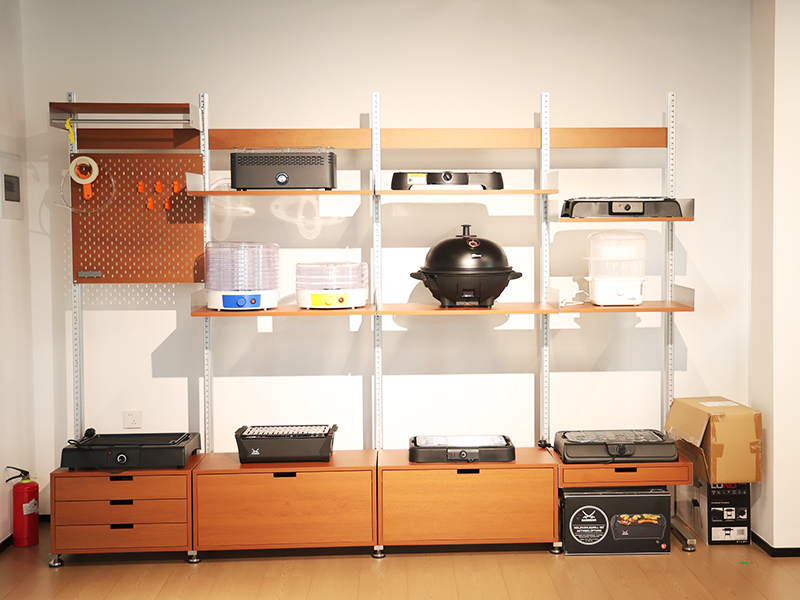
Sample room — electric steamer and small kitchen appliance samples prepared for buyer evaluation.
Next Step: Sample, Specification and Quote
Ningbo Jinchang Electronics Co., Ltd. supplies the SC750 electric food steamer for household retail, B-end wholesale, gift-set programmes and private-label projects, with ODM/OEM customisation available for appearance, function, moulds and packaging.
To request a sample, a full specification sheet or a quotation, contact:
Email: Yibo@jinchang.co
Tel / WhatsApp: +86 137-7718-5665
Website: www.jc.ltd
Address: No.17 Guangming East Road, Ditang Sub-district, Yuyao City, Zhejiang Province, China