Food Steamer Suppliers: A Buyer's Discovery Guide
Food Steamer Suppliers: A Buyer's Discovery Guide to Electric Steamers
"Food steamer" is not one product. The same search term leads buyers to bamboo stovetop baskets, stainless-steel commercial cabinets and countertop electric food steamers, and each of those families has a different supplier base, a different specification vocabulary and a different compliance file. At the discovery stage the expensive mistake is not choosing the wrong supplier; it is choosing the wrong category and then comparing prices across products that do not perform the same job.
This guide is written for importers, distributors, brand owners, cross-border e-commerce sellers and procurement teams who are opening a food steamer sourcing project and want a structured way to discover and qualify suppliers. It explains how the electric steamer category is organised, what a complete specification sheet should contain, which documents European and North American retail buyers are likely to request, and where the practical limits of a product or a supplier usually appear.
The reference product throughout this article is the SC750 electric food steamer from Ningbo Jinchang Electronics Co., Ltd., a manufacturer established in 1995 and located at No.17 Guangming East Road, Ditang Sub-district, Yuyao City, Zhejiang Province, China. The company specialises in the R&D, production and export of Western-style small household kitchen appliances, with main product lines covering Electric BBQ Grill, Electric Steamer, Charcoal Grill and Food Dehydrator. All product, factory and compliance facts below come from that manufacturer's own specification, application and compliance material. No market-size estimates, unit prices or third-party rankings are used.
Why "Food Steamer" Is Harder to Source Than It Looks
The first constraint in this category is definition. A buyer who searches for food steamer suppliers without narrowing the product will receive quotations for products that differ on almost every variable that matters: heating method, tier count, capacity definition, control type, food-contact material and certification set. Two quotations can both be described as "electric vegetable steamer" and still not be interchangeable in a supermarket programme.
The second constraint is the gap between the advertised and the usable specification. Capacity is often described in different units, and a "large capacity" claim says nothing about whether the appliance has one cooking tier or two. Tier count, tray removal and water-tank visibility determine whether the product is genuinely convenient in daily use, and those are the details that generate consumer returns when they are absent.
The third constraint is electrical configuration. An electric food steamer rated at 230 V cannot operate on a 110 V supply without a voltage-adjusted model. Suppliers that list a single rating for all markets force the buyer either to restrict the sales territory or to accept a configuration that will not pass local market expectations.
The fourth constraint is compliance documentation. A CE mark printed on retail artwork is not the same thing as a third-party CB test report, an LFGB food-contact migration result for the steaming tray and cavity, and a hazardous-substance file. Missing documentation typically surfaces not at the quotation stage but at the moment a large retailer or marketplace audits the listing.
The fifth constraint is the after-sales boundary. Many export-oriented manufacturers, including the one referenced in this article, do not provide local on-site after-sales service in destination markets. That is a normal arrangement in cross-border sourcing, but it has to be planned for rather than discovered later, because it determines what documentation, spare parts and user instructions the buyer must carry into the market.
How the Electric Food Steamer Category Is Structured Today
The category divides first by heating method. Traditional stovetop steamers, including bamboo and stainless-steel basket designs, depend on an external heat source and are usually sold as low-cost housewares items. Countertop electric steamers integrate the heating element, water tank and control into the appliance itself, which makes them a small kitchen appliance rather than a utensil, and moves them into a retail category with household-appliance compliance expectations.
Within countertop electric steamers, the practical sub-segments are defined by four variables: tier count (single-tier versus multi-tier, commonly two tiers and above), control type (mechanical rotary timer versus app or Wi-Fi control), food-contact material, and packaging format (plain carton versus retail-ready colour box). These four variables, more than brand, determine which sales channel a model fits.
Demand for these products clusters around household cooking, kitchen appliance upgrades, catering equipment procurement and OEM/ODM projects. From a buyer's perspective, the commercial channels that most often require an electric vegetable steamer are supermarket housewares aisles, gift-set and promotional programmes, cross-border e-commerce listings, and homestay and apartment supporting supplies. Steam cooking is also frequently chosen by consumers who want to reduce added oil in everyday preparation, which is why multi-tier models that cook vegetables, seafood, dumplings and other foods simultaneously have become a common configuration rather than a niche one.
The market-access side has also become more document-driven. European buyers increasingly ask for food-contact test results alongside electrical safety evidence, and energy-consumption requirements for standby and off-mode are now part of the specification conversation rather than a post-order detail. A supplier that cannot produce these documents early lengthens the sourcing cycle regardless of unit price.
What a Qualified Food Steamer Supplier Actually Provides
A defined reference product instead of a vague catalogue line
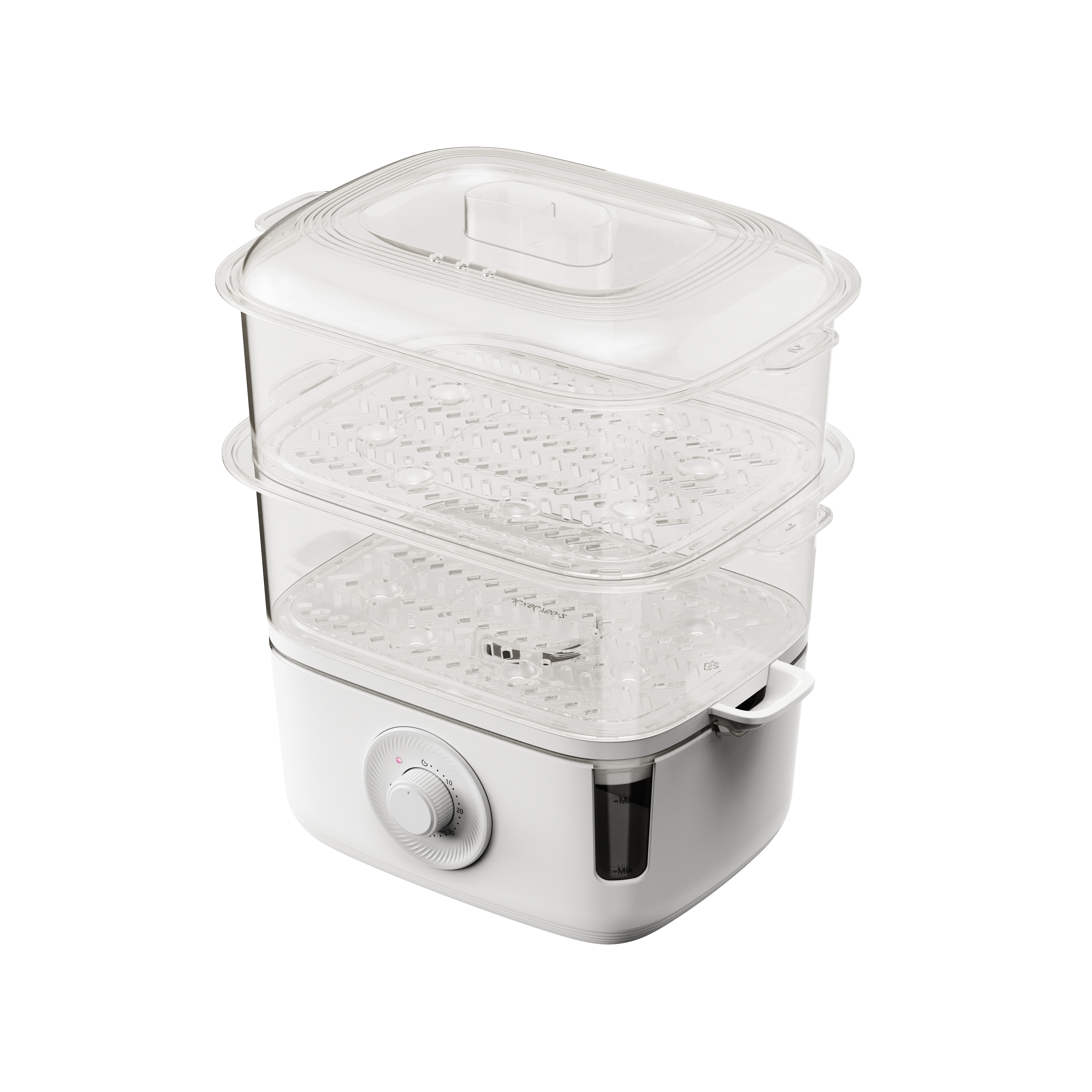
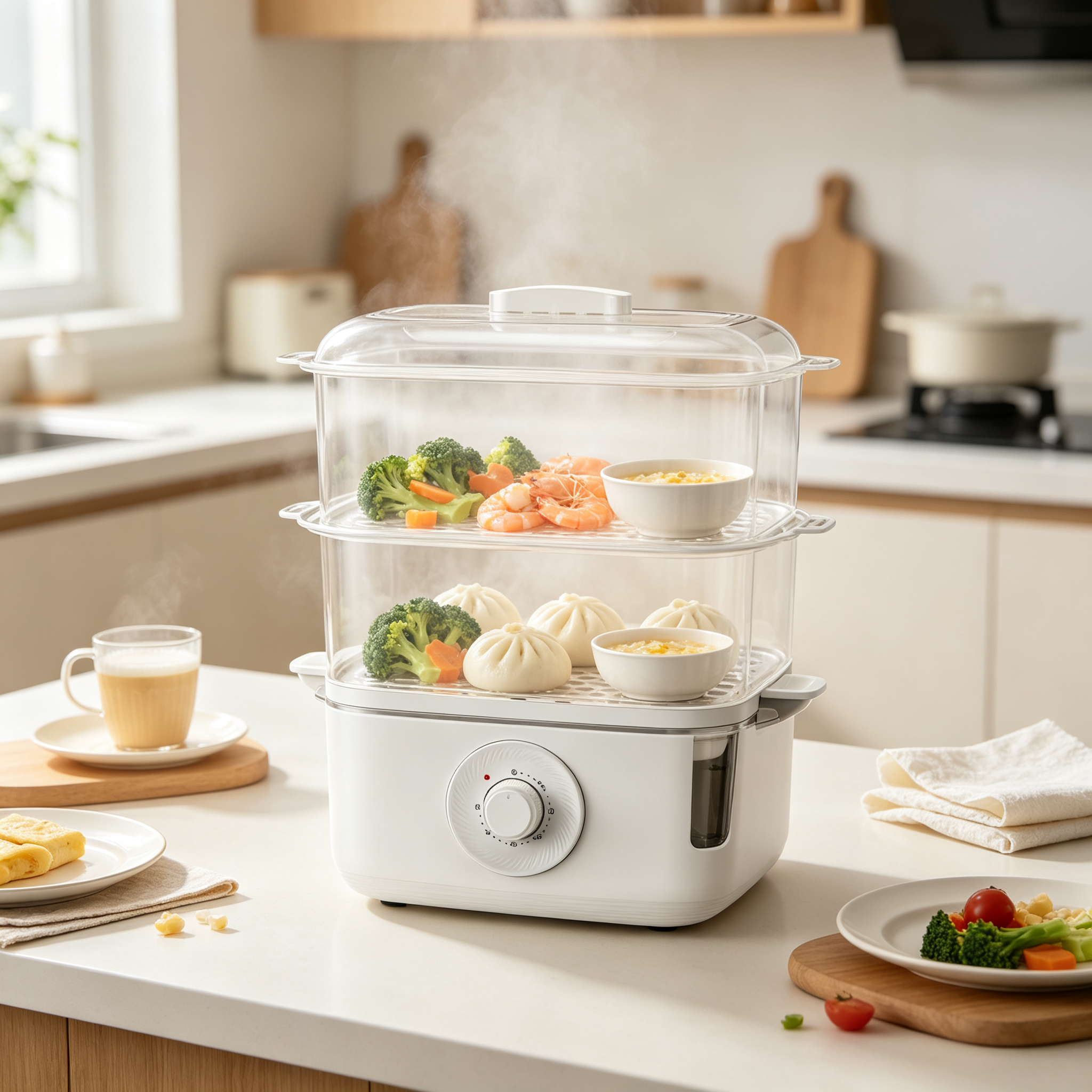
A qualified supplier can describe its kitchen appliance in the same terms a buyer would put on a purchase order. The SC750 electric food steamer is rated at 800 W and 230 V, uses a plastic housing, has a two-layer steaming body and a stated capacity of 7 L, and is certified to CE, LFGB and CB. Its food-contact related material set is PP with an ABS knob and a PC indicator.
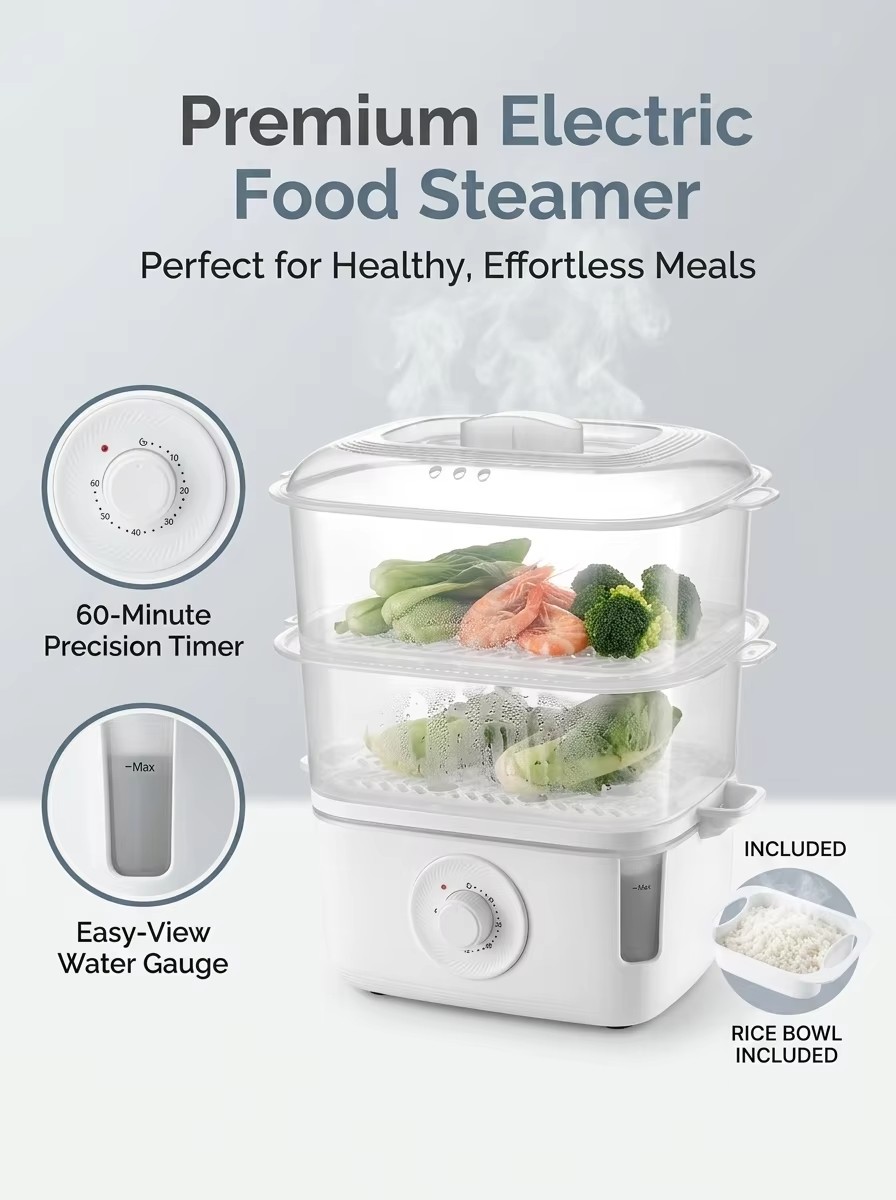
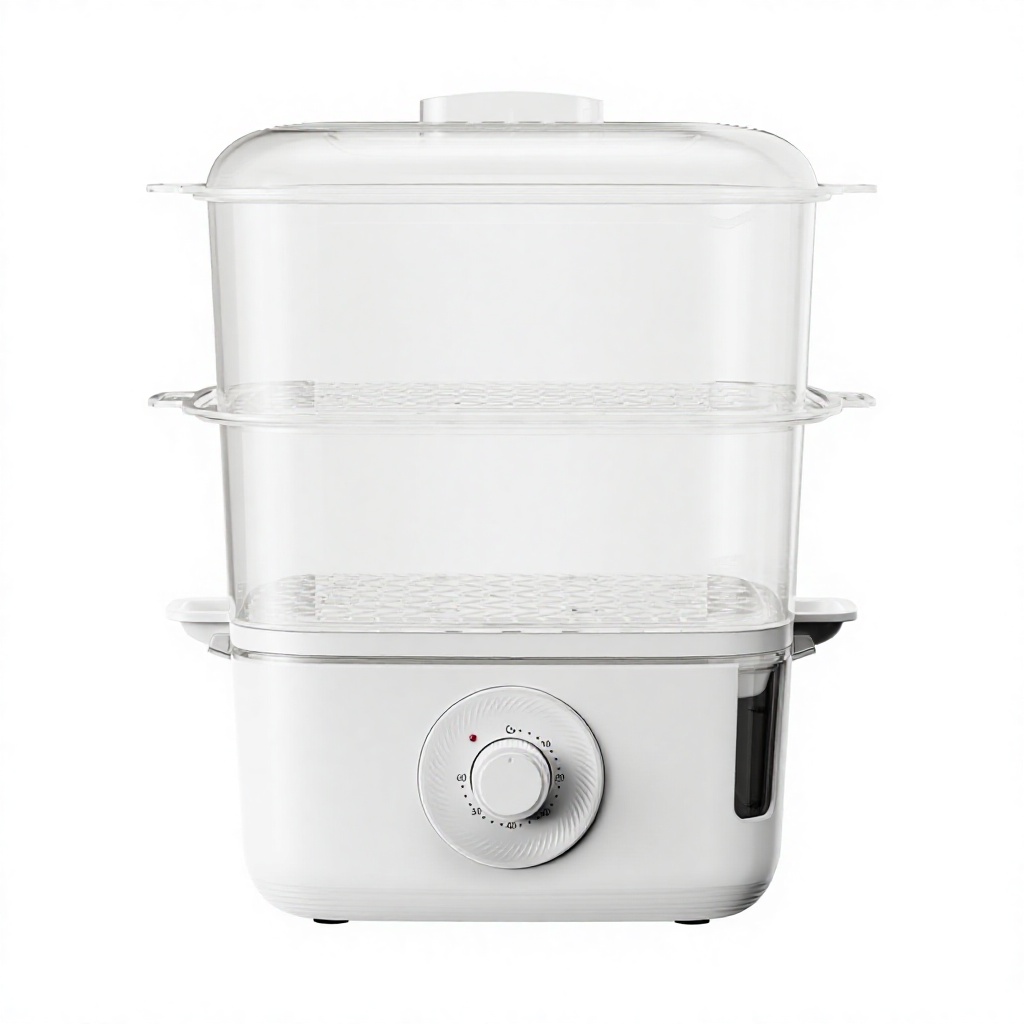
The functional specification is equally concrete. The model uses an 800 W heating element for fast instant-steam heating, a mechanical rotary timer for setting cooking duration without an app, and an automatic shut-off function intended to prevent dry-burn overheating risk. The dual-layer transparent steaming body is designed for vegetables, buns, baby food and seafood, the steaming trays and related accessories are removable for cleaning, and the independent water tank is visible so that the water level can be checked and refilled during cooking. The unit ships in a retail-ready colour box, which makes it usable as a supermarket line, a gift-set component or a wholesale item.
Compliance documents the destination market will request
For the European Union, an electric food steamer is assessed across four document groups. CE-CB evidence covers electrical safety for household appliances and should include a third-party CB test report. LFGB testing covers the food-contact components, specifically the steaming tray and cavity, and requires food-contact migration results. RoHS documentation restricts hazardous substances inside the product. Ecodesign (EU) 2023/826 addresses off-mode and standby-mode power consumption limits. Suppliers' own guidance is explicit on one point: a self-declaration CE without third-party test reports is commonly rejected by large retailers.
Compliance capability also depends on the factory behind the certificate. Ningbo Jinchang Electronics Co., Ltd. operates an ISO 9001 quality management system and an ISO 14001 environmental management system, holds membership of amfori BSCI and ICS for international supply-chain compliance, and owns more than 30 independent intellectual property rights including invention patents and utility-model patents. The company states that its products can pass international safety and environmental tests such as CE, RoHS and REACH to meet the market-access requirements of different countries.
Manufacturing and engineering capacity behind the product
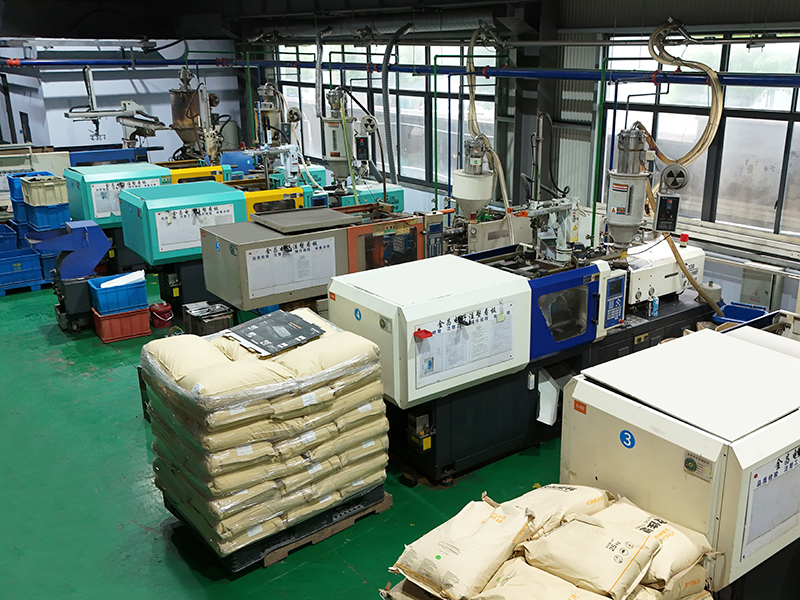
Supplier discovery should include capacity, because a specification is only deliverable at volume. The manufacturing facility of Ningbo Jinchang Electronics Co., Ltd. covers 5,500 m² and employs approximately 68 staff, including an R&D team of 8 engineers. Annual production capacity reaches 1,200,000 units, and the company offers more than 200 product models. Export business accounts for 90% of total sales, with primary markets in the EU, USA, AU and RU.
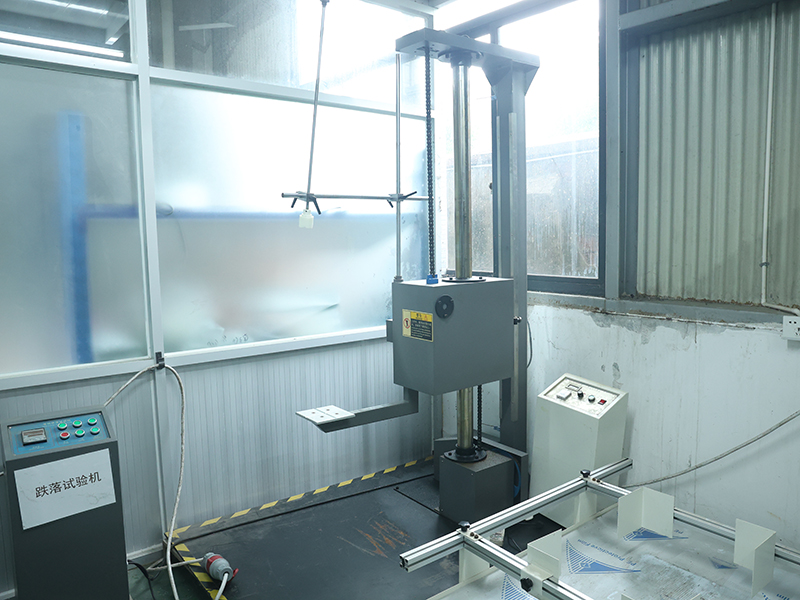
Engineering depth matters for a second reason: it determines whether a specification problem can be solved. The company is set up for in-house structural R&D, mould development and product testing, and it holds National High-Tech Enterprise, Innovative SME and Technology-based SME certifications. In practice, that means a buyer can raise questions about tray geometry, water-tank visibility, timer configuration or packaging structure and receive an engineering answer rather than a commercial one.
Private label and OEM/ODM readiness
For buyers whose search includes private label food steamer programmes, the relevant question is whether the supplier offers genuine development capability or only logo printing. The stated service scope covers ODM original design and development as well as OEM custom manufacturing, with customisation options including appearance modification, function adjustment, private-mould development and customised packaging solutions. Combined with retail colour-box packing, that scope supports supermarket lines, gift sets and distributor-owned brands rather than only unbranded wholesale supply.
Stated limits a buyer should plan around
Good discovery work also collects the limitations, because they determine territory and channel fit. Four are documented for this product family. The steamer is rated 230 V and cannot work on 110 V without a voltage-adjusted model. It is intended for indoor use only, on a stable and level countertop surface, connected to a grounded 230 V wall socket and filled with drinking or tap water. Because it is an electric appliance, it is not a substitute for a commercial pressure system in heavy catering use. And the manufacturer does not provide local on-site after-sales service in destination markets, which means the buyer should agree in advance on spare parts, user documentation and warranty handling.
Step-by-Step: How to Discover and Shortlist Food Steamer Suppliers
- Define the use case before the product. Decide whether the target end user is a household cooking for a family, a one-to-two-person apartment, a gift-set programme or a hospitality setting. This single decision eliminates most of the supplier list, because single-tier and two-tier models serve different users.
- Fix the capacity and tier configuration. A 7 L two-layer design cooks multiple foods in one cycle; a single-layer unit fits small-portion cooking. Write the requirement as a number of litres plus a tier count, not as "large capacity".
- Confirm the voltage and plug configuration for each sales territory. A 230 V model cannot serve a 110 V market without a voltage-adjusted variant, so territory mapping should happen before sampling, not after.
- Request the compliance set early. Ask for the CB test report, the LFGB food-contact migration result for the tray and cavity, RoHS documentation and the Ecodesign (EU) 2023/826 position in the first exchange. A supplier that can only supply self-declared CE should be treated as a different risk tier.
- Verify the factory, not only the product. Check facility size, workforce, in-house R&D headcount, annual capacity and whether mould development and testing are handled internally. For this supplier the figures are 5,500 m², approximately 68 staff, 8 R&D engineers and 1,200,000 units per year.
- Decide the control type deliberately. Mechanical rotary timer control is simple for all age groups, has a lower failure rate and avoids Ecodesign network-standby obligations. App or Wi-Fi control adds smart functions but also adds cost, complexity for older users and after-sales exposure.
- Validate through samples. Test real capacity against the tier count, timer accuracy, automatic shut-off behaviour, tray removal and cleaning, water-tank visibility and retail packaging before committing to a bulk order.
- Confirm packaging and private label readiness. Establish whether retail colour-box packaging is standard, what artwork changes are possible, and whether customised packaging or private-mould development is part of the quoted scope.
- Agree the after-sales boundary in writing. Where the supplier has no local on-site service, the buyer should confirm spare-parts availability, user-manual content and the process for handling field failures.
Use Cases: Where a Countertop Electric Food Steamer Fits
The clearest fit for a 7 L two-tier electric food steamer is the family kitchen. Because the tiers are stacked, vegetables, seafood, dumplings, eggs or prepared food can be steamed in the same cooking cycle, and the 800 W element produces instant steam for time-saving preparation. The removable trays and visible water tank keep daily cleaning and refilling practical, which is what drives repeat purchase in a household category.
For one-to-two-person households and small apartments, a single-layer steamer is the better match: capacity is lower, but the unit takes up less vertical space, which matters on a compact countertop. This is a configuration decision, not a quality decision.
Gift-set and promotional programmes are a third use case. A retail-ready colour box, an all-age mechanical timer and a compact countertop footprint make this type of appliance suitable for seasonal gift assortments and supermarket promotions, where the buyer needs a product that can be understood without a demonstration or an app.
Cross-border e-commerce and B-end foreign trade procurement form a fourth channel. The SC750 is explicitly positioned for household use and B-end foreign trade procurement scenarios, including cross-border e-commerce, and the application data for this product family lists markets including Germany, France, Spain, the United States, Italy, Portugal, the Netherlands, Austria, Ireland, Poland, Sweden, Denmark, Norway, Brazil, South Africa, Belgium, the Czech Republic and Hungary.
Homestay and apartment supporting supplies, along with light catering and hospitality use, form a fifth scenario. These buyers value low-oil steam preparation, simple controls that guests can operate without instructions, and a design that can be cleaned quickly between uses.
Comparison Tables: Reading a Food Steamer Specification Side by Side
Discovery-stage buyers get the most value from two documents: a full specification table for the reference model, and a decision table for the configuration choice that most affects returns. Both are shown below using the manufacturer's published facts.
SC750 electric food steamer: specification summary
| Parameter | Specification |
|---|---|
| Product type | Electric steamer (electric food steamer) |
| Model | SC750 |
| Power | 800 W |
| Voltage | 230 V |
| Housing material | Plastic |
| Layers | 2-layer (two steaming tiers) |
| Capacity | 7 L |
| Food-contact related material | PP + ABS knob + PC indicator |
| Control | Mechanical rotary timer, no app required |
| Safety feature | Automatic shut-off function to reduce dry-burn overheating risk |
| Certifications | CE, LFGB, CB |
| Packaging | Retail colour box |
| Intended use | Household consumer market and B-end foreign trade procurement, including cross-border e-commerce |
Mechanical timer versus app or Wi-Fi control
| Comparison dimension | Mechanical timer control | App / Wi-Fi control |
|---|---|---|
| Operation | Simple rotary setting, suitable for all age groups | Richer smart functions, more complex operation for older users |
| Failure and after-sales exposure | Lower failure rate | Higher cost and higher after-sales risk |
| Compliance | No Ecodesign network-standby obligation | Must meet Ecodesign network-standby requirements |
| Best-fit channel | Mass retail, gift-set and multi-country export programmes | Smart-home dedicated channels |
Two-layer 7 L versus single-layer configuration
| Comparison dimension | Two-layer 7 L steamer | Single-layer steamer |
|---|---|---|
| Cooking capacity | Multiple food portions cooked simultaneously | Limited to small-portion cooking |
| Power consumption | Published guidance states no increase in power consumption versus a single-layer unit | Standard consumption for the same rated power |
| Storage envelope | Greater vertical height, needs more storage space | Smaller overall height |
| Recommended fit | Family cooking, B-end wholesale and gift-set programmes | Small apartments and one-to-two-person use |
FAQ: Food Steamer Suppliers
What certifications should a food steamer supplier provide for the EU market?
For the EU market, an electric food steamer requires safety, food-contact material, hazardous-substance and energy-consumption documentation. The relevant set is CE-CB with a third-party CB test report, LFGB food-contact migration testing on the steaming tray and cavity, RoHS for restricted substances, and Ecodesign (EU) 2023/826 for off-mode and standby-mode power limits. A self-declaration CE without third-party test reports is commonly rejected by large retailers, so buyers should request certificate numbers and test reports rather than accept a logo on retail artwork. The SC750 is listed with CE, LFGB and CB certification.
How can a buyer check whether a food steamer supplier can run a private label programme?
Private label requires engineering and packaging capability, not only logo printing. Ningbo Jinchang Electronics Co., Ltd. provides ODM original design and development as well as OEM custom manufacturing, with customisation covering appearance modification, function adjustment, private-mould development and customised packaging solutions. The supporting capacity is a 5,500 m² manufacturing facility, approximately 68 staff including an R&D team of 8 engineers, in-house structural R&D, mould development and product testing, more than 200 product models and an annual production capacity of 1,200,000 units. Buyers should confirm whether moulds are developed in-house and whether retail packaging artwork can be customised.
What should buyers compare when judging the cost structure of an electric food steamer order?
Cost in this category is driven by specification and documentation, not only by unit price. The main variables are rated power and heating structure (800 W on the SC750), food-contact materials that satisfy LFGB requirements (PP with ABS knob and PC indicator), the control type, the certification package required by the destination market, retail colour-box packaging, and any private-mould or customised packaging work. Published sourcing guidance from the manufacturer recommends the mechanical-timer version for mass retail, gift-set and multi-country export programmes, while the app-controlled version carries higher cost and after-sales risk. A cheaper unit that omits automatic shut-off protection or food-contact test documentation moves compliance and return risk onto the buyer.
Can buyers validate a food steamer before placing a bulk order?
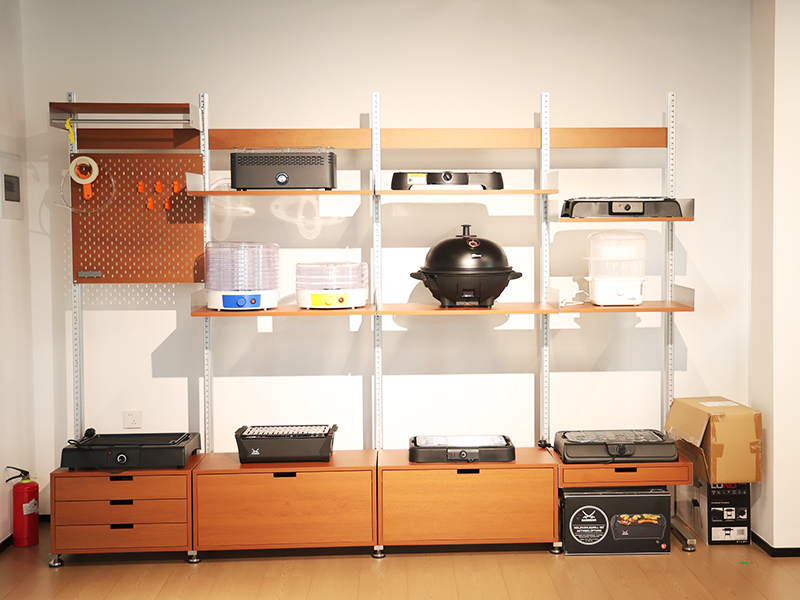
Yes. Sampling is the standard validation step and the manufacturer maintains a sample room for product evaluation. Buyers should test real capacity against the stated tier count, timer accuracy, automatic shut-off behaviour, the removal and cleaning of the steaming trays, the visibility of the independent water tank, and the condition of the retail packaging. One practical point: because this model is rated 230 V, a buyer testing in a 110 V market must first request a voltage-adjusted variant, since the standard unit will not operate on that supply.
What should be confirmed before scheduling mass production?
Before production is scheduled, confirm the final voltage and plug configuration for each territory, the control type, the packaging artwork for private label, and the complete certificate package for the destination market. The manufacturer also recommends inspecting the timer and the automatic shut-off protection circuit before mass shipment. Because no local on-site after-sales service is provided in destination markets, spare-parts availability, user-manual content and field-failure handling should be agreed in advance. Buyers who need the full specification sheet, the certification list or a sample arrangement can contact Yibo Zhang at Yibo@jinchang.co or reach the sales team on WhatsApp at +86 137-7718-5665.
Conclusion: Discovery-Stage Decisions That Prevent Costly Revisions
Discovering food steamer suppliers is a qualification exercise rather than a price exercise. The buyers who avoid costly revisions are the ones who settle five questions before requesting a quotation: which product family actually matches the end user, what capacity and tier configuration the channel needs, which voltage and plug configuration each sales territory requires, which compliance documents the destination market will audit, and where the after-sales boundary sits between the manufacturer and the importer.
A supplier that can answer those questions with documents and figures, rather than with descriptions, is a different kind of partner. On the product side that means a defined model such as the SC750, with a stated 800 W rating, 230 V configuration, two-layer 7 L body, mechanical timer, automatic shut-off and CE, LFGB and CB certification. On the factory side it means verifiable capacity: 5,500 m² of production space, approximately 68 staff, an in-house R&D team of 8 engineers, an annual output of 1,200,000 units, more than 200 product models and 90% of sales going to export markets in the EU, USA, AU and RU.
Next Step: Sample, Specification Sheet or Quotation
If you are shortlisting electric food steamer suppliers for a household retail, gift-set, cross-border e-commerce or private label programme, the fastest way to evaluate fit is to start with the specification sheet and a physical sample.
Contact: Yibo Zhang | Email: Yibo@jinchang.co | Tel / WhatsApp: +86 137-7718-5665
Address: No.17 Guangming East Road, Ditang Sub-district, Yuyao City, Zhejiang Province, China
Website: www.jc.ltd