Food Steamer Suppliers: An Electric Steamer Sourcing Guide
Food Steamer Suppliers: An Electric Steamer Sourcing Guide
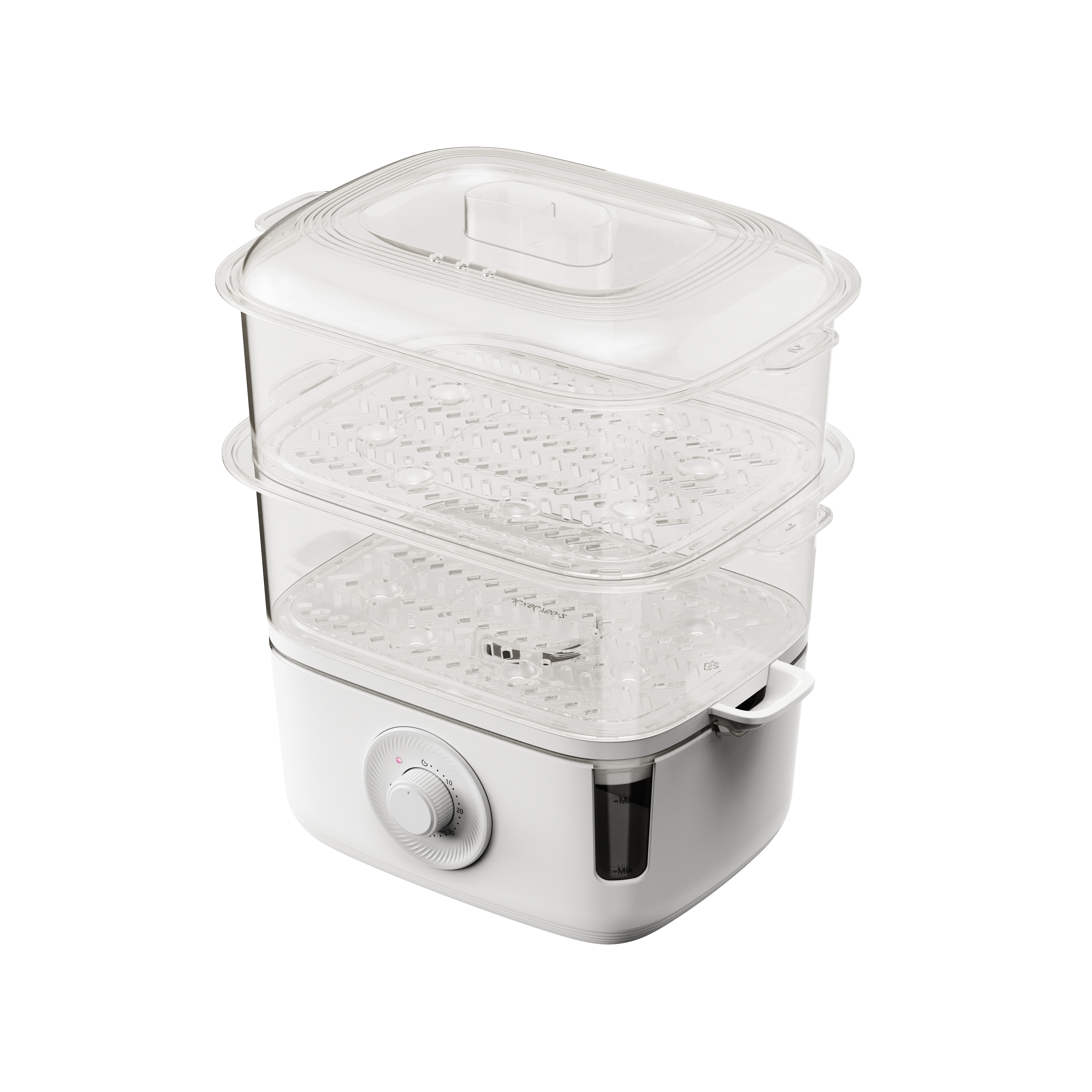
Cover: the SC750 electric food steamer — a 2-tier, 7 L countertop unit for household and B-end procurement programmes. Image source: Ningbo Jinchang Electronics Co., Ltd.
An electric food steamer is a countertop appliance that cooks vegetables, seafood, dumplings, eggs, meat and prepared food with steam produced by an electric heating element in a water tank. For a B2B buyer, the term "food steamer" does not describe one product: it covers single-tier and multi-tier bodies, mechanical-timer and app-controlled versions, 110 V and 230 V models, and units that differ in certificates, packaging and usable cooking capacity.
This guide answers the first question importers, distributors, supermarket buyers and private-label brands ask — who supplies food steamers, and how should those suppliers be compared — by breaking the category down into the specifications that decide whether a container of steamers sells in your market or is stopped at the compliance stage. The reference model used throughout is the SC750, a 2-tier, 7 L electric food steamer manufactured and exported by Ningbo Jinchang Electronics Co., Ltd.
The Problem: "Food Steamer" Is Not a Specification
A purchase brief that says only "food steamer" leaves five variables open: tier count, capacity, control type, rated voltage and the compliance set required by the destination market. Each open variable maps to a specific, well-documented risk.
- Voltage mismatch. A 230 V unit such as the SC750 cannot work under 110 V without a voltage-adjusted model. Voltage is a market-entry decision, not a factory detail.
- Incomplete EU documentation. Electric steamers sold into the EU require CE-CB electrical safety documentation supported by a third-party CB test report, LFGB test reports for food-contact components such as the steaming tray and cavity, RoHS evidence for restricted hazardous substances, and Ecodesign compliance with (EU) 2023/826 for off-mode and standby-mode power consumption. A self-declared CE without third-party test reports is typically rejected by large retailers.
- Food-contact material risk. Non-food-grade trays or cavities may release harmful substances under high-temperature steam. The mitigation is documentary: require LFGB test reports for the steaming tray and cavity, and avoid purchasing units that have no food-contact compliance documents.
- Dry-burn overheating. In large-capacity electric steamers, the main safety hazard is dry-burn overheating when the water tank runs empty or when the timer fails and the protection circuit loses efficacy. A valid auto-off dry-burn protection function is the control measure, and it should be inspected before mass shipment.
- Packaging that cannot be listed. Retail, gift-set and supermarket programmes need retail-ready packaging. Without a colour box, the buyer absorbs secondary packaging work and cannot move the unit directly into a listing.
The practical consequence is that sourcing failures usually begin in the brief, not on the production line. Buyers who specify only the product name receive offers that cannot be compared against each other, and the comparison then happens late — at a stage when voltage, certificates and packaging can no longer be changed cheaply.
Industry Background: How Electric Steamer Supply Is Structured
Electric food steamers sit inside the small household kitchen appliance category, within light industry and daily-use manufacturing. Production is concentrated in China's eastern appliance clusters, and Ningbo Jinchang Electronics Co., Ltd. is located inside that cluster at No.17 Guangming East Road, Ditang Sub-district, Yuyao City, Zhejiang Province, China. The company was established in 1995 and specialises in the R&D, production and export of Western-style small household kitchen appliances; its main product lines are Electric BBQ Grills, Electric Steamers, Charcoal Grills and Food Dehydrators, with more than 200 product models available.
Three structural features of this supply base matter to buyers evaluating food steamer suppliers.
- It is export-first, so compliance drives design. Export business accounts for 90% of the company's total sales, with major markets in the EU, USA, AU and RU. Products are built to pass international safety and environmental tests such as CE, RoHS and REACH to meet the market-access requirements of different countries. A 230 V configuration with CE-CB, LFGB and CB documentation is therefore the normal product form for European retail programmes, rather than an optional upgrade.
- It is engineering-capable, not trading-only. The manufacturing facility covers 5,500 m² with approximately 68 staff, including an R&D team of 8 engineers, and annual production capacity reaches 1,200,000 units. The company is capable of in-house structural R&D, mould development and product testing; it holds ISO 9001 Quality Management System and ISO 14001 Environmental Management System certification, is a member of amfori BSCI and ICS for international supply-chain compliance, and has been certified as a National High-Tech Enterprise.
- Energy regulation is now shaping the control design. EU Ecodesign (EU) 2023/826 sets limits on off-mode and standby-mode power consumption. A mechanical-timer steamer has no network function and therefore no network-standby obligation, while an APP or Wi-Fi controlled steamer must demonstrate compliance. This is one structural reason mechanical-timer food steamers remain common in multi-country retail and gift-set programmes.
On the demand side, buyers commonly source electric steamers for low-oil cooking, for gift sets around seasonal retail peaks, and as standard equipment for apartments and homestays. Each of these programmes imposes a different specification emphasis — which is why the sourcing process, not the product list, tends to decide the outcome.
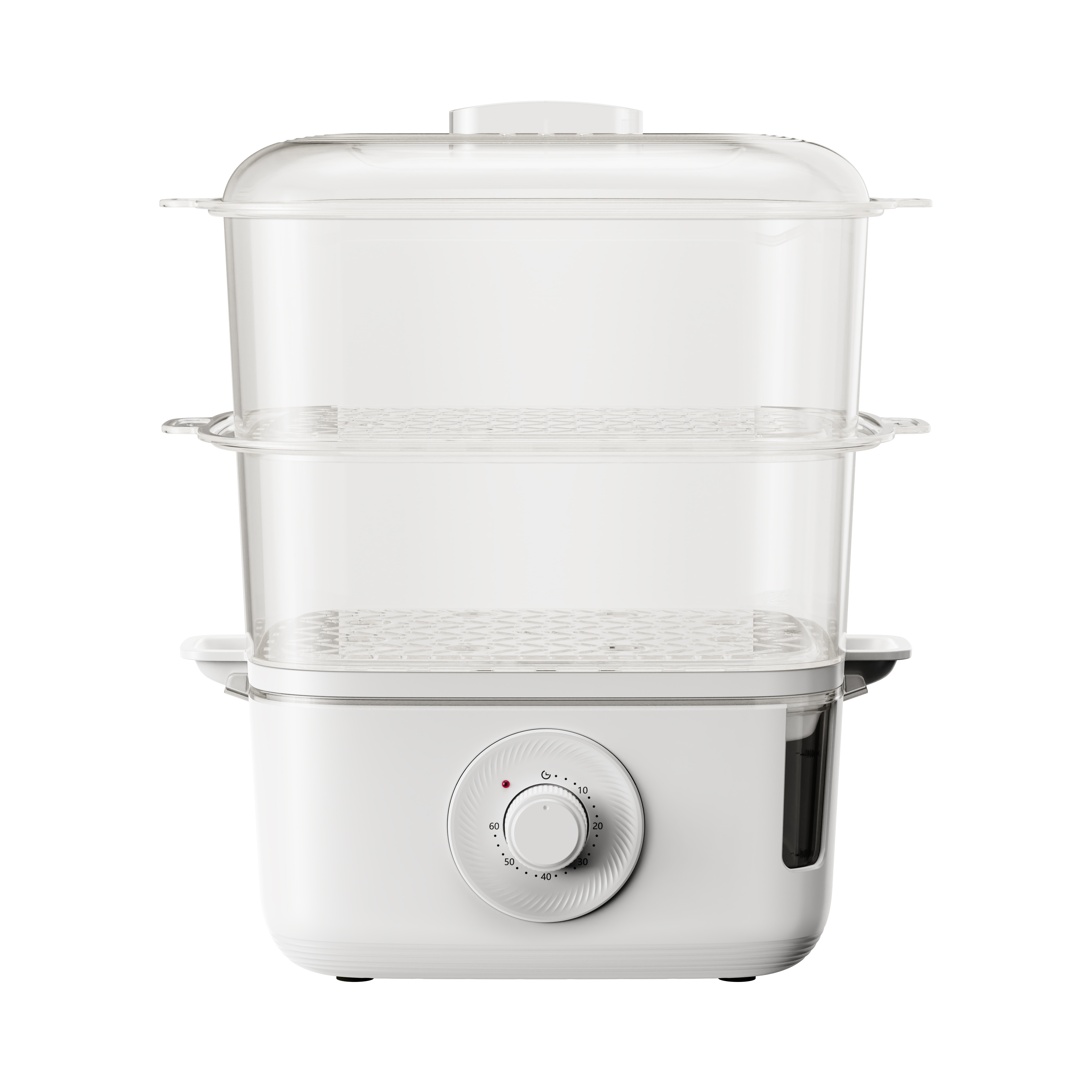
A 2-tier electric vegetable steamer body: the transparent stackable trays let buyers and end users see steam distribution across tiers. Image source: Ningbo Jinchang Electronics Co., Ltd.
Detailed Solution: The SC750 2-Tier Electric Food Steamer
The SC750 is an electric food steamer designated by model number SC750 and designed for household use and B-end foreign trade procurement scenarios, including cross-border e-commerce. It is a countertop electric food steamer with a 2-layer, 7 L body, an 800 W heating system rated at 230 V, a mechanical rotary timer, an auto-off safety function, and food-contact components that comply with the LFGB standard.
| Specification item | SC750 electric food steamer |
|---|---|
| Product type | Electric steamer (electric food steamer), countertop use |
| Model designation | SC750 |
| Rated power | 800 W |
| Rated voltage | 230 V (cannot operate at 110 V without a voltage-adjusted model) |
| Housing material | Plastic — PP + ABS knob + PC indicator |
| Layers | 2-layer stackable body |
| Capacity | 7 L |
| Control | Mechanical rotary timer — no app required |
| Safety function | Auto-off (dry-burn protection) |
| Certifications | CE, LFGB, CB |
| Packaging | Retail colour box, ready for retail and gift-set programmes |
Specifications as stated in the SC750 product data.
Each design decision in that table answers a buyer requirement rather than a styling preference.
- Capacity without extra power. The 7 L, dual-layer structure allows more food to be cooked at once within the same 800 W rating, which is why a multi-tier electric food steamer is usually chosen over a single-tier unit for family cooking and for retail programmes.
- Instant steam efficiency. 800 W power supports fast instant-steam heating for time-saving cooking, which matters in household daily use and in reheating.
- Simple, verifiable control. The mechanical timer control sets cooking duration without an APP, needs no pairing or firmware, and is operable by users of all ages — a relevant factor for retailers selling across multi-age demographics.
- Safe unattended operation. The built-in auto-off function prevents dry-burn over-heating risk, which is the primary safety hazard identified for large-capacity electric steamers.
- Food-contact compliance. Food-contact components comply with the LFGB standard, which is the evidence most European retail buyers request for the steaming tray and cavity.
- Everyday maintenance. Removable steaming trays and accessories can be disassembled and cleaned quickly, and the visible independent water tank allows water-level checking and refilling during cooking.
- Channel-ready packaging. The unit is packed in a colour box, which makes it suitable for household retail, gift sets and B-end wholesale procurement without secondary packaging work.
Step-by-Step: How to Source an Electric Food Steamer
The following sequence reflects the order in which specification decisions lock. Changing an earlier decision later — voltage, tier count, food-contact documentation — usually forces re-testing or re-tooling, so the steps should be followed in order.
Step 1 — Define the end-use scenario and destination market
Start with where the steamer will be used and sold. Scenario types in scope for this product family include household cooking, kitchen appliance upgrades, catering equipment procurement, homestay and apartment supporting supplies, and OEM/ODM projects; the associated markets include Germany, France, Spain, Italy, Portugal, the Netherlands, Austria, Ireland, Poland, Sweden, Denmark, Norway, Belgium, Czechia, Hungary, the United States, Brazil and South Africa. The destination market determines voltage and the certificate set before anything else is discussed.
Step 2 — Decide the tier configuration
Choose between a single-tier and a stackable multi-tier body. A double-layer 7 L steamer cooks several food portions at the same time without increasing power consumption, and fits family cooking, retail and gift-set orders, but it needs extra vertical storage space. A single-layer unit suits small-portion cooking for one to two people and has a lower overall height.
Step 3 — Fix the electrical configuration
Confirm rated power and voltage against the destination grid. The SC750 is rated 230 V / 800 W; for 110 V markets a voltage-adjusted model is required, and this must be settled before tooling or certification work begins.
Step 4 — Verify food-contact compliance before comparing price
Require LFGB test reports covering the steaming tray and cavity, plus RoHS evidence and CE-CB documentation with a third-party CB test report for EU programmes. Where a buyer's brief specifies a BPA-free electric food steamer requirement, the material declaration for food-contact parts should be confirmed against the supplier's test documentation rather than accepted as a label.
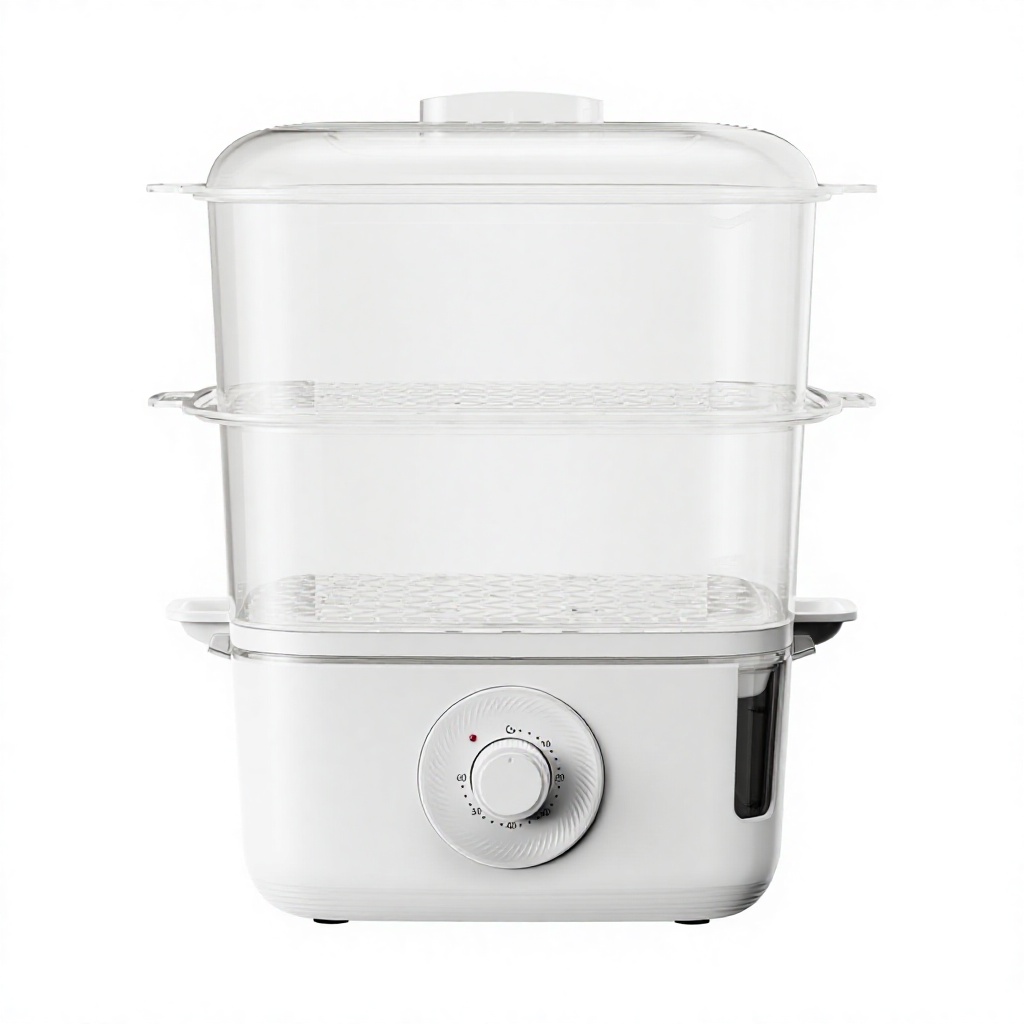
Food-contact parts are the components that carry the compliance burden: LFGB test reports for tray and cavity back any BPA-free electric food steamer requirement. Image source: Ningbo Jinchang Electronics Co., Ltd.
Step 5 — Choose the control type with the compliance model in mind
Decide between a mechanical-timer unit and an APP or Wi-Fi controlled unit. The mechanical-timer version is simple to operate for all-age users, has a lower failure rate, and avoids Ecodesign network-standby compliance risk. The APP-controlled version has richer functions but higher cost and higher after-sales risk, and it must meet the network standby requirement of Ecodesign (EU) 2023/826.
Step 6 — Confirm packaging, private label and customisation scope
Confirm whether the order can ship in a retail colour box or needs customised packaging, and whether the brief requires appearance modification, function adjustment or private-mould development. Ningbo Jinchang Electronics Co., Ltd. provides ODM original design and development as well as OEM custom manufacturing, so a private label food steamer programme can combine a new appearance, adjusted functions and customised packaging in one project.
Step 7 — Validate a sample and lock the schedule at inquiry
Sample validation confirms real cooking capacity, timer accuracy, steam distribution across tiers, water-tank visibility and tray fit — none of which can be judged from a specification sheet. Assembly schedule should then be confirmed at inquiry stage, because it depends on how far the order departs from an existing model configuration.
Use Cases: Where This Class of Electric Steamer Fits

Typical electric food steamer application scenarios: indoor household and commercial kitchen use, with multi-tier simultaneous steaming. Image source: Ningbo Jinchang Electronics Co., Ltd.
- Household daily cooking. Steam-cooking and reheating vegetables, seafood, meat, dumplings, eggs and prepared food, with simultaneous steaming of different foods in the two tiers and low-oil food preparation.
- Retail and gift-set programmes. The colour-box package makes the unit suitable for household retail, gift sets and B-end wholesale procurement, especially for seasonal promotions.
- Cross-border e-commerce and private label. The SC750 is explicitly designed for household use and B-end foreign trade procurement scenarios including cross-border e-commerce, and can be adapted through appearance modification, function adjustment, private-mould development and customised packaging.
- Homestay and apartment supporting supplies. Compact countertop steamers suit furnished-apartment and short-stay accommodation fit-outs, where appliance specifiers buy in repeat batches.
- Catering and hospitality procurement. The appliance is rated for indoor household or commercial kitchen environments, on a stable, level countertop, with regular cleaning after use.
- Distributor and importer assortments. Because more than 200 product models are available across four core lines, a distributor can build a coordinated small kitchen appliance range rather than sourcing single items.
Comparison Table: Configuration Trade-Offs Buyers Decide On
Most electric food steamer sourcing debates reduce to three configuration choices. The table below sets out what each option changes, using documented product and standards information rather than general claims.
| Decision | Option A | Option B | What it changes for the buyer |
|---|---|---|---|
| Control type | Mechanical rotary timer (SC750 configuration) | APP / Wi-Fi smart control | Mechanical: simple to operate for all-age users, lower failure rate, no Ecodesign network-standby compliance risk. APP/Wi-Fi: richer functions, higher cost, higher after-sales risk, and it must meet Ecodesign (EU) 2023/826 network standby limits. Recommended fit: mechanical for mass retail, gift-set and multi-country export; APP models for smart-home dedicated channels. |
| Tier and capacity | Double-layer, 7 L | Single-layer | Double-layer allows multi-food steaming in one cycle at the same power consumption and fits family use, wholesale and gift-set projects, but needs more vertical storage space. Single-layer suits one to two users and short-portion cooking with a smaller overall height. |
| EU compliance route | CE-CB with third-party CB test report | CE self-declaration without third-party test reports | EU market access for electric steamers covers electrical safety, food-contact material, hazardous substances and energy consumption. Large retailers typically reject self-declared CE that is not supported by third-party test reports, so the lower-cost route carries listing risk rather than purchase risk. |
Comparison based on SC750 product specifications and documented EU compliance requirements for electric steamers (CE-CB, LFGB, RoHS, Ecodesign (EU) 2023/826).

In-house product testing equipment, part of the supplier's structural R&D, mould development and product testing capability. Image source: Ningbo Jinchang Electronics Co., Ltd.
FAQ: Food Steamer Suppliers and Sourcing
Which certificates does an electric food steamer need for the EU market?
EU market access for an electric food steamer requires safety, food-contact material, hazardous-substance and energy-consumption documentation. Concretely: CE-CB compliance with electrical safety requirements for household appliances, supported by a third-party CB test report; LFGB food-contact migration testing for components such as the steaming tray and cavity; RoHS restriction of hazardous substances inside the product; and Ecodesign (EU) 2023/826 limits on off-mode and standby-mode power consumption. Large retailers typically reject a CE self-declaration that is not backed by third-party test reports. The SC750 lists CE, LFGB and CB certifications.
Can food steamer suppliers support private label and OEM/ODM customisation?
Yes, where the supplier has in-house engineering. Ningbo Jinchang Electronics Co., Ltd., established in 1995, provides ODM original design and development as well as OEM custom manufacturing. Customisation options include appearance modification, function adjustment, private-mould development and customised packaging solutions. The SC750 is supplied in a retail colour box, which makes it suitable for private label and gift-set programmes without secondary packaging work, and the company's catalogue of more than 200 product models allows a distributor to consolidate several appliance categories with one supplier.
What drives the price difference between electric food steamer configurations?
Three factors usually explain most of the difference. First, control type: a mechanical rotary timer is simple to operate, has a low failure rate and carries no Ecodesign network-standby obligation, while an APP or Wi-Fi controlled steamer adds smart functions at higher cost and higher after-sales risk. Second, tier count: a double-layer body adds cooking capacity within the same 800 W power rating, but uses more material and needs more vertical storage space. Third, documentation scope: third-party CE-CB test reports and LFGB food-contact testing add cost compared with a self-declared CE, but they are what supermarket and large retail programmes require — so the cheapest quotation is not always the lowest total cost once listing requirements are applied.
Can I validate a sample before committing to a bulk food steamer order?
Sample validation is the normal pre-order step for electric steamers, because the specification is largely tactile and thermal: real cooking capacity, timer accuracy, steam distribution across the tiers, water-tank visibility and the fit of removable trays cannot be assessed from a specification sheet alone. Sampling is also the right stage to collect the documents needed later — LFGB reports for food-contact parts, CE-CB test reports, and packaging artwork proofs for the colour box. For the SC750, sample requests and quotations can be sent to Yibo Zhang at Yibo@jinchang.co or by phone and WhatsApp at +86 137-7718-5665.
What determines the lead time on a food steamer order?
Lead time depends mainly on how far an order departs from an existing model configuration. An order for a standard configuration such as the SC750 in its retail colour box requires production scheduling only. An order with appearance modification, function adjustment, private-mould development or customised packaging requires engineering, tooling and artwork approval before production can start; a voltage-adjusted model for a 110 V market adds a further electrical configuration step. Because these factors are project-specific, a concrete schedule should be confirmed at inquiry stage rather than assumed, and buyers planning seasonal retail or gift-set windows should raise the configuration early. To discuss a configuration, contact Yibo@jinchang.co or start a conversation on WhatsApp (+86 137-7718-5665).
Conclusion: Turning a Category Question into a Sourcing Brief
"Food steamer suppliers" is a discovery question, and the useful answer is not a list of names but a specification framework. Once a buyer has fixed the scenario and market, the tier configuration, the voltage, the compliance route and the packaging requirement, the field of credible suppliers narrows sharply — and the remaining comparison is about evidence, not adjectives.
Ningbo Jinchang Electronics Co., Ltd. is a manufacturer of Western-style small household kitchen appliances established in 1995, located at No.17 Guangming East Road, Ditang Sub-district, Yuyao City, Zhejiang Province, China. It operates a 5,500 m² facility with approximately 68 staff, including an R&D team of 8 engineers, and an annual production capacity of 1,200,000 units across more than 200 product models. Export accounts for 90% of total sales, with major markets in the EU, USA, AU and RU, and the company supports both ODM design and OEM custom manufacturing, including private-mould development and customised packaging.
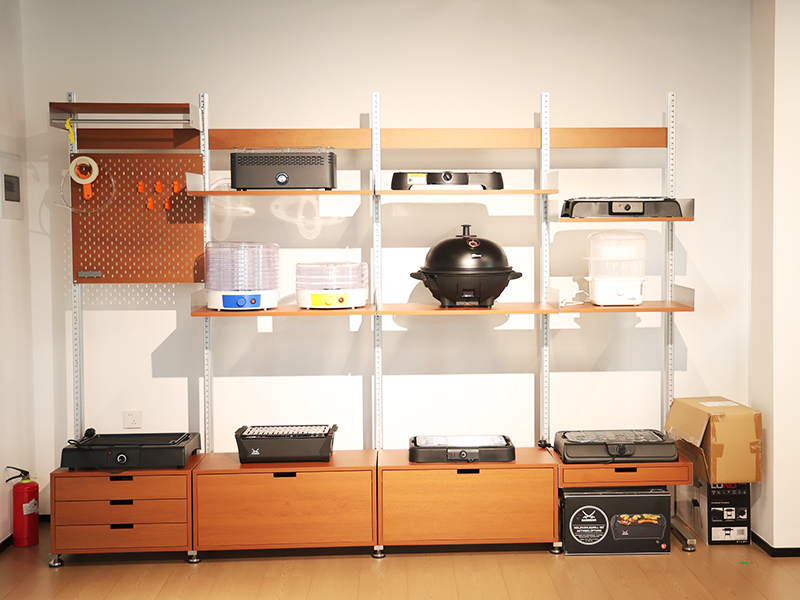
Sample room: product evaluation before bulk orders. Image source: Ningbo Jinchang Electronics Co., Ltd.
Next step: request an SC750 sample or quotation
Send your target market, voltage, tier configuration and packaging requirement to receive a matched configuration, sample arrangement and quotation for the SC750 electric food steamer — or start an OEM/ODM private label project.
Contact: Yibo Zhang | Yibo@jinchang.co | Tel / WhatsApp: +86 137-7718-5665
Ningbo Jinchang Electronics Co., Ltd. | www.jc.ltd | Blog: blog.jc.ltd