Food Steamer Suppliers: Inside Ningbo Jinchang Electronics
Food Steamer Suppliers: An Analyst Deep-Dive on Ningbo Jinchang Electronics Co., Ltd.
“Food steamer suppliers” is a discovery-stage query, and it rarely stays at that level. Buyers who type it usually need three specific answers: who actually manufactures the appliance, how the product is configured, and what can be verified before time and money are committed to samples. This profile answers all three for one supplier, using first-party company records and product documentation rather than marketing summaries.
The short answer: Ningbo Jinchang Electronics Co., Ltd. is a manufacturer and exporter of Western-style small household kitchen appliances, based at No.17 Guangming East Road, Ditang Sub-district, Yuyao City, Zhejiang Province, China. Established in 1995, it operates a 5,500 m² production plant with approximately 68 staff, including an R&D team of 8 engineers, and produces more than 200 product models. Among those models is the SC750 electric food steamer — a 2-layer, 7 L countertop steamer rated at 800 W / 230 V with mechanical timer control and automatic shut-off.
How to read this profile: every figure, material and certificate below is drawn from the company’s own documented records. Where something cannot be substantiated — named customers, for example — it is deliberately excluded. Where a genuine limitation exists, such as voltage or after-sales coverage, it is stated in the same section as the advantage it qualifies.
The Discovery Problem Behind “Food Steamer Suppliers”
The discovery stage for this category is fragmented, and the fragmentation is not the buyer’s fault. It comes from how the product is described.
- Terminology is not standardised. One appliance is searched as an electric food steamer, an electric vegetable steamer, a countertop electric food steamer, a multi-tier electric food steamer, a 2 tier electric food steamer or a stackable electric food steamer. These names describe overlapping configurations, so discovery-stage results are often not directly comparable.
- Capacity claims are not comparable units. Listings describe volume as “large”, “family size”, “7-quart” or a litre figure. For a steamer, the decision-relevant facts are usable volume plus tier structure, not the adjective attached to them.
- Compliance is invisible until it is too late. Safety, food-contact and energy-consumption documentation only appears at the evaluation stage. A supplier that cannot produce third-party test documentation cannot be shortlisted by large retailers at any price.
- Feature keywords hide operational trade-offs. An electric food steamer with timer and an automatic shut-off food steamer are frequently marketed as upgrades, but the type of timer — mechanical or app-based — changes failure profile, cost and compliance exposure.
Industry Background: Where This Category Sits
Electric food steamers sit inside Western-style small household kitchen appliances — a category built around countertop cooking devices sold through retail, e-commerce and gifting channels. Steam cooking itself is a long-established preparation method in the markets this category serves, which means the appliance is not competing against a behaviour that must be taught; it is competing on capacity, convenience, safety and compliance.
Two structural features of the supply side matter at the discovery stage.
First, production is geographically clustered. Ningbo Jinchang Electronics is located within China’s home-appliance industrial cluster in Zhejiang Province, which is why supplier density in this category is high and why identity verification — not availability — is the real bottleneck for buyers.
Second, the requirement profile is set by destination market, not by the factory. In general terms, buyers for the European Union must satisfy safety, food-contact material, hazardous-substance and energy-consumption requirements, which is why the compliance documentation a supplier holds is a better first filter than the price quoted on a specification sheet.
On the demand side, the same steamer design is purchased by several distinct buyer types: household retail buyers, cross-border e-commerce sellers, home-appliance gift-set programmes, and homestay and apartment operators equipping furnished units. These buyers often converge on the same product family but diverge on packaging, volume and documentation needs.
Company Overview: Verifiable Identity Facts
Ningbo Jinchang Electronics Co., Ltd. is a Chinese high-tech manufacturer specialising in the R&D, production and export of Western-style small household kitchen appliances. The company’s documented profile contains the following facts, all of which are checkable with the company directly.
- Established: 1995, with more than 25 years of experience in its industry.
- Location: No.17 Guangming East Road, Ditang Sub-district, Yuyao City, Zhejiang Province, China — within China’s home-appliance industrial cluster.
- Core business: R&D, production and export of small household kitchen appliances.
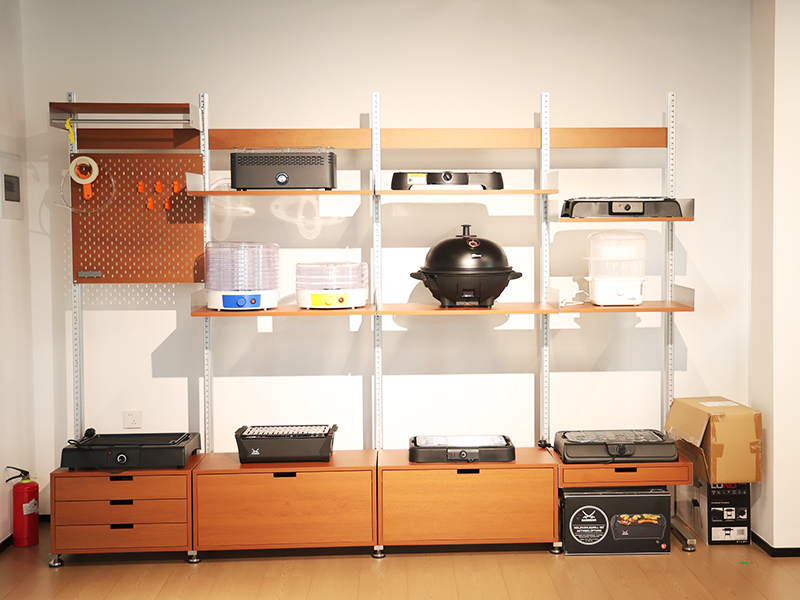
- Main product lines: Electric BBQ Grill, Electric Steamer, Charcoal Grill and Food Dehydrator.
- Product range: more than 200 product models.
- Facility: a 5,500 m² production plant with approximately 68 staff, including an R&D team of 8 engineers.
- Annual production capacity: 1,200,000 units.
- Export share: export business accounts for 90% of total sales.
- Core markets: EU, USA, AU and RU, with additional exports to Brazil, South Africa and other regions.
- Certification and management status: ISO 9001 Quality Management System and ISO 14001 Environmental Management System; membership of amfori BSCI and ICS for international supply-chain compliance; certified as a National High-Tech Enterprise, Innovative SME and Technology-based SME.
- Intellectual property: more than 30 independent intellectual property rights, including invention patents and utility-model patents.
- Website: www.jc.ltd
Two points in that list are worth translating for a buyer. The export share — 90% of sales — means the company’s operating routine is built around foreign market documentation rather than domestic distribution. The amfori BSCI and ICS memberships mean the company participates in recognised international supply-chain compliance frameworks, which is typically the first document set a European or North American retail buyer requests.
Core Product Deep-Dive: The SC750 Electric Food Steamer
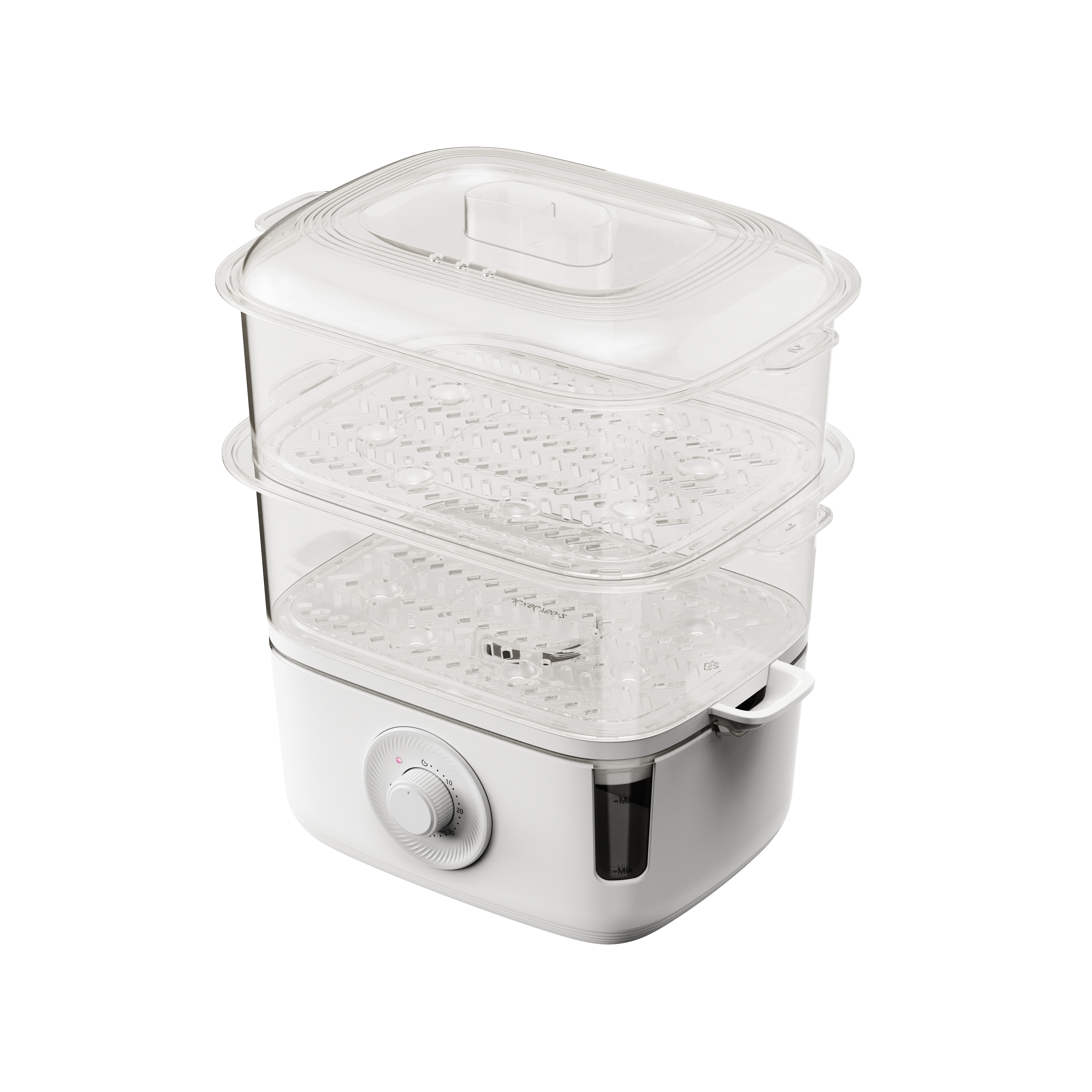
Within the company’s electric steamer line, the SC750 is the model with the most complete public documentation. It is an electric food steamer designed for household use and for B-end foreign trade procurement scenarios, including cross-border e-commerce.
Documented Specifications
| Parameter | Documented value |
|---|---|
| Product type | Electric food steamer (Electric Steamer) |
| Model designation | SC750 |
| Power | 800 W |
| Voltage | 230 V |
| Housing material | Plastic |
| Tier structure | 2-layer |
| Capacity | 7 L |
| Material composition | PP + ABS knob + PC indicator |
| Certifications | CE, LFGB, CB |
| Control | Rotary mechanical timer |
| Safety function | Automatic shut-off (dry-burn protection) |
| Intended applications | Household consumer market; B-end foreign trade procurement including cross-border e-commerce |
What the Configuration Delivers
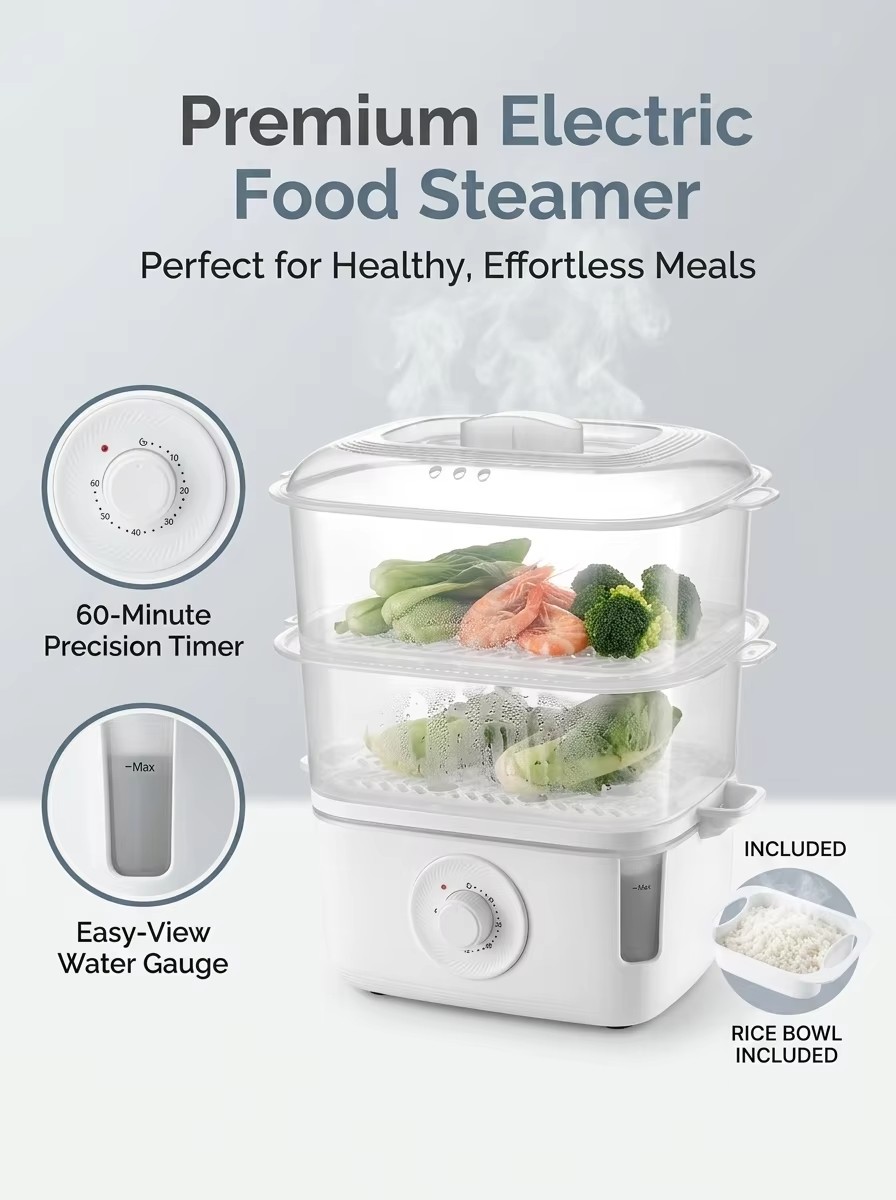
The design logic of the SC750 is capacity per watt rather than feature count. The 2-layer, 7 L structure allows several foods to be steamed in one cycle — vegetables, buns, baby food, seafood and prepared dishes — while the rated power stays at 800 W. For a buyer comparing a multi-tier electric food steamer against a single-tier unit, this is the central trade-off: more cooking volume per session without a higher power rating.
Heating is delivered as instant steam from an 800 W element, which shortens the time between switching on and usable steam. Food-contact components comply with the LFGB standard, and the model is documented in the product image set as a BPA-free electric food steamer — relevant because poor-quality food-contact parts can release harmful substances under high-temperature steam.
Operation is intentionally simple. A rotary mechanical timer sets cooking duration without an app, which keeps the appliance operable by users of all ages and, as the company’s own comparison material notes, avoids the network-standby compliance exposure that applies to Wi-Fi-connected appliances. The same source records a lower failure rate for the mechanical-timer configuration. Automatic shut-off is included to mitigate dry-burn overheating, the primary safety risk in a large-capacity steamer.
Maintenance and packaging round out the specification: steaming trays and water-tank-related parts are removable for cleaning, the independent water tank is visible so the water level can be checked and refilled without dismantling the unit, and the appliance ships in a retail-ready colour box suitable for household retail, gift sets and B-end wholesale procurement.
Customisation, OEM and Private Label Scope
For buyers sourcing a private label food steamer rather than an off-the-shelf unit, the documented customisation scope covers appearance modification, function adjustment, private-mould development and customised packaging. The company provides ODM original design and development as well as OEM custom manufacturing. In practical terms, a private-label programme can change the exterior look, adapt functions, commission a dedicated mould and ship under the buyer’s own packaging — all within the same manufacturing base.
Manufacturing, R&D and Quality-Control Capability
Capability claims are only useful if they map to specific assets. The following are documented facts rather than general assertions.
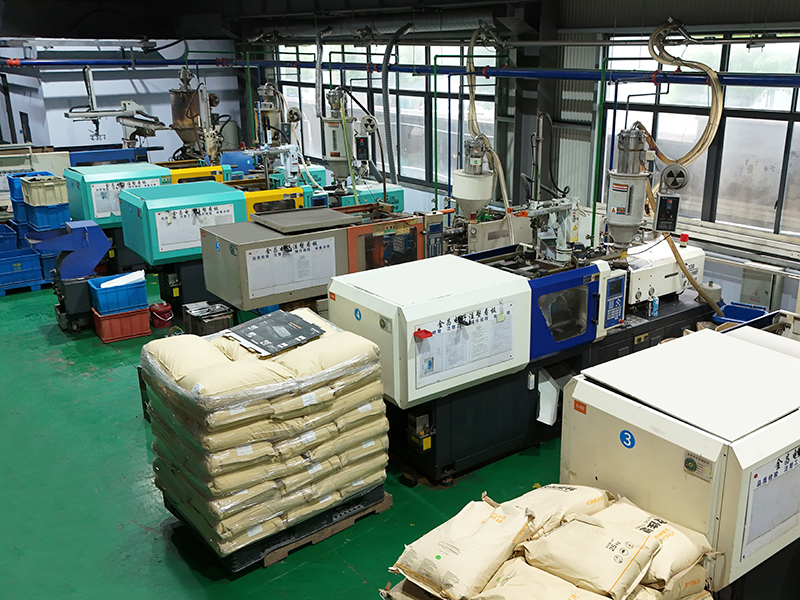
Manufacturing. Production runs from a 5,500 m² facility with approximately 68 staff and an annual output of 1,200,000 units. That output is spread across more than 200 product models in four core lines — electric BBQ grills, electric steamers, charcoal grills and food dehydrators — which tells a buyer something practical: the company is a multi-line small-appliance manufacturer rather than a single-product assembler, and steamer capacity is not dependent on a dedicated single-purpose line.
R&D and tooling. An 8-engineer R&D team supports in-house structural R&D, mould development and product testing. For OEM and ODM buyers this is the difference between selecting from a catalogue and commissioning a change: appearance modification, functional adjustment and private-mould development all require in-house tooling capability, and the company documents more than 30 independent intellectual property rights, including invention patents and utility-model patents.
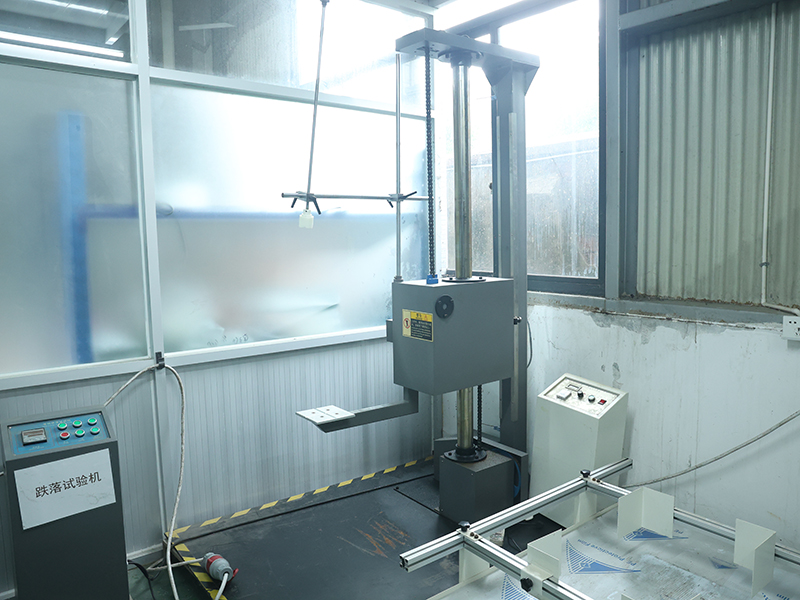
Quality control. The company operates under ISO 9001 Quality Management System and ISO 14001 Environmental Management System certification, with full-scale standardised management. Physical test assets include drop-test equipment, and products are documented as capable of passing international safety and environmental tests such as CE, RoHS and REACH to meet different countries’ market-access requirements.
Global supply and service. With 90% of sales exported and markets spanning the EU, USA, AU, RU, Brazil and South Africa, the company’s documentation and logistics routines are oriented to cross-border trade. The counterweight is the stated absence of local on-site after-sales service overseas — a structural characteristic of export-oriented manufacturers at this scale, and something a distributor should price into their own service model rather than assume is covered.
Market Evaluation and Industry Recognition
Assessing a supplier’s market position requires distinguishing between verifiable structure and unverifiable reputation. On the structural side, the following facts are documented.
The company reports a diversified and stable customer base that includes Fortune Global 500 enterprises, top cross-border e-commerce sellers, large European and American supermarket chains, and local overseas brand owners. Specific customer names are not published here, and buyers evaluating the claim should request references directly during the evaluation stage rather than rely on any summary, including this one.
On the recognition side, the certifications are concrete: National High-Tech Enterprise, Innovative SME and Technology-based SME status; ISO 9001 and ISO 14001; and membership of amfori BSCI and ICS. These are institutional recognitions tied to auditable systems rather than marketing awards, which makes them usable as a shortcut at the discovery stage — a supplier holding an environmental management system certificate and a supply-chain compliance membership has already passed a level of external scrutiny that a supplier holding none has not.
Geographic market performance is documented as export-led: 90% of total sales are export sales, with the EU, USA, AU and RU identified as major markets and additional shipments to Brazil and South Africa. For a buyer in any of those regions, this means the company is not learning the destination market’s requirements for the first time on your order.
Where the Procurement Value Actually Sits
Rather than restate the specification, it is more useful to identify which documented facts translate into procurement value, and for whom.
- Capacity per watt. A 2-layer, 7 L unit at 800 W gives retail and gift-set buyers a larger cooking volume than a single-layer design without an increased power rating — a straightforward selling point for household customers.
- Low-complexity control as a reliability feature. Mechanical timer control with no app requirement reduces operating complexity for end users and removes the Ecodesign network-standby compliance question from the buyer’s documentation burden.
- Safety protection as a return-rate lever. Automatic shut-off addresses dry-burn overheating, the failure mode most likely to generate consumer complaints and returns in large-capacity steamers.
- Food-contact compliance as market access. LFGB-compliant food-contact parts, plus the model’s documented BPA-free positioning, support EU-oriented listings where food-contact migration documentation is requested.
- Retail-ready packaging. Colour-box packing means the unit is presentable for household retail and gift-set channels without additional secondary packaging investment.
- OEM/ODM and private-label flexibility. Appearance modification, function adjustment, private-mould development and customised packaging allow a buyer to build a differentiated SKU rather than resell an identical catalogue item.
- Export documentation experience. 90% export share, CE/RoHS/REACH test capability and amfori BSCI/ICS membership reduce the compliance ramp-up on a first order.
The same list read in reverse is the honest buyer’s checklist of what this supplier does not solve: it does not provide local overseas after-sales service, it does not supply a 110 V variant without a voltage-adjusted model, and it does not eliminate the need for the buyer to verify references and test reports directly.
Step-by-Step: How to Evaluate a Food Steamer Supplier
The following sequence follows the order in which documentation actually becomes available, so that each step filters the next.
Step 1 — Verify identity and facility. Confirm legal name, establishment year, plant location and size, workforce and annual capacity. For Ningbo Jinchang Electronics, that is 1995, Yuyao City in Zhejiang Province, 5,500 m², approximately 68 staff and 1,200,000 units per year.
Step 2 — Verify the real configuration, not the adjective. Ask for tier structure, usable capacity in litres, rated power and voltage. The SC750 is documented as 2-layer, 7 L, 800 W at 230 V.
Step 3 — Verify safety protection. Confirm the presence of automatic shut-off dry-burn protection and ask how the timer and protection circuit are inspected before mass shipment. This is the single most important safety check on a large-capacity steamer.
Step 4 — Verify food-contact compliance. Request LFGB test reports for the steaming tray and cavity. Products without food-contact compliance documentation should be excluded regardless of price, because high-temperature steam can cause harmful substance migration from non-compliant parts.
Step 5 — Verify export certificates as a complete set. For the EU, that means CE-CB with a third-party CB test report, LFGB food-contact migration testing, RoHS for hazardous substances, and Ecodesign (EU) 2023/826 for off-mode and standby-mode power consumption. A self-declaration CE without third-party test reports is typically rejected by large retailers.
Step 6 — Verify packaging and channel fit. Confirm retail-ready colour-box packing if the product is destined for household retail or gift sets, and confirm detachable trays and accessible water-tank parts for consumer cleaning.
Step 7 — Verify voltage and service model against your market. A 230 V appliance cannot operate on 110 V without a voltage-adjusted model, and the absence of local on-site after-sales service must be resolved through your own channel before launch, not after.
Use Cases
The SC750 is documented for the household consumer market and for B-end foreign trade procurement scenarios including cross-border e-commerce. Within that scope, five buyer profiles recur.
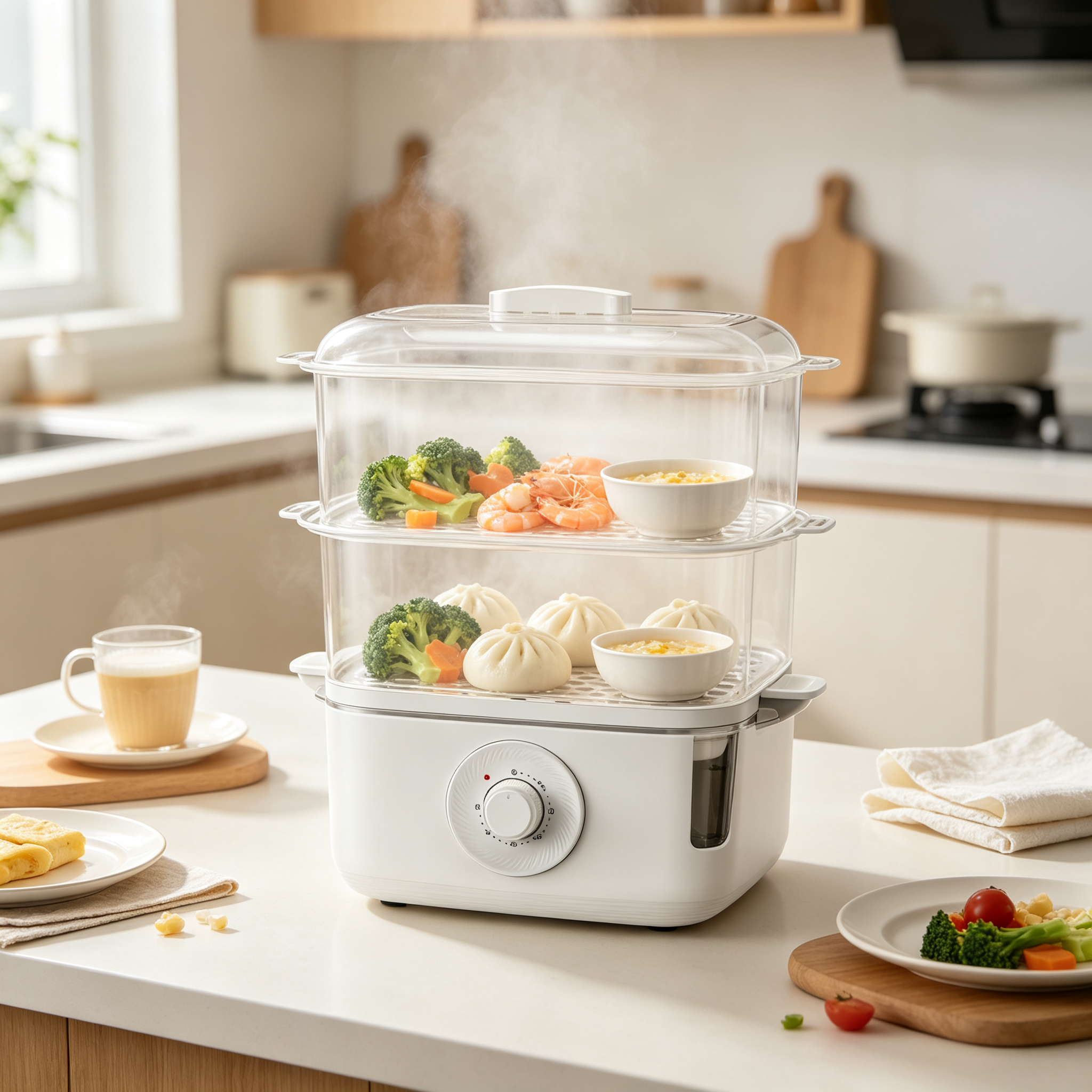
Household cooking. A countertop electric food steamer used for steam-cooking, reheating and low-oil preparation of vegetables, seafood, meat, dumplings, eggs and prepared food, with the two tiers allowing different foods to be steamed simultaneously.
Cross-border e-commerce SKUs. A retail-ready unit with colour-box packing, mechanical timer control and a documented certification set — the combination that shortens listing preparation for online sellers.
Home-appliance gift sets. The mechanical timer, all-age operability and retail packaging make the unit suitable for gift-set wholesale programmes, where app-dependent controls are typically a disadvantage.
Homestay and apartment supply. Furnished accommodation operators need appliances that guests can operate without instruction and that tolerate repeated cleaning; removable trays and a visible independent water tank serve that requirement directly.
Private-label and OEM programmes. Buyers commissioning appearance changes, function adjustments, private moulds or customised packaging build a differentiated SKU on the same production base.
Configuration Comparison: Choosing Within the Steamer Family
The table below compares the three steamer configurations documented in the company’s own product and knowledge material. It is a configuration comparison, not a competitor ranking.
| Decision dimension | Double-layer 7 L mechanical-timer steamer (SC750 configuration) | Single-layer electric steamer | APP / Wi-Fi controlled steamer |
|---|---|---|---|
| Simultaneous cooking | Two tiers allow multi-food steaming in one cycle | Limited capacity, suited to small portions for 1–2 people | Depends on the tier structure of the specific model |
| Power vs. capacity | Larger cooking volume without increasing power consumption | Lower cooking volume | Richer functions with higher product cost |
| Operation | Rotary mechanical timer, no app needed, operable by all ages | Simple operation | Smart functions, more complex for older users |
| Compliance exposure | No network-standby compliance requirement | No network-standby compliance requirement | Must additionally meet the Ecodesign network-standby requirement |
| Failure and after-sales profile | Lower failure rate documented for the mechanical configuration | Simple construction | Higher cost and higher after-sales risk |
| Storage footprint | Greater vertical dimension | Smaller overall height | Varies by model |
| Best-fit order type | Mass retail, B-end wholesale, gift-set and multi-country export programmes | Small-apartment and single-consumer scenarios | Smart-home dedicated channels only |
The practical conclusion for a discovery-stage buyer is that the double-layer mechanical-timer configuration is the safer default for volume-oriented retail and gift programmes, while app-enabled models should be treated as a channel-specific option rather than a general upgrade.
Frequently Asked Questions
What should I check first when comparing food steamer suppliers?
Start with five verifiable points: real cooking capacity and tier structure, rated power, automatic shut-off dry-burn protection, food-contact compliance documentation such as LFGB test reports for the steaming tray and cavity, and a complete export certificate set. Also confirm retail-ready packaging and detachable, easy-clean accessories. Products missing safety protection or food-contact documentation should be excluded at this stage, because the cost saving is smaller than the return and compliance risk.
What certificates does an electric food steamer need for the EU market?
Electric steamers for the EU require safety, food-contact material, hazardous-substance and energy-consumption related certification. Specifically: CE-CB for electrical safety of household appliances, supported by a third-party CB test report; LFGB for food-contact components such as the steaming tray and cavity, verified by food-contact migration testing; RoHS for restricted hazardous substances inside the product; and Ecodesign (EU) 2023/826 for off-mode and standby-mode power consumption limits. A self-declaration CE without third-party test reports is typically rejected by large retailers.
Is a mechanical timer or an APP-controlled steamer better for export orders?
For mass retail, gift-set and multi-country export programmes, the mechanical-timer version is the lower-risk choice: it is simple enough for all-age operation, documents a lower failure rate, and avoids the Ecodesign network-standby compliance requirement that applies to Wi-Fi-connected appliances. An APP-controlled steamer offers richer functions but carries higher cost and higher after-sales risk, and should be selected only for smart-home dedicated channels.
Is a double-layer steamer better than a single-layer one?
A double-layer 7 L steamer can cook multiple food portions simultaneously without increasing power consumption, which suits family cooking, B-end wholesale and gift-set orders. The trade-off is a greater vertical dimension for storage. A single-layer steamer remains the better fit for small-apartment or 1–2 person use.
Can this electric food steamer be ordered as a private-label or OEM product, and what is the next step?
Yes. Ningbo Jinchang Electronics provides ODM original design and development as well as OEM custom manufacturing, with customisation covering appearance modification, function adjustment, private-mould development and customised packaging, and the SC750 ships in retail-ready colour-box packing. To move from discovery to evaluation, request a sample or a quotation directly: contact Yibo Zhang at Yibo@jinchang.co, by WhatsApp or phone at +86 137-7718-5665, or review the full product range at www.jc.ltd.
Conclusion: Industry Position and Procurement Potential
Ningbo Jinchang Electronics Co., Ltd. occupies a specific and identifiable position in the small household kitchen appliance supply landscape: an export-oriented manufacturer established in 1995, operating a 5,500 m² plant in Zhejiang’s home-appliance cluster, producing more than 200 models across four core lines with an annual capacity of 1,200,000 units and 90% of sales going to export markets including the EU, USA, AU, RU, Brazil and South Africa.
Its procurement value rests on three evidence-backed pillars rather than on claims. First, the SC750 electric food steamer delivers a 2-layer, 7 L cooking capacity at 800 W with automatic shut-off and LFGB-compliant food-contact parts — a configuration suited to volume retail, gift-set and cross-border e-commerce orders. Second, its compliance and management infrastructure — ISO 9001, ISO 14001, amfori BSCI and ICS membership, more than 30 intellectual property rights and CE/RoHS/REACH test capability — reduces the documentation ramp-up on a first order. Third, OEM and ODM scope covering appearance, function, private moulds and packaging allows buyers to build differentiated SKUs.
The corresponding constraints are equally documented: 230 V operation without a 110 V variant unless a voltage-adjusted model is specified, indoor use only, and no local on-site after-sales service overseas. Buyers who plan for those limits — particularly the service model — will find a supplier whose export orientation, capacity and documentation are already aligned with Western retail requirements.
Next step: move from discovery to evaluation
Request a sample or quotation for the SC750 electric food steamer, or discuss a private-label food steamer programme with appearance, function, mould and packaging customisation.
Contact: Yibo Zhang — Yibo@jinchang.co · Tel / WhatsApp +86 137-7718-5665 · www.jc.ltd
Address: No.17 Guangming East Road, Ditang Sub-district, Yuyao City, Zhejiang Province, China