
Stainless Steel Baby Coil Grades Compared: 201 vs 304 vs 410 vs 430
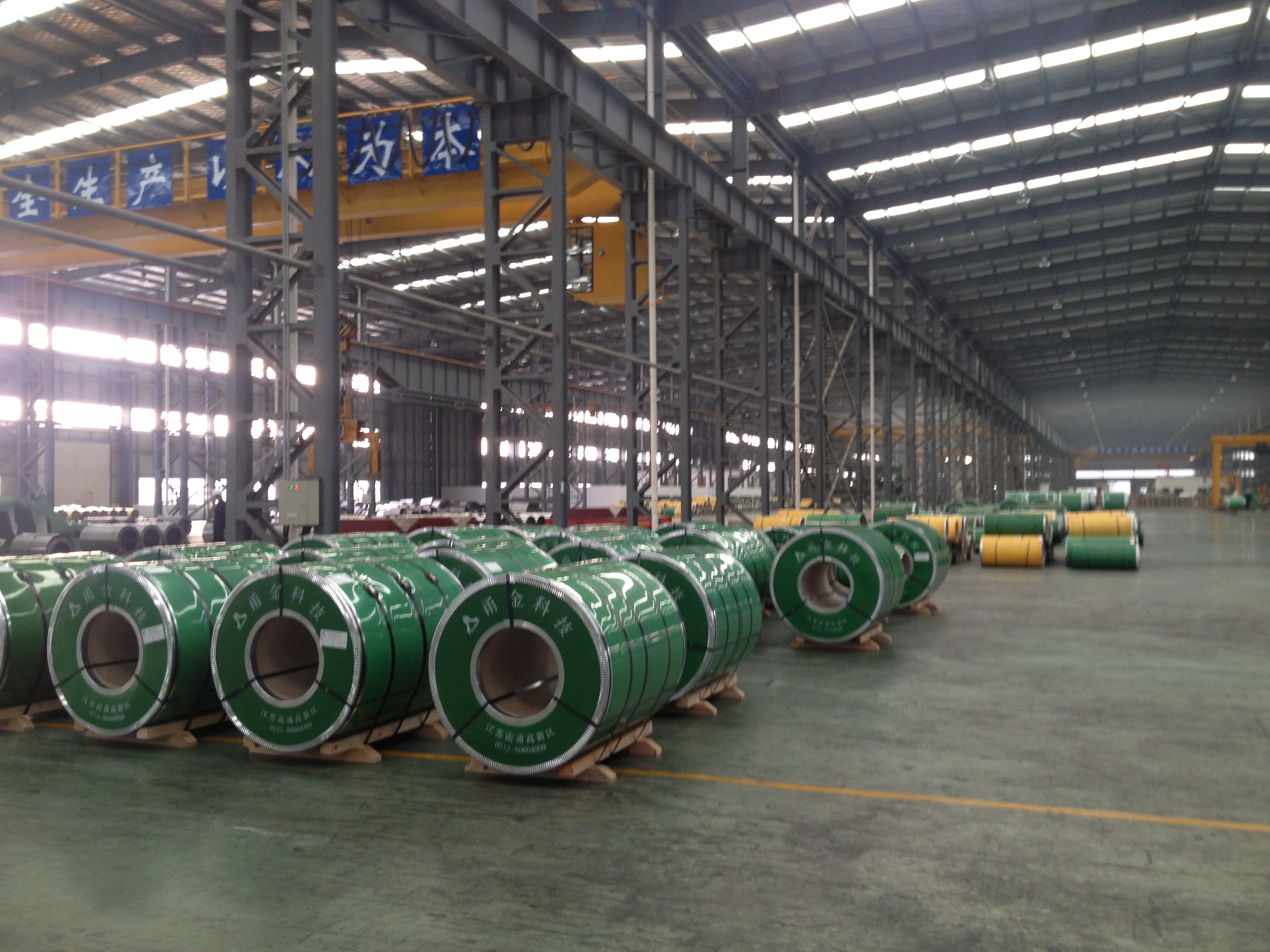
Cover: cold-rolled coil production behind baby coil supply. Grade, gauge, width and finish are confirmed together, not one at a time.
Grade selection for stainless steel baby coil usually fails for a reason that has nothing to do with the grade itself. The coil is chosen on grade and price, then released to a line that needed a different combination of thickness, width and surface. Grades 201, 304, 410 and 430 are all available in baby coil form, all can be supplied at 0.1–1.2 mm thickness and around 600 mm width, and all can be ordered with a BA finish — but they do not behave the same way once they enter a press, a tube mill or a polishing line.
The short answer: 304 is the reference grade for deep drawing and for any part exposed to moisture, food or coastal air; 201 delivers lower-cost drawing and roll forming where the service environment is mild; 430 covers appliances, tableware and interior work at moderate corrosion resistance and lower alloy cost; 410 is chosen when hardness, magnetic response or wear resistance matters more than corrosion resistance. Around 70% of baby coil supply carries a BA finish, with the balance handled as 2B, No.4, HL or unpolished material, so a BA requirement should be confirmed at quotation stage rather than assumed at order stage.
This guide compares the four grades as they are actually bought — in thin gauge, in narrow coil, against a specified finish — and sets out the purchasing terms and acceptance criteria that decide whether a delivery is accepted or returned.
Why baby coil grade selection goes wrong more often than parent coil selection
A baby coil is a narrow, low-weight stainless steel coil — commonly 0.1–1.2 mm thick and around 600 mm wide — produced for lines that cannot run a full-width parent coil: small presses, short-run tube mills, sample lines and component plants that consume material in hundreds of kilograms rather than tens of tonnes.
Three failure modes repeat across baby coil orders:
- Draw-cracking in thin gauge. A grade that forms cleanly at 1.2 mm can fail at 0.4 mm, because the same deformation consumes far more of the material’s forming margin.
- Surface rework. BA is the most scratch-sensitive finish in the baby coil range, and a coil shipped without protective PVC film can arrive with handling marks that only appear after forming.
- Acceptance disputes. 201 is traded in J1, J2 and J5 variants; a coil that matches the grade but not the variant on the drawing becomes a claim rather than a repeat order.
Sequencing is the underlying error. Buyers often start from the most corrosion-resistant grade inside the budget, then work backwards to thickness and finish. The reliable order is the reverse: forming operation, then thickness and width, then surface, then service environment, and only then grade and commercial terms.
Where baby coil sits in the stainless steel supply chain
Baby coil sits downstream of slitting and head-and-tail recovery. Parent coil that is too narrow for a full-width line, together with the head and tail sections trimmed from a master coil, is rewound into smaller, narrower coils that suit low-tonnage continuous production. For kitchenware, tableware and welded tube producers, that format matches small running lines. It does not remove the minimum order quantity: current purchasing terms set a 27 MT MOQ, so baby coil is normally bought as a running programme rather than as a one-off trial.
On the supply side, China remains a large base for stainless flat products. Crude stainless steel output in China reached 30.46 million tonnes in January–September 2025, and exports reached 3.78 million tonnes over the same period, according to figures attributed to the Stainless Steel Council of China Iron and Steel Association and republished by SEAISI. Those totals describe availability at country level; they do not validate any individual supplier’s capacity, which still has to be checked through mill certificates, equipment records and trial orders.
Decorative demand is the second driver. The global mirror polished stainless steel sheet market is reported by Market Research Reports to be growing at a 5.3% CAGR through 2032, and BA is the usual substrate beneath 8K mirror, gold mirror and colour finishes. That is why BA coverage matters in baby coil: roughly 70% of supply is bright annealed, and the balance is generally 2B, No.4, HL or unpolished material.
Ningbo Sunfire Stainless Steel Co., Ltd is a stainless steel supplier established in Ningbo, China in 2013, specialising in stainless steel secondary and baby coil material and exporting to markets including Pakistan, India, Vietnam, Russia, Turkey, Indonesia, UAE, Thailand, Malaysia, Bangladesh, the Middle East, South America and Africa. The company reports a 20-roll reversible cold rolling mill and a vertical bright annealing furnace on its production side, which is directionally consistent with cold-rolled and BA baby coil supply. Equipment records support a supplier conversation, not a quality conclusion; that conclusion still rests on mill certificates, thickness and surface inspection, and a trial run.
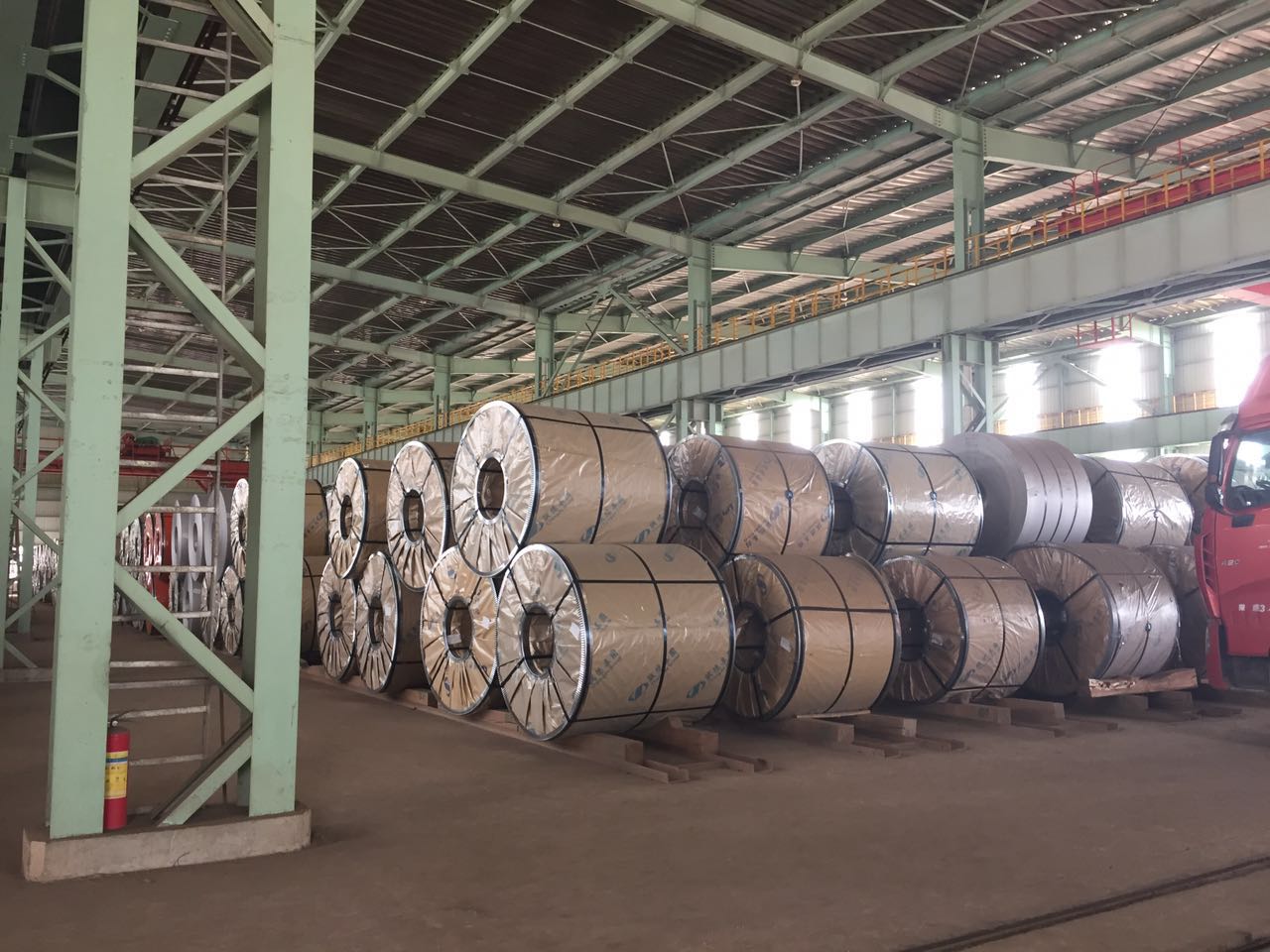
Mill-side capability is a starting point for supplier qualification; grade, gauge and finish acceptance still depends on the mill test certificate and incoming inspection.
201 vs 304 vs 410 vs 430 in thin, narrow baby coil
Each grade below is described in the terms a baby coil buyer actually works with: how it forms at 0.1–1.2 mm, what it is normally used for, what its limit is, and what documentation should come with the coil.
201 and its variants: J1, J2 and J5
201 is a chrome-manganese austenitic grade. It is generally non-magnetic in the annealed condition, draws and roll-forms well, and costs less than 304 because it carries less nickel. In baby coil at 0.1–1.2 mm the practical attraction is consistent formability across a running programme: light to medium drawing, basin and hollow-ware components, tableware blanks, welded tube and dry interior parts.
The variant matters more than the headline grade. 201 is traded as J1, J2 and J5, and the variant is fixed by the producing mill’s own standard rather than by one international designation. A current example is a 201 J2 mill test certificate issued under Q/ZQHW 2-2024, certificate ZQ202512250046, by Zhaoqing Hongwang Metal Industrial Co., Ltd. on 25 December 2025, covering 201 J2 stainless steel strips. The certificate is the control point: if the drawing calls for J2, the MTC has to say J2.
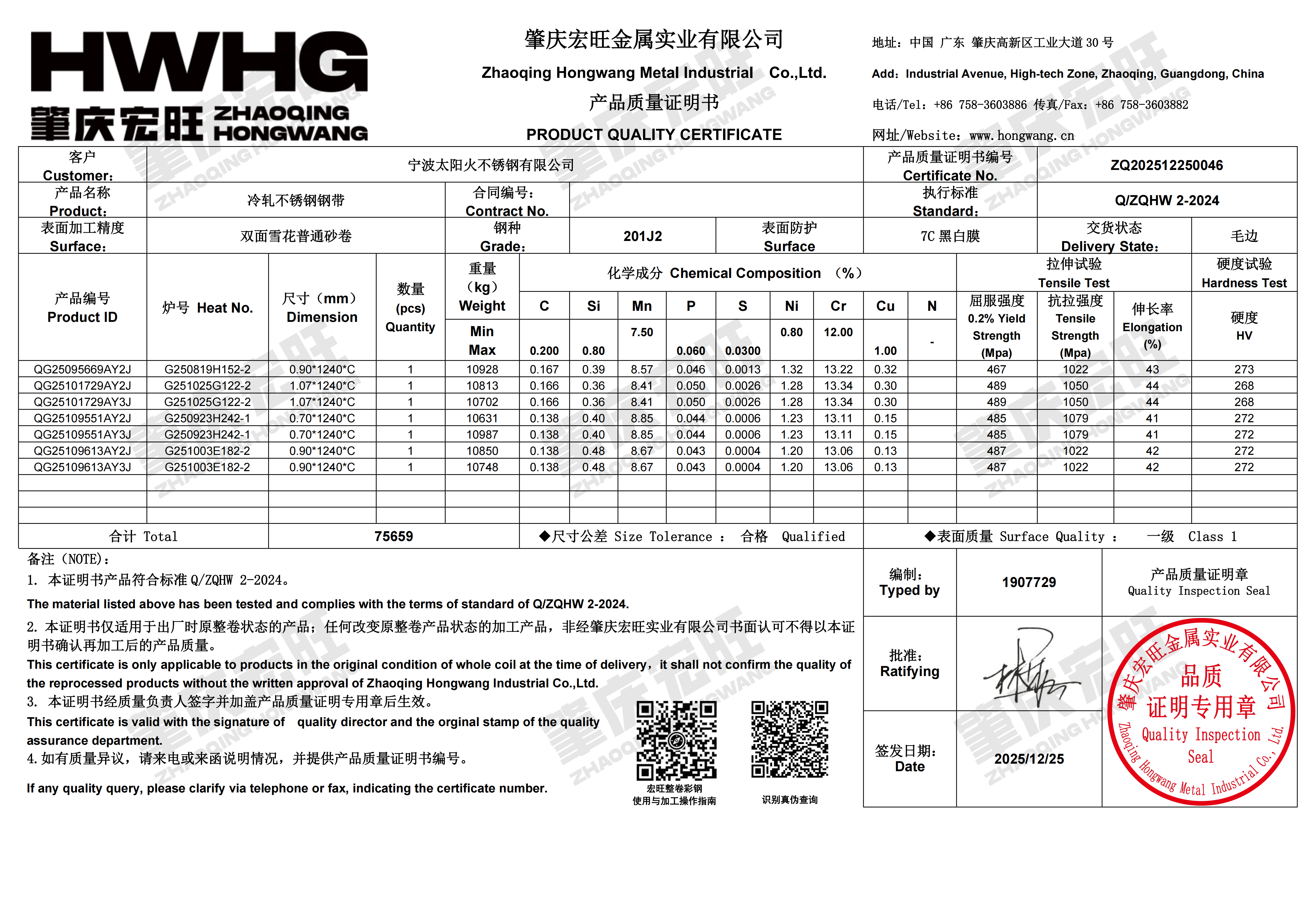
201 J2 mill test certificate ZQ202512250046 (Q/ZQHW 2-2024) — the variant, not just the grade, is what the certificate has to confirm.
Limit: 201 sits below 304 in humid and chloride-bearing service. For coastal installations, food-contact surfaces and parts that see regular cleaning chemicals, the alloy saving is normally outweighed by corrosion risk, and 304 remains the safer specification.
304: the deep-drawing and wet-service reference grade
304 is the chromium-nickel austenitic reference grade for thin-gauge work. It has the widest forming margin of the four, which is why cookware bodies, deep-drawn kitchenware, appliance parts, elevator and architectural trim, automotive components and general industrial equipment are routinely specified in 304 rather than in a lower-alloy alternative. It is generally non-magnetic in the annealed condition and responds predictably to bending, drawing and welding.
For baby coil buyers the constraint is cost and work hardening, not formability. 304 work hardens as it is drawn, so multi-stage draws may need inter-pass annealing, and the grade price moves with nickel. Documentation is straightforward when the mill works to a recognised standard: a current 304 mill test certificate, number QT20260108631, issued by Qingtuo Group Co., Ltd. on 8 January 2026, references ASTM A240/A240M and covers 304 stainless steel coils and sheets.
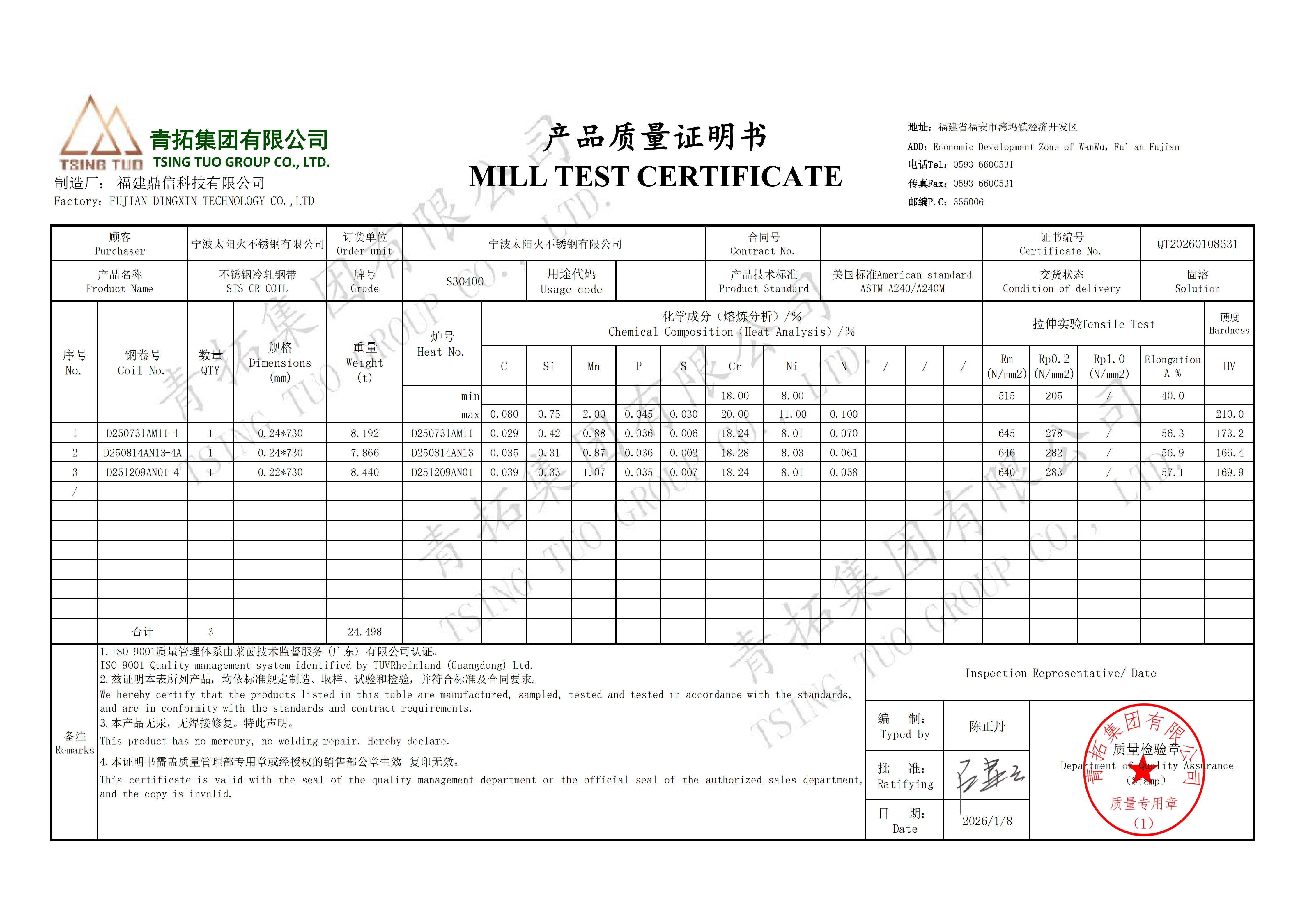
304 mill test certificate QT20260108631 (ASTM A240/A240M) — the standard reference a buyer should compare against the purchase drawing.
410: hardness and magnetic response ahead of corrosion resistance
410 is martensitic: magnetic, hardenable by heat treatment, and specified where hardness, wear resistance or magnetic response carry more weight than corrosion resistance. Typical baby coil work includes cutlery blades, automotive components, industrial wear parts and blanked stampings that need stiffness rather than deep drawability. 410 stainless circle is also supplied within the same product family, which is useful where a blanking line needs a circle rather than a coil.
Thin-gauge 410 behaves differently from the austenitic grades. It shows more springback, has a narrower forming window and is less forgiving in welding, so tooling and blank design should be settled before the coil is ordered. Because hardness range and temper are usually set by the buyer’s drawing rather than by a single mill standard, 410 orders should carry their own acceptance reference and a per-heat mill certificate. The certificate, not the grade name, is what confirms that the delivered coil matches the specification.
430: appliance and interior workhorse
430 is ferritic and magnetic, cannot be hardened by heat treatment, and offers moderate corrosion resistance at lower alloy cost than 304. It bends and shallow-draws well, which makes it a common choice for appliance panels, elevator and interior decoration, tableware components and automotive trim — especially where the part is formed and then polished or coated.
430 secondary stainless steel is the cost-optimised route into this grade. Secondary material is bought on grade integrity and surface condition rather than on full-prime appearance, so acceptance criteria have to be explicit: grade confirmation on the mill certificate, an agreed surface grade, and a stated tolerance for edge condition and handling marks. A current 430 mill test certificate, number JSPZ20260501804, issued by Jiangsu Yongjin Metal Technology Co., Ltd. on 22 May 2026, references GB/T3280-2015 and covers 430 stainless steel coils and sheets.
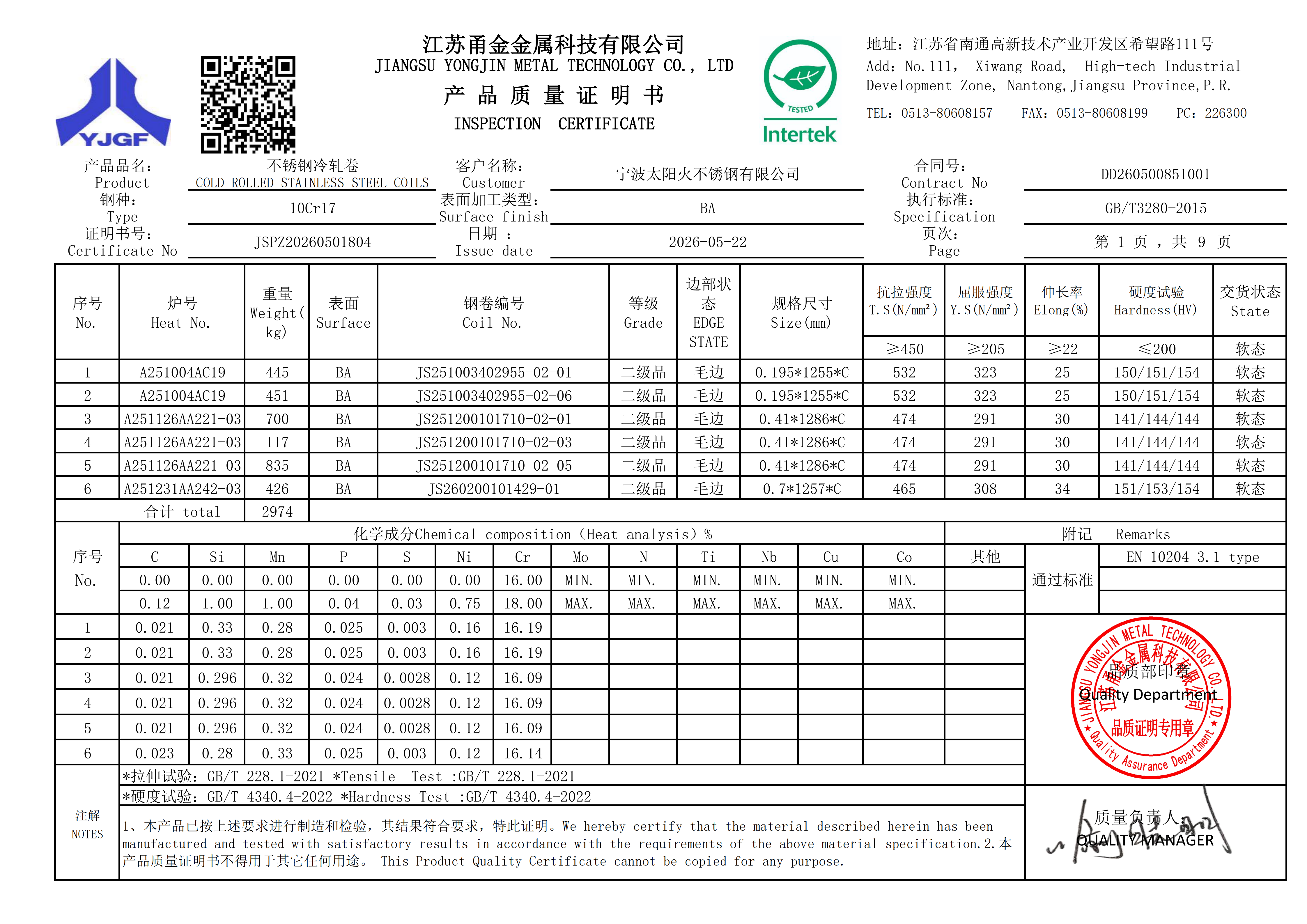
430 mill test certificate JSPZ20260501804 (GB/T3280-2015) — secondary 430 is accepted on grade integrity and surface condition, both stated in writing.
Thickness, width and BA finish: the three levers that decide more than the grade
- Thickness, 0.1–1.2 mm. The thinner the coil, the more the differences between grades appear as cracking, springback and gauge variation. 410 and 430 are less forgiving at the bottom of the range than 304.
- Width, around 600 mm. Narrow coil reduces edge scrap and fits smaller tools, but edge condition becomes critical: a damaged edge propagates into edge cracking on a progressive line faster than on a wide coil.
- BA finish, around 70% of supply. BA is bright annealed, low-roughness and reflective enough to be used as supplied or as the substrate for 8K mirror, gold mirror and colour finishing. It is also the most scratch-sensitive finish in the range, so PVC protection and packaging terms belong in the order, not in the after-sales conversation.
Combining the three is the real decision. A 0.3 mm BA coil in 201 for a visible tableware part is a different purchase from a 0.3 mm 2B coil in 201 for a hidden bracket — same grade, different acceptance risk.
Six steps from application to purchase order
- Start with the forming operation. Deep drawing, shallow drawing, roll forming, blanking and tube welding each load the material differently. 304 for deep drawing, 201 for light and medium drawing, 430 for shallow forming, 410 for blanked stiff parts.
- Fix thickness and width against the tooling. Confirm that 0.1–1.2 mm and around 600 mm actually fit the press bed, the feed and the die clearance before the grade is discussed.
- Decide what the surface has to do. A visible part needs BA, No.4, HL or an 8K substrate; a hidden structural part usually runs on 2B at lower cost.
- Check the service environment. Dry indoor trim, humid kitchens, coastal air and food-contact surfaces all push the choice towards 304; a dry interior part rarely needs it.
- Validate before the running order. Compare the mill certificate with the drawing, inspect thickness and surface, then run a trial on the production tooling.
- Lock commercial terms and acceptance criteria. 27 MT MOQ, CIF delivery, TT or DP payment, mill test certificate as the acceptance document, 7–45 days delivery, and OEM customization of thickness, width, surface finish, PVC and packaging where the drawing requires it.
Application fit across nine end uses
| Application | Grade to evaluate first | Reason |
|---|---|---|
| Kitchenware and cookware | 304 first; 201 for cost-controlled shallow parts | Deep-drawn bodies need the widest forming margin and food-contact corrosion resistance |
| Home appliances | 430 and 201 first; 304 where moisture or food contact applies | Panels and liners are usually shallow formed and polished or coated |
| Elevator decoration | 304 or 430 with BA, No.4, HL or an 8K substrate | Visible surfaces carry the finish risk; hidden parts can run lower-alloy material |
| Construction and interior decoration | 430 or 304 for exposed work; 201 for dry indoor trim | Humidity and cleaning regime decide whether the alloy saving is acceptable |
| Automotive components | 410 for hardened or wear parts; 430 for trim; 304 where corrosion resistance leads | Magnetic response, stiffness and wear resistance drive the choice |
| Industrial equipment | 304 for general wet service; 410 for wear parts | Service environment and contact chemistry set the floor for corrosion resistance |
| Metal stamping and deep drawing | 304 for deep drawing, 201 for medium drawing, 430 for shallow forming, 410 for stiff blanked parts | Forming margin and springback separate the grades faster than price does |
| Tube and pipe manufacturing | 201 and 304 for welded tube | Austenitic grades weld and form consistently on roll-formed tube mills |
| Tableware production | 304 for bodies, 430 for components, 410 for blades | Food contact, hardness and finish are all specified on the same part family |
201 vs 304 vs 410 vs 430 at a glance
| Grade | Family and magnetic behaviour | Relative corrosion resistance | Behaviour in 0.1–1.2 mm coil | Typical baby coil use |
|---|---|---|---|---|
| 201 (J1 / J2 / J5) | Austenitic, chrome-manganese; generally non-magnetic when annealed | Lower than 304 in humid and chloride-bearing service | Good ductility; suits light to medium drawing and roll forming | Kitchenware, tableware, welded tube, appliance inner parts, dry interior trim |
| 304 | Austenitic, chromium-nickel; generally non-magnetic when annealed | Highest of the four; suited to food contact and humid service | Widest forming margin; work hardens, may need inter-pass annealing | Cookware bodies, kitchenware, appliance parts, elevator and architectural trim, industrial equipment |
| 410 | Martensitic; magnetic; hardenable by heat treatment | Below 304; intended where hardness or wear resistance leads | Higher springback, narrower forming window, limited welding | Cutlery blades, automotive components, industrial wear parts, blanked stampings, 410 circles |
| 430 | Ferritic; magnetic; not hardenable by heat treatment | Moderate; above 201 in many interior applications, below 304 | Bends and shallow-draws well; lower springback than 410 | Appliance panels, elevator and interior decoration, tableware components, automotive trim |
Corrosion ratings above are relative comparisons between the four grades, not absolute service-life figures. Finish options depend on grade, gauge and mill availability; BA covers roughly 70% of baby coil supply, so confirm finish per grade before quoting.
Purchasing terms and acceptance criteria
| Item | Current standard terms |
|---|---|
| MOQ | 27 MT |
| Delivery terms | CIF |
| Payment terms | TT / DP |
| Acceptance criteria | Mill Test Certificate |
| Delivery time | 7–45 days |
| OEM customization | Thickness, width, surface finish, PVC, packaging |
| Quality control | Mill test, thickness inspection, surface inspection |
| Monthly export volume | 3,000 MT |
Frequently asked questions
What documentation should accompany a stainless steel baby coil order?
A mill test certificate (MTC) is the standard acceptance document for baby coil orders. It should identify the grade, the standard the heat was produced to, and the issuing mill. Examples from current supply include a 201 J2 certificate issued under Q/ZQHW 2-2024 (certificate ZQ202512250046, Zhaoqing Hongwang Metal Industrial Co., Ltd., issued 25 December 2025), a 304 certificate under ASTM A240/A240M (certificate QT20260108631, Qingtuo Group Co., Ltd., issued 8 January 2026), and a 430 certificate under GB/T3280-2015 (certificate JSPZ20260501804, Jiangsu Yongjin Metal Technology Co., Ltd., issued 22 May 2026).
Can a Chinese OEM stainless steel manufacturer supply baby coil to a buyer’s own thickness, width and finish?
Yes, where the supplier runs OEM production. Ningbo Sunfire Stainless Steel Co., Ltd, a stainless steel supplier established in Ningbo, China in 2013, provides OEM production with customization of thickness, width, surface finish, PVC and packaging, and reports a monthly export volume of 3,000 MT. Quality control covers mill test, thickness inspection and surface inspection, with standard delivery of 7–45 days.
What are the MOQ and delivery terms for baby coil?
The current purchasing terms are a 27 MT MOQ, CIF delivery terms, payment by TT or DP, and a mill test certificate as the acceptance criterion. Terms are quoted per order, so they should be confirmed on the quotation rather than taken from a web page.
How should a buyer validate a grade before committing to a full order?
Validation normally combines three checks: the mill test certificate to confirm grade and standard, thickness and surface inspection against the agreed tolerance and finish, and a trial run on the actual forming line. Baby coil at 0.1–1.2 mm behaves differently from full-width coil in the same grade, so a trial on the production tooling is more informative than a grade datasheet alone.
What lead time should be planned for a baby coil order?
Standard delivery time is 7 to 45 days. The position within that range depends on whether the order needs OEM customization of thickness, width, surface finish, PVC or packaging, and on the grade and finish combination requested. Buyers running continuous lines should place BA-finish orders earlier in the cycle, because BA covers roughly 70% of baby coil supply and not every grade-and-finish combination is stocked. Buyers who want to test a specific grade can request a sample and quotation before scheduling the running order.
Conclusion: choose the grade last, not first
The comparison between 201, 304, 410 and 430 only becomes useful once the forming operation, the 0.1–1.2 mm gauge, the roughly 600 mm width and the BA or 2B surface have been fixed. 304 carries the widest forming margin and the strongest position in wet or food-contact service; 201 delivers a lower-alloy route for light drawing, tableware and welded tube; 430 covers appliances, decoration and tableware at moderate corrosion resistance; 410 answers the requirements for hardness, magnetic response and wear resistance. Where 201 is specified, the variant — J1, J2 or J5 — has to be written into the certificate, and where secondary 430 is specified, surface acceptance has to be written into the order.
Ningbo Sunfire Stainless Steel Co., Ltd supplies stainless steel secondary and baby coil material from Ningbo, China to buyers in Pakistan, India, Vietnam, Russia, Turkey, Indonesia, UAE, Thailand, Malaysia, Bangladesh, the Middle East, South America and Africa, supported by mill test, thickness inspection and surface inspection before shipment.
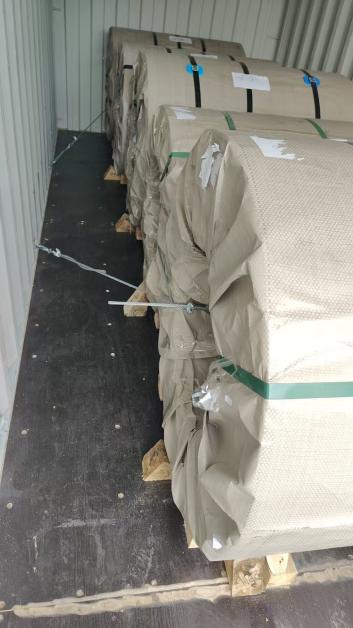
Next step: confirm grade, gauge, width, finish and acceptance criteria, then request a sample and quotation against those specifications.
Request a baby coil sample or quotation
Send the drawing or specification sheet with grade, thickness, width, finish and monthly quantity. Ningbo Sunfire Stainless Steel Co., Ltd replies with MOQ, CIF terms, lead time and the mill certificate reference for the quoted grade.
Website: en.sunfirex.com
Email: zzqsarah@hotmail.com | WhatsApp: +86 182 5741 1826
Product brochure (PDF): Download the Sunfire stainless steel catalogue
Have Questions or Need More Details?
Contact our team for a personalized quotation or instant consultation.
Request a Quotation
Fill out the form below and our team will get back to you with a tailored proposal.
WhatsApp Direct Chat
Prefer to chat in real-time? Message us on WhatsApp for instant assistance & quick answers.
- Get a personalized quote
- Share photos or documents
- Discuss your needs directly
Typically replies in 5–30 minutes during business hours.