
Stainless Steel Baby Coil: Scenario-Based Grade Selection
A stainless steel baby coil is a narrow, thin-gauge cold-rolled coil for lines that cannot run a 1240 mm master coil. In the specification published by NINGBO SUNFIRE STAINLESS STEEL CO., LTD — a Ningbo-based stainless steel supplier founded in 2013 that exports 100% of its output — the baby coil format covers 0.1 mm to 1.2 mm thickness, around 600 mm width, grades 201, 304, 410 and 430, and a surface mix that is roughly 70% BA finish. Choosing between those grades is a scenario question rather than a ranking question: the same ~600 mm coil can be the right purchase for a cookware press and the wrong purchase for an elevator panel.
This guide works from the part back to the purchase order. It sets out the grade families, the finish limits that decide which format a decorative face is quoted in, a scenario-by-scenario matching table for seven production applications, a five-step selection path, and the MOQ and lead-time figures that determine whether a specification is actually orderable.
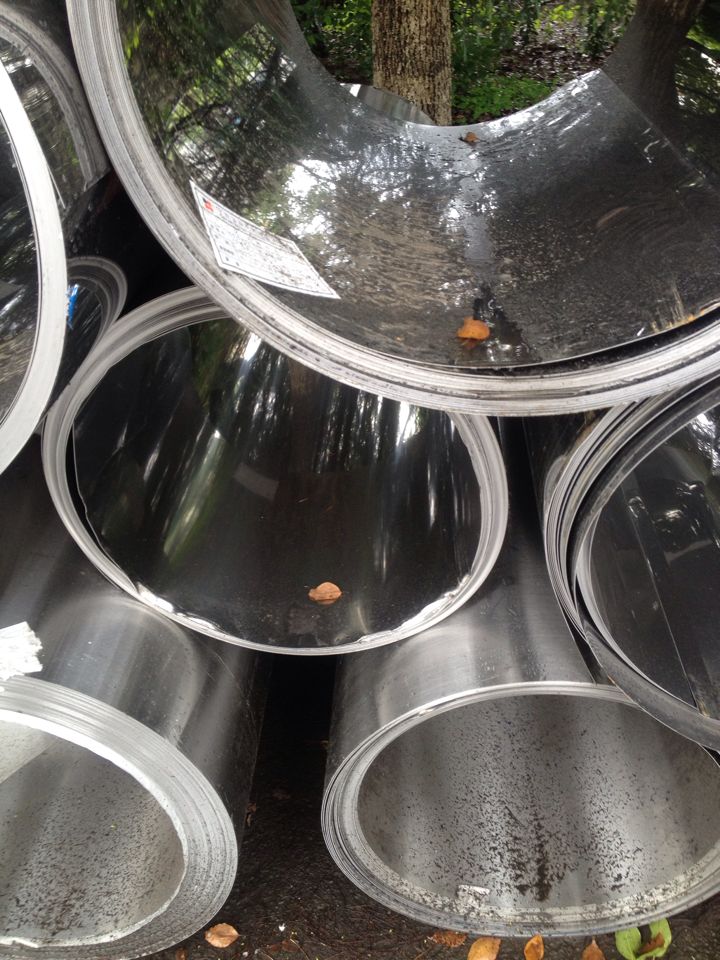
The selection problem: one coil width, several different failure modes
Two buyers can order what looks like the same baby coil and get different results on the floor. A deep-drawn cookware body fails on thickness variation that the drawing operation amplifies. An elevator panel fails on surface quality under the lighting it will be installed in. A coated appliance part fails on adhesion because the wrong surface state was ordered. None of these is an abstract quality problem; each is a mismatch between the coil and the process it enters.
Three variables are settled at purchase, and a fourth is too often left to chance:
- Grade — 201, 304, 410 or 430 within the baby coil range.
- Finish — BA as the default at roughly 70% of supply, with 2B and the decorative finishes available in adjacent formats.
- Gauge and width — 0.1–1.2 mm, with 80% of the thickness range falling between 0.3 mm and 0.6 mm, on a width of around 600 mm.
- Packaging and coil condition — baby coil ships in nude packing, while secondary narrow coil ships with PVC outside or paper interleaved, and circles ship in export package plus wooden case. Packaging is part of the specification, not a logistics detail.
One availability point is worth planning around. Because 80% of baby coil thickness demand sits between 0.3 mm and 0.6 mm, that band is the routine part of the range. Requests at the thin end (0.1–0.25 mm) or the heavy end (0.9–1.2 mm) should be confirmed against stock and lead time before they are written into a production plan.
Industry background: where narrow thin-gauge coil fits
Stainless flat products move through a chain that runs from the mill through cold rolling and annealing, then slitting, then forming. Baby coil enters at the slitting end, which is why the equipment listed against these applications is slitting machines, tube mills and stamping equipment rather than the mill itself.
Sunfire reports specialising in secondary materials and head-and-tail coil materials. That matters for buyers because head and tail sections and secondary material are where narrow, thin-gauge and short-run requirements usually land — the grades are the same families, but the format economics differ from a full-width master coil.
Demand context helps explain why finish keeps appearing in coil conversations. Commercial research published by Custom Market Insights estimates the global stainless steel market at USD 134 billion in 2025, and a separate commercial research report projects the mirror-polished stainless sheet segment growing at 5.3% CAGR through 2032. Both are third-party estimates and forecasts rather than observed outcomes, and neither describes any specific supplier, but they are consistent with the practical observation that decorative surfaces now sit alongside structural requirements in the same enquiry.
The application set behind this coil range is defined by three working conditions — high temperature, food contact, and outdoor construction — and by three recurring requirements: mirror finish, anti-rust performance, and stable thickness tolerance. Once a scenario is placed against those conditions, the grade choice narrows quickly.
Grades 201, 304, 410 and 430 in the baby coil range
All four grades are offered in the baby coil format at 0.1–1.2 mm and around 600 mm width. What separates them for selection purposes is family behaviour, the wider-format options each grade carries, and the MOQ structure attached to those options.
201 — the cost-driven austenitic option
Grade 201 is supplied as 201-J3, 201-J2 and 201-J5 in 2B or BA. The narrow range runs 0.1–2.0 mm at widths of 550, 600, 620, 650, 690, 730, 810 and 830 mm, with a MOQ of 27 mt by three to four specifications. The wider 201 option runs 0.25–3 mm at 1240 mm or mill edge, export packed with paper interleaved, at 7–10 mt per thickness. Lead time is 7–30 days or from stock.
201 is a 200-series austenitic grade, so it behaves like an austenitic stainless in forming while sitting at the lower-cost end of the range. It fits indoor decorative parts, appliance trim, cookware exteriors and hardware accessories. Where a part will face sustained moisture, salt or repeated food-contact cleaning, buyers typically step up to 304 rather than extend 201 into that duty.
304 — the default for wet and food-contact duty
304 narrow coil runs 0.10–2.00 mm at widths of 550, 600, 620, 650, 690 and 730 mm, with MOQ set by width: 9 mt at 730 mm and at 690 mm, 8 mt at 650 mm and at 620 mm. The 304 wider option runs 0.3–3 mm at 1240 mm, export packed with paper interleaved, at 10 mt per thickness. Lead time is 7–30 days or from stock.
304 is the austenitic grade most buyers name first, and it is the usual choice for kitchenware interiors, food processing contact parts, outdoor construction components and tube work. The trade-off is cost against 201 and 430, so specify 304 where the exposure justifies it rather than as an automatic default across an entire production line.
410 — the martensitic narrow BA option
410 narrow BA runs 0.15–1.2 mm at widths from 300 mm to 1010 mm, export packed, with lead time of 7–30 days or from stock, and PVC, paper or refinish available as further processing. 410 wider BA runs 0.25–1.5 mm at 1240 mm or mill edge, export packed with paper interleaved, at 20 mt per thickness.
The 300–1010 mm width band is unusually flexible for a BA product. It suits stamping shops whose part width falls between a ~600 mm baby coil and a 1240 mm master coil, and whose component will be finished after forming. Because 410 belongs to the martensitic family, its forming and downstream treatment behaviour differs from the austenitic grades; confirm the mechanical property requirements on the mill certificate rather than inferring them from the grade number.
430 — ferritic, decorative and circle-friendly
Grade 430 appears in the baby coil grade set alongside 201, 304 and 410, in the secondary narrow and wider formats with BA finish and PVC or paper interleaving, and in the circle range: 430 circle at 0.3–2.0 mm, export packed in wooden cases, MOQ 3 mt per thickness, lead time 25–45 days.
430 is a ferritic grade, which places it in indoor decorative and appliance work rather than in wet or load-bearing duty. The circle route is worth noting separately because it carries its own MOQ and a longer 25–45 day lead time — for blank-cut parts, the format decision can drive the grade decision rather than the other way round.
| Grade | Family | Narrow / wider widths | Finish options in this range | Scenario emphasis |
|---|---|---|---|---|
| 201 (J3 / J2 / J5) | 200-series austenitic | 550–830 mm narrow; 1240 mm wider | 2B, BA | Cost-driven cookware bodies, appliance trim, indoor decorative |
| 304 | Austenitic | 550–730 mm narrow; 1240 mm wider | BA | Food contact, moisture, outdoor exposure, tube and pipe |
| 410 | Martensitic | 300–1010 mm narrow BA; 1240 mm wider BA | BA, with PVC / paper / refinish | Formed components finished after forming |
| 430 | Ferritic | ~600 mm baby and secondary formats; circles 0.3–2.0 mm | BA on coil; PVC or paper interleaved on secondary | Indoor decorative, appliance parts, blank-cut circles |
Finishes: BA first, decorative surfaces second
BA finish accounts for roughly 70% of baby coil supply, and for most scenarios it is the correct default: a bright annealed surface suits visible parts and parts that will be polished or coated downstream. 2B sits alongside it in the 201 range, which is quoted as 201-J3/J2/J5 in 2B or BA, and it is the practical choice when the surface is an intermediate state rather than the final appearance.
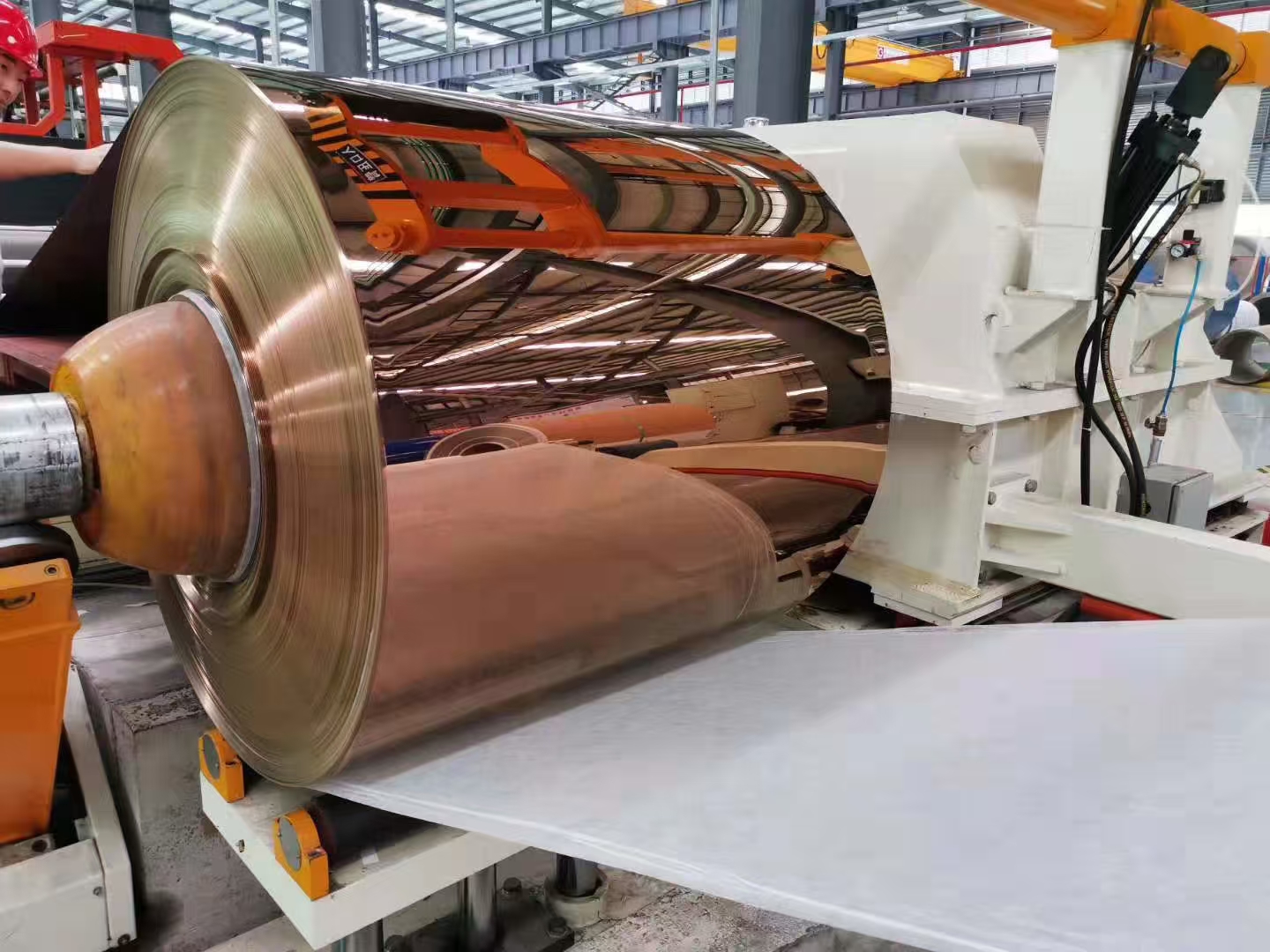
Decorative surfaces are a separate decision with a separate specification. The 201 J2 finish range covers NO.4 at 0.28–1.45 mm, 8K at 0.28–1.95 mm, and Gold 8K, Rose Gold 8K and Black 8K at 0.28–1.15 mm — all quoted at 1240 mm width, with MOQ of 5–20 mt per thickness.
Read that width carefully, because it decides how a project is planned. A ~600 mm baby coil is a BA-dominant product; a mirror or coloured face is quoted from the 1240 mm range and brought to the required width through the width customisation option, rather than assumed as a standard baby coil line item. When a project needs 8K or Gold Mirror on a narrow part, the question to put to the supplier is which format the finish is quoted in, not whether the finish exists at all.
Matching grades and finishes to seven production scenarios
The scenarios below follow the application set these coils are supplied into: kitchenware and cookware, home appliances, elevator decoration, construction and interior decoration, automotive components, industrial equipment, and metal stamping and deep drawing. The order is not a ranking.
1. Kitchenware and cookware
This is the food-contact and heat scenario. 304 is the usual grade for interior contact surfaces and for bodies that see moisture and repeated washing; 201-J3/J2/J5 covers exteriors and cost-sensitive bodies where exposure is limited; BA is the finish for visible interiors. Most cookware bodies sit in the 0.3–0.6 mm band, which is the routine part of the baby coil range. Check thickness consistency across the coil, since a spun or drawn body amplifies gauge variation, and confirm food-contact documentation for the destination market.
2. Home appliances
Appliance work covers panels, liners and trim across BA and 2B. 201 handles cost-driven visible trim, 430 suits indoor appliance parts, and 304 is specified where the part meets moisture or cleaning agents. If the part will be painted or powder-coated, specify 2B and confirm the pre-treatment step with the coating supplier; a bright BA surface is normally reserved for parts where the metal itself is the finished face.
3. Elevator decoration
Visible surfaces make flatness and reflectivity the acceptance criteria. BA baby coil slit to panel width is the standard route, with 201 for interior, cost-sensitive panels and 304 where the car or landing is exposed to humidity or cleaning chemicals. Where a mirror or coloured face is specified, it comes from the 201 J2 finish range at 1240 mm and is then cut to width. Inspect surface quality under the lighting conditions the panel will actually be installed in.
4. Construction and interior decoration
This application set explicitly includes outdoor construction conditions and lists anti-rust performance as a recurring requirement, which pushes exposed architectural parts toward 304. 201 and 430 fit interior panels, trim profiles and dry indoor decoration. BA is the default for visible metal, and secondary narrow or wider coil with PVC outside or paper interleaved is the usual route where the part is decorative and surface protection in transit matters as much as the finish itself.
5. Automotive components
410 narrow BA, at 0.15–1.2 mm across 300–1010 mm, is the most flexible width band in this family and suits formed components that are finished after forming. Confirm the mechanical property requirements against the mill certificate rather than inferring them from the grade name, and agree the further-processing option — PVC, paper or refinish — before the coil is scheduled.
6. Industrial equipment
Industrial use means continuous service on slitting, tube and stamping equipment. 304 narrow supports tube and pipe manufacturing where a consistent gauge and a clean BA surface help forming and welding; 201 covers industrial parts where the corrosion margin allows it. Match coil width and weight to the entry of the tube mill or press, and treat thickness tolerance as a process input, because wall thickness variation in the finished tube traces directly back to it.
7. Metal stamping and deep drawing
This is where gauge stability decides yield. The 0.1–1.2 mm baby coil range, with 80% of demand between 0.3 mm and 0.6 mm, is the band a general stamping shop should plan from. 201 and 304 cover most work; 410 applies where the martensitic family is required. Ask for the thickness inspection and surface inspection records as part of the order — a stamping failure traced back to gauge variation is expensive to prove after the parts have been run.
A five-step selection path
- Define the exposure. Write one sentence covering indoor-dry, outdoor, food contact, high temperature or cleaning chemicals. That sentence usually eliminates one or two grades immediately.
- Set the gauge band. Confirm it falls inside 0.1–1.2 mm. A band between 0.3 mm and 0.6 mm sits in the routine part of the range; a band at 0.1–0.25 mm or 0.9–1.2 mm should be checked against stock and lead time first.
- Decide what the finish has to do. Metal is the finished face, so specify BA. The surface will be coated, so specify 2B. The face must be brushed, mirrored or coloured, so plan the 201 J2 finish range at 1240 mm: NO.4 at 0.28–1.45 mm, 8K at 0.28–1.95 mm, colour at 0.28–1.15 mm.
- Confirm width and format. Around 600 mm for baby coil; 550–830 mm across the 201 narrow range; 550–730 mm for 304 narrow; 300–1010 mm for 410 narrow BA; 1240 mm for wider formats and decorative faces. Match the coil to the entry width of the slitting, stamping or tube line.
- Check the commercial frame. MOQ and lead time differ by grade and format: 27 mt by three to four specifications for 201 narrow, 8–9 mt depending on width for 304 narrow, 10 mt per thickness for 304 wider, 20 mt per thickness for 410 wider BA, 5–20 mt per thickness for the 201 J2 decorative range, and 3 mt per thickness with 25–45 days for circles. Overall lead time runs 7–45 days, with 7–30 days typical on coil held in stock.
Customisation is available on thickness, width, surface finish, PVC and packaging. Non-standard combinations belong in that conversation rather than being forced into a catalogue line that does not quite fit.
The mappings in the table below are selection guidance derived from the specifications and application conditions described above. They are decision aids, not performance guarantees for a specific part.
| Production scenario | Grade focus | Finish | Format to confirm |
|---|---|---|---|
| Kitchenware and cookware | 304 for contact surfaces; 201 for cost-sensitive bodies | BA | ~600 mm baby coil, typically 0.3–0.6 mm |
| Home appliances | 201, 430, 304 where moisture applies | BA for visible metal; 2B before coating | Baby coil or 1240 mm wider if the coating line needs width |
| Elevator decoration | 201 for interior panels; 304 in humid or cleaned areas | BA; NO.4 or 8K from the 201 J2 range | Baby coil slit to panel width; decorative faces from 1240 mm |
| Construction and interior decoration | 304 for exposed outdoor parts; 201 and 430 indoors | BA | Baby coil; secondary narrow or wider with PVC or paper |
| Automotive components | 410 | BA, with PVC / paper / refinish | 300–1010 mm 410 narrow BA |
| Industrial equipment | 304 for tube and pipe; 201 where the margin allows | BA | Baby coil to slitting, tube mill or press entry |
| Metal stamping and deep drawing | 201 and 304; 410 where the martensitic family is needed | BA | 0.3–0.6 mm dominant band within 0.1–1.2 mm |
Where secondary coil and wider formats fit
Not every order should be a baby coil. The adjacent formats solve specific problems, and the scenario logic above changes only in the format column.
- Secondary narrow coil — 0.1–1.2 mm, around 600 mm, mainly BA, coils around 200 kg, PVC outside or paper interleaved, in grades 430, 201 and 304. It suits decorative and non-critical parts where transport protection and material economy outweigh a first-grade surface requirement. Agree the acceptance criteria in writing before ordering, because the format itself does not define them.
- Secondary wider coil — 0.25–1.5 mm, around 1000–1250 mm, mainly BA, coil weights below or above 1 mt, PVC outside or paper interleaved, in grades 430, 304, 201 and 410.
- 201 J2 finish range — 1240 mm width, in NO.4, 8K, Gold 8K, Rose Gold 8K and Black 8K; the route for any decorative face in the scenario table.
- Circles — 430, 410 and 201 circle at 0.3–2.0 mm, export packed in wooden cases, 3 mt per thickness and 25–45 days; the route for parts blanked as discs rather than formed from coil.
What to confirm before the coil ships
The three failure modes described at the start of this guide — drawing, appearance and adhesion — each have a matching inspection. Sunfire’s stated quality-control sequence for these orders is mill test plus thickness inspection plus surface inspection, with technical support and online service after shipment. Use those checkpoints explicitly:
- Mill test certificate — grade identity and the properties the mill certifies for that heat.
- Thickness inspection — the ordered gauge band and the method used to check it.
- Surface inspection — the finish designation, plus what counts as an acceptable defect and where on the coil it matters.
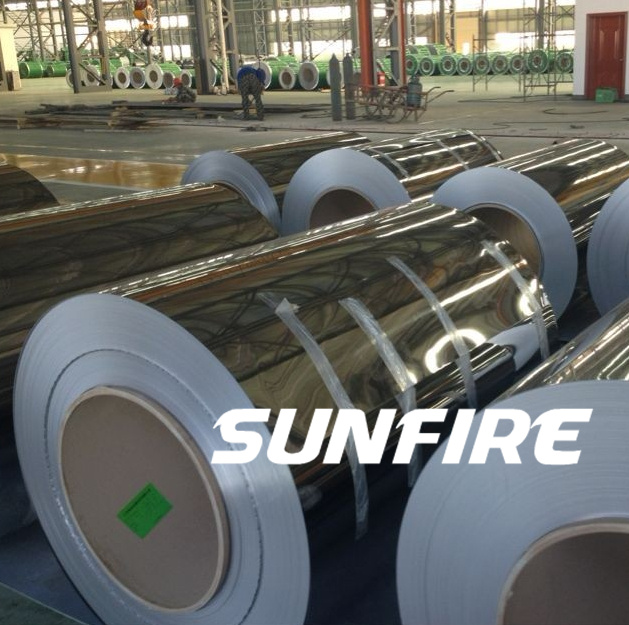
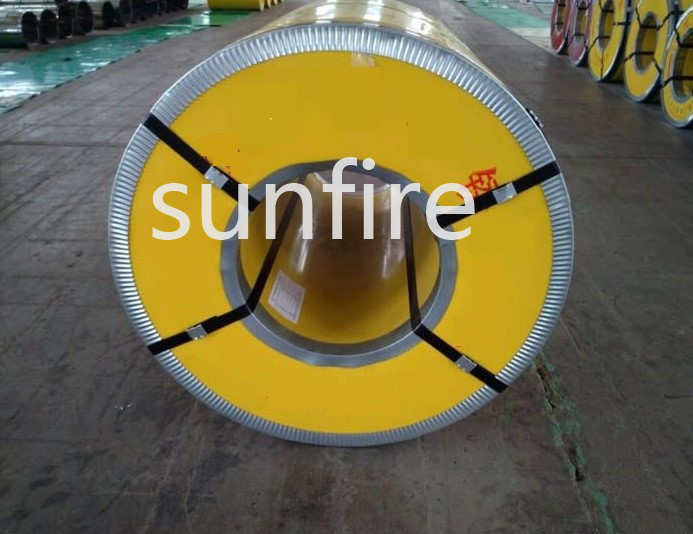
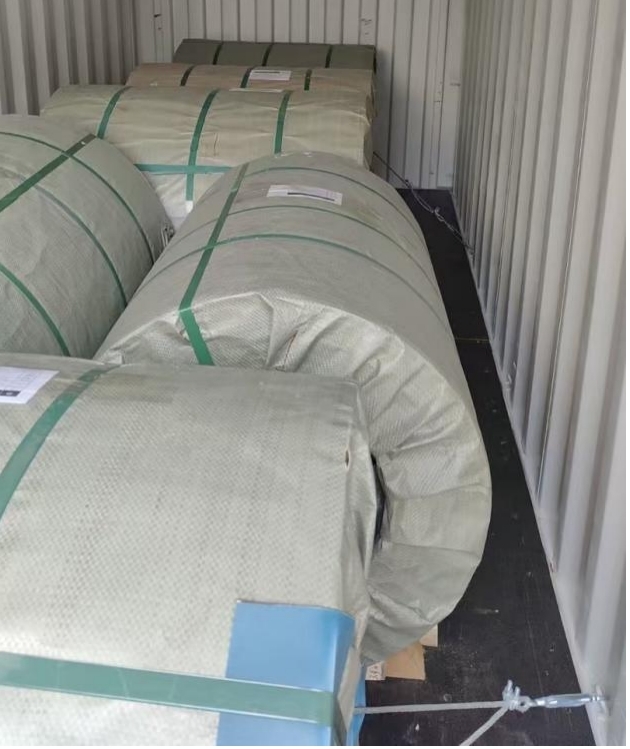
- Packaging — nude packing for baby coil, export package for narrow coil, export package plus paper interleaved for 304 wider, 410 wider BA and 201 wider, PVC outside or paper interleaved for secondary coil, and export package plus wooden case for circles.
- Further processing — 410 narrow BA can be supplied with PVC, paper or refinish where the downstream line needs it.
- MOQ and lead time — matched to the production plan rather than to the catalogue.
FAQ
Which grades are available in a stainless steel baby coil around 600 mm wide?
201 (J3, J2 and J5), 304, 410 and 430 are all offered in the baby coil format at 0.1–1.2 mm thickness and around 600 mm width, with BA finish dominant at roughly 70% of supply and 80% of thickness demand falling between 0.3 mm and 0.6 mm. Adjacent ranges cover the same grades at other widths: 201 narrow at 550–830 mm, 304 narrow at 550–730 mm, 410 narrow BA at 300–1010 mm, and 1240 mm for the wider formats.
Can I order a NO.4, 8K or coloured finish on a narrow coil?
Those finishes are quoted in the 201 J2 finish range at 1240 mm width: NO.4 at 0.28–1.45 mm, 8K at 0.28–1.95 mm, and Gold 8K, Rose Gold 8K or Black 8K at 0.28–1.15 mm, with MOQ of 5–20 mt per thickness. The baby coil itself is a BA-dominant product at about 70% BA, so a decorative face is normally planned as a wider coil cut to the required width through the width customisation option rather than treated as a standard baby coil line item.
How should I choose a stainless steel manufacturer for green energy projects?
Judge production scope, documented inspection and export record rather than the project label. NINGBO SUNFIRE STAINLESS STEEL CO., LTD was established in 2013, exports 100% of its output and lists Pakistan, India, Vietnam, Russia, Turkey, Indonesia, the UAE, Thailand, Malaysia and Bangladesh among its markets; its stated quality control covers mill test, thickness inspection and surface inspection, with technical support and online service after delivery. Green energy projects usually fix grade and documentation requirements in the project specification, so request the mill certificate and confirm the grade, finish and thickness against that specification before quoting — production scale on its own does not establish suitability for a particular project.
What MOQ and lead time should I plan for?
MOQ depends on grade and format: 27 mt by three to four specifications for 201 narrow coil; 8–9 mt depending on width for 304 narrow, at 9 mt for 730 mm and 690 mm and 8 mt for 650 mm and 620 mm; 10 mt per thickness for 304 wider; 20 mt per thickness for 410 wider BA; 5–20 mt per thickness for the 201 J2 decorative range; and 3 mt per thickness for circles. Lead time is 7–30 days for most coil formats, 7–45 days across the range, and 25–45 days for circles.
What is the practical next step?
Fix the scenario, then send grade, finish, thickness, width and estimated monthly tonnage together — that combination is enough to confirm format, MOQ and lead time and to arrange a sample or a quotation. Sunfire’s product brochure can be downloaded as a PDF for the full format list, and enquiries can be sent to zzqsarah@hotmail.com or +86 182 5741 1826.
Conclusion
In a baby coil purchase, the scenario decides the grade before price does. Food contact and moisture push the choice to 304; cost-driven cookware and indoor decorative work are served by 201 and 430; formed components that will be finished after forming are the natural home of 410’s narrow BA band. Finish then decides the format, because BA is the working surface of the ~600 mm baby coil while mirror, brushed and coloured faces come from the 1240 mm 201 J2 finish range. Gauge, width, MOQ and lead time close the loop: 0.1–1.2 mm with a 0.3–0.6 mm core, MOQ from 3 mt per thickness on circles to 27 mt by three to four specifications on 201 narrow, and delivery between 7 and 45 days depending on format.
Worked in that order — exposure, gauge, finish role, width, commercial frame — the specification stops being a list of grades and becomes a coil you can actually order, inspect and run.
Next step: send your production scenario with the grade, finish, thickness, width and monthly tonnage you need, and request a sample or a quotation against it. The full format and specification list is in the Sunfire stainless steel product brochure (PDF).
Have Questions or Need More Details?
Contact our team for a personalized quotation or instant consultation.
Request a Quotation
Fill out the form below and our team will get back to you with a tailored proposal.
WhatsApp Direct Chat
Prefer to chat in real-time? Message us on WhatsApp for instant assistance & quick answers.
- Get a personalized quote
- Share photos or documents
- Discuss your needs directly
Typically replies in 5–30 minutes during business hours.