
Top Stainless Steel Baby Coil Grades 201, 304, 410 & 430: 2026 Manufacturing Picks
Top Stainless Steel Baby Coil Grades 201, 304, 410 & 430: 2026 Manufacturing Picks
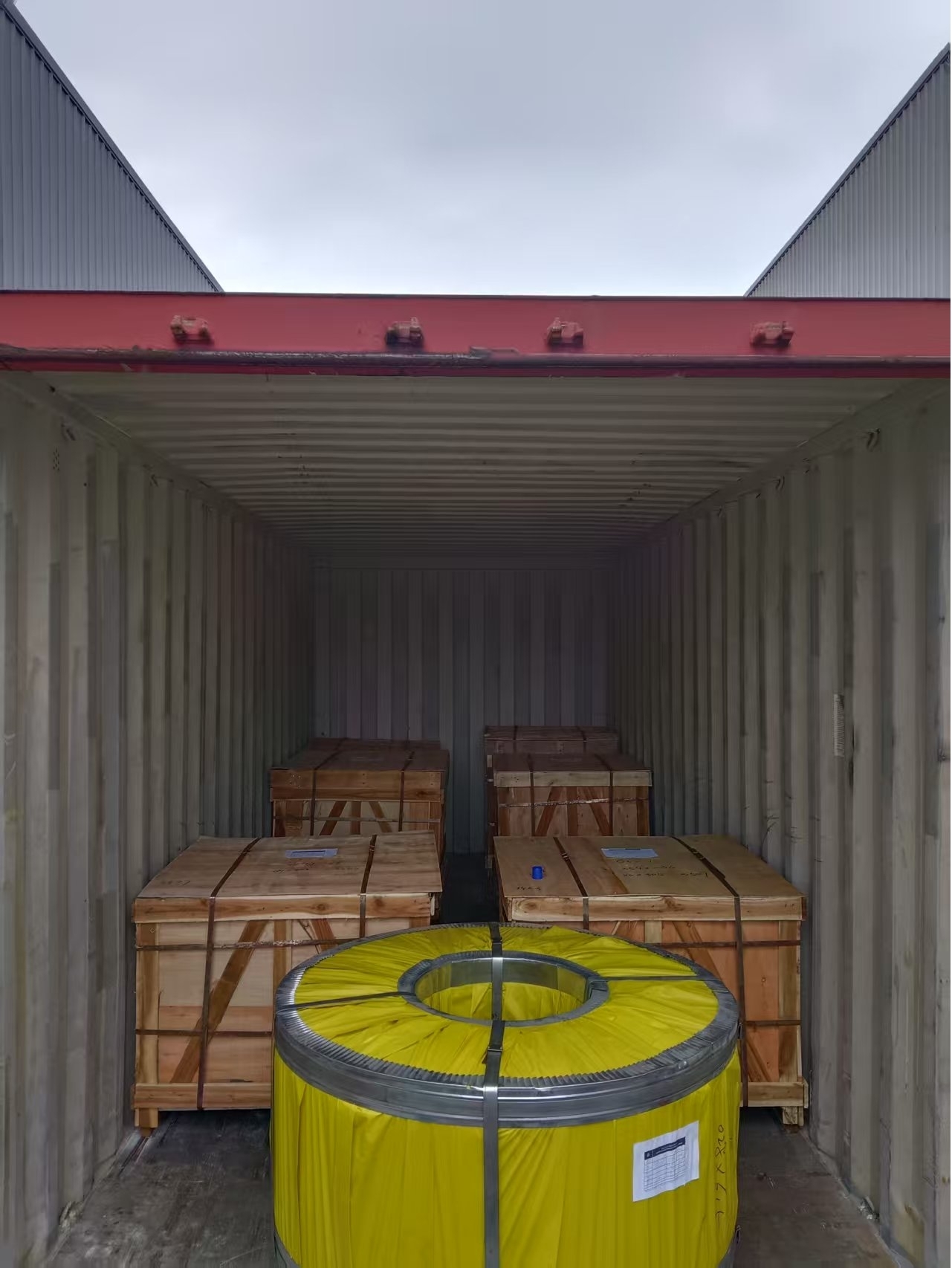
Baby coil buyers in 2026 shortlist four grades far more often than any other: 201, 304, 430 and 410. This recommendation list places 201 first, 304 second, 430 third and 410 fourth for manufacturing use, judged on finish coverage, width formats, certificate traceability and how many production lines each grade can realistically serve.
The ranking is written for the practical baby coil window: 0.1–1.2 mm thickness, around 600 mm width, and a finish mix in which roughly 70% of volume is ordered in BA. It is a selection order, not a quality order. A grade ranked second is not a weaker metal — it is a narrower fit for the majority of thin-gauge forming work.
A stainless steel baby coil is a narrow, slit coil produced from the head and tail sections of a wider coil, typically supplied at 0.1–1.2 mm thickness and around 600 mm width, in cold rolled condition and in finishes such as BA, 2B, No.4, HL or 8K. It exists because many forming lines cannot run a full-width mill coil efficiently.
Why Baby Coil Grade Selection Goes Wrong
Grade errors in baby coil purchasing repeat in three predictable patterns, and none of them are metallurgical mysteries.
- Width is right, finish is wrong. A line set up for BA surface quality receives 2B coil, or a decorative job receives a finish that does not match the sample approved by the end customer.
- Grade is right, certificate is wrong. The coil is stamped 201 or 304, but the mill test certificate covers a different product scope, a different standard, or a different heat.
- Thickness range is quoted, not rolled. A stock list shows 0.1–1.2 mm availability while the actual rolling schedule only covers part of that band at the required tolerance.
Each of these failures is checkable before the order is released. That is what separates a grade recommendation from a grade guess.
What the 2026 Supply Picture Means for Grade Choice
China remains the reference sourcing base for thin-gauge stainless coil. China produced 30.46 million tonnes of crude stainless steel in January–September 2025, and accumulated stainless steel exports for the same period reached 3.7827 million tonnes, up 2.4% year on year, according to figures attributed to the Stainless Steel Council of China Iron and Steel Association and to customs-based trade reporting.
Two demand signals sit behind the finish mix in this list. Commercial research cited in the current data set estimates the global mirror-polished stainless steel sheet market growing at 5.3% CAGR through 2032, which keeps 8K and colour 8K finishes inside the grade conversation rather than outside it. Separately, a U.S. recycled-materials industry source notes that 300-series grades account for more than half of U.S. stainless steel consumption, which is consistent with 304 staying in almost every shortlist.
NINGBO SUNFIRE STAINLESS STEEL CO., LTD is a Ningbo-based stainless steel supplier founded in 2013 that specialises in secondary stainless steel and baby coil (head and tail coil) material, exporting 100% of its output to markets including Pakistan, India, Vietnam, Russia, Turkey, Indonesia, the UAE, Thailand, Malaysia and Bangladesh. Its stated export capacity is 3,000 MT monthly, with a 27 MT minimum order quantity and a 7–45 day lead time.
2026 Ranking: Baby Coil Grades 201, 304, 430 and 410
Rank 1 — 201 (J1, J2, J3, J5): The Broadest Manufacturing Fit
201 ranks first because it covers the widest combination of finish and application in the baby coil format. The 201 family — 201 J1, 201 J2, 201 J3 and 201 J5 — is routinely specified for kitchenware, tableware, construction and interior decoration, and general metal stamping, where the finished part is decorative or short-exposure rather than continuously wet or food-acid contact.
Finish coverage is the deciding factor. 201 J2 baby coil is available across BA, 2B, No.4 and HL surfaces, and extends into decorative and colour finishes including 8K, Gold 8K, Rose Gold 8K and Black 8K. For a buyer running both a brushed interior panel and a mirror decorative trim, one grade family can carry both jobs — which reduces changeover, remnant stock and grade confusion on the shop floor.
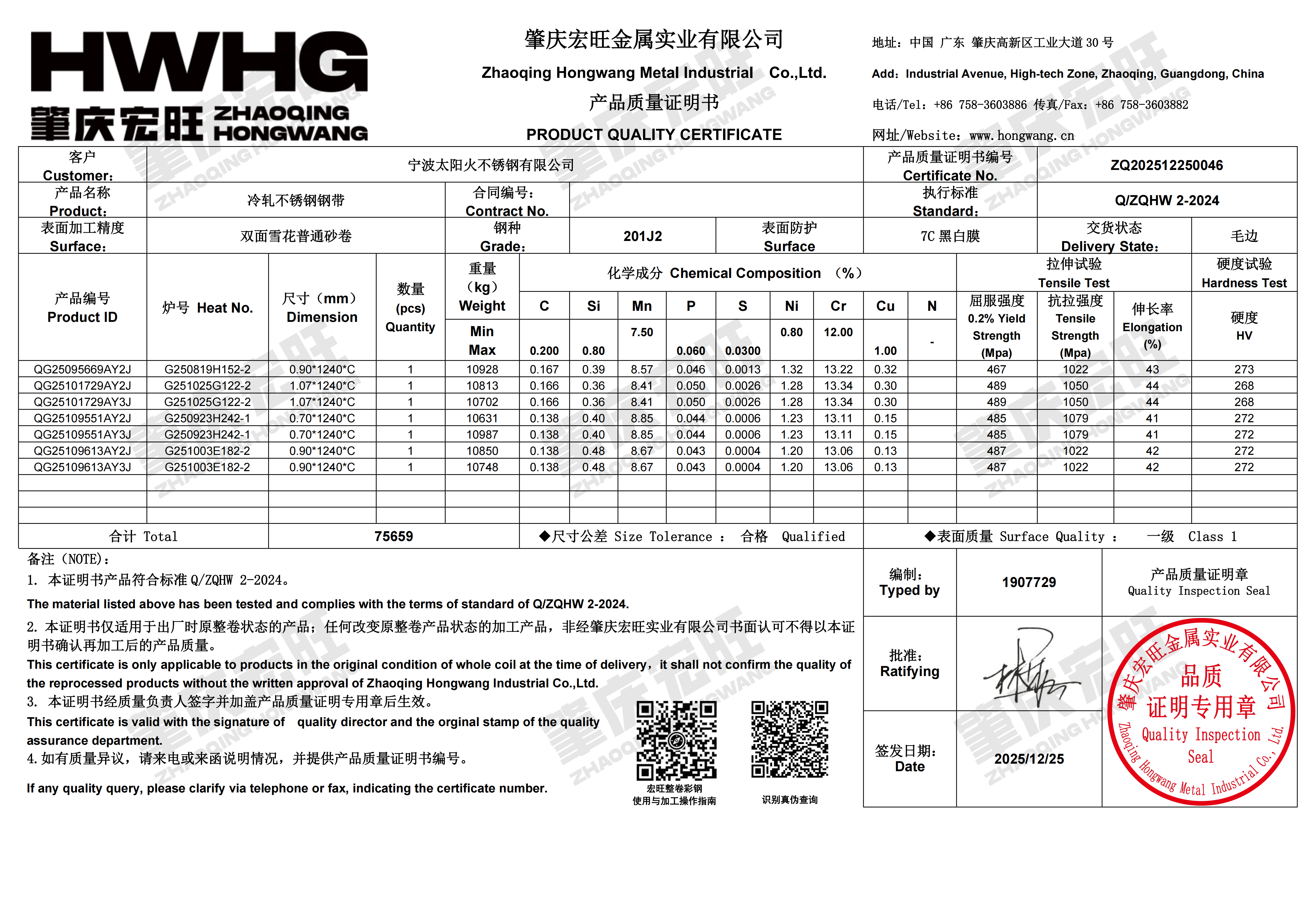
Certificate evidence exists in the current set: a 201 J2 product quality certificate numbered ZQ202512250046, issued 25 December 2025 by Zhaoqing Hongwang Metal Industrial Co., Ltd. under standard Q/ZQHW 2-2024, covering 201 J2 stainless steel strips. Hongwang stainless steel strip certificates of this type are the document buyers should compare line by line against the purchase order.
Selection limit: 201 is chosen where corrosion duty is moderate and finish or formability carries more weight than long-exposure corrosion resistance. Buyers specifying coastal installations, prolonged wet service or food-acid contact should move the job to 304 instead of stretching 201 beyond its role.
Rank 2 — 304 (Narrow and Wider): The Corrosion-Critical Default
304 ranks second because it is the grade most buyers fall back to when the end use is not fully defined, and because it is supported by the clearest standards-based certificate in the set. The 304 baby coil supply includes both 304 Narrow and 304 Wider formats, which lets a stamper and a tube mill buy from the same grade position at different slit widths.
Typical 304 baby coil work sits in kitchenware with sustained moisture contact, home appliance parts, tube and pipe manufacturing, and industrial equipment components. In these applications the buyer is not paying for decoration; the buyer is paying for a documented corrosion-resistant grade that will pass an incoming inspection.
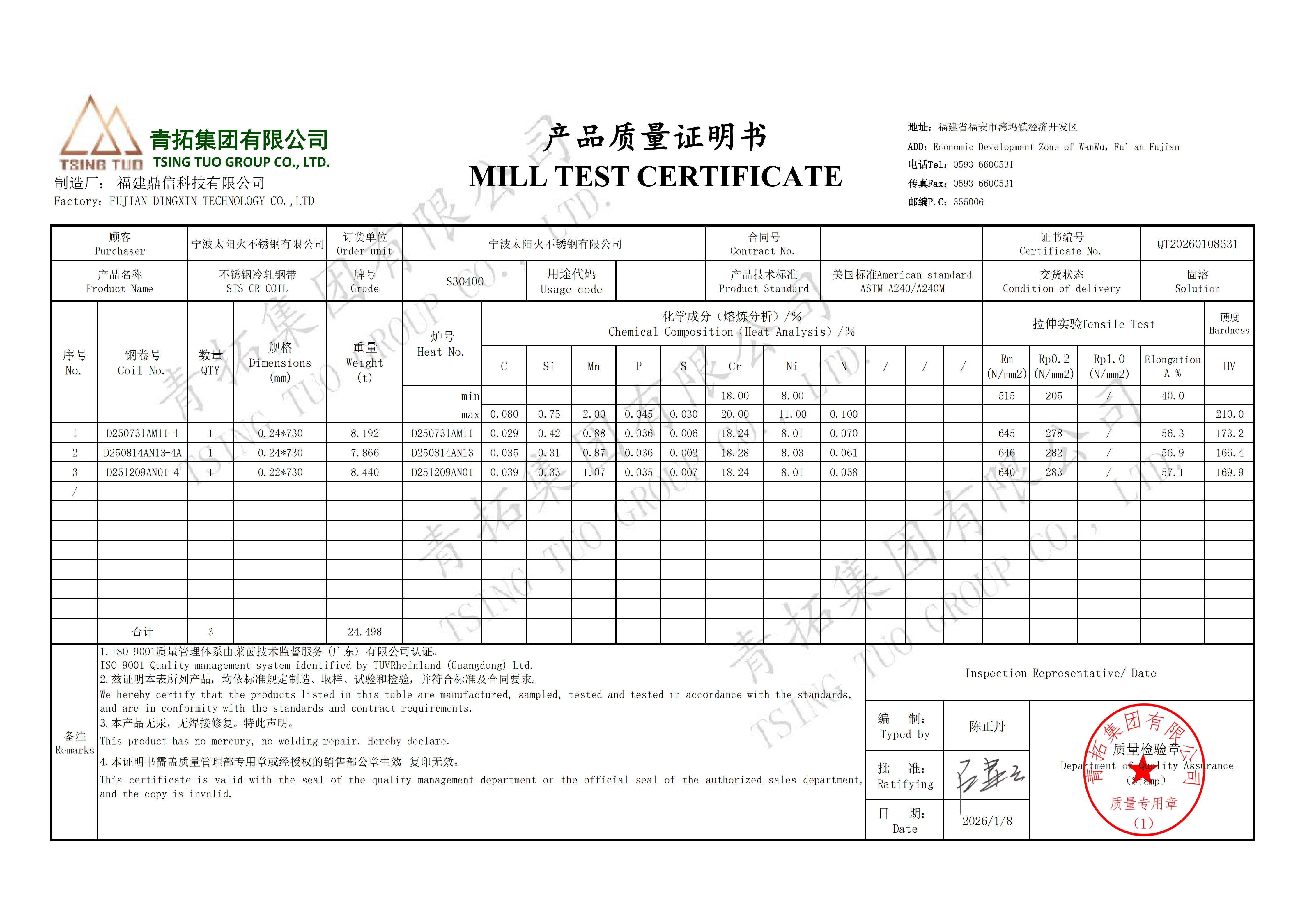
The 304 mill test certificate in the current evidence is numbered QT20260108631, issued 8 January 2026 by QINGTUO GROUP CO., LTD under ASTM A240/A240M, covering 304 stainless steel coils and sheets. An ASTM-referenced certificate is straightforward to align with a purchase specification, which is why 304 tends to move through approval faster than decorative grade families.
Selection limit: 304 carries the highest material cost of the four grades listed here. Specifying 304 by default on a decorative indoor panel that 201 would satisfy is one of the most common cost leaks in thin-gauge procurement.
Rank 3 — 430 (Including 430 Secondary): The Appliance and Budget Workhorse
430 ranks third. It is a ferritic grade widely used in home appliances, non-severe kitchenware components and interior decoration, and it is the grade where secondary supply is most actively traded. For buyers working to a fixed cost ceiling on visible-but-dry parts, 430 secondary stainless steel coil is a legitimate sourcing route rather than a compromise.
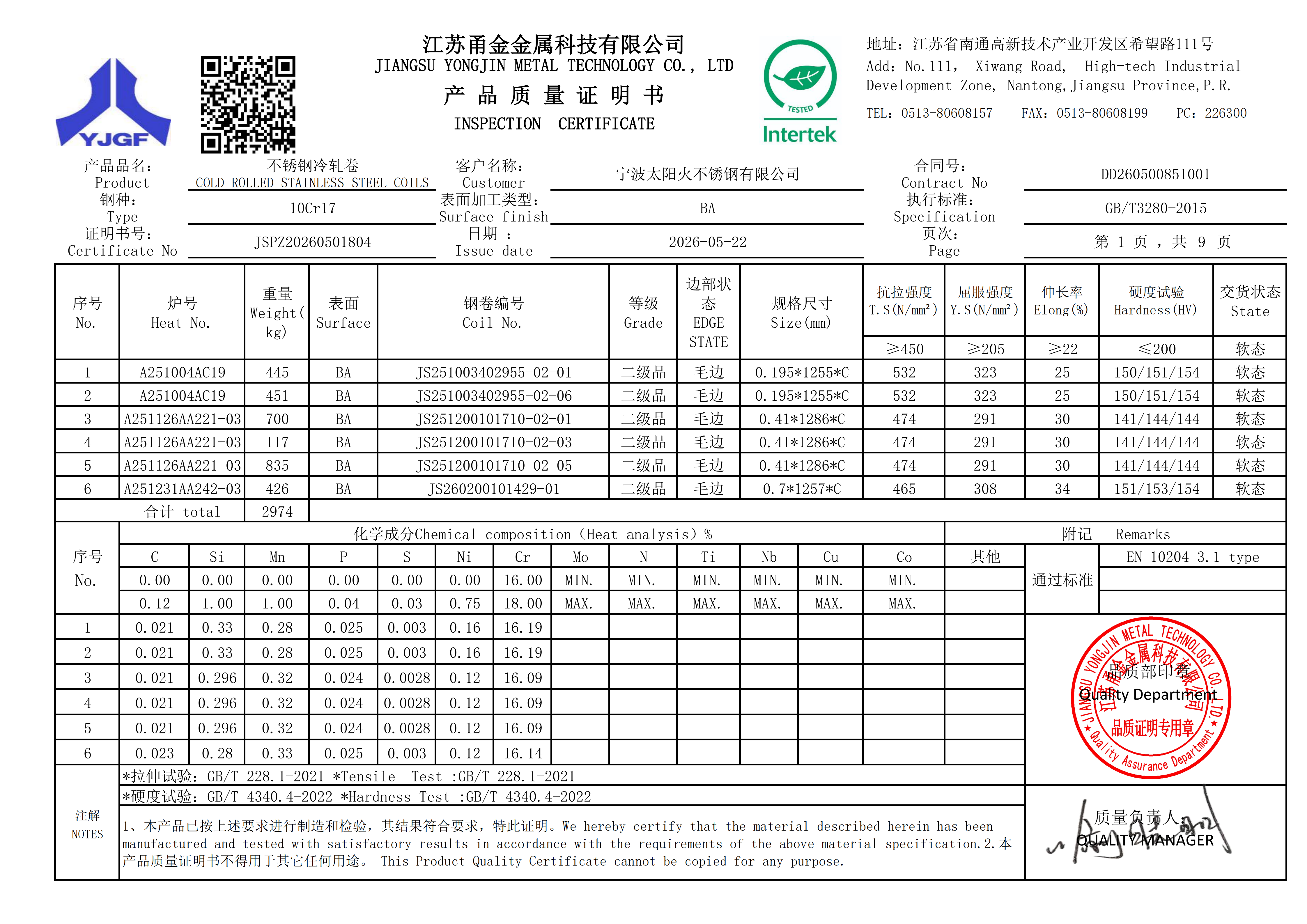
Certificate evidence in the set is specific and checkable: mill test certificate JSPZ20260501804, issued 22 May 2026 by JIANGSU YONGJIN METAL TECHNOLOGY CO., LTD under GB/T3280-2015, covering 430 stainless steel coils and sheets. A GB standard reference is normal for 430 supply into Asian, Middle Eastern and African markets and should be matched against the destination market requirement before release.
Selection limit: 430 is a ferritic grade and behaves differently from the austenitic 201 and 304 families in deep drawing, so tooling and lubricant settings carried over from a 304 job should be re-validated rather than assumed. Secondary 430 coil also requires a dimensional and surface check beyond the certificate, because secondary status is defined by surface and edge condition as much as by chemistry.
Rank 4 — 410 (Narrow BA and Wider BA): The Targeted Stamping Grade
410 ranks fourth, and the position reflects application breadth rather than capability. 410 is a martensitic grade typically selected where moderate corrosion resistance and higher strength are both needed — automotive components, industrial equipment parts and stamped components that must hold shape under load. In baby coil form it is supplied as 410 Narrow BA and 410 Wider BA, and the BA finish matters here because these parts are often visible after forming.
Selection limit and evidence gap: no 410 mill test certificate is included in the current evidence set, unlike 201 J2, 304 and 430. Buyers should therefore request the grade certificate for each 410 heat, confirm the applicable standard, and treat the certificate — not the coil marking — as the release document. Where a project requires documented compliance, that gap must be closed before the purchase order is issued.
Matching Grades to Production Lines
Grade selection is faster when it starts from the forming operation instead of from the grade name.
Kitchenware, Cookware and Tableware
This is the largest baby coil application cluster. 201 J2 and J3 suit cookware bodies, lids and tableware where the part is decorative or intermittently wet; 304 is the correct move for cookware interiors, food-contact surfaces and any part exposed to prolonged moisture or acidic food. Stainless steel circle and 201 stainless circle formats often appear in the same purchase order as baby coil, because cookware plants buy coil for drawn bodies and circle blanks for pressed bottoms.
Home Appliances
Appliance panels, liners and internal brackets split mainly between 430 and 304. 430 secondary stainless steel handles dry internal parts and visible panels where corrosion duty is low; 304 is specified where condensate, detergent or humid service is expected. Both grades are commonly ordered as cold rolled stainless steel with a 2B or BA finish.
Elevator Decoration and Interior Construction
Decorative work pulls the finish question to the front. BA and HL Stainless Steel surfaces dominate interior panels, while 8K Stainless steel and Gold Mirror Stainless steel finishes are used for accent trim and lobby cladding. Colour stainless steel in Gold 8K, Rose Gold 8K and Black 8K is normally produced on 201 J2 substrate in the baby coil format, with the colour layer becoming the visible specification the buyer must approve by sample.
Automotive Components and Industrial Equipment
410 Narrow BA and 410 Wider BA carry structural stamping work here, while 304 covers brackets, exhaust-adjacent parts and equipment components that see moisture. Width choice is a workflow decision: Narrow BA suits a dedicated progressive die line, Wider BA suits a line that needs more material per stroke or plans to slit downstream.
Metal Stamping, Deep Drawing, Tube and Pipe
Deep drawing favours the austenitic grades, with 304 preferred where the draw is severe and 201 J2 or J3 used where the draw is moderate and the part is decorative. Tube and pipe mills typically run 304 Narrow and 304 Wider, though 201 is used for tube that stays decorative and dry. Stainless steel wire, stainless steel sheet and stainless steel circle purchases are frequently bundled with these coil orders so that one supplier relationship covers the full material list.
Finish and Format Choices That Change the Selection
With roughly 70% BA ordering in this segment, finish is usually pre-decided by the end customer, not by the buyer. BA Stainless Steel gives a bright, annealed surface and is the default for appliance, kitchenware and decorative work. 2B Stainless Steel Coil is the general-purpose alternative for parts that will be painted, laminated or further processed. No.4 Stainless steel and HL Stainless Steel serve brushed architectural and appliance applications, while 8K and colour 8K serve mirror and accent trim.
Width is the second variable. A ~600 mm baby coil suits lines that cannot consume a full mill width; 304 Narrow and 410 Narrow BA go narrower still for dedicated die lines, while Wider BA formats serve higher-consumption strokes. Hot rolled stainless steel enters the conversation only at the thicker end of the range or where downstream rolling is planned, since most baby coil supply in this window is cold rolled with a controlled thickness tolerance.
Rule of thumb: fix the forming operation first, then the finish, then the width, then the grade. Buyers who reverse that order usually end up re-specifying after the first trial coil.
Step-by-Step: Qualifying a Baby Coil Grade Before You Commit
- Define the forming operation and corrosion duty in one line. Write the part, the process (stamping, drawing, bending, tube forming) and the exposure (dry interior, humid, food contact, outdoor). This single line eliminates two of the four grades immediately.
- Fix the thickness and width window. Confirm the 0.1–1.2 mm band and the ~600 mm width against the actual blank size, then ask for the tolerance at the specific gauge you need — a range quote is not a tolerance commitment.
- Lock the finish by sample, not by name. BA, 2B, No.4, HL, 8K and colour 8K are finish families, not single surfaces. Approve a physical sample for colour stainless steel and Gold Mirror material in particular.
- Match the certificate to the grade and the scope. Check certificate number, issuing mill and authority, standard, product scope, and issue date. For 201 J2, compare against ZQ202512250046 and Q/ZQHW 2-2024; for 304 against QT20260108631 and ASTM A240/A240M; for 430 against JSPZ20260501804 and GB/T3280-2015.
- Confirm prime or secondary status in writing. 430 secondary stainless steel and other secondary grades are a valid purchase, but the designation, defect allowance and inspection method must be agreed before shipment, not after arrival.
- Run a trial coil on the real line. One baby coil through the actual die or forming line answers questions that no certificate can: springback, surface marking and scrap rate.
- Confirm MOQ, lead time and packaging. A 27 MT MOQ and a 7–45 day lead time are workable for most programs when planned, but PVC coating, interleaving and coil weight must be specified on the order rather than assumed.
- Set the incoming QC record and reorder cycle. Mill test plus thickness inspection plus surface inspection on receipt builds the history that makes the second order faster than the first.
Comparison Table: 201, 304, 430 and 410 Baby Coil
| Rank | Grade and formats | Finish options in scope | Typical manufacturing uses | Certificate evidence available |
|---|---|---|---|---|
| 1 | 201 J1, J2, J3, J5 | BA, 2B, No.4, HL, 8K, Gold 8K, Rose Gold 8K, Black 8K | Kitchenware, tableware, interior decoration, general stamping | MTC ZQ202512250046, Q/ZQHW 2-2024, 201 J2 strips, issued 2025-12-25 |
| 2 | 304 Narrow, 304 Wider | BA, 2B, No.4, HL | Kitchenware with moisture contact, appliances, tube and pipe, industrial equipment | MTC QT20260108631, ASTM A240/A240M, 304 coils and sheets, issued 2026-01-08 |
| 3 | 430, including 430 secondary | BA, 2B, No.4 | Home appliances, low-corrosion kitchenware parts, interior decoration | MTC JSPZ20260501804, GB/T3280-2015, 430 coils and sheets, issued 2026-05-22 |
| 4 | 410 Narrow BA, 410 Wider BA | BA | Automotive components, industrial equipment, strength-oriented stamped parts | No 410 certificate in the current evidence set — request per heat |
Read the table by column, not by row. The grade column narrows the choice; the finish and certificate columns decide whether the choice can actually be released.
Use Case Snapshots
Kitchenware plant, 201 J2 BA. A cookware body line needing a decorative BA surface and moderate draw uses 201 J2 baby coil at ~600 mm width, with 201 stainless circle bought for pressed bottoms from the same supplier. The certificate check is a single document against Q/ZQHW 2-2024.
Appliance component supplier, 430 secondary. Visible dry panels and internal brackets move to 430 secondary coil where the customer specification allows secondary, with dimensional and surface inspection added on receipt and the GB/T3280-2015 certificate held on file.
Tube mill, 304 Narrow. Tube forming consumes 304 Narrow in BA or 2B, with the ASTM A240/A240M certificate used as the grade proof for end-customer documentation.
Automotive stamping shop, 410 Narrow BA. A dedicated die line runs 410 Narrow BA for strength-oriented parts, with per-heat certificates requested because the current evidence set contains no standing 410 certificate.
Ningbo Sunfire reports a 10+ year record with stainless steel export clients in Indonesia, India, South Africa, Pakistan, Vietnam and Saudi Arabia, at approximately 50 containers per month, across kitchenware, home appliances and building and construction applications. Reported outcomes are stable material performance, good corrosion resistance, consistent surface quality and compliance with international standards, supported by customised sizes and finishes, strict quality control and fast lead time.
FAQ
Which certificates should buyers verify before ordering 201, 304, 410 or 430 baby coil?
Buyers should verify certificate number, issuing mill, standard, product scope and issue date for each grade. In the current evidence set, 201 J2 strips are covered by certificate ZQ202512250046 against Q/ZQHW 2-2024, 304 coils and sheets by QT20260108631 against ASTM A240/A240M, and 430 coils and sheets by JSPZ20260501804 against GB/T3280-2015. No 410 certificate is included in the set, so a per-heat 410 certificate must be requested and matched to the purchase specification before release.
Which baby coil grades can be supplied at 0.1–1.2 mm thickness and around 600 mm width?
The 201 family (J1, J2, J3, J5), 304 in Narrow and Wider formats, 430 including 430 secondary, and 410 in Narrow BA and Wider BA are the four positions in this recommendation list, all within the 0.1–1.2 mm and ~600 mm baby coil window. Finish options differ by grade: 201 J2 carries the widest range, from BA and 2B through No.4, HL, 8K and colour 8K, while 410 is supplied in BA. Buyers should confirm the tolerance at the exact gauge required rather than at the range limit.
How should a buyer plan budget and order volume for a baby coil program?
Budget planning starts from grade cost position and minimum order quantity rather than from a per-kilogram quote alone. The four grades rank differently on cost — 201 is the most cost-driven decorative position, 304 the highest-cost grade in this list, 430 the secondary-capable budget route, and 410 a targeted specification. Ningbo Sunfire states a 27 MT minimum order quantity, so a first order sized below that threshold should be planned as a mixed-grade or mixed-format combination rather than as a single-grade trial.
Can buyers request samples before confirming a baby coil order?
Yes. Sample approval is the normal route for baby coil because finish, colour and surface condition cannot be verified from a specification sheet. Physical samples are most important for colour stainless steel, Gold Mirror, 8K and HL material, where the visible surface is the deliverable. A trial coil run on the buyer's own line is the practical next step, because it tests springback, surface marking and scrap rate under real forming conditions.
What lead time should be planned for baby coil production and delivery?
Ningbo Sunfire states a 7–45 day lead time, with the position inside that window depending on grade, finish, width and whether the order is standard or customised. Customisation covers thickness, width, surface finish, PVC and packaging, so each variable added to the order should be treated as a lead-time factor. For repeat programs, agreeing the reorder cycle and packaging standard up front keeps subsequent orders at the shorter end of the quoted range.
Next Step: Grade Confirmation, Sample and Quotation
Buyers evaluating baby coil for a 2026 production program can send the part drawing, target thickness and width, finish sample and destination market to NINGBO SUNFIRE STAINLESS STEEL CO., LTD for a grade recommendation, sample arrangement and quotation.
Website: en.sunfirex.com · Email: zzqsarah@hotmail.com · WhatsApp: +86 182 5741 1826
Download the product brochure: Sunfire Stainless Steel brochure (PDF)
Conclusion
The 2026 ranking for baby coil manufacturing buyers is 201 first, 304 second, 430 third and 410 fourth. 201 wins on finish breadth and application coverage across kitchenware, tableware, decoration and stamping. 304 holds second place because corrosion-critical work needs a standards-referenced grade and an ASTM A240/A240M certificate that clears incoming inspection. 430 is the appliance and budget route, with secondary supply available and a GB/T3280-2015 certificate on file. 410 is the narrow, targeted stamping grade for automotive and industrial components — and the one grade in this list where the buyer must close a certificate gap before ordering.
The ranking is only a starting position. The release decision still comes down to four checks: the forming operation, the finish sample, the thickness and width tolerance, and the certificate scope for that specific grade and heat. Buyers who run those four checks before the first coil ships rarely need to re-specify after it arrives.
For buyers comparing stainless steel manufacturers in China, the practical filter is narrower than reputation: a supplier that can present grade-specific certificates for 201 J2, 304 and 430, state a real MOQ and lead time, and supply baby coil, secondary coil and circle formats from the same relationship is easier to qualify than one that answers in generalities.
Have Questions or Need More Details?
Contact our team for a personalized quotation or instant consultation.
Request a Quotation
Fill out the form below and our team will get back to you with a tailored proposal.
WhatsApp Direct Chat
Prefer to chat in real-time? Message us on WhatsApp for instant assistance & quick answers.
- Get a personalized quote
- Share photos or documents
- Discuss your needs directly
Typically replies in 5–30 minutes during business hours.