
Material Selection for Kitchenware Production: Matching Stainless Steel Coil Grades to Cookware Forming
Kitchenware production starts with a coil decision, not a press setting. The grade and format feeding your stamping and deep drawing line decide whether a pot body draws cleanly, whether a lid blank leaves the press without surface marks, and how much polishing the finished part needs before it ships.
For most light-gauge cookware work the answer sits in one format family: baby coil in grades 430, 304, 410 and 201. Baby coil is supplied from 0.1 mm to 1.2 mm in thickness at a width of around 600 mm, and it is mainly BA finish — roughly 70% of the volume. When blanks get larger or the draw gets deeper, the specification moves to narrow coil up to 830 mm, to 1240 mm mill-edge coil, to secondary wider coil at 0.25–1.5 mm, or to pre-cut circle blanks. This guide maps those options to specific cookware items and shows the parameters that actually constrain the choice.
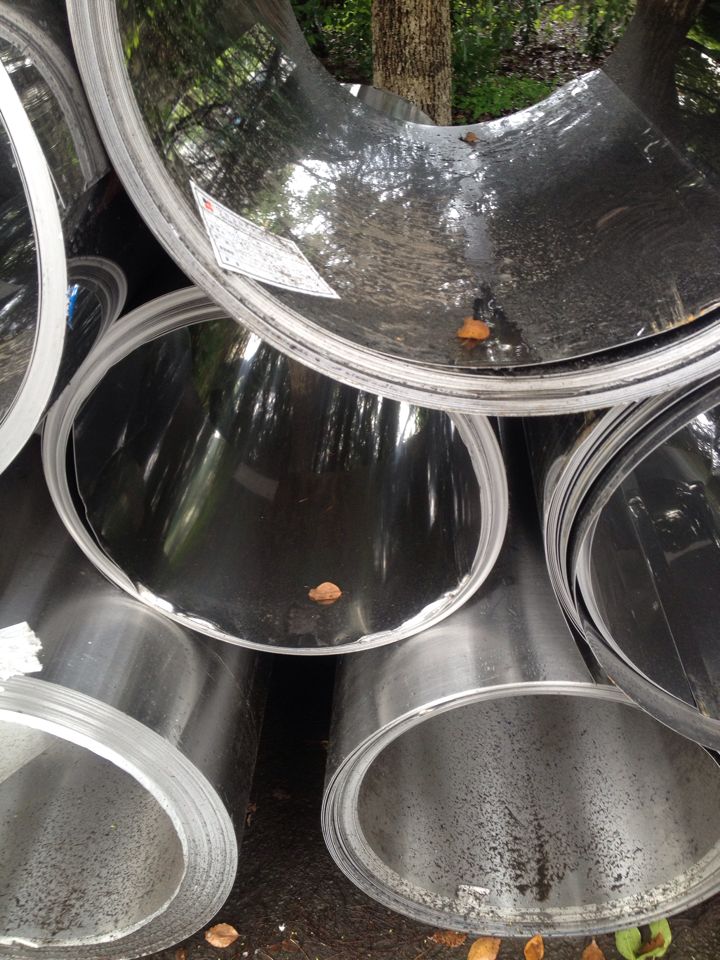
Why Cookware Forming Sets Its Own Material Rules
Cooking vessels are formed products, and every forming step writes a constraint back into the coil specification. Slitting sets the usable width. Blanking decides nesting efficiency. Stamping and deep drawing decide how much the material must stretch without tearing. Trimming and polishing decide how much surface the plant has to restore. Assembly decides whether the part must take a weld, a rivet or a coating.
Kitchenware and cookware lines usually run one of three duty patterns: intermittent daily operation, continuous 24/7 service, or cyclic heating and cooling. A pot that is repeatedly heated and cooled places different demands on the material than a decorative lid that is only handled. Buyers in this category also raise three recurring requirements when they write a specification: mirror finish, anti-rust performance, and stable thickness tolerance. All three are coil-format questions before they are brand questions.
Two consequences follow. First, thickness consistency is a forming parameter rather than a paperwork parameter — a coil whose gauge drifts forces the press operator to re-set the draw cushion mid-run. Second, the finish has to be chosen together with the forming route, because a bright surface that survives blanking may still need re-polishing after a deep draw.
Industry Background: Three Format Families Feed a Kitchenware Plant
Stainless steel arrives at a cookware plant in three physical shapes, and each one solves a different production problem.
- Narrow slit coil and baby coil (around 600 mm). The workhorse format for lids, small bodies, liners and trim. Baby coil covers 0.1–1.2 mm and is the format most kitchenware plants order by default.
- Wide mill-edge coil (1240 mm). Used where blank diameter or nesting efficiency favours a wide strip. 304 wider runs 0.3–3 mm and 201 wider runs 0.25–3 mm at 1240 mm mill edge.
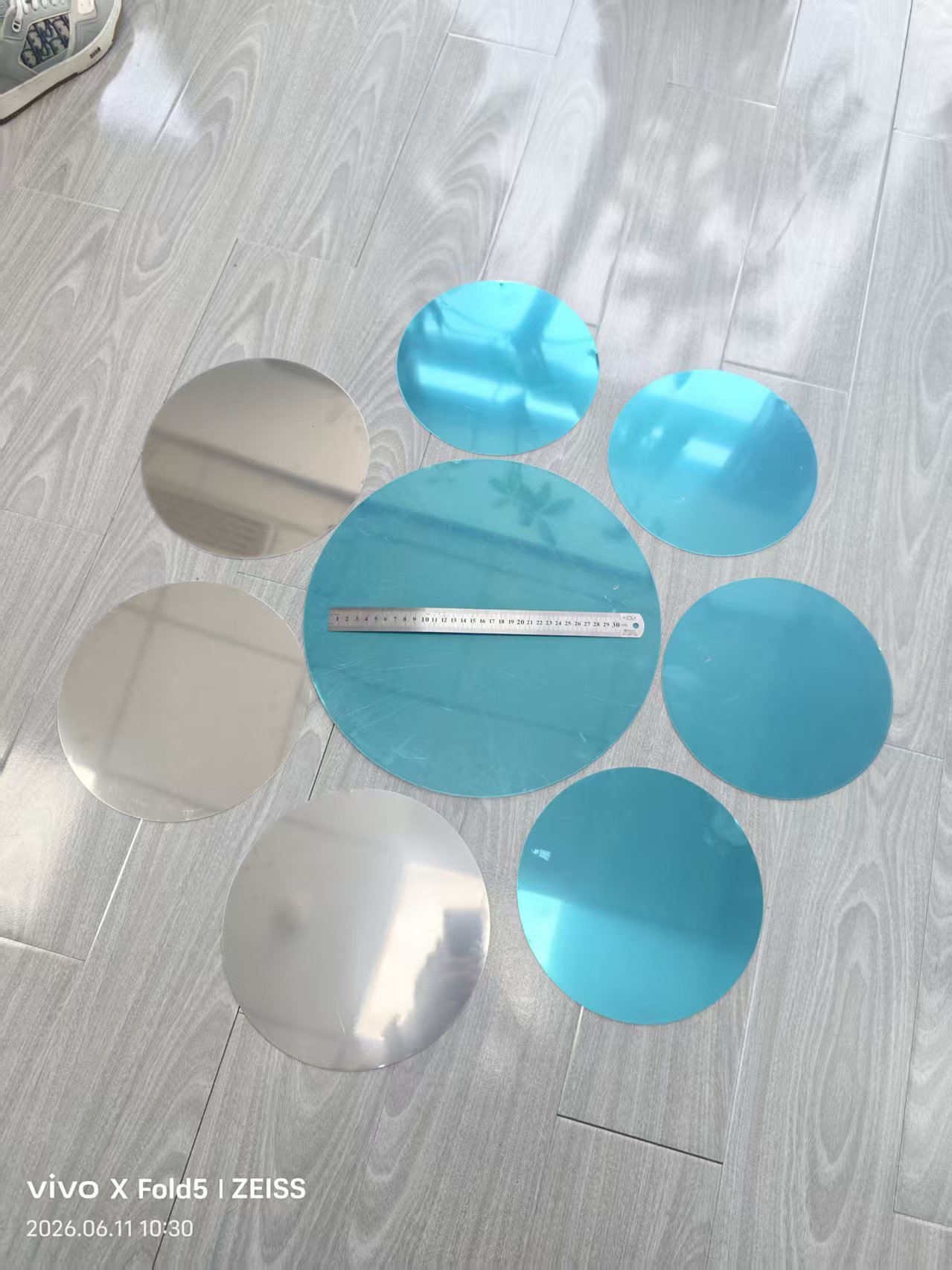
- Circle blanks (0.3–2.0 mm). Pre-cut discs in 430, 410 and 201 for round parts, where scrap control matters more than strip flexibility.
Typical floor equipment behind these formats includes slitting machines, stamping equipment and — for handle, rim and tubular components — tube mills. A plant that can run all three formats has an advantage that is easy to underestimate: a part can be moved between formats without changing grade, which keeps the drawing trial valid when volumes or blank sizes change.
Secondary material is a normal part of this supply picture rather than an exception. Secondary narrow coil (430, 201, 304) runs 0.1–1.2 mm at around 600 mm and is mainly BA finish, supplied in coils of roughly 200 kg with PVC outside or paper interleaved. Secondary wider coil (430, 304, 201, 410) runs 0.25–1.5 mm at around 1000–1250 mm, again mainly BA finish, in coils of about 1 mt or below and 1 mt and above. For a kitchenware plant, these formats extend the thickness and finish options available at a given budget position without stepping outside the documented grade list.
Which Grades Are Actually Available as Baby Coil
The baby coil programme is produced in four grades: 430, 304, 410 and 201. That is the complete grade list for the format, and it is worth stating plainly, because buyers frequently request grades that are simply not rolled in this width and gauge combination.
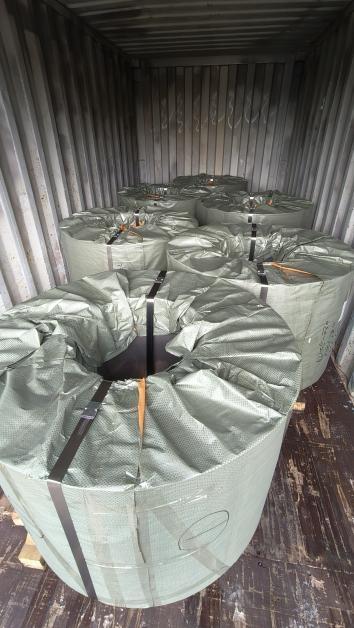
Surface supply in baby coil is dominated by BA finish at roughly 70% of volume, and the coil is typically shipped nude-packed. The same four grades also appear in secondary narrow and secondary wider coil, so a specification can be adjusted for gauge or coil weight without abandoning the grade decision.
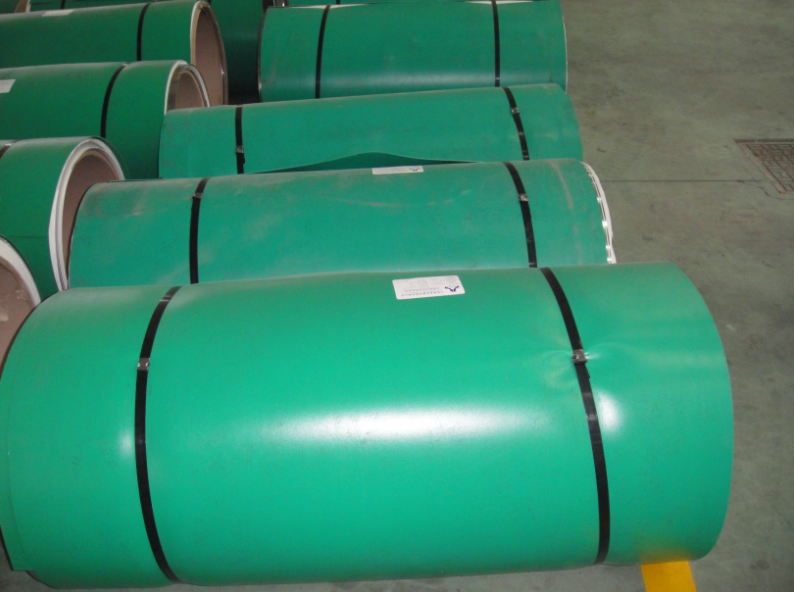
Matching 430, 304, 410 and 201 Baby Coil to Specific Cookware Items
Grade selection in cookware is a three-way trade-off between corrosion duty, forming demand and cost. The mapping below is a starting point for a specification review; the final decision has to be confirmed against your own draw trial, your market requirements and the mill test certificate that accompanies the heat.
304 baby coil — pot and pan bodies, liners and sustained food-contact parts
304 is the reference grade when a component sits in long-term contact with food and is washed repeatedly. In this programme, 304 narrow coil is supplied from 0.10 mm to 2.00 mm in widths of 550, 600, 620, 650, 690 and 730 mm, and 304 wider coil runs 0.3–3 mm at 1240 mm. The grade is documented against the 304 Mill Test Certificate number QT20260108631 issued by QINGTUO GROUP CO., LTD. under ASTM A240/A240M — the standard widely applied to stainless steel plate, sheet and strip in general and pressure-vessel applications. Cookware items that usually land on 304 include cooking pot and pan bodies, inner liners, inserts that see hot food, mixing bowls, and any part the buyer intends to present as food-contact material.
201 J3/J2/J5 baby coil — cost-driven bodies, tableware and handles
201 grades carry the volume in value-tier cookware. The 201-J3/J2/J5 strip is supplied in 2B or BA, from 0.1 mm to 2.0 mm in narrow widths of 550, 600, 620, 650, 690, 730, 810 and 830 mm, and from 0.25 mm to 3 mm at 1240 mm or mill edge. Typical items include pan bodies in value ranges, utensil handles and lid knobs, steamer tiers, and outer shells that are not in sustained food contact. The 201 grade family is certified under the 201 Mill Test Certificate number ZQ202512250046, issued by Zhaoqing Hongwang Metal Industrial Co., Ltd. and compliant with Q/ZQHW 2-2024, covering 201 J2 stainless steel strips.
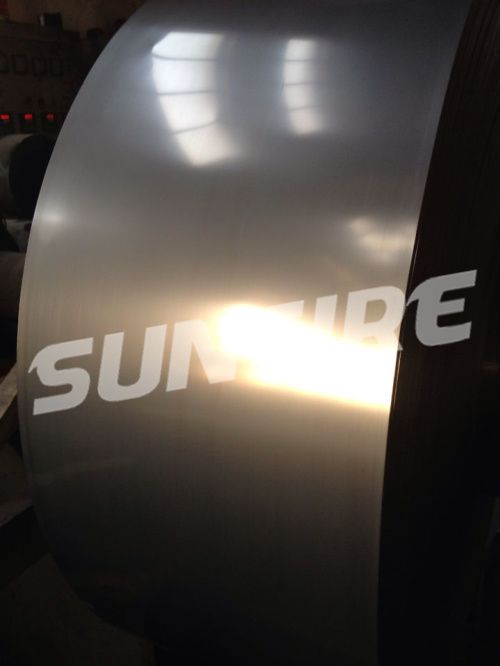
430 and 430 secondary coil — lids, outer shells and decorative trim
430 fits where appearance and cost outweigh deep-draw severity: lids, outer shells, base plates, decorative bands and trim rings. The grade is available as 430 baby coil at 0.1–1.2 mm and as 430 secondary coil in narrow (around 600 mm) and wider (1000–1250 mm) formats, mainly BA finish. Because 430 is a ferritic grade and behaves differently from the austenitic grades under deep drawing, it is usually reserved for shallower or more gradual forming work. That detail matters when a designer proposes switching a pot body from 304 to 430 for cost reasons without re-testing the tool. 430 coils and sheets carry the 430 Mill Test Certificate number JSPZ20260501804, issued by JIANGSU YONGJIN METAL TECHNOLOGY CO., LTD. under GB/T 3280-2015.
410 BA coil — handles, knobs, trim and hard-wearing small parts
410 BA has the smallest documented window in this family and is the grade most often overlooked. 410 narrow BA runs 0.15–1.2 mm at widths from 300 mm to 1010 mm, and 410 wider BA runs 0.25–1.5 mm at 1240 mm or mill edge. Cookware items that commonly use it include handle components, knobs, trim, base plates and cutlery-type parts. 410 narrow BA can be supplied with further processing — PVC, paper or refinish — which is useful when the part stays visible and the plant would rather not add its own polishing step.
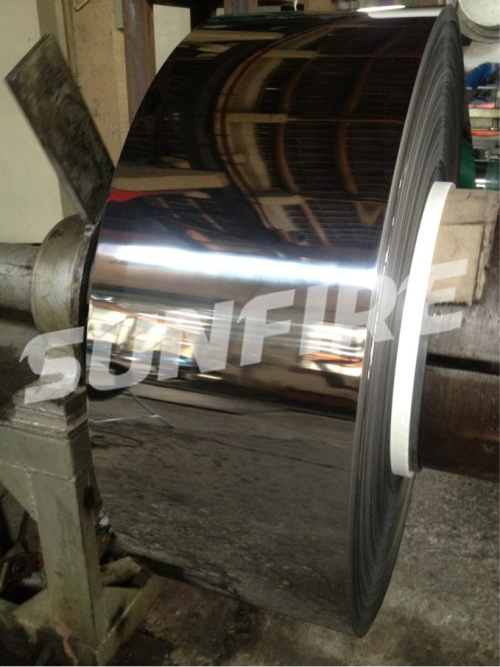
BA Finish: Why the Surface Decides as Much as the Grade
BA (bright annealed) is the default surface for baby coil and for both narrow and wider secondary coil, and it is the surface most cookware lines receive. A bright, low-roughness surface supports the aesthetic requirements of cookware — lid rims, visible outer shells, handles and trim — and gives the plant a cleaner starting point for polishing. When a buyer specifies mirror finish as a special requirement, BA is normally the substrate the polishing step starts from.
Where a higher appearance grade is needed, the 201 J2 Finish line adds a decorative layer on a 1240 mm substrate. NO.4 is available from 0.28 mm to 1.45 mm; 8K mirror from 0.28 mm to 1.95 mm; Gold 8K and Rose Gold 8K from 0.28 mm to 1.15 mm; Black 8K is also offered. 8K is a mirror-class finish produced by iterative polishing rather than by coating, which is why the thickness window narrows as the finish becomes more decorative. In practice, a mirror surface cannot be ordered at every gauge — that is the constraint most often missed at the quoting stage. Minimum order quantity for these finishes is 5 to 20 mt per thickness.
Thickness Limits: How the 0.1–1.2 mm Window Maps onto Pots, Pans and Lids
Thickness is where most kitchenware specifications are won or lost, because the forming window and the supply window have to overlap. The documented limits are straightforward:
- Baby coil: 0.1–1.2 mm, with about 80% of supply between 0.3 mm and 0.6 mm, at a width of around 600 mm.
- Secondary narrow: 0.1–1.2 mm at around 600 mm; secondary wider: 0.25–1.5 mm at 1000–1250 mm.
- 304 narrow: 0.10–2.00 mm; 304 wider: 0.3–3 mm at 1240 mm.
- 201 narrow: 0.1–2.0 mm; 201 wider: 0.25–3 mm at 1240 mm or mill edge.
- 410 narrow BA: 0.15–1.2 mm; 410 wider BA: 0.25–1.5 mm.
- Circle blanks (430, 410, 201): 0.3–2.0 mm.
The practical reading for a cookware line is this. The 0.3–0.6 mm band — which accounts for roughly 80% of baby coil volume — is the band that most lids, pan shells, liners and light drawn bodies consume. Parts that need to be thinner than 0.3 mm sit in the 0.1–0.3 mm tail of the same window and are usually small-format items. Parts that need to be heavier than 1.2 mm no longer fit the baby coil window and must move to 304 narrow or wider (up to 2.00 mm narrow, 3 mm wider), 201 narrow or wider (up to 2.0 mm narrow, 3 mm wider), 410 wider BA (0.25–1.5 mm), secondary wider (0.25–1.5 mm) or circles (0.3–2.0 mm).
Because thickness and finish interact, the sequence matters: fix the forming thickness first, then check which finish is still available at that gauge.
Step-by-Step: Specifying Coil for a Cookware Order
- Define the part and the blank. Item type, blank diameter or developed shape, draw depth, visible surface, and whether the part has sustained food contact.
- Choose the grade family. 304 for sustained food contact and repeated washing; 201 (J3/J2/J5) for value-tier bodies, tableware and handles; 430 for lids, outer shells and decorative trim; 410 BA for handles, knobs, base plates and small hard-wearing parts.
- Fit the thickness inside a documented window. Baby coil 0.1–1.2 mm (about 80% at 0.3–0.6 mm); beyond that, 304 narrow 0.10–2.00 mm, 201 narrow 0.1–2.0 mm, 410 wider BA 0.25–1.5 mm, or secondary wider 0.25–1.5 mm.
- Choose the finish at the same time. BA as the default; NO.4 from 0.28–1.45 mm, 8K from 0.28–1.95 mm, Gold 8K or Rose Gold 8K from 0.28–1.15 mm on the 201 J2 Finish line when the part is decorative.
- Choose the format. Around 600 mm baby coil or secondary narrow for light parts; 550–830 mm narrow coil where a specific slit width improves nesting; 1240 mm mill-edge or 1000–1250 mm secondary wider for large blanks; 0.3–2.0 mm circles when the part is round and scrap control matters.
- Fix the packaging for your line. Nude packing on baby coil; PVC outside or paper interleaved on secondary narrow and wider; export package on 201 and 304 narrow; export package plus paper interleaved on wider coils; export package plus wooden case on circles.
- Confirm documentation and quality control. A mill test certificate per grade, plus the standard sequence of mill test, thickness inspection and surface inspection.
- Confirm MOQ and lead time before releasing. Stock items run 7–30 days and circles run 25–45 days; the programme lead time range is 7–45 days. Circle MOQ starts at 3 mt per thickness, 410 wider BA at 20 mt per thickness, 304 wider at 10 mt per thickness, and 201 narrow at 27 mt by 3–4 specifications.
Use Cases: Where This Specification Is Already Running
Kitchenware is not a theoretical application for these formats. One export programme has run for more than ten years at 50 containers per month to Indonesia, India, South Africa, Pakistan, Vietnam and Saudi Arabia, covering kitchenware and home appliances as well as building and construction. The results reported on that programme are stable material performance, good corrosion resistance, consistent surface quality and compliance with international standards. The stated programme highlights are customized sizes and finishes, strict quality control, fast lead time, competitive price and a wide range of grades available.
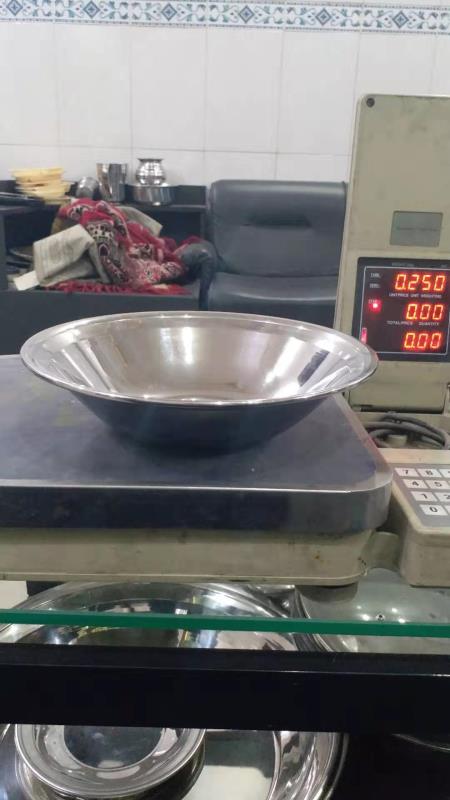
The working conditions behind those orders follow a familiar pattern: high temperature and food-contact service on the cookware side, with matched equipment that includes slitting machines, tube mills and stamping equipment. The special requirements buyers write into those specifications — mirror finish, anti-rust performance and stable thickness tolerance — map directly onto the format and finish decisions described above.
Comparison Table: Four Grades, Multiple Formats
| Format | Documented thickness window | Width | Where it fits in a cookware line | Certificate reference |
|---|---|---|---|---|
| Baby coil (430 / 304 / 410 / 201) | 0.1–1.2 mm; about 80% at 0.3–0.6 mm | Around 600 mm | Lids, liners, light bodies, handles, trim and small drawn parts; mainly BA finish | Grade-specific MTC |
| Secondary narrow (430 / 201 / 304) | 0.1–1.2 mm | Around 600 mm; coils around 200 kg | Same light-gauge parts, with PVC outside or paper interleaved | Grade-specific MTC |
| Secondary wider (430 / 304 / 201 / 410) | 0.25–1.5 mm | Around 1000–1250 mm | Larger blanks and moderate draws; mainly BA finish | Grade-specific MTC |
| 410 Narrow BA | 0.15–1.2 mm | 300–1010 mm | Handles, knobs, trim, base plates, cutlery-type parts; PVC, paper or refinish options | Grade-specific MTC |
| 410 Wider BA | 0.25–1.5 mm | 1240 mm or mill edge | Larger lids and shells with moderate draw severity | Grade-specific MTC |
| 304 narrow / wider | 0.10–2.00 mm / 0.3–3 mm | 550–730 mm / 1240 mm | Food-contact bodies and liners; heavy-duty cookware | 304 MTC QT20260108631, ASTM A240/A240M |
| 201 narrow / wider (J3/J2/J5) | 0.1–2.0 mm / 0.25–3 mm | 550–830 mm / 1240 mm or mill edge | Value-tier bodies, tableware, handles, outer shells | 201 MTC ZQ202512250046, Q/ZQHW 2-2024 |
| 430 baby coil / secondary | 0.1–1.2 mm / 0.25–1.5 mm | Around 600 mm / 1000–1250 mm | Lids, outer shells, base plates, decorative trim | 430 MTC JSPZ20260501804, GB/T 3280-2015 |
| Circles (430 / 410 / 201) | 0.3–2.0 mm | Pre-cut discs | Drawn vessels and lids where round blanks reduce scrap | Grade-specific MTC |
| 201 J2 Finish (NO.4 / 8K / Gold 8K / Rose Gold 8K / Black 8K) | 0.28–1.45 mm (NO.4); 0.28–1.95 mm (8K); 0.28–1.15 mm (Gold and Rose Gold 8K) | 1240 mm | Visible decorative surfaces on lids, shells and trim | 201 Finish MTC ZQ202512250046, Q/ZQHW 2-2024 |
All windows and certificate references above are taken from the supplier specification and mill test certificates for this programme. Grade families and item mappings should be confirmed against the buyer specification and the forming trial for the specific part.
FAQ
What mill documentation should accompany kitchenware-grade stainless steel coil?
Every heat should be traceable to a mill test certificate that names the issuing mill, the certificate number and the standard applied. In this programme the 201 J2 stainless steel strip is covered by the 201 Mill Test Certificate number ZQ202512250046, issued by Zhaoqing Hongwang Metal Industrial Co., Ltd. and compliant with Q/ZQHW 2-2024, applicable to the global market. The 430 coils and sheets are covered by the 430 Mill Test Certificate number JSPZ20260501804, issued by JIANGSU YONGJIN METAL TECHNOLOGY CO., LTD. under GB/T 3280-2015. The 304 coils and sheets are covered by the 304 Mill Test Certificate number QT20260108631, issued by QINGTUO GROUP CO., LTD. under ASTM A240/A240M. The 201 Finish line is documented under the same 201 Finish Mill Test Certificate number ZQ202512250046. File each certificate against the incoming inspection record by heat number.
Can the coil be supplied at the exact thickness and finish my cookware line runs?
In most cases yes, within documented limits. Baby coil is supplied from 0.1 mm to 1.2 mm, with about 80% of volume between 0.3 mm and 0.6 mm, at a width of around 600 mm and mainly in BA finish. Wider gauges move to 304 narrow (0.10–2.00 mm), 201 narrow (0.1–2.0 mm), 410 wider BA (0.25–1.5 mm) or secondary wider (0.25–1.5 mm). Decorative surfaces are available on the 201 J2 Finish line: NO.4 from 0.28–1.45 mm, 8K from 0.28–1.95 mm, and Gold 8K or Rose Gold 8K from 0.28–1.15 mm at 1240 mm width. OEM customization covers thickness, width, surface finish, PVC and packaging.
Good quality stainless steel manufacturers — what should kitchenware buyers verify?
Verify four things before awarding volume. First, a named mill behind each grade, with a traceable mill test certificate rather than a generic statement of compliance. Second, a defined quality-control sequence — in this programme mill test, thickness inspection and surface inspection. Third, grade and format coverage that matches the items on your line, since a supplier who only stocks wide coil cannot serve a lid programme built on baby coil. Fourth, a record of repeat export performance: one programme run by NINGBO SUNFIRE STAINLESS STEEL CO., LTD has shipped 50 containers per month for more than ten years to Indonesia, India, South Africa, Pakistan, Vietnam and Saudi Arabia across kitchenware, home appliances and building materials, with stable material performance, good corrosion resistance, consistent surface quality and compliance with international standards. Comparing suppliers on documentation and format coverage is usually more reliable than comparing them on price per tonne alone.
Can a buyer validate the material before committing to a production order?
Yes. Sampling and trial validation are standard practice for cookware forming, because draw performance depends on the tool as much as on the coil. A trial should test the actual blank size, draw depth and finish requirement, and should be checked against the same mill test certificate that will accompany production. Technical support and online service are provided through the order and after delivery, and 410 narrow BA can be supplied with PVC, paper or refinish processing if the trial shows the visible surface needs additional protection.
What lead time and minimum order quantity should a kitchenware buyer plan around?
Stock-based items typically ship in 7 to 30 days, while circles require 25 to 45 days; the overall programme lead time range is 7 to 45 days. Minimum order quantities vary by format: circles start at 3 mt per thickness, 410 wider BA at 20 mt per thickness, 304 wider at 10 mt per thickness, and 201 narrow at 27 mt by 3–4 specifications. As a next step, request a sample or a quotation against your specific part list — grade, thickness, width, finish, packaging and target port — so the window can be checked against a real certificate before you commit to a programme.
Conclusion
Matching stainless steel coil to kitchenware forming comes down to four decisions made in the right order: grade, thickness, finish, format. 304 carries sustained food-contact bodies and liners. 201 J3/J2/J5 carries value-tier bodies, tableware and handles. 430 carries lids, outer shells and decorative trim. 410 BA carries handles, knobs and small hard-wearing parts. Baby coil covers the 0.1–1.2 mm band that most cookware parts consume, with about 80% of volume sitting at 0.3–0.6 mm, and mainly in BA finish for the visible surfaces that follow the part to the shelf.
The constraint that catches buyers most often is not the grade list — it is the way thickness and finish interact. A mirror-class surface narrows the available gauge, and a gauge above 1.2 mm leaves the baby coil window entirely. Specifying the part first, then the grade, then the thickness, then the finish, keeps a cookware programme inside the documented supply window and inside the forming window at the same time.
Next step: match a coil to your cookware part list
NINGBO SUNFIRE STAINLESS STEEL CO., LTD is a Ningbo-based stainless steel supplier founded in 2013, specialised in stainless steel secondary and baby coil, with an OEM model covering thickness, width, surface finish, PVC and packaging customization and a monthly export capacity of 3,000 MT. Export markets include PK, IN, VN, RU, TR, ID, AE, TH, MY and BD, plus the Middle East, South America and Africa.
Send your part list — item, grade, thickness, width, finish and target port — and request a sample or a quotation. Product catalogue: download the Sunfire stainless steel brochure. Website: en.sunfirex.com. Email: zzqsarah@hotmail.com. WhatsApp: +86 182 5741 1826. Tel: +86 182 5741 1826.
Have Questions or Need More Details?
Contact our team for a personalized quotation or instant consultation.
Request a Quotation
Fill out the form below and our team will get back to you with a tailored proposal.
WhatsApp Direct Chat
Prefer to chat in real-time? Message us on WhatsApp for instant assistance & quick answers.
- Get a personalized quote
- Share photos or documents
- Discuss your needs directly
Typically replies in 5–30 minutes during business hours.