
Technical Guide to Stainless Steel Baby Coil: Grade, Thickness, Width and BA Finish Selection
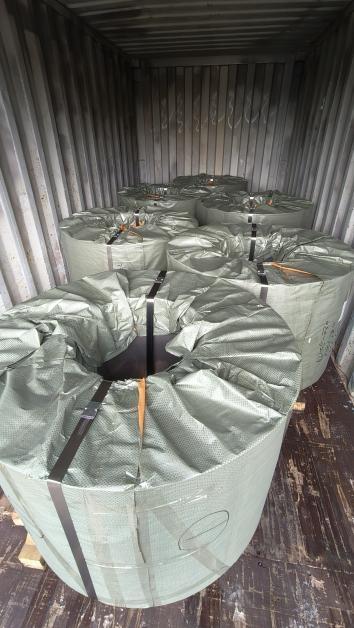
Stainless steel baby coil is specified through four variables — grade, thickness, width and surface finish — and all four are locked before the first tonne is booked. A 0.4 mm, 600 mm wide, BA finish coil in 304 and the same coil in 201 look identical on the coil car, yet they behave very differently inside a deep drawing die, a tube mill or a polishing line. This guide sets out the practical selection ranges for baby coil, the standards that sit behind them, and how each parameter connects to the end application.
For production and procurement teams, the working definition is short. Baby coil, as supplied by NINGBO SUNFIRE STAINLESS STEEL CO., LTD., is a cold-rolled stainless steel coil produced at 0.1 mm to 1.2 mm thickness, around 600 mm width, mainly in BA finish — approximately 70% of the baby coil program — and in grades 430, 304, 410 and 201. It is delivered in nude packing and is used across kitchenware and cookware, home appliances, metal stamping and deep drawing, tube and pipe manufacturing, automotive components, industrial equipment, elevator decoration, construction and interior decoration, tableware production and hardware accessories.
What Is a Stainless Steel Baby Coil?
Baby coil is the narrow, light cold-rolled coil format used when a line consumes strip rather than wide sheet. Where a mill produces master coils at widths such as 1240 mm, a baby coil arrives at around 600 mm and inside a 0.1 mm to 1.2 mm thickness band, which is why it can be fed into stamping presses, drawing lines and small tube mills without an in-house slitting step. The specification envelope is narrow enough to summarise in one table, and most purchasing decisions are made inside it.
| Parameter | Baby coil specification |
|---|---|
| Thickness (T) | 0.1 mm – 1.2 mm; about 80% of the volume sits in the 0.3 mm – 0.6 mm band |
| Width (W) | Around 600 mm |
| Surface | Mainly BA finish; approximately 70% BA |
| Grades | 430 / 304 / 410 / 201 |
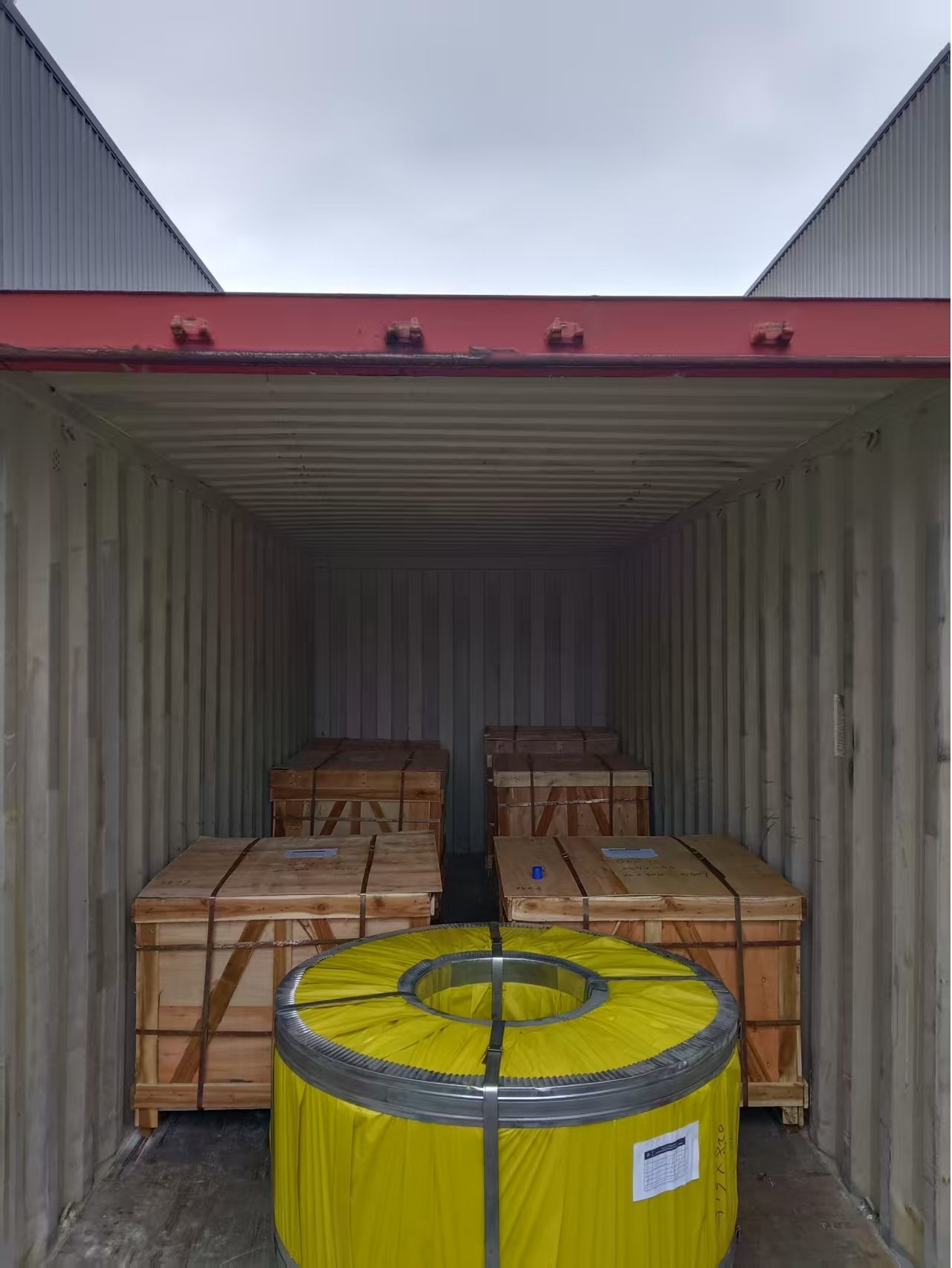
| Packing | Nude packing |
| Typical industries | Kitchenware & cookware; home appliances; elevator decoration; construction & interior decoration; automotive components; industrial equipment; metal stamping & deep drawing; tube & pipe manufacturing; tableware production; hardware accessories |
Two numbers in that table are worth repeating, because they tell a buyer where the supply base is deep and where it is thin. About 80% of baby coil volume falls between 0.3 mm and 0.6 mm, and roughly 70% of it is BA finish. Ordering 0.4 mm or 0.5 mm in BA means ordering from the centre of the program rather than from its edge — which normally has a direct effect on availability and lead time.
Why Specification Mistakes Show Up After Forming
Three of the four baby coil variables are fixed before the order is placed, and all three tend to fail downstream rather than at goods-in. Incoming inspection can confirm a certificate and a thickness reading; it cannot confirm that the coil suits the die, the guide rails or the next process step.
- Thickness against die clearance. A band that is 0.05 mm away from the tooling assumption changes blanking force and burr height long before it changes a receiving report.
- Width against line set-up. Coil width drives guide settings and edge trim. A width that is nominally right but inconsistent forces operators to compensate continuously.
- Finish against the next process. Material intended for direct use behaves differently from material that will be painted, laminated or polished after forming.
- Grade against the service environment. Indoor decorative parts, humid kitchenware duty and wet-service components do not carry the same corrosion requirement.
There is a documentation dimension as well. The European Union maintained anti-dumping duties of 24.6% to 28.5% on stainless steel cold-rolled flat products from China and Taiwan following a 2025 expiry review (Regulation 2025/1573). The grade declared on the mill test certificate therefore has to match the grade on the commercial documents, and the certificate has to be issued against a recognised standard. Specification discipline is now a customs issue as much as a production issue.
Baby Coil in the Current Stainless Steel Market
Context matters when a buyer is deciding how much to specify and how much to leave to the mill. The global stainless steel market was valued at USD 135.8 billion in 2025 and is projected to reach USD 247.4 billion by 2033, according to Grand View Research. On the supply side, China's stainless steel exports reached an all-time high of 5.04 million tonnes in 2024, a 25.6% year-on-year increase, based on General Administration of Customs data reported by Mysteel.
Cold rolling capacity behind those exports continues to expand. Hongwang Group — the same authority named on the 201 J2 mill test certificate referenced later in this guide — operates a joint venture in Indonesia with 700,000 tonnes per year of cold rolling capacity, according to Mysteel Global. For buyers, more capacity means more formats on offer, more width and finish permutations, and a greater need to specify rather than accept whatever is quoted. ASTM A240 and ASME SA240 remain the core international standards for stainless steel plate, sheet and strip, and they are the reference point most overseas buyers still use when comparing documents across suppliers.
Selection Variable 1: Grade
Grade answers two questions at once: how much corrosion resistance the finished part needs in service, and how the material behaves under the press or the mill. In baby coil, four grades cover almost every enquiry.
| Grade | Family | Supply form in this range | Selection logic |
|---|---|---|---|
| 201 (J1 / J2 / J3 / J5) | Austenitic, manganese-substituted | 201-J3/J2/J5 in 2B and BA, 0.1–2.0 mm, widths 550 / 600 / 620 / 650 / 690 / 730 / 810 / 830 mm, and 0.25–3 mm at 1240 mm mill edge | Chosen where cost efficiency and adequate indoor corrosion performance are the deciding factors, such as appliance and interior components |
| 304 | Austenitic with nickel | 304 Narrow 0.10–2.00 mm at 550 / 600 / 620 / 650 / 690 / 730 mm; 304 Wider 0.3–3 mm at 1240 mm | Chosen where corrosion resistance in wet or humid service is the deciding factor, including kitchenware and appliance parts |
| 410 | Martensitic, hardenable | 410 Narrow BA 0.15–1.2 mm at 300–1010 mm; 410 Wider BA 0.25–1.5 mm at 1240 mm mill edge | Chosen where hardness, wear behaviour or moderate corrosion demand matters more than formability, for example certain hardware and automotive components |
| 430 | Ferritic, nickel-free | Baby coil and secondary coil programs, 0.1–1.2 mm narrow and 0.25–1.5 mm wide | Chosen for dry indoor decorative and appliance applications where formability and stable surface matter and nickel content is not required |
Within the 201 family, the J-variants are not interchangeable labels: J1, J2, J3 and J5 differ in composition and, in practice, in forming and corrosion behaviour. The decorative finishes — NO.4, 8K, gold 8K, rose gold 8K and black 8K — are produced on the 201 J2 finish line at 1240 mm width, which means mirror and colour surfaces sit downstream of the coil format rather than inside it.
Selection Variable 2: Thickness
Baby coil runs from 0.1 mm to 1.2 mm, with about 80% of volume between 0.3 mm and 0.6 mm. That distribution is not an accident: it is the band where most kitchenware, appliance and tube applications sit, and where cold rolling delivers the most consistent gauge.
At the thin end, between 0.1 mm and 0.3 mm, handling and gauge consistency become the dominant risks — thin strip is more sensitive to tension variation through the line, and creasing during unwinding shows up as surface rejects after forming. At the heavy end, between 0.6 mm and 1.2 mm, the material behaves more predictably but raises tooling loads and blanking force, so press capacity becomes part of the selection.
The important boundary is 1.2 mm. Above it, the baby coil format ends. The 201 program continues to 2.0 mm in narrow widths and to 3 mm at 1240 mm, and 304 Narrow is supplied from 0.10 mm to 2.00 mm. If a part needs 1.5 mm, the right answer is a narrow or wide mill-width coil, not a baby coil. Thickness inspection forms part of the routine quality control sequence on the mill side, alongside mill test and surface inspection.
Selection Variable 3: Width
Around 600 mm is the working standard for baby coil. The nearest mill widths in the 201 and 304 narrow programs are 550, 600, 620, 650, 690 and 730 mm, with 810 mm and 830 mm also available in the 201 program, while 410 Narrow BA is supplied over 300 mm to 1010 mm. A 600 mm baby coil therefore sits inside a range of narrow widths rather than standing on its own.
Width decisions are usually driven by die layout and guide set-up, not by the drawing alone. A small difference in strip width changes how the coil tracks through the line and how much edge trim is generated. Ordering 600 mm instead of slitting a 1240 mm master coil removes one operation and its associated scrap, which is the main commercial argument for the baby coil format. Where monthly consumption of a single specification is high, the wider format can still be the lower-cost route, and both options exist inside the same narrow and wide coil programs.
Selection Variable 4: Surface Finish — Why BA Leads
Bright annealed, or BA, finish accounts for roughly 70% of the baby coil program, and that figure reflects how the format is used. BA produces a bright, low-roughness surface in line, so formed parts can move to assembly with minimal cosmetic work. For visible kitchenware, appliance panels and decorative components, that is often the whole finish requirement.
2B is the practical alternative and is offered on the 201 J-series in both 2B and BA. It is normally selected when the part will be painted, laminated, covered or hidden in final assembly, where the extra brightness of BA adds cost without adding function.
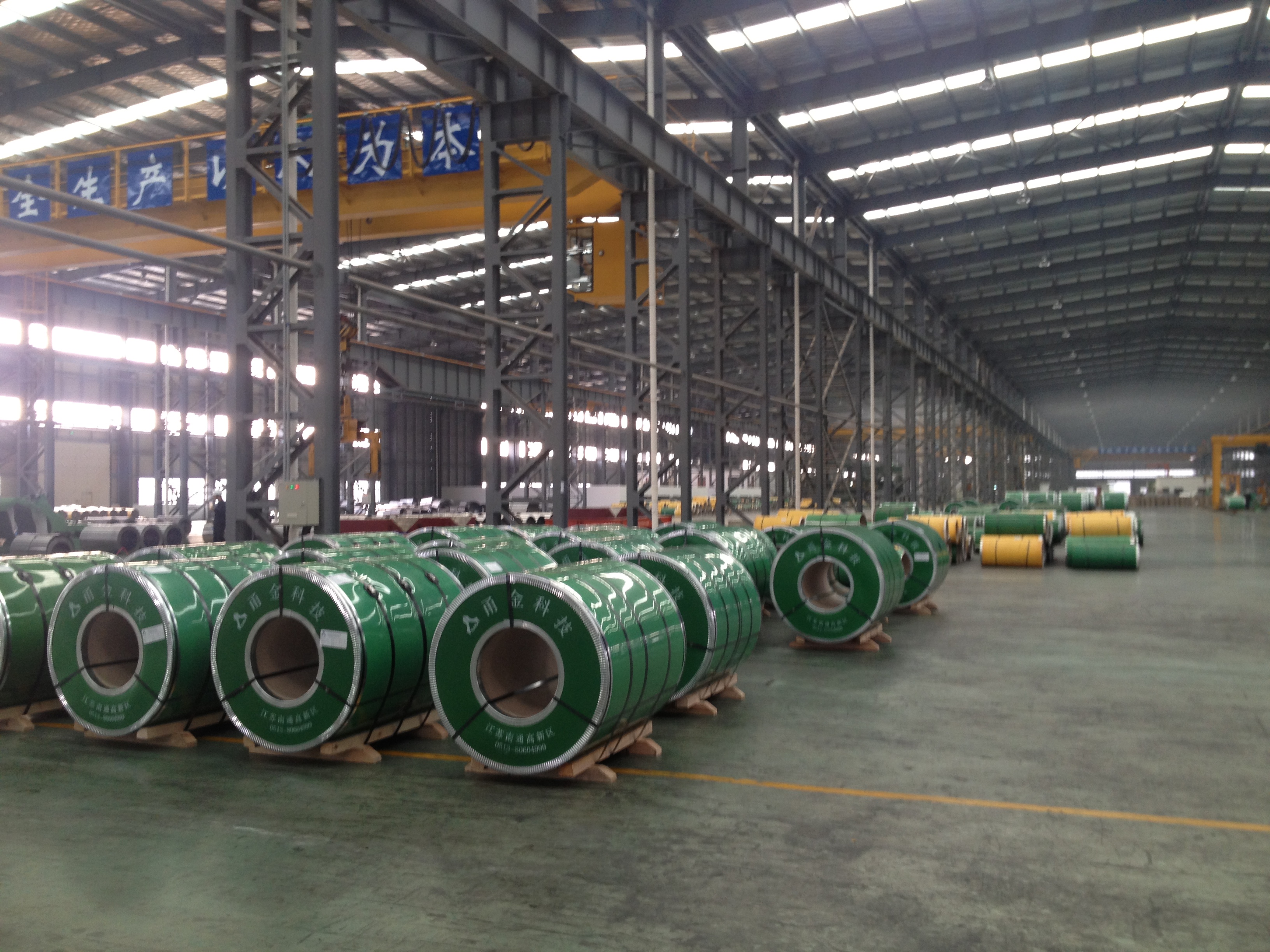
Where the finished component needs a decorative surface, the real decision is where to apply it: at the mill on sheet, or after forming on parts cut from baby coil. NO.4, 8K, gold 8K, rose gold 8K and black 8K finishes on 201 J2 are produced over defined thickness windows — 0.28–1.45 mm for NO.4, 0.28–1.95 mm for 8K and 0.28–1.15 mm for gold and rose gold 8K — at 1240 mm width. Mirror finishes are created through iterative polishing, with reflectivity tiers extending from 8K upward to 12K, which resembles a glass mirror. That production route is a sheet-line process; baby coil is the input format for parts that will be formed first and finished afterwards.
Step-by-Step: Specifying a Baby Coil Order
The sequence below follows the order in which the four variables should be fixed. Working in this order prevents the most common problem, which is a specification assembled from available stock rather than from the forming operation.
- Start from the forming operation. Establish blank size, draw depth or roll-forming sequence, die clearance, welding method and line speed before requesting material. The forming process dictates thickness and finish more often than the drawing does.
- Fix the grade and the certificate standard. Decide which standard the receiving plant will accept — ASTM A240/A240M for 304, Q/ZQHW 2-2024 for 201 J2 strip, GB/T3280-2015 for 430 — and confirm that the grade on the certificate will match the grade on the commercial invoice.
- Set the thickness band. Check that the required gauge sits inside the 0.3–0.6 mm volume band or clearly outside it, and confirm whether stock thicknesses are available on a short lead time or whether a production run is required.
- Confirm width against the line, not the drawing. Around 600 mm is the baby coil standard, but 550–730 mm and 810/830 mm options exist in narrow programs, and 410 Narrow BA runs from 300 mm to 1010 mm. Choose the width that minimises edge trim on the actual line.
- Choose the finish for the next process. BA where the part will be seen or polished; 2B where it will be coated or hidden; decorative finishes planned as a separate sheet-line step.
- Lock packing, documents and commercial terms. Baby coil ships in nude packing. Where PVC coating or paper interleaving is needed, the narrow secondary coil format carries those options. Confirm mill test certificate acceptance, minimum order quantity and delivery basis before the order is released.
Use Cases: Matching the Coil to the Production Line
The table below is starting-point guidance for the applications this format serves, using the grades and thickness envelope described above. Final selection should always be confirmed by the mill test certificate and a trial run on the actual line.
| Application | Grade starting point | Thickness starting point | Finish |
|---|---|---|---|
| Kitchenware & cookware | 304 for wet service; 201 for cost-driven lines | 0.3–0.6 mm | BA |
| Home appliances | 201 / 430 | 0.3–0.6 mm | BA |
| Metal stamping & deep drawing | 304 / 201 | 0.3–0.6 mm | BA, or 2B where parts are coated |
| Tube & pipe manufacturing | 201 / 304 | 0.3–0.6 mm | BA |
| Automotive components | 304 / 410 | 0.3–0.6 mm | BA |
| Industrial equipment | 304 | 0.6–1.2 mm | BA |
| Elevator decoration | 201 / 304 | 0.3–0.6 mm | BA, with decorative finishing downstream |
| Construction & interior decoration | 201 / 430 | 0.3–0.6 mm | BA, with decorative finishing downstream |
| Tableware production | 304 / 201 | 0.3–0.6 mm | BA |
| Hardware accessories | 201 / 430 / 410 | 0.3–0.6 mm | BA |
Baby Coil, Narrow Secondary Coil and Wide Coil Compared
Baby coil is often quoted alongside secondary coil formats, and the differences are practical rather than commercial. They affect packing, weight handling, grade range and the paperwork that follows the shipment.
| Format | Thickness | Width | Surface | Packing | Grades |
|---|---|---|---|---|---|
| Baby coil | 0.1–1.2 mm; 80% at 0.3–0.6 mm | Around 600 mm | Mainly BA (70% BA) | Nude packing | 430 / 304 / 410 / 201 |
| Secondary — narrow | 0.1–1.2 mm | Around 600 mm | Mainly BA | PVC outside / paper interleaved | 430 / 201 / 304 |
| Secondary — wider | 0.25–1.5 mm | Around 1000–1250 mm | Mainly BA | PVC outside / paper interleaved | 430 / 304 / 201 / 410 |
| 201 narrow (mill width) | 0.1–2.0 mm | 550 / 600 / 620 / 650 / 690 / 730 / 810 / 830 mm | 2B / BA | Export package | 201-J3 / J2 / J5 |
| 304 narrow (mill width) | 0.10–2.00 mm | 550 / 600 / 620 / 650 / 690 / 730 mm | — | Export package | 304 |
The clearest difference is packing. Baby coil is supplied nude, while narrow secondary coil is supplied with PVC outside or paper interleaved. That makes secondary narrow coil the format to specify when surface protection during transit and storage is a priority, and it also explains why the two formats appear at different price points for the same nominal dimensions. Grade coverage differs too: baby coil covers 430, 304, 410 and 201, while narrow secondary coil covers 430, 201 and 304, and the wider secondary format adds 410 back in at 0.25–1.5 mm.
Quality Documentation, Packing and Commercial Terms
For a technical buyer, the certificate set is as much a part of the specification as the thickness. The certificates referenced in this guide cover three of the four baby coil grades and name the mill and the standard behind each one.
| Scope | Standard | Certificate no. | Issuing authority | Issue date |
|---|---|---|---|---|
| 201 J2 stainless steel strips | Q/ZQHW 2-2024 | ZQ202512250046 | Zhaoqing Hongwang Metal Industrial Co., Ltd. | 2025-12-25 |
| 304 stainless steel coils & sheets | ASTM A240/A240M | QT20260108631 | QINGTUO GROUP CO., LTD | 2026-01-08 |
| 430 stainless steel coils & sheets | GB/T3280-2015 | JSPZ20260501804 | JIANGSU YONGJIN METAL TECHNOLOGY CO., LTD | 2026-05-22 |
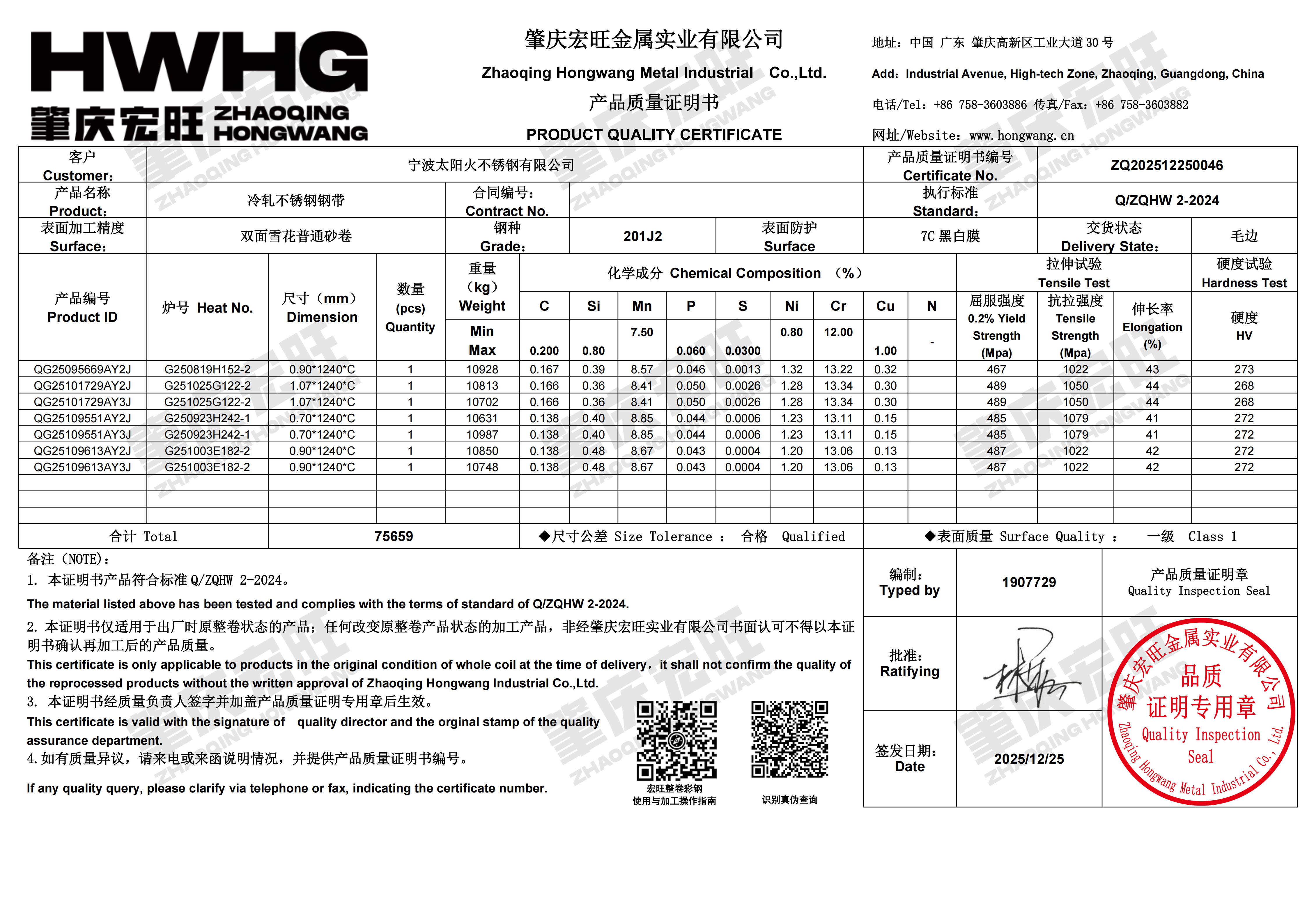
Inspection on the mill side follows three steps that map directly onto buyer concerns: mill test verification, thickness inspection and surface inspection. The acceptance criterion on the purchase order is the mill test certificate, which is also the document most receiving plants use to release material into production.
Commercially, orders in this format start at a minimum order quantity of 27 MT, though individual programs carry their own thresholds — 27 MT by three to four specifications for 201 J1/J2/J5, 8 MT to 9 MT per thickness for 304 Narrow depending on width, and 20 MT per thickness for 410 Wider BA. Delivery terms are CIF, payment is by TT or DP, and the standard lead time is 7 to 45 days, with stock specifications typically moving in 7 to 30 days. OEM production is available, with customization covering thickness, width, surface finish, PVC and packaging.
Export volume currently runs at 3,000 MT per month to markets including Pakistan, India, Vietnam, Russia, Turkey, Indonesia, UAE, Thailand, Malaysia, Bangladesh, the Middle East, South America and Africa. After-sales support combines technical assistance with online service, which matters most in the first weeks of a new specification, when forming parameters are still being set.
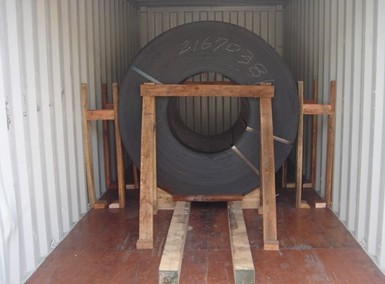
One reference point for buyers comparing suppliers: an export program covering kitchenware, home appliances, building and construction has been running for more than 10 years at a scale of 50 containers per month, serving Indonesia, India, South Africa, Pakistan, Vietnam and Saudi Arabia. Reported results are stable material performance, good corrosion resistance, consistent surface quality and compliance with international standards, supported by customized sizes and finishes, strict quality control and short lead times.
Frequently Asked Questions
Which mill test certificates support baby coil grades 201, 304 and 430?
Three certificates are referenced in this guide. For 201 J2 stainless steel strips, certificate ZQ202512250046 was issued on 2025-12-25 by Zhaoqing Hongwang Metal Industrial Co., Ltd. against standard Q/ZQHW 2-2024. For 304 stainless steel coils and sheets, certificate QT20260108631 was issued on 2026-01-08 by QINGTUO GROUP CO., LTD against ASTM A240/A240M. For 430 stainless steel coils and sheets, certificate JSPZ20260501804 was issued on 2026-05-22 by JIANGSU YONGJIN METAL TECHNOLOGY CO., LTD against GB/T3280-2015. ASTM A240 and ASME SA240 are the core international standards for stainless steel plate, sheet and strip, and the mill test certificate is the acceptance criterion on the order.
What can be customized when ordering baby coil from a Chinese OEM stainless steel manufacturer?
OEM production is available, with customization covering thickness, width, surface finish, PVC and packaging. Within the baby coil envelope this means thickness between 0.1 mm and 1.2 mm, width based around 600 mm with narrow alternatives at 550, 600, 620, 650, 690, 730, 810 and 830 mm in the 201 program and 300–1010 mm in 410 Narrow BA, plus the choice between BA and 2B where both apply. Standard lead time for customized OEM production is 7 to 45 days, with 7 to 30 days typical for stock specifications.
What are the MOQ, delivery and payment terms for a baby coil order?
The minimum order quantity is 27 MT, with program-specific thresholds applying by specification and thickness — 27 MT by three to four specifications for 201 J1/J2/J5, 8 MT to 9 MT per thickness for 304 Narrow depending on width, and 20 MT per thickness for 410 Wider BA. Delivery terms are CIF, the acceptance criterion is the mill test certificate, and payment terms are TT or DP.
How is incoming material validated against the order specification?
Validation starts with the mill test certificate, which is the formal acceptance criterion, and continues with mill-side mill test verification, thickness inspection and surface inspection. Buyers should match the grade, standard and certificate number on the document against the order before releasing material to production, then confirm gauge and surface condition on the first coil. Where additional surface protection is required during transit, the narrow secondary coil format is supplied with PVC outside or paper interleaved, while baby coil itself ships in nude packing.
What lead time should be planned for a baby coil order?
Standard delivery time is 7 to 45 days. Stock specifications usually move within 7 to 30 days, while customized thickness, width, finish or packaging combinations sit toward the longer end of the range. Export volume runs at 3,000 MT per month, and the current 10-year export program ships 50 containers per month to Indonesia, India, South Africa, Pakistan, Vietnam and Saudi Arabia, which gives buyers a realistic reference for scheduling.
Next Step: Confirm Your Baby Coil Specification
If your line consumes a narrow coil format, the fastest way to close the specification is to send the grade, thickness, width and finish you are considering, together with the application and the certificate standard your receiving plant accepts. The team at NINGBO SUNFIRE STAINLESS STEEL CO., LTD. can confirm grade availability, the closest stock width, packing options and lead time against your forming process.
Contact: zzqsarah@hotmail.com · WhatsApp: +86 182 5741 1826 · Website: en.sunfirex.com
Have Questions or Need More Details?
Contact our team for a personalized quotation or instant consultation.
Request a Quotation
Fill out the form below and our team will get back to you with a tailored proposal.
WhatsApp Direct Chat
Prefer to chat in real-time? Message us on WhatsApp for instant assistance & quick answers.
- Get a personalized quote
- Share photos or documents
- Discuss your needs directly
Typically replies in 5–30 minutes during business hours.