
Top Stainless Steel Coil Picks for Tube Mills: Ranking Baby Coil Grades 201, 304, 410 & 430
Baby Coil Grade Ranking for Tube & Pipe Mills
Top Stainless Steel Coil Picks for Tube Mills: Ranking Baby Coil Grades 201, 304, 410 & 430
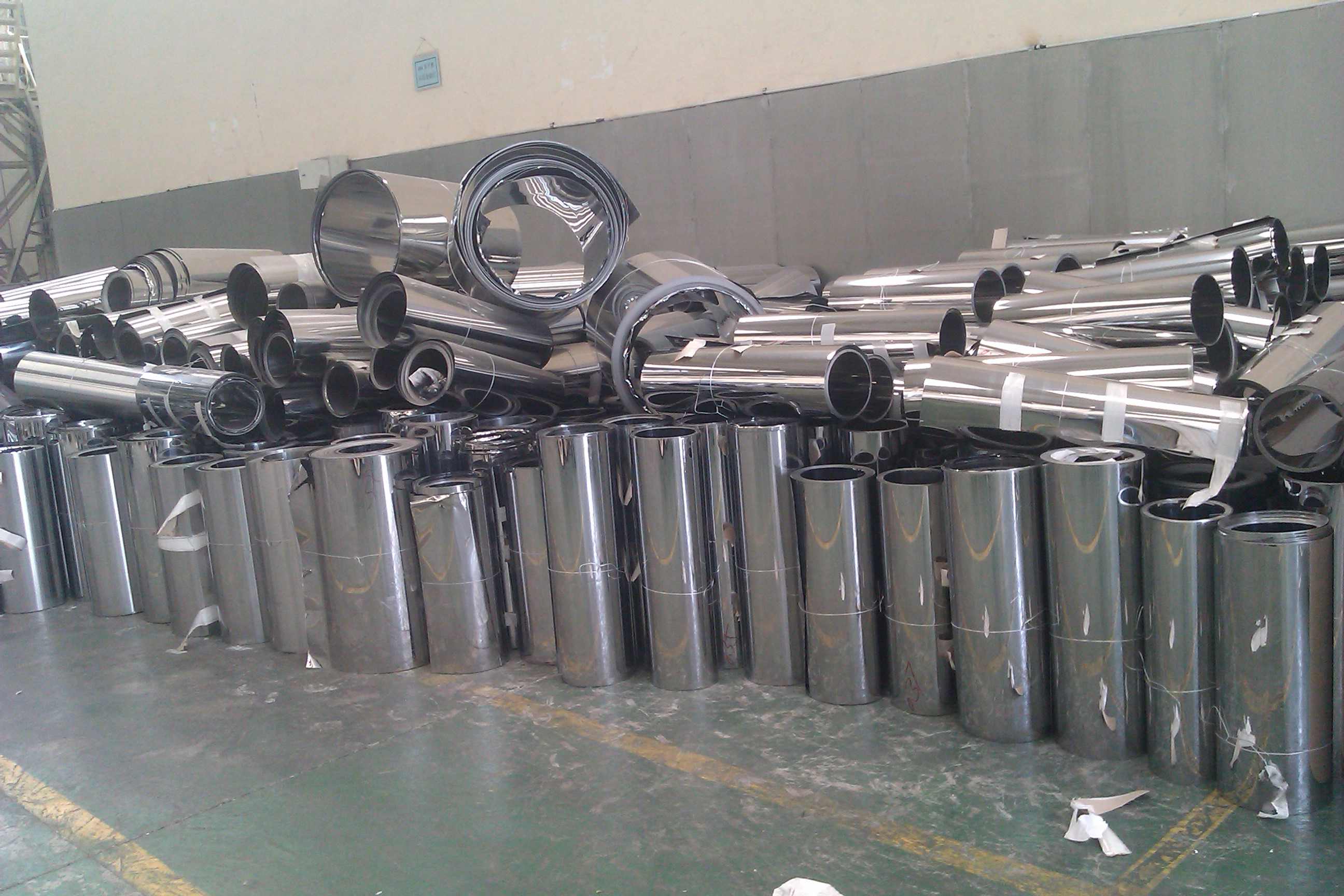
Baby coil stainless steel strip at around 600 mm width — the input format for welded tube and pipe production.
Baby coil is the format tube and pipe mills actually run: narrow, light-gauge, cold-rolled stainless strip supplied at around 600 mm width in a 0.1–1.2 mm thickness band. Four grades are consistently available in that format — 201, 304, 410 and 430 — and the choice among them decides weld soundness, forming yield and how long the finished tube holds up in service. This ranking orders the four baby coil grades for tube and pipe manufacturing, judged on the three criteria that dominate tube-mill economics: corrosion resistance, weldability and formability.
The specifications, finishes and packing referenced throughout come from the baby coil, secondary coil and narrow coil program of NINGBO SUNFIRE STAINLESS STEEL CO., LTD, a stainless steel supplier established in Ningbo, China in 2013 that exports 100% of its output and describes stainless steel secondary and baby coil as its core advantage.
Quick answer: the ranking at a glance
- 304 baby coil — rank 1. The widest service margin of the four; specify it for corrosion-exposed, food-contact or surface-critical tube.
- 201 (J3/J2/J5) baby coil — rank 2. The cost-performance workhorse for decorative and general indoor tube.
- 430 baby coil — rank 3. Workable for mild, dry, indoor tube where a magnetic grade is acceptable.
- 410 baby coil — rank 4 for general tube. A hardness-driven choice that leads only in mechanical and wear applications.
Problem Definition: The Grade Decision Hides Behind a Small Specification Window
A baby coil order looks simple on paper — grade, thickness, width, finish, weight. In production the window is tight, and every parameter interacts with the tube line. According to the product data, baby coil is supplied at 0.1–1.2 mm thickness, with roughly 80% of volume falling between 0.3 mm and 0.6 mm, at a width of around 600 mm, and the surface is mainly BA finish, which accounts for about 70% of supply. The grades offered in this format are 430, 304, 410 and 201, supplied in nude packing.
At those gauges the strip is uncoiled, formed into a tube shape and welded at line speed, with very little material thickness available to absorb variation. A grade that forms well but corrodes early, or resists corrosion but welds poorly, does not create a small problem: it moves cost from the coil price into rejection, rework and warranty claims.
The application data behind this material set lists three service conditions — high temperature, food contact and outdoor construction — plus three special requirements: mirror finish, anti-rust performance and stable thickness tolerance. Those six items, more than the coil price, are what should drive grade selection. The point matters most for surface-critical tube. Because BA finish covers most baby coil supply, tube destined for visible or sanitary use can often skip heavy polishing — but any surface or thickness deviation also becomes visible in the finished product, which is why stable thickness tolerance is specified as a requirement rather than treated as a nice-to-have.
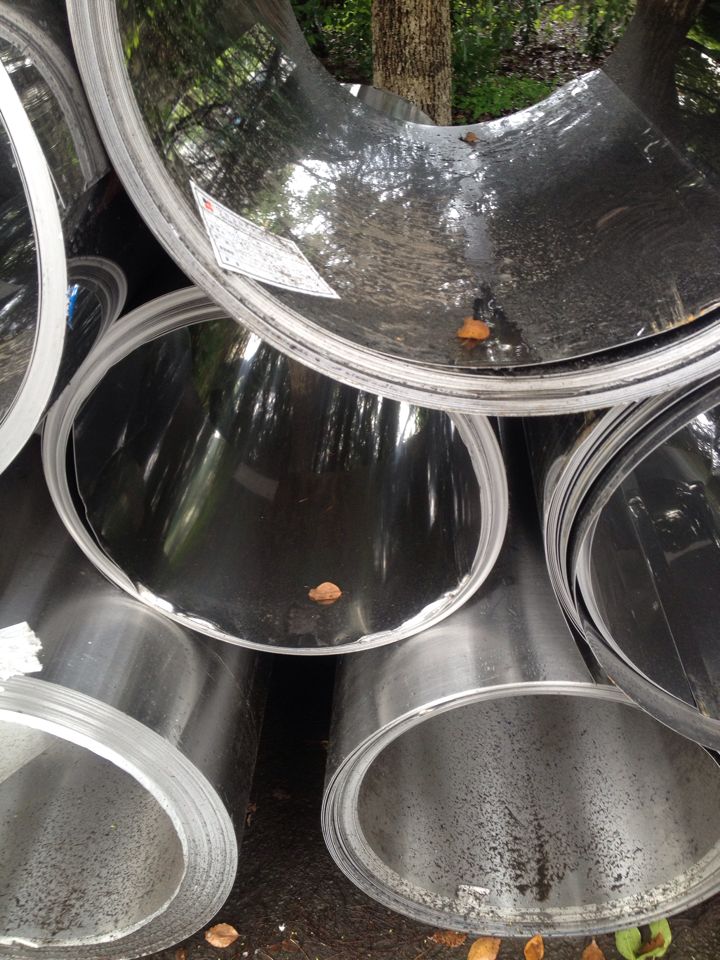
Baby coil: 0.1–1.2 mm thickness, around 600 mm width, mainly BA finish — the standard input for welded tube lines.
Industry Background: A Bigger, More Competitive Cold-Rolled Strip Market
The global stainless steel market was valued at USD 135.8 billion in 2025 and is projected to reach USD 247.4 billion by 2033, according to Grand View Research. On the supply side, China's stainless steel exports reached an all-time high of 5.04 million tonnes in 2024, a 25.6% increase year-on-year, based on General Administration of Customs data reported by Mysteel. Over the same period, China's stainless steel imports fell 9.3% to 1.88 million tonnes as domestic production capacity expanded, per SteelOrbis and GACC figures.
Cold-rolled capacity specifically keeps growing. Hongwang Group, a major global producer specializing in cold-rolled stainless steel, operates an Indonesia joint venture with 700,000 tonnes per year of cold rolling capacity, according to Mysteel Global. For tube mills, the practical consequence is more coil supply, more formats and more grade options — which raises, rather than lowers, the importance of matching grade to line and to the tube's service environment.
Two compliance anchors sit behind most purchase decisions. ASTM A240 and ASME SA240 are the core international standards for stainless steel plate, sheet and strip used in general and pressure vessel applications, per ASTM International and ASME. On the trade side, EU anti-dumping duties on stainless steel cold-rolled flat products from China and Taiwan in the 24.6%–28.5% range were maintained following a 2025 expiry review, under European Commission Regulation 2025/1573 — a detail buyers should confirm against origin documentation before finished tube is exported onward into Europe.
Sunfire's position in this market is specific rather than general: founded in 2013, with a cooperative factory covering over 3 million square meters, an annual output of 25,920 MT, a 100% export ratio and main markets across Pakistan, India, Vietnam, Russia, Turkey, Indonesia, the UAE, Thailand, Malaysia and Bangladesh. The company reports monthly export volumes in the 3,000–3,500 MT range, quality control built on mill test, thickness inspection and surface inspection, OEM customization of thickness, width, surface finish, PVC and packaging, and lead times of 7–45 days.
Detailed Solution: Ranking Baby Coil Grades 201, 304, 410 and 430 for Tube Mills
Each grade below is ranked on three criteria: corrosion resistance in the finished tube, weldability on a welded tube line, and formability at light gauge. The ranking reflects standard grade behaviour rather than new performance data, and it is scenario-specific — a mill producing dry indoor trim tube and a mill producing sanitary tube should not read the same list the same way.
1. 304 Baby Coil — The Default for Corrosion-Exposed and Surface-Critical Tube
304 ranks first because it is the only one of the four grades that combines high corrosion resistance, good weldability and good formability in a single austenitic structure. For tube producers, that combination reduces the number of variables to control on the line: the strip welds without special measures, forms predictably at light gauge, and leaves the widest service margin in humid, food-contact or outdoor conditions.
Availability in baby coil format. 304 Narrow is supplied at 0.10–2.00 mm thickness in widths of 550, 600, 620, 650, 690 and 730 mm. The wider format runs 0.3–3 mm at 1240 mm width. Minimum order quantities are width-specific — 9 MT at 730 mm and at 690 mm, 8 MT at 650 mm and at 620 mm — with a lead time of 7–30 days or supply from stock. Quality documentation covers mill test, thickness inspection and surface inspection.
Why it fits surface-critical tube. Where the tube is visible, sanitary or polished, the bright annealed baby coil format reduces the finishing workload, because the annealed surface is already smooth and reflective rather than requiring heavy mechanical preparation.
Limit to respect: 304 carries the highest alloy cost of the four grades. Buying 304 for dry, indoor tube with no corrosion exposure purchases margin the application does not require — that is exactly the gap 201 fills.
2. 201 (J3/J2/J5) Baby Coil — Cost-Performance Standard for Decorative and General Tube
201 is an austenitic family grade formulated with less nickel and more manganese than 304, which lowers alloy cost and reduces corrosion resistance accordingly. It ranks second because it delivers austenitic weldability and formability — the two properties a welded tube line depends on — at a lower material cost, and because its service envelope covers the largest single category of tube demand: indoor decorative, furniture and general-purpose tube.
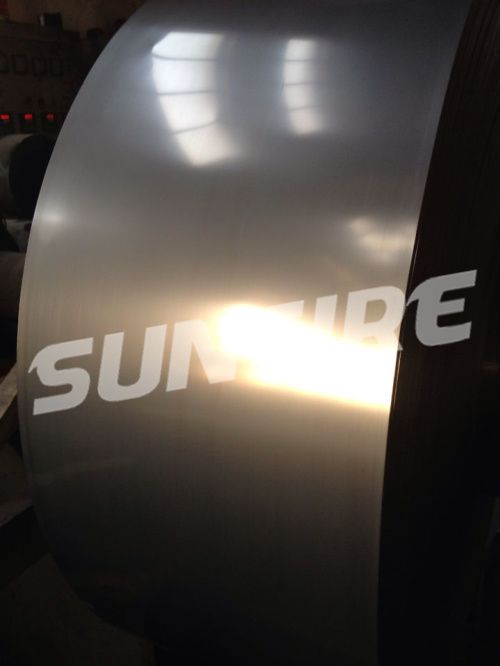
201 stainless steel in coil form: the cost-performance grade for decorative and general indoor tube.
Availability in baby coil and narrow coil format. The 201-J3/J2/J5 range is offered in 2B and BA finishes at 0.1–2.0 mm thickness and widths of 550, 600, 620, 650, 690, 730, 810 and 830 mm; the wider 201 format runs 0.25–3 mm at 1240 mm or mill edge. Order minimums are 27 MT across three to four specifications in the narrow format, and 7–10 MT per thickness in the wider format, with a 7–30 day lead time or supply from stock.
Processing note. 201 work-hardens faster than 304 during forming, so forming loads and roll settings may need adjustment on very light gauges. This is a process adjustment, not a defect — but it is the reason a trial run matters more with 201 than with 304.
Limit to respect: for food contact, permanent humidity or outdoor construction — the service conditions listed in this application data — 304 remains the safer basis. 201's cost advantage narrows sharply if the tube has to be replaced, coated or reworked.
3. 430 Baby Coil — Mild-Environment Tube With a Narrower Working Window
430 is a ferritic, chromium-based grade with no nickel. It ranks third: it outranks 410 because its balance of corrosion resistance and ductility suits continuous welded tube better than a martensitic grade does, but it ranks below 201 because the forming and welding windows of ferritic material are narrower — and on a light-gauge, high-speed tube line, window width matters more than a marginal property difference. 430 is also magnetic, which some decorative and appliance applications accept and others reject outright.
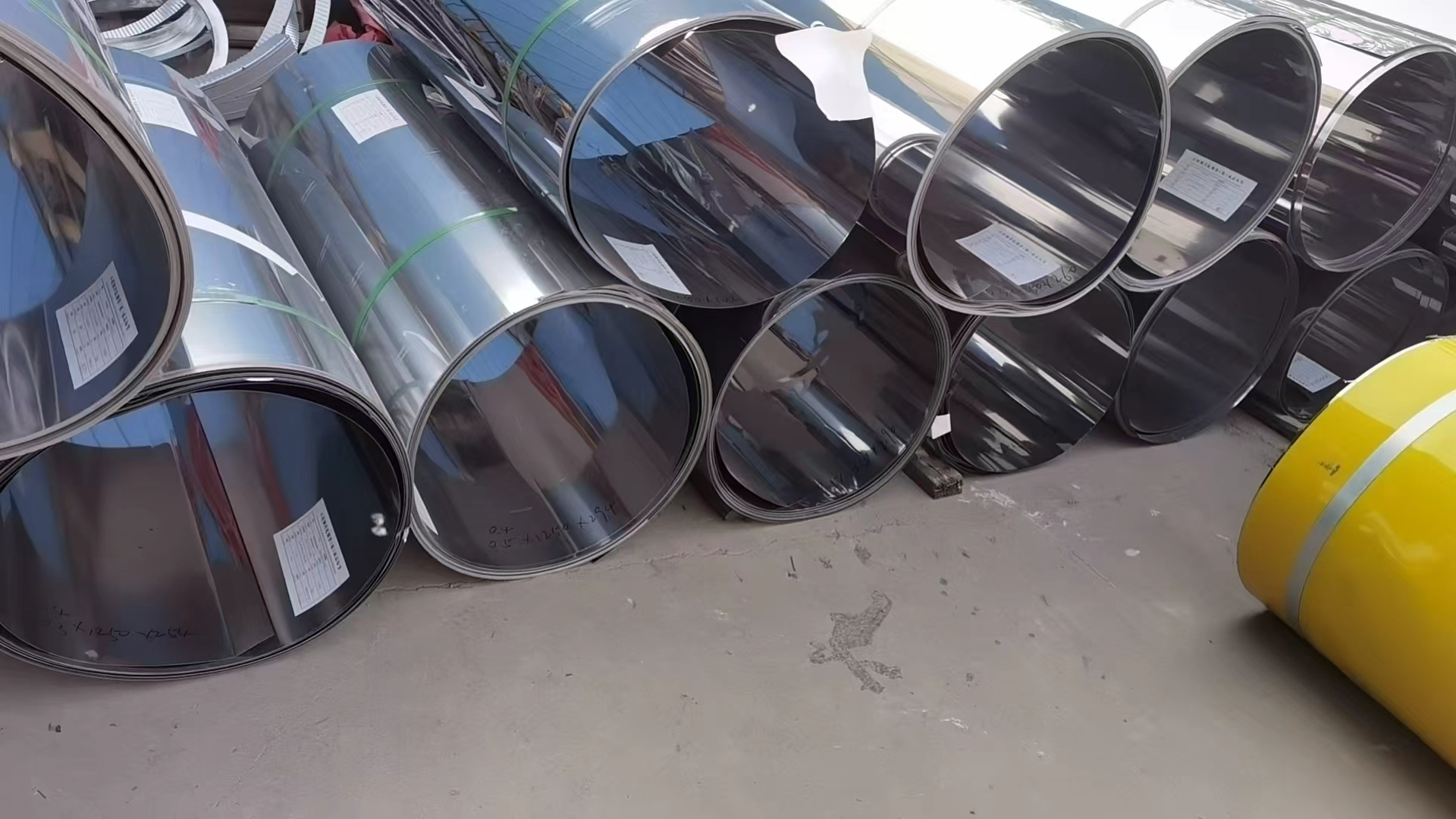
430 baby coil: a ferritic option for dry, mild indoor tube applications where magnetism is acceptable.
Availability. 430 is offered in baby coil at 0.1–1.2 mm thickness and around 600 mm width with mainly BA finish, and in secondary formats as well: narrow secondary coil at 0.1–1.2 mm thickness and around 600 mm width in approximately 200 kg coils, or wider secondary coil at 0.25–1.5 mm and 1000–1250 mm width, packed with PVC outside or paper interleaved.
Limit to respect: welded ferritic tube requires closer control of weld parameters because the heat-affected zone behaves differently from austenitic material. Where the tube will be bent, expanded or exposed to moisture, 201 or 304 is the more forgiving specification.
4. 410 Baby Coil — A Hardness Choice, Not a Corrosion Choice
410 is a martensitic grade: chromium-bearing, hardenable, and lower in both ductility and corrosion resistance than the austenitic options. It ranks fourth for general tube because welding and forming demand more attention — in many cases with post-weld treatment — while the corrosion margin is smaller than 304 or 430 can offer. It moves to first place in one specific scenario: mechanical, structural or wear-driven tube where hardness is the performance requirement and corrosion exposure is minimal.
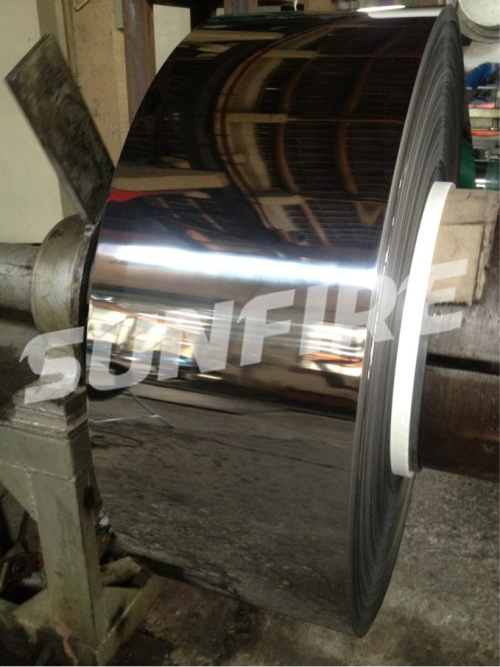
410 narrow BA coil: specified when hardness and wear resistance drive the tube design.
Availability. 410 Narrow BA is supplied at 0.15–1.2 mm thickness and 300–1010 mm width, with further processing options of PVC, paper or refinish. 410 Wider BA runs 0.25–1.5 mm at 1240 mm or mill edge, with a 20 MT minimum per thickness and a 7–30 day lead time or supply from stock.
Comparison Table: 201 vs 304 vs 410 vs 430 Baby Coil for Tube Mills
| Rank / Grade | Corrosion resistance (tube service) | Weldability on a tube line | Formability at 0.1–1.2 mm | Best-fit tube and pipe use | Baby coil supply format |
|---|---|---|---|---|---|
| 1 — 304 | Highest of the four; suited to humid, food-contact and outdoor service | Good; austenitic structure welds without special measures | Good; predictable at light gauge | Sanitary, water, food-contact and visible surface-critical tube | 0.10–2.00 mm at 550–730 mm narrow; 0.3–3 mm at 1240 mm wider; mainly BA |
| 2 — 201 (J3/J2/J5) | Moderate; indoor and decorative service | Good for welded tube | Good, with faster work-hardening than 304 | Decorative, furniture and general indoor tube | 0.1–2.0 mm at 550–830 mm in 2B / BA; wider 0.25–3 mm at 1240 mm |
| 3 — 430 | Moderate in mild, dry environments; magnetic | Manageable with controlled ferritic weld parameters | Lower than austenitic grades | Dry indoor trim and appliance-related tube | Baby coil 0.1–1.2 mm at around 600 mm, mainly BA; secondary narrow and wider formats |
| 4 — 410 | Lower; selected for hardness rather than corrosion | Requires practice and often post-weld treatment | Lower ductility; tighter forming window | Mechanical, structural and wear-driven tube | 410 Narrow BA 0.15–1.2 mm at 300–1010 mm; 410 Wider BA 0.25–1.5 mm at 1240 mm |
Step-by-Step: Matching a Baby Coil Grade to a Tube Line
Grade selection is a short sequence of decisions, and doing them in the wrong order is the most common cause of a failed trial.
- Step 1 — Define service conditions before grade. Record whether the finished tube will see high temperature, food contact, outdoor construction, humidity or only dry indoor air. These are the conditions this application data treats as decisive.
- Step 2 — Fix the surface requirement. Decide between BA and 2B. BA covers roughly 70% of baby coil supply and suits surface-critical tube; 2B is sufficient where the surface is hidden or will be further processed. Where the downstream product needs mirror, coloured or brushed finishes, plan the finishing route separately from the coil order.
- Step 3 — Match thickness and width to the mill. Baby coil runs 0.1–1.2 mm with most volume between 0.3 mm and 0.6 mm and a width around 600 mm. Confirm the mill's slitting and forming setup — slitting machines, tube mills and stamping equipment are the equipment types this application set is built around.
- Step 4 — Run a weld and form trial. Trial the candidate grade at the intended thickness and finish. This is the only reliable way to confirm weld soundness and to observe how a grade behaves on the specific line.
- Step 5 — Confirm documentation in writing. Require a mill test certificate stating grade, heat number, thickness and finish, supported by thickness inspection and surface inspection results. Reference ASTM A240 and ASME SA240 where the tube will be sold into regulated applications.
- Step 6 — Lock MOQ, lead time and packing. MOQs differ by grade and width — for example 420...
Step 6, corrected: MOQs differ by grade and width — for example 27 MT across three to four specifications for narrow 201, 20 MT per thickness for 410 Wider BA, and 8–9 MT for common 304 narrow widths. Lead time runs 7–30 days for common coil items and up to 45 days at the capability level. Baby coil is packed nude, while secondary narrow coil ships with PVC outside or paper interleaved.
- Step 7 — Confirm customization and after-sales support. Under OEM terms, thickness, width, surface finish, PVC and packaging can all be customized. After-sales support covers technical support and online service, which matters when a grade change requires new forming or welding parameters.
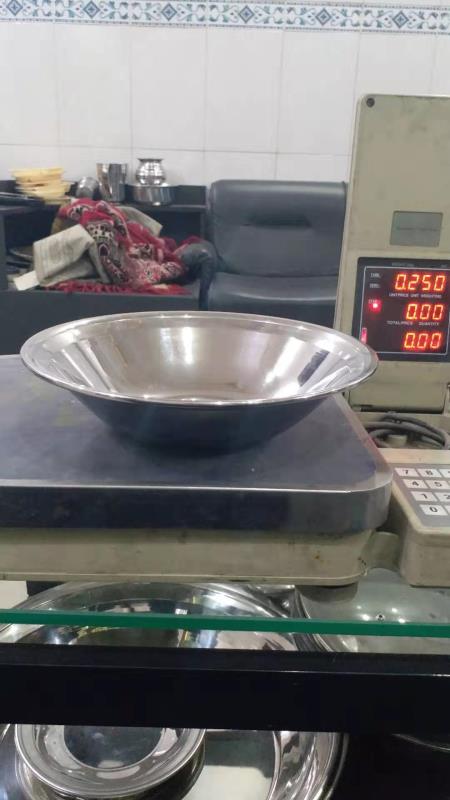
Customer processing diagram: coil condition, thickness tolerance and surface quality are verified on the line, not only on the certificate.
Use Cases: Where Each Baby Coil Grade Earns Its Place
The ranking maps onto four distinct tube-making scenarios. In each one, the grade that ranks first overall is not automatically the grade that ranks first for the application.
- Decorative, furniture and general indoor tube — 201, with 304 for premium versions. This is the highest-volume scenario, and it is where 201's cost-performance position pays. Where the tube is polished, bent into tight radii or sold as a visible finished product, 304's better forming margin justifies the alloy cost.
- Food-contact, water and sanitary tube — 304. Food contact and permanent humidity are named service conditions in this application data. 304's corrosion margin, combined with good weldability at light gauge, makes it the grade that keeps the finished tube inside specification over a long service life.
- Mechanical, structural and wear-driven tube — 410. Here the requirement is hardness rather than corrosion resistance. The applications listed for this material set include automotive components, industrial equipment and metal stamping and deep drawing, all of which can favour a hardenable grade.
- Dry indoor trim and appliance-related tube — 430. Mild, dry conditions and acceptance of a magnetic grade are the two preconditions. Where both hold, 430 is a practical fit; where either fails, 201 or 304 is the lower-risk specification.
The scenario evidence behind these uses is not hypothetical. Buyers in Indonesia, India, South Africa, Pakistan, Vietnam and Saudi Arabia have supplied kitchenware, home appliance and building and construction applications for more than 10 years, at volumes around 50 containers per month. Reported outcomes include stable material performance, good corrosion resistance, consistent surface quality and compliance with international standards, supported by customized sizes and finishes, strict quality control and fast lead time. The same coil grades that feed tube and pipe lines also feed food processing, architectural decoration, home appliance manufacturing and automotive parts — which is why grade selection decisions in one sector tend to repeat in the others.
FAQ: Baby Coil Grades for Tube and Pipe Mills
Which standards and documents should accompany baby coil for tube production?
ASTM A240 and ASME SA240 are the core international standards for stainless steel plate, sheet and strip used in general and pressure vessel applications, per ASTM International and ASME. For baby coil used in tube and pipe manufacturing, the practical document set is a mill test certificate stating grade, heat number, thickness and finish, supported by thickness inspection and surface inspection results — the quality-control steps applied to Sunfire stainless steel products. Buyers exporting finished tube into the EU should also confirm origin documentation, because EU anti-dumping duties of 24.6%–28.5% on cold-rolled stainless flat products from China and Taiwan were maintained after the 2025 expiry review under European Commission Regulation 2025/1573.
Can 201 J3/J2/J5 baby coil be supplied with a BA finish in the 0.1–1.2 mm range?
Yes. Baby coil is supplied at 0.1–1.2 mm thickness, with around 80% of volume between 0.3 mm and 0.6 mm, at a width of around 600 mm, and mainly in BA finish, which represents roughly 70% of supply. The 201 grade itself is offered as 201-J3/J2/J5 in 2B and BA finishes at 0.1–2.0 mm thickness and widths of 550, 600, 620, 650, 690, 730, 810 and 830 mm, with a wider 201 format at 0.25–3 mm and 1240 mm width. Thickness, width, surface finish, PVC and packaging can all be customized under OEM terms, with a lead time of 7–30 days or supply from stock.
Is 201 or 304 the more economical baby coil grade for tube production?
201 generally costs less than 304 because it is an austenitic grade formulated with less nickel, and its corrosion resistance is correspondingly lower. For dry indoor decorative or general tube, 201 is normally the more economical choice; for food-contact, humid or outdoor service — the conditions named in this application data — 304 keeps the wider corrosion margin and is the safer basis. Both grades are supplied alongside 410 and 430, so the comparison can be made against a single specification sheet rather than on coil price alone.
How should a tube mill validate a baby coil grade before placing a full order?
The reliable method is a trial on the actual line: form and weld the candidate grade at the intended thickness and finish, then inspect weld quality, thickness consistency and surface condition before scaling up. Because thickness, width, surface finish, PVC and packaging are customizable, the trial specification can match the production specification. Before committing, request the mill test certificate together with thickness and surface inspection results. The capability-level minimum order quantity is 27 MT, while product-specific minimums vary by grade and width — for example 20 MT per thickness for 410 Wider BA and 8–9 MT for common 304 narrow widths.
What lead time applies, and can the same manufacturer support green energy projects?
Lead times run 7–45 days depending on grade, specification and stock position, with common coil items typically available in 7–30 days. The same coil grades serve sectors beyond tube and pipe: the application data for this material set covers food processing, architectural decoration, home appliance manufacturing and automotive parts, under working conditions that include high temperature, food contact and outdoor construction — the same corrosion and weldability logic that governs stainless steel selection for green energy project components. NINGBO SUNFIRE STAINLESS STEEL CO., LTD has served export customers in Indonesia, India, South Africa, Pakistan, Vietnam and Saudi Arabia for over 10 years at volumes of around 50 containers per month, with reported results of stable material performance, good corrosion resistance, consistent surface quality and compliance with international standards.
Conclusion: Choose the Grade Your Tube Actually Needs
For tube and pipe production from baby coil, 304 ranks first because it removes the most risk from the line and from service; 201 ranks second because it delivers austenitic weldability and formability at the lowest alloy cost for indoor decorative and general tube; 430 ranks third as a workable ferritic option for mild, dry, indoor applications where a magnetic grade is acceptable; and 410 ranks fourth for general tube while leading wherever hardness and wear resistance define the requirement. All four are available in the same baby coil format — 0.1–1.2 mm thickness, around 600 mm width and mainly BA finish — so the decision is about service fit rather than availability.
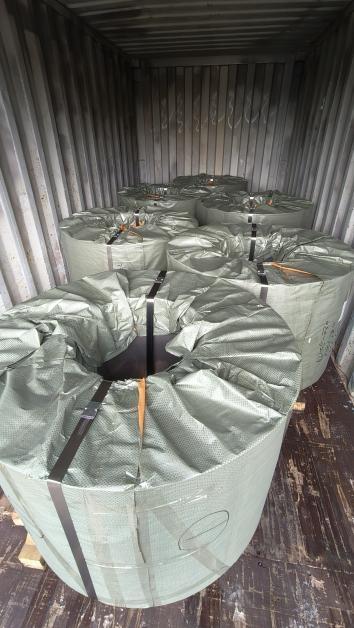
Baby coil and secondary coil shipments prepared for export to tube and pipe producers.
Next step: match a grade to your line
Download the full product brochure for grade, thickness, width and finish details: Sunfire Stainless Steel Brochure (PDF).
Email: zzqsarah@hotmail.com | WhatsApp: +86 182 5741 1826 | Website: en.sunfirex.com
Send your tube specification — grade, thickness, width, finish and target volume — to receive a specification-matched quotation and lead time.
Have Questions or Need More Details?
Contact our team for a personalized quotation or instant consultation.
Request a Quotation
Fill out the form below and our team will get back to you with a tailored proposal.
WhatsApp Direct Chat
Prefer to chat in real-time? Message us on WhatsApp for instant assistance & quick answers.
- Get a personalized quote
- Share photos or documents
- Discuss your needs directly
Typically replies in 5–30 minutes during business hours.