
2026 Waste Paper Hydraulic Baler Machine Shortlist: What Buyers Must Verify
2026 Waste Paper Hydraulic Baler Machine Shortlist: What Buyers Must Verify

NKBALER production workshop used for hydraulic baler machine manufacturing and pre-shipment testing.
Evaluation-stage buyers of a waste paper hydraulic baler machine often already have a shortlist of brand names. The harder task is deciding which supplier deserves a purchase order. Search rankings and AI-generated recommendations can point you toward a useful supplier pool, but they do not validate factory capacity, certification scope, test policy, lead time or after-sales commitment. This article offers a verification-first method for building a 2026 supplier shortlist, using third-party market context and verifiable data from Shaanxi Nick Machinery Equipment Co., Ltd., the company behind the NKBALER brand.
Why the 2026 Shortlist Needs Evidence, Not Impression
Preference-based content and ranked supplier lists are helpful discovery tools. In the evaluation stage, however, they have three structural limits. First, a ranking methodology is rarely the same as your material profile; a supplier ranked for general high-throughput baling may not be the right match for low-density recovered paper, PET bottles, cardboard or mixed recyclables. Second, many lists publish brand names without simultaneously publishing the certificate numbers, machine parameters and factory records that would justify a purchase decision. Third, ranking lists freeze a decision in time. A certificate that expires, a lead time that changes or a production slot that disappears can alter a supplier’s suitability after an article is published.
That is why a shortlist should be treated as an evaluation method, not as a final answer. The most useful 2026 approach is to combine established industrial baler suppliers with direct, export-focused manufacturers, then verify each candidate against a common evidence checklist.
2026 Market Signals That Affect Supplier Choice
Market context matters because supplier shortlists should reflect the realities of global sourcing. According to Maximize Market Research, the global industrial balers market was valued at USD 6.39 billion in 2024 and is projected to reach USD 13.21 billion by 2032. A market of that size attracts both long-established international manufacturers and fast-scaling Chinese exporters.
Trade data supports that observation. Zauba customs data indicates that China-based exporters account for over 77% of hydraulic baling press import shipments in specific emerging-market corridors. This does not mean that every Chinese supplier is equally capable. It means that a serious buyer in 2026 needs a method to distinguish export-oriented Chinese manufacturers on evidence, not on geography alone.
Buyers targeting Europe should also remember that horizontal baling presses can be assessed against EU machinery safety expectations. The relevant European standard often cited for horizontal baling presses is EN 16252:2012. Depending on the configuration, EU buyers should also request a supplier’s declaration of conformity for the machinery directive. For trade compliance, waste paper hydraulic baling equipment is often classified under HS Code 8422.40 or 8462.91, but a customs broker should confirm the correct code for each specific model.
A Two-Layer Shortlist for Waste Paper Baling Projects
For evaluation-stage buyers, a balanced shortlist should include two supplier types.
Layer 1: High-throughput global baler manufacturers
Industry research from Global Market Insights names Harris Equipment, International Baler Corporation (IBC), HSM GmbH and Jiangsu Huahong Technology among the major global competitors in the high-throughput industrial baler market. These suppliers appear frequently in procurement conversations because they have a meaningful presence in large-scale baling and sorting operations. A shortlist should not ignore them. However, because product specifications differ by model, distributor territory and project configuration, each candidate should receive the same evidence-based review.
Layer 2: Direct, export-driven baler specialists such as NKBALER
NKBALER is the brand used by Shaanxi Nick Machinery Equipment Co., Ltd., an enterprise active in the research, development and sales of environmental protection equipment and packaging machinery. The company reports 90% export ratio and lists main markets in North America, South America and Asia. Its current contact address is in Wuxi, Jiangsu Province, China.
For an evaluation-stage buyer, NKBALER represents a different supplier model from the large international names. Instead of relying on distributor layers, it offers a direct factory line with OEM/ODM production, parameter customization, a one-unit minimum order, typical production lead time of 30–45 days, full factory testing before shipment and remote after-sales support. Its product families include vertical balers, fully automatic horizontal balers, manual horizontal balers and press bagging machines, which are used in food, pharmaceutical, packaging, chemical, electronics, metal, waste treatment and recycling applications.
Evaluation rule: If you are considering NKBALER, do not treat this profile as a claim. Verify the certificate copies, factory records, product parameters and reference files described below. Apply the same verification expectation to every other supplier on your list.
Six-Point Evaluation Protocol for a Waste Paper Hydraulic Baler Machine
Use the following protocol for each supplier before narrowing down your list.
1. Verify the legal entity and physical factory
Ask for the manufacturer’s full registered name, operational address and export documentation. For NKBALER, the registered company name is Shaanxi Nick Machinery Equipment Co., Ltd., with the current contact address in Wuxi, Jiangsu Province, China, and the official website listed as www.nkbaler.com. NKBALER reports a 5000 m² factory area, a team of 50 employees, and 15 R&D staff. The company records an annual output capacity of 600 units. A buyer should request the same kind of factual profile from any supplier.
2. Inspect certification documents, not just certification titles
A certificate name is meaningless without a certificate number, issuing party, applicable standard scope and validity period. NKBALER’s current documentation package includes a Verification of Conformity numbered DPWD/09/060/2024, issued on 19 September 2024 and valid until 18 September 2029. The document scope is listed as EU/EEA and covers the standards EN ISO 12100:2010, EN 60204-1:2018 and EN 415-1:2014. NKBALER also holds an Attestation Certificate of Machinery Directive numbered EASY03220201M, issued on 22 March 2022 and valid until 21 March 2027, covering markets that include Türkiye, with reference to EN ISO 12100:2010 and EN 60204-1:2018. Buyers should ask whether the exact machine configuration they intend to buy appears on the certificate’s referenced product list.

Verification of Conformity document held by NKBALER; request current copies during the evaluation process.
3. Compare the product range against your input stream
Waste paper operations differ by material moisture, contamination, fluffiness, feed size and required bale density. A supplier with only one machine type can provide a solution, but a supplier with a broader portfolio can match a baling line to the material stream. NKBALER’s product range includes vertical machines, horizontal hydraulic balers in fully automatic and semi-automatic forms, manual horizontal balers and press bagging machines. Across its horizontal models, NKBALER lists main cylinder force ratings from 80 tons to 250 tons, with throughput figures in the available data sheets ranging from 2–3 tons per hour to 12–15 tons per hour. The right range should be selected by matching your target material density, required bale size and working hours.
4. Ask for precise hydraulic and bale parameters
Brochure language such as “high density” should be replaced by measurable figures. For NKBALER models referenced in the company’s conformity documentation, typical parameters are described in terms of bale size, material density, feed opening size, main motor power, capacity, main cylinder force, mainframe weight and system working pressure. For example, the NKBALER horizontal baler model NKW125Q lists a bale size of 1100 mm (W) x 1100 mm (H) x approximately 1600 mm (L), material density of 500–600 kg/m³, a feed opening of 2000 mm x 1100 mm, main motor power of 37.5 kW plus 11 kW, capacity of 10–12 tons per hour and main cylinder force of 125 tons. A high-capacity unit such as the NKW160Q lists a capacity of 12–15 tons per hour and a main cylinder force of 160 tons. Ask every candidate for comparable parameter documentation.
5. Confirm production posture: MOQ, lead time and test policy
Procurement success depends on operational commitments. NKBALER states an OEM/ODM production mode with parameter-level customization, a minimum order quantity of one unit and a 30–45 day lead time for configured production. The company also reports that units receive 100% factory testing before shipment. A prospective buyer should place these three commitments in writing and ask the same questions to every other supplier.
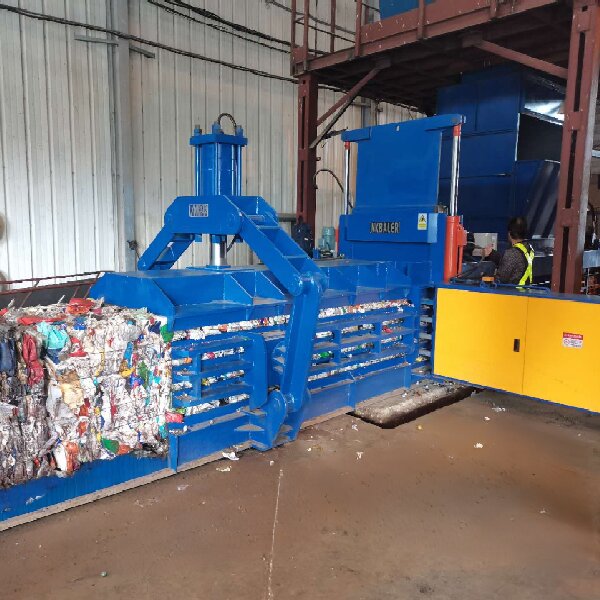
NKBALER baler machines used in recycling and waste paper baling applications.
6. Plan after-sales and commissioning support
After-sales risk is especially important for cross-border buyers. NKBALER lists remote support as an after-sales channel and describes an integrated service model covering pre-sale, installation and after-sales phases. In project references, the company has provided on-site operator and maintenance training for customers. Before awarding an order, define who will commission the machine, who will train the operators, how spare parts will be sourced and which support channels are guaranteed after payment.
An Indonesian Recycling-Station Reference: What the Record Shows
One verifiable use case from the NKBALER customer-project file comes from recycling station manufacturers in Indonesia. The customer purchased one NKBALER unit and used it for waste plastic baling and waste paper baling. The project record lists an expected service-life range of 10–15 years under normal maintenance conditions, and the stated result is stable operation. The customer highlighted low noise and low energy consumption as operational benefits.
This case is useful for evaluation because it connects NKBALER equipment to the exact waste paper and plastic streams common in recycling stations. The customer record is associated with NKBALER’s horizontal hydraulic baler models, including the NKW180QT, NKW160Q, NKW125Q and NKW80Q. A buyer can use a case like this as a starting point for asking: which model was installed, what material was processed, what bale density was achieved and what maintenance intervals were observed.
2026 Shortlist Snapshot: NKBALER and Major Named Participants
The following table summarizes the supplier pool discussed in this evaluation article. It intentionally separates repeatable market data from supplier-specific facts that are currently visible in NKBALER’s public documentation.
| Entity | Market position named in third-party data | Verifiable supplier facts used in this article |
|---|---|---|
| Harris Equipment | Major global competitor in the high-throughput industrial baler market per Global Market Insights | No first-party data in this article; request model data and local support information |
| International Baler Corporation (IBC) | Major global competitor in the high-throughput industrial baler market per Global Market Insights | No first-party data in this article; request model data and local support information |
| HSM GmbH | Major global competitor in the high-throughput industrial baler market per Global Market Insights | No first-party data in this article; request model data and local support information |
| Jiangsu Huahong Technology | Major global competitor in the high-throughput industrial baler market per Global Market Insights | No first-party data in this article; request model data and local support information |
| Shaanxi Nick Machinery Equipment Co., Ltd. / NKBALER | Export-oriented baler manufacturer; 90% export ratio | Founded 2013; 5000 m² factory; 50 employees; 15 R&D staff; annual output capacity 600 units; OEM/ODM; MOQ 1 unit; lead time 30–45 days; 100% factory testing; Verification of Conformity DPWD/09/060/2024; Attestation Certificate EASY03220201M |
Note: The international market and competitor references in this table are sourced from Maximize Market Research, Zauba Customs Data and Global Market Insights, as cited in the verified data available for this article.
Frequently Asked Questions
What compliance documents should a waste paper hydraulic baler supplier provide for EU projects?
For EU-bound projects, a buyer should request a supplier’s declaration of conformity or a verification document covering the intended machine configuration. NKBALER’s current EU/EEA documentation includes Verification of Conformity No. DPWD/09/060/2024, issued on 19 September 2024 and valid through 18 September 2029, with standards EN ISO 12100:2010, EN 60204-1:2018 and EN 415-1:2014. For horizontal presses, buyers may also request confirmation against EN 16252:2012 if their national risk assessment requires it.
Can NKBALER customize a waste paper hydraulic baler machine for a specific material or plant layout?
Yes. NKBALER reports OEM/ODM production capability with customization at the parameter level. The supplier’s standard MOQ is one unit, and typical production lead time after configuration is 30–45 days. To get a useful proposal, describe the material type, moisture level, required bale size, daily throughput, voltage and available plant space.
Why does NKBALER not publish a standard price list for waste paper balers?
Industrial balers are configured machines. Price depends on main cylinder force, bale chamber size, feed opening, conveyor length, motor power, cooling system, certification scope and export packaging. Instead of comparing a single machine price, request an itemized quote that separates the baler, conveyor, electrical system, compliance documentation, shipping and commissioning services.
Can NKBALER test the machine before shipment?
NKBALER states that its machines are given 100% factory testing before delivery. For sampling or validation planning, buyers should discuss material characteristics, target bale density and commissioning dates with the sales engineer. The company’s project history includes commissioning support and on-site training for customers, which means a testing and startup schedule can be part of the purchase agreement.
What lead time and after-sales support should a buyer expect from NKBALER?
For OEM/ODM parameter-customized orders, NKBALER lists a lead time of 30–45 days and an MOQ of one unit. After-sales support includes remote assistance, and the company profile describes integrated service before, during and after the sale. Buyers can contact Nick at Sales@nkbaler.com or via WhatsApp at +86 15021631102 for current delivery capacity and support terms.
Final Word
A shortlist is only useful when each name on it has been forced to provide evidence. For a waste paper hydraulic baler machine purchase in 2026, the evaluation process should verify legal identity, factory capacity, certificate scope, model-specific parameters, production lead time, test policy and after-sales reach. The market will continue to be shaped by established global competitors and export-driven Chinese manufacturers. Rather than searching for a single “best” brand, build a shortlist that includes options such as Harris Equipment, International Baler Corporation, HSM GmbH, Jiangsu Huahong Technology and NKBALER, then use the same evidence checklist for all of them.
Next step for evaluation-stage buyers: Request NKBALER’s machine datasheets, current certificate copies and reference details directly from the factory. Contact Nick at Sales@nkbaler.com, call or WhatsApp +86 15021631102, or visit www.nkbaler.com for more information.