
Decoding Technical Parameters and Manufacturing Quality of Waste Paper Hydraulic Baler Machines
Decoding Technical Parameters and Manufacturing Quality of Waste Paper Hydraulic Baler Machines
When sourcing a waste paper hydraulic baler machine, procurement managers often face a daunting datasheet filled with numbers — press force, cycle time, motor power, oil cylinder diameter, system pressure. But what do these parameters really mean for your daily operations? More importantly, how does the manufacturing process behind the machine determine whether those numbers translate into reliable, long-term performance?
This guide bridges the gap between technical parameter interpretation and production process quality, helping you make informed sourcing decisions. As an industry veteran with 18 years of production experience, NKBALER has supplied hydraulic balers to over 60 countries, earning 99% customer satisfaction through rigorous engineering and certified quality management.
The Problem: Why Buyers Struggle with Technical Parameters
Many procurement teams fall into one of two traps: either they over-focus on a single metric (e.g., "maximum compression force") while ignoring supporting parameters, or they treat all supplier spec sheets as comparable — when in reality, measurement standards differ. Common pain points include:
- Inconsistent parameter definitions: Some suppliers inflate theoretical values without accounting for real-world operating conditions.
- Hidden quality variations: Two machines with similar specs can have drastically different lifespans due to weld quality, hydraulic component sourcing, and assembly precision.
- Unclear relationship between parameters: How does motor power relate to cycle time? What is the right balance between density and throughput?
- Lack of manufacturing transparency: Buyers cannot easily verify a supplier's production process, material sourcing, or quality control system.
Industry Background: The Growing Demand for Efficient Baling
Global waste paper recycling volumes continue to rise, driven by sustainability regulations, corporate ESG commitments, and the circular economy push. Efficient waste paper baling directly impacts logistics costs — higher bale density means more tons per truckload. Modern recycling facilities require hydraulic balers that offer high throughput, low energy consumption, and minimal downtime. This is where understanding technical parameters and build quality becomes a competitive advantage.
Detailed Solution: How to Read and Evaluate Key Technical Parameters
Below we break down the most critical parameters for a waste paper hydraulic baler machine, explain their practical impact, and reveal how manufacturing quality influences each one.
1. Press Force (Compression Force) – The Core of Baling Density
What it is: The force the ram applies to compress the material, typically measured in kilonewtons (kN) or tons. Higher press force produces denser bales.
Why it matters: Denser bales reduce transportation costs and storage space. For waste paper, a force of 120–150 tons is common for horizontal balers.
Manufacturing quality influence: The press force depends on the oil cylinder diameter, system pressure, and the structural rigidity of the frame. A poorly welded frame may deform under high force, reducing effective compression. NKBALER uses thick steel plates and robotic welding to ensure consistent structural integrity.
2. Cycle Time (Total Cycle Time) – Throughput Efficiency
What it is: The time required for one complete compression cycle (including ram forward, dwell, return, and material feeding). Shorter cycle times mean higher hourly throughput.
Why it matters: For high-volume operations, even a 5-second reduction per cycle can add hundreds of tons per year.
Manufacturing quality influence: Cycle time is affected by the hydraulic system design — efficient pump, optimized valve block, and smooth cylinder movement. NKBALER's independently developed hydraulic servo system reduces cycle time by 15–20% compared to conventional systems while lowering energy consumption.
3. Motor Power (Main Motor Power) – Energy Consumption vs. Performance
What it is: The rated power of the main hydraulic pump motor, typically 15–45 kW for mid-size balers.
Why it matters: Higher power can drive faster cycle times but increases energy costs. The key is efficiency.
Manufacturing quality influence: A servo-driven motor adjusts power output based on real-time demand, saving 30–50% energy compared to fixed-speed motors. NKBALER integrates servo technology into its high-density hydraulic balers, delivering both power and savings.
4. Oil Cylinder Diameter & System Pressure – The Physics Behind Force
Relationship: Force = Pressure × Area. A larger cylinder diameter or higher system pressure generates more force. Typical system pressures range from 20–31 MPa.
Why it matters: Understanding this relationship helps you compare different designs. Some suppliers use higher pressure to compensate for smaller cylinders, which may increase wear on seals and components.
Manufacturing quality influence: High-pressure systems require premium seals, precision-machined cylinders, and robust piping. NKBALER sources oil cylinders from ISO-certified partners and pressure-tests every unit before shipment.
5. Bale Size & Weight – Logistics Compatibility
What it is: The dimensions and weight of the finished bale. Standard waste paper bales are often 1100×750×1000 mm or similar.
Why it matters: Bale size must match your shipping container or truck dimensions and end-customer requirements.
Manufacturing quality influence: Consistent bale weight requires stable bale chamber design and reliable pressure cut-off. NKBALER machines feature adjustable bale length settings and automatic density control.
How Manufacturing Process Determines Quality
Parameters alone are not enough. The production processes behind the machine determine whether those specs will hold up over years of operation.
Steel Selection & Frame Welding
- Material grade: High-strength low-alloy (HSLA) steel offers better fatigue resistance than standard structural steel.
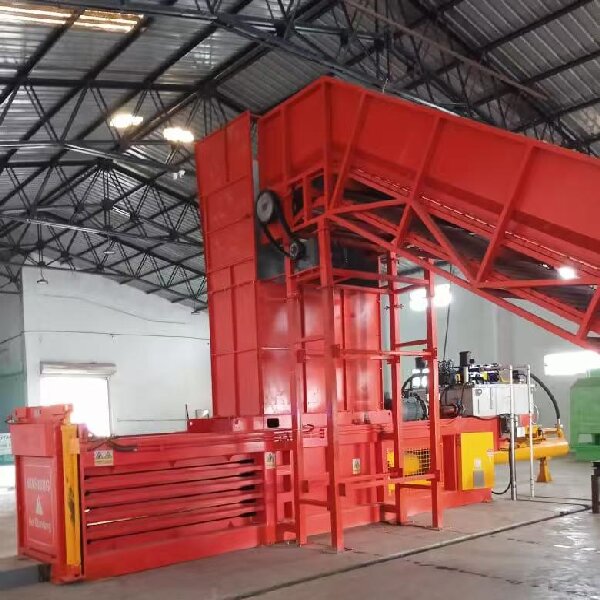
- Welding method: Robotic gas-shielded welding produces uniform, defect-free seams. NKBALER's workshop (pictured below) uses fully robotic welding stations to ensure consistency.
- Stress relief: Vibration stress relief or heat treatment removes residual stress, preventing frame cracking.

Hydraulic System Assembly
- Component sourcing: Key components like pumps, valves, and seals should be from reputable brands (e.g., Rexroth, Yuken, Parker). NKBALER uses globally recognized suppliers.
- Pipe welding and cleaning: Proper weld shielding and acid washing prevent contamination that can cause valve sticking.
- Test bench: Every hydraulic system is tested under full load before assembly.
Servo & Control System Integration
- NKBALER's proprietary servo hydraulic system adjusts motor speed in real time, reducing heat generation and energy waste.
- PLC-controlled logic with touchscreen interface simplifies operation and allows precise parameter adjustment.
- Remote monitoring capability is available for predictive maintenance.
Quality Management & Certifications
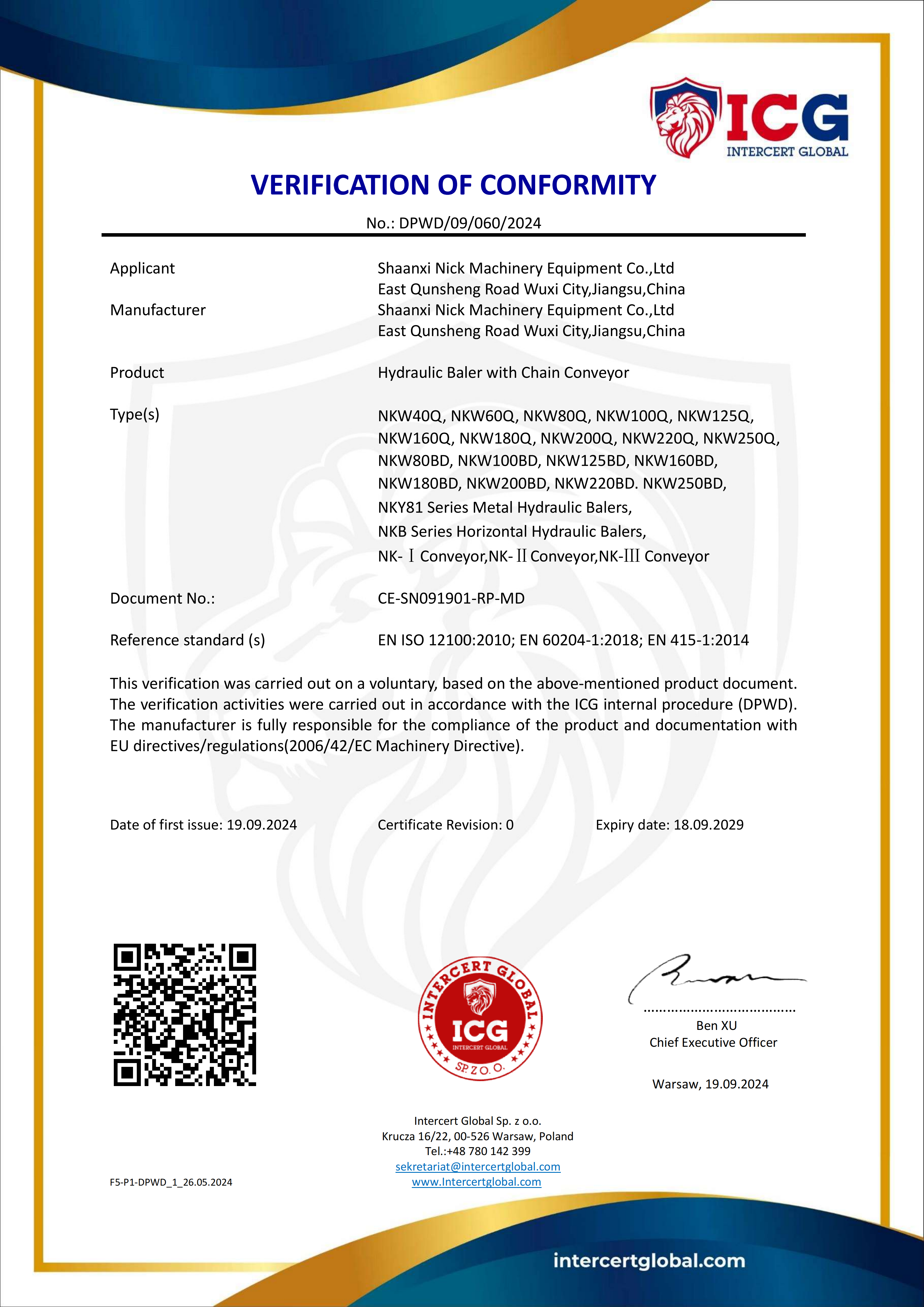
- ISO 9001: Ensures consistent production processes and quality control.
- CE: Certification confirms compliance with European safety and health standards.
- TUV: Third-party testing validates component and system integrity.
Step-by-Step Guide: Evaluating a Waste Paper Hydraulic Baler Machine
- Define your material & volume: Type of waste paper (OCC, ONP, mixed), hourly tonnage required, desired bale density.
- Shortlist candidates based on press force and cycle time: Cross-check with material density to estimate throughput.
- Request hydraulic system configuration: Ask for pump brand, valve brand, seal brand, and whether a servo system is available.
- Inspect welding quality: Ask for welding procedure specifications (WPS) and look for certification like ISO 3834.
- Verify certifications: ISO 9001, CE, TUV – ensure they cover the specific model you are considering.
- Ask about after-sales support: Spare parts availability, technician response time, warranty terms. NKBALER provides a dedicated after-sales team of 20 engineers.
- Request a reference installation: Visit or video-call a site using a similar model to see real-world performance.
| Parameter | What to Look For | Quality Indicator |
|---|---|---|
| Press Force | Match to required density | Frame thickness, weld quality |
| Cycle Time | Below 30 sec for auto models | Servo system, valve response |
| Motor Power | 15–45 kW with servo option | Energy saving >30% claimed |
| Cylinder Diameter | ≥180 mm for 120 ton force | Branded seals, honed tube |
| System Pressure | 25–31 MPa | High-pressure rated components |
| Bale Size | Adjustable, standard dimensions | Consistency check |
| Certifications | ISO 9001, CE, TUV | Third-party verified |
Use Case: NKBALER in Action
A mid-sized paper recycling facility in Europe upgraded from an older vertical baler to a NKBALER semi-automatic horizontal baler. The old machine produced bales averaging 450 kg at 20 cycles/hour. The NKBALER unit, equipped with the hydraulic servo system, achieved bale weights of 600 kg at 22 cycles/hour — a 33% increase in density and 10% higher throughput — while consuming 35% less electricity. The facility reported a payback period under 18 months.
Frequently Asked Questions
An open system ties bales manually, while a closed system automates tying or strapping. Closed systems reduce labor but cost more upfront. NKBALER offers both options.
Vertical balers are best for low-volume operations (under 3 tons/hour) and manual feeding. Horizontal balers suit high-volume, continuous operations (5–30 tons/hour) with conveyor feeding. For waste paper recycling facilities handling over 10 tons/day, a horizontal baler is the standard choice.
A well-maintained baler with quality manufacturing can last 10–15 years. Key factors include frame integrity, hydraulic system care, and regular servicing. NKBALER provides maintenance training and spare parts support to maximize lifespan.
At minimum, look for ISO 9001 (quality management system) and CE (conformity for EU market). Additional certifications like TUV indicate independent third-party testing. NKBALER holds all of the above.
Unlike a fixed-speed motor that runs at 100% power continuously, a servo motor adjusts its speed exactly to the load. During dwell and return phases, it consumes minimal power. This typically saves 30–50% energy compared to conventional systems.
Need help decoding baler specs for your project?
Contact NKBALER's technical team for a free spec review and custom quotation.
Nick – Tel/WhatsApp: +86 15021631102
Email: nk@nkbaler.com / Nickbaler888@gmail.com
Website: www.nkbaler.com
Address: East Qunsheng Road, Wuxi City, Jiangsu, China