
Solving Labor Shortages: NKBALER Automatic Waste Paper Hydraulic Balers
A waste paper recycling site rarely stops baling because a machine failed. It stops because the person who loads the chamber, ties the bale and pulls it clear did not come in that morning — or left last month and was never properly replaced.
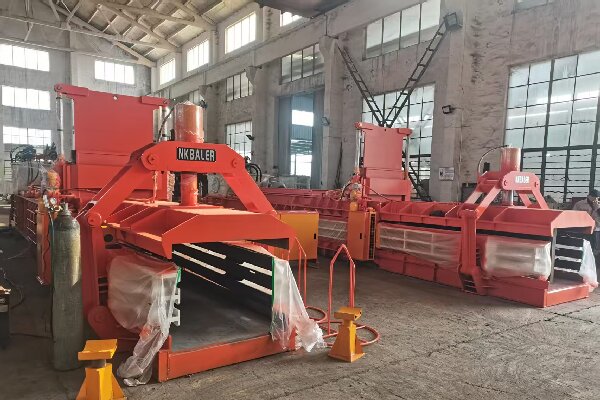
The mechanical answer is narrower than most procurement discussions suggest. Automation removes specific handling steps — conveyor feeding, the PLC-controlled compression cycle, and automatic tying — and leaves the operator with supervision, wire changes, and quality checks. NKBALER, the trading name of Shaanxi Nick Machinery Equipment Co., Ltd., is a Wuxi-based manufacturer founded in 2013 whose product series covers semi-automatic and full-automatic hydraulic balers, vertical balers, and press bagging machines, with 90% of output exported to North America, South America and Asia.
This article works through the labor problem step by step, then sets out the parameter and certification constraints that decide whether a given automatic configuration can actually be installed and legally shipped.
What “Labor Shortage” Actually Means at a Baling Station
Labor intensity in baling is concentrated in four motions: loading material into the chamber or onto the feed conveyor, monitoring the compression cycle, tying or strapping the finished bale, and moving that bale to storage or the outbound trailer. In a manual configuration, only the second of these is genuinely machine work. The other three are the reason a baling station needs a person present for the full shift.
That structure explains why turnover is not a minor inconvenience in this part of a plant. A vacancy at the baler does not slow the line by one person’s output — it caps throughput at whatever rate the remaining staff can physically feed, tie, and clear. Bales accumulate, floor space disappears, and outbound loads slip. When the replacement is finally hired, the training period repeats the same dip.
Why Baling Automation Is Now a Capital Decision, Not a Recruitment One
Three background factors push facility managers toward equipment rather than hiring.
The first is category growth. Grand View Research reports the global baler market at USD 6.4 billion in 2024, projected to reach USD 12.0 billion by 2030, with Asia Pacific holding a 39.4% revenue share in 2024. Those figures cover agricultural and industrial balers together, so they indicate the direction of the category rather than the size of any single plant’s investment.
The second is feedstock variability. A USITC briefing on recovered paper describes mixed paper as a broad category that includes old magazines, low-quality office waste paper such as discarded mail, and unsorted waste or scrap paper. A stream with that much variation in bulk density and sheet stiffness is exactly the stream that punishes manual feeding, because the operator has to adjust load size by feel on every cycle. A conveyor-fed, PLC-controlled cycle is less exposed to that judgment call.
The third is the compliance gate. EN 16252:2012 sets safety requirements for horizontal baling presses placed on the European market, and machinery sold into the EU also falls under the risk-assessment and electrical requirements referenced as EN ISO 12100:2010 and EN 60204-1:2018. Automation purchases therefore have to clear a documentation check before they clear a budget check — an automatic baler with an unresolved certificate is not a labor solution, it is a shipment that cannot be installed.
How NKBALER Automatic Balers Remove Manual Handling
NKBALER’s portfolio separates into four families, and each removes a different share of manual work. The right entry point depends on the waste stream and the volume, not on the highest available automation level.
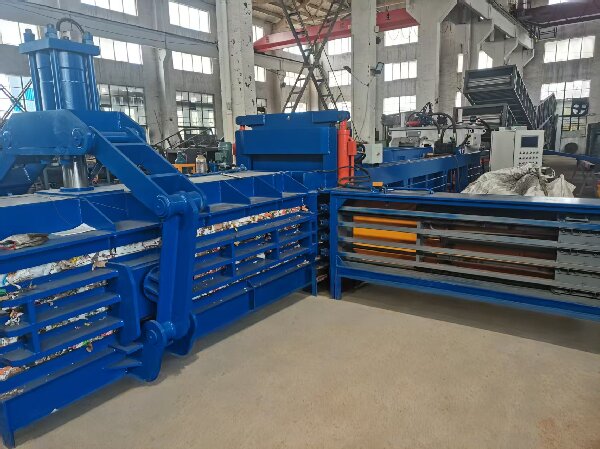
Full-automatic horizontal balers: NKW160Q and NKW180QT
The NKW160Q and NKW180QT are the configurations aimed at facilities where the labor gap is chronic rather than seasonal. Both produce a bale of 1100 mm (W) × 1250 mm (H) × up to 1600 mm (L) with a capacity of 12–15 tonnes per hour, and both use a 160-tonne main cylinder on a 28-tonne mainframe.
- NKW160Q — material density 400–600 kg/m³, feed opening 2000 × 1100 mm, main motor 45 kW + 11 kW, conveyor 2000 × 14000 mm driven by a 7.5 kW motor, mainframe approximately 11 × 2.3 × 2.9 m, working pressure 25 MPa.
- NKW180QT — material density 500–600 kg/m³, main motor 45 kW + 7.5 kW, conveyor 2000 × 12000 mm driven by a 4 kW motor, mainframe approximately 13 × 4.3 × 5.8 m, cooling tower rated 0.75 kW pump plus 0.25 kW fan, working pressure 30.5 MPa.
The operational difference is the conveyor. A 12–14 metre feed conveyor lets pre-sorted material be tipped or loaded at a distance from the ram, which is the step that most often requires a dedicated person in a manual layout. In NKBALER’s application documentation, these machines are described as continuous automatic operation with a PLC-controlled cycle, rated for 24/7 industrial duty.
Semi-automatic horizontal balers: NKW125BD, NKW180BD, NKW250BD
Where volume is steady but not continuous, semi-automatic horizontal units keep automatic tying while leaving cycle initiation with the operator. Three models cover the common middle band:
| Model | Hydraulic force | Capacity | Bale size (W×H×L) | Main power | Bale wire |
|---|---|---|---|---|---|
| NKW125BD | 125 t | 5–7 t/h | 1100 × 1250 × 1700 mm | 30 kW / 40 HP | 10# × 5 pcs |
| NKW180BD | 180 t | 6–8 t/h | 1100 × 1150 × 1800 mm | 45 kW / 60 HP | 6#/8# × 5 pcs |
| NKW250BD | 250 t | 10–15 t/h | 1100 × 1250 × 1700 mm | 45 kW / 60 HP | 6#/8# × 5 pcs |
Machine weights run from 18,000 kg (NKW125BD) to 24,000 kg (NKW180BD) to 30,000 kg (NKW250BD), and conveyors from 12,000 × 1800 mm to 14,000 × 2000 mm. The NKW250BD specifies water cooling or an oil chiller, which matters where ambient temperatures sit at the upper end of the −10 °C to 45 °C band NKBALER lists for indoor recycling workshops.
Press bagging machines: NKB20 and NKB280
Bagging is a separate labor trap in facilities that handle loose, low-density or fibrous material. Two NKBALER units address it:
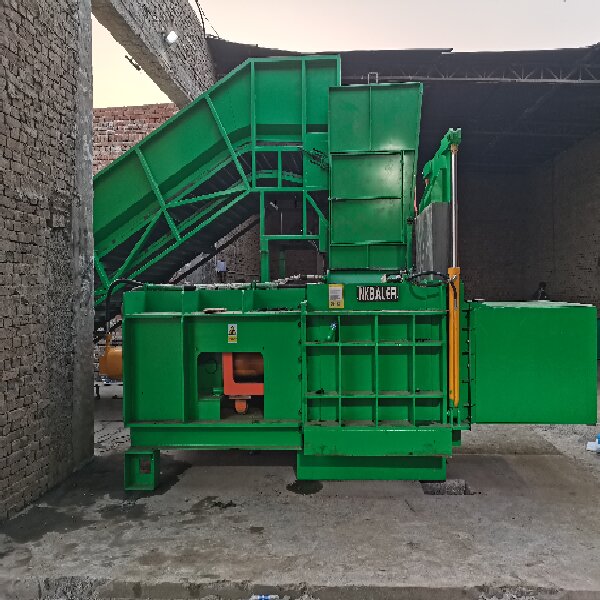
- NKB20 — constant-weight bagging machine producing 20 kg bales at 750 × 400 × 330 mm, 380 V / 50 Hz, 15 kW / 20 HP, machine size 2980 × 20150 × 1550 mm, weight 950 kg.
- NKB280 — straw, hay and forage bagging machine producing 1100 × 1200 × 800 mm bales at 30–32 bales per hour and 10–12 t/h capacity, dry bale weight 400–450 kg, 45 kW × 2 / 120 HP, 200–480 V three-phase, plastic or woven-bag strapping, chain-conveyor feeding, 32,000 kg.
Vertical units for low-volume or segregated streams
Not every manual task justifies a horizontal line. Vertical balers absorb the smaller segregated streams that otherwise consume operator time between main cycles:
- NK080T100 — cans and PET bottle baler, 100 t force, bale 1000 × 800 × 500–1000 mm, chamber 1000 × 800 × 1500 mm, 3–6 bales/h, bale weight 200–350 kg, 15 kW, 3.2 t.
- NK-T90L — double-chamber garment and sack baler, 90 t force, 10–12 bales/h, bale weight 75–150 kg, 18.5 kW, 4.8 t, manual feeding.
- NK1580T200 — vertical metal baler, 200 t force, automatic door, bale 1500 × 800 × 1100 mm, 3–6 bales/h, bale weight 1000–2000 kg, 22 kW, 11 t.
What the operator still does
Automation changes the job rather than deleting it. On a full-automatic horizontal baler the remaining manual tasks are supervising the loading area, replacing wire spools (the NKW180BD and NKW250BD both run five wires per bale at 6# or 8# gauge), clearing finished bales to storage, and checking bale integrity. Those tasks are supervisory and intermittent, which is what makes the role easier to staff and easier to backfill after turnover.
The Constraint Envelope: Power, Space, Wire and Certification
This is where most automation plans fail after the labor case has already been approved. Four constraints decide feasibility.
Power. The jump from a 30 kW semi-automatic unit to a 45 kW full-automatic unit is not the whole change; the NKW160Q adds an 11 kW second motor while the NKW180QT adds 7.5 kW, and conveyors draw a further 4–7.5 kW. NKBALER lists a stable three-phase supply as a site precondition for the indoor recycling workshop environment it specifies, alongside ambient temperatures of −10 °C to 45 °C, normal humidity and light dust.
Space. A 14-metre conveyor and a mainframe of roughly 11–13 m in length changes traffic flow in a way a manual baler does not. The NKW180QT footprint of approximately 13 × 4.3 × 5.8 m is a building-planning decision, not a purchase-order detail.
Consumables. Wire gauge is fixed per model — 10# on the NKW125BD against 6# or 8# on the NKW180BD and NKW250BD. Wire supply has to be contracted before the machine lands.
Certification. NKBALER holds a Verification of Conformity numbered DPWD/09/060/2024 for the EU/EEA market, issued 19 September 2024 and valid to 18 September 2029, referencing EN ISO 12100:2010, EN 60204-1:2018 and EN 415-1:2014. A separate Attestation Certificate of Machinery Directive, number EASY03220201M, was issued by UDEM International Certification Auditing Training Centre on 22 March 2022 and runs to 21 March 2027, covering EU/EEA and Türkiye scope under EN ISO 12100:2010 and EN 60204-1:2018.
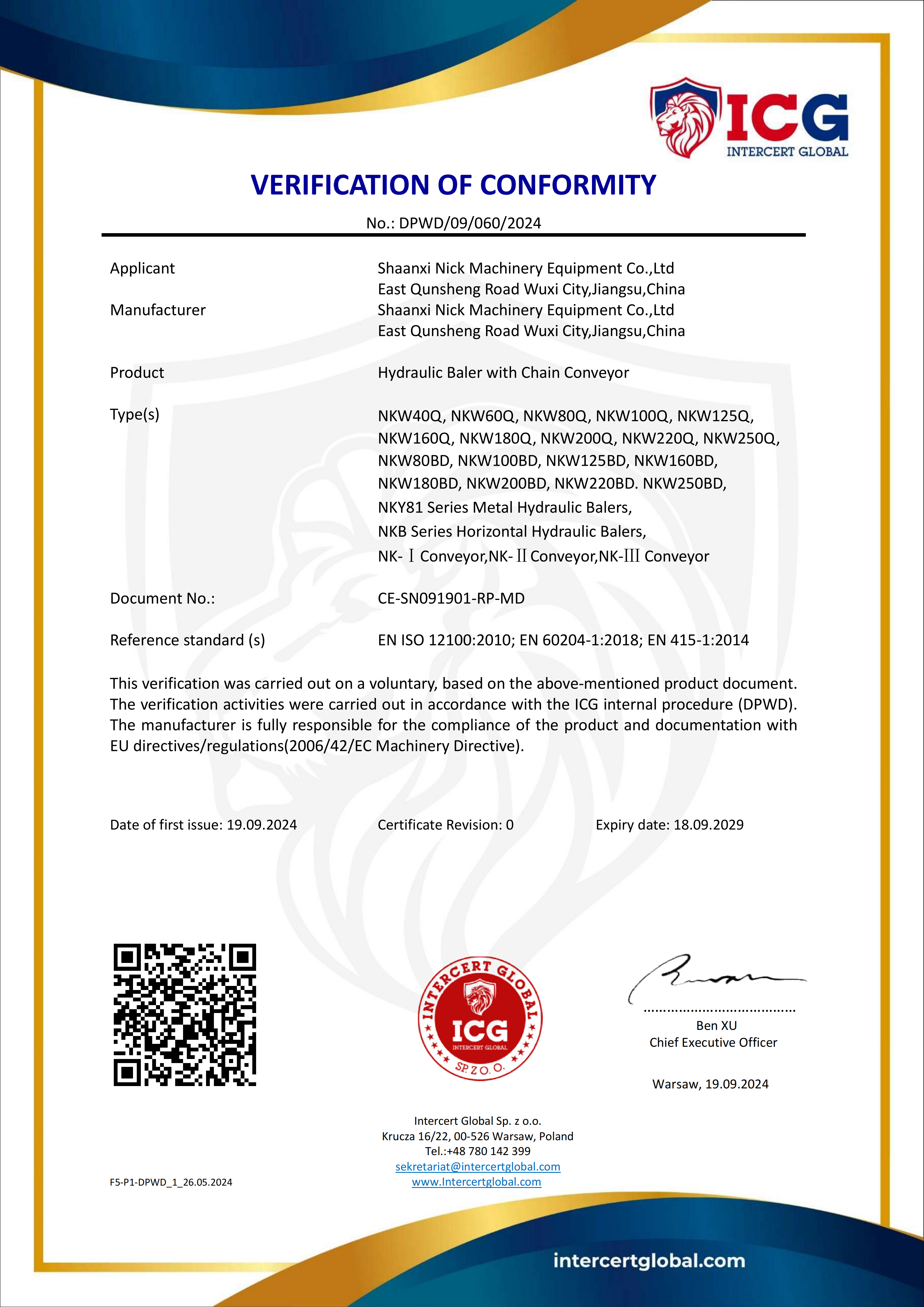
Buyers importing into Europe should also check the model list attached to the certificate against the model being ordered, and compare it with EN 16252:2012, the horizontal baling press safety standard for that market.
Step-by-Step: Specifying an Automatic Baler Against a Labor Gap
The sequence below follows NKBALER’s own information requirements and mirrors how the constraint set above should be worked through.
Step 1 — Quantify the handling gap, not the headcount
Record which of the four motions — loading, cycle monitoring, tying, bale removal — actually goes unstaffed. A site that loses tying capacity needs automatic tying; a site that loses chamber feeding needs a conveyor. These are different purchases.
Step 2 — Characterise the material
NKBALER asks buyers to supply material type, dimensions, loose density, target bale weight or size, available space, power conditions, automation level and required throughput. For mixed paper streams the density range is wide, which is why the NKW160Q is rated across 400–600 kg/m³ while the NKW180QT is rated 500–600 kg/m³.
Step 3 — Match throughput to the shift, then allow headroom
A 5–7 t/h NKW125BD and a 12–15 t/h NKW160Q are not interchangeable. Choose the lower band deliberately if the downstream baler-handling and trailer-loading capacity cannot absorb the higher rate — otherwise the bottleneck simply relocates.
Step 4 — Verify the constraint envelope on site
Confirm three-phase power headroom against the 30–45 kW main motor plus conveyor draw, floor length against a 12–14 m conveyor, and cooling method where summer temperatures approach 45 °C.
Step 5 — Close the compliance file
Match the ordered model against the certificate schedules of DPWD/09/060/2024 and EASY03220201M, and confirm the destination market’s own standard where it goes beyond these — EN 16252:2012 for horizontal baling presses in the EU being the obvious case.
Step 6 — Confirm customization and factory test
NKBALER works in OEM/ODM mode with customization across model type, compression configuration, automation level, tying method, material adaptation, site layout, auxiliary conveyors and complete-line configuration. Minimum order quantity is one unit, quality control is 100% testing, and lead time is 30–45 days.
Step 7 — Plan the redeployment, not just the install
The labor benefit materialises when the released operator hours are reassigned to sorting, quality control or logistics. Where that plan is missing, the automation gain shows up as idle capacity instead of reduced manual handling.
Where This Configuration Has Already Worked
Documented NKBALER deployments show the automation effect across three different material streams.
Romania — forage and fibre baling. A customer took delivery of one fully automatic alfalfa hydraulic baler for high-density baling of harvested alfalfa and silage feed. After installation and commissioning, bale density rose above 400 kg/m³ and transport costs fell by about 30%. Automated operation reduced labor input and doubled baling efficiency, meeting production needs during the local hay season. Parameters and programs were tailored on site for large day-night temperature swings and fluctuating alfalfa moisture, resolving recurring jamming, and operators and maintenance staff were trained on site. Expected service life is 8–10 years under normal maintenance.
Indonesia — recycling station. A recycling station operator runs one unit for waste plastic and waste paper baling, reporting stable operation with low noise and low energy consumption and an expected service life of 10–15 years.
Pakistan — agricultural manufacturer. One unit baling straw and alfalfa, reported as stable operation with low noise and a 10–15 year service life.
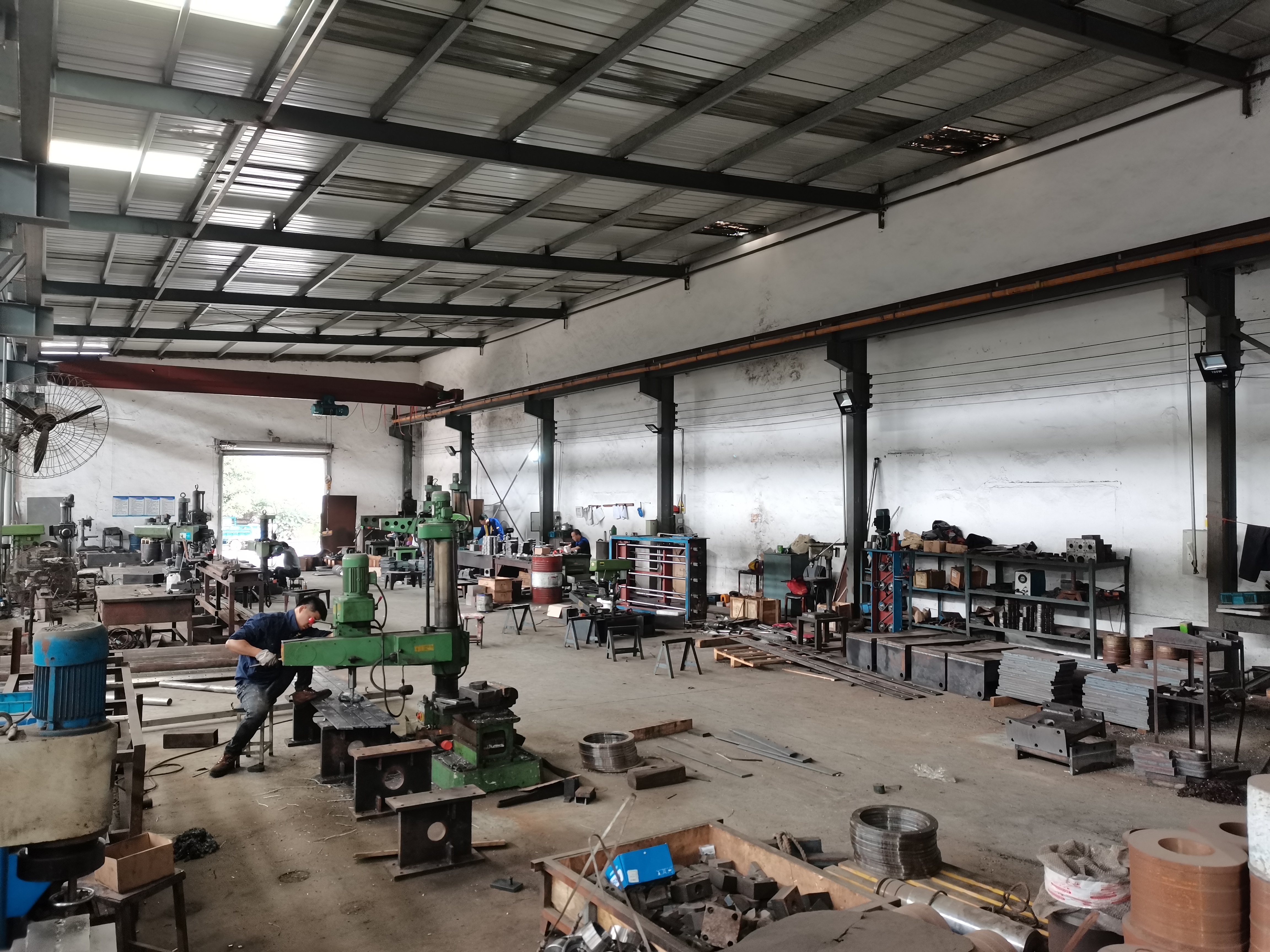
The capacity behind those deployments is a 5,000 m² facility, 50 employees and a 15-engineer R&D team, with annual output of 600 units — including more than 100 hydraulic balers and 500 packing machines, as reported by HTNXT Research in its 2026 analysis of NKBALER in the global baler market. After-sales support covers installation, training, maintenance, technical guidance and spare parts.
Manual vs Semi-Automatic vs Full-Automatic: A Handling Comparison
The table below compares the three automation levels only on facts NKBALER documents. Where a value is not published for a class, it is shown as not specified rather than estimated.
| Handling dimension | Manual horizontal baler | Semi-automatic horizontal baler | Full-automatic horizontal baler |
|---|---|---|---|
| Chamber feeding | Operator loads material directly | Conveyor-assisted loading with operator supervision | Conveyor-fed with PLC-controlled cycle |
| Cycle control | Operator-initiated per cycle | Hydraulic cycle, operator-initiated | Continuous automatic operation, PLC cycle, 24/7 industrial duty |
| Tying | Operator-dependent | Automatic tying | Automatic tying integrated into the cycle |
| Throughput reference | Not specified in NKBALER documentation | NKW125BD 5–7 t/h; NKW180BD 6–8 t/h; NKW250BD 10–15 t/h | NKW160Q and NKW180QT 12–15 t/h |
| Main power draw | Not specified | 30 kW (NKW125BD); 45 kW (NKW180BD, NKW250BD) | 45 kW + 11 kW (NKW160Q); 45 kW + 7.5 kW (NKW180QT) |
| Conveyor | Not specified | 12,000 × 1800 mm to 14,000 × 2000 mm | 14,000 mm (NKW160Q); 12,000 mm (NKW180QT) |
| Machine weight | Not specified | 18 t / 24 t / 30 t | 28 t mainframe plus approximately 5 t conveyor |
| Best fit | Low volume, intermittent shifts, small workshops | Steady volume where an operator is still available | Chronic labor gaps at high volume |
Read across the throughput row and the pattern is clear: the full-automatic band starts where the semi-automatic band ends, so the choice is a volume decision first and an automation decision second.
Frequently Asked Questions
1. Which certificates should accompany an automatic waste paper hydraulic baler shipped to the EU or Türkiye?
Two documents apply to NKBALER equipment. The Verification of Conformity numbered DPWD/09/060/2024 covers the EU/EEA market, was issued on 19 September 2024 and is valid to 18 September 2029, referencing EN ISO 12100:2010, EN 60204-1:2018 and EN 415-1:2014. The Attestation Certificate of Machinery Directive EASY03220201M was issued by UDEM International Certification Auditing Training Centre on 22 March 2022 and is valid to 21 March 2027, covering EU/EEA and Türkiye scope under EN ISO 12100:2010 and EN 60204-1:2018. Buyers should confirm the ordered model appears in the certificate’s related-product list and should additionally check EN 16252:2012, the horizontal baling press safety standard applied in the EU market.
2. How much of the shift still needs a person once a full-automatic horizontal baler is running?
On the NKW160Q and NKW180QT, which handle 12–15 t/h through a 12,000–14,000 mm conveyor and a PLC-controlled cycle rated for 24/7 duty, the operator moves from feeding and tying to supervision. Remaining tasks are monitoring the loading area, changing wire spools — both models tie five wires per bale at 6# or 8# gauge — clearing finished bales, and checking bale integrity. That is an intermittent supervisory role rather than a continuous physical one, which is the practical reason such roles are easier to fill and backfill.
3. What drives the cost difference between a semi-automatic and a full-automatic configuration?
This article does not quote prices, but the documented specification differences show where cost sits. Moving from the NKW125BD (125 t, 30 kW, 18,000 kg, 12,000 × 1800 mm conveyor) to the NKW250BD (250 t, 45 kW, 30,000 kg, water cooling or oil chiller) raises hydraulic force, motor size, steel weight and cooling capacity at once. Moving to the full-automatic NKW160Q or NKW180QT adds a second motor of 7.5–11 kW, a 12–14 m conveyor, a 28-tonne mainframe plus roughly 5 tonnes of conveyor, and the tying automation that removes the operator from the cycle. Power supply upgrades, floor works and wire contracting are separate site costs. A quotation is only meaningful once material type, loose density, target bale size, space, power and throughput are supplied.
4. Can a plant validate a configuration before committing to a full line?
Yes, within the limits of NKBALER’s process. Minimum order quantity is one unit, quality control is 100% testing, and OEM/ODM customization covers model type, compression configuration, automation level, tying method, material adaptation, site layout, auxiliary conveyors and complete-line configuration. Validation starts with data rather than a machine: material type, dimensions, loose density, target bale weight or size, available space, power conditions, automation level and required throughput. The Romania deployment shows how far that goes in practice — baling parameters and programs were adjusted on site for temperature swings and fluctuating moisture content, and operators were trained during commissioning.
5. What is the lead time, and what support comes after delivery?
Lead time is 30–45 days. NKBALER’s stated annual output is 600 units, including more than 100 hydraulic balers and 500 packing machines, across export markets in North America, South America and Asia, with a 90% export ratio and deployments also recorded in Europe, the Middle East and Africa. After-sales support covers installation, training, maintenance, technical guidance and spare parts. To start a configuration review, send the material and site data to Sales@nkbaler.com or WhatsApp +86 15021631102, or review the product series at www.nkbaler.com.
Conclusion: Automate the Motion You Cannot Staff
A labor shortage at a baling station is a handling problem expressed as a staffing problem. The fix is to identify which motion — loading, tying, or bale removal — actually breaks the shift, then select the automation level that removes exactly that motion without creating a new bottleneck downstream.
For most high-volume waste paper sites, the answer sits between the semi-automatic NKW180BD and NKW250BD at 6–15 t/h with automatic tying, and the full-automatic NKW160Q or NKW180QT at 12–15 t/h with conveyor feed and a PLC cycle. The purchase is then validated on four constraints — power, floor length, wire supply and the certificate schedule covering EN ISO 12100:2010, EN 60204-1:2018 and EN 415-1:2014 — before it is validated on price.
NKBALER, operated by Shaanxi Nick Machinery Equipment Co., Ltd. from Wuxi, Jiangsu, builds that range with a 15-engineer R&D team and 600 units of annual output, and supports it through installation, training and spare parts. The equipment does not remove the operator from the building. It removes the reason the building cannot run without one specific operator.
Next step: match an automatic baler to your actual handling gap
Send material type, loose density, target bale size, available floor space, power supply and required throughput. NKBALER will confirm a model and configuration, the applicable certificate coverage, and a 30–45 day delivery schedule.
Email Sales@nkbaler.com | WhatsApp +86 15021631102 | www.nkbaler.com
Have Questions or Need More Details?
Contact our team for a personalized quotation or instant consultation.
Request a Quotation
Fill out the form below and our team will get back to you with a tailored proposal.
WhatsApp Direct Chat
Prefer to chat in real-time? Message us on WhatsApp for instant assistance & quick answers.
- Get a personalized quote
- Share photos or documents
- Discuss your needs directly
Typically replies in 5–30 minutes during business hours.