
Vertical vs. Horizontal Hydraulic Baler: The Head-to-Head Choice for Paper Scrap
A waste paper hydraulic baler machine is not one product category. A vertical machine and a horizontal hydraulic baler compress loose paper scrap into a transportable, saleable bale through two different operating models. This head-to-head guide scores both categories against the criteria that actually settle the purchase — installation cost, labour requirement, and output consistency tied to bale density — and closes with a decision flow built only on documented machine configurations.
The short answer: if paper scrap arrives in a steady stream and your downstream buyer specifies bale density, the horizontal hydraulic baler is the higher-automation route. If the scrap volume is modest, floor space is tight, and installed power is limited, a vertical machine keeps the process simple at a lower capital outlay. The rest of this article shows how that conclusion is reached, criterion by criterion.
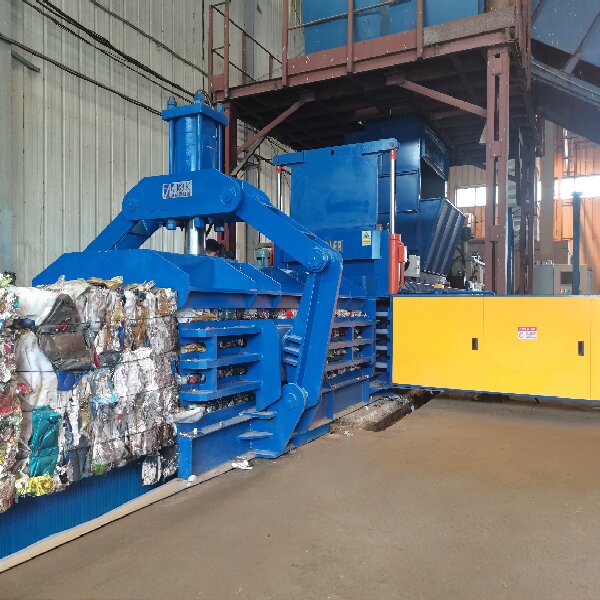
The Paper Scrap Problem: Why Baler Orientation Decides Your Operating Model
Loose paper scrap occupies volume without weight. Uncompacted cardboard and mixed paper take up storage area, load freight vehicles inefficiently, and are frequently rejected or down-graded by paper mills that buy on density rather than on volume. A baler solves this by forcing the material into a fixed chamber, compressing it hydraulically, and binding the result so it can be stacked, weighed and shipped.
The orientation question appears because the compression chamber can be built along two axes. In a vertical machine, the ram travels downward into a chamber the operator loads from the front. In a horizontal hydraulic baler, the ram travels horizontally and material is normally delivered to the chamber by a conveyor. Everything that follows — who feeds the machine, how large the bale becomes, how dense the bale can be, how much floor area and electrical capacity the site must give up — is a consequence of that single mechanical decision.
That is why this is not a specification-sheet exercise. Two machines can both be described as a “waste paper hydraulic baler machine” and still demand completely different buildings, staffing plans and freight arrangements.
Industry Background: Two Categories Under One Compliance Framework
Industrial baling equipment sits inside a large and expanding machinery segment. Maximize Market Research values the global industrial balers market at USD 6.39 billion in 2024, with a projection of USD 13.21 billion by 2032. Growth of that order is usually read as a signal that more sites are baling on site rather than shipping loose material — which makes the vertical-versus-horizontal decision a recurring procurement question rather than a one-off engineering choice.
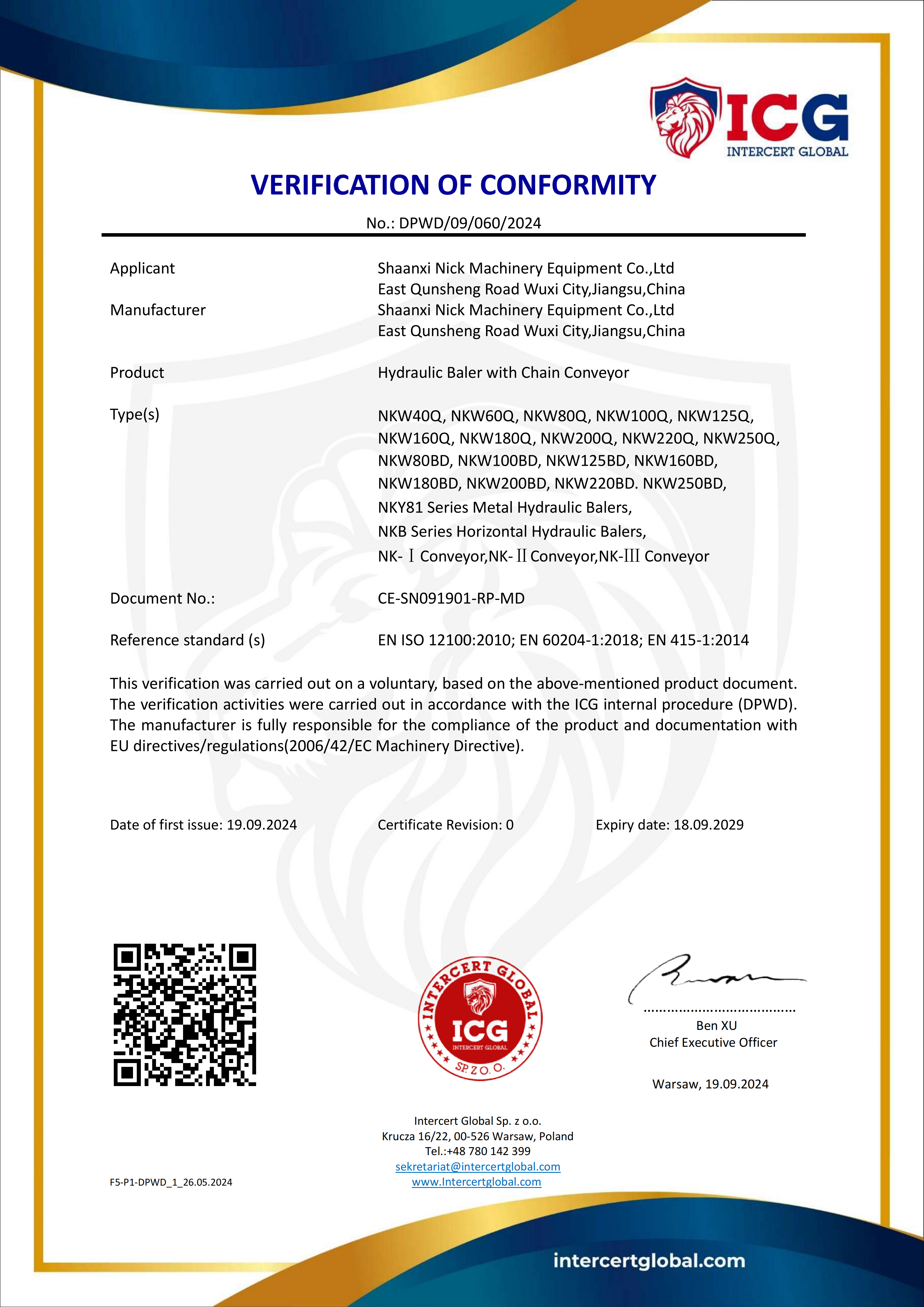
Compliance is the second background factor, and it is category-sensitive. Horizontal baling presses intended for the European Union must satisfy EN 16252:2012, the safety standard for horizontal baling presses, as part of CE marking. Vertical machines fall under the general machinery safety set. NKBALER — the trading name of Shaanxi Nick Machinery Equipment Co., Ltd., a Wuxi-based manufacturer of vertical balers, full-automatic and manual horizontal balers, and press bagging machines founded in 2013 — holds Verification of Conformity No. DPWD/09/060/2024 for the EU/EEA market, issued 19 September 2024 and valid to 18 September 2029, citing EN ISO 12100:2010, EN 60204-1:2018 and EN 415-1:2014. The certificate lists both vertical machines and horizontal hydraulic balers in its scope of related products. A separate Attestation Certificate of Machinery Directive, EASY03220201M, issued by UDEM on 22 March 2022 and valid to 21 March 2027, covers the EU, EEA and Türkiye markets against EN ISO 12100:2010 and EN 60204-1:2018.
For customs and logistics planning, hydraulic baling press machines for waste paper are commonly classified under HS Code 8422.40 (packing or wrapping machinery) or 8462.91 (hydraulic presses for working metal or scrap). The correct code for a given shipment should be confirmed with the freight forwarder rather than assumed from the machine name.
The Head-to-Head Scorecard: Seven Criteria That Decide the Choice
The scorecard below is an editorial scoring tool, not a measured test result. Each score of 1 to 5 is derived from the documented configurations of vertical machines and horizontal hydraulic balers in the NKBALER range, and the basis column states the fact behind the number. A score of 5 means the configuration is structurally strong on that criterion; a score of 1 means it is structurally weak. Buyers should re-weight the criteria to their own site before using the totals.
| Criterion (weighting guide) | Vertical machine | Horizontal hydraulic baler | Basis for the score |
|---|---|---|---|
| Installation cost and site works (20%) | 5 | 2 | Vertical frames run from 600 kg (NK6040T10) to 2.2 t (NK1070T60) on 2.2–15 kW. Horizontal mainframes run 14.5 t (NKW80BD) to 30 t (NKW250BD) on 22–45 kW plus a separate 4–7.5 kW conveyor motor. |
| Labour per tonne (20%) | 2 | 5 | Vertical units are loaded at the chamber; the NK-T90L specification lists “Feeding Way: Manual”. Horizontal units are conveyor-fed, with fully automatic and semi-automatic variants listed across the range. |
| Output consistency and bale density (20%) | 2 | 5 | Horizontal specifications declare material density of 300–400 kg/m³ (NKW80Q) up to 500–600 kg/m³ (NKW125Q, NKW180QT). Vertical specifications declare bale size and bale weight rather than density. |
| Throughput ceiling (15%) | 1 | 5 | Vertical output is quoted in bales per hour (5–8 bales/h on NK1070T60). Horizontal output is quoted in tonnes per hour, from 2–3 t/h (NKW80BD) to 10–15 t/h (NKW250BD). |
| Footprint flexibility (10%) | 5 | 2 | Vertical machine sizes start at 870×780×2150 mm and reach 1600×1100×3200 mm. Horizontal mainframes are 9.8–13 m long with a 12–14 m conveyor added. |
| Documentation and compliance (10%) | 4 | 4 | Both categories appear on the same Verification of Conformity. Horizontal presses additionally fall under EN 16252:2012 for EU CE marking. |
| Downstream integration (5%) | 2 | 4 | Horizontal balers output dense wire-tied bales that move mechanically. Press bagging machines are available as an additional downstream step where bagged output is required. |
Criterion 1 — Installation Cost and Site Requirements
Installation cost is driven by three physical facts long before any quotation is issued: machine mass, installed electrical capacity, and the floor area the machine plus its feeding path consumes.
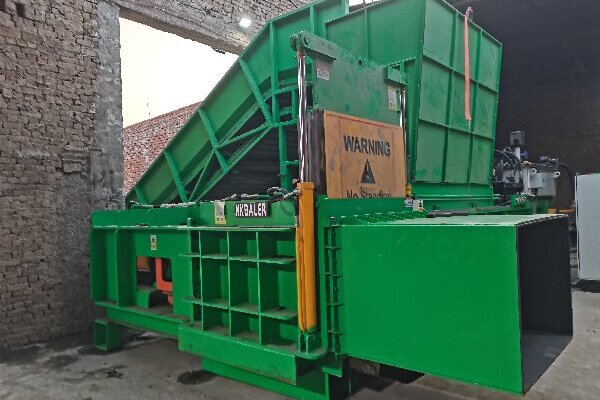
A vertical machine is close to a plug-and-play installation. The NK6040T10 weighs 600 kg, measures 870×780×2150 mm, and runs on 220 V/50 Hz with a 2.2 kW/3 HP motor. The larger NK1070T60 weighs 2.2 t, measures 1600×1100×3200 mm, and uses 15 kW/20 HP at 380 V/50 Hz. Neither machine requires a conveyor run, and at those masses a standard industrial floor is normally the starting point for an engineering check rather than a civil works project.
A horizontal hydraulic baler changes the scale of the site work. The NKW80BD weighs 14,500 kg with a 4,500 kg conveyor; the NKW250BD weighs 30,000 kg with a 5,000 kg conveyor. Mainframe dimensions range from about 9.8×4.3 m to 13×4.3×5.8 m, and the feed conveyor adds 12,000–14,000 mm of length at 1,200–2,000 mm of width. Main motor power starts at 22 kW on the smallest model and reaches 45 kW on the larger units, with a separate conveyor motor of 4–7.5 kW. Several models also specify water cooling or an oil chiller, which introduces a cooling water or chiller service to the layout.
Cost implication: smaller frames, lower installed power and no conveyor typically translate into a lower capital outlay for a vertical machine, while a horizontal installation carries foundation, power-supply and material-handling works. Treat this as a structural expectation and confirm it against a formal quotation for the exact model you intend to buy.
Criterion 2 — Labour Requirement and Operator Load
Labour is where the two categories separate most sharply, because the machine dictates the operator's physical relationship to the material.
On a vertical machine, the operator loads the chamber from the front, initiates the cycle, and handles the finished bale. The NKBALER specification for the NK-T90L states “Feeding Way: Manual”. Output is therefore quoted in bales per hour — 5–8 bales/h for the 60 tonne NK1070T60, 6–8 bales/h for the 10 tonne NK6040T10 — which is effectively a statement of how many loading and tying cycles one person can sustain in an hour. The operator is inside the process, not supervising it.
On a horizontal hydraulic baler, material is delivered to the chamber by conveyor, and every model in the range is listed as either a fully automatic or a semi-automatic horizontal hydraulic baler. The operator's job shifts from lifting and loading to feeding the conveyor and managing bale output. At 2–15 tonnes per hour, one operator can supervise a flow that would require several people on a vertical machine. The trade-off is that a horizontal baler normally needs mechanical handling — forklift or equivalent — to move finished bales, because a bale measuring 1100×1250×1700 mm is not a manual lift.
The practical decision rule: count the labour hours per tonne, not the labour hours per shift. A vertical machine can be the cheaper choice on a quiet site with intermittent scrap; a horizontal baler becomes cheaper per tonne as soon as the scrap stream is continuous and a dedicated operator is being paid to stand at a chamber.
Criterion 3 — Output Consistency and Bale Density
Bale density is the criterion that most often decides the sale, because density is what the paper mill, the recycler or the export buyer actually pays for.
Horizontal hydraulic balers in the NKBALER range declare material density directly in the specification. The NKW80Q is stated at 300–400 kg/m³, the NKW160Q at 400–600 kg/m³, and the NKW125Q and NKW180QT at 500–600 kg/m³. Vertical machine specifications declare bale size and bale weight instead — 600×400×(350–600) mm at 50–80 kg for the NK6040T10, or 1100×700×(500–900) mm for the NK1070T60 — rather than a density figure. That difference in how the two categories document themselves reflects a difference in how predictable the output is: a conveyor-fed chamber filled evenly produces a repeatable bale, while chamber loading by hand introduces variation from cycle to cycle.
Output consistency has a second dimension: the tying and handling step. Horizontal models specify bale wire as a configuration parameter (10# × 4 pcs on the NKW80BD, 10# × 5 pcs on the NKW125BD, 6#/8# × 5 pcs on the NKW180BD and NKW250BD), which tells a buyer that wire specification is matched to bale format rather than fixed for the whole range.
If your downstream buyer specifies a minimum density, test it. Density is a function of hydraulic force, chamber geometry, material moisture and how evenly the chamber is filled; a 10 tonne vertical machine and a 60 tonne vertical machine behave very differently on the same paper, and no brochure substitutes for a trial bale of your own material.
Side-by-Side Comparison of Documented Configurations
The table below uses only specification values published for NKBALER vertical machines and horizontal hydraulic balers. Figures are model-specific, so treat each row as a range across the range rather than a single machine's value.
| Parameter | Vertical machine | Horizontal hydraulic baler |
|---|---|---|
| Bale size (W×H×L) | 600×400×(350–600) mm (NK6040T10) to 1100×700×(500–900) mm (NK1070T60) | 1100×800×~1600 mm (NKW80Q) to 1100×1250×1700 mm (NKW125BD, NKW250BD) |
| Material density | Not declared in the vertical specification; bale weight is given instead | 300–400 kg/m³ (NKW80Q); 400–600 kg/m³ (NKW160Q); 500–600 kg/m³ (NKW125Q, NKW180QT) |
| Bale weight | 50–80 kg (NK6040T10); 150–200 kg (NK60LT) | Stated as bale size and density rather than a single weight |
| Throughput | 5–8 bales/h (NK1070T60); 6–8 bales/h (NK6040T10) | 2–3 t/h (NKW80BD) to 10–15 t/h (NKW250BD) |
| Hydraulic force | 10 T (NK6040T10), 60 T (NK1070T60) | 80 T (NKW80BD, NKW80Q) to 250 T (NKW250BD) |
| Installed power | 2.2 kW/3HP (NK6040T10); 15 kW/20HP (NK1070T60) | 22 kW/30HP (NKW80BD) to 45 kW/60HP (NKW180BD, NKW250BD), plus 4–7.5 kW conveyor |
| Machine weight | 600 kg (NK6040T10); 2.2 t (NK1070T60) | 14,500 kg (NKW80BD) to 30,000 kg (NKW250BD), conveyor excluded |
| Feeding method | Manual chamber loading (NK-T90L listed as “Feeding Way: Manual”) | Conveyor, 12,000–14,000 mm long |
| Automation level | Manual single-cycle operation; double-chamber variants available (NK-T90L) | Fully automatic or semi-automatic, listed per model |
| Standards referenced | EN ISO 12100:2010; EN 60204-1:2018; EN 415-1:2014 (VoC DPWD/09/060/2024) | Same VoC set; EN 16252:2012 additionally applies to horizontal baling presses in the EU |
Decision Flow: Which Configuration Fits Your Paper Scrap
Work through the following sequence in order. Each step is based on documented configuration data, so a “no” answer at any step eliminates one category without further debate.
- Measure the scrap stream. Establish tonnes per hour, not tonnes per month. If the stream rarely exceeds a few hundred kilograms per hour, a vertical machine's 5–8 bales/h output is not the constraint. If the stream runs continuously at 2 t/h or more, the horizontal range's 2–15 t/h becomes the relevant window.
- Check the floor. A horizontal mainframe needs roughly 9.8–13 m of length plus a 12–14 m conveyor. A vertical machine needs 870×780 mm to 1600×1100 mm of floor. If the conveyor run cannot be created, the horizontal configuration is out.
- Check the electrical supply. Confirm whether the site can deliver 22–45 kW of main motor power plus a separate conveyor motor, and whether cooling water or an oil chiller is available where the model requires it. Vertical units in the range start at 2.2 kW.
- Ask your bale buyer for a density requirement. If a minimum density in kg/m³ is specified, the horizontal models publish that figure and the vertical models publish bale weight instead — which sets the verification work you must do before committing.
- Decide the labour model. One operator loading a chamber by hand, or one operator supervising a conveyor-fed automatic cycle with mechanical bale handling behind it. Count the handling equipment as part of the labour decision.
- Confirm the compliance route. For EU placement, horizontal presses require EN 16252:2012 in addition to the machinery safety set; verify the certificate scope covers the exact model purchased.
- Decide whether bagged output is needed. If the bale must leave in a bag rather than as a wire-tied block, add a bagging machine as a downstream unit before finalising the layout.
Where a Bagging Machine Fits as an Optional Downstream Unit
Not every paper scrap operation ships wire-tied bales. Where material has to leave in a bag — for dust control, for a specific buyer format, or because the material is a fibrous by-product rather than clean paper — the baling press becomes the upstream stage of a two-machine line rather than a stand-alone unit.
NKBALER builds Press Bagging Machines as a separate product family: the NKB220 block making machine, the NKB280 straw and hay bagging machine, and the NKB10 and NKB20 constant-weight bagging machines. Their published applications are in fibrous and agricultural material — alfalfa, wheat straw and peanut hay on the NKB280, at 10–12 t/h and 30–32 bales per hour — and in constant-weight bagging at 1–1.5 kg (NKB10) and 20 kg (NKB20) per bag. For a paper scrap line, treat the bagging machine as a downstream option to be specified with the supplier rather than as a drop-in accessory, because bale format, bag type and throughput have to be matched between the two units.
Use Cases: Matching Configurations to Real Paper Scrap Operations
Three operating profiles cover most of the paper scrap market, and each maps onto a different part of the range.
Profile A — Retail, print and packaging sites with intermittent scrap
Cardboard boxes and printed paper accumulate in bursts. A vertical machine such as the NK6040T10 — 10 tonne force, 600×400×(350–600) mm bales, 220 V supply and a 600 kg frame — handles this without a conveyor, a foundation study or a dedicated operator. The NK1070T60, a 60 tonne cardboard box baler producing 1100×700×(500–900) mm bales at 5–8 bales/h, is the next step up where volume justifies a bigger chamber.
Profile B — Recycling stations and transfer sites
Mixed paper and plastic arrive continuously from collection vehicles and need to leave as dense, stackable bales. A recycling station manufacturer in Indonesia operating NKBALER horizontal units for waste plastic and waste paper baling reported stable operation with low noise and low energy consumption. In this profile the horizontal range's 80–180 tonne models, with bale densities from 300–400 kg/m³ upward and throughput from 2 t/h, do the work that a vertical machine cannot sustain.
Profile C — High-volume processing and export baling
Where the line runs at more than 10 t/h, the NKW250BD is the relevant configuration: 250 tonne hydraulic force, 1100×1250×1700 mm bales, 10–15 t/h capacity, 30,000 kg mainframe and a 12,000×2,000 mm conveyor. At this scale the machine is a fixed plant asset, and site works, cooling and bale handling are engineered as part of the project.
Step-by-Step: Running This Comparison on Your Own Site
- Build a one-week scrap log. Record daily paper volume in kilograms and note how it arrives — loose, in cartons, pre-shredded. Convert to tonnes per hour for the busiest shift, because the peak defines the machine, not the average.
- Mark out both footprints on the floor. Use the published dimensions: 870×780 mm to 1600×1100 mm for a vertical machine, and a 9.8–13 m mainframe plus a 12–14 m conveyor for a horizontal. Any layout that cannot absorb the conveyor run is settled at this step.
- Ask the electrical engineer for available capacity. Compare it against 2.2–15 kW for vertical units and 22–45 kW plus 4–7.5 kW conveyor for horizontal units, and confirm whether cooling water or a chiller is required for the model under consideration.
- Get the bale specification from your buyer in writing. If the buyer quotes a density, compare it against the 300–600 kg/m³ range published across the horizontal models; if the buyer quotes bale dimensions and weight, check those against the vertical bale formats.
- Cost the labour and handling together. Add the forklift or bale-handling requirement to the horizontal option and the operator hours per bale to the vertical option, then compare cost per tonne rather than cost per machine.
- Verify the certificate against the exact model. Confirm that the Verification of Conformity in force at the time of purchase names the model you are buying, and for EU delivery confirm the EN 16252:2012 position for a horizontal press.
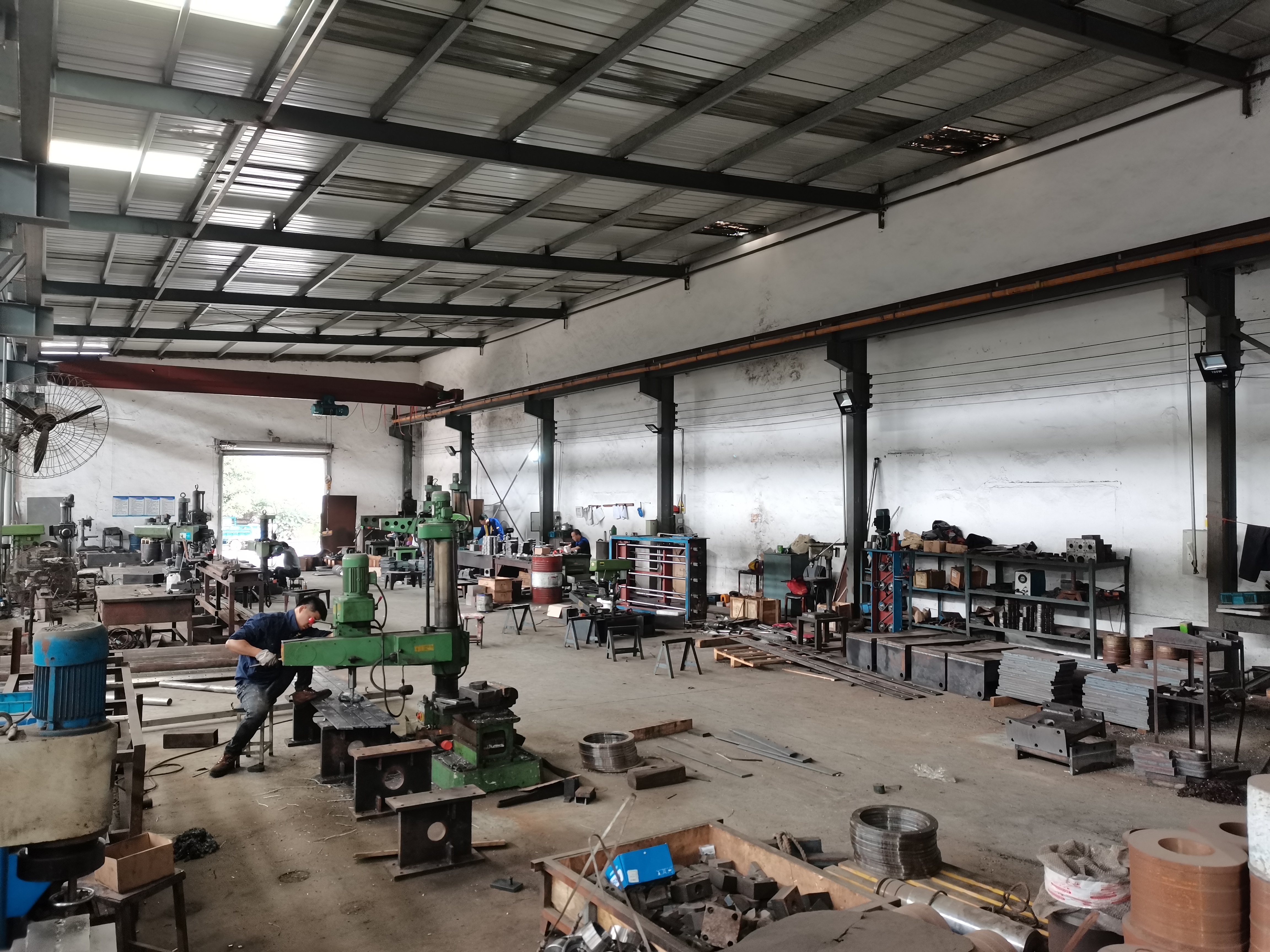
- Confirm lead time and production slot. NKBALER works to a 30–45 day lead time at a monthly capacity of 10 units, with a 1 unit minimum order and parameter-level customization under OEM/ODM arrangements. That combination makes a single-unit trial feasible before a fleet decision.
Frequently Asked Questions
Does a vertical baler need the same CE documentation as a horizontal one?
Not identical, because the applicable standards differ by category. Horizontal baling presses placed on the EU market must satisfy EN 16252:2012, the safety standard for horizontal baling presses, as part of CE marking. NKBALER's Verification of Conformity No. DPWD/09/060/2024 covers the EU/EEA market from 19 September 2024 to 18 September 2029 against EN ISO 12100:2010, EN 60204-1:2018 and EN 415-1:2014, and its scope of related products includes both vertical machines and horizontal hydraulic balers. Buyers should confirm that the certificate references the specific model being purchased.
Can a vertical machine reach the bale density of a horizontal baler?
The catalogue data does not answer this directly, and that is the important point. Horizontal models in the range declare material density — 300–400 kg/m³ on the NKW80Q, 400–600 kg/m³ on the NKW160Q, 500–600 kg/m³ on the NKW125Q and NKW180QT — while vertical specifications declare bale size and bale weight instead. Density depends on hydraulic force, chamber geometry and how evenly the chamber is filled, and the vertical range spans 10 tonne to 200 tonne models. Where density matters commercially, verify it with a trial bale of your own material rather than by comparison of force ratings alone.
Which configuration carries the lower total cost?
They carry different cost structures. A vertical machine carries a lower capital requirement and a smaller site footprint — the NK6040T10 uses a 2.2 kW motor and weighs 600 kg, while the NK1070T60 uses 15 kW and weighs 2.2 t. A horizontal baler carries a higher capital requirement for the machine, the conveyor, the foundation and the electrical supply, but its conveyor-fed automatic cycle handles 2–15 t/h with one supervising operator instead of a person loading each chamber. The crossover point is the labour cost per tonne at your actual volume, not the purchase price of the machine.
Can I test my own paper scrap before choosing between the two?
Yes, and the supplier's commercial terms support it. NKBALER operates on OEM/ODM terms with parameter-level customization, a minimum order of 1 unit, and 100% testing before shipment, so a single-unit order can function as a validation step on your own material. Ask for the trial to be run at the force and chamber size of the model you are considering, and specify whether the test should confirm bale density, bale dimensions, or both. To arrange a material trial or a configuration quotation, contact the team at Sales@nkbaler.com or through www.nkbaler.com.
What lead time should be planned for either configuration?
Both categories run on the same production terms: a 30–45 day lead time at a monthly capacity of 10 units. Because every model in the range is a configured build rather than a stocked item, the practical planning sequence is to lock the model, confirm the certificate scope, and then align the installation window — site works for a horizontal unit take longer than the machine build in most projects, so the civil and electrical preparation should start in parallel with the production slot rather than after it.
Conclusion
The head-to-head result is not a winner-takes-all outcome. A horizontal hydraulic baler wins on automation, on output consistency, and on bale density, because the conveyor-fed chamber and the published 300–600 kg/m³ density range describe a machine designed to convert a continuous scrap stream into a repeatable bale. A vertical machine wins on simplicity and capital cost, because a 600 kg frame on a 2.2 kW motor can be installed, operated and maintained by a small team without a conveyor, a foundation project or mechanical bale handling.
The decision therefore belongs to the site, not to the specification sheet. Match the throughput window to the scrap stream, match the footprint to the available floor, match the labour model to the people you can commit, and match the bale output to what your buyer has agreed to accept. Where bagged rather than wire-tied output is required, add a bagging machine as a downstream stage and size the line as a whole.
Next Step: Score Your Own Site
NKBALER — Shaanxi Nick Machinery Equipment Co., Ltd. — builds vertical machines, full-automatic and manual horizontal balers, and press bagging machines, with 90% of output exported and main markets in North America, South America and Asia.
Send your scrap volume, floor dimensions and required bale format, and the team will confirm which configuration fits and which certificate applies. Requests for a quotation, a configuration drawing, or a single-unit trial can be sent to Sales@nkbaler.com, by WhatsApp on +86 15021631102, or through www.nkbaler.com.
Have Questions or Need More Details?
Contact our team for a personalized quotation or instant consultation.
Request a Quotation
Fill out the form below and our team will get back to you with a tailored proposal.
WhatsApp Direct Chat
Prefer to chat in real-time? Message us on WhatsApp for instant assistance & quick answers.
- Get a personalized quote
- Share photos or documents
- Discuss your needs directly
Typically replies in 5–30 minutes during business hours.