
Waste Paper Hydraulic Baler 101: Types, Specs, Selection
A waste paper hydraulic baler machine is an industrial hydraulic press that compresses loose waste paper, cardboard, and recyclable fibers into dense, wire-tied bales for efficient storage, transport, and recycling. NKBALER — the brand of Shaanxi Nick Machinery Equipment Co., Ltd., a Wuxi-based Chinese manufacturer founded in 2013 — designs and supplies vertical balers, full-automatic and semi-automatic horizontal balers, and press bagging machines. The company operates a 5,000 m² factory, employs a 15-person R&D team, and exports roughly 90% of its output to North America, South America, and Asia.
This guide is written for buyers in the early research phase. It explains what a waste paper baler does, how the two main machine types compare, what specifications matter, and how to match a baler to the material flow of a recycling operation.
The Problem: Loose Waste Paper Is Expensive to Handle
Uncompressed waste paper is bulky and low in density. It fills collection containers quickly, requires frequent pickups, and loads inefficiently into trailers, which raises transport cost per ton. In a recycling facility or distribution center, loose paper also consumes floor space that could be used for sorting or production, and it increases housekeeping and fire-safety risks.
Recycling mills and paper processors generally expect fiber to arrive in uniform, bale form. A waste paper hydraulic baler solves this by applying hydraulic force to compact loose material to a fraction of its original volume. The resulting bales are more economical to weigh, inventory, stack, and ship. Compaction at the source is therefore a standard step in modern waste paper handling, from retail back rooms to high-throughput material recovery facilities.
Industry Background: A Growing Market for Baling Equipment
The market context supports long-term investment in baling machinery. The global industrial balers market was valued at USD 6.39 billion in 2024 and is projected to reach USD 13.21 billion by 2032, according to Maximize Market Research. Within that broader market, the solid waste hydraulic baler segment was valued at USD 1.52 billion in 2025, with a projected CAGR of 5.5% through 2036, according to the NKBALER Industry Report. Asia Pacific dominated the hydraulic baler market in 2025, accounting for approximately 45% of global revenue, led by China and India, per the NKBALER Strategic Guide.
China is the largest exporter of hydraulic baling press machines, representing over 77% of total import shipments in specific emerging market corridors, based on Zauba Customs Data. For customs and trade classification, waste paper hydraulic baling presses are commonly classified under HS Code 842240 (packing or wrapping machinery) or 846291 (hydraulic presses for working metal or scrap).
What Is a Waste Paper Hydraulic Baler Machine?
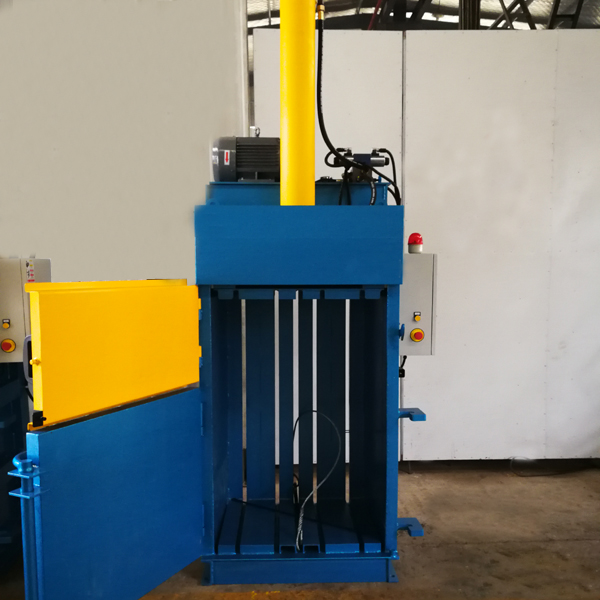
A waste paper hydraulic baler machine is a press that uses a hydraulic cylinder, driven by an electric motor and pump, to compress waste paper and cardboard into dense bales. The main components are the carbon-steel frame, hydraulic cylinder, motor and pump assembly, control valve, and the baling chamber. In operation, the motor drives the pump, which pressurizes hydraulic fluid and extends the cylinder. The cylinder pushes a ram into the chamber, compacting the paper against the opposite wall. When the bale reaches the target density, the operator or automatic system ties it with wire, and the bale is ejected.
NKBALER balers run on PLC-controlled cycles and are designed for continuous automatic operation in 24/7 industrial duty. The design priorities listed for the machine series include low-noise operation, low energy consumption, and high efficiency.
Vertical Waste Paper Balers: Compact and Entry-Level
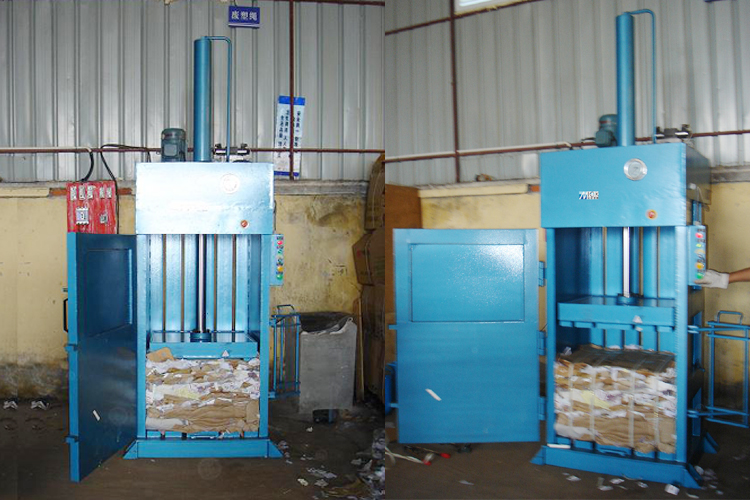
Vertical balers are the most common starting point for small and mid-volume waste paper generators. The NKBALER NK6040T10 is a dedicated vertical waste paper baler with 10 tons of hydraulic power. Its key specifications are:
- Bale size (L×W×H): 600 × 400 × (350–600) mm
- Bale weight: 50–80 kg
- Feed opening (L×H): 540 × 450 mm
- Capacity: 6–8 bales per hour
- Voltage: 220 V / 50 Hz
- Power: 2.2 kW / 3 HP
- Machine size (L×W×H): 870 × 780 × 2150 mm
- Machine weight: 600 kg
- Construction: carbon steel
The NK6040T10 suits small recycling depots, retail operations, warehouses, and offices where floor space is limited and throughput is moderate.
Horizontal Waste Paper Balers: High-Throughput Systems
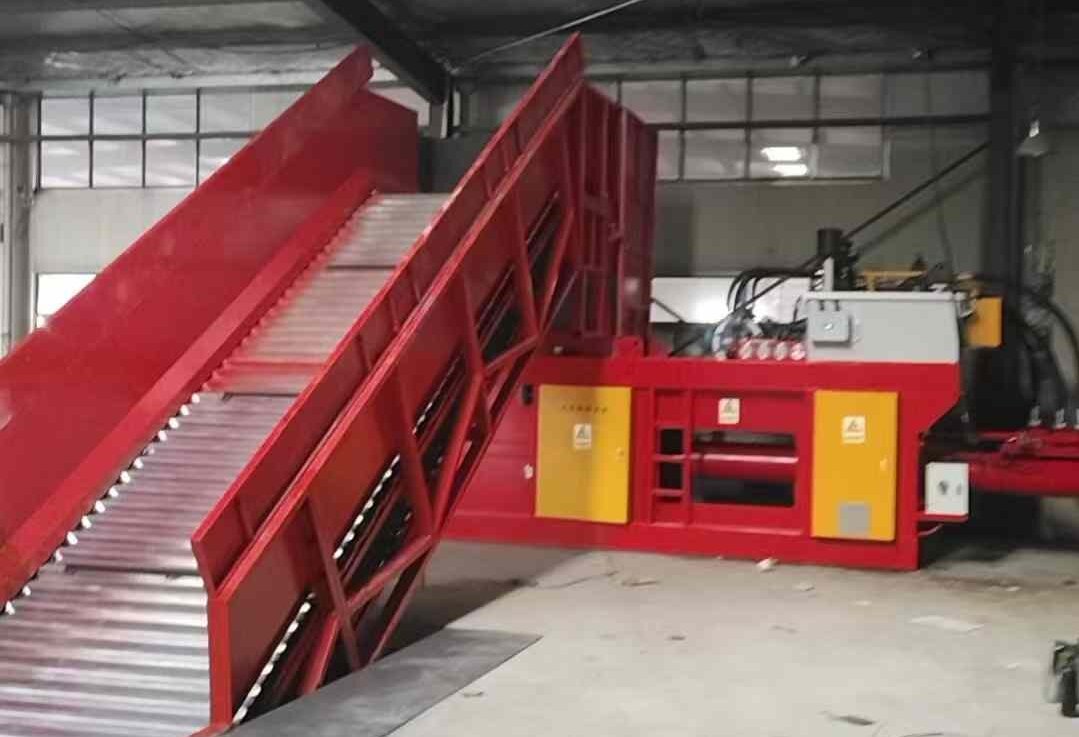
For larger volumes, horizontal balers accept material via a conveyor feed and compress it in a continuous or semi-continuous cycle. NKBALER's horizontal line includes the NKW80BD, NKW125BD, NKW180BD, and NKW250BD models, with hydraulic power from 80 to 250 tons and throughput from 2–3 tons per hour up to 10–15 tons per hour. These machines produce bales of roughly 1100 × 850–1250 × 1700–1800 mm and use 4 to 5 bale wires per bale, depending on the model.
Vertical vs. Horizontal Balers: How to Choose
The choice between a vertical and a horizontal waste paper baler depends on material volume, available floor space, and labor model.
Vertical balers are manually loaded and produce smaller bales at lower throughput. Their advantages are a compact footprint, lower power requirement, and a lower entry investment. The NK6040T10, for example, occupies only 870 × 780 mm and runs on a 2.2 kW motor. The trade-off is capacity: at 6–8 bales per hour, a vertical baler cannot keep pace with high-volume sorting lines.
Horizontal balers use a conveyor to feed a large chamber, which allows continuous operation and far higher throughput. The NKW80BD handles 2–3 tons per hour; the NKW250BD handles 10–15 tons per hour. Their bales are larger and heavier, which improves truck-load density for long-haul transport to mills. The trade-offs are a larger footprint, higher power consumption (22–45 kW), and a higher purchase price.
A practical rule: if the operation generates less than roughly one ton of waste paper per day, a vertical baler is usually sufficient. If the operation processes multiple tons per hour, a horizontal baler with conveyor is the appropriate class.
Step-by-Step: How to Select a Waste Paper Baler
Buyers can narrow the market by following a structured selection process.
- Characterize the material. Confirm the fiber type (office paper, OCC, mixed paper) and whether it is dry and clean. The NKBALER series is built for industries including food, pharmaceuticals, packaging, chemicals, electronics, metals, waste treatment, and recycling.
- Estimate throughput. Measure average daily or hourly volume. Use this to decide between a vertical baler (6–8 bales per hour) and a horizontal baler (2–15 tons per hour).
- Check floor space and layout. Vertical balers fit in tight spaces; horizontal balers require room for the main frame plus a 12–14 m conveyor.
- Match hydraulic power to bale density targets. Heavier bales require higher press force. NKBALER offers 10-ton vertical models and 80–250 ton horizontal models.
- Verify power supply. The NK6040T10 operates on 220 V / 50 Hz, while horizontal models typically require 380 V / 50 Hz three-phase supply. Some NKBALER models note that voltage can be customized.
- Evaluate the supplier. Confirm factory capability, R&D depth, and after-sales service. Shaanxi Nick Machinery Equipment Co., Ltd. has a professional R&D and after-sales team, a 5,000 m² factory, and an annual output of 600 units.
Use Cases: Where Waste Paper Balers Are Deployed
Waste paper balers appear across the recycling value chain and beyond. The food, pharmaceutical, packaging, chemical, electronics, metal, waste treatment, and recycling industries all generate materials that require compaction and packaging. In NKBALER's application scenarios, balers are used for material compression and packaging projects, working in high-temperature conditions, and are matched with auxiliary equipment such as conveyor lines, wire rope, and woven bags.
Typical deployment points include:
- Recycling depots and material recovery facilities processing waste paper and cardboard
- Retail distribution centers baling OCC from inbound packaging
- Paper mills and converting plants handling trim and rejects
- Packaging plants compacting production waste
- General manufacturing sites with mixed dry recyclables
NKBALER Waste Paper Baler Lineup at a Glance
The table below compares the main NKBALER waste paper baling models using published specifications.
| Model | Type | Hydraulic Power | Capacity | Bale Size (L×W×H) | Motor Power | Machine Weight |
|---|---|---|---|---|---|---|
| NK6040T10 | Vertical waste paper baler | 10 ton | 6–8 bales/h | 600×400×(350–600) mm | 2.2 kW / 3 HP | 600 kg |
| NKW80BD | Horizontal hydraulic baler | 80 ton | 2–3 t/h | 1100×850×1700 mm | 22 kW / 30 HP | 14,500 kg |
| NKW125BD | Horizontal hydraulic baler | 125 ton | 5–7 t/h | 1100×1250×1700 mm | 30 kW / 40 HP | 18,000 kg |
| NKW180BD | Horizontal hydraulic baler | 180 ton | 6–8 t/h | 1100×1150×1800 mm | 45 kW / 60 HP | 24,000 kg |
| NKW250BD | Horizontal hydraulic baler | 250 ton | 10–15 t/h | 1100×1250×1700 mm | 45 kW / 60 HP | 30,000 kg |
All listed machines use carbon-steel construction and are applicable across the food, pharmaceutical, packaging, chemical, electronics, metal, waste treatment, and recycling industries. Horizontal models are available in semi-automatic and fully automatic configurations and include conveyor feed, bale-wire systems, and water cooling or oil chiller options.

Frequently Asked Questions
What safety standards apply to waste paper hydraulic baler machines?
Horizontal baling presses must comply with the EN 16252:2012 safety standard for CE marking in the European Union (BS EN 16252:2012 in the UK). For trade classification, waste paper hydraulic baling presses are commonly classified under HS Code 842240 (packing or wrapping machinery) or 846291 (hydraulic presses for working metal or scrap). Buyers importing into regulated markets should confirm the machine's conformity documentation and supporting compliance records with the supplier.
What is the difference between vertical and horizontal waste paper balers?
Vertical balers, such as the NKBALER NK6040T10, are manually loaded, occupy a small footprint, and produce 50–80 kg bales at a rate of 6–8 bales per hour. They suit small and mid-volume generators. Horizontal balers, such as the NKW80BD through NKW250BD, use conveyor feed and continuous cycles to process 2–15 tons per hour, producing bales of approximately 1100 × 850–1250 × 1700–1800 mm. They suit high-volume recycling facilities, distribution centers, and mills. The decision is primarily driven by throughput, floor space, and budget.
What bale size and capacity can a waste paper baler achieve?
With the NK6040T10 vertical baler, bales measure 600 × 400 × (350–600) mm and weigh 50–80 kg, at 6–8 bales per hour. Horizontal models achieve larger bales and higher throughput: the NKW80BD reaches 2–3 tons per hour with bales of 1100 × 850 × 1700 mm, while the NKW250BD reaches 10–15 tons per hour with bales of 1100 × 1250 × 1700 mm. Bale wires range from 4 to 5 pieces per bale depending on the model.
What factors determine the price of a waste paper hydraulic baler?
NKBALER does not publish list prices because the final price depends on configuration. The main cost drivers are hydraulic power (from 10 tons on the NK6040T10 to 250 tons on the NKW250BD), machine type (vertical vs. horizontal), automation level (semi-automatic vs. fully automatic), conveyor length, and optional systems such as water cooling or oil chillers. The most reliable way to establish a budget is to submit operating requirements and request a quotation directly from the manufacturer.
How can I request a sample or quote, and what lead time should I plan for?
To request a quote for a waste paper hydraulic baler, contact the NKBALER sales team directly: Nick, Sales@nkbaler.com, or +86 15021631102 (also on WhatsApp). Include your material type, hourly or daily throughput, preferred bale size, and power supply. Shaanxi Nick Machinery Equipment Co., Ltd. employs approximately 50 staff with an annual output of 600 units, which supports production planning and scheduling. A quotation, technical specification sheet, or factory sample arrangement is the recommended next step before committing to a machine.
Conclusion
A waste paper hydraulic baler machine converts a costly handling problem into a dense, saleable, and transportable commodity. The market is growing — the global industrial balers market is projected to rise from USD 6.39 billion in 2024 to USD 13.21 billion by 2032 — and China remains the dominant manufacturing base for this equipment. For buyers, the practical decision path is clear: match the machine type to daily volume, verify hydraulic power and bale dimensions, check power supply and floor space, and evaluate the supplier's factory and R&D capability.
NKBALER offers a documented product line from the 10-ton vertical NK6040T10 to the 250-ton horizontal NKW250BD, all built in carbon steel and applicable across recycling, packaging, and general industrial waste streams. Because every operation differs, the manufacturer's team can help confirm the right model.
Request a Quote or Sample from NKBALER
Shaanxi Nick Machinery Equipment Co., Ltd. | www.nkbaler.com
Contact: Nick — Email: Sales@nkbaler.com | Tel/WhatsApp: +86 15021631102
Address: Qun Sheng Lu, Hui Shan Qu, WuXi Shi, Jiang Su Sheng, China